How long does caffeine stay in your system?
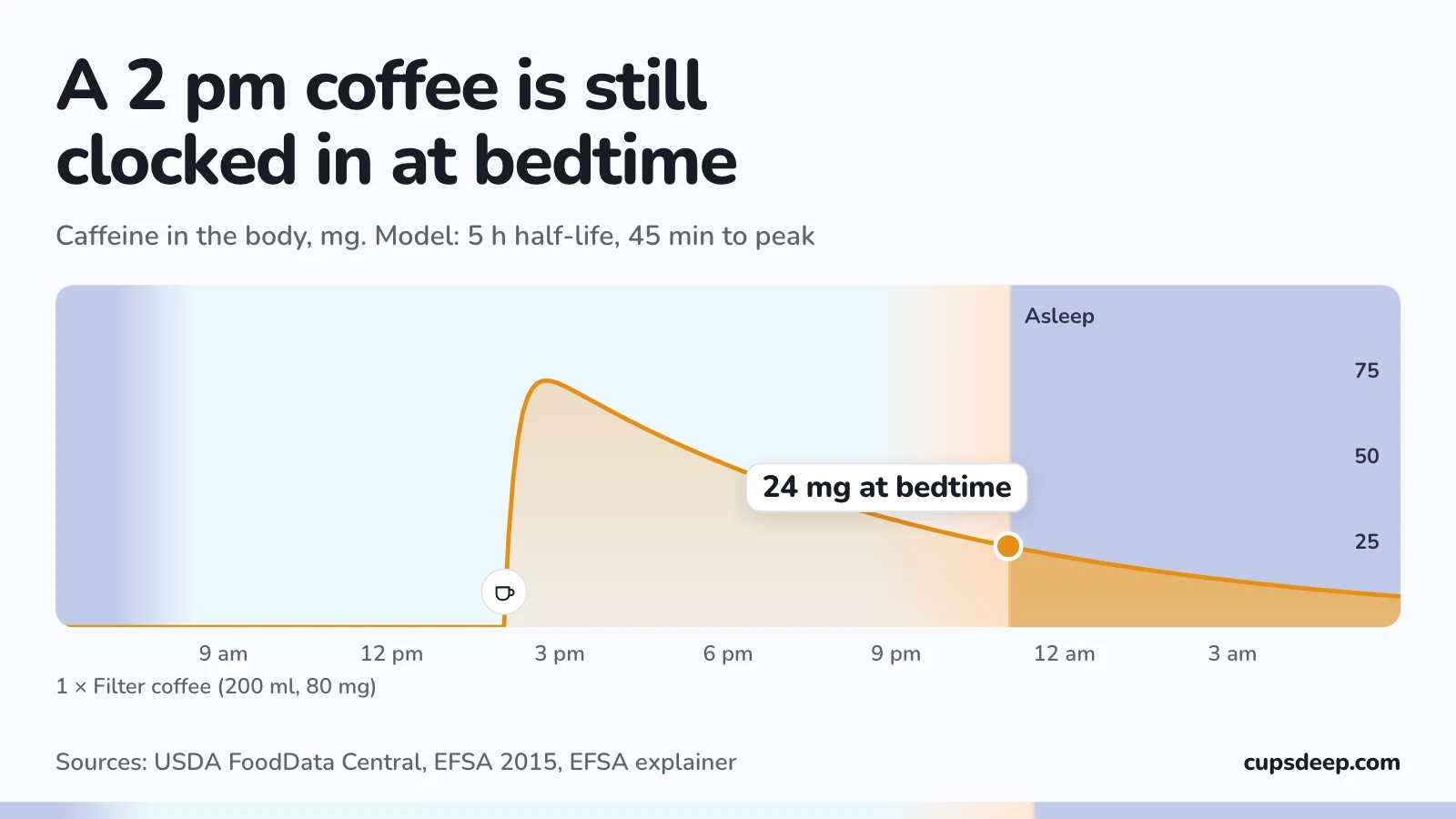
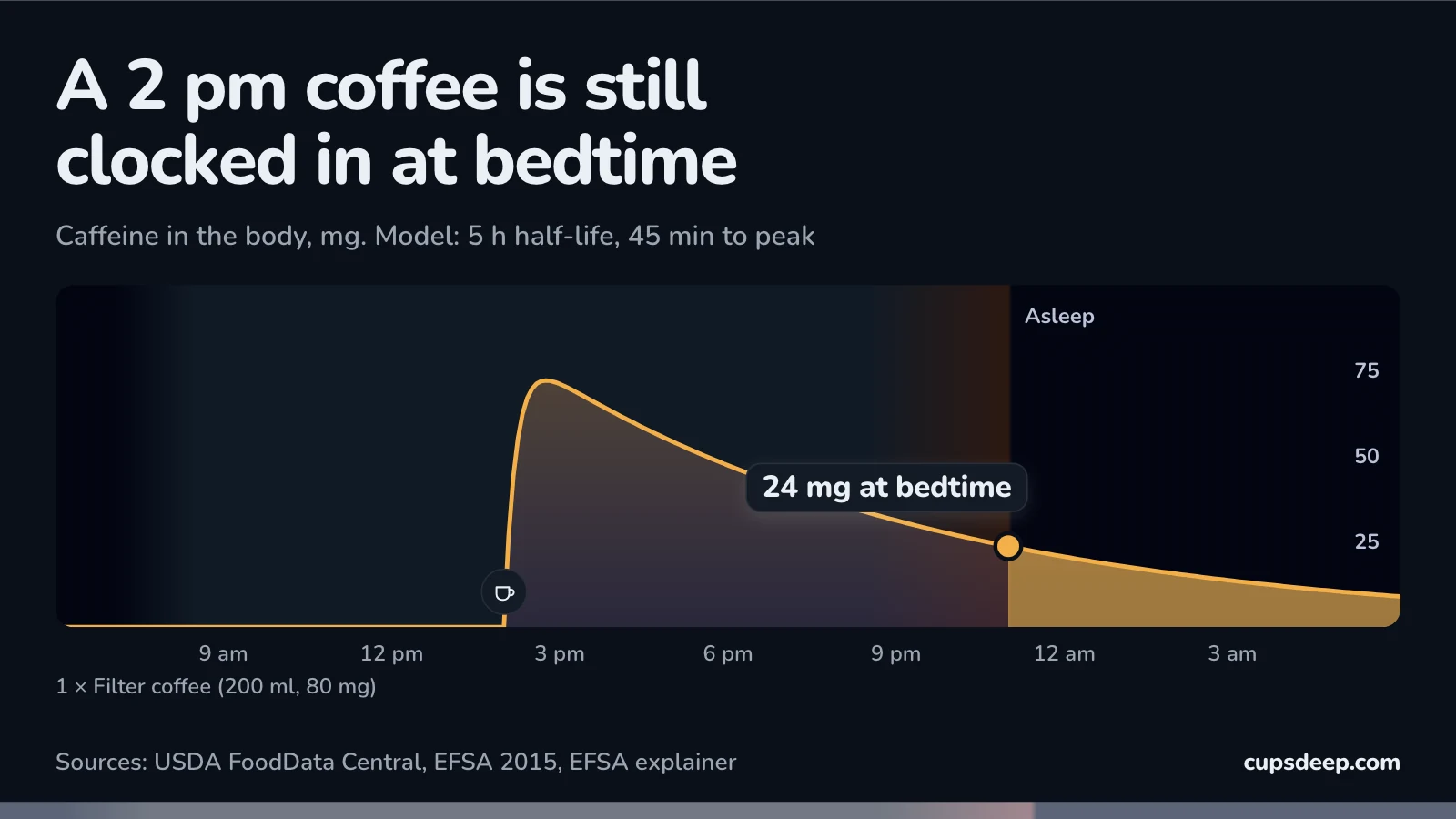
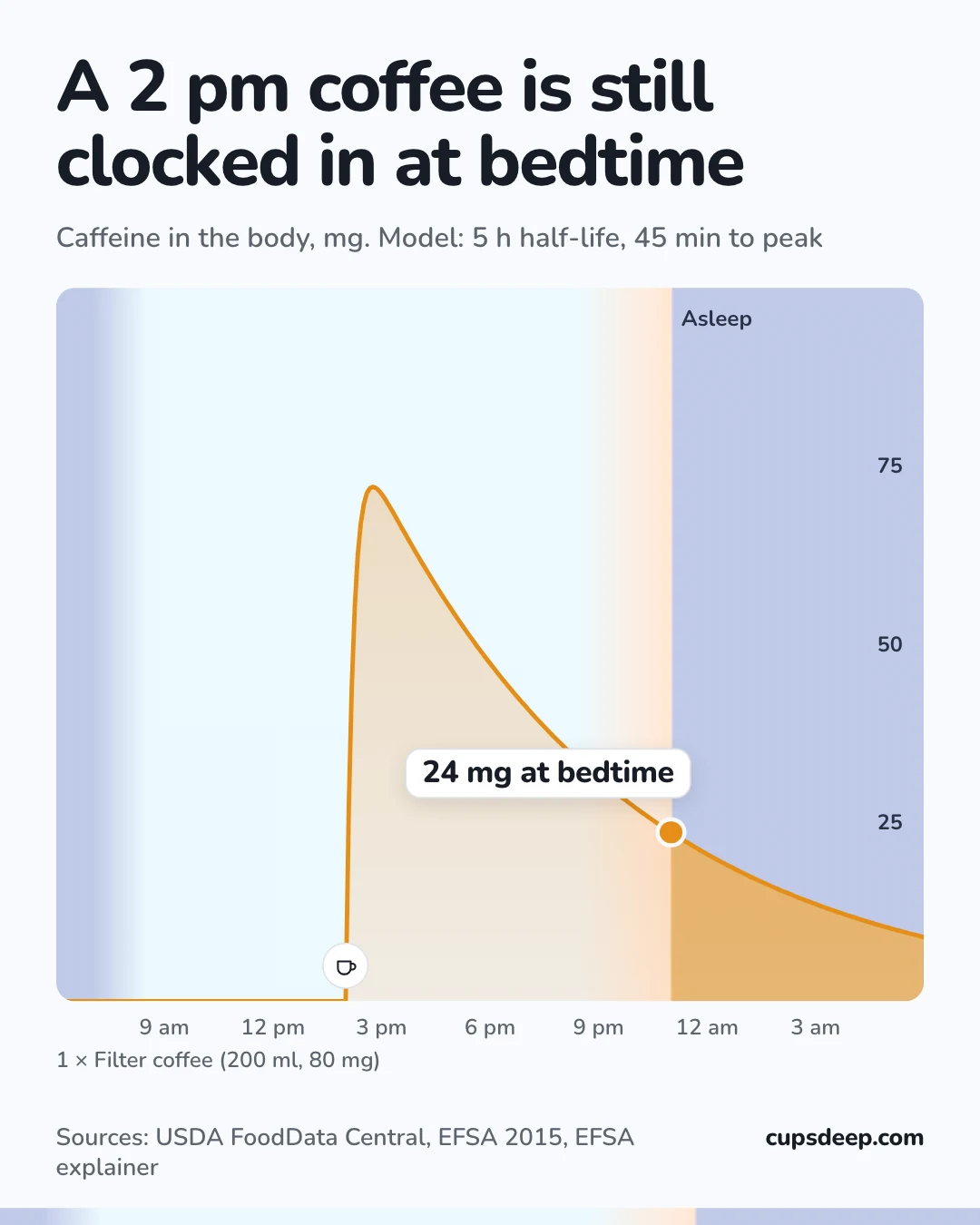
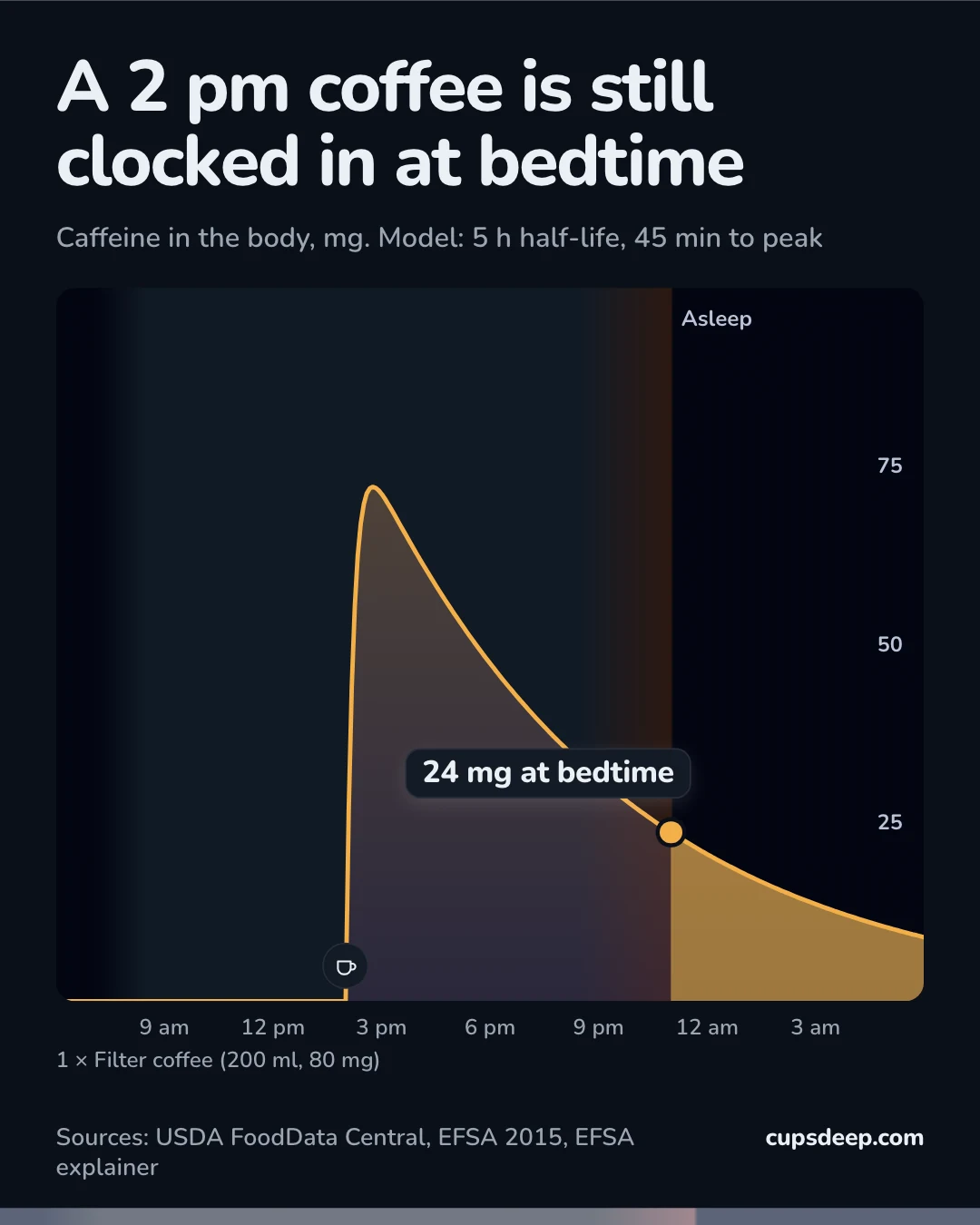
It depends which clock you mean. You feel caffeine within the half hour, half of it is gone by mid-afternoon, and the last of it is still in the building after you have gone to bed. It is easy to blend the three. Here they are apart, each with its source.
The short answer
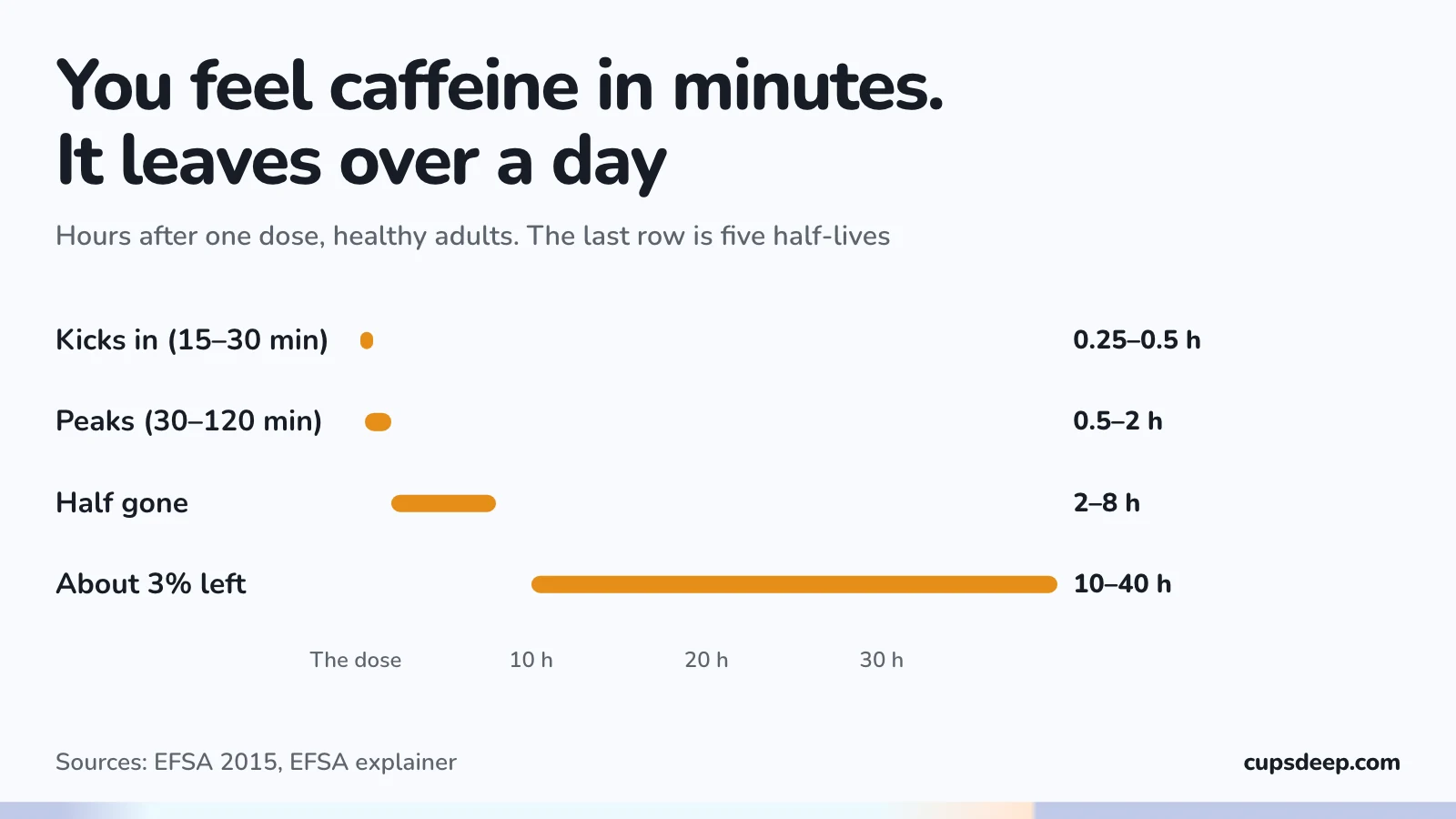
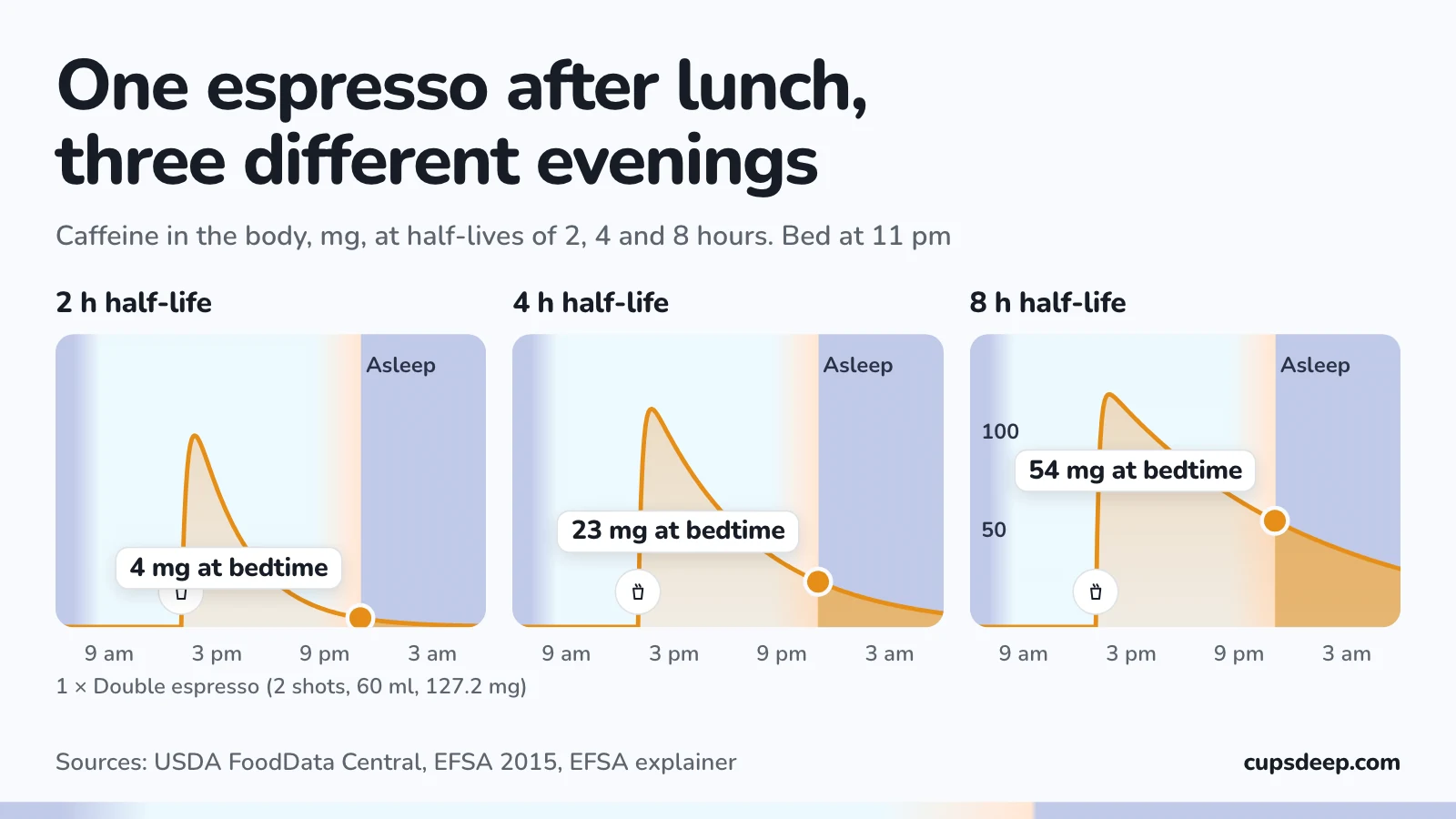
In a healthy adult, half of a dose of caffeine is gone in about 4 hours, and between people that runs from 2 hours to 8 hours. Its effects may begin within 15–30 minutes and it peaks in the blood at 30–120 minutes. Getting down to 3.1% of the dose takes five half-lives: about 20 hours on average, and up to 40 hours at the slow end.
How long does caffeine last? Three clocks, not one
- When you feel it. Effects may begin 15–30 minutes after you swallow, and the level in your blood peaks at 30–120 minutes.
- When half is gone. About 4 hours in a healthy adult, 2–8 hours between people. This is the half-life.
- When it is effectively gone. After five half-lives 3.1% of the dose is left. That takes 20 hours (10–40 hours), depending on whose liver is doing the work.

Caffeine leaves the way guests leave a party. Half, then half of what’s left, and one of them is still in my kitchen at 11 pm
Most of the caffeine can be gone and the rest still counts. In one study, nine men took 200 mg at ten past seven in the morning. By eleven at night the caffeine in their saliva had fallen from 17 µmol/L to 3 µmol/L, about 18% of its peak, and their sleep was still shorter and less efficient than after a placebo. We have read only that paper’s abstract, which does not say by how many minutes.
Why do some pages say ten hours, some twelve and some a whole day?
Most likely because they count the same half-life a different number of times. The European Food Safety Authority puts the average at 4 hours; a 2001 Institute of Medicine review puts the mean at 5 hours. Start from either and you can reach ten hours, twelve hours and about a day.
| Half-lives counted | Still in you | At EFSA’s average | At the IOM’s mean | How it gets quoted |
|---|---|---|---|---|
| One | Half | 4 hours | 5 hours | The half-life |
| Two | 25% | 8 hours | 10 hours | “About ten hours” |
| Three | 12.5% | 12 hours | 15 hours | “Up to twelve hours” |
| Five | 3.1% | 20 hours | 25 hours | “About a day” |
Our arithmetic, elimination only: it ignores the hour or so a dose takes to be absorbed. At the slow end of the healthy range, 8 hours, five half-lives are 40 hours.
None of those figures is wrong. They need not be three findings. And the half-life under them is softer than one round number suggests: the Institute of Medicine’s range is 1.5–9.5 hours, and when 24 people, all healthy and aged eighteen to thirty, were measured after coffee and energy drinks, their mean came out at 6.7–7.6 hours.
How long does caffeine take to kick in?
Effects may begin within 15–30 minutes. The peak comes later, and it has been measured by drink: the same 24 people each took 160 mg of caffeine five ways.
| Drink | How it was drunk | Mean time to peak (fastest to slowest person) |
|---|---|---|
| Hot coffee | Sipped over twenty minutes | 59 minutes (20–120 minutes) |
| Cold coffee | Downed in two minutes | 62 minutes (40–120 minutes) |
| Cold coffee | Sipped over twenty minutes | 64 minutes (40–90 minutes) |
| Sugar-free energy drink | Downed in two minutes | 70 minutes (20–240 minutes) |
| Sugar-free energy drink | Sipped over twenty minutes | 82 minutes (40–240 minutes) |
White and colleagues, the same dose in every row. None of the differences between rows was statistically significant.
So downing it does not buy an earlier peak, and a can is not faster than a cup. The spread between people is far wider than the spread between drinks. The format that did move the peak is gum: caffeine gum peaked at 44.2–80.4 minutes, capsules at 84–120 minutes, in a different study (an abstract, not the full paper). How high the peak goes depends on the dose and on the person, and the doses are in every drink we chart.
The clock is the same whatever the caffeine came in. What changes is how much there is to clear, and that is in the article for each drink: a cup of coffee, a shot of espresso, a Monster, a Red Bull, the strongest energy drinks, a bowl of matcha, a cup of green tea, a can of Coke Zero, a Diet Coke and a Dr Pepper. For the sodas with nothing to clear, there is a list of those too. And for the ones people forget to count: a Mountain Dew, a Celsius, a mug of black tea, a bar of dark chocolate and a Swiss Water decaf. And the long ones: a cold brew, a flat white, a gourd of yerba mate and the strongest coffee you can buy.
Kicks in right after the meeting
Why does caffeine last longer for some people?
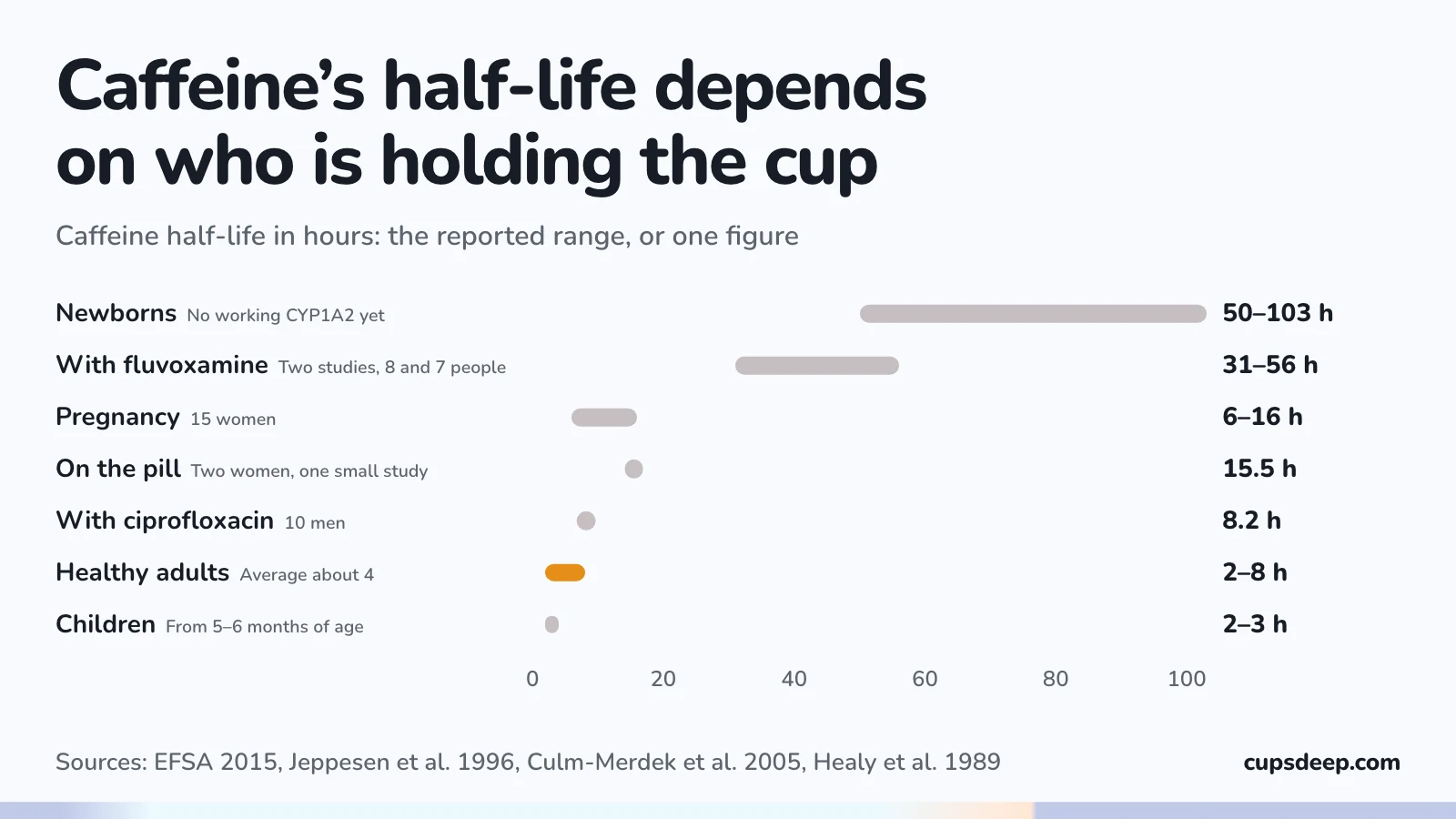
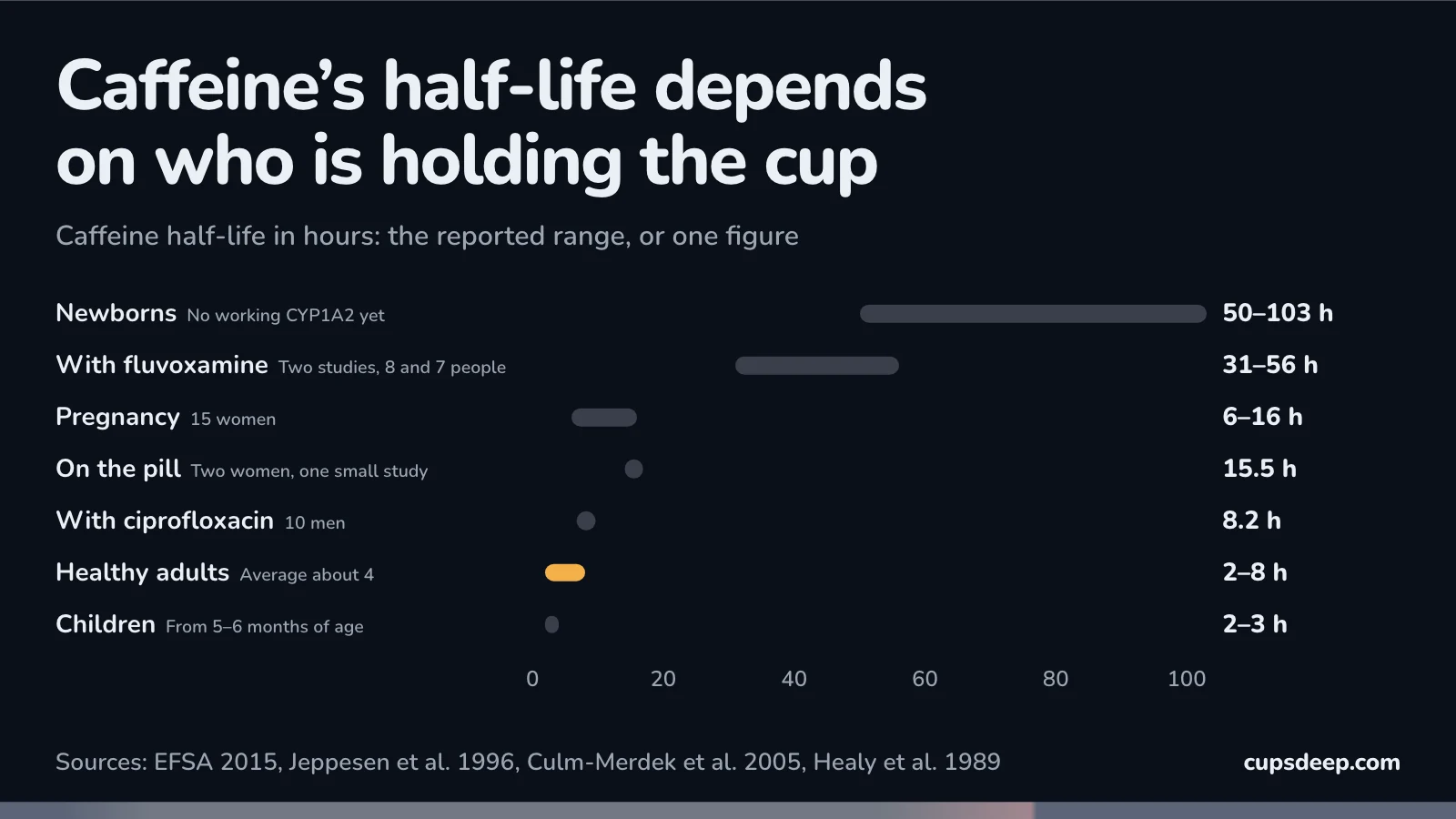
One liver enzyme, CYP1A2, does about 95% of the clearing. Whatever speeds it up or slows it down moves your number, and the size of the move has been measured.
| What | Measured effect | How good the evidence is |
|---|---|---|
| Smoking | Clearance 1.22 times non-smokers at a few cigarettes a day, 1.72 times non-smokers at more than a pack | One study of several hundred people |
| The pill | Half-life 15.5 hours in two users, 5.6 hours in the rest | One small study |
| Pregnancy | Half-life 6–16 hours | Fifteen women |
| Fluvoxamine, an antidepressant | Half-life from 5 hours to 31 hours; in a second study, 4.9 hours to 56 hours | Eight and seven volunteers; the first an abstract only, the second’s long figure estimated from a day of blood samples |
| Ciprofloxacin, an antibiotic | Half-life from 5.2 hours to 8.2 hours | Ten men |
| Alcohol, 50 g a day | Half-life up 72% | Healthy men; abstract only |
| Being a woman | Clearance 0.9 times that of men; half-life 502 minutes against 349 minutes in young adults | Two studies; half of the young women were on the pill |
| Drinking coffee every day | Clearance 1.45 times per liter a day | The large study; in a small one, a week of heavy caffeine changed nothing |
| Liver disease | Cirrhosis: 6.1 hours against 5.2 hours, not a significant difference. Two patients with alcoholic liver disease: 60 hours and 168 hours | Abstracts only; the long figures are two patients |
Clearance and half-life move in opposite directions: faster clearance, shorter half-life. “Abstract only” means we have read the paper’s published summary and not its tables.
I’m not a slow metaboliser. I’m thorough
The far end of the chart is a newborn, who has no working CYP1A2 yet: 50–103 hours, or 3–4 days on the FDA’s label for the caffeine given to premature babies. By three to four months it is 14 hours, and through childhood 2–3 hours, faster than an adult. EFSA gives no separate figure for teenagers.
Genes often get the credit for fast and slow metabolisers. In the large study, no relevant genetic difference in clearance was left once coffee, smoking, the pill and sex were counted; other studies EFSA cites found a genotype difference only in smokers and in heavier coffee drinkers. Getting older may do less than you would think, too: one study of adult men cited in the Institute of Medicine review found that age did not change the half-life.
When should you stop drinking caffeine before bed?
You may have heard the rule: no caffeine six hours before bed. One study tested that gap: 400 mg taken six hours before bedtime still cut sleep by more than an hour on a home monitor (1.1–1.2 hours across the three timings tested), in 12 people. Short sleep is also one of the reasons caffeine can leave you tired the next day.
A 2023 meta-analysis replaced the rule with a model. Pooled across every dose and timing studied, caffeine cost 45.3 minutes (29–61.5 minutes) of sleep. The authors then worked out how early a given dose has to be taken before the model can no longer detect a loss.
| Drink in the model | Caffeine assumed | Stop this long before bed | For a ten o’clock bedtime |
|---|---|---|---|
| A cup of coffee | 107 mg | 8.8 hours | 1:12 pm |
| A pre-workout supplement | 217.5 mg | 13.2 hours | 8:50 am |
| A cup of black tea | 47 mg | No cut-off found | Up to bedtime |
Gardiner and colleagues. The cut-off is a statistical line, not a biological one: the first point at which the model can no longer tell the loss from zero. “No cut-off found” means the model could not show a loss at that dose, not that tea was shown to be harmless. The caffeine contents are the paper’s assumptions, and the authors call the times a starting point to adjust from.
Two things to hold on to. A tall brewed coffee at Starbucks in the US starts at 235 mg, more than the pre-workout in that table, so the earlier line is the nearer one for a chain coffee. That is our reading of two numbers; the paper does not say it. And these are averages over people whose half-lives run 2–8 hours.
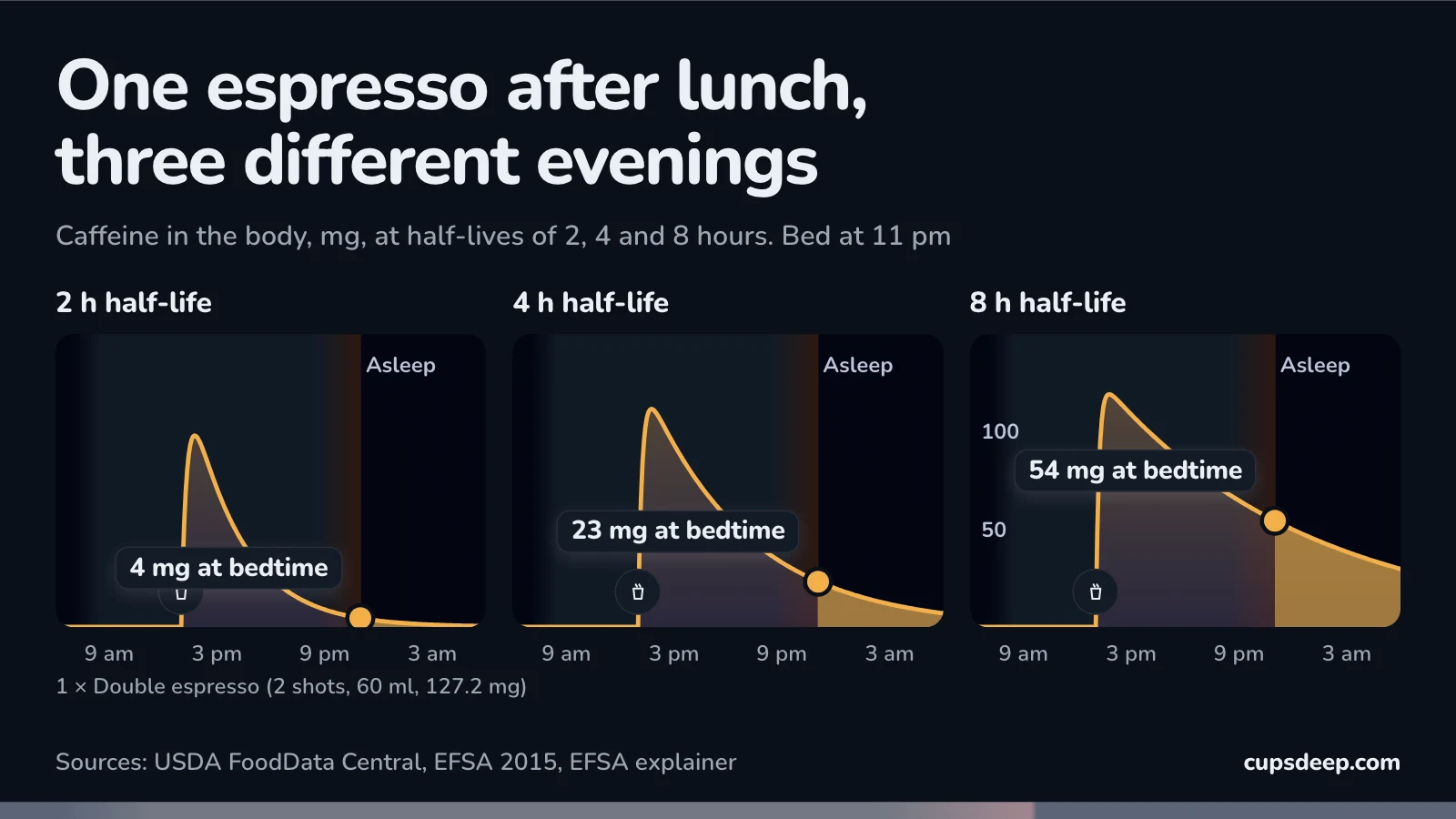
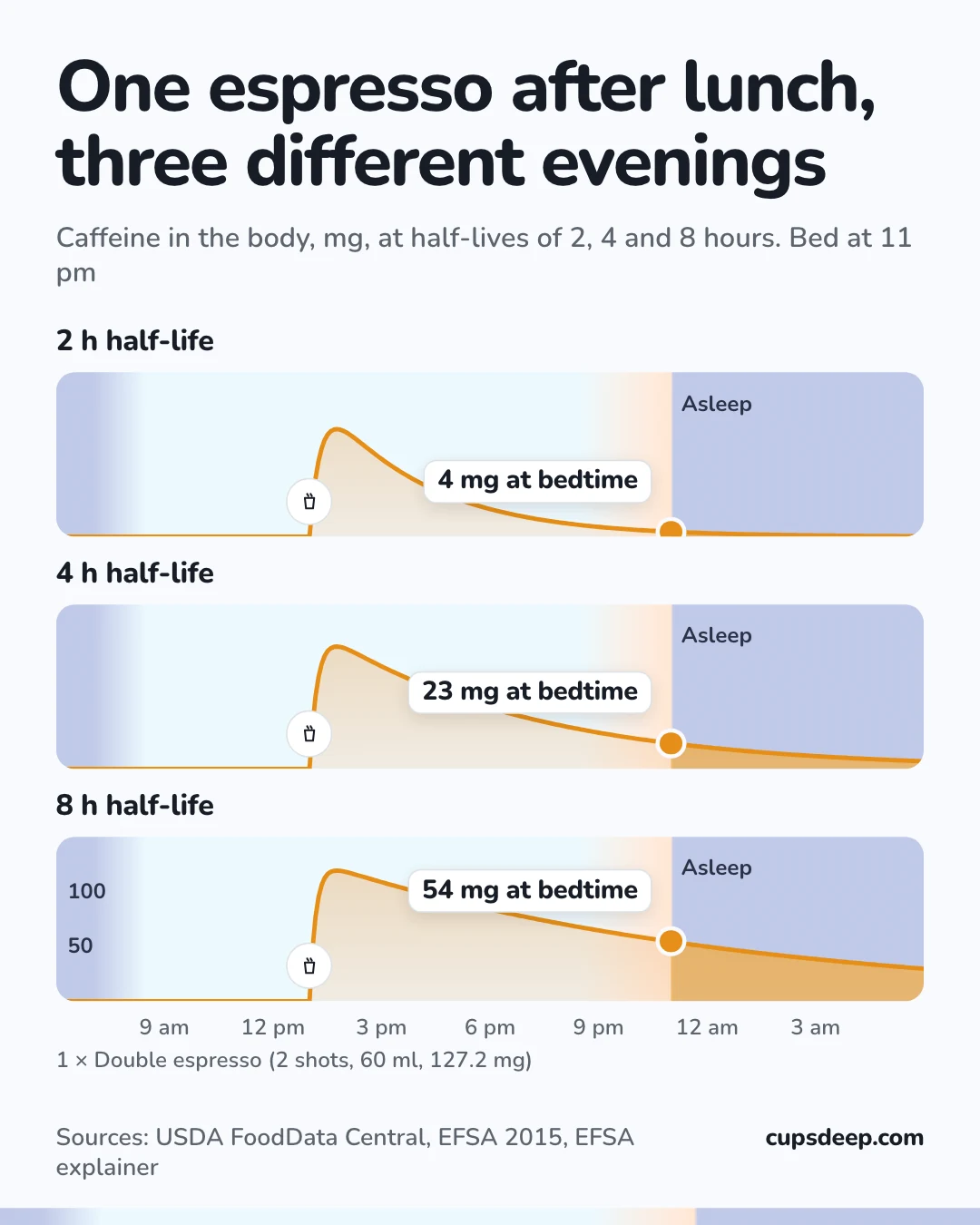

Tonight’s sleep was decided at 3 pm
Can you flush caffeine out, and how long is it detectable?
You cannot hurry it in any way worth doing. The kidney filters caffeine and then takes it back: in adults about 1% of a dose leaves in urine unchanged. The rest waits for the liver. In one study of six people, about 70% of the dose turned up in urine as caffeine and its breakdown products together, and the kidney passed them faster when more urine flowed. That is little help when the kidney’s share of unchanged caffeine is so small. No source we hold says water or exercise changes the liver’s pace. Smoking does speed it up, which is a poor trade for an earlier bedtime. Stopping altogether has a clock of its own.
As for a detection window, there is no honest number. We looked for a primary source that states how long caffeine can be found in urine, blood, saliva or hair after a dose, and did not find one; a figure quoted without one may be half-life arithmetic and not a lab result. What has been measured is how common it is: in a US national survey, caffeine and its breakdown products were detectable in the urine of most of the 2,466 people tested. If you want the arithmetic anyway, it is the last row of the table above: 3.1% left after 20 hours (10–40 hours).
Questions people ask
How long does 200 mg of caffeine stay in your system?
The dose sets how high you start, not how fast it leaves. At the average half-life, half is gone in about 4 hours, a quarter is left after 8 hours and 3.1% after 20 hours. At the slow end of the healthy range, each of those takes twice as long.
How long does caffeine take to kick in?
Effects may begin 15–30 minutes after you swallow, and the level in the blood peaks at 30–120 minutes. In one study of 24 people, the mean time to peak ran from 59 minutes for hot coffee to 82 minutes for a sipped energy drink, and drinking faster made no significant difference.
How long before bed should you stop drinking coffee?
A 2023 meta-analysis puts the line at 8.8 hours before bedtime for a cup of coffee of 107 mg, and 13.2 hours for a dose of 217.5 mg. Those are statistical cut-offs that the authors call a starting point, not a guarantee in either direction.
Does drinking water flush caffeine out of your system?
Not in any way that matters, on the sources we hold. In adults about 1% of a dose leaves in urine unchanged; the rest is cleared by a liver enzyme that accounts for about 95% of caffeine’s clearance, at its own pace.
How long does caffeine stay in a child’s or a teenager’s system?
Through childhood the half-life is about 2–3 hours, shorter than the adult average of 4 hours, and it lengthens during adolescence. EFSA gives no separate figure for teenagers. A newborn is the exception: 50–103 hours.
How long is caffeine detectable in urine?
No primary source we could find states a detection window. By arithmetic, 3.1% of a dose is left after five half-lives, which is 20 hours (10–40 hours); what a given lab test can still pick up at that point is not something we can cite.
Sources
Every number above links to the place it came from. How the numbers are chosen and checked is on the method page; the drink table is at /drinks. Written with AI agents, as the whole site is. A model of a typical body, not advice for pregnancy, illness or medication.
- Beverages, coffee, brewed, prepared with tap water
- Beverages, coffee, brewed, espresso, restaurant-prepared
- Scientific Opinion on the safety of caffeine
- EFSA explains risk assessment: Caffeine
- Pharmacology of Caffeine (chapter 2 of Caffeine for the Sustainment of Mental Task Performance: Formulations for Military Operations)
- Caffeine Effects on Sleep Taken 0, 3, or 6 Hours before Going to Bed
- Medium Roast - Pike Place Roast: nutrition (starbucks.com, United States)
- The effect of caffeine on subsequent sleep: A systematic review and meta-analysis
- Caffeine intake (200 mg) in the morning affects human sleep and EEG power spectra at night
- Pharmacokinetic analysis and comparison of caffeine administered rapidly or slowly in coffee chilled or hot versus chilled energy drink in healthy young adults
- The rate of absorption and relative bioavailability of caffeine administered in chewing gum versus capsules to normal healthy volunteers
- A fluvoxamine-caffeine interaction study
- Fluvoxamine impairs single-dose caffeine clearance without altering caffeine pharmacodynamics
- Interaction between oral ciprofloxacin and caffeine in normal volunteers
- Influence of alcohol and caffeine consumption on caffeine elimination
- Caffeine Citrate solution: prescribing information, Clinical Pharmacology (set id 5f38c395-0093-4afd-89ec-f96e5dc0934a)
- Impaired elimination of caffeine in cirrhosis
- Urine excretion of caffeine and select caffeine metabolites is common in the U.S. population and associated with caffeine intake
Keep reading
Body and sleep
Caffeine withdrawal: symptoms and timeline
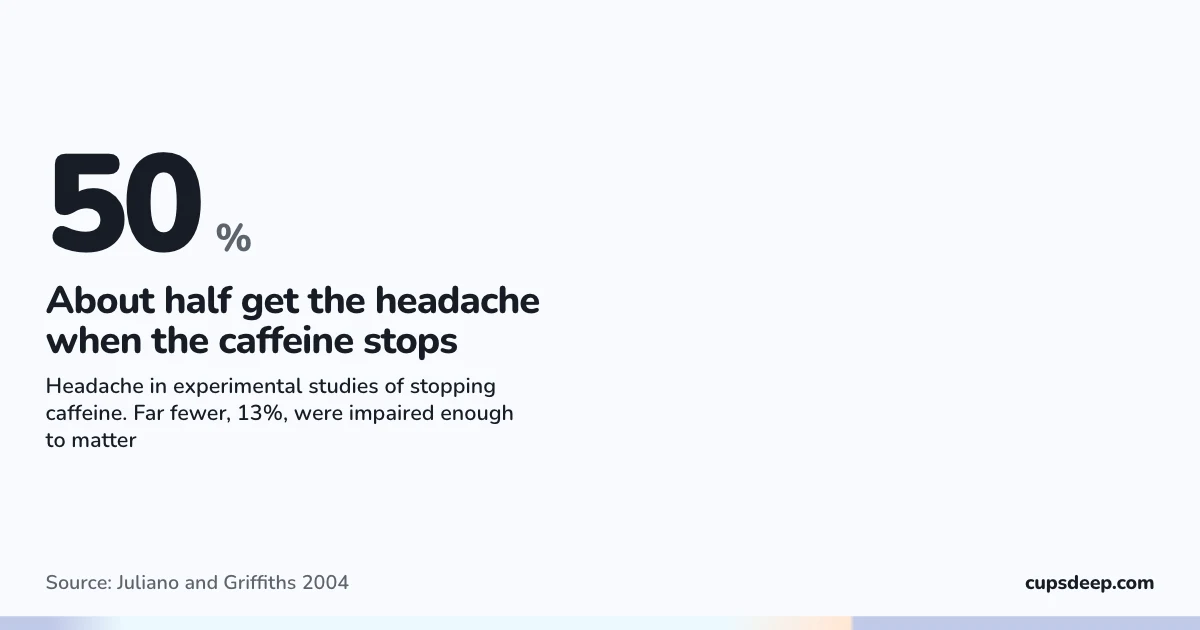
Caffeine withdrawal starts 12–24 hours after the last cup, peaks at 20–51 hours and lasts 2–9 days. About half get the headache. The odds and the fix.
Tea and mate
Does matcha have caffeine?
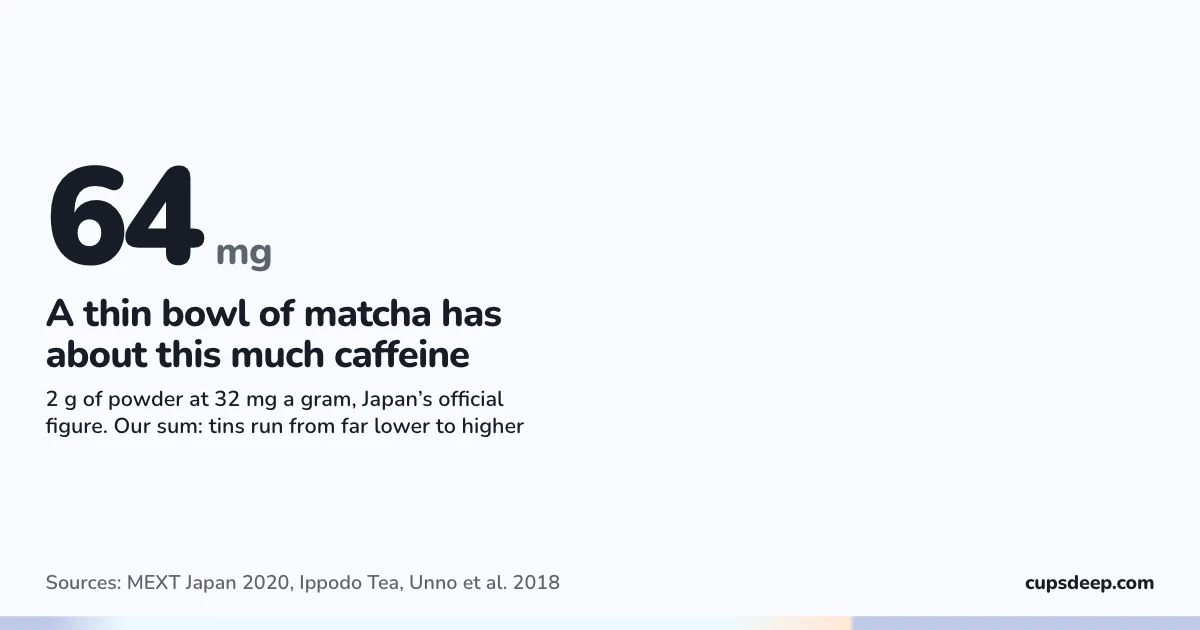
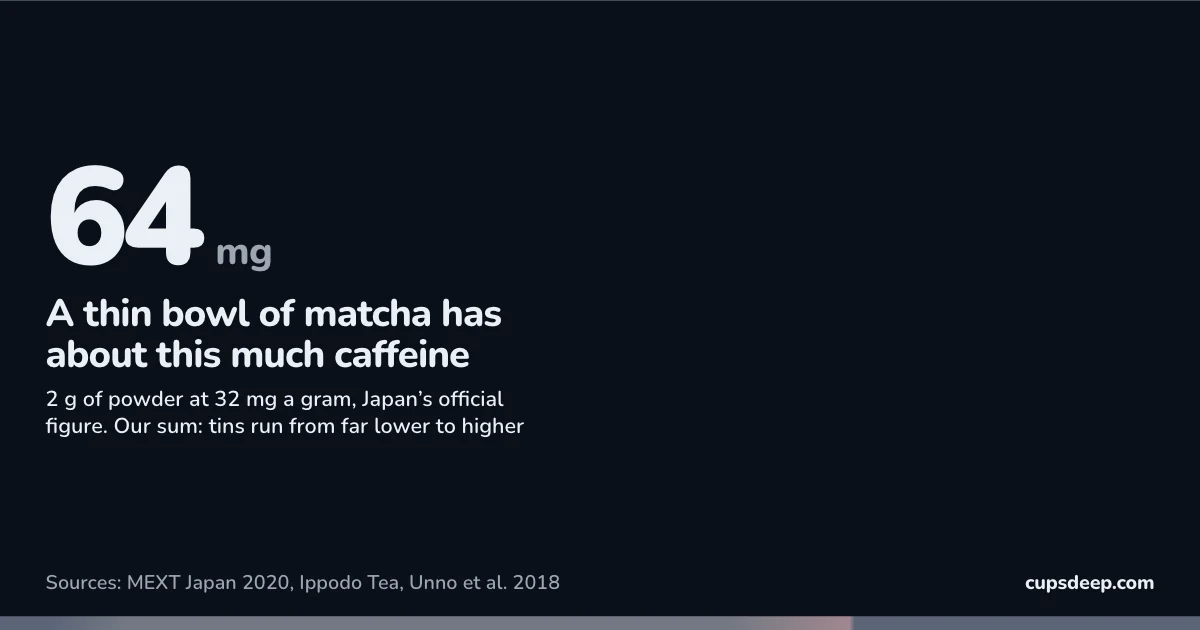
Yes. Matcha powder is about 32 mg/g: 64 mg in a thin 2 g bowl, 128 mg in a thick one. A Starbucks grande matcha latte is 65 mg.
Cans
Does Coke Zero have caffeine?
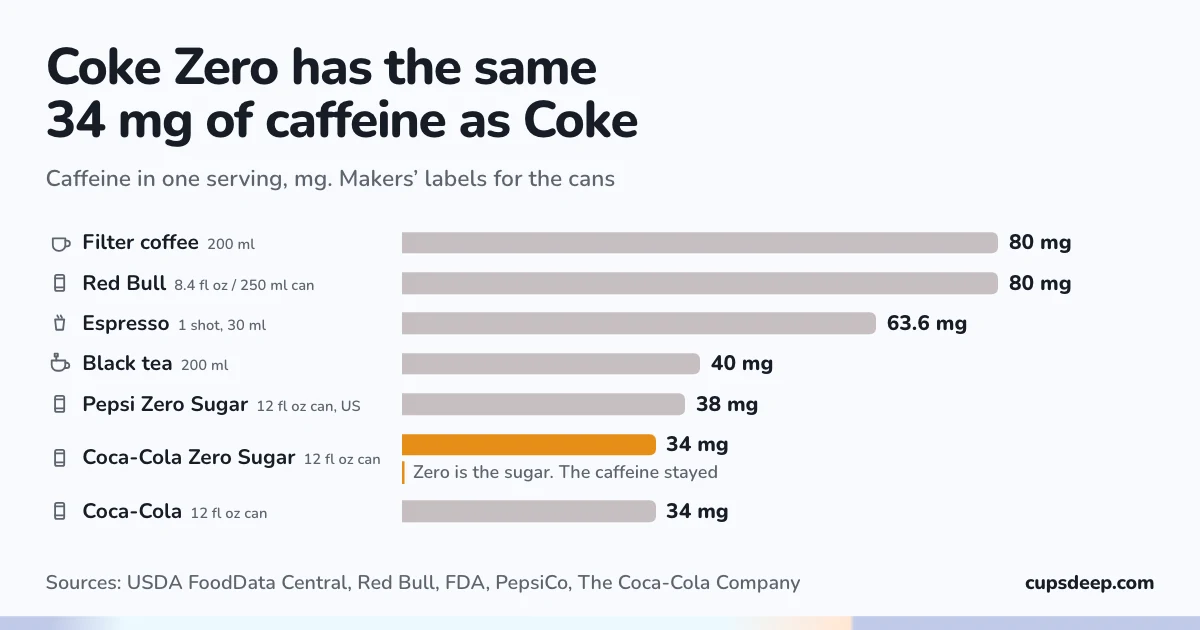
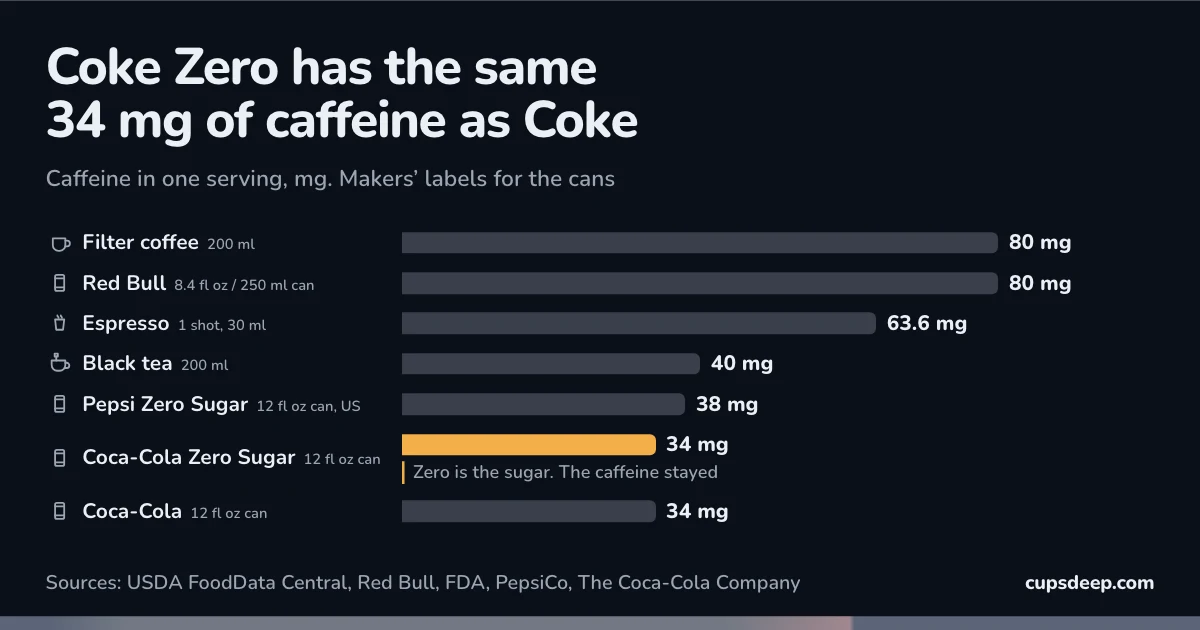
Yes. A 12 fl oz can of Coke Zero has 34 mg of caffeine, the same as regular Coke. Diet Coke has 46 mg. Every soda, by its maker.