Does matcha have caffeine?
Yes, and the honest answer comes in grams, not cups. How much depends on how much powder went into the bowl and, more than any tin will tell you, on where that tin was sold.
The short answer
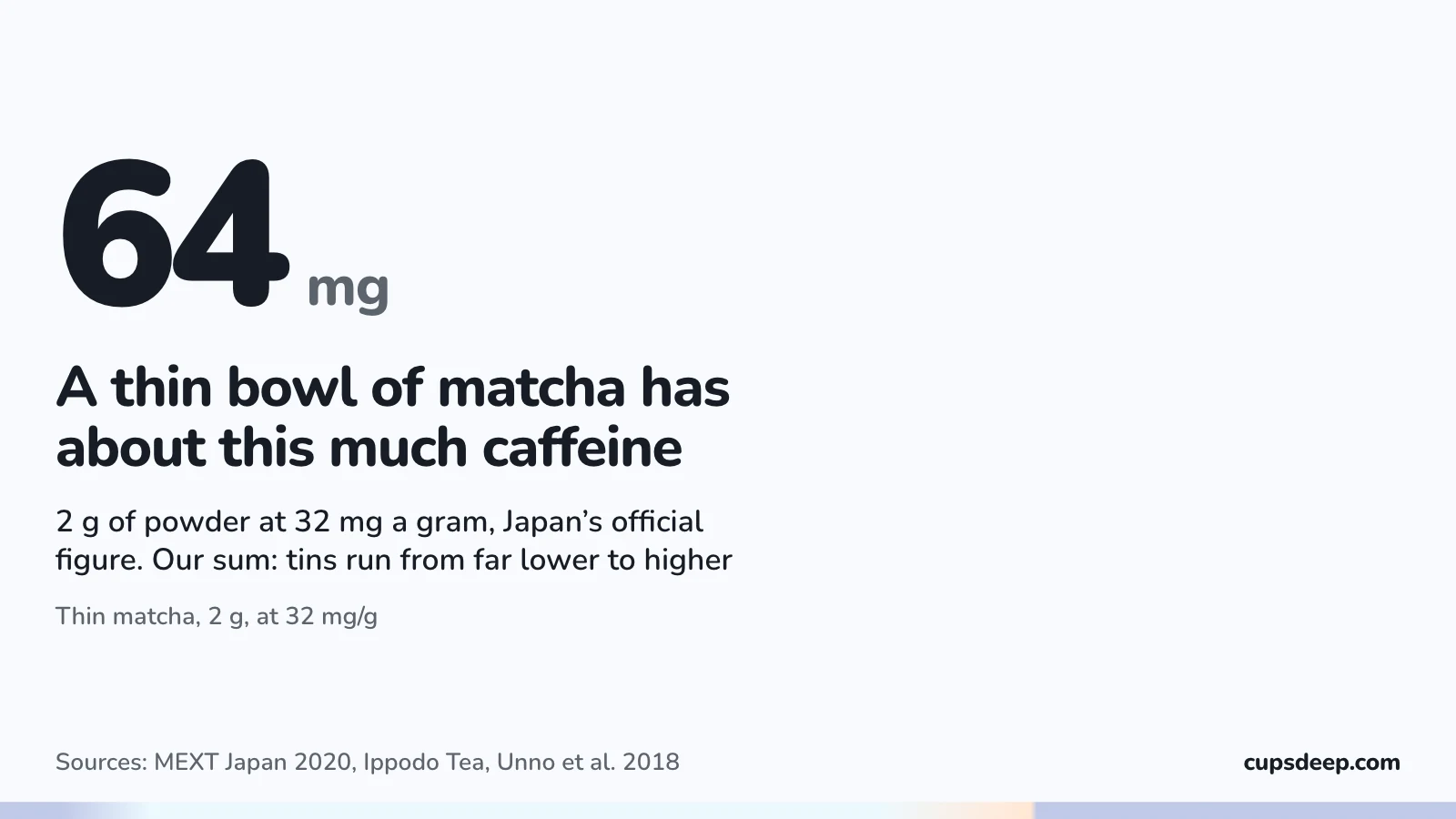
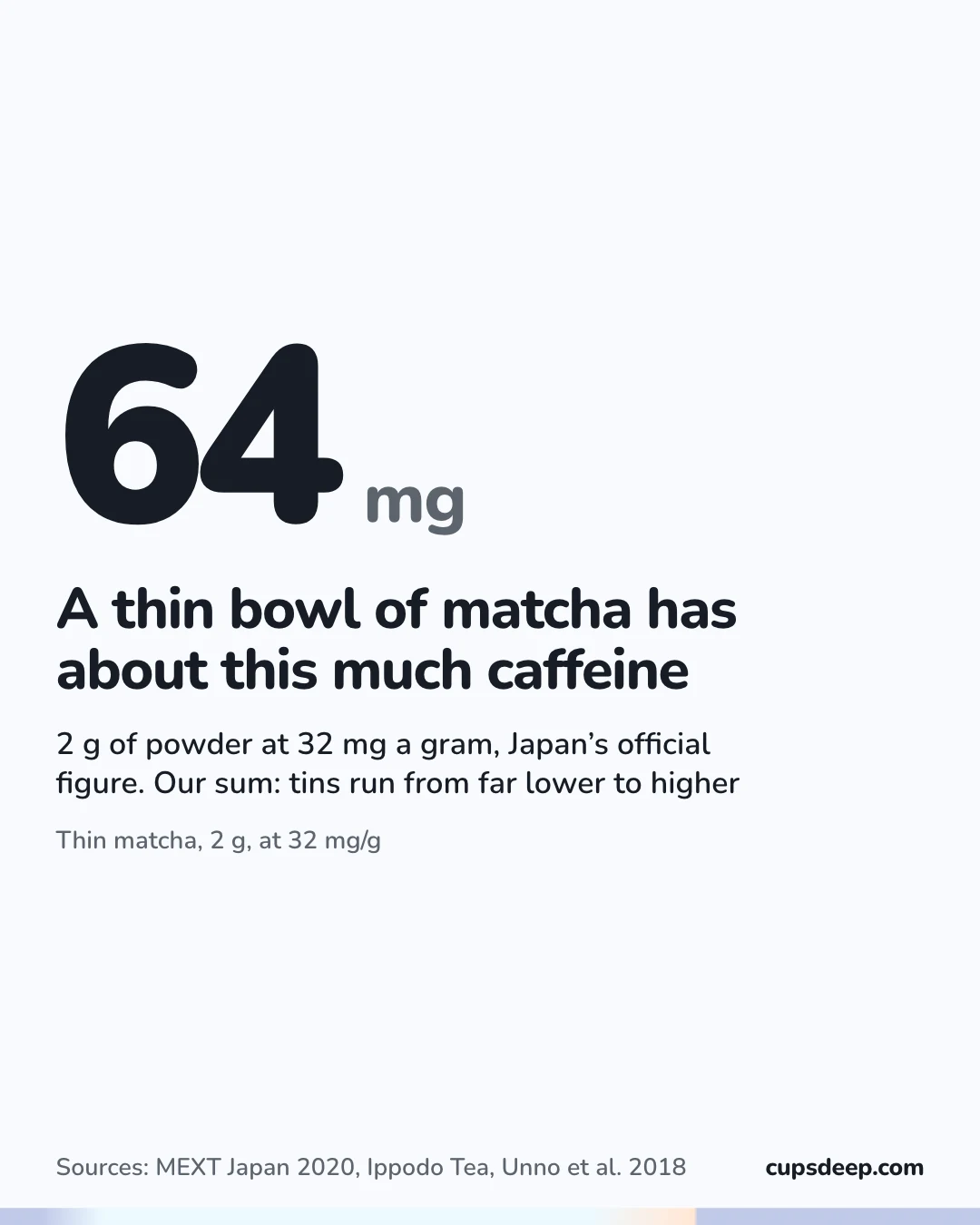
Yes. Matcha is tea leaf ground to a powder and drunk whole, and Japan’s food tables put it at 32 mg/g of caffeine. A thin bowl made with 2 g has about 64 mg, close to a shot of espresso, and a thick bowl made with 4 g about 128 mg. The tin matters: 143 powders measured in one study ran from 0.85 mg/g to 50.16 mg/g.

How much caffeine is in a bowl of matcha?
Matcha is not brewed and thrown away. You whisk the ground leaf into water and drink the lot, so the caffeine in the bowl is plain arithmetic: grams of powder times milligrams per gram. Any answer that starts “a cup of matcha has” is hiding one of those two numbers. Here are both.
Japan’s Standard Tables of Food Composition (2020, eighth revision) give matcha powder 3.2 g of caffeine per 100 g, which is 32 mg per gram. The same table gives sencha leaf 2.3 g per 100 g (23 mg per gram), brewed sencha 0.02 g per 100 g (10 g of leaf in 430 mL of water at 90 °C for one minute) and brewed coffee 0.06 g per 100 g (10 g of ground coffee in 150 mL of hot water). 90
Ippodo Tea of Kyoto makes thin matcha (usucha) from 2 g of powder, which it describes as 1.5 heaped tea ladles or 1 level teaspoon, in 60 ml of water at 80 °C. Its thick matcha (koicha) takes 4 g, 3 heaping ladles or 2 level teaspoons, in 30 ml. These are one maker’s recipes, not a standard. 9293
Multiply them and a thin bowl is about 64 mg, level with a shot of espresso at 63.6 mg. A thick bowl doubles the powder and lands at about 128 mg. The teaspoon answer is the same answer: a level one is that maker’s 2 g. A heaped one is more, and nobody at home levels the spoon.
| Bowl | Powder | Japan’s official figure | Median tin sold in Japan | Median tin sold abroad |
|---|---|---|---|---|
| Thin (usucha) | 2 g | 64 mg | 76 mg | 51 mg |
| Thick (koicha) | 4 g | 128 mg | 152 mg | 102 mg |
Our sums: powder weight times caffeine per gram, at 32 mg/g, 37.9 mg/g and 25.5 mg/g. The two medians are our own, worked out from one paper’s tables. Nobody measured these bowls.
I did the maths. You can keep ignoring it
Why does every source give a different number?
Because it depends where you bought it, and we found one paper that looked. It is the largest set of measurements we could find, and none of the top pages we read for this question uses it.
Unno and colleagues (Nutrients, 2018) measured 143 commercial matcha powders by HPLC: 76 sold in Japan and 67 sold outside it. Caffeine ran from 5.95 to 50.16 mg per gram in the powders sold in Japan and from 0.85 to 40.96 mg per gram in those sold abroad. Theanine ran from 2.48 to 44.65 mg per gram in Japan and from 0.32 to 27.09 abroad. The paper does not describe the individual products; it says only that low-grade green teas with low amino acid contents are also sold as matcha. 91
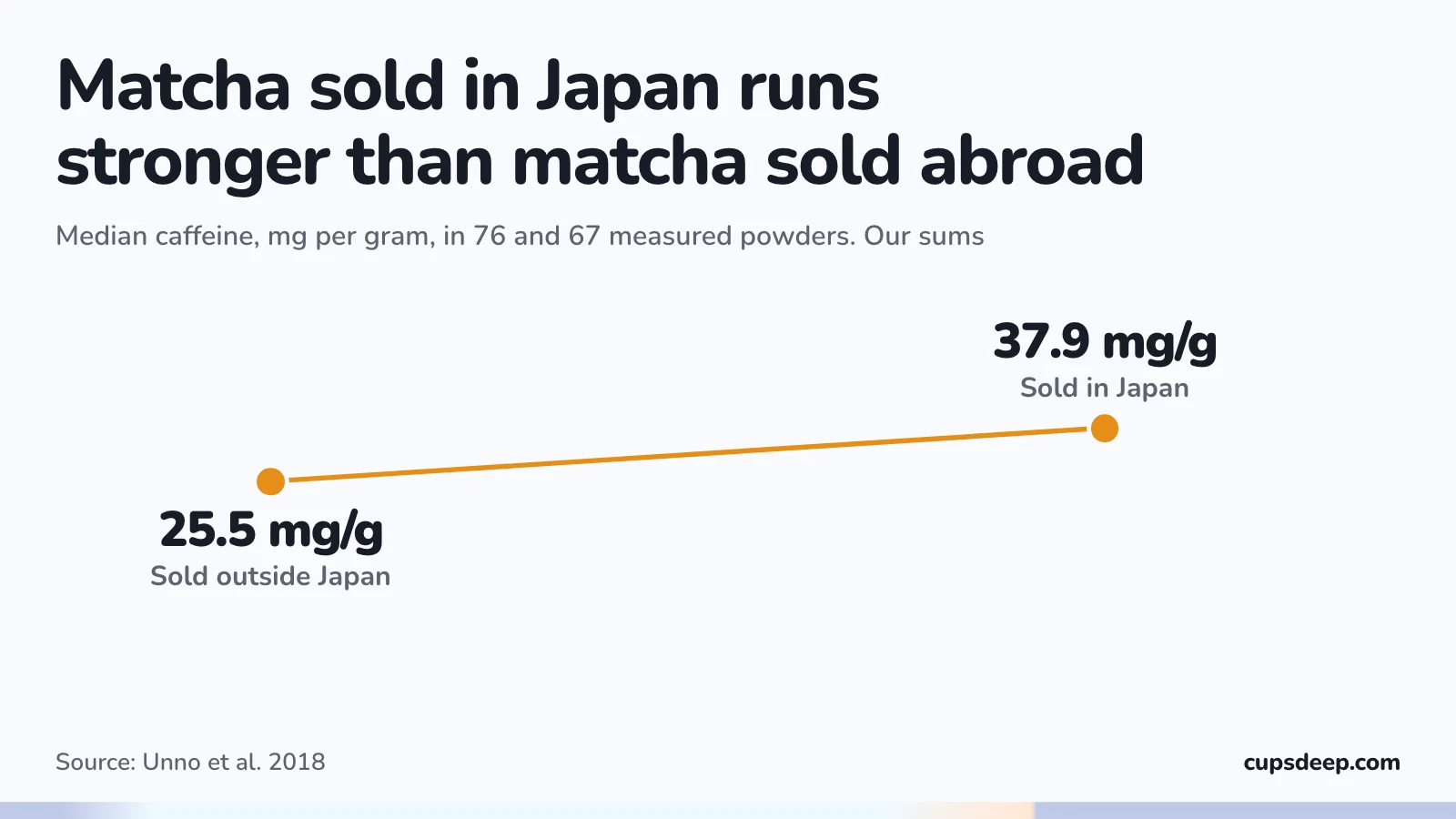
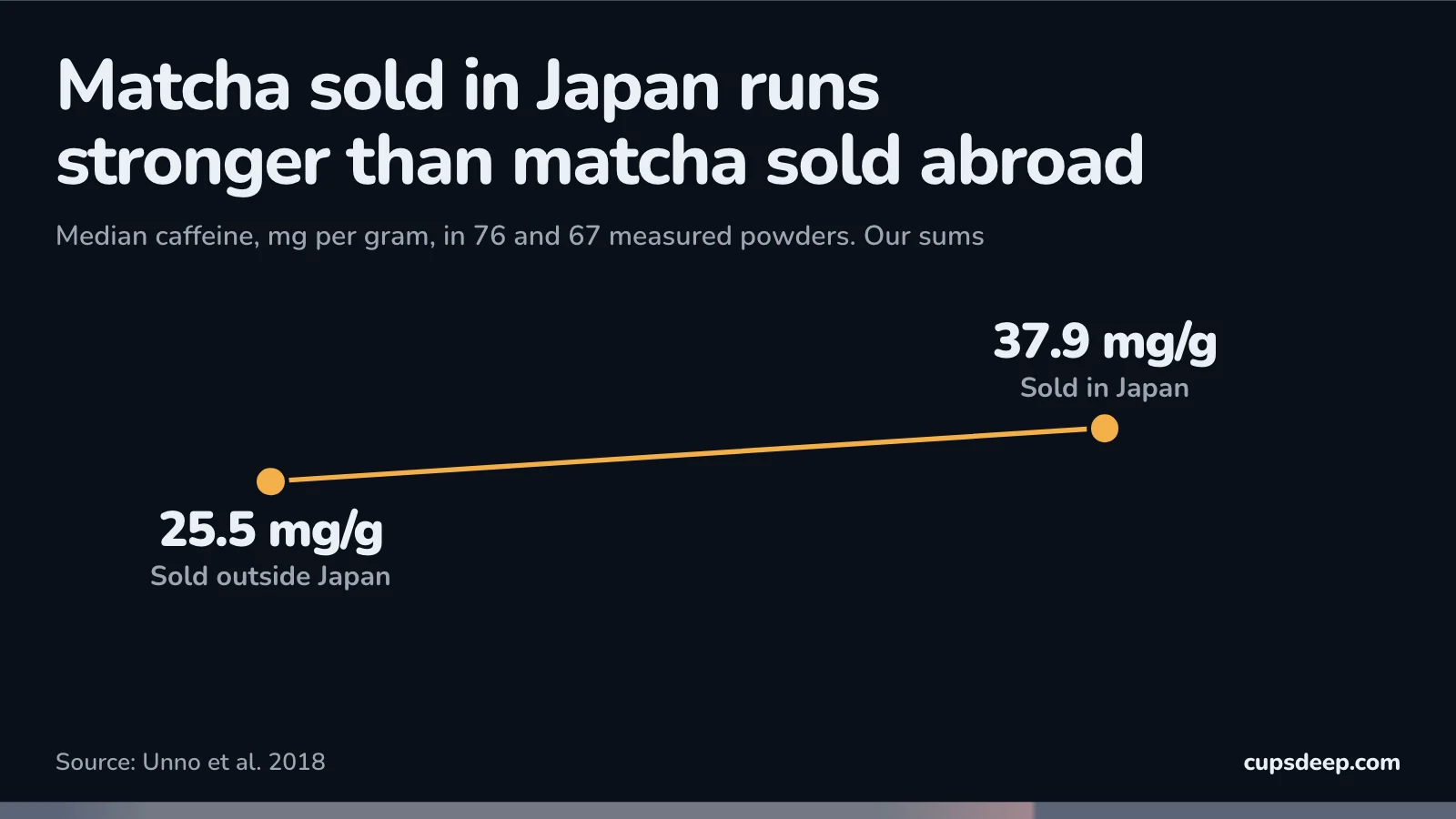
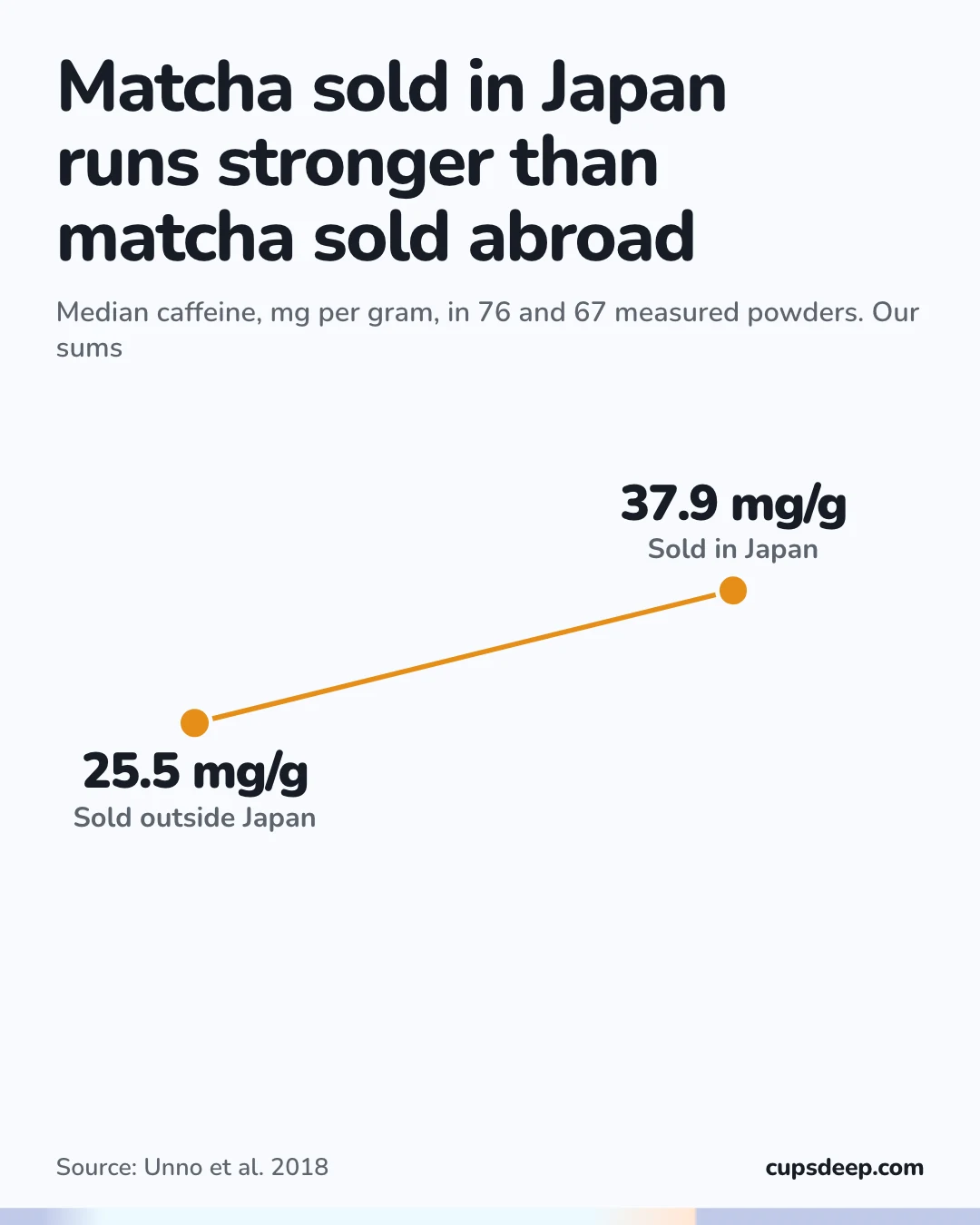
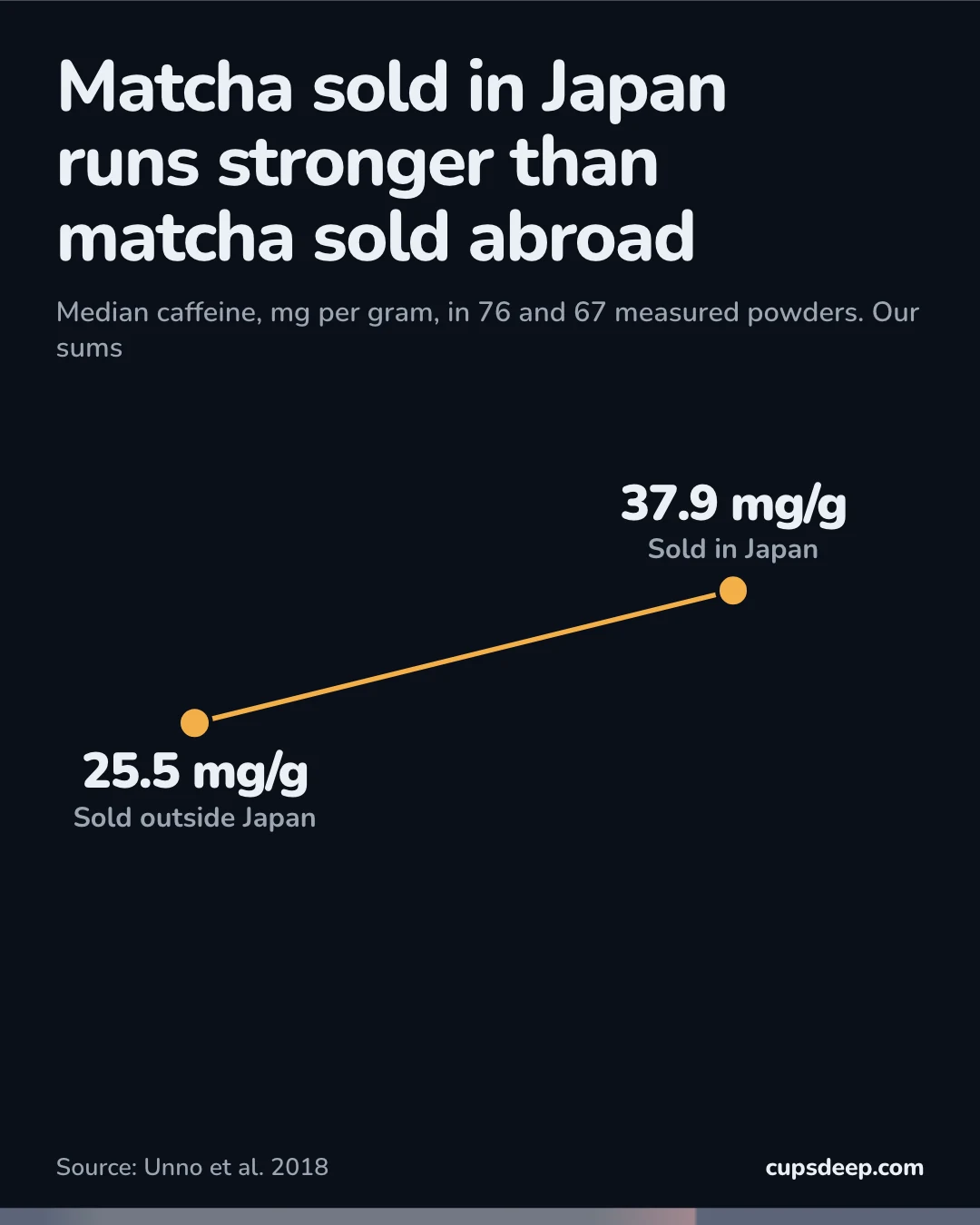
The middle of Unno and colleagues’ 143 powders is our own sum; the paper prints each powder’s result and no median. Median caffeine is 37.9 mg per gram in the 76 powders sold in Japan (mean 37.3) and 25.5 mg per gram in the 67 sold outside Japan (mean 26.2). 70 of the 76 sold in Japan had 30 mg per gram or more; 17 of the 67 sold abroad had under 20. Median theanine is 20.7 mg per gram in Japan and 7 abroad. Derived by us; a second reader repeated the sums from the paper’s tables and got the same figures. 91
Read the low end again. One tin sold outside Japan measured 0.85 mg/g, which makes a bowl with 1.7 mg of caffeine in it: decaf by another name. The strongest tin, sold in Japan, would put 100.3 mg in the same bowl. Both say matcha on the front.
The paper does not say what each product was. The weakest few are low in everything, catechins included, by the same factor, which is what a powder cut with something else would look like. They were still sold as matcha.
Ceremonial grade is not a unit of measurement
The range some pages repeat (two of the five we read, neither saying where it came from) traces back to a single paper by way of a review.
A 2021 review (Kochman and colleagues, Molecules) puts caffeine in matcha between 18.9 and 44.4 mg per gram, against 11.3 to 24.67 mg per gram in other green teas. The matcha range comes from a single 2020 paper by Koláčková and colleagues, which is paywalled and which we could not read, so how many powders it tested and how is unconfirmed here. 96
It is a fair range. It is also one lab’s, and it sits inside the wider spread above. How we read sources, and what we do when we cannot open one, is on the method page.
Does matcha have more caffeine than coffee?
By the sip, yes. By the serving, usually not. Thin matcha packs 64 mg into 60 ml of water, where the same Japanese tables give brewed coffee 60 mg per 100 g. But a bowl is a few mouthfuls and a coffee is a mug.
| Drink | Serving | Caffeine |
|---|---|---|
| Thin matcha (usucha) | 2 g of powder in 60 ml of water | 64 mg |
| Thick matcha (koicha) | 4 g of powder in 30 ml of water | 128 mg |
| Espresso | 1 shot, 30 ml | 63.6 mg |
| Filter coffee | 200 ml | 80 mg (60–88 mg) |
| Black tea | 200 ml | 40 mg |
| Green tea, brewed | 200 ml | 24 mg (16–36 mg) |
The matcha rows are our sums at Japan’s official 32 mg/g. The others are typical measured values from the drinks table. Mugs are bigger than these servings, and so are most scoops.
So a proper bowl sits level with one espresso and under a filter coffee. It is well clear of ordinary green tea, and the sources say why.
Matcha is higher in caffeine than other green tea for reasons the sources give without a figure. Unno and colleagues write that matcha is high in caffeine because the buds and young leaves of the tea plant contain more caffeine than mature leaves. A 2018 study of covered tea fields (Sano and colleagues, read as an abstract only) found that covering the plants decreased some catechins and increased theanine and caffeine; the size of the rise is not in the abstract. 9197
There is a simpler reason too. Brewing leaves most of the leaf in the pot: the same tables put sencha leaf at 23 mg/g and the tea brewed from it at 20 mg per 100 g. With matcha you drink the leaf.
How much caffeine is in a Starbucks matcha latte?
Less than the price suggests. Starbucks builds the drink from scoops of matcha powder, one more for each size up, and publishes the caffeine for every size, which most boba and milk tea shops do not. The drinks on its menu with none at all, and the Refreshers that only look like they have none, are in Starbucks drinks without caffeine.
| Size | Matcha scoops | Hot | Iced |
|---|---|---|---|
| Short, 8 fl oz | One | 20 mg | No iced short listed |
| Tall, 12 fl oz | Two | 45 mg | 40 mg |
| Grande, 16 fl oz | Three | 65 mg | 65 mg |
| Venti, 20 fl oz hot, 24 fl oz iced | Four | 85 mg | 85 mg |
Starbucks’ own figures for the United States, for the standard recipe; Starbucks marks each caffeine figure as approximate. Read from its menu on 10 November 2026. Starbucks gives no weight for a scoop, so the grams of matcha in the cup are not known.
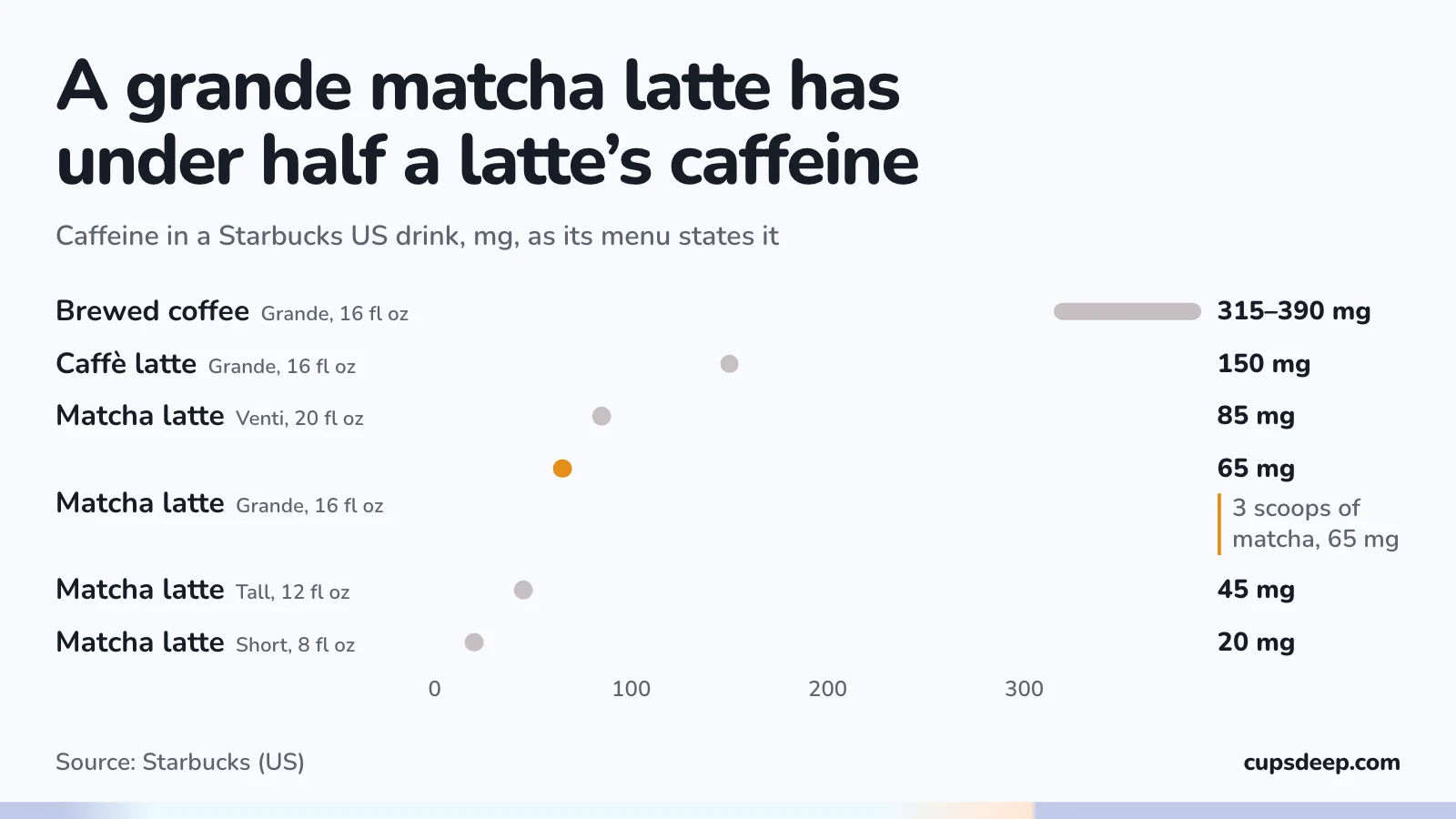
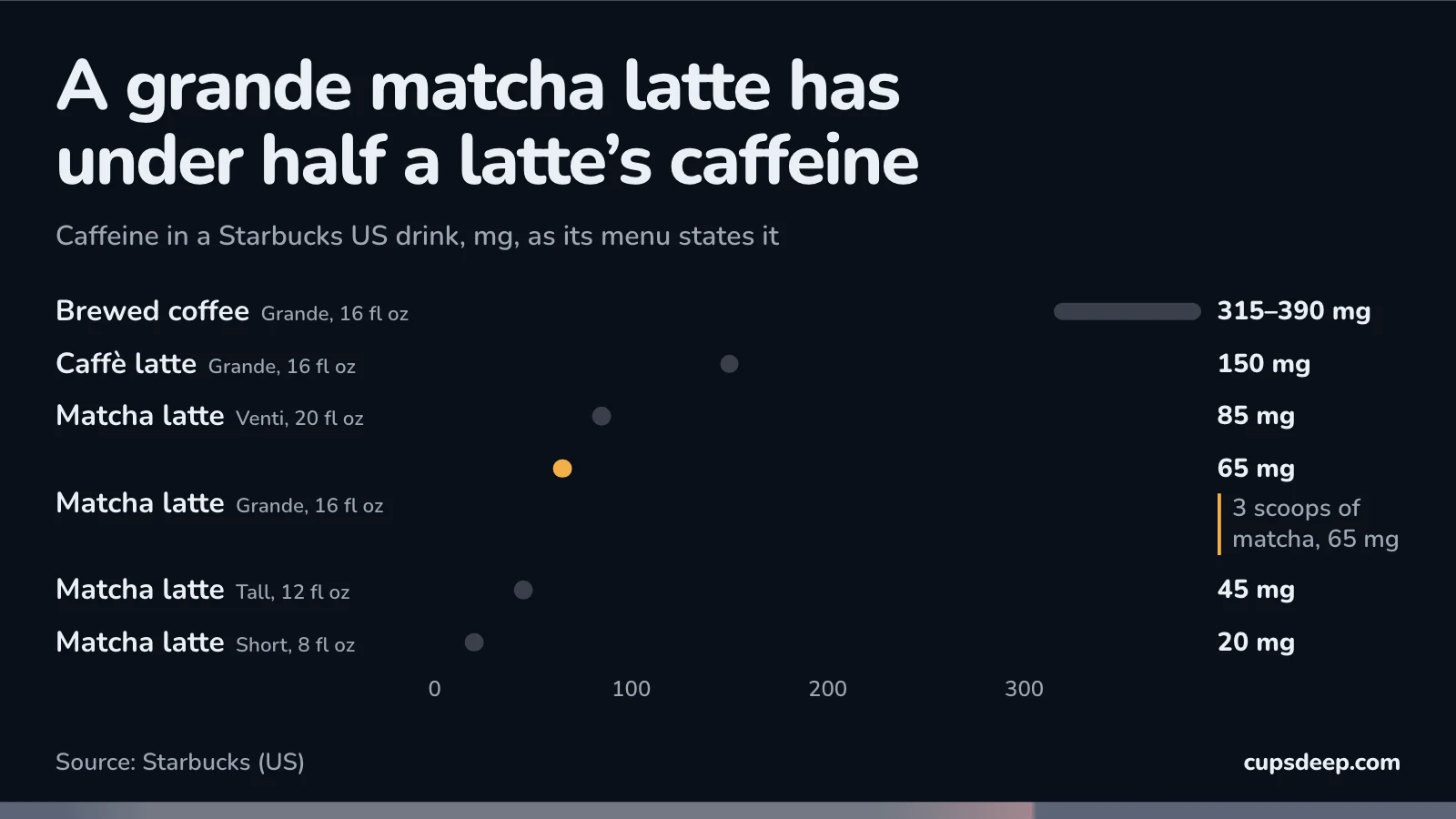
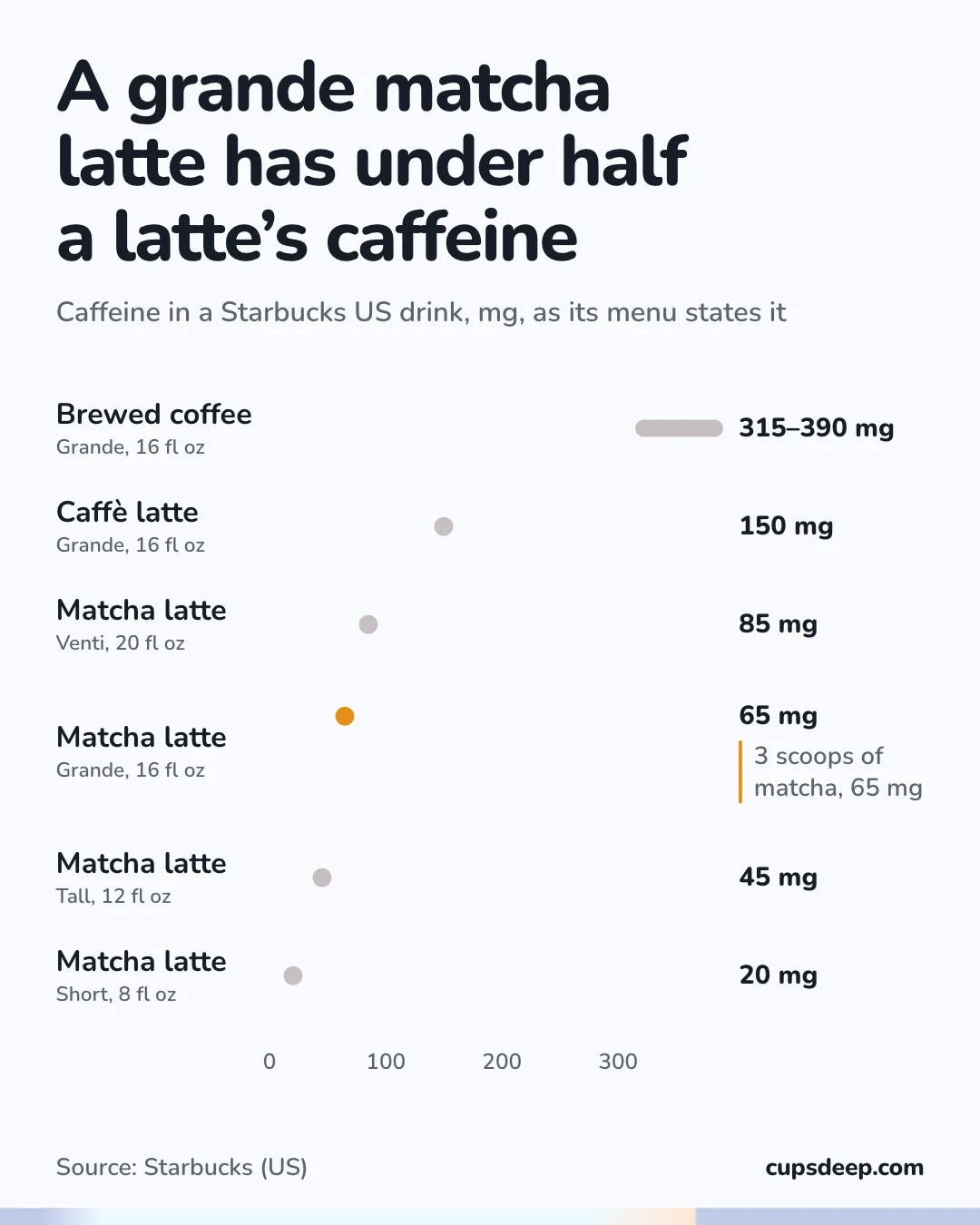

A grande matcha latte is 65 mg. A grande caffè latte is 150 mg, and a grande brewed coffee is somewhere between 315 mg and 390 mg. If you swapped drip coffee for matcha lattes and feel calmer, hold that thought for the next section.
Dunkin’ is the other name people search. Its site would not open from where we read it, outside the United States, so we could not read its own figure, and we do not print anyone else’s guess at it.
2 cups deep in matcha and telling everyone I quit caffeine
Is matcha’s energy really calmer than coffee’s?
This is the line on every tin: matcha gives calm, focused energy because its caffeine arrives with L-theanine, an amino acid in tea. It is repeated far more often than it is tested, so here is what the trials we found gave people. One warning first: we read these as abstracts, not as full papers.
Two trials stand behind the claim that L-theanine and caffeine work well together. Both were read as abstracts only, and the first author of each gives a Unilever affiliation. Giesbrecht and colleagues (2010) gave 44 people 97 mg of L-theanine with 40 mg of caffeine: against placebo, accuracy on a task-switching test and self-reported alertness improved and tiredness fell, with no significant effects on the other cognitive tasks. Owen and colleagues (2008) gave 27 people 50 mg of caffeine with and without 100 mg of L-theanine: the combination improved speed and accuracy on an attention-switching task 60 minutes after the dose. 9899
Look at the recipe. Both trials gave at least twice as much theanine as caffeine. A bowl of matcha does not.
A 2 g bowl made from a powder at the Japan-market medians (37.9 mg of caffeine and 20.7 mg of theanine per gram) would hold about 76 mg of caffeine and about 41 mg of theanine: more caffeine than theanine, the reverse of the two trials that found a benefit. Our sum from our own derived medians; nobody measured the bowl. 9192
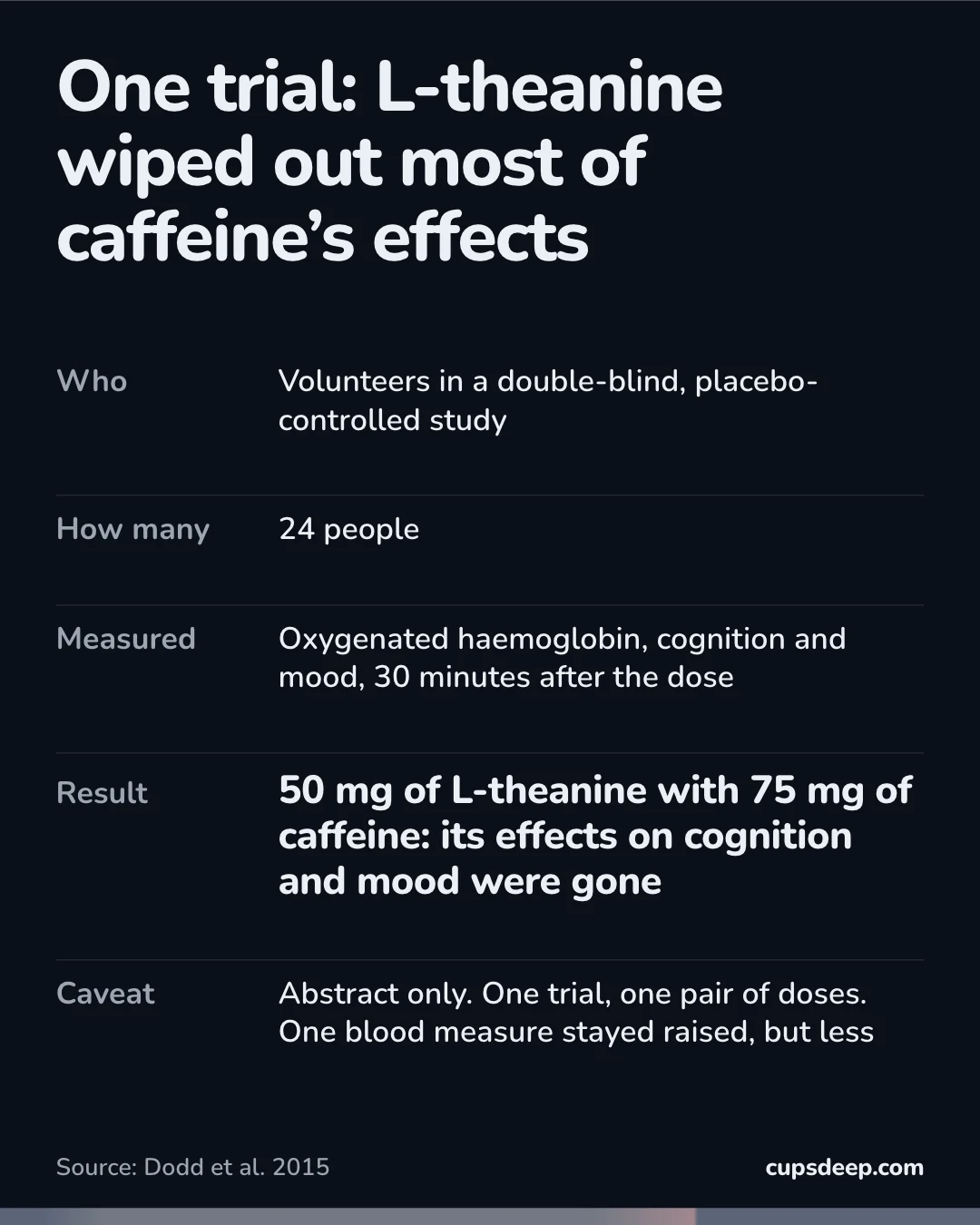
One trial tested doses close to that bowl. It is the one the tins leave out.
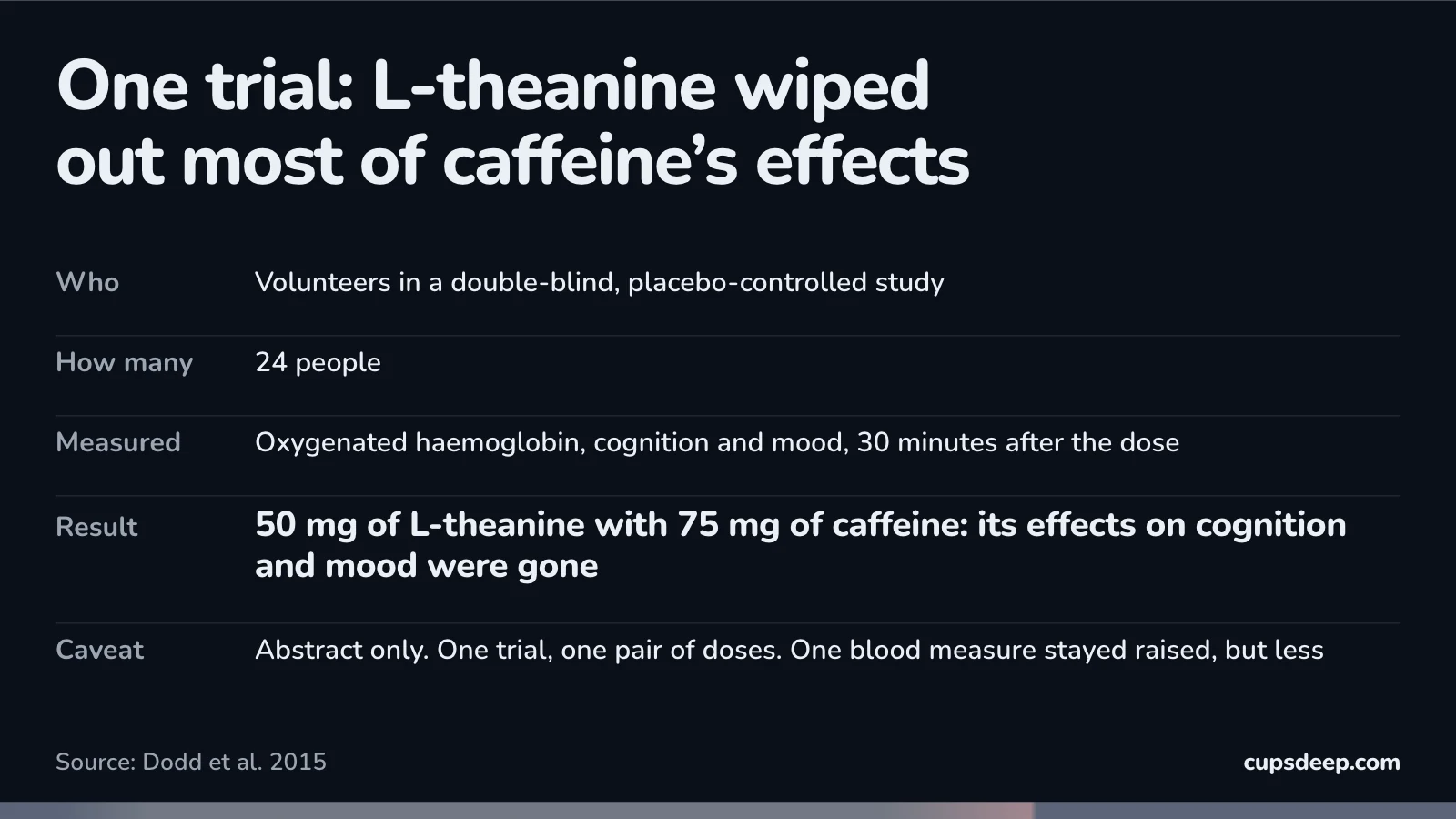
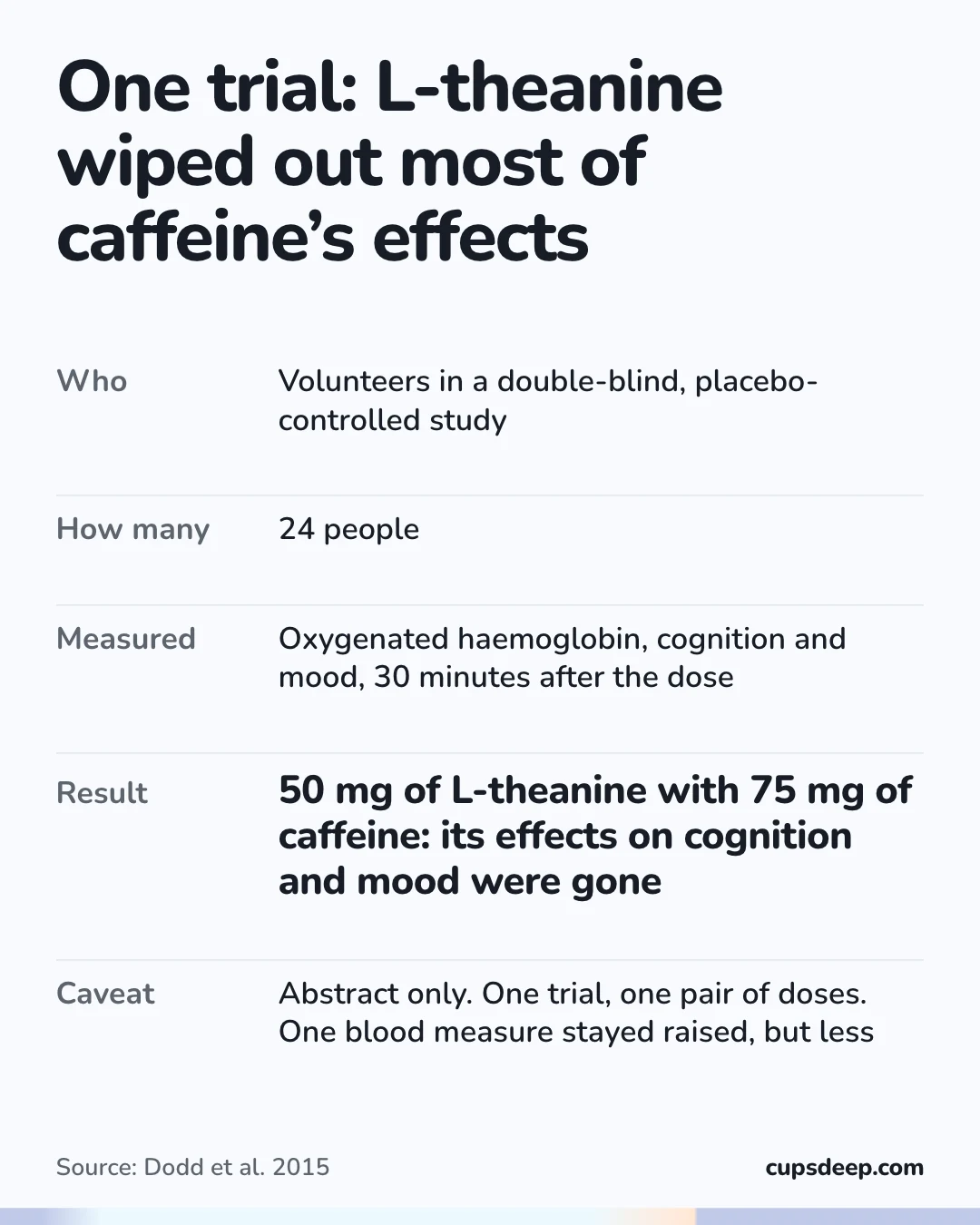
Dodd and colleagues (2015), in a double-blind, placebo-controlled study of 24 people, gave 75 mg of caffeine and 50 mg of L-theanine, alone and together, and tested 30 minutes after the dose. With the two combined, the abstract says, the effects of caffeine on oxygenated haemoglobin, cognition and mood “were eradicated”, while some of its effect on deoxygenated haemoglobin remained, weakened, and at these doses the combination did not lead to a positive impact on behaviour. Read as an abstract only. 100

The one trial here that used matcha itself (Dietz and colleagues, 2017) gave 23 people 4 g of matcha powder, as a drink or in a snack bar, and tested them 60 minutes later. The abstract reports slight effects on speed of attention and on episodic secondary memory, to a low degree, and no significant change in mood. Read as an abstract only. 101
None of this says the calm is imaginary. It says we found no trial that shows it at the doses in a bowl, and one small trial points the other way. My own guess is duller: a matcha latte feels gentler than a drip coffee because it has a fraction of the caffeine.
Matcha is caffeine that went on a retreat and won’t shut up about it
Will matcha keep you awake?
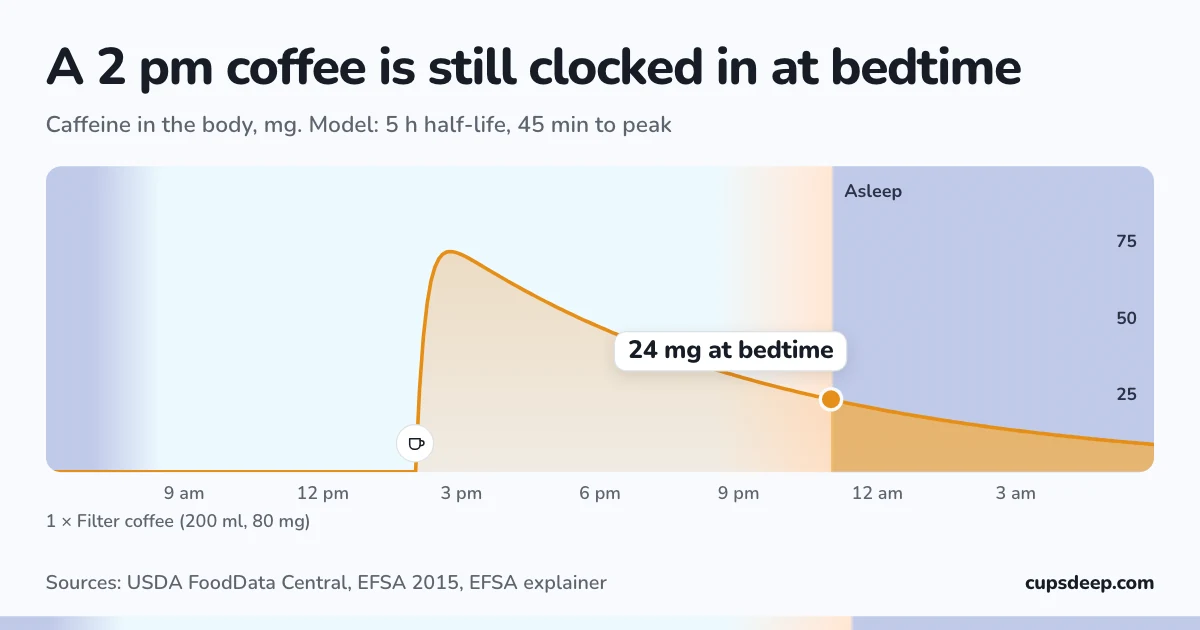
It is caffeine and it behaves like caffeine. It peaks 30 minutes to 120 minutes after you drink it, and half of it is still in you about 4 hours later, longer for some people.
A single 100 mg dose of caffeine, about 1.4 mg/kg body weight for a 70 kg adult, may increase the time it takes to fall asleep and reduce sleep duration in some adults, particularly when taken close to bedtime. 2223
A thick bowl is over that amount on its own, and a thin one from a strong tin is not far under it. For the whole day, EFSA’s line is 400 mg/day for healthy adults and 200 mg/day in pregnancy, from all sources. Matcha counts toward it like any other cup: by the grams you scoop.
Questions people ask
Does matcha have more caffeine than coffee?
Per serving, usually not. A thin bowl made with 2 g of powder is about 64 mg, level with a single espresso (63.6 mg) and under a 200 ml filter coffee (80 mg). A thick bowl, at about 128 mg, is over both.
How much caffeine is in a teaspoon of matcha?
About 64 mg, if the teaspoon is level. One Kyoto tea house weighs a level teaspoon at 2 g, and Japan’s food tables put matcha at 32 mg/g. Measured tins have run from 0.85 mg/g to 50.16 mg/g, so the true figure depends on the powder.
How much caffeine is in a Starbucks matcha latte?
By Starbucks’ own figures for the United States, a hot matcha latte has 20 mg in a short, 45 mg in a tall, 65 mg in a grande and 85 mg in a venti. A grande caffè latte has 150 mg.
Does matcha have more caffeine than green tea?
Yes. A 200 ml cup of brewed green tea is typically 24 mg and a thin bowl of matcha about 64 mg, because with matcha you drink the whole ground leaf and not an infusion of it.
Does the L-theanine in matcha cancel out the jitters?
We found no trial that shows it at the doses in a bowl. The trials that found a benefit gave 97 mg to 100 mg of L-theanine with 40 mg to 50 mg of caffeine; a bowl of typical Japanese matcha holds about 41 mg of theanine with 76 mg of caffeine. We read those trials as abstracts only.
Can you drink matcha while pregnant?
EFSA says caffeine up to 200 mg/day from all sources raises no safety concern for the fetus. A thin bowl of matcha is about 64 mg and a thick one about 128 mg at the official figure for the powder, and tins vary, so count it by the grams you use.
Sources
Every number above links to the place it came from. How the numbers are chosen and checked is on the method page; the drink table is at /drinks. Written with AI agents, as the whole site is. A model of a typical body, not advice for pregnancy, illness or medication.
- Beverages, coffee, brewed, prepared with tap water
- Beverages, coffee, brewed, espresso, restaurant-prepared
- Beverages, tea, green, brewed, regular
- Beverages, tea, black, brewed, prepared with tap water
- Scientific Opinion on the safety of caffeine
- EFSA explains risk assessment: Caffeine
- Medium Roast - Pike Place Roast: nutrition (starbucks.com, United States)
- Caffè Latte: nutrition (starbucks.com, United States)
- Standard Tables of Food Composition in Japan 2020 (Eighth Revised Edition), main table
- Stress-Reducing Function of Matcha Green Tea in Animal Experiments and Clinical Trials (Unno et al., Nutrients 2018;10:1468), with supplementary Tables S1 and S2
- Basic Usucha (Matcha)
- Koicha
- Matcha Latte: nutrition (starbucks.com, United States)
- Iced Matcha Latte: nutrition (starbucks.com, United States)
- Health Benefits and Chemical Composition of Matcha Green Tea: A Review (Kochman et al., Molecules 2021;26:85)
- Effect of shading intensity on morphological and color traits and on chemical components of new tea shoots under direct covering cultivation (Sano et al., Journal of the Science of Food and Agriculture 2018)
- The combination of L-theanine and caffeine improves cognitive performance and increases subjective alertness (Giesbrecht et al., Nutritional Neuroscience 2010)
- The combined effects of L-theanine and caffeine on cognitive performance and mood (Owen et al., Nutritional Neuroscience 2008)
- A double-blind, placebo-controlled study evaluating the effects of caffeine and L-theanine both alone and in combination (Dodd et al., Psychopharmacology 2015)
- An intervention study on the effect of matcha tea, in drink and snack bar formats, on mood and cognitive performance (Dietz et al., Food Research International 2017)
Keep reading

Tea and mate
Does chai have caffeine?
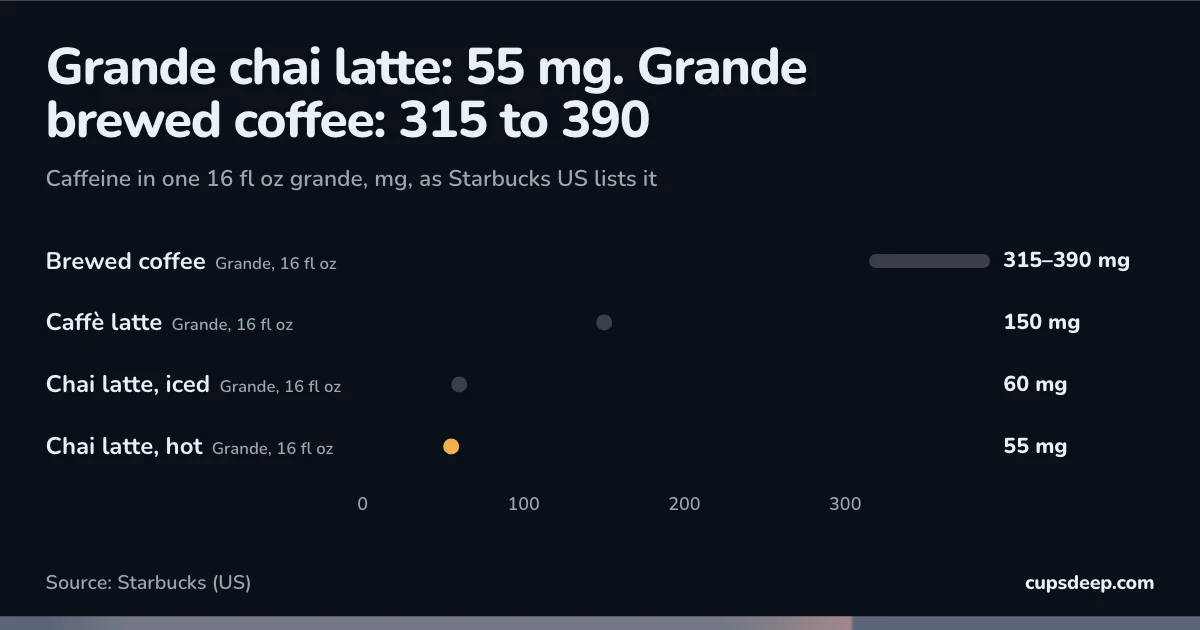
Yes. Chai is spiced black tea. A Starbucks grande chai latte lists 55 mg, a brewed cup is about 40 mg, and rooibos chai has none.
Coffee
How much caffeine is in a shot of espresso?
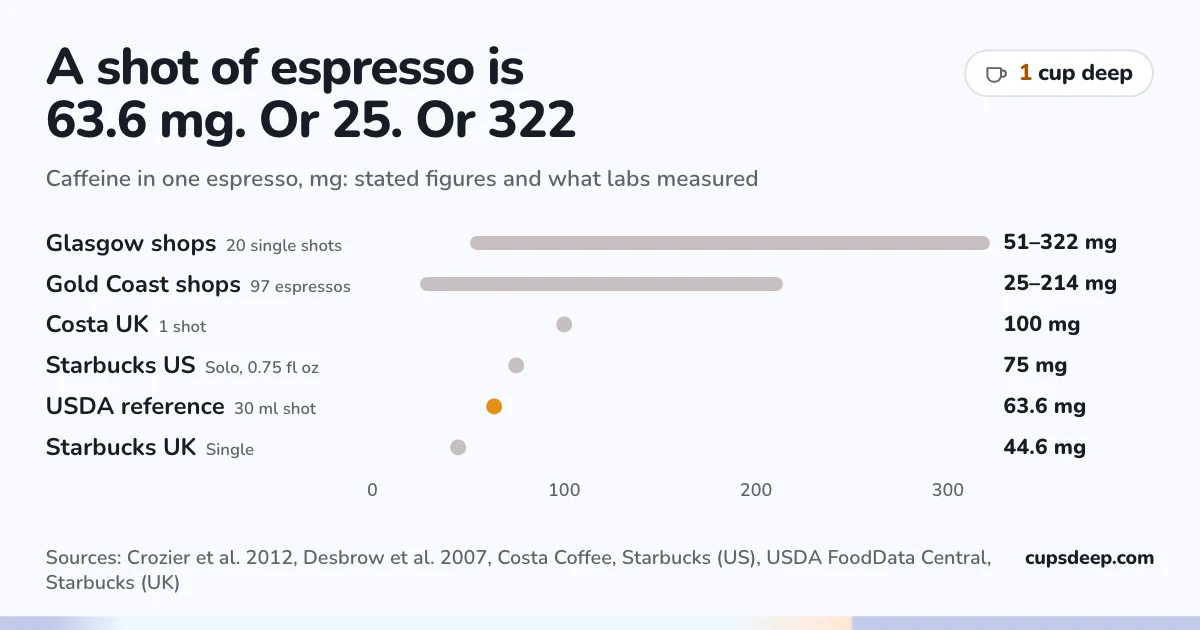
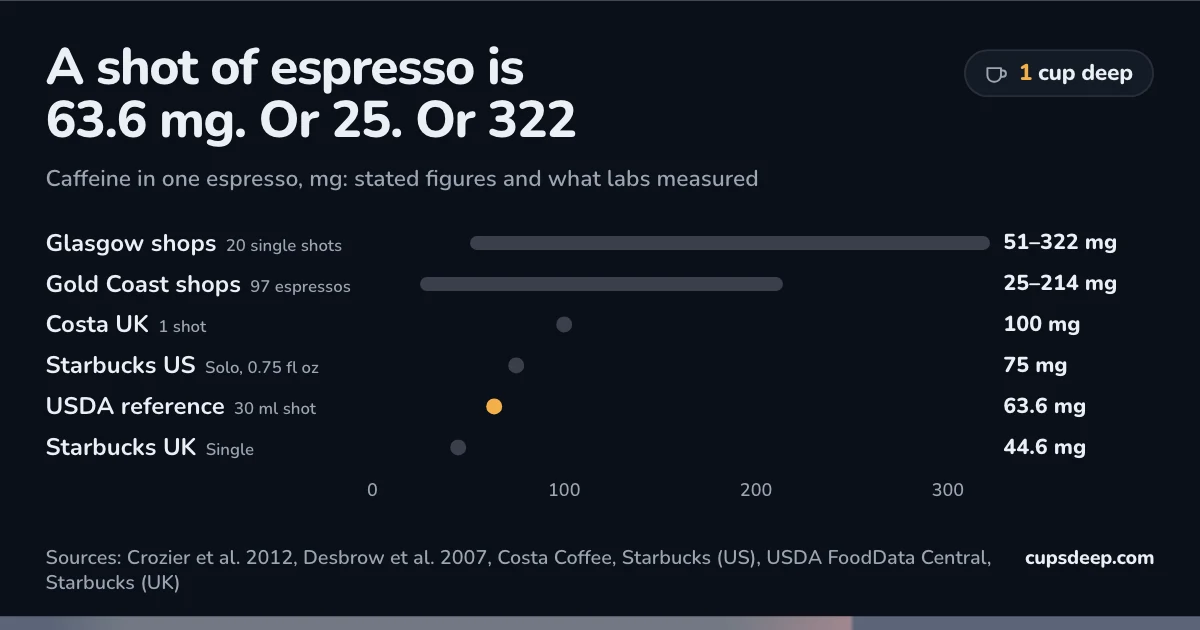
A shot of espresso is 63.6 mg by the USDA’s figure. Chains state 44.6 mg to 100 mg, and labs that bought real shots found 25 mg to 322 mg.
Body and sleep
How long does caffeine stay in your system?
Half of a dose of caffeine is gone in about 4 hours, 2–8 hours between people. After five half-lives, 20 hours on average, 3.1% is left.