How much caffeine is in Mountain Dew?
One number gets quoted for Mountain Dew, and it is right for the can and wrong for the bottle, the Zero Sugar and the fountain. Here is every size, every flavor worth asking about, the fountain and the Freeze, from PepsiCo’s own caffeine table and product pages, plus the cola rule people keep holding it up against.
The short answer
A 12 fl oz can of Mountain Dew has 54 mg of caffeine, by PepsiCo’s own figure, and so does Diet Mountain Dew. Mountain Dew Zero Sugar has more, 68 mg a can. A 20 fl oz bottle of Mountain Dew is 91 mg, and a Zero Sugar bottle is 113 mg.

How much caffeine is in a can of Mountain Dew?
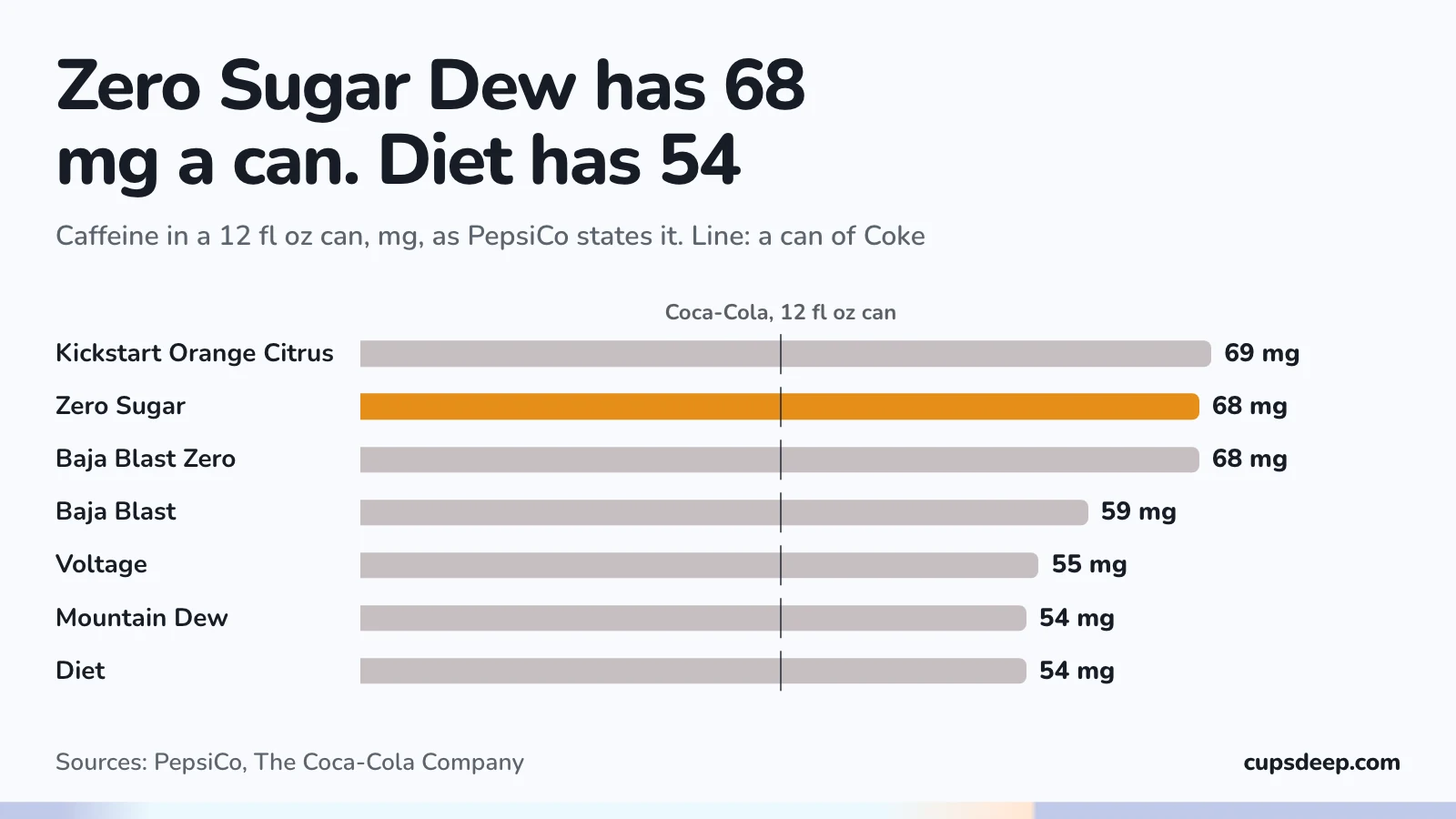
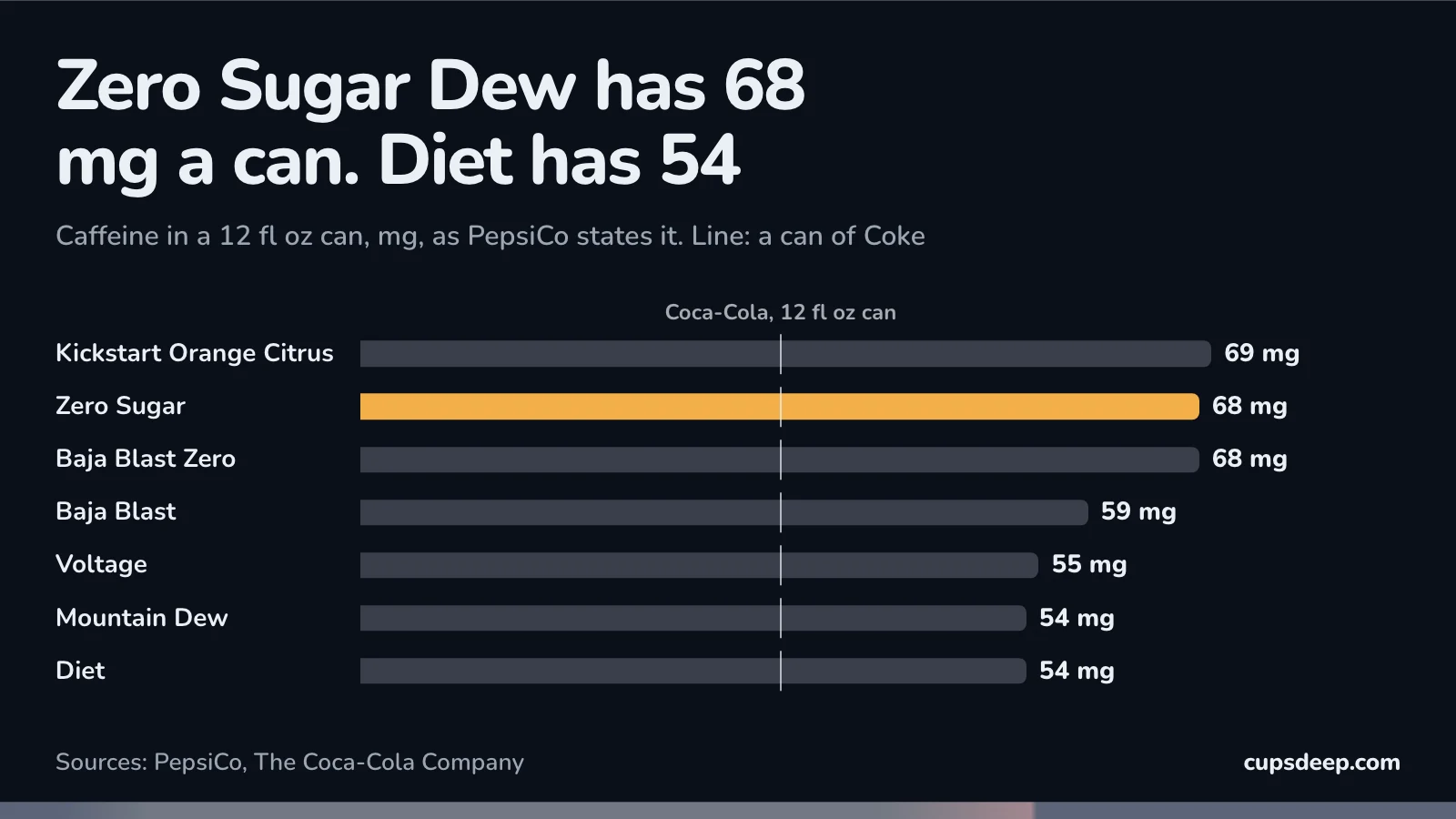
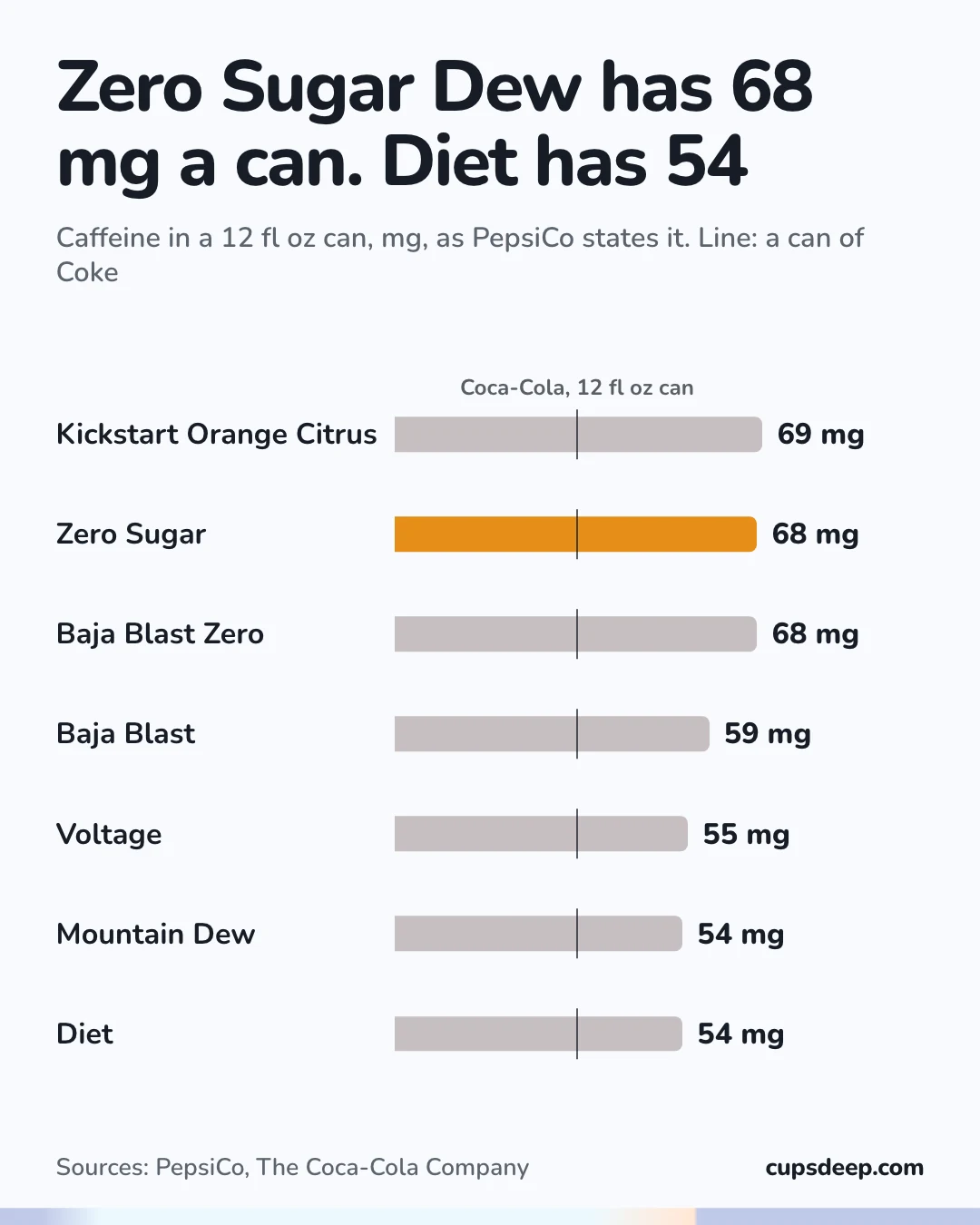
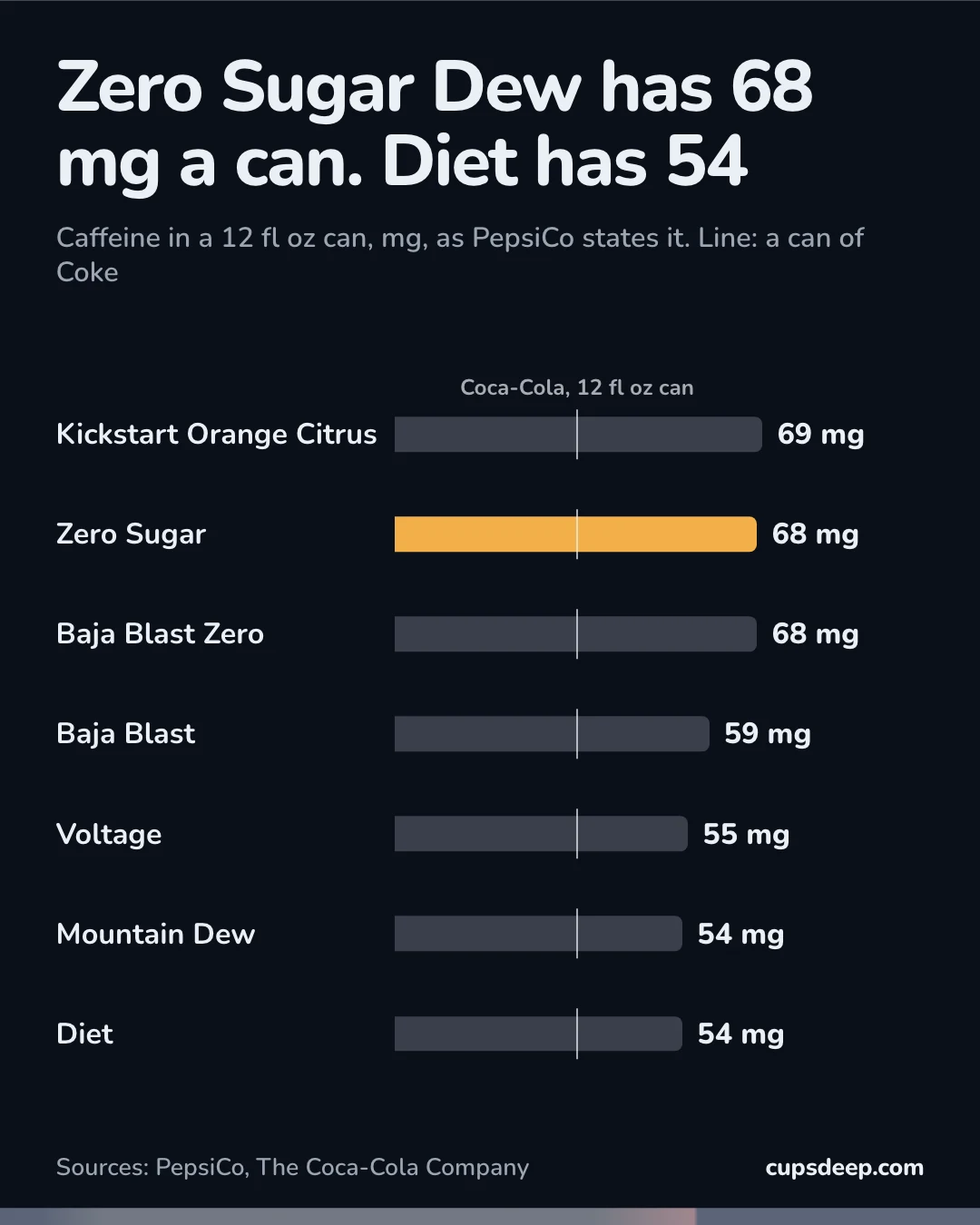
54 mg in a 12 fl oz can. That is PepsiCo’s figure, from the caffeine table on its product facts site, which lists its US Mountain Dew drinks by package. Diet Mountain Dew is the same 54 mg. Most flavors sit within a few milligrams of it. The zero-sugar ones and Kickstart do not.
| Drink | Package | Serving the figure is for | Caffeine | Per fl oz (our arithmetic) |
|---|---|---|---|---|
| Kickstart Orange Citrus | 12 fl oz can | 1 can | 69 mg | 5.8 mg per fl oz |
| Kickstart Black Cherry | 12 fl oz can | 1 can | 69 mg | 5.8 mg per fl oz |
| Kickstart Grape | 12 fl oz can | 1 can | 68 mg | 5.7 mg per fl oz |
| Kickstart Pineapple Orange Mango | 12 fl oz can | 1 can | 68 mg | 5.7 mg per fl oz |
| Mountain Dew Zero Sugar | 12 fl oz can | 1 can | 68 mg | 5.7 mg per fl oz |
| Baja Blast Zero Sugar | 12 fl oz can | 1 can | 68 mg | 5.7 mg per fl oz |
| Code Red Zero Sugar | 12 fl oz can | 1 can | 68 mg | 5.7 mg per fl oz |
| Dirty Mountain Dew Zero Sugar | 12 fl oz can | 1 can | 68 mg | 5.7 mg per fl oz |
| Baja Blast | 12 fl oz can | 1 can | 59 mg | 4.9 mg per fl oz |
| Baja Cabo Citrus | 12 fl oz can | 1 can | 56 mg | 4.7 mg per fl oz |
| Voltage | 12 fl oz can | 1 can | 55 mg | 4.6 mg per fl oz |
| Dragon Fruit | 12 fl oz can | 1 can | 55 mg | 4.6 mg per fl oz |
| Mountain Dew | 12 fl oz can | 1 can | 54 mg | 4.5 mg per fl oz |
| Diet Mountain Dew | 12 fl oz can | 1 can | 54 mg | 4.5 mg per fl oz |
| Code Red | 12 fl oz can | 1 can | 54 mg | 4.5 mg per fl oz |
| Live Wire | 12 fl oz can | 1 can | 54 mg | 4.5 mg per fl oz |
| Maui Burst | 12 fl oz can | 1 can | 54 mg | 4.5 mg per fl oz |
| White Out | 12 fl oz can | 1 can | 54 mg | 4.5 mg per fl oz |
| Dirty Mountain Dew | 12 fl oz can | 1 can | 54 mg | 4.5 mg per fl oz |
PepsiCo’s US caffeine table, read on November 12, 2026. Kickstart is filed by PepsiCo under juice drinks, not sodas. Per fl oz is the figure divided by the serving, rounded to one decimal: our sum, not PepsiCo’s.
A label is a claim, so it is worth knowing whether anyone has put one in a machine. Someone has: a lab study published in 2007 measured both Dews by name.
A 2007 study in the Journal of Food Science measured caffeine by HPLC in 56 national-brand and 75 store-brand carbonated drinks. Its abstract, which is all we have read, gives per 12 oz: Coca-Cola 33.9 mg, Diet Coke 46.3 mg, Pepsi 38.9 mg, Diet Pepsi 36.7 mg, Dr Pepper 42.6 mg, Diet Dr Pepper 44.1 mg, Mountain Dew 54.8 mg and Diet Mountain Dew 55.2 mg. The abstract gives no figure for Coca-Cola Zero Sugar and no sampling dates. 143
The lab found 54.8 mg in Mountain Dew and 55.2 mg in Diet, against PepsiCo’s current figure of 54 mg for each. The measurements sit within a milligram of today’s figure; the abstract gives no dates, so it says nothing about the can you are holding.
How much caffeine is in a 20 oz Mountain Dew, or a 2-liter?
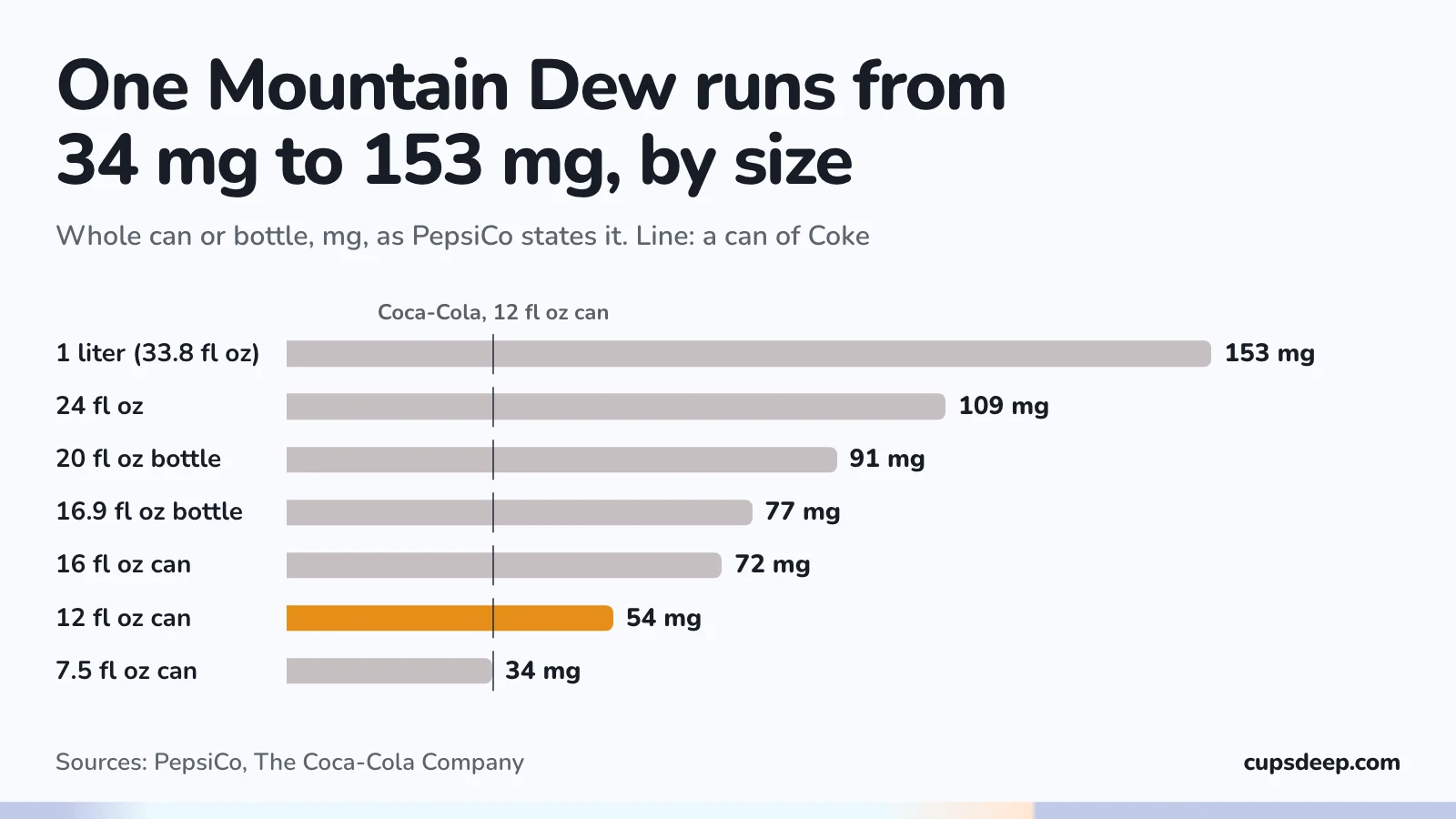
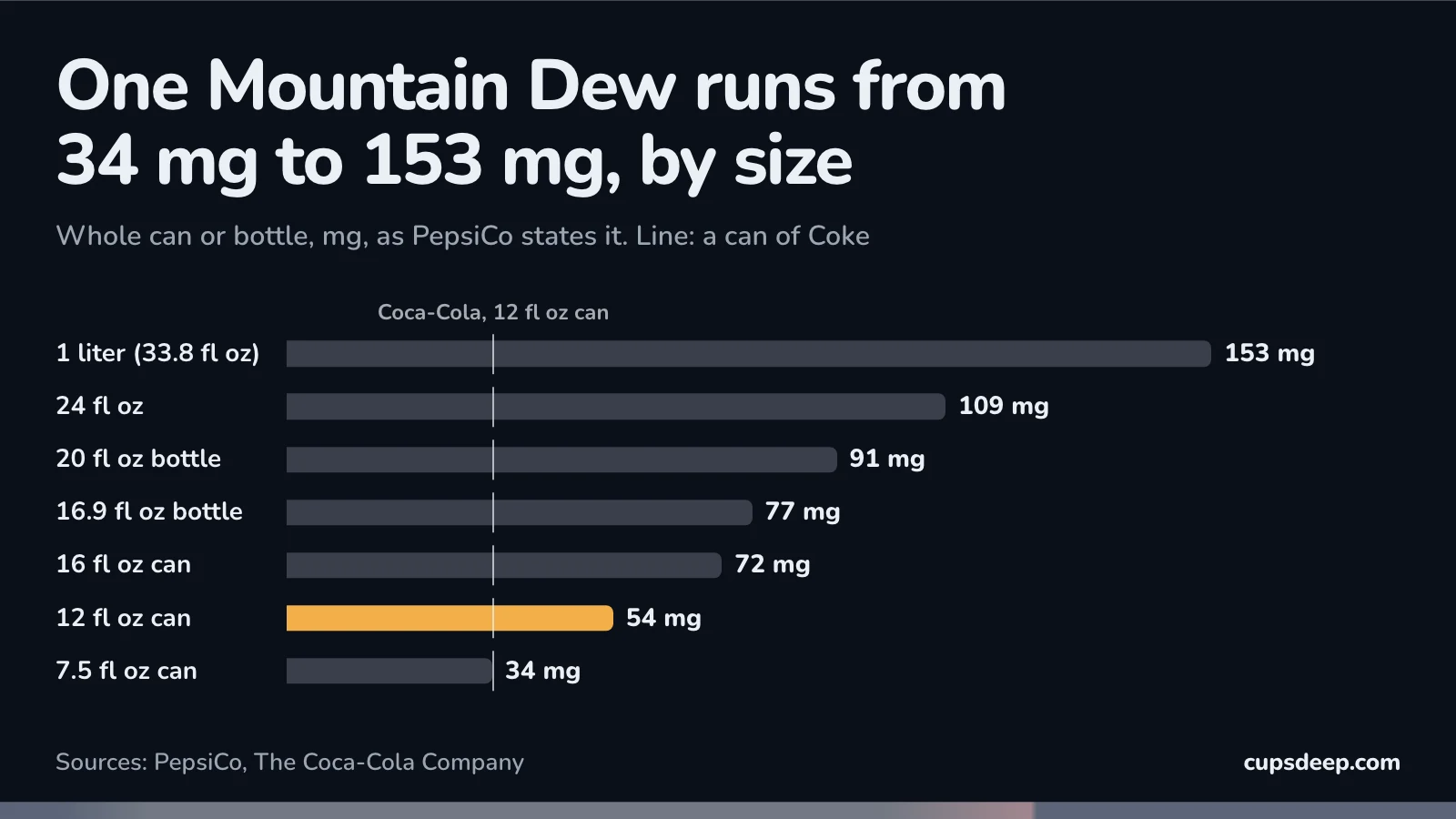
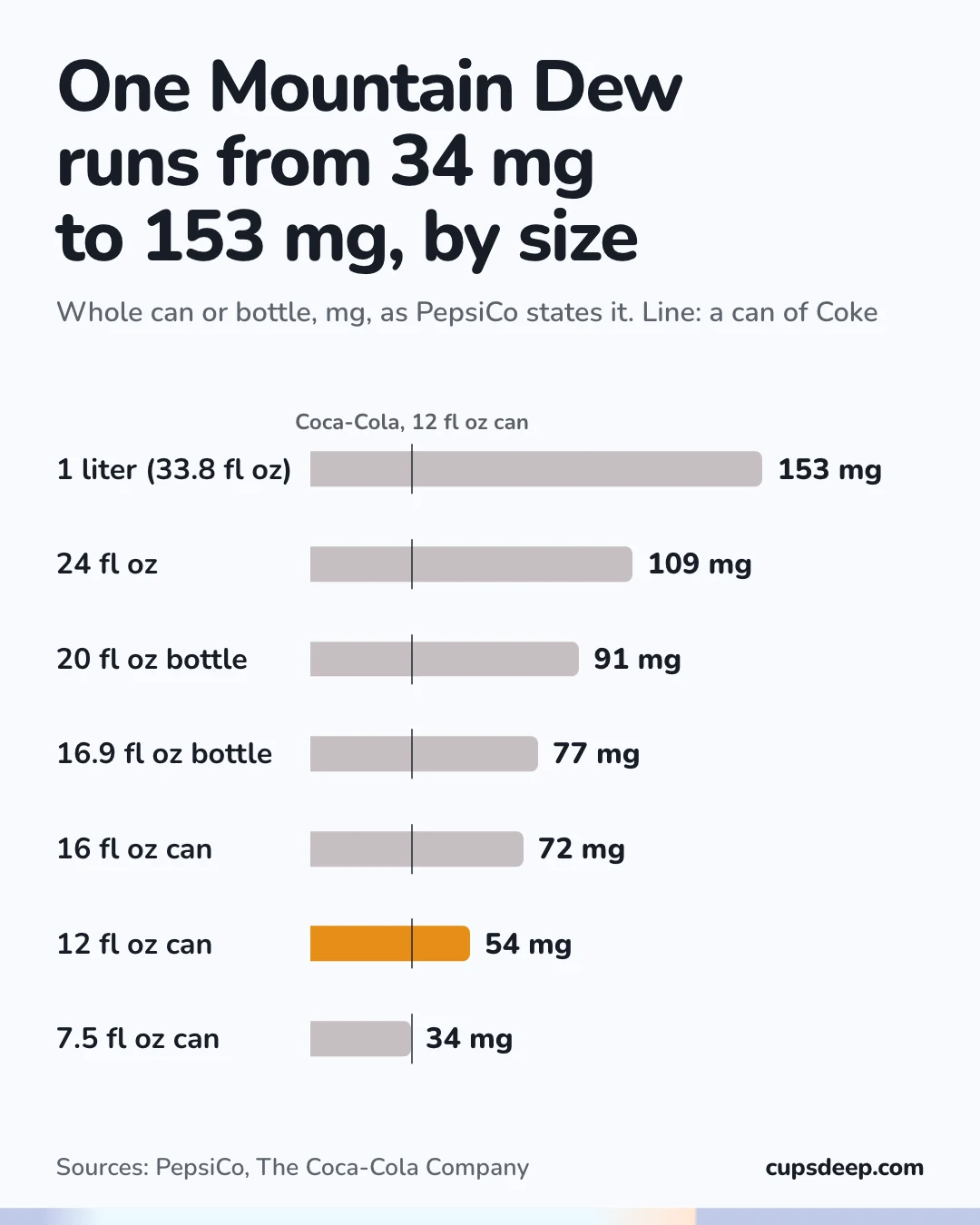
A 20 fl oz bottle is 91 mg. A 16 fl oz can is 72 mg. Every size is the same drink at the same strength, about 4.5 mg per fl oz by our arithmetic, so the number just follows the liquid. The big bottles are where it gets interesting, because PepsiCo’s own pages do not agree with each other.
| Package | Serving the figure is for | Caffeine per serving | Whole can or bottle |
|---|---|---|---|
| 7.5 fl oz can | 1 can | 34 mg | 34 mg |
| 12 fl oz can | 1 can | 54 mg | 54 mg |
| 13 fl oz bottle | 1 bottle | 59 mg | 59 mg |
| 16 fl oz can | 1 can | 72 mg | 72 mg |
| 16.9 fl oz bottle | 1 bottle | 77 mg | 77 mg |
| 20 fl oz bottle | 1 bottle | 91 mg | 91 mg |
| 24 fl oz | 12 fl oz | 54 mg | 109 mg, from the product page |
| 1 liter (33.8 fl oz) | 12 fl oz | 54 mg | 153 mg, from the product page |
| 42.3 fl oz | 12 fl oz | 54 mg | Not stated |
| 2-liter (67 fl oz) | 12 fl oz | 54 mg | Not stated; about 302 mg by our arithmetic |
PepsiCo’s caffeine table labels the 24 fl oz and 33.8 fl oz sizes “(1 can)” at the 12 fl oz figure. Their product pages give that figure per 12 fl oz serving and add a per-container figure, so this table follows the product pages.
So a 1 liter bottle is 153 mg, PepsiCo’s number. For the 2-liter PepsiCo stops at 54 mg per 12 fl oz serving. Nobody drinks a 2-liter in servings, so here is the sum, marked as ours.
Our arithmetic, not PepsiCo’s: PepsiCo states 54 mg of caffeine per 12 fl oz serving of a 67 fl oz (2-liter) bottle of Mountain Dew and prints no figure for the whole bottle. At that strength the whole bottle holds about 302 mg. 237
A two-liter of Mountain Dew is not a bottle. It is how my evening is going to go
Zero Sugar and Baja Blast climb the same way, each from its own stronger start. Zero Sugar goes 68 mg, 90 mg, 95 mg, 113 mg from the 12 fl oz can to the 20 fl oz bottle. Baja Blast goes 37 mg for the mini can, 59 mg for the can, 78 mg for the 16 fl oz bottle and 98 mg for the 20 fl oz. The highest single-package figure for a Mountain Dew soda in PepsiCo’s caffeine table is the 20 fl oz Baja Cabo Citrus Zero Sugar, at 114 mg; the bigger bottles are stated per 12 fl oz.
Does Diet Mountain Dew have caffeine, and why does Zero Sugar have more?
Diet Mountain Dew has exactly as much as the regular, 54 mg a can. Zero Sugar has more, and PepsiCo confirms it. It does not say why.
PepsiCo’s Mountain Dew FAQ says that “Mountain Dew Zero Sugar also includes more caffeine than Diet Mountain Dew”, beside the calorie difference (zero calories per 20 oz against 10). It gives no reason for the caffeine difference. 324
Our arithmetic from PepsiCo’s figures: a 12 fl oz can of Mountain Dew Zero Sugar (68 mg) has 14 mg more caffeine than a can of Mountain Dew or Diet Mountain Dew (54 mg each), about 26% more. In a 20 fl oz bottle the gap is 22 mg: 113 mg against 91 mg. 237134132133
Every reason you will read for it elsewhere, from masking the sweetener to chasing energy drink buyers, is somebody’s guess. We looked for PepsiCo saying anything more and found only the sentence above, so the gap stays a fact without a motive. What it means in practice: if you switched from Diet to Zero Sugar for the taste, you also switched to a stronger drink, and the can does not shout about it.
They took the sugar out of Mountain Dew Zero and put the caffeine back with interest
Going sugar-free moves caffeine differently from brand to brand. Coke to Coke Zero is flat; Coke to Diet Coke goes up; Pepsi to Diet Pepsi goes down. Of the sodas we hold, Mountain Dew is the only one where the diet version stays put and the zero version climbs. The cola side is in the Coke Zero article.
Is there a caffeine-free Mountain Dew? Yes, one, and it is a diet drink. We found no regular, sugared Mountain Dew without caffeine on PepsiCo’s US product facts site.
PepsiCo’s US product facts site lists Diet Mountain Dew Caffeine Free at 0 mg of caffeine for one bottle, in 12, 16 and 67 fl oz sizes. It was the only Mountain Dew returned by the site’s search for “caffeine free”. PepsiCo’s Mountain Dew FAQ says that “Caffeine-free Mountain Dew products are available in certain regions.” 323324
Diet Mountain Dew Caffeine Free is for people who want the color and none of the consequences
“Certain regions” is doing a lot of work in that answer, so check the shelf, and check the words on the can: the name says Caffeine Free, and a Diet Mountain Dew without those words has the same caffeine as the regular one. Other sodas that skip caffeine entirely are in sodas without caffeine.
How much caffeine is in Baja Blast, from the can or the fountain?
A 12 fl oz can of Baja Blast is 59 mg, a little more than regular Dew. Poured from a fountain, PepsiCo states 54 mg per 12 fl oz. The Freeze, the slush, is 36 mg. The same drink name, three figures, depending on how it reaches you.
| Drink | Can | Fountain | Freeze |
|---|---|---|---|
| Mountain Dew | 54 mg | 52 mg | 30 mg |
| Mountain Dew Zero Sugar | 68 mg | 69 mg | Not listed |
| Diet Mountain Dew | 54 mg | 54 mg | Not listed |
| Baja Blast | 59 mg | 54 mg | 36 mg |
| Baja Blast Zero Sugar | 68 mg | 54 mg | Not listed |
| Voltage | 55 mg | 54 mg | 30 mg |
PepsiCo states fountain and Freeze figures per 12 fl oz serving. A large cup holds several of those. PepsiCo gives no reason for the gaps between can and fountain.
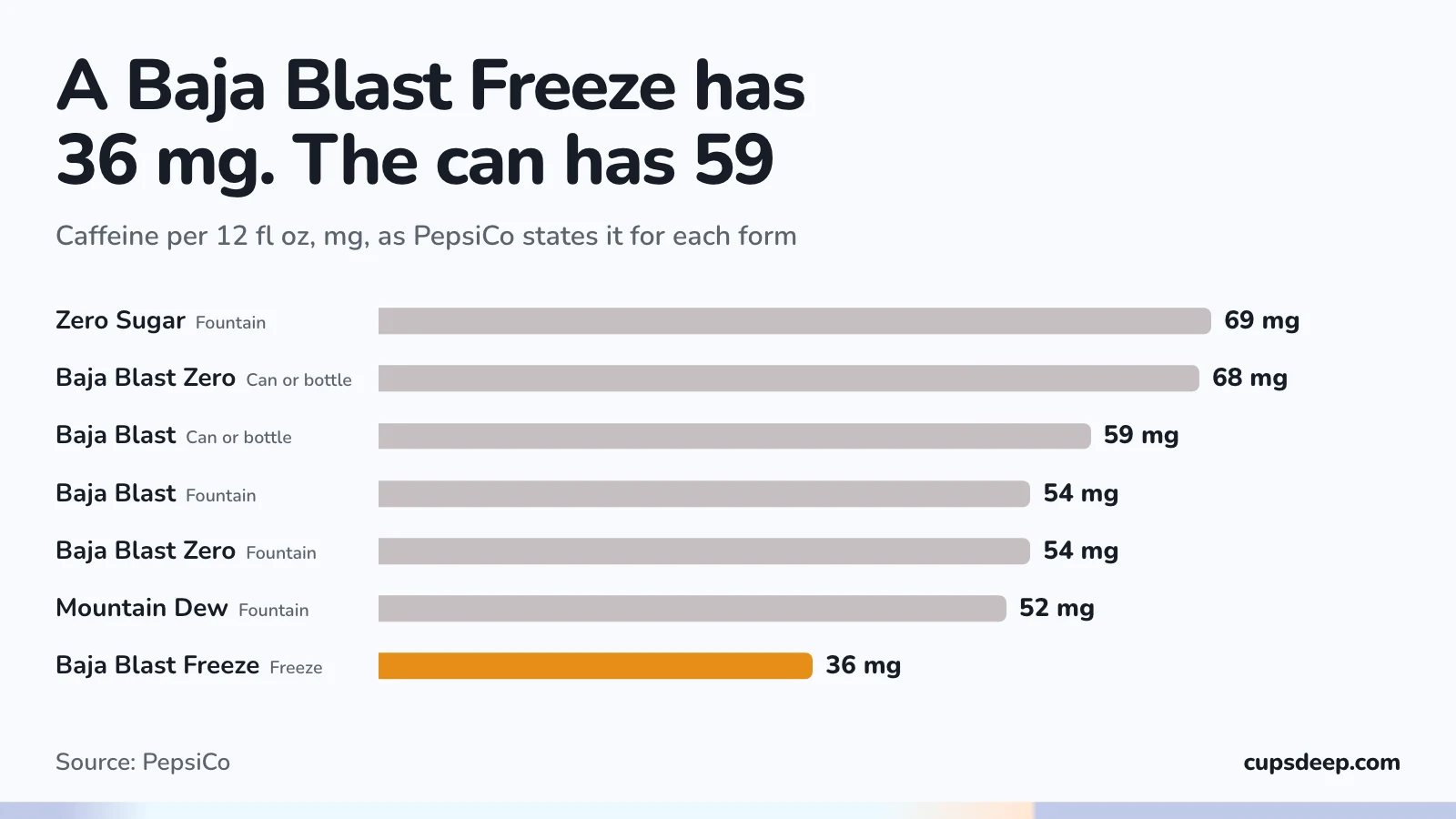
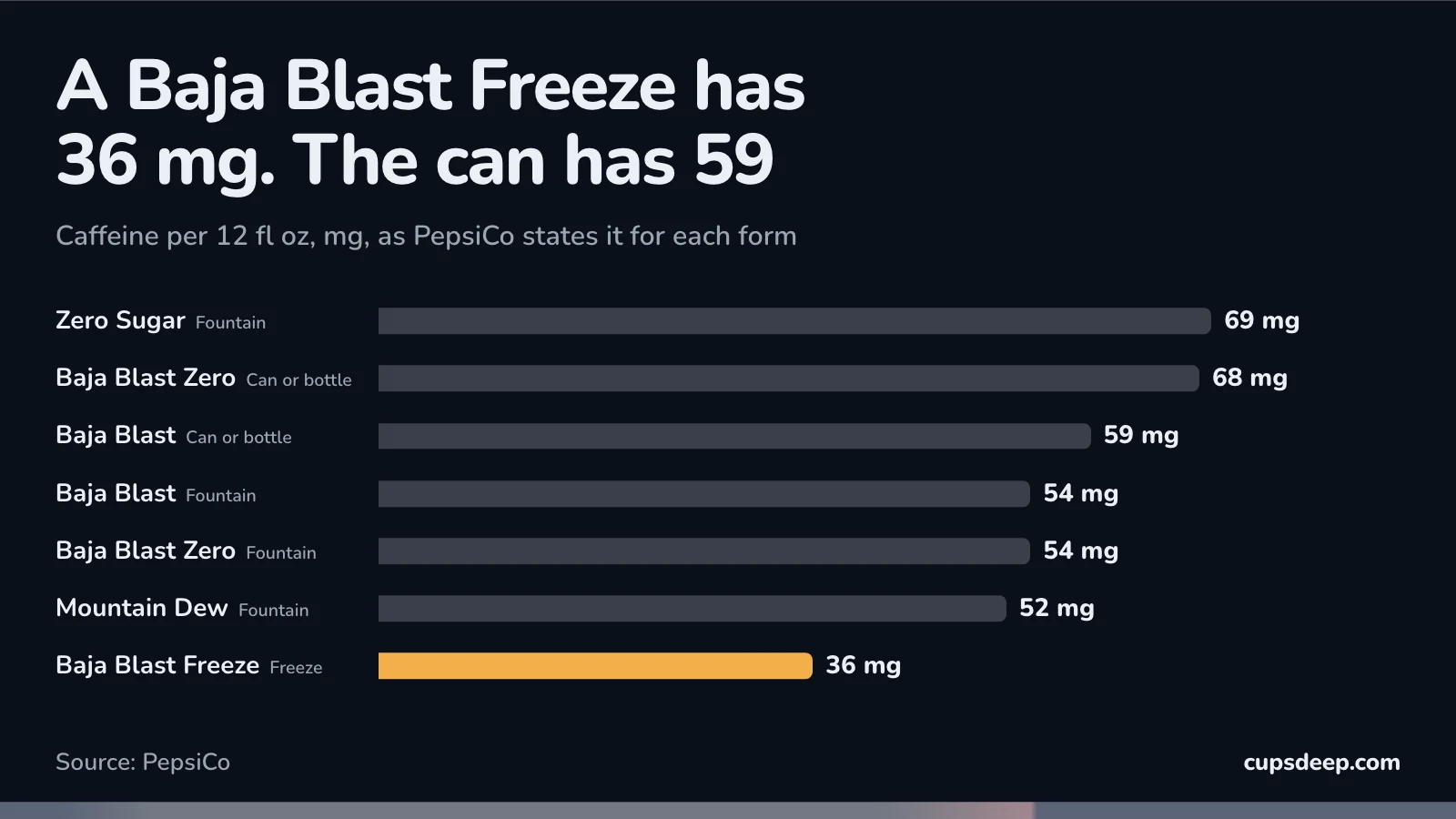
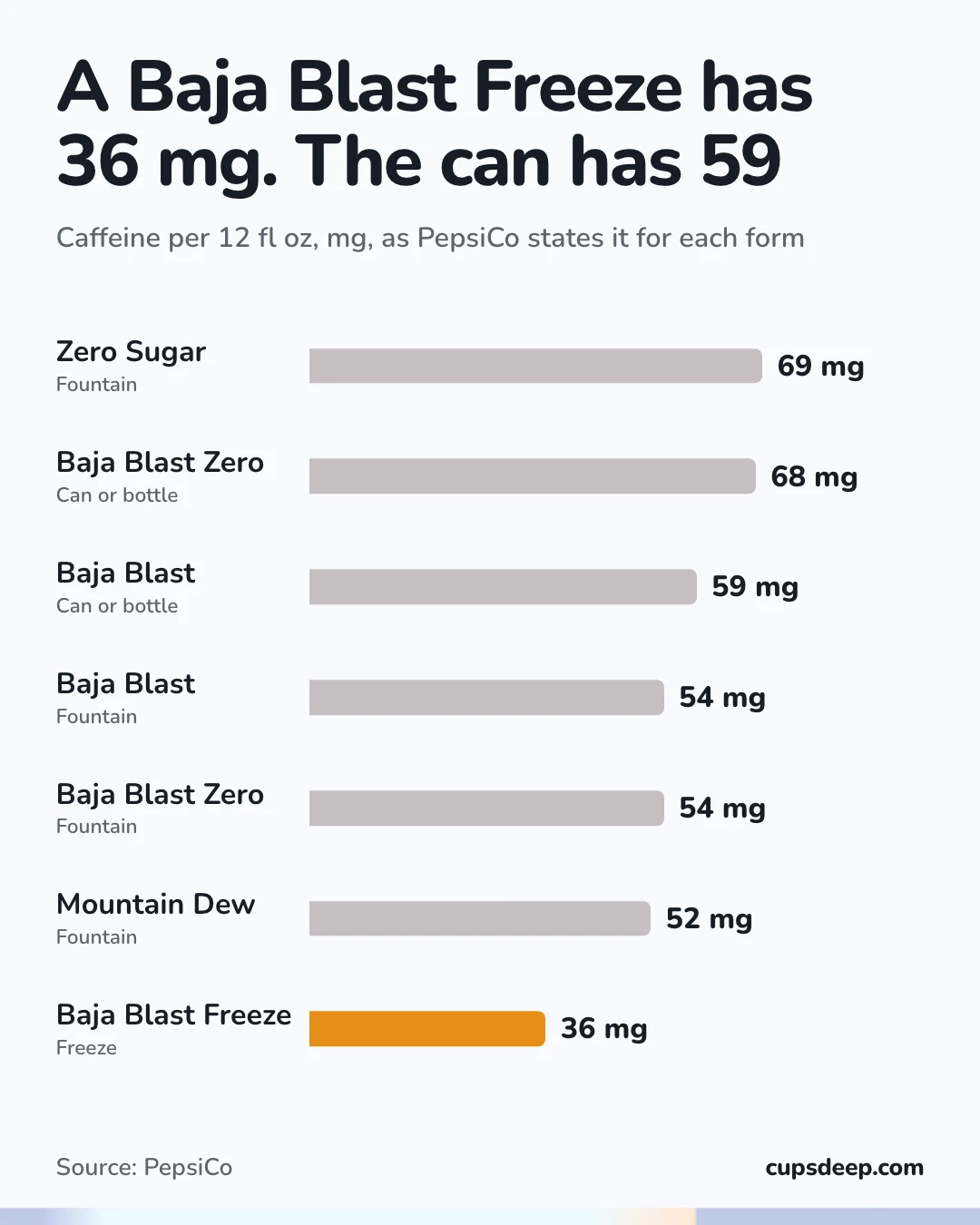
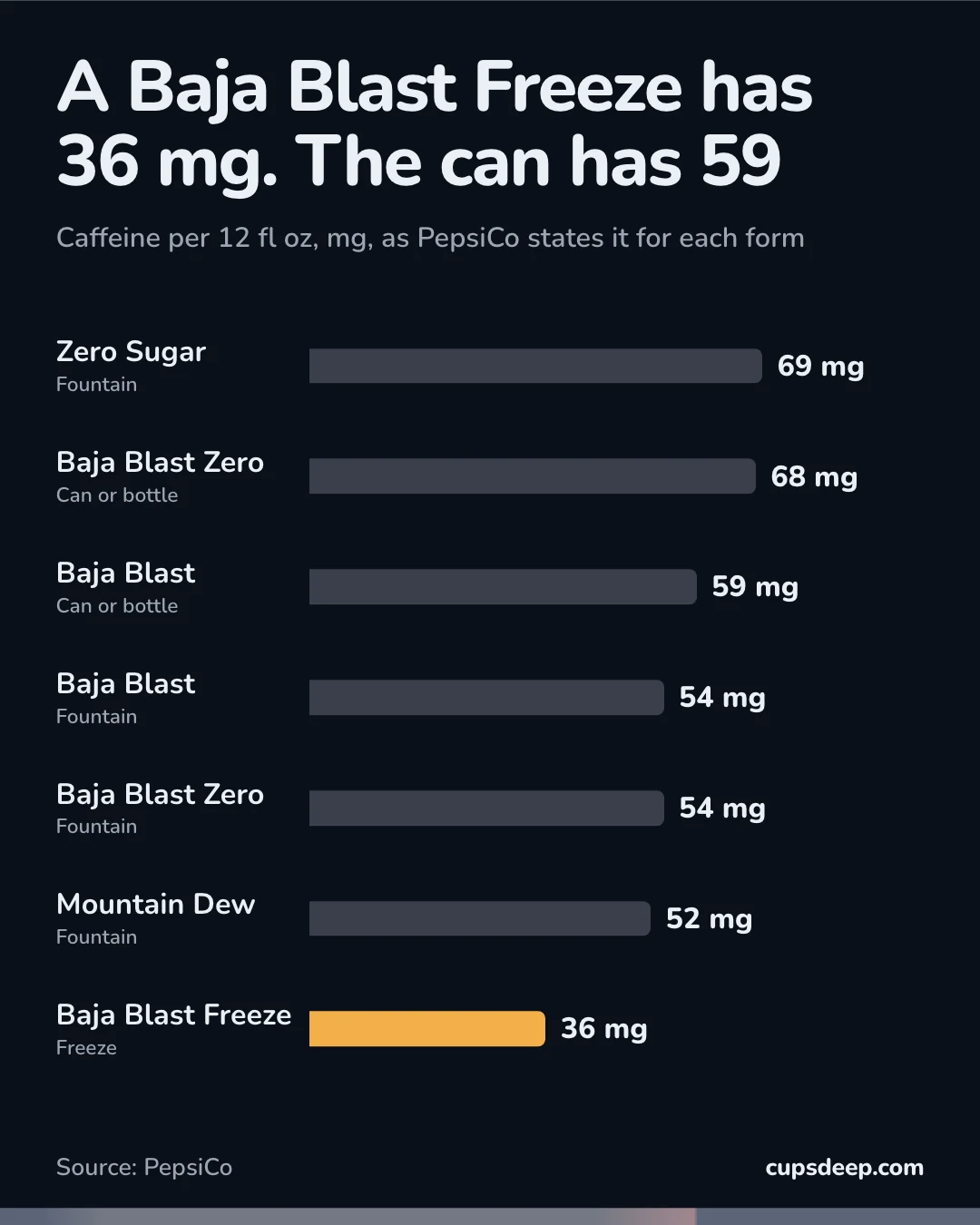
The biggest gap between can and fountain is Baja Blast Zero Sugar: 68 mg in the can, 54 mg from the fountain. Zero Sugar goes the other way, one milligram higher at the fountain. Every Freeze in the table sits well below the soda it is named after. A Freeze is partly ice, which would explain some of it, but PepsiCo does not say, so neither do we. And all of this is per 12 fl oz: a 30 oz fountain cup is two and a half of those servings before the refill.
How much caffeine is in Mtn Dew Kickstart and AMP?
Kickstart sits level with Zero Sugar or a milligram above it. The 12 fl oz cans are 68 mg or 69 mg; most of the 16 fl oz Kickstarts are stated per 8 fl oz serving, and the product pages give the whole package as 90 mg to 92 mg. AMP Energy is an energy drink with the Dew name on it, and its numbers say so.
| Drink | Package | Serving the figure is for | Caffeine per serving | Whole can or bottle |
|---|---|---|---|---|
| AMP Energy Cherry Blast | 16 fl oz can | 1 can | 160 mg | 160 mg |
| AMP Energy Original | 16 fl oz can | 1 can | 142 mg | 142 mg |
| Kickstart Black Cherry | 16 fl oz | 8 fl oz | 46 mg | 92 mg |
| Kickstart Fruit Punch | 16 fl oz | 8 fl oz | 46 mg | 92 mg |
| Kickstart Orange Citrus | 16 fl oz | 8 fl oz | 46 mg | 92 mg |
| Kickstart Grape | 16 fl oz | 8 fl oz | 45 mg | 90 mg |
| Kickstart Pineapple Orange Mango | 16 fl oz | 8 fl oz | 45 mg | 90 mg |
| Kickstart Strawberry Start-up | 16 fl oz | 16 fl oz | 90 mg | 90 mg |
| Kickstart Orange Citrus, fountain | Fountain | 12 fl oz | 69 mg | None stated |
The 16 fl oz Kickstart cans are stated per 8 fl oz serving in PepsiCo’s caffeine table; the whole-can figures are from each product page. Strawberry Start-up is stated for the whole 16 fl oz.
AMP Cherry Blast, at 160 mg, matches a 16 fl oz green Monster (160 mg). Which energy drink has the most caffeine ranks the rest of that aisle.
What about Mtn Dew Energy, Mtn Dew Rise and Game Fuel? You will find confident milligram figures for all three online. None of them is in PepsiCo’s current US caffeine table, and the product facts site’s search returns nothing for “rise” or “game fuel”. We found no maker page with a figure, so we print none. If you have a can, the number on it is the only one worth reading.
Does Mountain Dew have more caffeine than Coke, Pepsi or coffee?
More than the colas, less than a coffee. Per 12 fl oz, Mountain Dew at 54 mg beats Coca-Cola (34 mg), Pepsi (38 mg) and Dr Pepper (about 41 mg). Zero Sugar, at 68 mg, is the highest 12 fl oz figure in our whole soda table, above Mr. Pibb and poppi Alpine Blast. FDA gives 23–83 mg for a caffeinated soft drink in that serving, so Zero Sugar sits near the top of it.
| Soda | Maker | Caffeine in 12 fl oz |
|---|---|---|
| Mountain Dew Zero Sugar | PepsiCo | 68 mg |
| poppi Alpine Blast | PepsiCo | 55 mg |
| Mountain Dew | PepsiCo | 54 mg |
| Diet Mountain Dew | PepsiCo | 54 mg |
| Mr. Pibb | Coca-Cola | 54 mg |
| Diet Coke | Coca-Cola | 46 mg |
| Dr Pepper | Keurig Dr Pepper | About 41 mg |
| Pepsi | PepsiCo | 38 mg |
| Coca-Cola | Coca-Cola | 34 mg |
Keurig Dr Pepper states its figure as approximate. Every soda we hold, by the same rule, is in the Coke Zero article and the Dr Pepper article.
Against coffee the can is small. A 200 ml filter coffee is about 80 mg, more than a can of Dew and a bit less than a 20 fl oz bottle. A Starbucks US grande brewed coffee states 315 mg to 390 mg, against 72 mg for a 16 fl oz can of Dew, the same amount of liquid. The rest are on the drinks page.
Is there a legal limit on how much caffeine Mountain Dew can have? Not one that was written for it. Pages that put Mountain Dew just under an FDA ceiling are reading a rule about colas.
The US rule that names caffeine, 21 CFR 182.1180, lists it as generally recognized as safe “when used in cola-type beverages”, with a tolerance of 0.02 percent. The part it belongs to says, in 21 CFR 182.1(a), that “It is impracticable to list all substances that are generally recognized as safe for their intended use.” On our reading, because the list is not exhaustive, the cola rule neither sets a limit for a drink that is not a cola nor rules one out. 142325
Mountain Dew is not a cola, so on our reading that 0.02% figure simply is not about it. Converting it to milligrams and holding a can of Dew up against it, as some pages do, measures the Dew against a rule for a different drink.
Canada is plainer, because its rule names sodas that are not colas.
In Canada, caffeine may be added to carbonated soft drinks other than colas as a food additive at up to 150 ppm. Since January 1, 2026 the same 150 ppm applies to colas, down from 200 ppm. Above 150 ppm and up to 400 ppm, Health Canada regulates the caffeine as a supplemental ingredient under its supplemented foods rules. 326
Our arithmetic, not Health Canada’s: 150 ppm is about 150 mg per liter for a drink of about 1 g per ml, or about 53 mg in 12 fl oz (355 ml). On that reading a US can of Mountain Dew (54 mg) is about 152 ppm and a US can of Mountain Dew Zero Sugar (68 mg) about 192 ppm. We did not find what Canadian Mountain Dew contains. 326132134
By that arithmetic both US cans reach the line: regular Dew at about 152 ppm, within the rounding of our conversion, and Zero Sugar at about 192 ppm, clearly past it. Past 150 ppm Canada regulates the caffeine as a supplemental ingredient, up to 400 ppm, under its own rules. We did not find PepsiCo stating a figure for Mountain Dew sold in Canada, so we do not print one.
How many Mountain Dews a day is too much caffeine?
EFSA concludes that caffeine intakes up to 400 mg a day from all sources, spread through the day, do not raise safety concerns for healthy adults, except pregnant women. FDA cites 400 mg a day for most adults as an amount not generally associated with negative effects, and notes wide variation in how sensitive people are to caffeine and how fast they eliminate it. 225
Our arithmetic against the 400 mg a day that EFSA and FDA cite for healthy adults who are not pregnant: about 7.4 cans of Mountain Dew (54 mg), 5.9 cans of Mountain Dew Zero Sugar (68 mg) or 4.4 bottles of 20 fl oz Mountain Dew (91 mg), counting no other caffeine. Two 20 fl oz bottles, the amount PepsiCo’s FAQ uses to describe moderate intake, come to 182 mg. 225237324
PepsiCo’s Mountain Dew FAQ says moderate amounts of caffeine “are most often defined as the amount of caffeine that would be consumed daily in two 8-ounce cups of home-brewed coffee, two 20-ounce bottles of caffeinated soda, or a 16-ounce energy drink.” It names no regulator for that definition. 324
By that measure two 20 fl oz bottles, 182 mg, count as moderate in PepsiCo’s own words, and a 2-liter on its own, about 302 mg by our sum, is most of the 400 mg/day before anything else you drink that day. For one sitting, EFSA’s figure is 200 mg; a 20 fl oz Zero Sugar is 113 mg.
The better question is when. Caffeine’s half-life in healthy adults averages 4 hours and runs from 2 hours to 8 hours, so the bottle with dinner is still around when the lights go out. How long caffeine stays in your system has the arithmetic, and the method page shows how the instrument draws it.
A single 100 mg dose of caffeine, about 1.4 mg/kg body weight for a 70 kg adult, may increase the time it takes to fall asleep and reduce sleep duration in some adults, particularly when taken close to bedtime. 2223
Questions people ask
How much caffeine is in a 20 oz Mountain Dew?
PepsiCo states 91 mg for a 20 fl oz bottle of Mountain Dew, and the same for Diet Mountain Dew. A 20 fl oz Mountain Dew Zero Sugar is 113 mg.
Does Diet Mountain Dew have caffeine?
Yes, the same as regular: PepsiCo states 54 mg for a 12 fl oz can. Diet Mountain Dew Caffeine Free is the version with none, at 0 mg by PepsiCo’s figure.
Does Mountain Dew Zero Sugar have more caffeine than regular Mountain Dew?
Yes. PepsiCo states 68 mg for a 12 fl oz can of Zero Sugar against 54 mg for regular and Diet. PepsiCo confirms Zero Sugar has more caffeine than Diet and gives no reason.
How much caffeine is in Baja Blast?
PepsiCo states 59 mg for a 12 fl oz can of Baja Blast, 54 mg per 12 fl oz from the fountain and 36 mg per 12 fl oz for the Baja Blast Freeze.
Sources
Every number above links to the place it came from. How the numbers are chosen and checked is on the method page; the drink table is at /drinks. Written with AI agents, as the whole site is. A model of a typical body, not advice for pregnancy, illness or medication.
- Development of a Caffeine Content Table for Foods, Drinks, Medications and Supplements Typically Consumed by the Brazilian Population (BraCaffT)
- What is caffeine?
- Coca-Cola (US), 12 fluid ounce can: SmartLabel nutrition facts
- Spilling the Beans: How Much Caffeine is Too Much?
- Monster Energy Original Green
- Pepsi - 12 fl oz (PepsiCo Product Facts)
- Beverages, coffee, brewed, prepared with tap water
- Scientific Opinion on the safety of caffeine
- EFSA explains risk assessment: Caffeine
- Medium Roast - Pike Place Roast: nutrition (starbucks.com, United States)
- Diet Coke - Flavors, Nutrition Facts, Caffeine & More (US)
- Mountain Dew - 12 fl oz (PepsiCo Product Facts)
- Diet Mountain Dew - 12 fl oz (PepsiCo Product Facts)
- Mountain Dew Zero Sugar - 12 fl oz (PepsiCo Product Facts)
- Dr Pepper 12 fl oz - Keurig Dr Pepper Product Facts
- 21 CFR 182.1180 Caffeine
- Caffeine content of prepackaged national-brand and private-label carbonated beverages
- Mr. Pibb - Varieties & Nutrition Facts (US)
- Caffeine - PepsiCo Product Facts
- Mountain Dew, 24 fl oz (PepsiCo Product Facts)
- Mountain Dew, 33.8 fl oz (PepsiCo Product Facts)
- Diet Mountain Dew Caffeine Free (PepsiCo Product Facts)
- FAQ (Mountain Dew)
- 21 CFR 182.1 Substances that are generally recognized as safe
- Modification to the List of Permitted Food Additives with Other Purposes of Use to revise the use of caffeine and caffeine citrate (M-FAA-25-07)
- Mtn Dew Kickstart - Black Cherry, 16 fl oz (PepsiCo Product Facts)
- Mtn Dew Kickstart - Fruit Punch, 16 fl oz (PepsiCo Product Facts)
- Mtn Dew Kickstart - Grape, 16 fl oz (PepsiCo Product Facts)
- Mtn Dew Kickstart - Orange Citrus, 16 fl oz (PepsiCo Product Facts)
- Mtn Dew Kickstart - Pineapple Orange Mango, 16 fl oz (PepsiCo Product Facts)
Keep reading
Cans
Does Coke Zero have caffeine?
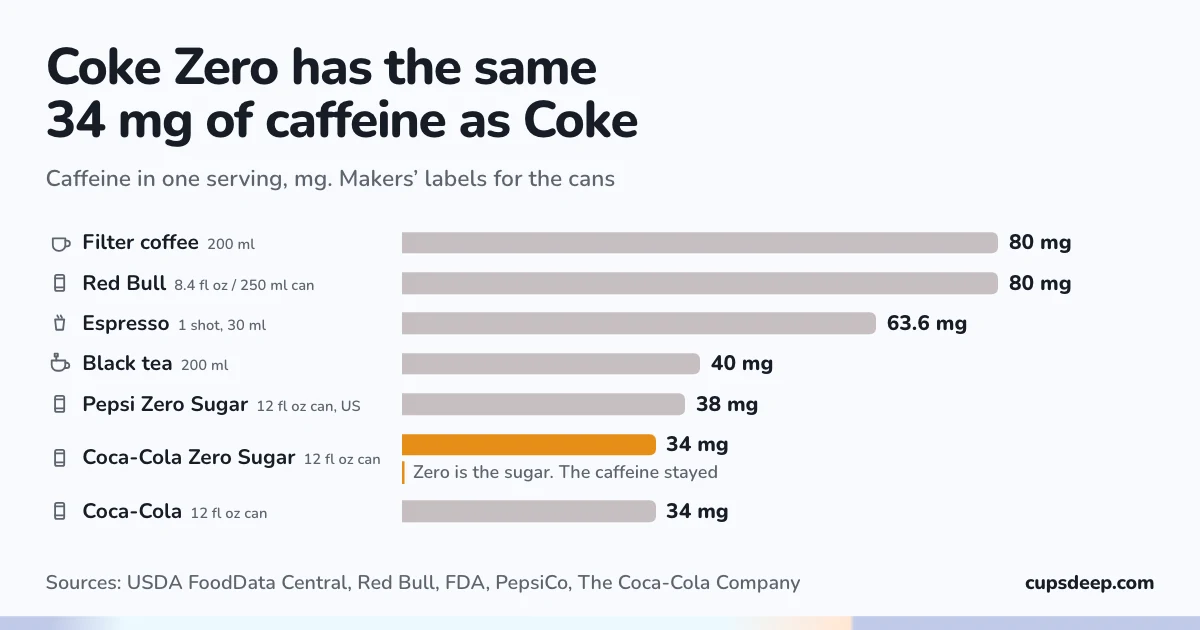
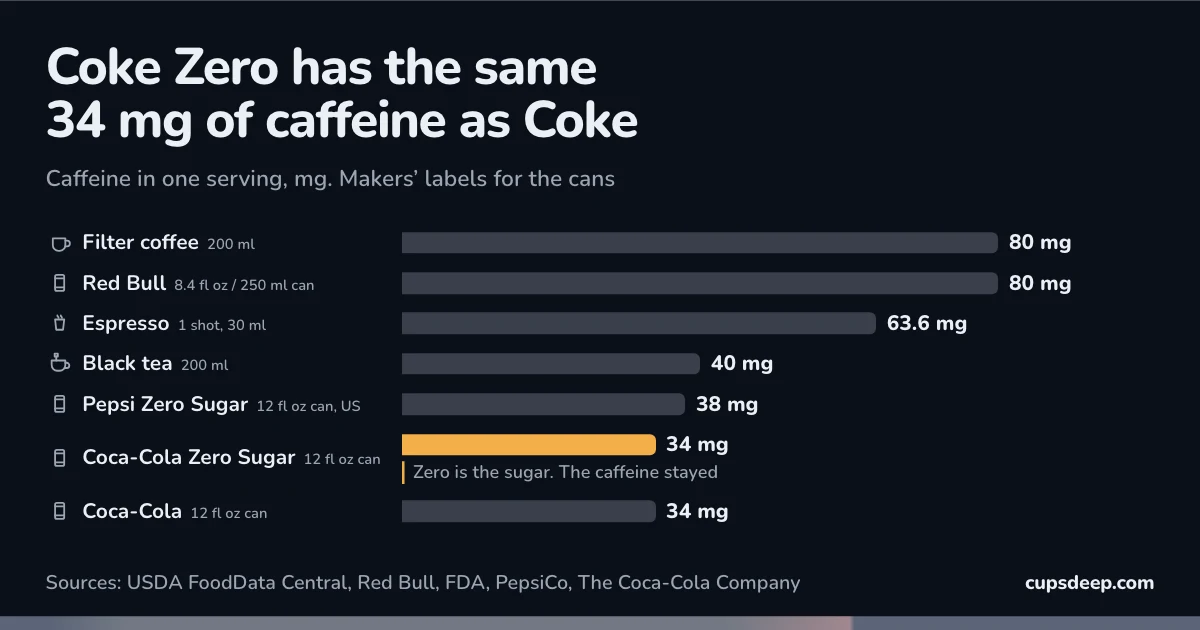
Yes. A 12 fl oz can of Coke Zero has 34 mg of caffeine, the same as regular Coke. Diet Coke has 46 mg. Every soda, by its maker.
Cans
Does Dr Pepper have caffeine?
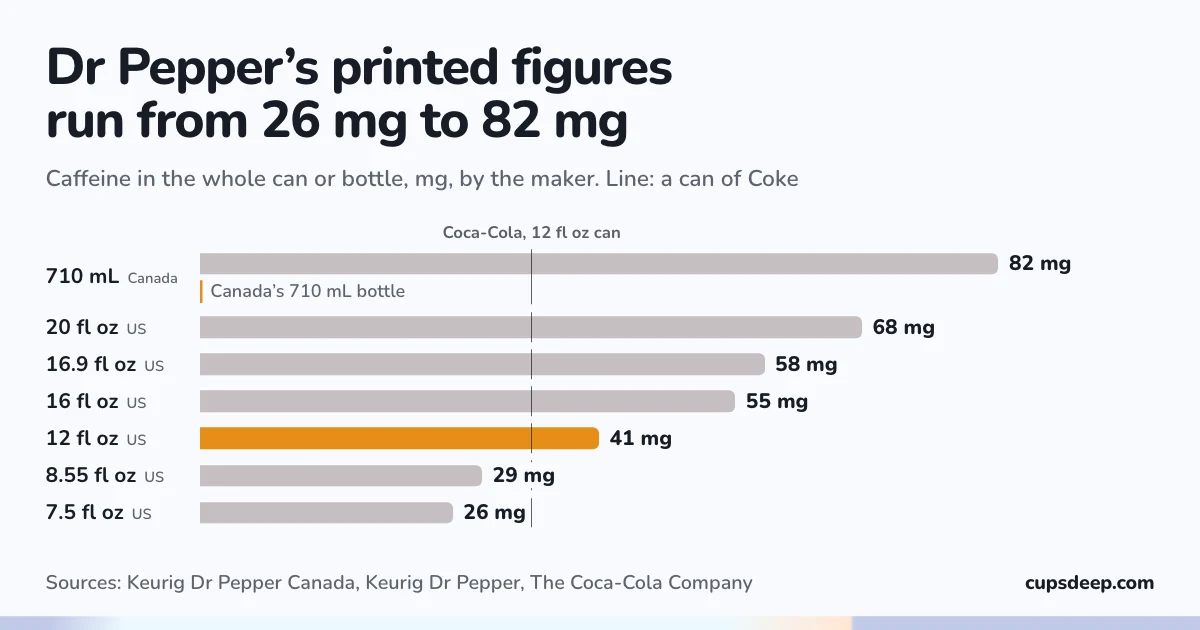
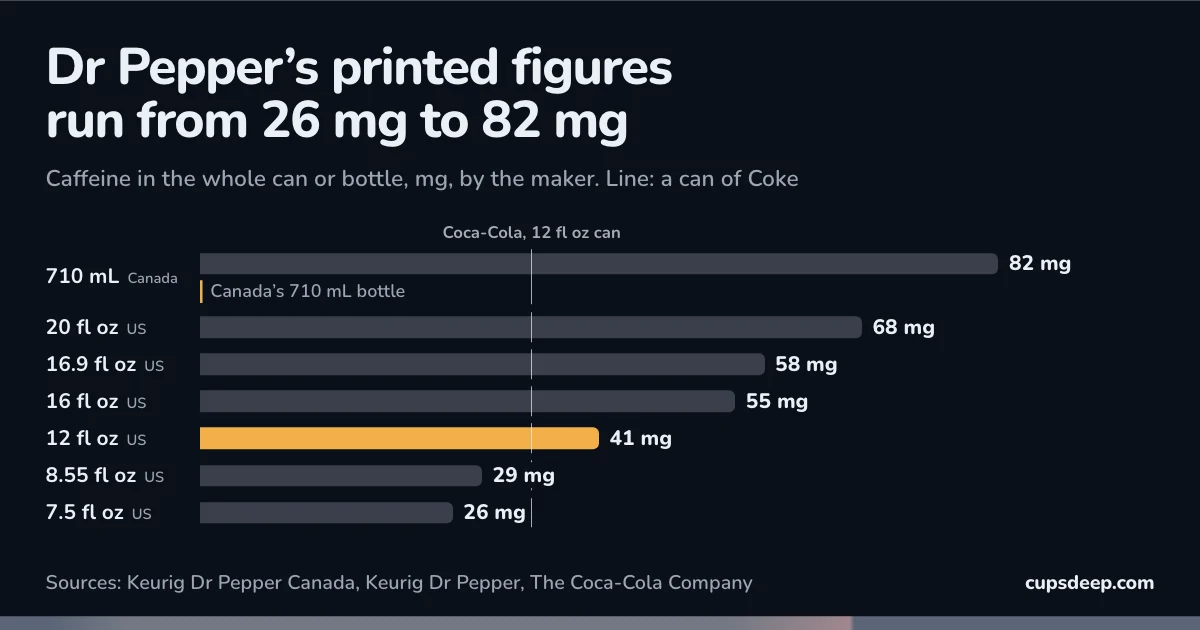
Yes: about 41 mg in a 12 fl oz can of Dr Pepper and 68 mg in a 20 fl oz bottle. Diet, Zero Sugar, the flavors and the 2 liter, by the maker.

Cans
Which energy drink has the most caffeine?
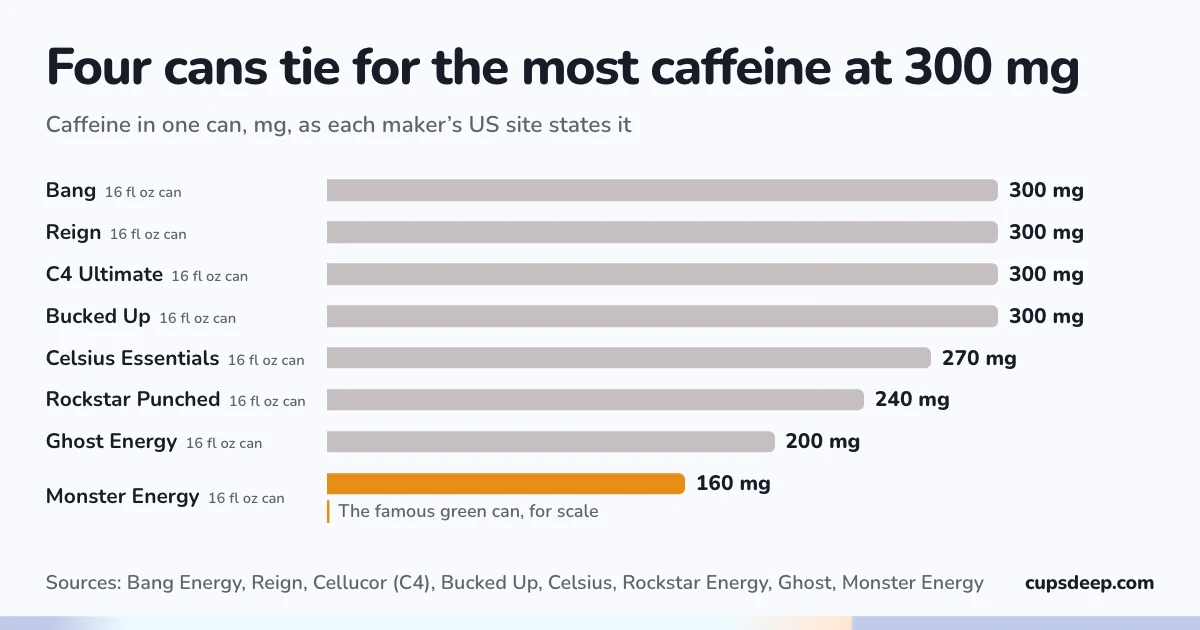
Four US cans tie at 300 mg in 16 fl oz: Bang, Reign, C4 Ultimate and Bucked Up. Per fl oz, Killer Brew wins. Each can by its maker, plus the legal caps.