Does chocolate have caffeine?
It does, and the bar is the least interesting part. The darker chocolate is not always the stronger one, a brownie gets three different answers from three serious sources, and the coffee ice cream in your freezer has no number from USDA or its maker. Here is what USDA measured, what the makers will and will not say, and what a bar after dinner looks like next to a coffee.
The short answer
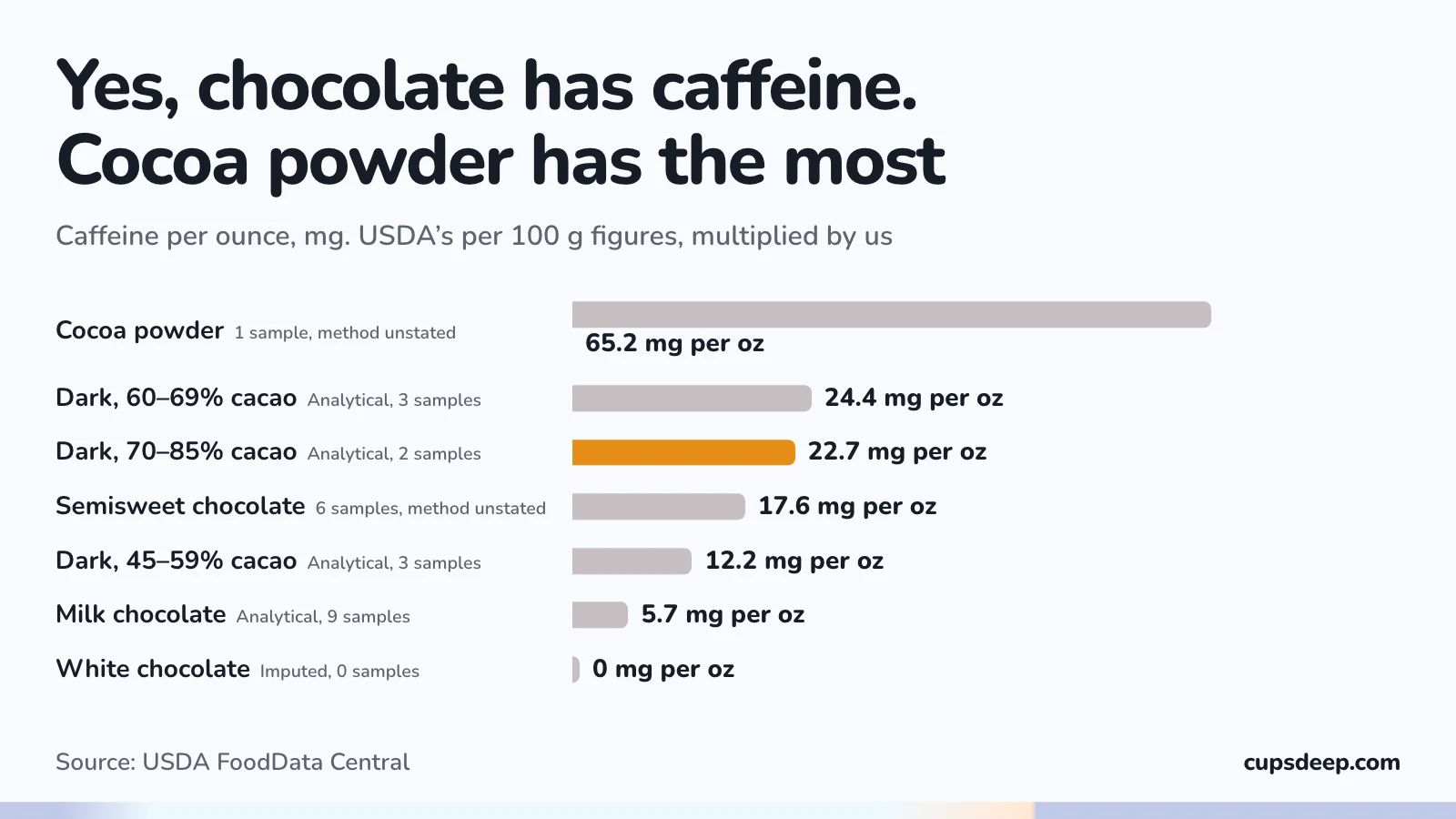
Yes. By USDA’s figures, dark chocolate of 70–85% cacao has caffeine at about 22.7 mg per oz, and milk chocolate about 5.7 mg per oz; white chocolate has 0 mg per 100 g by USDA’s estimate, which is not a measurement. A whole 101 g bar of that dark chocolate comes to about 80.8 mg, close to a 200 ml filter coffee at 80 mg. The per-ounce and per-bar figures are our arithmetic from USDA’s figures per hundred grams.

How much caffeine is in chocolate?
It comes from the cocoa bean, Hershey says, and in USDA’s table it broadly follows the cocoa. Cocoa powder is the most concentrated thing on the list, dark chocolate is next, milk chocolate has a fraction of it and white chocolate has none by USDA’s estimate.
The numbers below come from USDA’s food composition tables, which give caffeine per hundred grams. We multiplied each one out to an ounce and to a portion USDA itself names, so you can compare a bar with a bar. Read the second column before the others: some of these rest on a handful of samples, and some are estimates from an ingredient list.
| Chocolate | USDA’s basis | Caffeine per hundred grams | Per ounce (our arithmetic) | USDA portion | In that portion (our arithmetic) |
|---|---|---|---|---|---|
| Cocoa powder, unsweetened | 1 sample, method unstated | 230 mg per 100 g | 65.2 mg per oz | 1 tbsp, 5.4 g | 12.4 mg |
| Cocoa powder, Dutch-process | 1 sample, method unstated | 78 mg per 100 g | 22.1 mg per oz | 1 tbsp, 5.4 g | 4.2 mg |
| Dark chocolate, 60–69% cacao | Analytical, 3 samples | 86 mg per 100 g | 24.4 mg per oz | 1 bar, 112 g | 96.3 mg |
| Dark chocolate, 70–85% cacao | Analytical, 2 samples | 80 mg per 100 g | 22.7 mg per oz | 1 bar, 101 g | 80.8 mg |
| Semisweet chocolate | 6 samples, method unstated | 62 mg per 100 g | 17.6 mg per oz | 1 cup of chips, 168 g | 104.2 mg |
| Dark chocolate, 45–59% cacao | Analytical, 3 samples | 43 mg per 100 g | 12.2 mg per oz | 1 bar, 162 g | 69.7 mg |
| Milk chocolate | Analytical, 9 samples | 20 mg per 100 g | 5.7 mg per oz | 1 bar (1.55 oz), 44 g | 8.8 mg |
| M&M’s, milk chocolate | Imputed, 0 samples | 14 mg per 100 g | 4 mg per oz | 1 pack (1.69 oz), 48 g | 6.7 mg |
| White chocolate | Imputed, 0 samples | 0 mg per 100 g | 0 mg per oz | 1 bar (3 oz), 85 g | 0 mg |
USDA SR Legacy, last updated 2019. “Analytical” is USDA’s own label where the record states one; “method unstated” means USDA gives a count of samples but no derivation; “Imputed” means USDA estimated the value from the ingredient list, with no sample of its own. An ounce is 28.35 g. Per ounce and per portion are our multiplication, rounded to one decimal.
The cocoa powder figure looks alarming until you remember nobody eats it by the ounce: a tablespoon of the natural kind is about 12.4 mg. The Dutch-process powder, treated with alkali, comes in at 78 mg per 100 g against 230 mg per 100 g, but each figure rests on a single sample, and the same Dutch sample carries more theobromine than the natural one. One sample each is not enough to say that dutching removes caffeine, so we do not.
One more thing the label will not tell you. In the US, caffeine that comes inside an ingredient is not listed as caffeine.
FDA says all packaged foods must list caffeine in the list of ingredients when it is added as a stand-alone ingredient, and that many packaged foods voluntarily state how much caffeine they contain. When a food contains an ingredient that inherently contains caffeine instead, caffeine will not appear in the list of ingredients, but the caffeine-containing ingredient will be listed. 5
Does dark chocolate have more caffeine? Does a higher cacao percent mean more?
More than milk chocolate, yes, by a wide margin. More cacao always meaning more caffeine, no, at least not in USDA’s own numbers.
USDA’s SR Legacy table measures dark chocolate in three bands of cacao solids. At 45–59% it gives 43 mg of caffeine per 100 g, from 3 samples between 40 and 50; at 60–69%, 86 mg from 3 samples between 70 and 100; at 70–85%, 80 mg from 2 samples that were both 80. In these few samples the darkest band is not the highest. 334335336
So the 70–85% band sits at 22.7 mg per oz by our arithmetic, under the 60–69% band at 24.4 mg per oz. That rests on two samples against three, and the 60–69% samples alone spanned 70–100 mg per 100 g. Read it as what it is: in USDA’s few samples, a bar’s percentage does not predict its caffeine to the milligram. Ghirardelli says the amount depends on the type and origin of the cocoa bean.
Lindt, which sells its Excellence bars by cocoa percentage, says it cannot give a figure.
Lindt USA says it is “not able to provide specific data on the content of caffeine in our products”, that chocolates with higher cocoa contents, such as Lindt Excellence 85%, generally contain “if at all, more caffeine” than those with less, and that white chocolate “does not contain any caffeine at all”. 353
Note the words “if at all”. Ghirardelli is braver and gives round numbers: about 20 mg an ounce for dark chocolate and 6 mg for milk, which sit within or near USDA’s range. Health Canada lists sweet chocolate at 19 mg and unsweetened baking chocolate at 25 mg to 58 mg, both per 1 oz (28 g), and names no source for either.
Does white chocolate have caffeine? And milk chocolate?
White chocolate: no, by every source we read, though none of them says it measured it. USDA’s 0 mg per 100 g is imputed from the recipe, with 0 samples. Ghirardelli says white chocolate contains no caffeine, and Lindt says it does not contain any at all.
White chocolate is the decaf of chocolate, and it is every bit as smug about it
Milk chocolate has a little. USDA measured 20 mg per 100 g in 9 samples, all at the same figure, which comes to about 8.8 mg in the 1.55 oz bar USDA uses as its portion, by our arithmetic. The record is generic milk chocolate, not any brand’s, and Hershey itself gives no number.
The Hershey Company’s answer to “How much caffeine is in chocolate?” gives no amount. It says the small amount of caffeine in chocolate occurs naturally in the cocoa bean, unlike the caffeine added to soft drinks. 354
M&M’s are in USDA’s table too, at 14 mg per 100 g, or about 6.7 mg for a 1.69 oz pack. That one is imputed as well, estimated from the ingredient list and the manufacturer’s data rather than measured. Health Canada gives milk chocolate candy 7 mg per 1 oz (28 g).
Does hot chocolate have caffeine? How much is in a Starbucks hot chocolate?
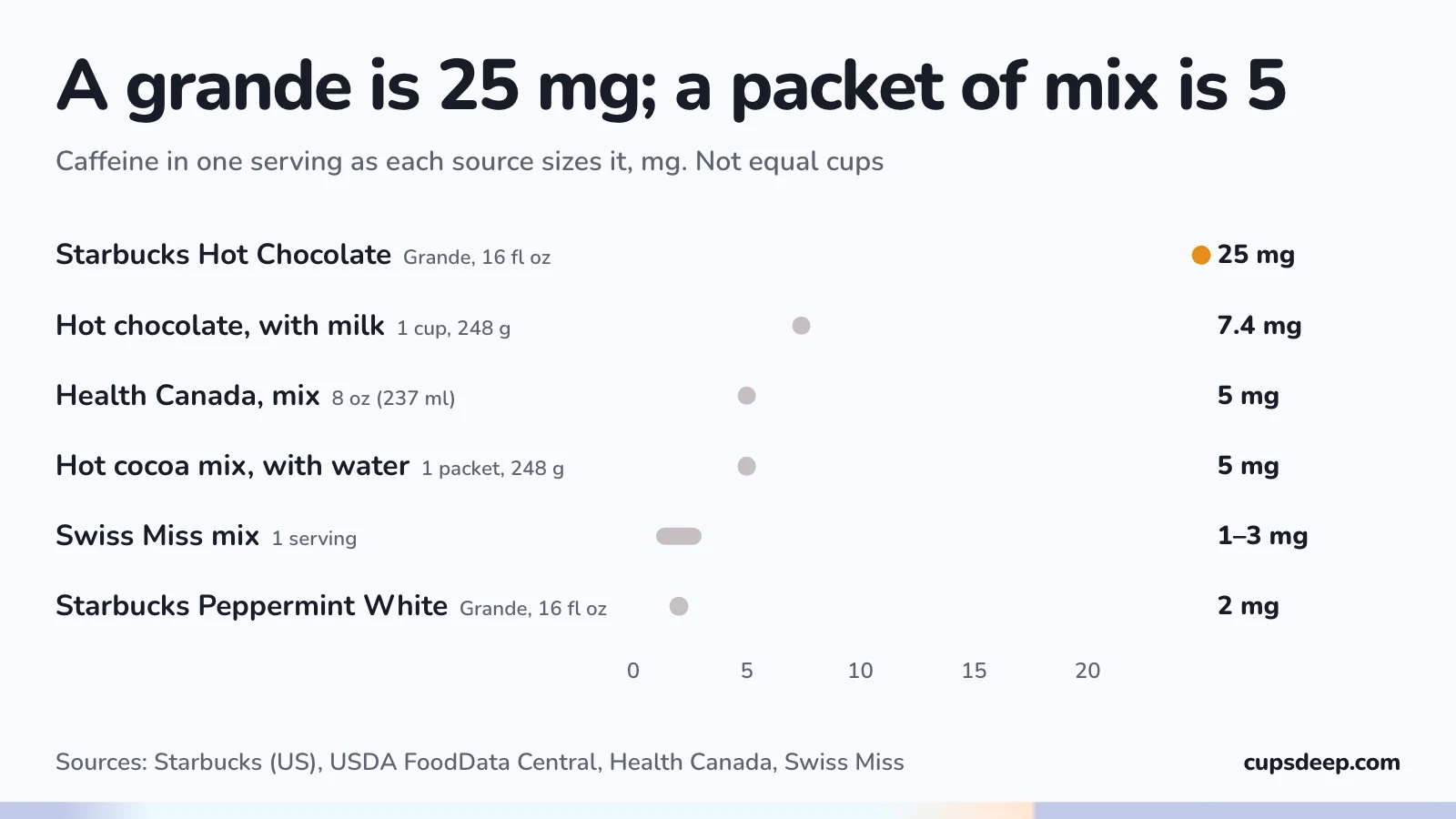
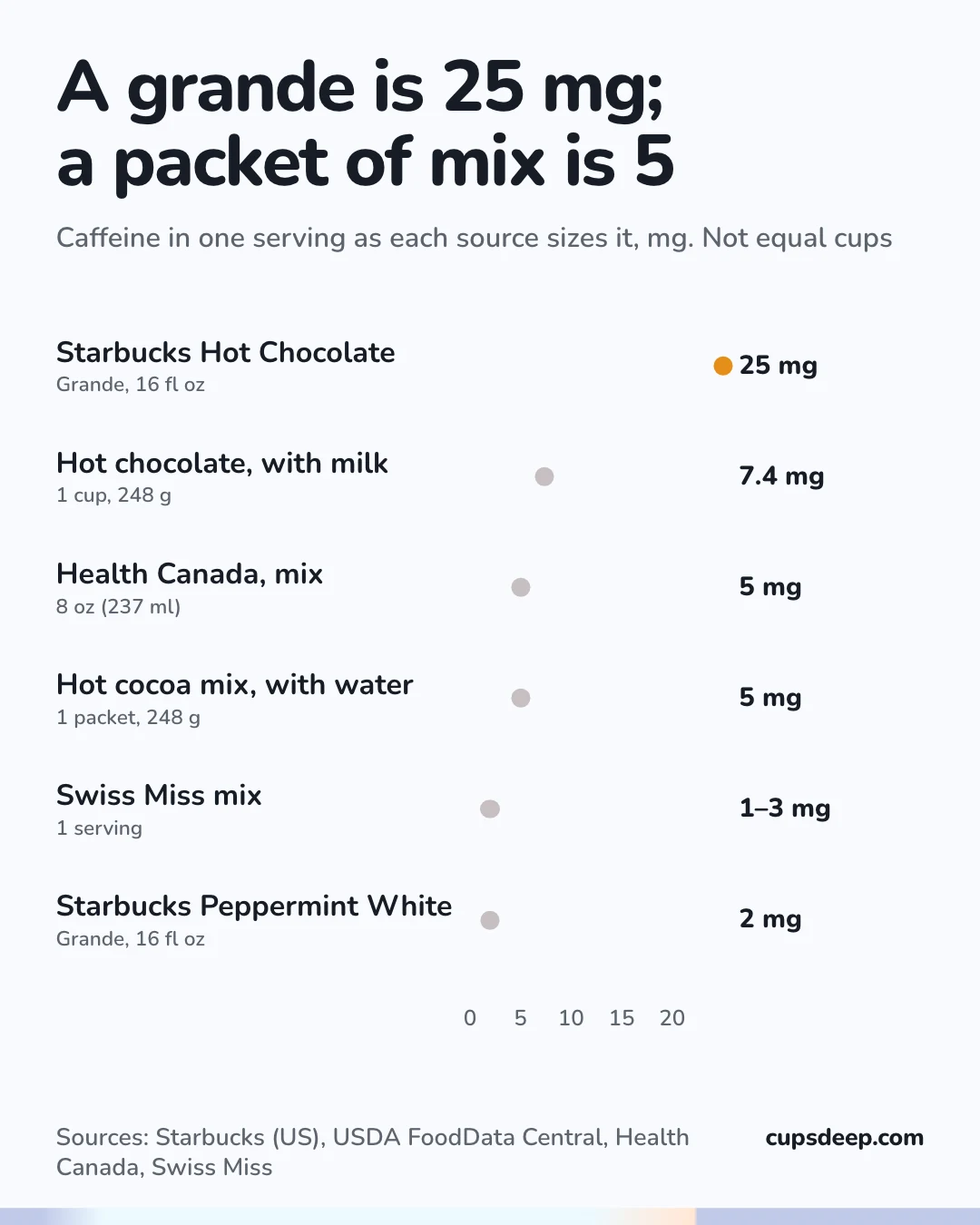
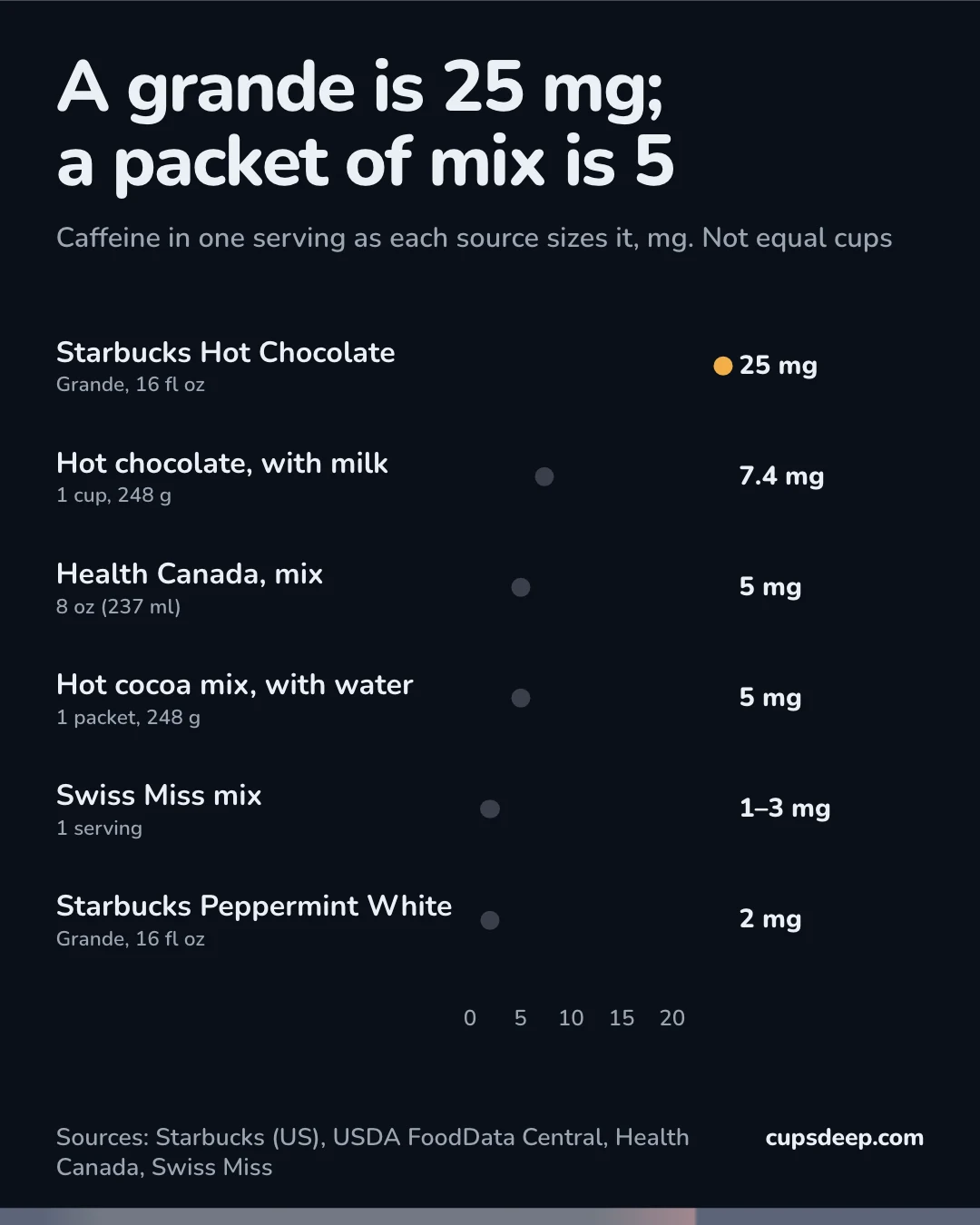
Yes, a little, and it depends heavily on who made it. Starbucks states 25 mg for a grande (16 fl oz) Hot Chocolate. USDA’s hot chocolate made with milk works out to about 7.4 mg for its 248 g cup by our arithmetic, and a packet of mix made with water to about 5 mg. Swiss Miss says 1–3 mg a serving.

| Drink | Whose figure | Serving | Caffeine |
|---|---|---|---|
| Hot Chocolate | Starbucks US | Short, 8 fl oz | 15 mg |
| Hot Chocolate | Starbucks US | Tall, 12 fl oz | 20 mg |
| Hot Chocolate | Starbucks US | Grande, 16 fl oz | 25 mg |
| Hot Chocolate | Starbucks US | Venti, 20 fl oz | 35 mg |
| Peppermint White Hot Chocolate | Starbucks US | Grande, 16 fl oz | 2 mg |
| Caffè Mocha, for comparison | Starbucks US | Grande, 16 fl oz | 175 mg |
| Hot chocolate made with milk | USDA FNDDS, our arithmetic | 1 cup, 248 g | 7.4 mg |
| Hot cocoa mix made with water | USDA FNDDS, our arithmetic | 1 packet, 248 g | 5 mg |
| Hot-cocoa mix, one envelope | Health Canada | 8 oz (237 ml) | 5 mg |
| Swiss Miss hot cocoa mix | Swiss Miss | 1 serving | 1–3 mg |
| Chocolate milk | USDA FNDDS, our arithmetic | 1 cup, 248 g | 2.5 mg |
| Chocolate milk | Health Canada | 8 oz (237 ml) | 8 mg |
Starbucks marks every caffeine figure as approximate. Swiss Miss says “approximately”. Health Canada gives averages and names no source. USDA’s cup is its own portion, which its record puts at 8 fl oz.
The mocha is in the table to make one point. Same chocolate sauce, plus espresso, and the number jumps.
By our arithmetic, a grande Starbucks Caffè Mocha (175 mg) has 150 mg more caffeine than a grande Hot Chocolate (25 mg), which is roughly what the espresso adds. USDA’s record for hot chocolate made with milk gives 1 cup = 248 g and 1 fl oz = 31 g, so two of its cups are 16 fl oz by USDA’s own portions; at 3 mg per 100 g they come to about 14.9 mg. Against that, the Starbucks grande has about 1.7 times as much. 349347341
So in a mocha, most of the caffeine is the espresso’s. The white one is almost nothing: 2 mg for a grande Peppermint White Hot Chocolate. Swiss Miss adds a footnote of its own: its Triple Chocolate Dream flavor carries an extra 2.12 mg from instant espresso. Chocolate milk is lower still, 2.5 mg a cup by our arithmetic from USDA and 8 mg by Health Canada, which differ, as recipes for chocolate milk do.
Does coffee ice cream have caffeine?
Almost certainly, since it is made with coffee. How much, nobody we could find will put in writing. Here is exactly what we checked.
No figure for caffeine in coffee ice cream was found from USDA or a maker. USDA FoodData Central’s SR Legacy, Foundation and FNDDS tables have no coffee ice cream row. A FoodData Central search for “coffee ice cream” on November 12, 2026 returned 264 branded records; none of the ice creams among them lists caffeine, including the four Häagen-Dazs records named “COFFEE ICE CREAM, COFFEE”, and the one record that does is a bottled iced coffee. Häagen-Dazs’ US page for its Coffee ice cream gives no caffeine figure. 356355357
The figures you will see elsewhere for Häagen-Dazs and Ben & Jerry’s coffee flavors appear on caffeine compiler sites, and we could not trace them to a maker’s page or a lab. Ben & Jerry’s site turned our reader away, so its pages are unread. Until a maker or a lab publishes a number, this page has none to give you. If you want to treat a bowl as coffee, that is your call, and a fair one.
Coffee ice cream is a coffee that refuses to say how strong it is, and I respect it
Chocolate ice cream is easier. USDA measured 3 mg per 100 g in a single sample, which is about 2 mg in its portion of ½ cup (4 fl oz), 66 g, by our arithmetic. Chocolate syrup is 18 mg per 100 g in USDA’s survey table, about 3.6 mg a tablespoon.
How much caffeine is in a brownie?
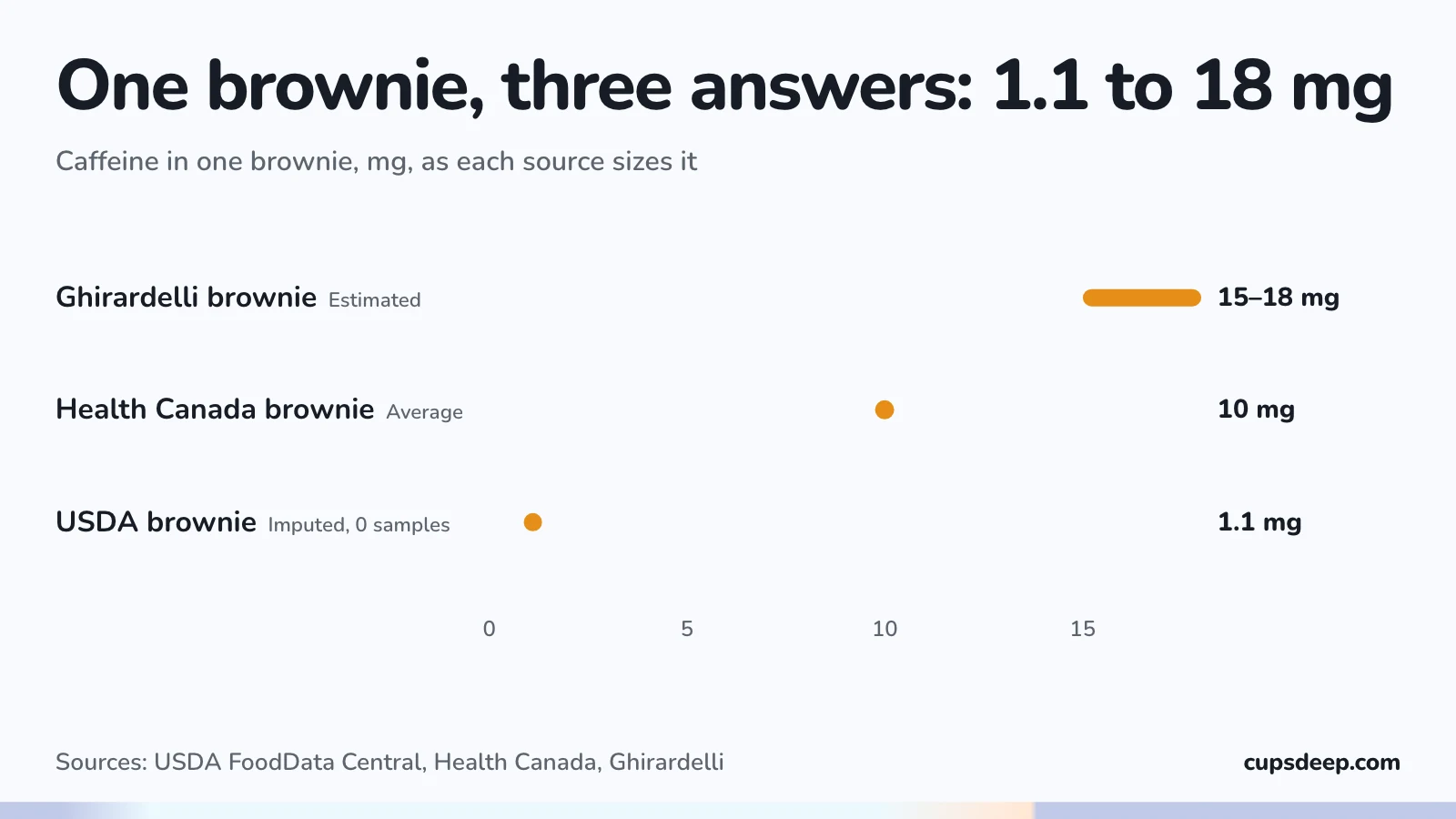
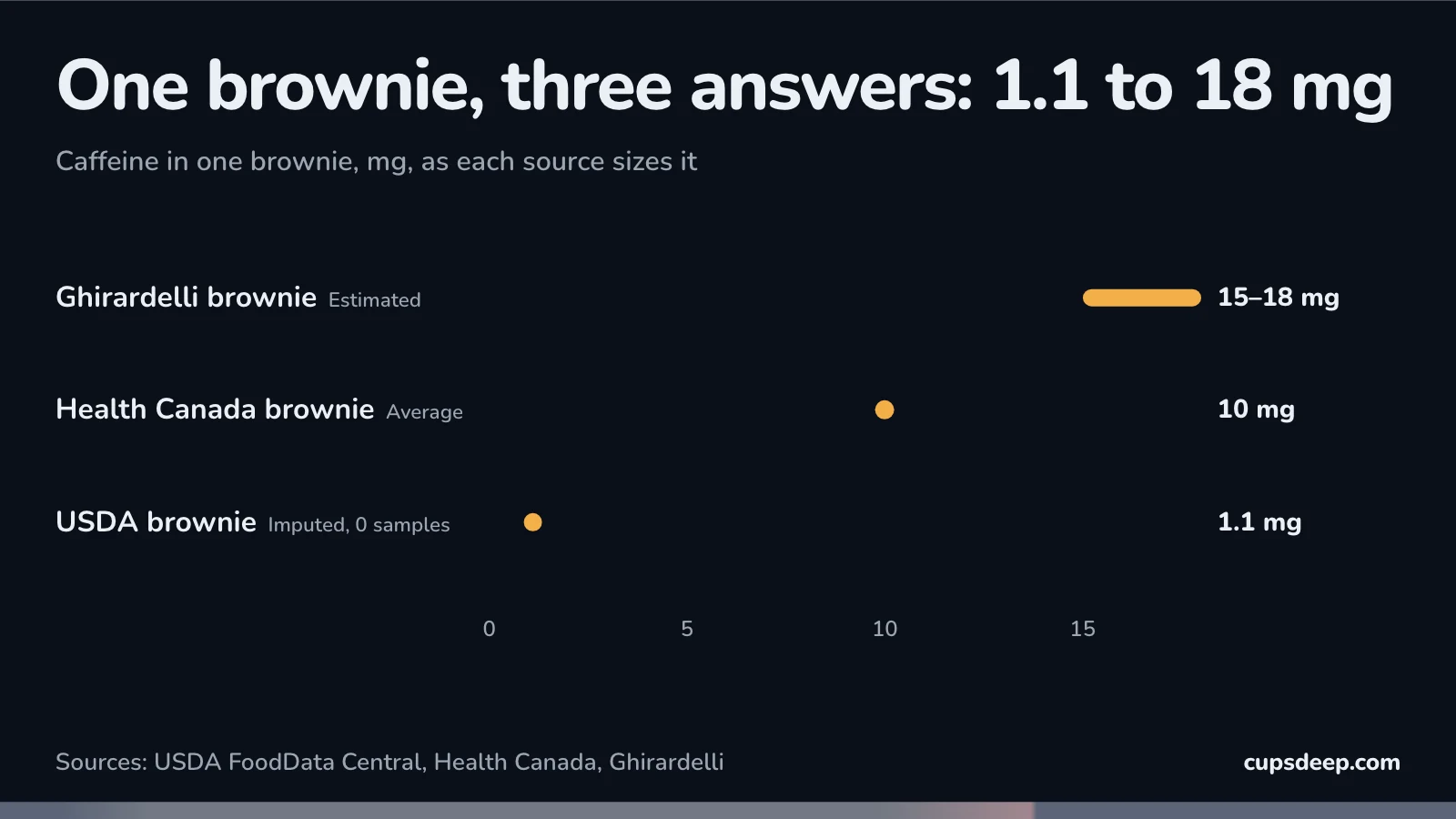
Three sources, three answers. USDA’s commercially prepared brownie works out to about 1.1 mg for a 56 g square by our arithmetic, but that value is imputed from an ingredient list, with 0 samples. Health Canada says 10 mg for 1.5 oz (42 g). Ghirardelli says an estimated 15 mg to 18 mg for one 2-inch brownie from its mixes.

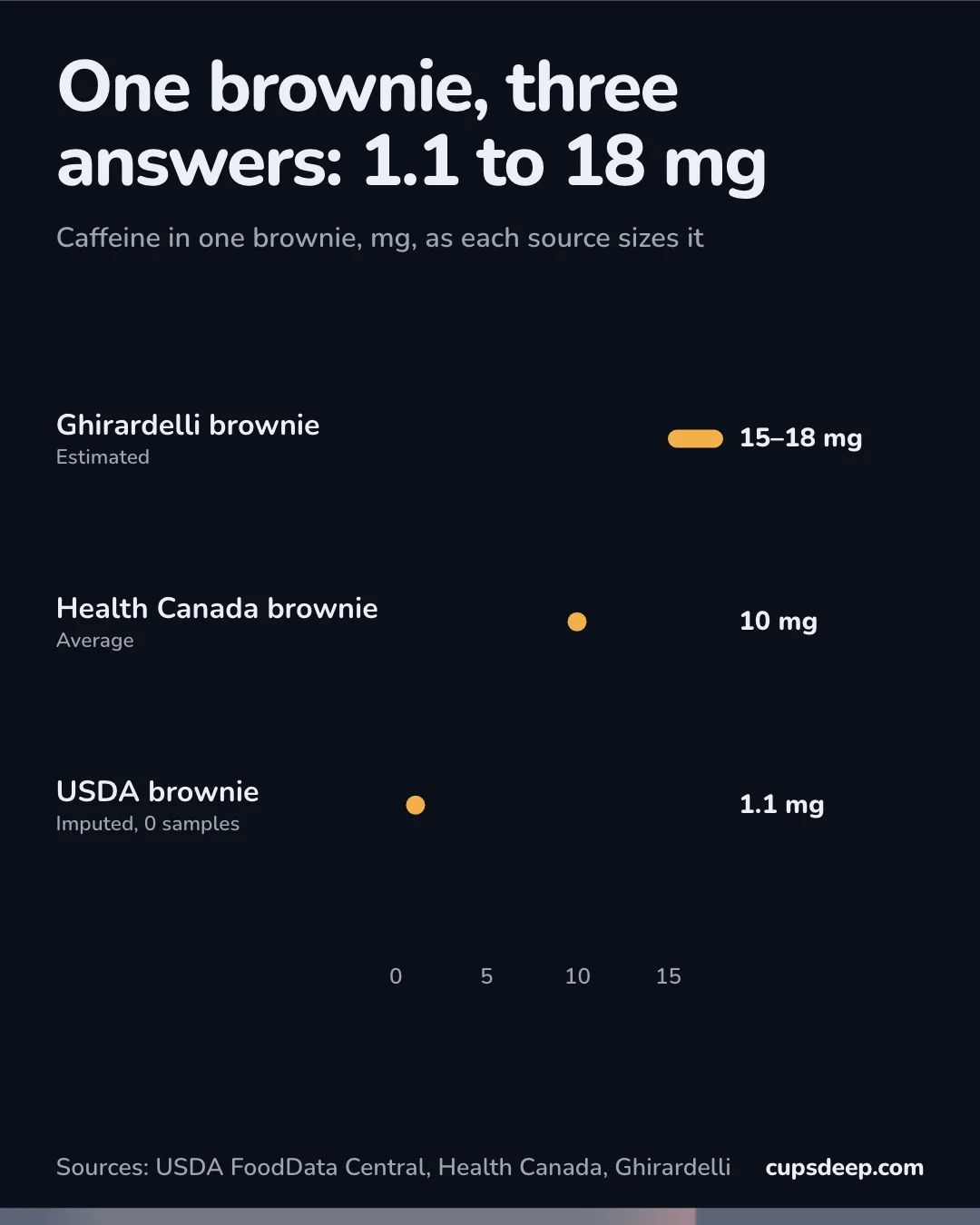
Ask three authorities how much caffeine is in a brownie and you get three answers and a fourth brownie
None of them is wrong, exactly. A brownie made with a lot of dark chocolate and cocoa should carry more than a packaged one built on sugar and flour, and none of the three says how much chocolate went into the pan. If you bake, the cocoa and the chips are where the caffeine is, and the table at the top of this page has both.
How much chocolate equals a cup of coffee? Can chocolate keep you awake?
By our arithmetic from USDA’s figures, matching the caffeine in USDA’s 8 fl oz cup of brewed coffee (95 mg) takes about 4.2 oz of 70–85% dark chocolate, or about 10.8 bars of milk chocolate of 1.55 oz each. 11336338
So a square or two is a rounding error next to a cup of coffee. A whole 101 g bar of 70–85% dark chocolate is not: at about 80.8 mg by our arithmetic, it is roughly a 200 ml filter coffee, and the 60–69% bar USDA weighs at 112 g comes to about 96.3 mg. The list of drinks has the rest of the comparison.
Chocolate also brings a second compound in far larger amounts: theobromine. USDA measures it next to caffeine.
By our division of USDA’s per 100 g figures, chocolate holds several times more theobromine than caffeine: milk chocolate 10.3 times, dark chocolate of 45–59% cacao 11.5, of 60–69% 7.3, of 70–85% 10, and natural cocoa powder 9. Dutch-process cocoa powder, one sample, is 33.7. An ounce of the 70–85% bar holds about 227.4 mg of theobromine against 22.7 mg of caffeine. These are amounts only; the USDA records say nothing about effects. 336338334335332333

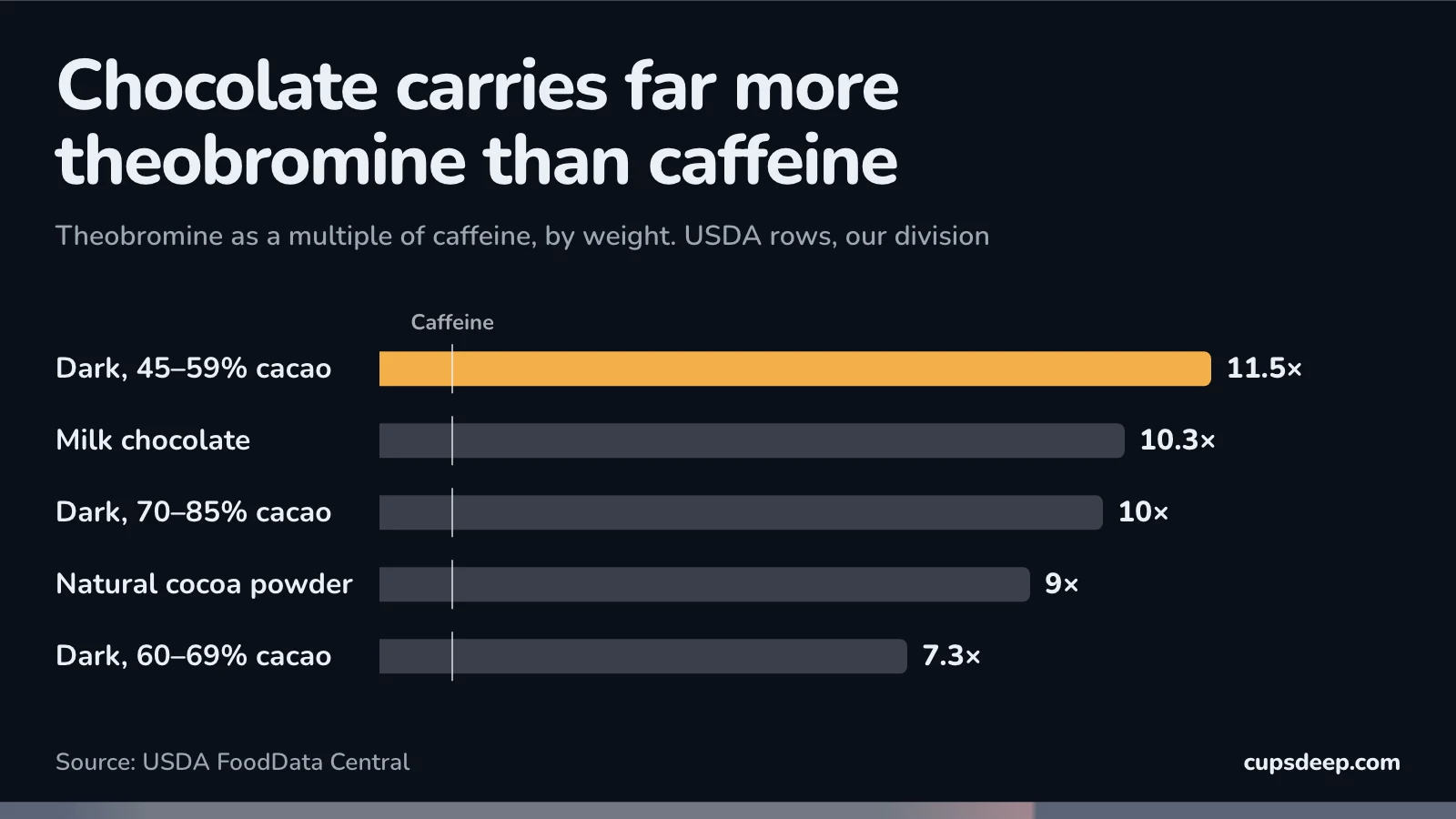
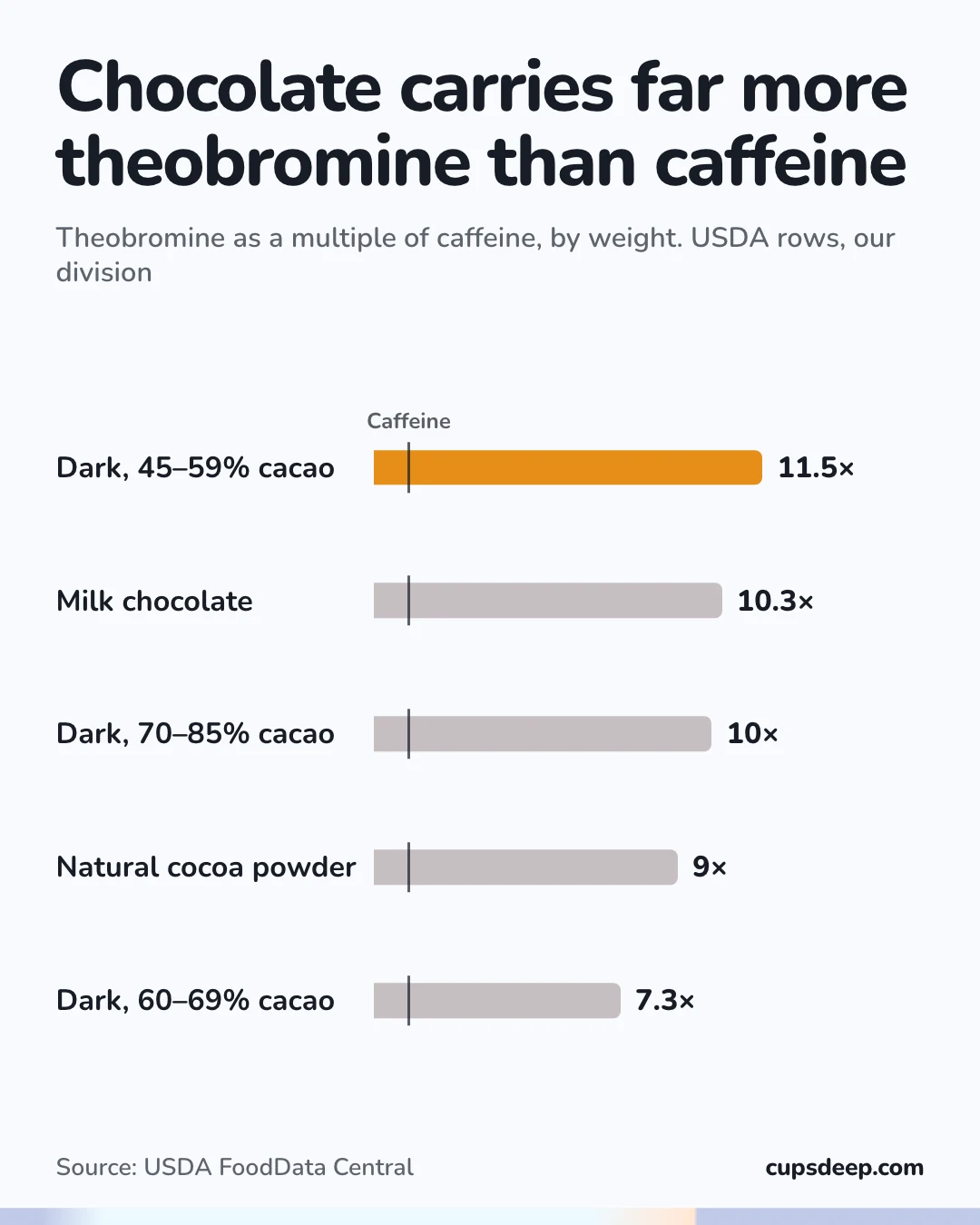
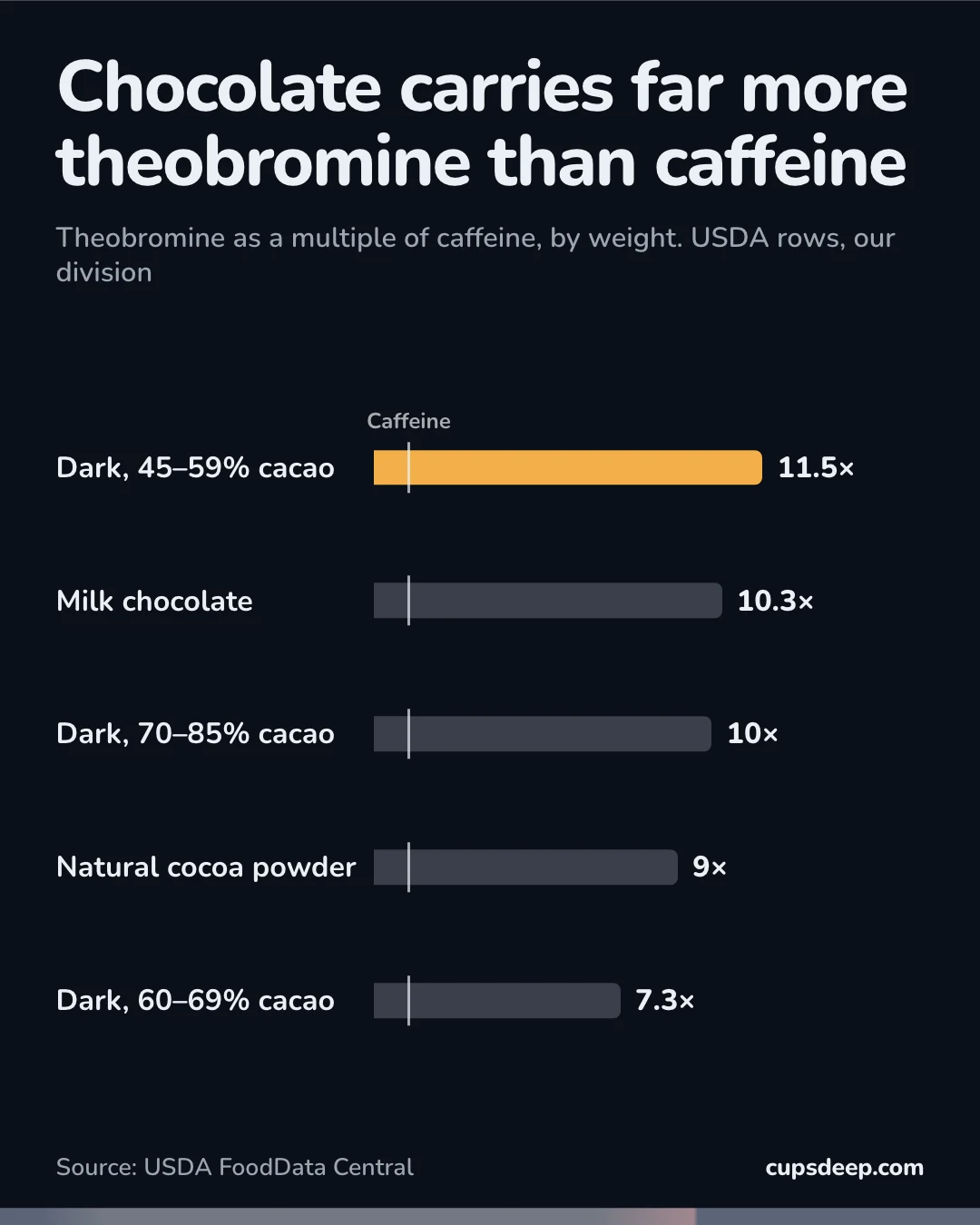
We give theobromine as amounts only. None of the sources we read for this page says what those amounts do to a person, and we will not guess on their behalf.
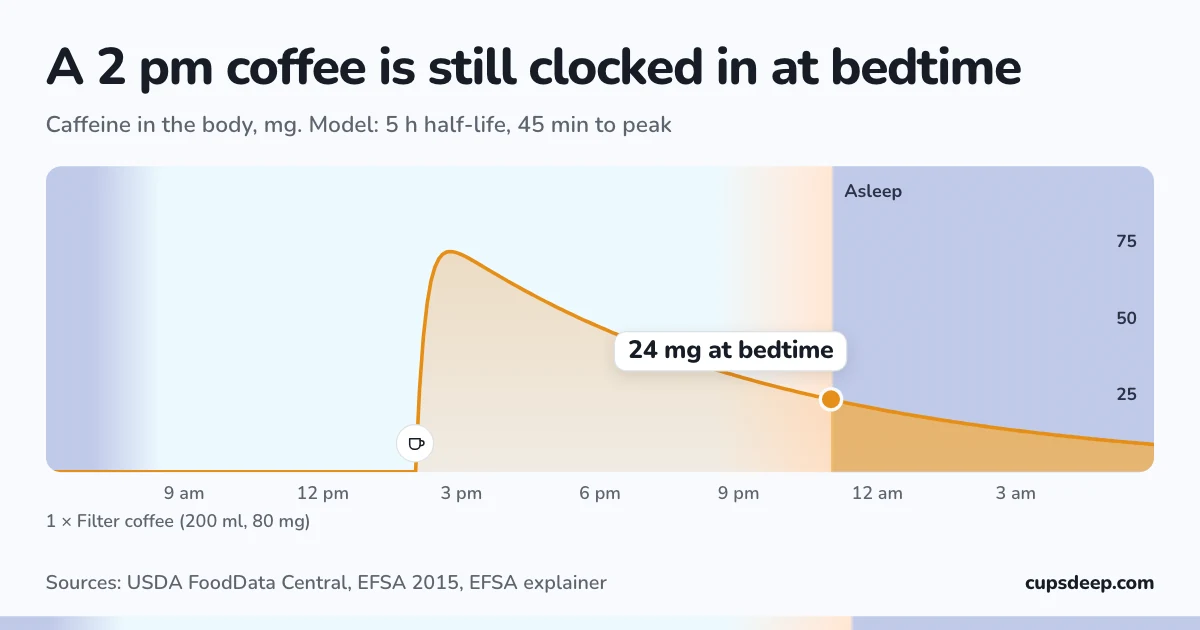
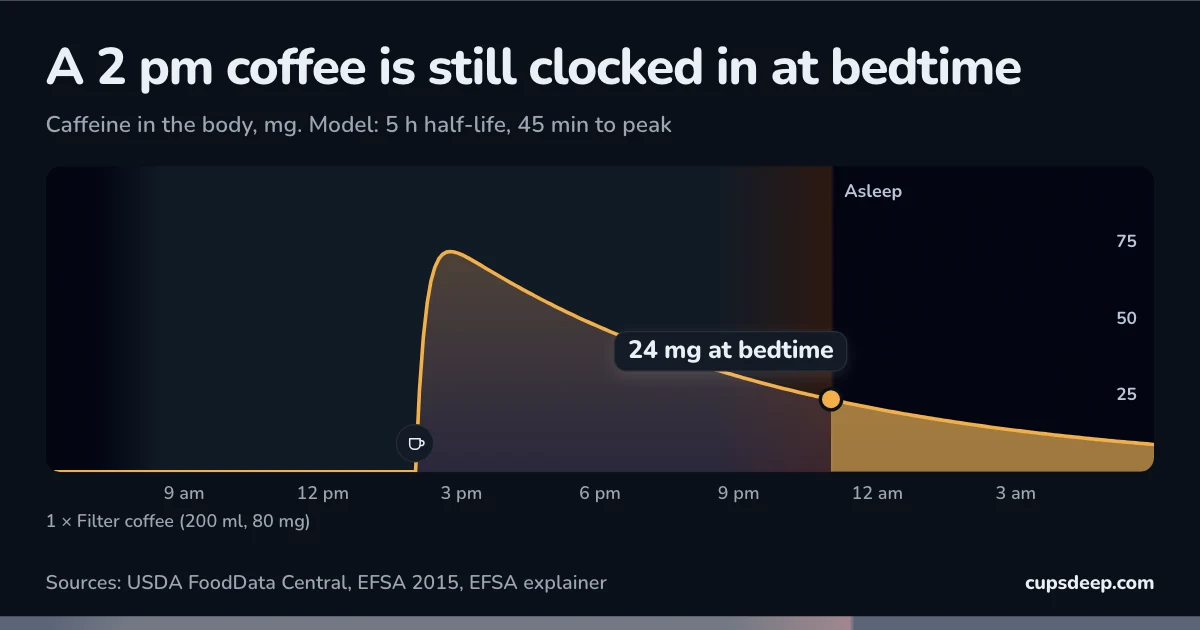
The caffeine part works like any other caffeine: it stays in you for hours. The half-life in healthy adults averages 4 hours, from 2 hours to 8 hours, so a bar eaten after dinner is still partly there at bedtime. How long caffeine stays in your system has the arithmetic, and the method page shows how the curve below is built.
EFSA’s figure below is for 100 mg; the 70–85% bar is about 80.8 mg and the 60–69% bar about 96.3 mg, by our arithmetic.
A single 100 mg dose of caffeine, about 1.4 mg/kg body weight for a 70 kg adult, may increase the time it takes to fall asleep and reduce sleep duration in some adults, particularly when taken close to bedtime. 2223
Questions people ask
Does chocolate have caffeine?
Yes. By our arithmetic from USDA’s figures, dark chocolate of 70–85% cacao has caffeine at about 22.7 mg per oz, and milk chocolate about 5.7 mg per oz. Cocoa powder has the most; white chocolate has none by USDA’s estimate.
Does hot chocolate have caffeine?
A little. Starbucks states 25 mg for a grande (16 fl oz) Hot Chocolate, Swiss Miss says 1–3 mg a serving of its mix, and USDA’s hot chocolate made with milk works out to about 7.4 mg for a 248 g cup by our arithmetic. A grande Caffè Mocha, with espresso, is 175 mg.
Does coffee ice cream have caffeine?
It is made with coffee, so it should, but we found no published figure from USDA or a maker. USDA’s tables have no coffee ice cream row, the branded records list no caffeine, and Häagen-Dazs’ own page gives none. The numbers that circulate online appear on compiler sites, and we could not trace them to a maker or a lab.
Does white chocolate have caffeine?
No, by every source we read. USDA lists 0 mg per 100 g, estimated from the recipe rather than measured, and Ghirardelli and Lindt both say white chocolate contains no caffeine.
Sources
Every number above links to the place it came from. How the numbers are chosen and checked is on the method page; the drink table is at /drinks. Written with AI agents, as the whole site is. A model of a typical body, not advice for pregnancy, illness or medication.
- Spilling the Beans: How Much Caffeine is Too Much?
- Beverages, coffee, brewed, prepared with tap water
- Scientific Opinion on the safety of caffeine
- EFSA explains risk assessment: Caffeine
- Caffeine in Foods
- Cocoa, dry powder, unsweetened (SR Legacy 169593)
- Cocoa, dry powder, unsweetened, processed with alkali (SR Legacy 169594)
- Chocolate, dark, 45- 59% cacao solids (SR Legacy 170271)
- Chocolate, dark, 60-69% cacao solids (SR Legacy 170272)
- Chocolate, dark, 70-85% cacao solids (SR Legacy 170273)
- Candies, semisweet chocolate (SR Legacy 167976)
- Candies, milk chocolate (SR Legacy 167587)
- Candies, MARS SNACKFOOD US, M&M's Milk Chocolate Candies (SR Legacy 169583)
- Candies, white chocolate (SR Legacy 167571)
- Hot chocolate / cocoa, made with whole or reduced fat (2%) milk (FNDDS 2705473)
- Hot chocolate / cocoa, dry mix, made with water (FNDDS 2705483)
- Chocolate milk, whole (FNDDS 2705467)
- Chocolate syrup (FNDDS 2710276)
- Ice creams, chocolate (SR Legacy 168809)
- Cookies, brownies, commercially prepared (SR Legacy 172713)
- Hot Chocolate: nutrition (starbucks.com, United States)
- Peppermint White Hot Chocolate: nutrition (starbucks.com, United States)
- Caffè Mocha: nutrition (starbucks.com, United States)
- Frequently Asked Questions: Does Swiss Miss have caffeine?
- Product FAQs: What is the caffeine level in your products?
- Ghirardelli Brownies FAQs: Do Ghirardelli brownies contain caffeine?
- Caffeine – How Much Caffeine Is in Lindt Chocolate?
- Frequently Asked Questions: How much caffeine is in chocolate?
- Häagen-Dazs Coffee Ice Cream (FoodData Central Branded 2110057)
- FoodData Central search: “coffee ice cream”, all data types
- Coffee Ice Cream (Häagen-Dazs, United States)
Keep reading
Coffee
How much caffeine is in a cup of coffee?
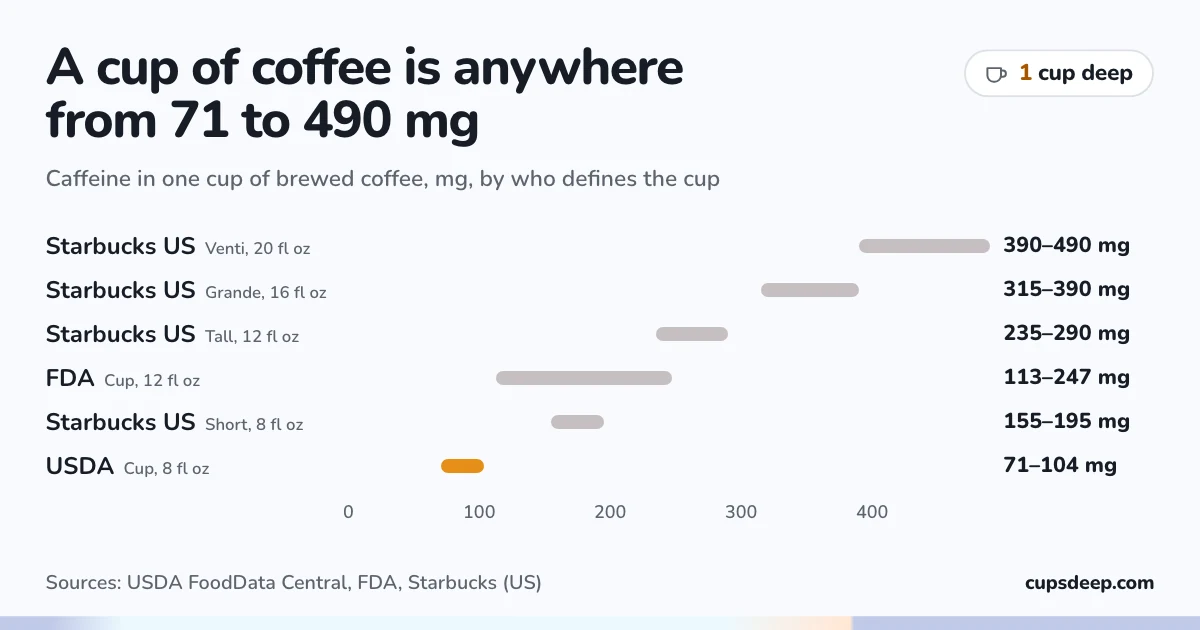
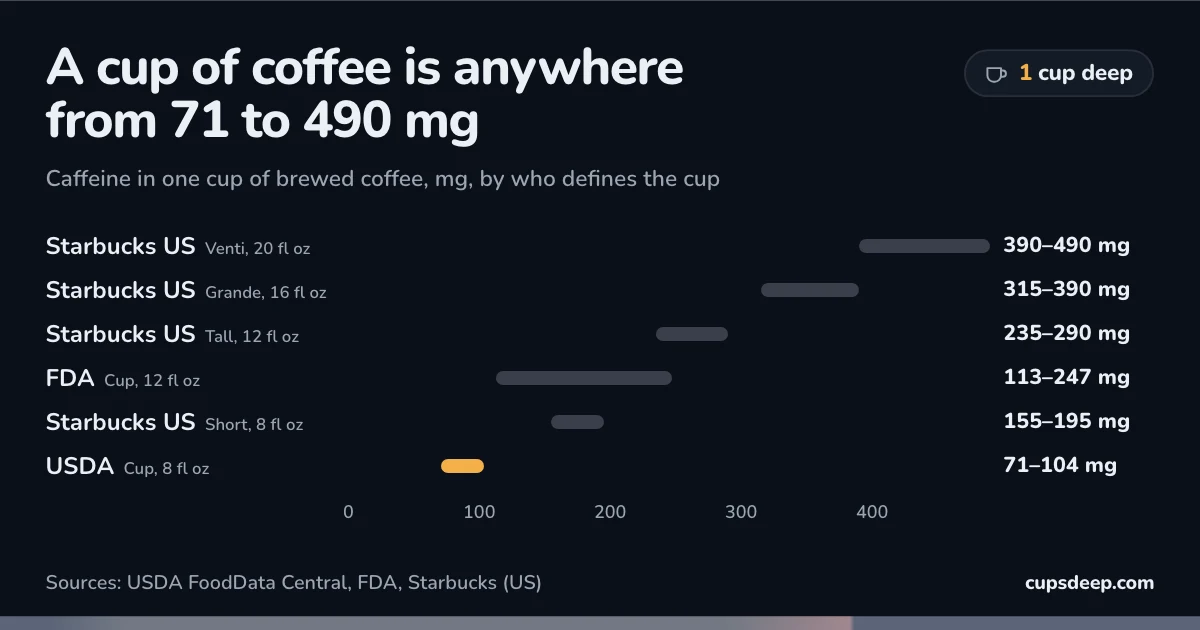
An 8 fl oz cup of brewed coffee has about 95 mg of caffeine by USDA’s figure. A Starbucks cup the same size states 155 mg to 195 mg. Tables by size and type.
Body and sleep
How long does caffeine stay in your system?
Half of a dose of caffeine is gone in about 4 hours, 2–8 hours between people. After five half-lives, 20 hours on average, 3.1% is left.

Coffee
Does decaf coffee have caffeine?
Yes. FDA puts decaf at 2–15 mg per 8 fl oz cup, and Starbucks lists 25 mg for a grande. The lab ranges, the law and the maths.