What is Swiss Water decaf, and how much caffeine is left?
Swiss Water is the decaf with the reassuring name and the reassuring number. The name belongs to a company in Canada, and the number describes a raw bean. Here is what each one actually says, from the company’s own securities filing, the regulators and the roasters.
The short answer
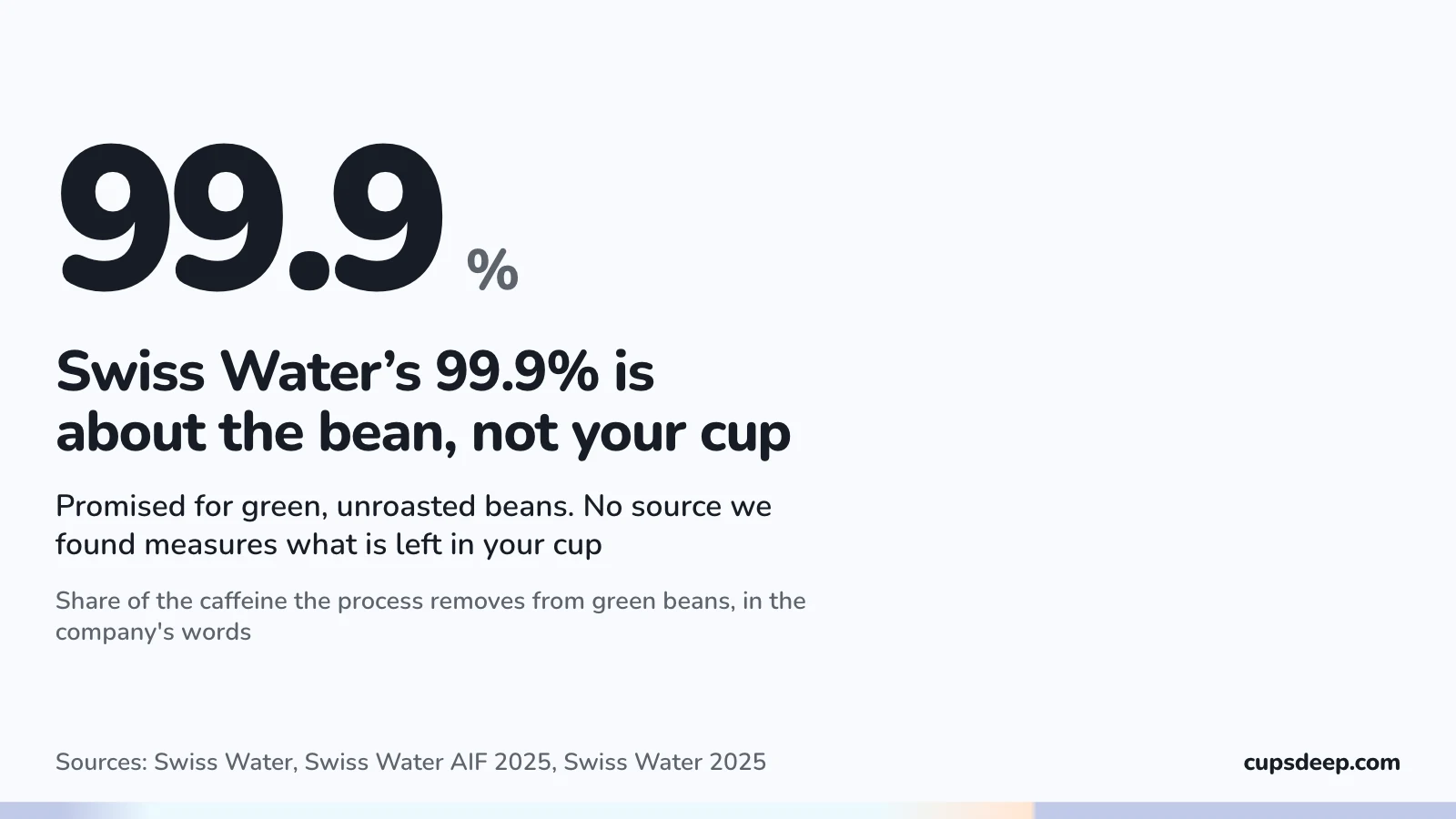
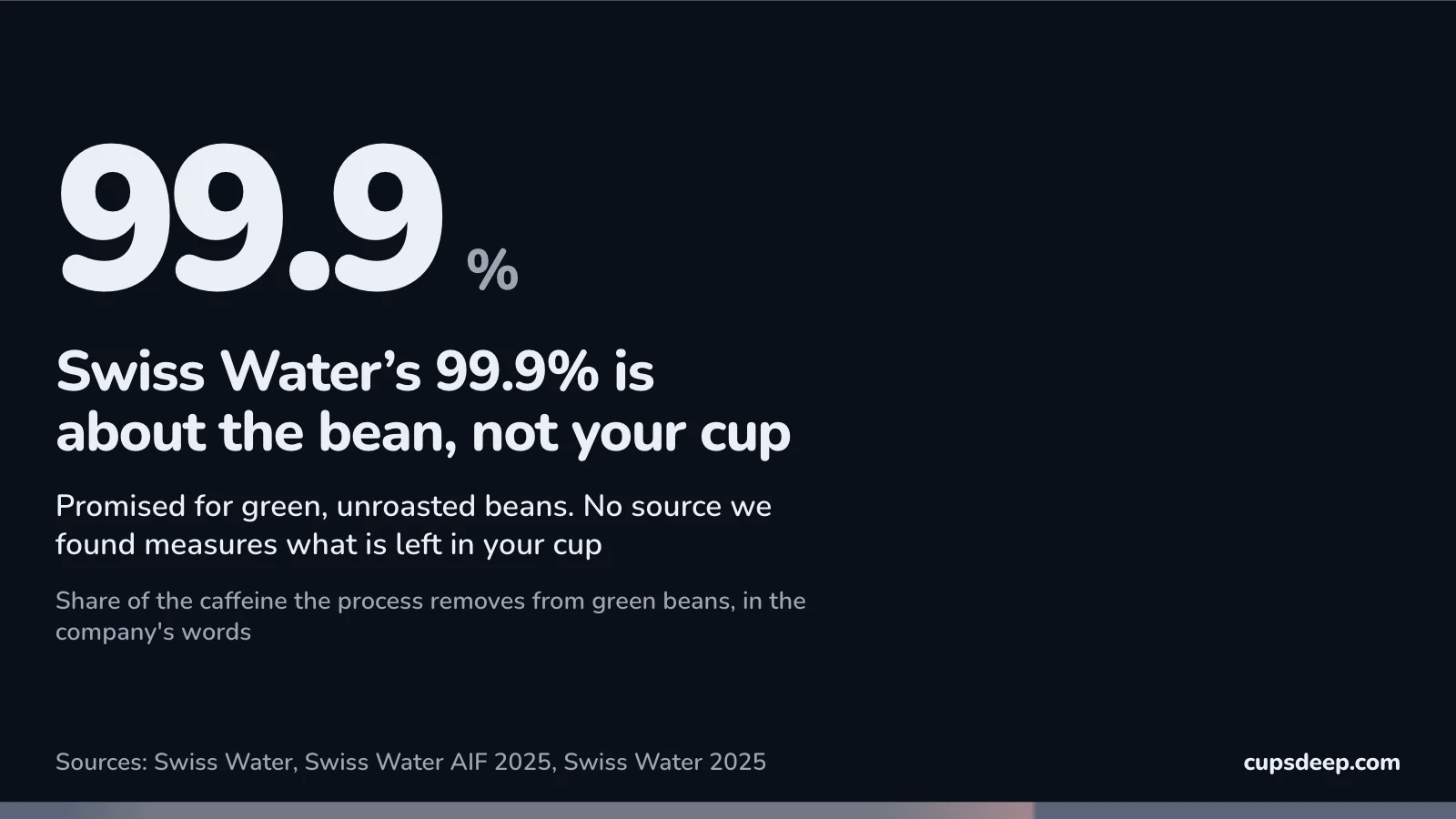
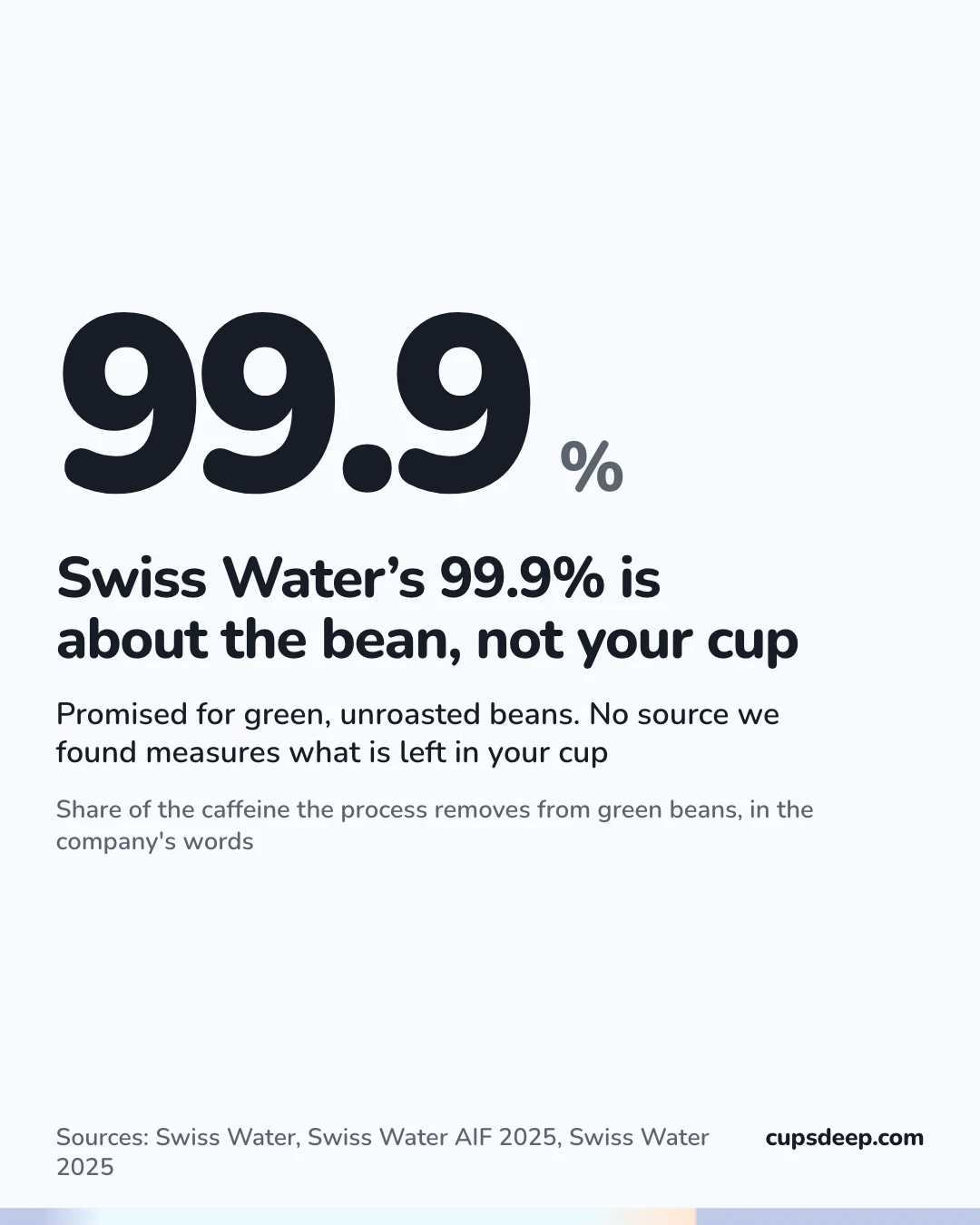
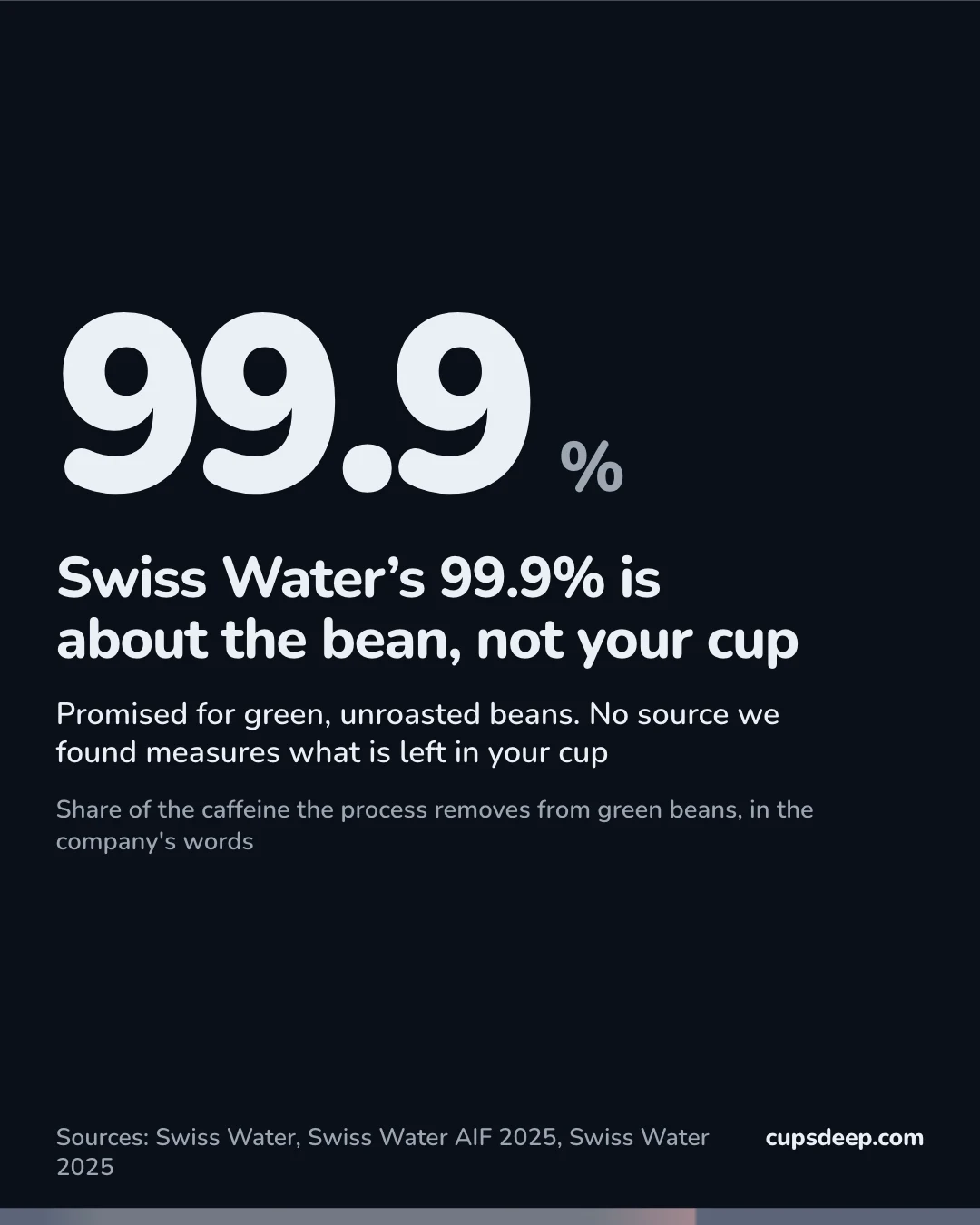
Swiss Water decaf is coffee decaffeinated with water and carbon instead of a solvent, at the company’s plant in Delta, British Columbia. The company says its process removes 99.9% of the caffeine from the green, unroasted bean: a guarantee about the bean, not a figure for the cup. Brewed, decaf coffee typically has 2–15 mg in an 8 fl oz cup by FDA’s figure, which does not split decaf by process.
What is Swiss Water decaf, and how does the process work?
The Swiss Water Process takes the caffeine out of green coffee with water and carbon. This is how the company describes it, in its annual filing and on its own site:
- Make the extract. Green beans are soaked in fresh water until the water holds what dissolves out of them, caffeine included. The company calls it green coffee extract, makes it once and keeps refreshing it.
- Take the caffeine out of the extract. Activated carbon, which the company says adsorbs virtually nothing but caffeine, strips the extract.
- Soak the next beans in it. New green beans go into the caffeine-free extract. Because it already holds everything else the bean could lose, the company says only the caffeine moves out, until no more than 0.1% of caffeine remains in the beans.
- Dry the beans, clean the carbon. The beans go into dryers, and the carbon is regenerated so it can be used again. The company says its process does not currently allow the caffeine to be recaptured for resale.
By Swiss Water's 2025 filing, its decaffeination plant is in Delta, British Columbia, Canada: one facility of about 128,000 square feet that currently holds two production lines, built to take a maximum of four. The first line ran its first commercial coffee in September 2020 and the second has been fully operational since the third quarter of 2023. The plant runs 24 hours a day, seven days a week. The company's process pages describe four steps, preparation and hydration, caffeine migration, drying, and filtering and renewing the extract, and say the whole process takes approximately 8 to 10 hours. 374375376
So is Swiss Water decaf made in Switzerland? Not by the company’s filing: both of its production lines are in Delta, British Columbia, in Metro Vancouver. The filing does not explain the name, so neither will I. The whole process takes 8–10 hours by the company’s process page, in a plant that runs around the clock.
Swiss Water decaf is made in Canada, and I am calm. Two labels doing a lot of work
How much caffeine is in Swiss Water decaf?
Two different numbers get called the answer. One is the company’s guarantee about the bean. The other is what ends up in the cup, which nobody we found has measured for Swiss Water decaf in particular.
Swiss Water guarantees that decaffeinated green (unroasted) coffee leaving its process is 99.9% caffeine free. The guarantee describes the bean before roasting, not the brewed cup. Its process page says the process removes 99.9% of the caffeine, a share of the caffeine the bean started with. 85375
Swiss Water's process page says the Swiss Water Process removes 99.9% of the caffeine. Its 2025 annual information form, a securities filing, describes the same target from the other side: green coffee is immersed in green coffee extract until there is no more than 0.1% of caffeine remaining in the coffee beans. Both describe the green, unroasted bean, not the brewed cup. 37537485
The process page says it plainly: the process removes 99.9% of the caffeine, a share of the caffeine the bean started with. The filing’s sentence, “no more than 0.1% of caffeine remaining in the coffee beans”, says the same thing from the other side. Read on its own, that sentence would also fit the looser ceiling German law sets for decaf, a share of the bean’s weight, but the company’s page says which one it means.
| Green arabica beans | Caffeine per kg |
|---|---|
| Before decaffeination, at 0.9–1.5% caffeine by dry weight | 9,000–15,000 mg per kg |
| After Swiss Water’s stated 99.9% is removed, at most | 9–15 mg per kg |
| German legal ceiling for decaf, for scale | 1,000 mg per kg |
Our arithmetic. These are ceilings on the green, unroasted bean, not measurements, and the sums ignore the weight a bean loses in the process. Germany’s ceiling is per kg of dry matter.
By our arithmetic, Swiss Water's stated 99.9% of the caffeine removed leaves at most 9 to 15 mg of caffeine per kg of green arabica beans that started at 0.9 to 1.5% caffeine by dry weight, that is 9,000 to 15,000 mg per kg. The filing's sentence on its own (no more than 0.1% of caffeine remaining in the beans) would also allow a share of the bean's weight, up to 1,000 mg per kg, the figure German law sets as the ceiling for decaf; the company's process page says it means a share of the caffeine. Both are ceilings on the green bean, not measurements, the sums ignore the weight a bean loses in the process, and none of it says what is in a cup. 3753745582
So the guarantee is a tight one on the bean. What it cannot do is tell you what is in your cup. A cup depends on how much coffee went in, the roast and the brew. Turning a bean guarantee into milligrams per mug would be inventing a number, and this page does not.
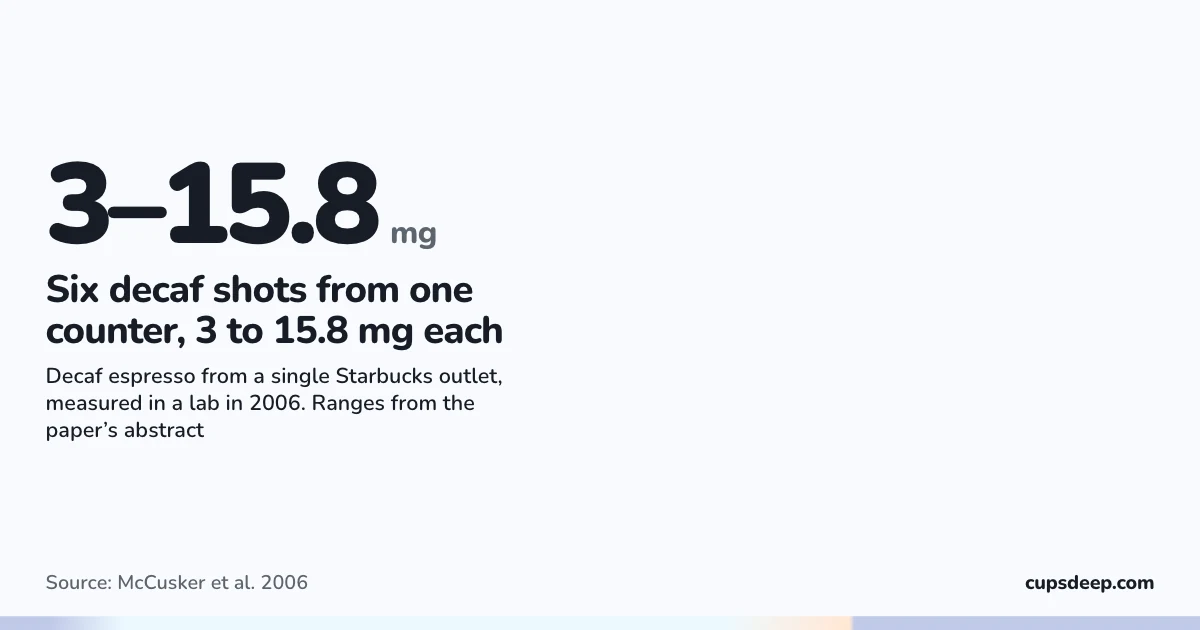
No study we found measured caffeine in a cup by decaf process, Swiss Water or any other, so the cup numbers here are for decaf in general. FDA puts a typical 8 fl oz cup at 2–15 mg. A 2006 lab study found 0–13.9 mg per 16 oz serving in ten decafs collected from different coffee establishments, and 3–15.8 mg per decaf espresso shot from one Starbucks. Starbucks lists 25 mg for a grande decaf. The full table, with regular coffee beside it, is in does decaf coffee have caffeine.
Swiss Water’s own page on the cup is worth a look, because it cites that same study.
Swiss Water's page on caffeine in decaf says a 2006 study from the University of Florida found caffeine in a cup of brewed decaf landed between 3 and 15 mg, depending on the size of the coffee and the method (a shot of espresso or 16 oz brewed). That study's abstract reports three ranges: 0 to 13.9 mg per 16 oz serving for ten decafs collected from different coffee establishments, and, from one Starbucks, 3.0 to 15.8 mg per decaf espresso shot and 12.0 to 13.4 mg per 16 oz brewed decaf. Swiss Water's 3 to 15 mg is closest to the espresso range with its top rounded down, and the page applies it to a cup of brewed decaf. 8563
The sentence is not invented. It is the espresso range, rounded, applied to a cup of brewed decaf. The study’s decafs from different establishments went as low as 0 mg, and its strongest shot went past the top of the company’s range, at 15.8 mg. Rounding a lab result toward neat is not a scandal. It is a reason to read the abstract.
The Starbucks name carries two numbers. Starbucks at Home, a site where Nestlé uses the Starbucks trademarks under license, says a typical decaf has about 2 mg. Starbucks’ own US menu lists 15 mg for its smallest decaf, a short of 8 fl oz. Different drinks, perhaps, but nobody reading “typical cup” would guess it.
Caffeine free to one decimal place is my favorite kind of free
Where does the 97% decaf rule come from?
The decaf article searched the US rules for it and found nothing. This time we found it on a page with a large brand on it.
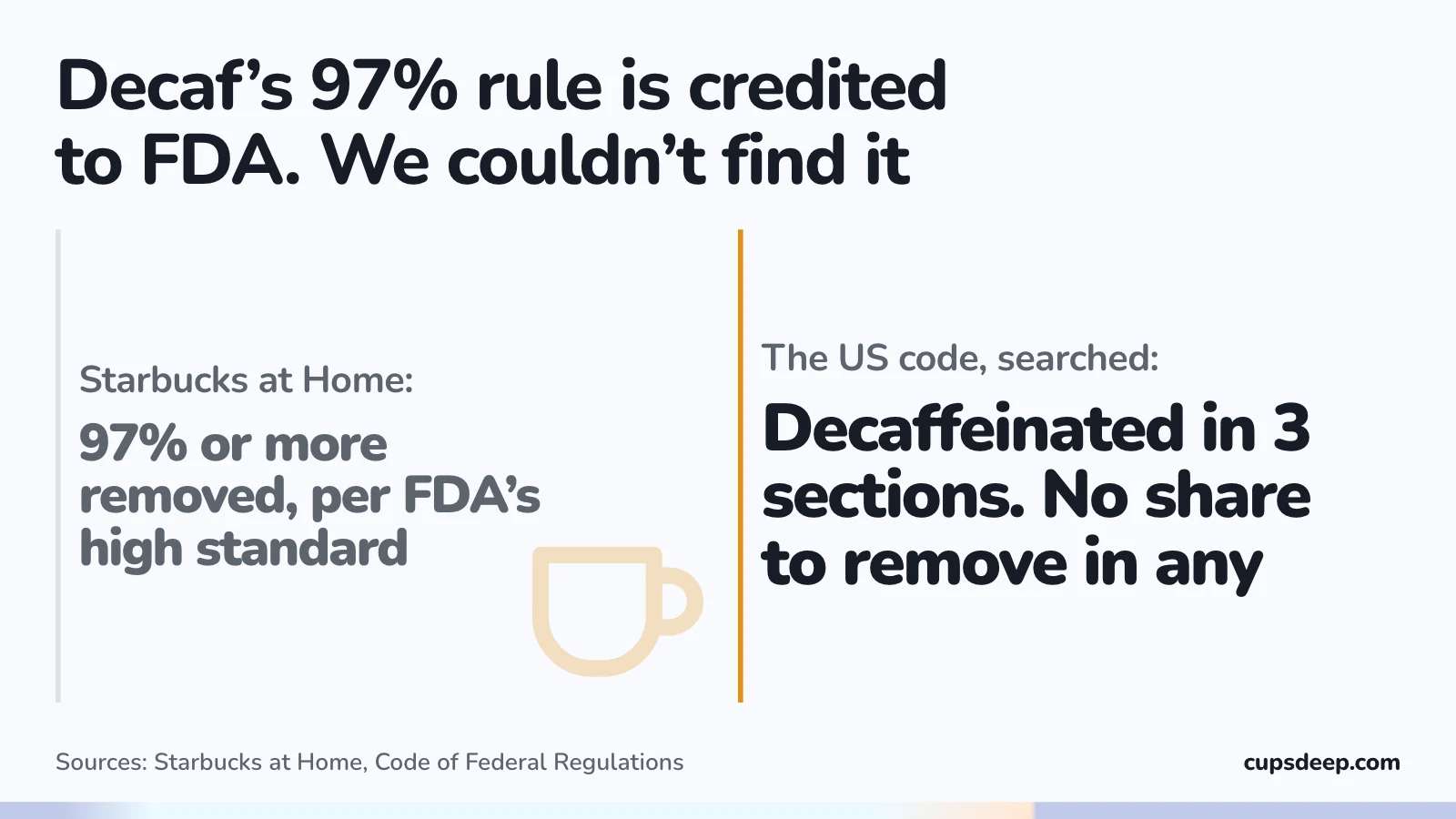
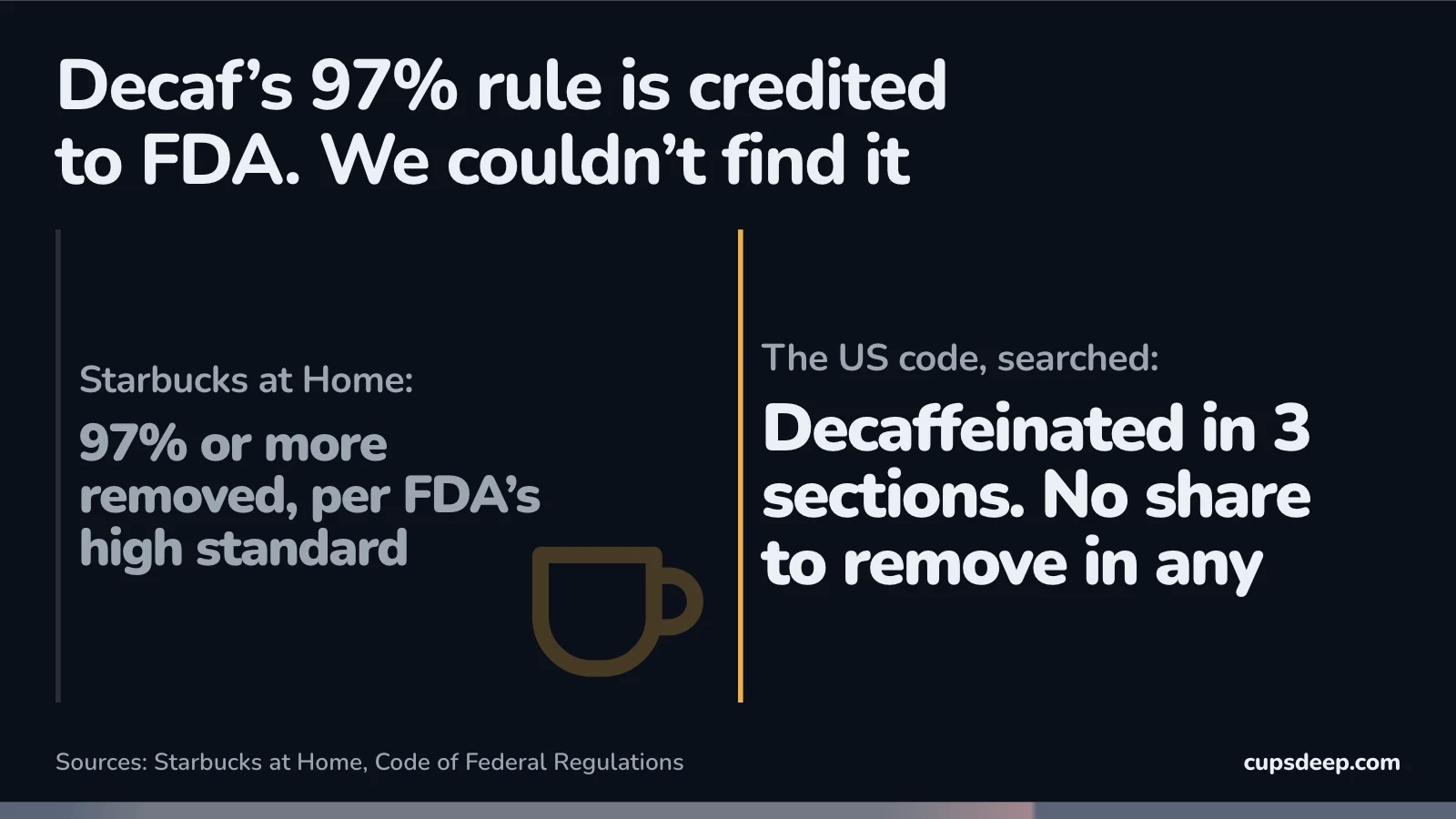
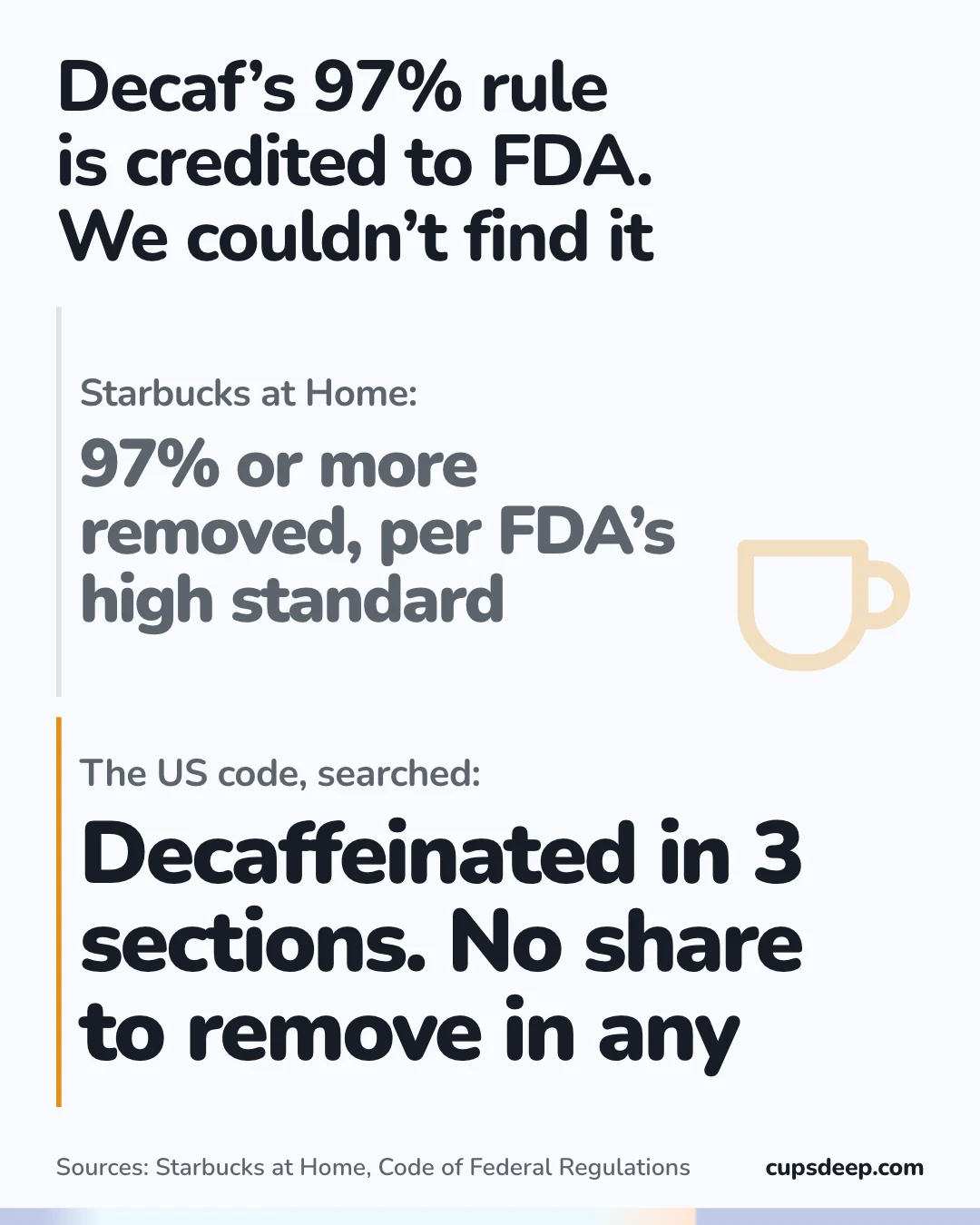
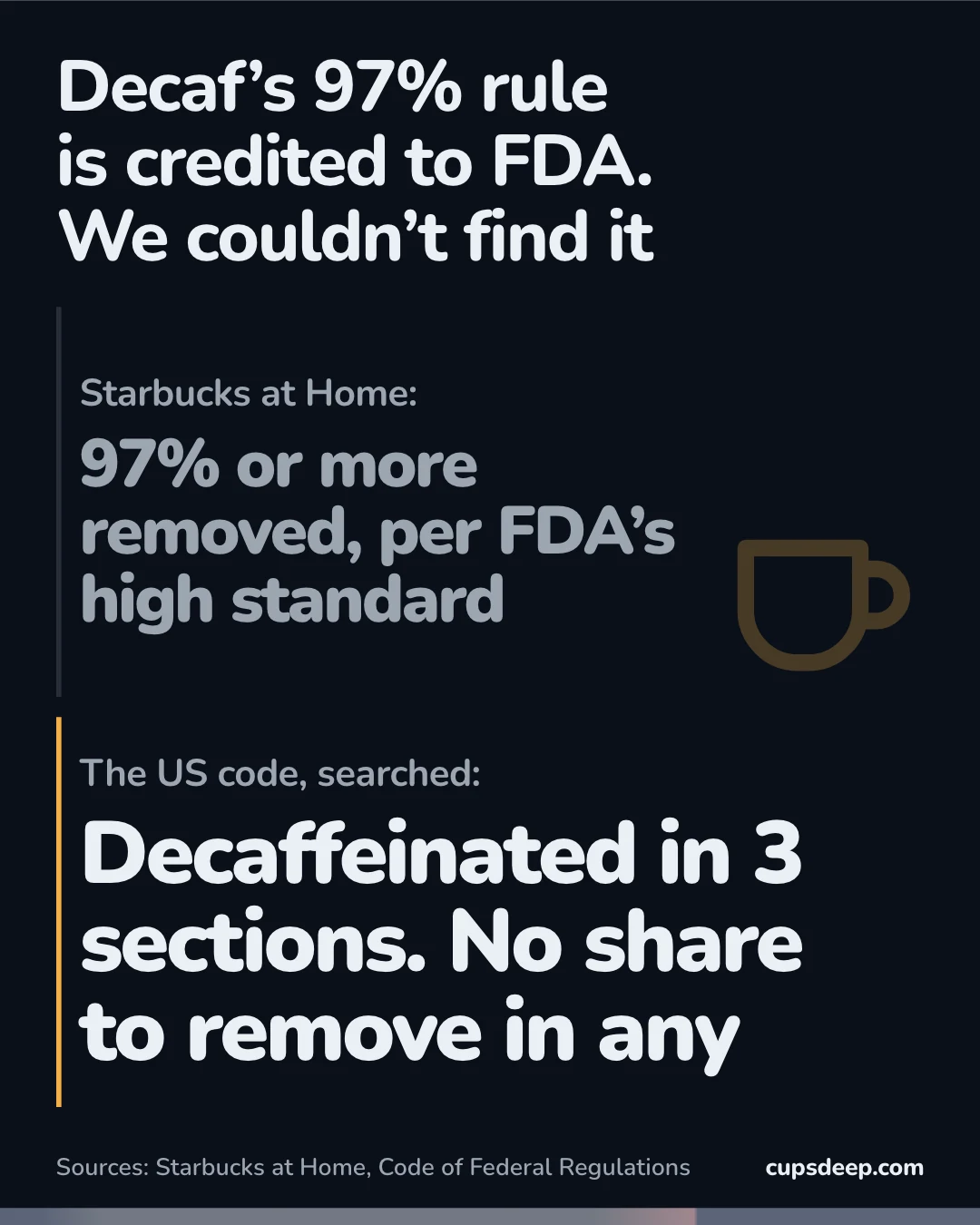
Starbucks at Home, a site whose footer says Nestlé uses the Starbucks trademarks under license, says each of three decaf methods, Swiss Water among them, removes 97% or more of the caffeine from the beans, per the high standard put in place by FDA, and that a typical cup of decaf has about 2 mg of caffeine. The page names no rule. A full-text search of the US Code of Federal Regulations on November 10, 2026 found the word decaffeinated in 3 sections, none of which defines decaf or sets a share of caffeine to be removed. 37878
Counter Culture repeats the figure on its own decaf page, also with no source, and says in the same article that it has not tested the caffeine in its coffee. Not testing is honest. Repeating is how a rule gets invented. Where a law does write a number down, it is a ceiling on the coffee, not a share removed: at most 0.1% caffeine in German raw and roasted decaf, and 0.1% in Canada’s.
I don’t drink caffeine after noon. I drink a small, legally undefined amount of it
Is Swiss Water decaf chemical free, and is solvent decaf safe?
The company says its process uses only water and carbon, and that neither methylene chloride nor ethyl acetate touches it. By its own filing, its competitors in Germany, Mexico and Colombia use methylene chloride, ethyl acetate, carbon or water processes, and Peet’s says its decaf espresso capsules are decaffeinated with carbon dioxide. Here is what the law lets a solvent leave behind.
| Country and solvent | Left in decaf roasted or instant coffee, at most | Where it is written |
|---|---|---|
| US, methylene chloride | 10 parts per million | 21 CFR 173.255 |
| US, ethyl acetate | No number: good manufacturing practice | 21 CFR 173.228 |
| Canada, methylene chloride | 10 parts per million | Health Canada |
| Canada, ethyl acetate | 10 parts per million | Health Canada |
| Canada, carbon dioxide | No number: good manufacturing practice | Health Canada |
| Swiss Water Process | No solvent used, by the company’s account | Swiss Water’s filing |
Health Canada calls methylene chloride dichloromethane. We did not read the EU’s limits, and the rules in Japan and South Korea appear here only as the company’s claim.
US regulation lets methylene chloride be used to extract caffeine from green coffee beans provided no more than 10 parts per million (0.001%) is left in decaffeinated roasted coffee or decaffeinated instant coffee. Ethyl acetate is permitted as a solvent for decaffeinating coffee and tea under good manufacturing practice, with no numeric residue limit. 7980
Health Canada's list of permitted extraction solvents sets the same residue limit for both decaf solvents in coffee: dichloromethane (methylene chloride) and ethyl acetate used on green coffee beans may leave no more than 10 ppm in decaffeinated roasted coffee and decaffeinated instant coffee. Ethyl acetate used on tea leaves may leave up to 50 ppm. Carbon dioxide used to decaffeinate green coffee is allowed under good manufacturing practice, with no number. 379
Two things stand out. Canada writes a number for ethyl acetate and the US does not. And 10 parts per million is 0.001% of the coffee: a ceiling on residue, not a measurement of anyone’s cup. Nothing in the sources behind this page measured solvent in a cup of decaf, so this page does not call solvent decaf unsafe, or safe beyond what the rules say.
Statements by Swiss Water's management in its 2025 filing, not independently checked: more than 60% of worldwide decaffeination capacity uses chemical methods, including methylene chloride and ethyl acetate; methylene chloride is prohibited for decaffeination in Japan and South Korea; and management believes the Swiss Water Process is one of only four third-party 100% chemical free water processes for coffee decaffeination. The company also says its process does not currently allow the caffeine to be recaptured for resale. 374377
Those are the company’s numbers about its own market, and a company that sells the alternative to solvents has a view on solvents. They are claims, and I print them as claims.
Is it healthier? The company says only the caffeine leaves the bean, and that its coffees keep more chlorogenic acids. The closest outside evidence we found is one 2006 study of water-decaffeinated arabica.
In a 2006 study of regular and water-decaffeinated arabica coffees, decaffeination raised total chlorogenic acids in the green coffee by 16% on average (dry matter), but after roasting the decaf held 3 to 9% less than regular coffee. The authors say the differences appear relatively small but may be enough to affect flavor and the biopharmacological properties of the final beverage, and call for further study. Only the abstract was read; it does not name the decaffeinator or state funding. 390
So the green beans gained about a sixth more, and the roasted coffee you actually drink held a little less than regular. The abstract does not name the decaffeinator, and no study we read compared Swiss Water with solvent decaf on health. Calling either one healthier would say more than the evidence does.
Is the FDA banning methylene chloride in decaf coffee?
Not as of November 12, 2026. A petition asks it to, and it has been open a long time.
On December 21, 2023, FDA filed a food additive petition (FAP 4A4839) from Environmental Defense Fund and others asking it to remove the approvals of four solvents, methylene chloride among them, including the section that lets methylene chloride decaffeinate coffee (21 CFR 173.255). Comments were due March 11, 2024, and FDA said it would publish its decision in the Federal Register. On May 28, 2026, FDA reopened comments for updated data, due June 29, 2026, and also asked what practical considerations food manufacturers would have in phasing out the uses if it granted the petition in part or in whole. On November 12, 2026 the Federal Register listed 2 documents in the docket and no decision, and the eCFR's version history, which begins on November 22, 2016, listed no change to 21 CFR 173.255. 380381382383
By our count of calendar days from the petition's filing on December 21, 2023: the filing notice came 21 days later (January 11, 2024), the first comments closed at day 81 (March 11, 2024), EPA's methylene chloride rule followed at day 139 (May 8, 2024), FDA reopened comments at day 889 (May 28, 2026) and they closed at day 921 (June 29, 2026). On November 12, 2026, day 1,057, no decision was published. 380381382384
By our count that is 1,057 days since the filing. The other ban you may have read about is real, but it is not about coffee.
EPA's 2024 rule restricting methylene chloride under the Toxic Substances Control Act applies only to chemical substances as that law defines them, and the law excludes food and food additives, as the Federal Food, Drug, and Cosmetic Act defines them, when made, processed or distributed for use as such. Methylene chloride used to decaffeinate coffee is regulated by FDA as a food additive (21 CFR 173.255), not by that rule. 38479
So the 2024 EPA rule does not reach your decaf, and the US limit for methylene chloride in decaf coffee is still 10 parts per million. If FDA acts on the petition, this section changes, and the date at the top of the page says when we last looked.
The FDA has been thinking about my decaf longer than I have
Does Starbucks use Swiss Water decaf?
Starbucks at Home lists Swiss Water as one of three ways to make decaf and does not say which one Starbucks uses, and we did not find Starbucks saying so anywhere we read. Other brands do say, on their own pages.
| Brand | Decaf | Process, as the brand states it |
|---|---|---|
| Peet’s | Bagged decaf and pods | Water process; Swiss Water is one of several partners |
| Peet’s | Decaffeinato Ristretto capsules | Carbon dioxide |
| Counter Culture | Slow Motion, year-round | Swiss Water |
| Counter Culture | Single-origin decafs from Colombia | Ethyl acetate |
| Stumptown | Trapper Creek Decaf | Swiss Water |
| Tim Hortons, Canadian shop | Decaf fine grind | Swiss Water |
| Starbucks at Home | Not stated | Lists Swiss Water as one of three methods |
Read on November 12, 2026. A brand can change its decaffeinator without changing its bag, so the bag you are holding is the thing to read.
In their own words, on November 12, 2026: Peet's says all its bagged decaf and pods are water processed, with Swiss Water one of several water-process partners, and its decaf espresso capsules are decaffeinated with carbon dioxide. Counter Culture uses Swiss Water for its year-round decaf, Slow Motion, and ethyl acetate for its single-origin decafs from Colombia. Stumptown says Trapper Creek Decaf is Swiss Water processed. Tim Hortons' Canadian shop says its decaf fine grind is Swiss Water processed. Verve says its Swiss Water decaf is 99.99% caffeine free, a higher figure than the 99.9% Swiss Water itself states. Starbucks at Home lists Swiss Water as one of three methods and does not say which Starbucks uses. 385386387388389378
How do you tell? Read the bag. “Water process” alone does not mean Swiss Water: Peet’s says its water-process partners include facilities in Germany and Mexico. And one for the collection: Verve calls its Swiss Water decaf 99.99% caffeine free, a higher figure than the 99.9% Swiss Water itself states. The roaster is more confident than the decaffeinator.
Swiss Water's 2025 filing says the Swiss Water Process and its decaffeination plant are certified organic by the Organic Crop Improvement Association Canada, and that its decaf carries Kosher certification. The certification named is for the process and the plant; the filing does not say every coffee decaffeinated there is organic. 374
For the regular side of all this, how much caffeine is in a cup of coffee has the chains and the labs, and the drinks page has every drink the instrument knows. The method page shows how the curve is built.
Questions people ask
Is Swiss Water decaf completely caffeine free?
No. Swiss Water guarantees its process removes 99.9% of the caffeine from the green, unroasted bean, so some is always left. FDA says decaf coffee typically has 2–15 mg in an 8 fl oz cup; we found no cup measurement for Swiss Water decaf in particular.
Is Swiss Water decaf made in Switzerland?
No. By the company’s 2025 annual filing, its plant and both of its production lines are in Delta, British Columbia, Canada.
Is Swiss Water decaf better than other decaf?
It is made without solvents, by the company’s account. Solvent decaf is held to legal residue limits, such as 10 parts per million of methylene chloride in US decaf coffee. We found no study that compared Swiss Water with solvent decaf on health, and taste is yours to judge.
Does Starbucks use Swiss Water decaf?
Starbucks at Home lists the Swiss Water Process as one of three decaf methods and does not say which one Starbucks uses. Peet’s names Swiss Water as one of several water-process partners, and Counter Culture, Stumptown and Tim Hortons’ Canadian shop name it for at least one of their decafs.
Is methylene chloride banned in decaf coffee?
Not in the US as of November 12, 2026: FDA allows up to 10 parts per million in decaf roasted or instant coffee, and a petition to remove that approval has been open since December 21, 2023. Canada allows 10 parts per million. Swiss Water says Japan and South Korea prohibit it; we did not read those rules.
Is Swiss Water decaf organic?
The process and the plant are certified organic by the Organic Crop Improvement Association Canada, by the company’s filing. Whether a given bag is organic is on that bag’s label.
Sources
Every number above links to the place it came from. How the numbers are chosen and checked is on the method page; the drink table is at /drinks. Written with AI agents, as the whole site is. A model of a typical body, not advice for pregnancy, illness or medication.
- Spilling the Beans: How Much Caffeine is Too Much?
- Decaf Roast - Pike Place Roast: nutrition (starbucks.com, United States)
- Influence of Various Factors on Caffeine Content in Coffee Brews
- Caffeine content of decaffeinated coffee (McCusker, Fuehrlein, Goldberger, Gold, Cone; J Anal Toxicol 2006;30(8):611-3)
- Electronic Code of Federal Regulations: full-text search for 'decaffeinated'
- 21 CFR 173.255, Methylene chloride
- 21 CFR 173.228, Ethyl acetate
- Directive 1999/4/EC of the European Parliament and of the Council of 22 February 1999 relating to coffee extracts and chicory extracts
- Verordnung über Kaffee, Kaffee- und Zichorien-Extrakte (KaffeeV 2001), § 2 Abs. 3 Nr. 1
- How Much Caffeine is in Decaf from Swiss Water Process (10 November 2025)
- Swiss Water Decaffeinated Coffee Inc., Annual Information Form for the year ended December 31, 2025 (dated March 12, 2026)
- The Swiss Water® Process: Learn The Science Behind Our Chemical-Free Decaf Coffee (blog, November 13, 2025)
- Coffee Decaffeination Process
- Partner FAQ
- What is decaffeinated coffee? (Starbucks at Home)
- List of Permitted Carrier or Extraction Solvents (Lists of permitted food additives, part 15; date published 2025-10-20)
- Filing of Food Additive Petition From Environmental Defense Fund, et al.; Request To Amend the Food Additive Regulations To Remove the Solvents Benzene, Ethylene Dichloride, Methylene Chloride, and Trichloroethylene (89 FR 1857, January 11, 2024)
- Food Additive Petition From Environmental Defense Fund, et al.; Reopening of the Comment Period (Federal Register document 2026-10615, May 28, 2026)
- Federal Register documents matching docket FDA-2023-F-5684 (API search)
- eCFR version history of 21 CFR 173.255, Methylene chloride
- Methylene Chloride; Regulation Under the Toxic Substances Control Act (TSCA), final rule (89 FR 39254, May 8, 2024)
- Decaf Coffee (Peet’s Coffee help center)
- Coffee Basics: Decaf Coffee
- Trapper Creek Decaf (product page)
- Decaf Fine Grind Coffee (Tim Hortons Canada online shop)
- Vancouver Swiss Water Decaf (product page)
- Chlorogenic acids and lactones in regular and water-decaffeinated arabica coffees (Farah, de Paulis, Moreira, Trugo, Martin; J Agric Food Chem 2006;54(2):374-81)
Keep reading

Coffee
Does decaf coffee have caffeine?
Yes. FDA puts decaf at 2–15 mg per 8 fl oz cup, and Starbucks lists 25 mg for a grande. The lab ranges, the law and the maths.
Coffee
How much caffeine is in a cup of coffee?
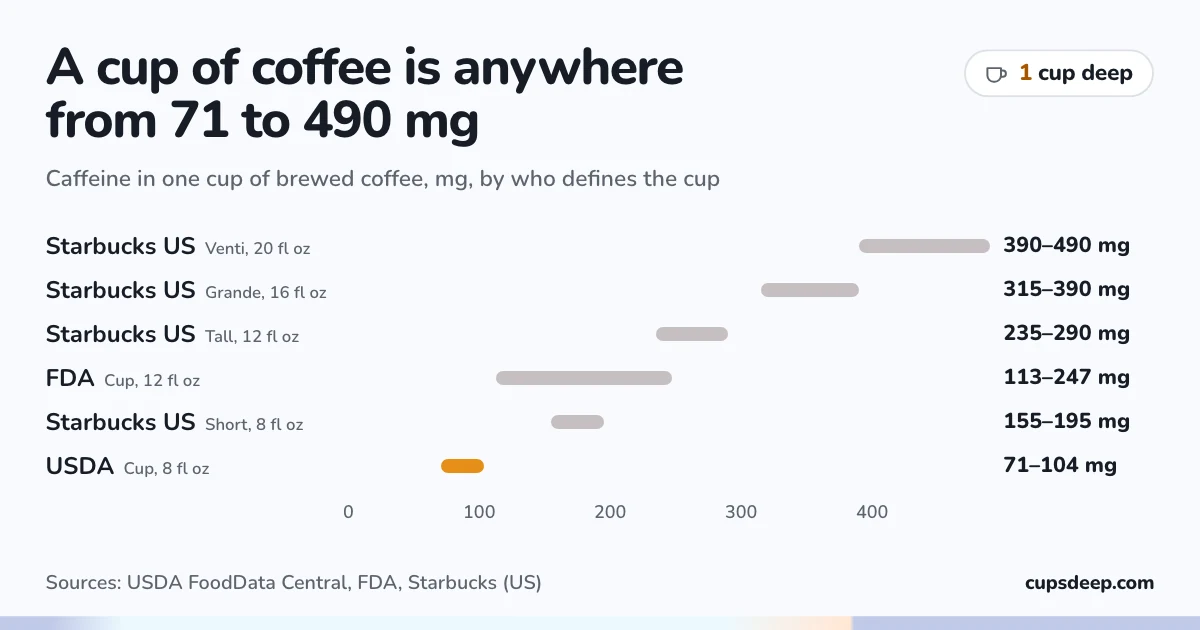
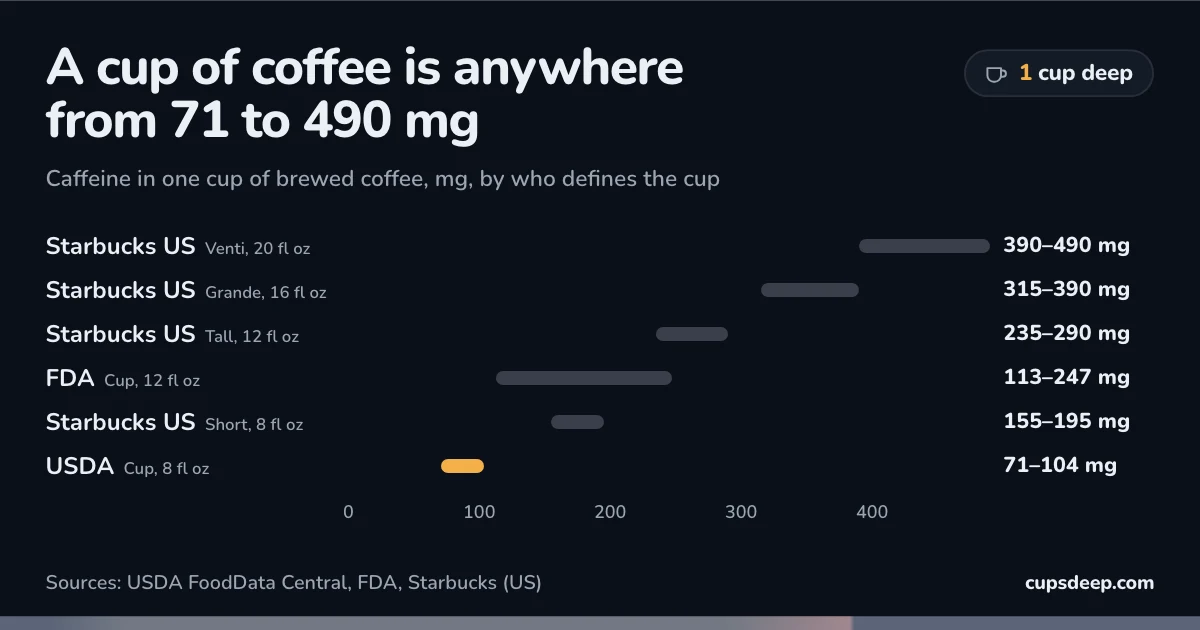
An 8 fl oz cup of brewed coffee has about 95 mg of caffeine by USDA’s figure. A Starbucks cup the same size states 155 mg to 195 mg. Tables by size and type.
Body and sleep
How long does caffeine stay in your system?
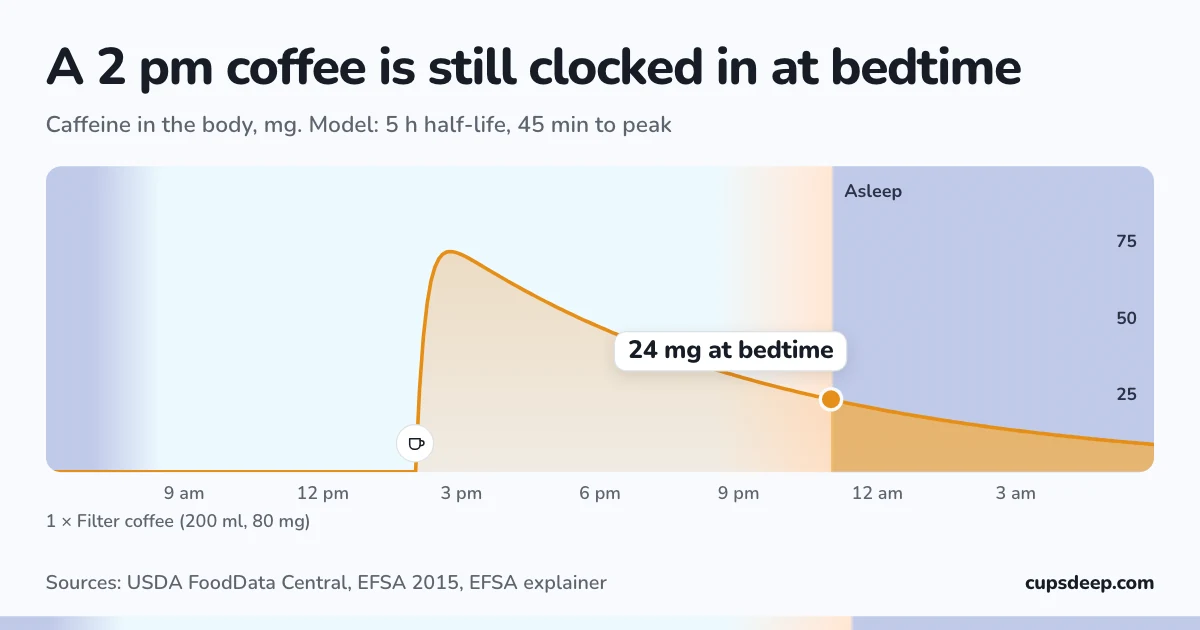
Half of a dose of caffeine is gone in about 4 hours, 2–8 hours between people. After five half-lives, 20 hours on average, 3.1% is left.