Cold brew vs iced coffee: which has more caffeine?
The roaster blogs we read for this question mostly say cold brew has more caffeine, and none of them cites a measurement. Here are the numbers: Starbucks’ own menu, size by size, the bottles in the fridge aisle, and two lab studies that brewed the same coffee hot and cold. Within one brand, cold brew usually wins. Across brands there is no rule, and the cold is only part of the reason.
The short answer
At a Starbucks counter, cold brew wins by a little: a grande Cold Brew states 205 mg of caffeine and a grande Iced Coffee 185 mg, 20 mg apart in the same 16 fl oz cup. Starbucks’ bottled cold brew is 35–135 mg ahead of its unsweetened bottled iced coffees. In the lab, at the same ratio, one study found the two matched and another had cold brew 2–27% ahead; across brands there is no rule, because the recipe decides.

Does cold brew have more caffeine than iced coffee?
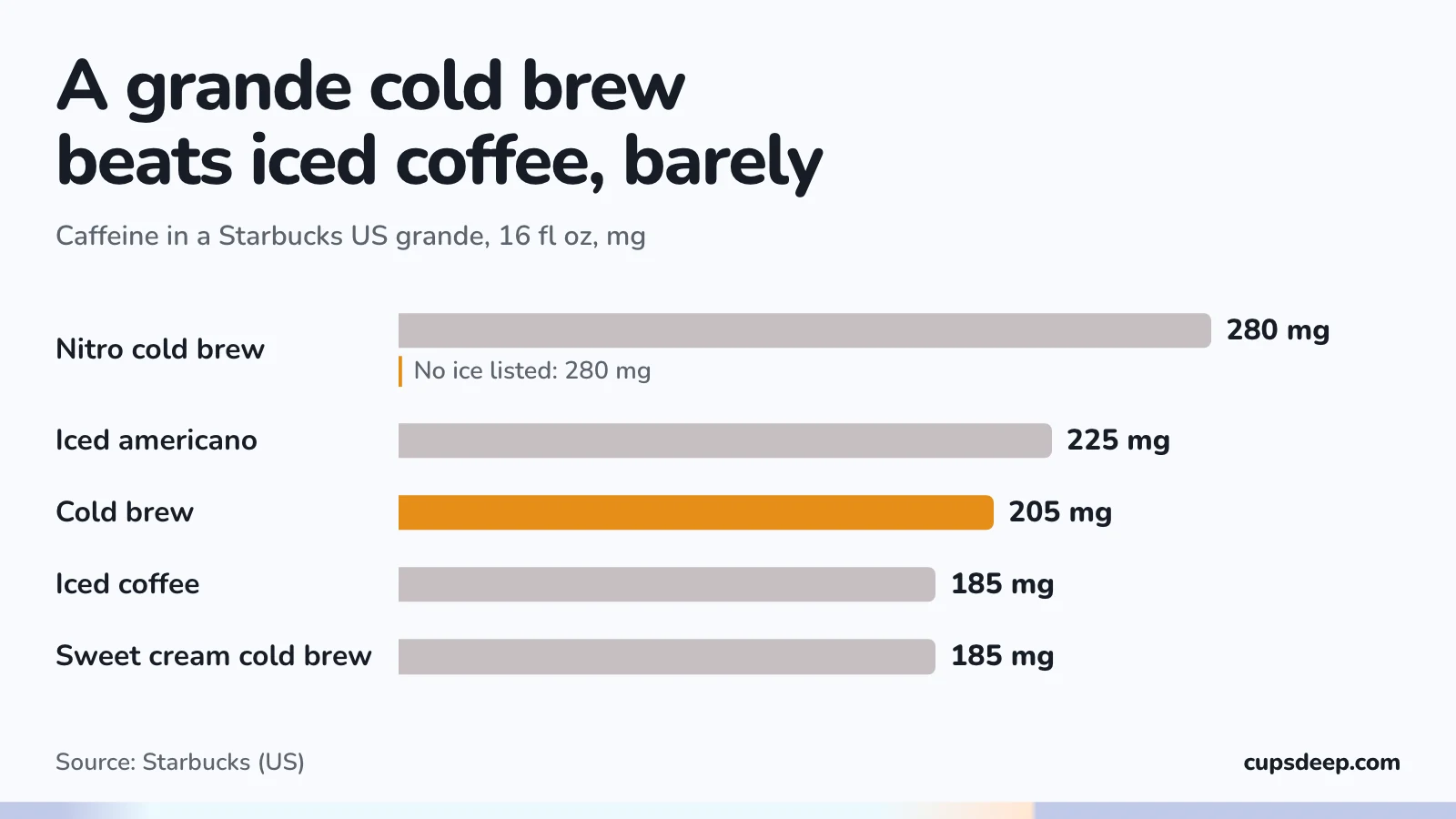
At Starbucks, yes, at every size, and by a little. The grande gap is 20 mg, about 11% more. It widens to 45 mg at venti and 40 mg at trenta, because the cups get bigger, not because the cold brew gets stronger: per fluid ounce the two stay within a couple of milligrams of each other at every size, by our arithmetic.
| Size | Iced Coffee | Cold Brew | Cold Brew per fl oz | Iced Coffee per fl oz |
|---|---|---|---|---|
| Tall, 12 fl oz | 135 mg | 155 mg | 12.9 mg per fl oz | 11.3 mg per fl oz |
| Grande, 16 fl oz | 185 mg | 205 mg | 12.8 mg per fl oz | 11.6 mg per fl oz |
| Venti, 24 fl oz | 265 mg | 310 mg | 12.9 mg per fl oz | 11 mg per fl oz |
| Trenta, 30 fl oz | 320 mg | 360 mg | 12 mg per fl oz | 10.7 mg per fl oz |
Caffeine as Starbucks US states it on each drink’s nutrition page, read on November 12, 2026. Starbucks marks caffeine as an approximate value. Per fl oz is the figure divided by the cup: our sum, not Starbucks’.
On Starbucks US’s own figures, a Cold Brew has 20 mg more caffeine than an Iced Coffee in a Tall and in a Grande, about 11% more in the Grande, 45 mg more in a Venti and 40 mg more in a Trenta. A Grande Nitro Cold Brew has 75 mg more than a Grande Cold Brew, about 37% more. Per fluid ounce, a Grande Iced Coffee is about 11.6 mg, a Grande Cold Brew 12.8 mg and a Grande Nitro 17.5 mg. These are our subtractions and divisions; Starbucks prints none of them. 48592593
So the roaster blogs we read are right about the direction and silent about the size. Swapping a grande iced coffee for a grande cold brew is a nudge, not a second coffee.
Cold brew isn’t stronger just because it’s cold. My money’s on more coffee and less ice
How much caffeine is in a Starbucks cold brew?
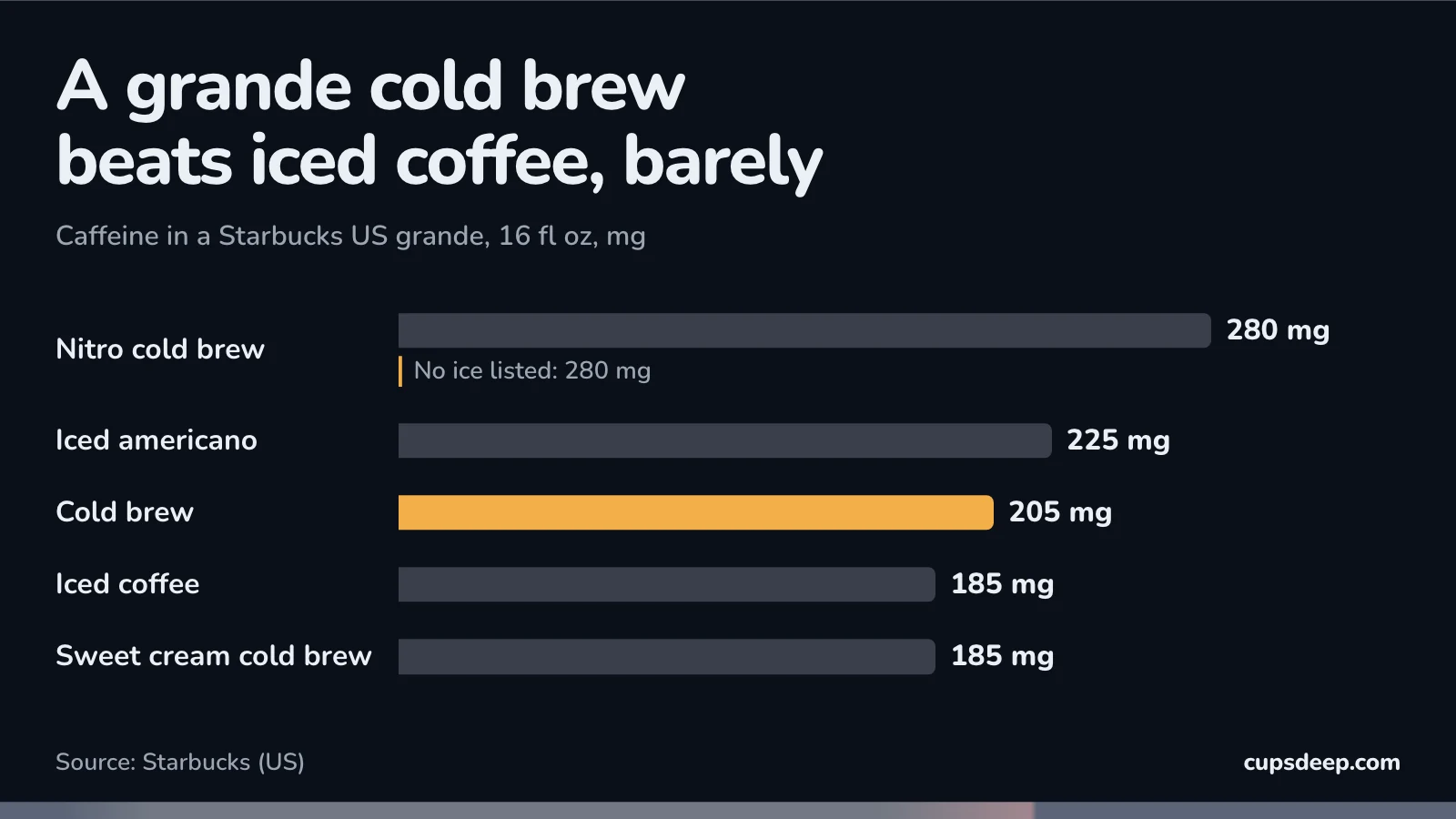
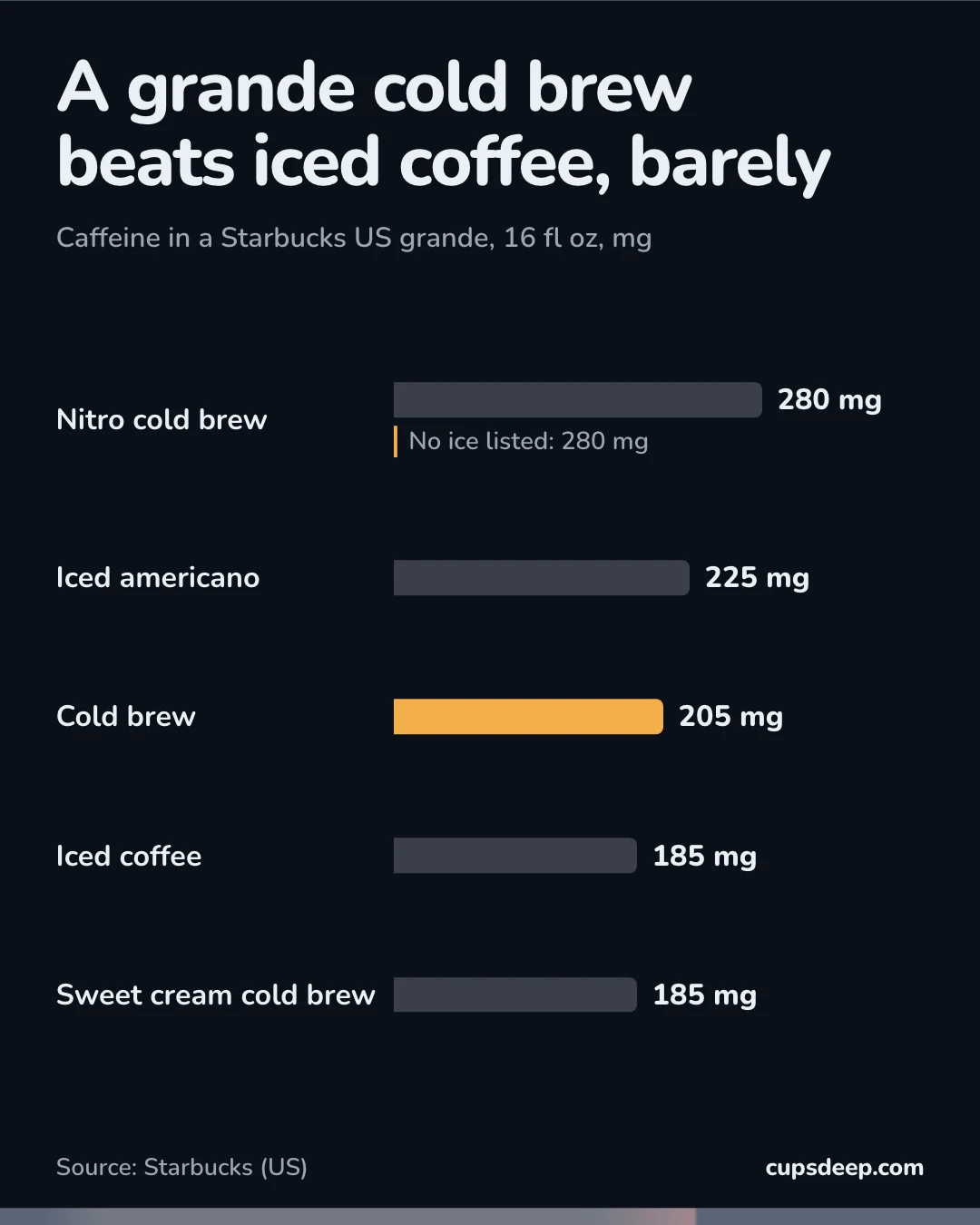
A Starbucks US Cold Brew states 155 mg in a tall, 205 mg in a grande, 310 mg in a venti and 360 mg in a trenta. The surprise on the menu is the Nitro Cold Brew: 280 mg in a grande, 75 mg more than the plain Cold Brew in the same cup.
| Drink | Caffeine | Per fl oz (our arithmetic) | Ingredients, as Starbucks lists them |
|---|---|---|---|
| Nitro Cold Brew | 280 mg | 17.5 mg per fl oz | Brewed coffee |
| Iced Caffè Americano | 225 mg | 14.1 mg per fl oz | Ice, water, brewed espresso |
| Cold Brew | 205 mg | 12.8 mg per fl oz | Brewed coffee, ice |
| Iced Coffee | 185 mg | 11.6 mg per fl oz | Brewed coffee, ice |
| Vanilla Sweet Cream Cold Brew | 185 mg | 11.6 mg per fl oz | Ice, brewed coffee, vanilla sweet cream, vanilla syrup |
Ingredients are shortened to their names. The Nitro is sold in tall and grande only.
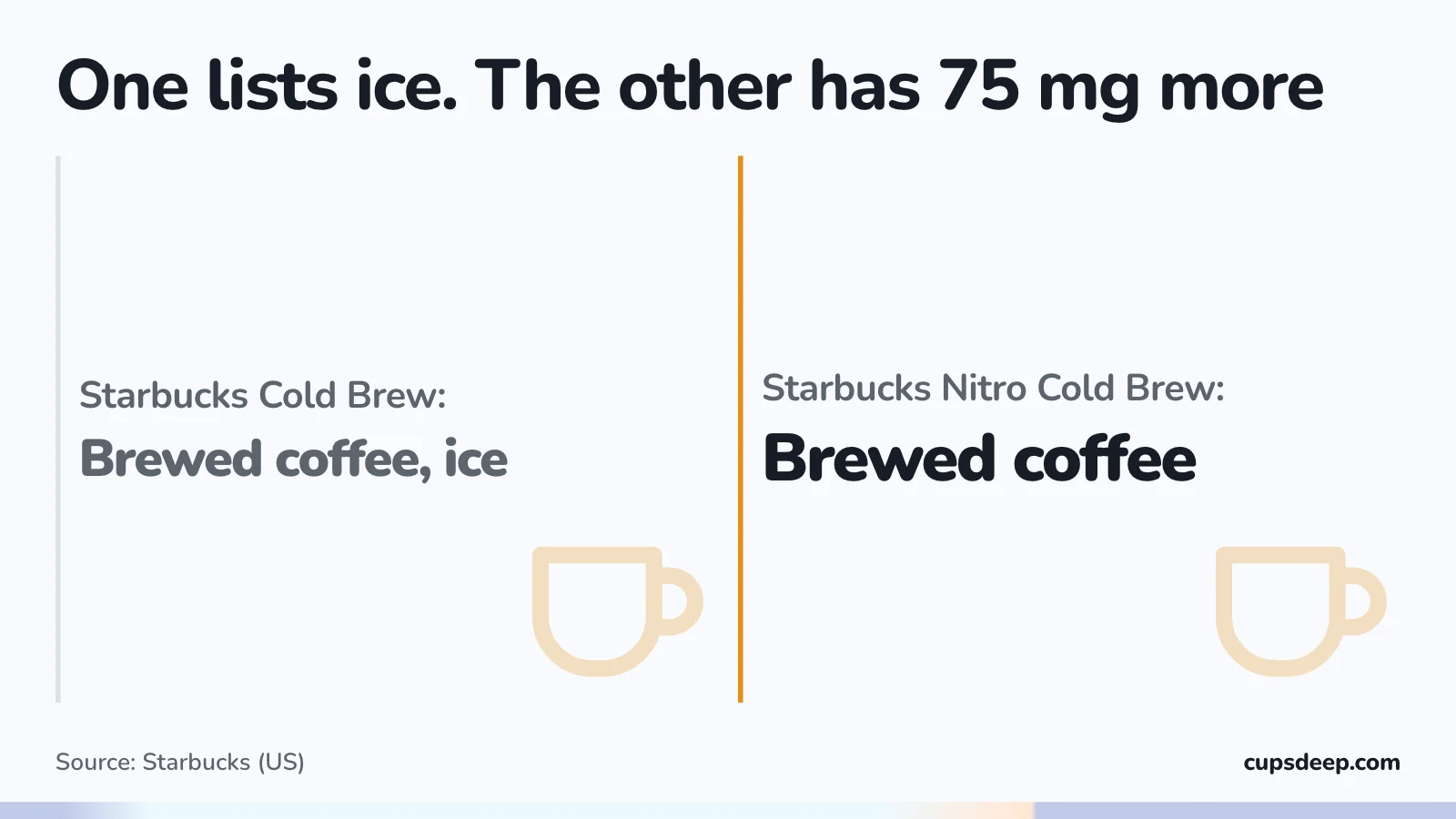
Starbucks US says its Cold Brew is “slow-steeped in cool water for 20 hours, without touching heat”. It lists the Cold Brew’s ingredients as “Brewed Coffee, Ice.” and the Iced Coffee’s as “BREWED COFFEE, ICE.” The Nitro Cold Brew lists only “BREWED COFFEE.”, with no ice. 48592593
Starbucks does not say why the Nitro is stronger. What its pages do show is that the Nitro lists no ice and the Cold Brew does. Our reading, and it is ours: ice takes up room in the cup, and room taken by ice is room not taken by coffee. The same goes for the sweet cream. A grande Vanilla Sweet Cream Cold Brew states 185 mg, less than the plain Cold Brew, with cream and syrup where some of the coffee would be.
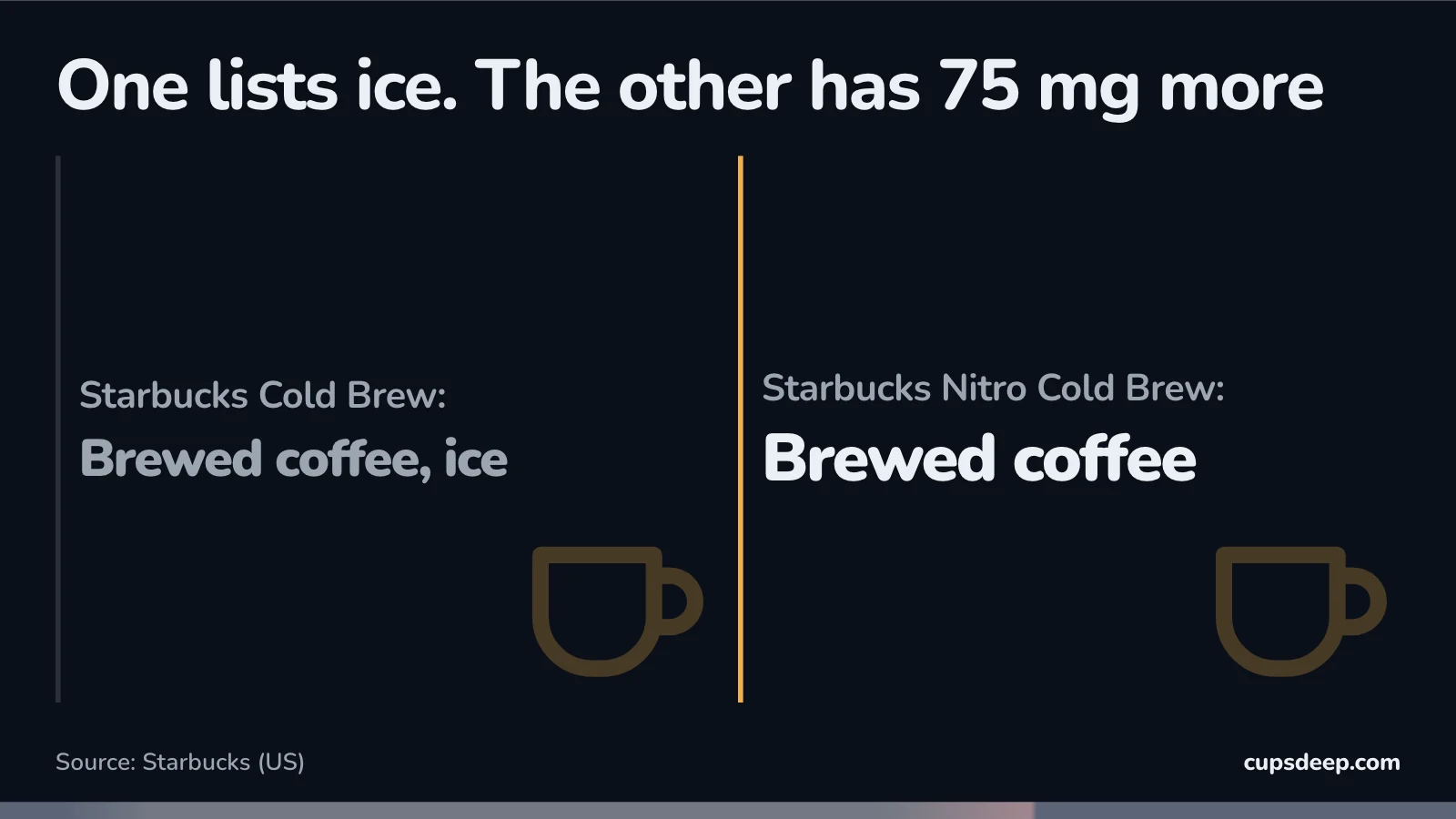
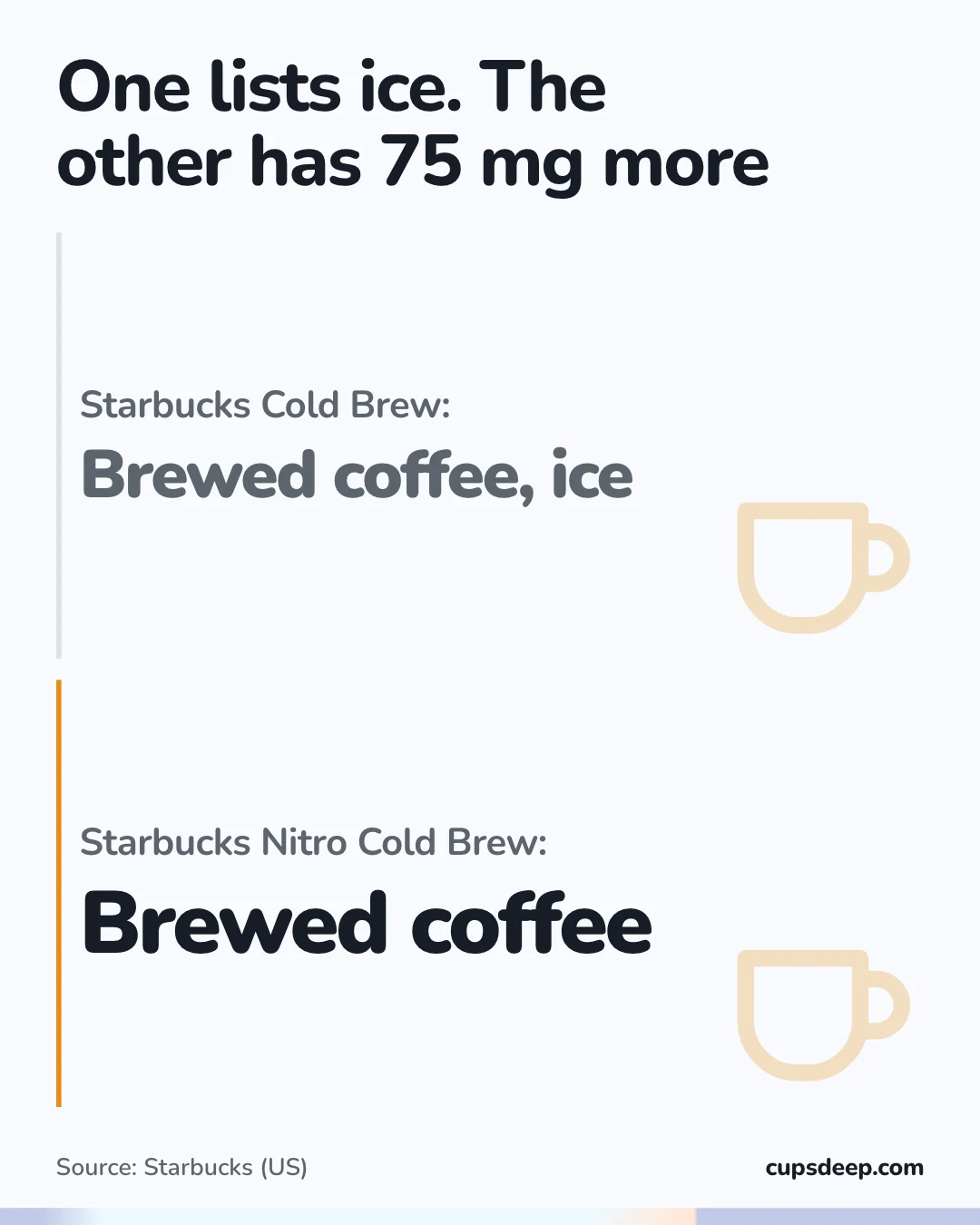
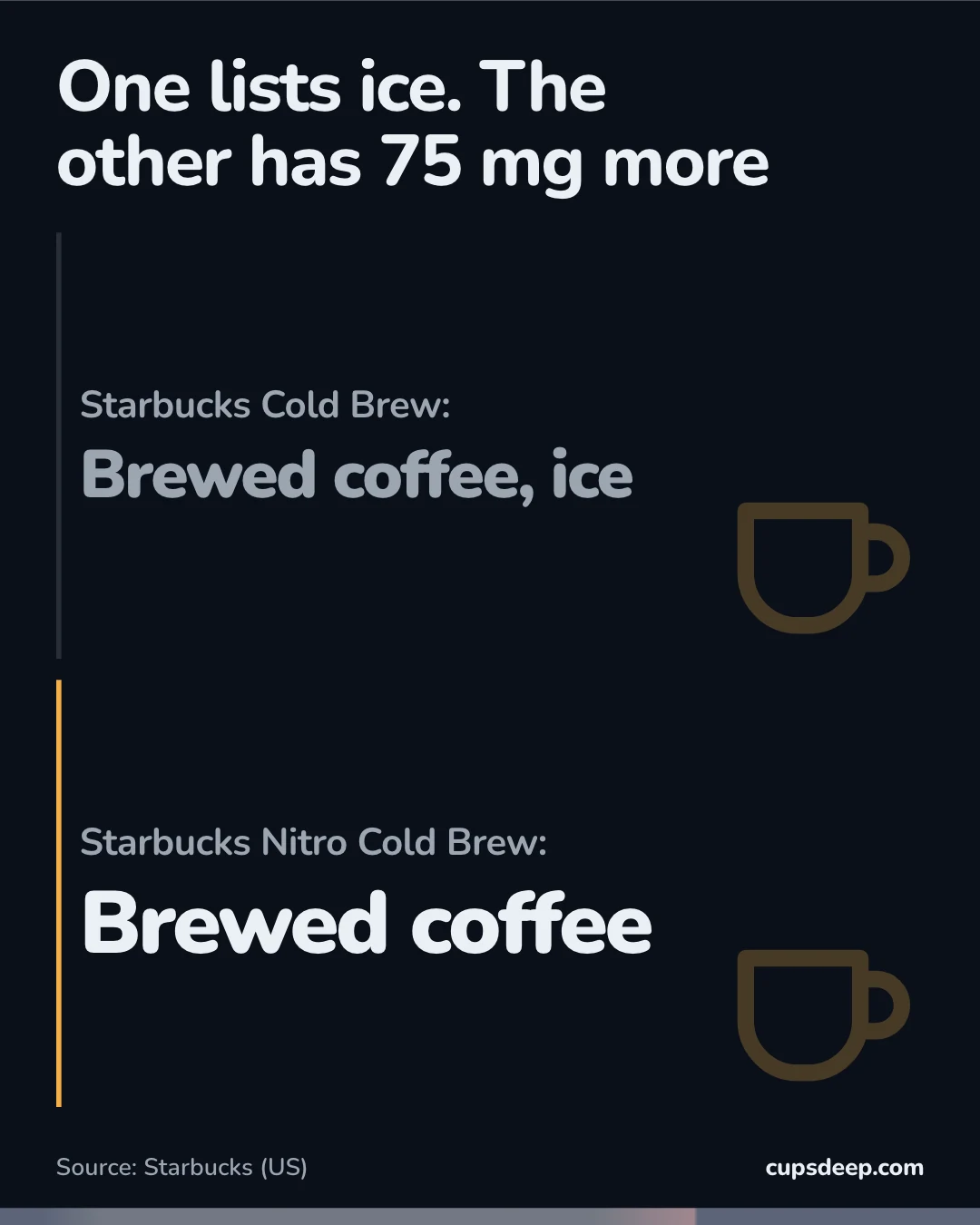
Nitro is cold brew that skipped the ice and kept the change
Of the five grandes here, the Nitro has the most. A grande hot brewed coffee still beats all of them: Starbucks states 315 mg to 390 mg for a grande Pike Place. The rest of the menu is ranked in which coffee has the most caffeine, and the drinks with none are in Starbucks drinks without caffeine.
Why does cold brew have more caffeine if it’s brewed cold?
Partly the brewing, mostly the recipe. Two lab studies brewed the same coffee both ways at the same ratio of coffee to water, which no coffee shop menu we read does, and they did not agree.
A 2020 study brewed one Colombian coffee cold (20 g in 200 mL at room temperature for 7 hours) and hot (the same ratio at 100 °C for 6 minutes). At the lightest roast cold brew held 1,114 mg of caffeine per liter and hot 1,095; at the middle roast cold 1,036 and hot 1,056. The authors found no significant difference and call the caffeine “comparable regardless of roast level or brewing temperatures”. The darkest roast’s cold figure is printed as 1,962, which contradicts the paper’s own markings and text, so it is left out here. 603
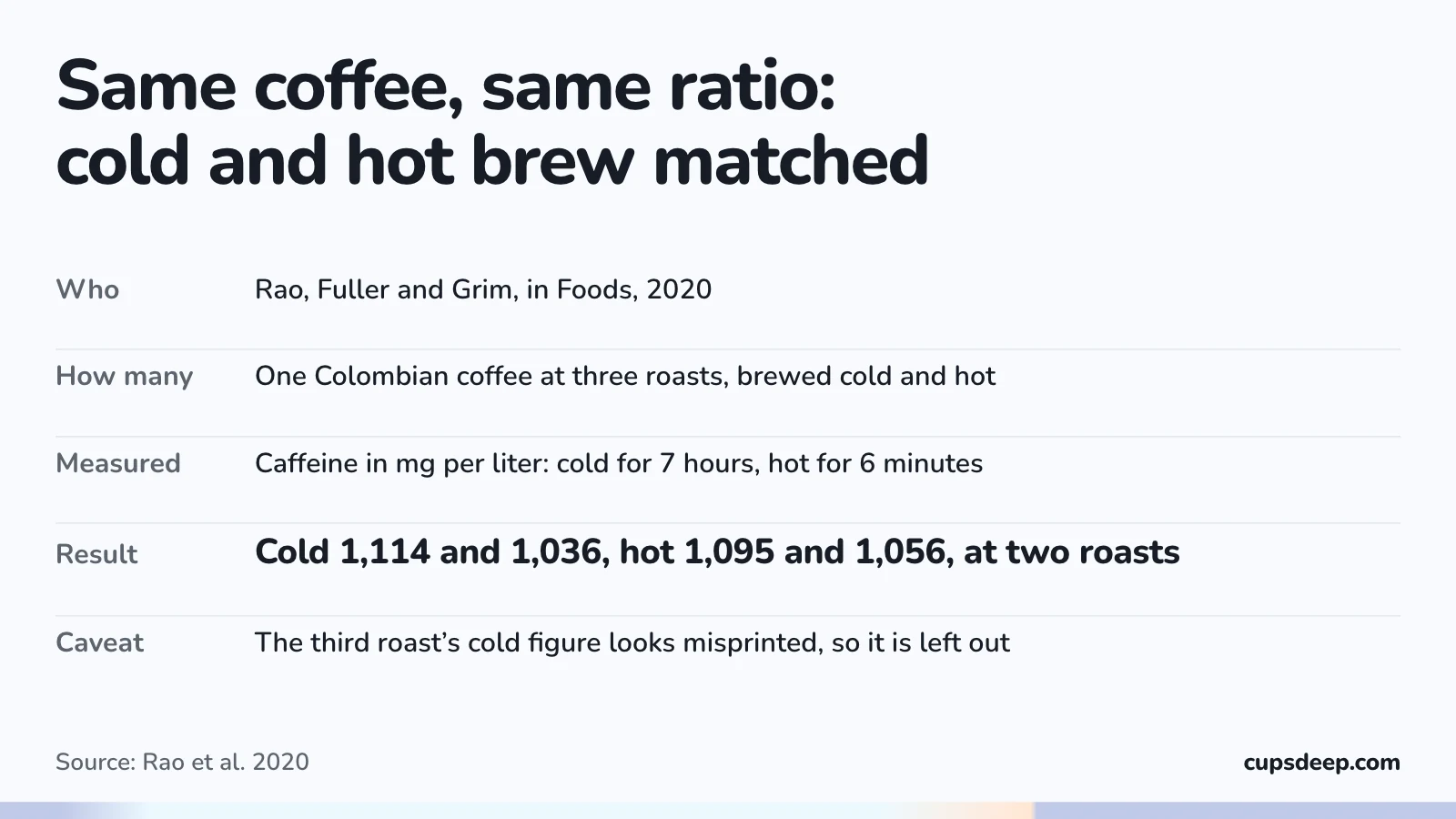
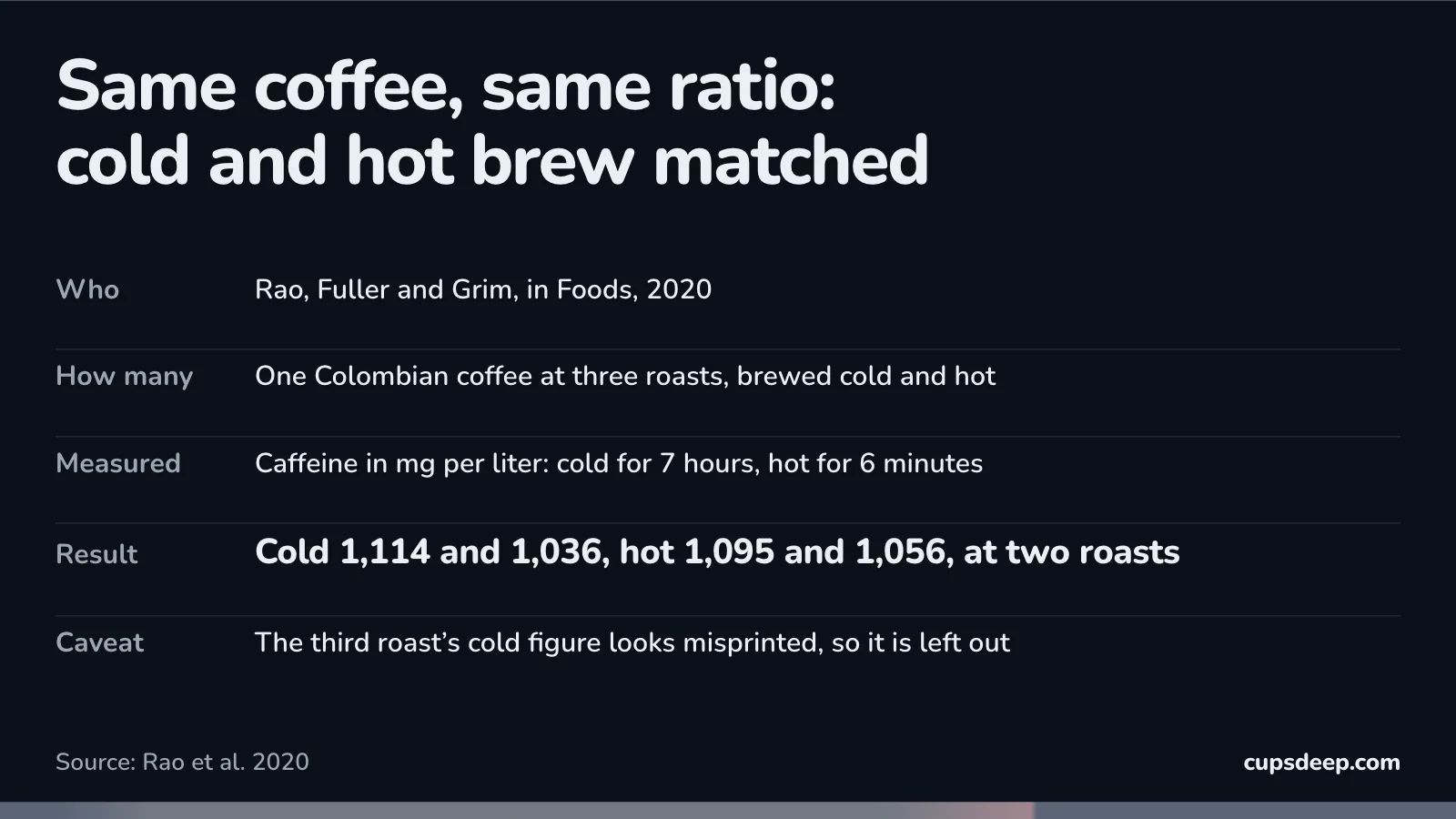
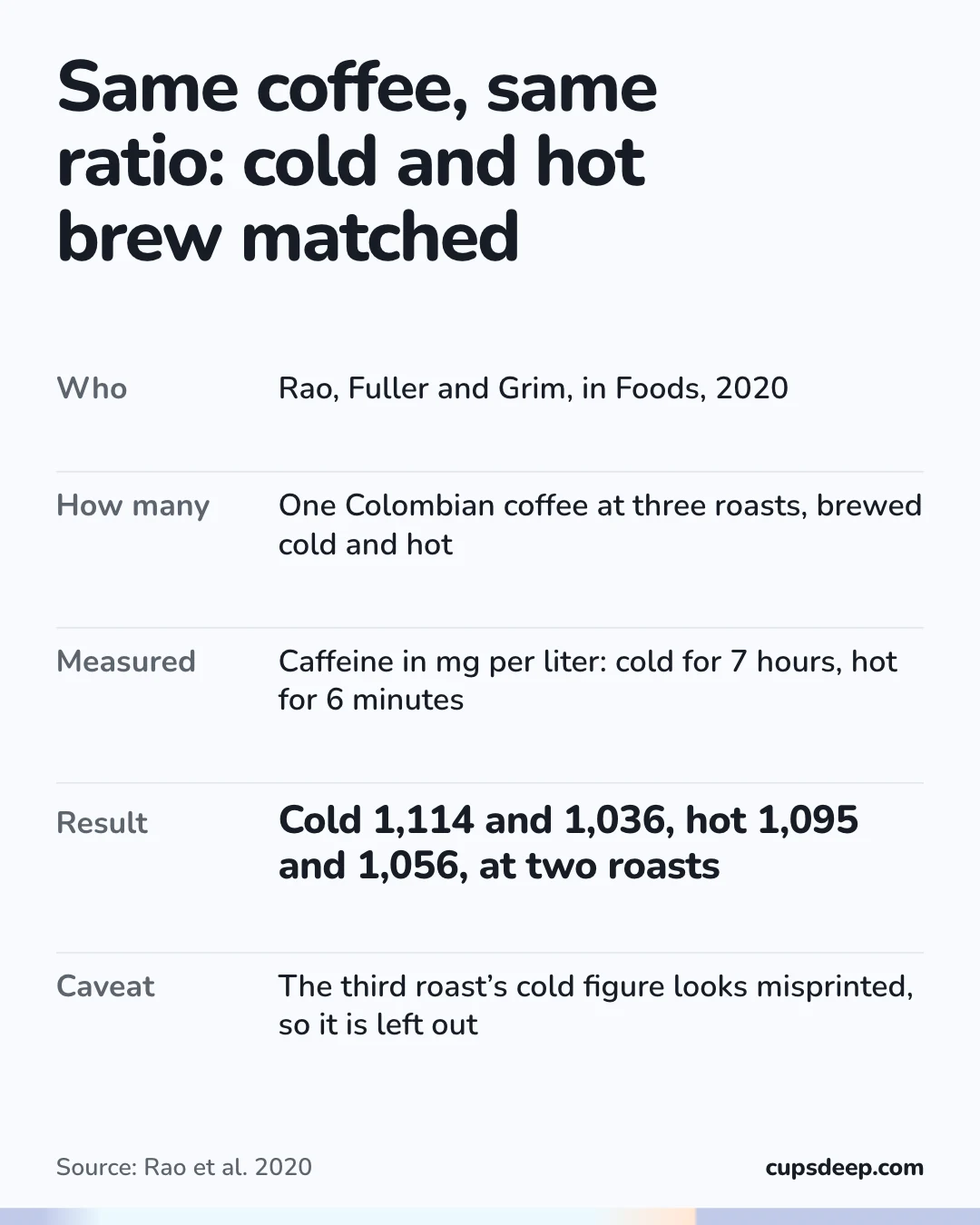
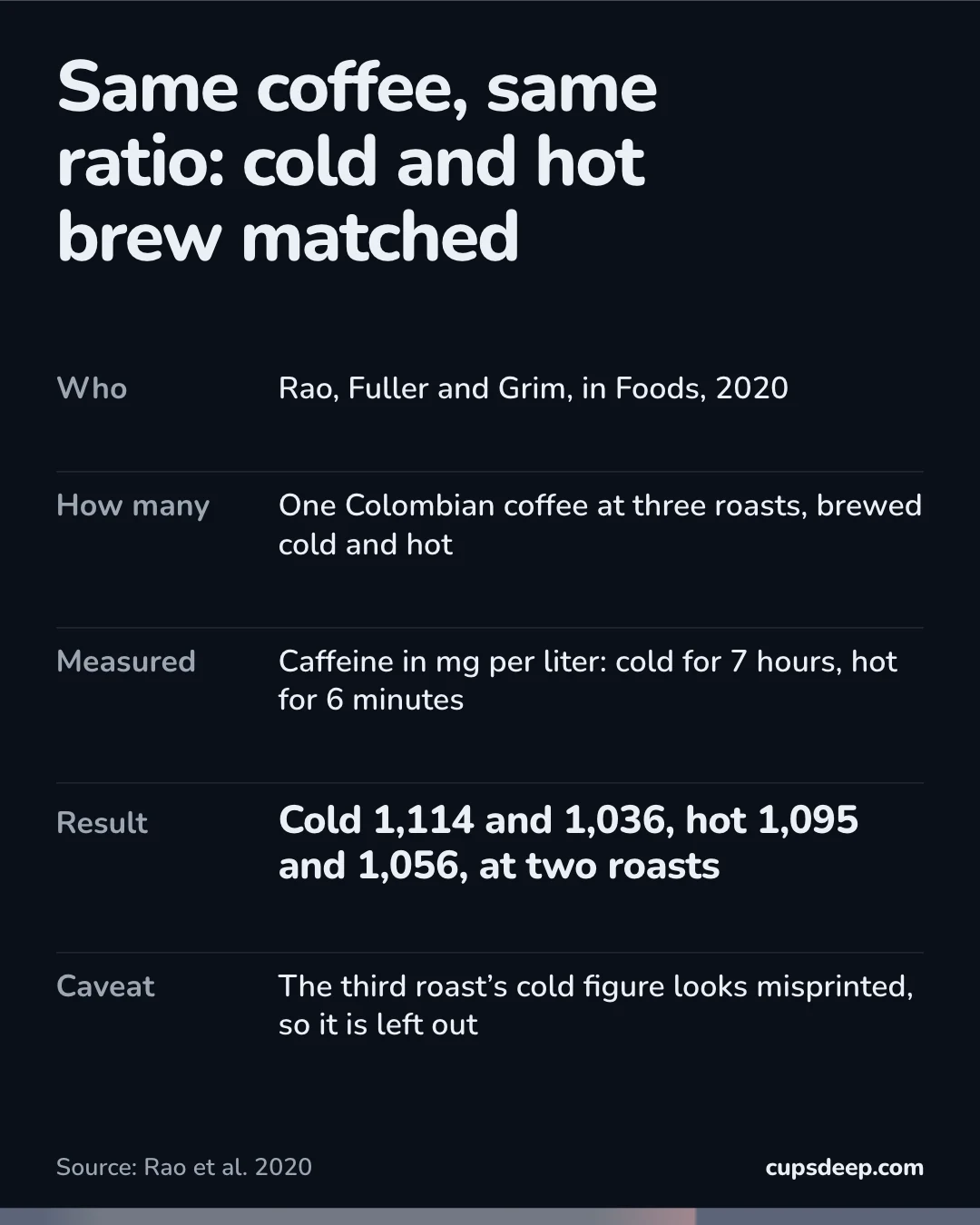
The darkest roast in that study is the awkward one. Its cold brew is printed as nearly double its hot brew, while the paper marks the pair as not different and its text calls all the caffeine values comparable. A figure that contradicts its own paper is more likely a misprint than a discovery, so we leave it out rather than guess what it should say.
In the 2017 study, brewed at the same ratio, each 24-hour cold brew held 2% to 27% more caffeine than the same coffee brewed hot for 6 minutes, by our division of the study’s means. The study found the gap clear for the two coarse grinds and not statistically significant for the two medium grinds. 57
So at the same ratio, cold brew came out level in one study and up to 27% ahead in the other. The method matters, then, but the recipe matters more. Some cold brews are drunk as brewed, some are concentrates meant to be cut with water, and how much coffee goes in, and how much water or ice goes in afterward, decides the rest. A review of eleven lab studies found cold brew anywhere from 96–360.2 mg per 200 ml, from recipes that ran from a light brew to a concentrate. That range is why the drinks page gives cold brew no single typical figure, and the method page says why.
Does steeping cold brew longer make it stronger?
Past the first few hours, barely. The 2017 study sampled its cold brews over a whole day.
In a 2017 study of four cold brews (one Kona arabica at two roasts and two grinds, 35 g in 350 mL at room temperature), caffeine reached equilibrium between 6 and 7 hours, in the authors’ words, “instead of 10 to 24 hours outlined in typical cold brew methods”. After 400 minutes the four brews held 930 to 1,130 mg of caffeine per liter; after 24 hours, 990 to 1,230. By the table’s means, the last 17 hours still added 6% to 11%; that division is ours. 57
Starbucks steeps its Cold Brew for 20 hours, by its own description. That may do something for the taste. For the caffeine, the study’s brews had nearly leveled off by 7 hours; the rest of the day added only 6–11%. If you make it at home, a longer steep is barely a stronger one: more coffee is.
I paid for a day of steeping. The caffeine clocked out after the first shift
How much caffeine is in bottled cold brew?
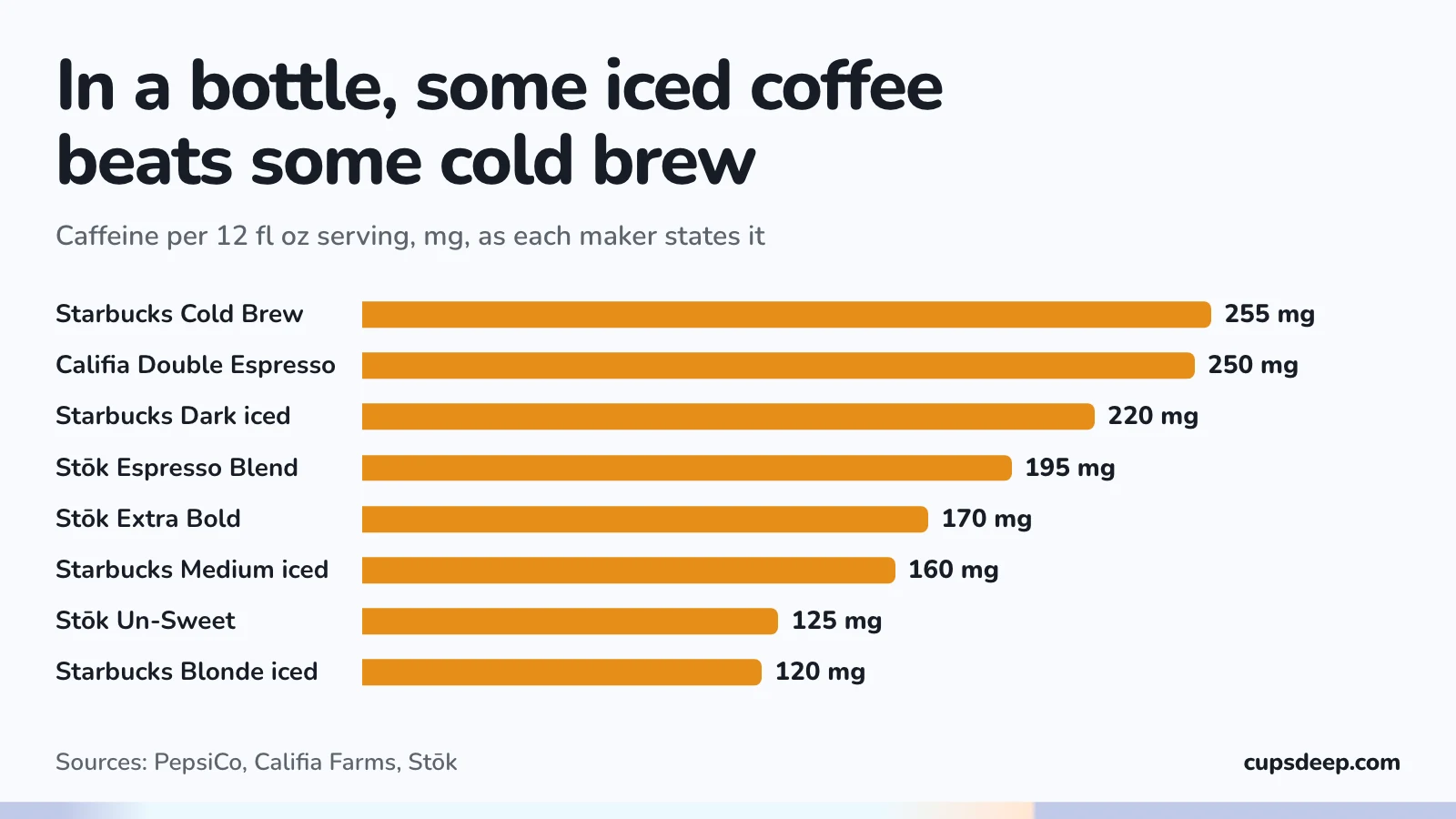
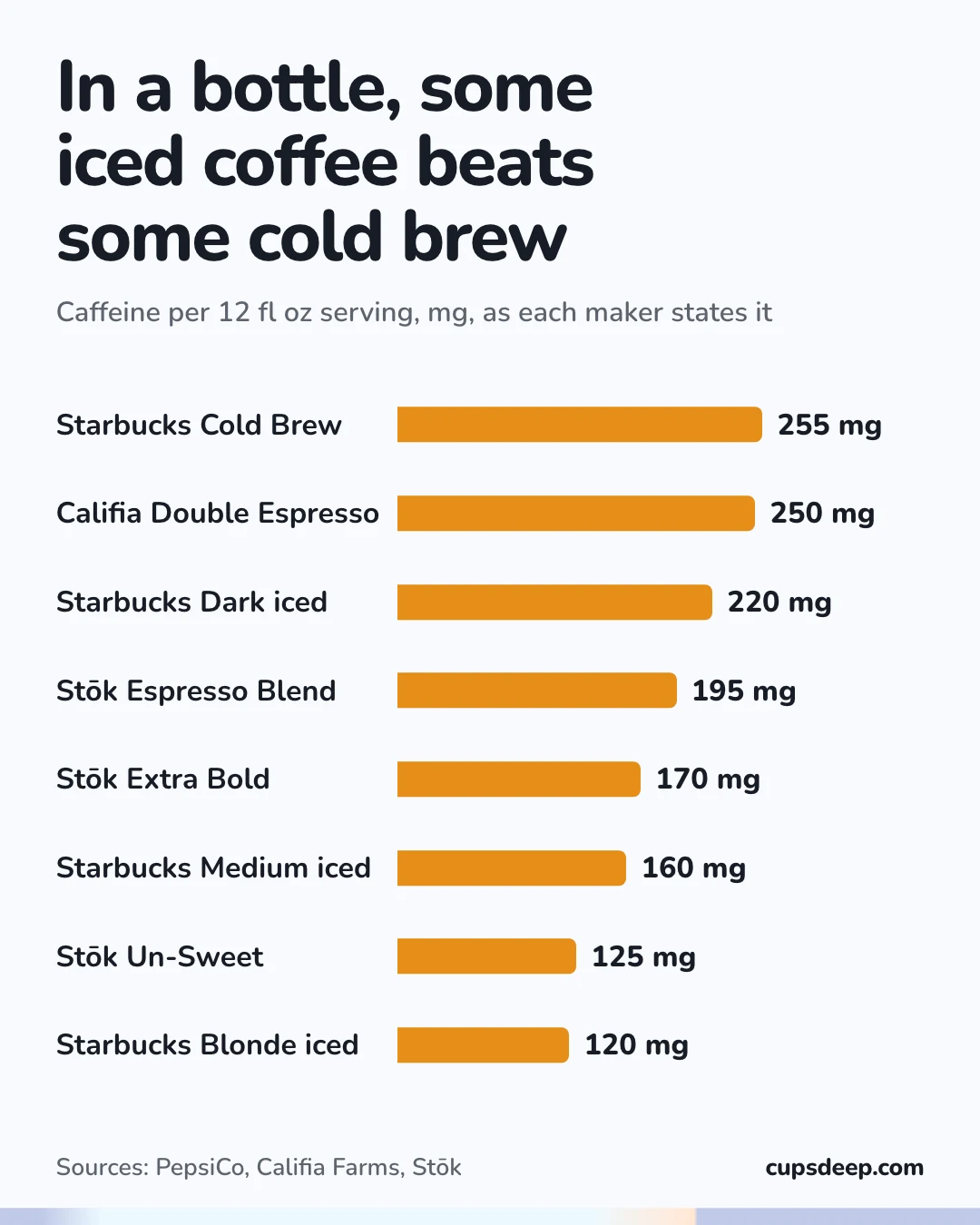
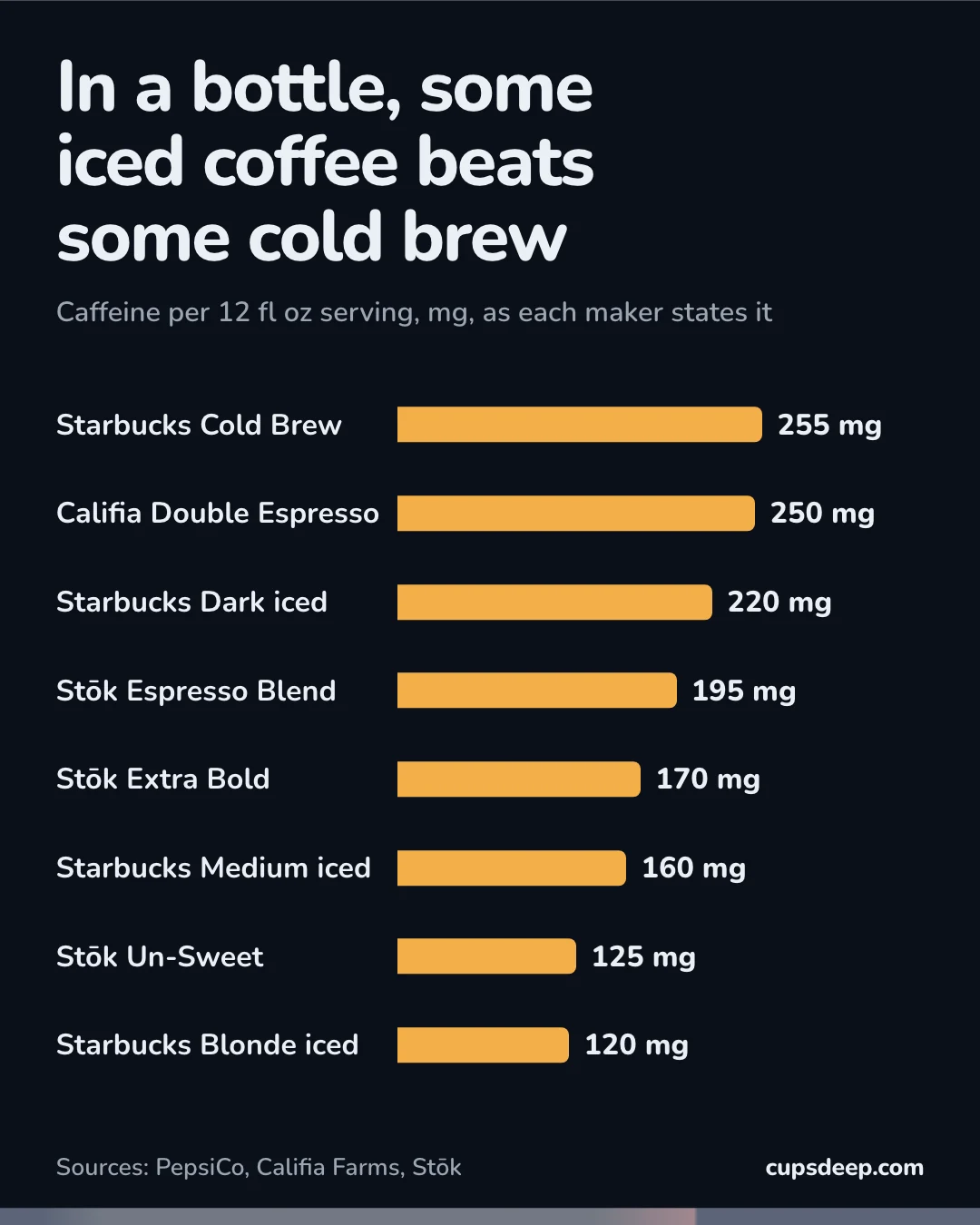
Anywhere from 125 mg to 255 mg per 12 fl oz serving among the black, unsweetened cold brews we read. Starbucks’ bottled iced coffees run from 120 mg (Blonde) to 220 mg (Dark), so the two shelves overlap almost end to end.
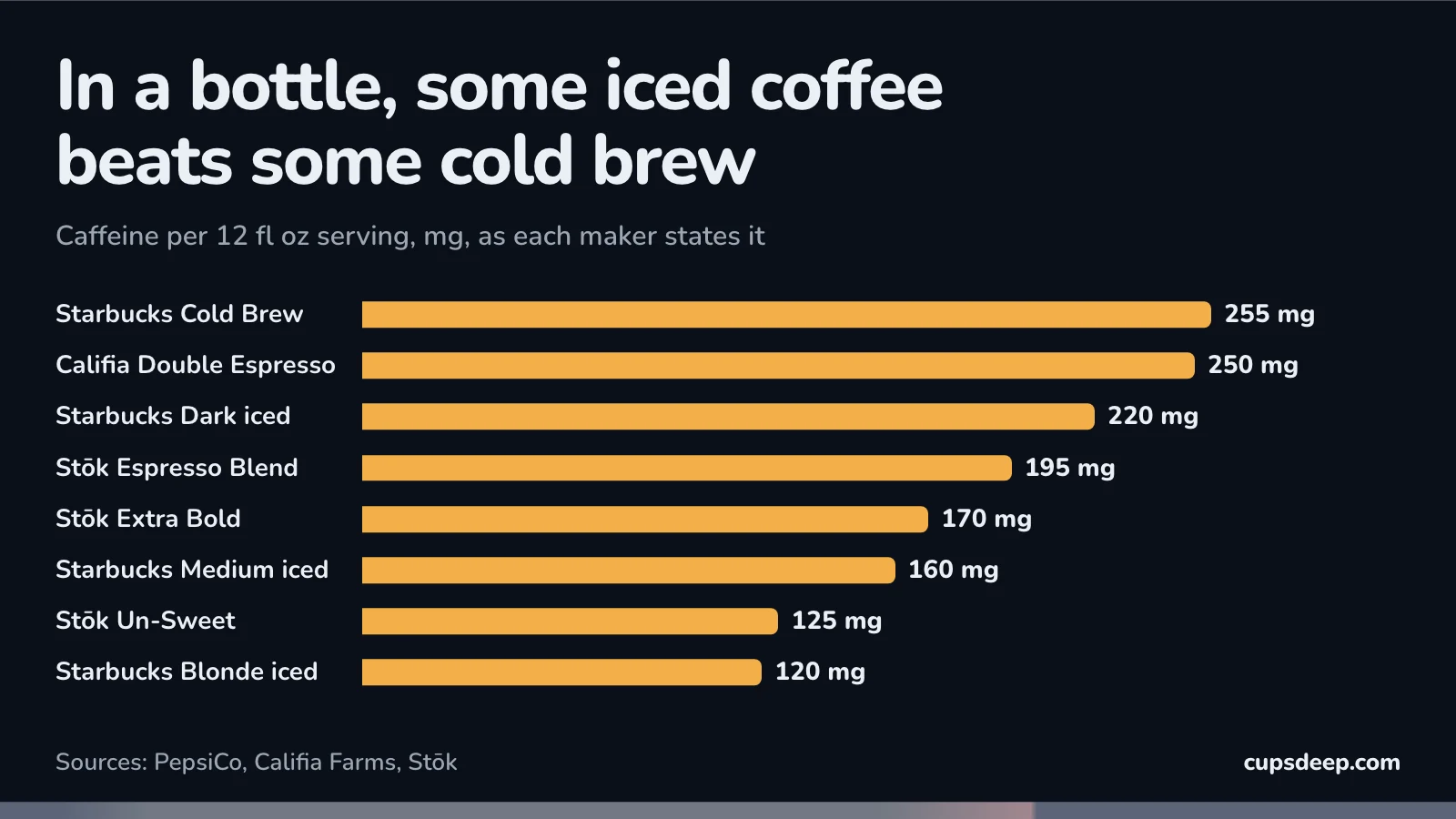
| Product | Kind | Serving | Caffeine | Per fl oz (our arithmetic) |
|---|---|---|---|---|
| Starbucks Cold Brew - Black Unsweet | Cold brew | 12 fl oz | 255 mg | 21.3 mg per fl oz |
| Califia Farms Double Espresso Cold Brew | Cold brew, caffeine added | 12 fl oz | 250 mg | 20.8 mg per fl oz |
| Starbucks Dark Roast Unsweetened Iced Coffee | Iced coffee | 12 fl oz | 220 mg | 18.3 mg per fl oz |
| STōK Black Espresso Cold Brew Unsweetened | Cold brew | 12 fl oz | 195 mg | 16.3 mg per fl oz |
| STōK Extra Bold Black Cold Brew | Cold brew | 12 fl oz | 170 mg | 14.2 mg per fl oz |
| Starbucks Medium Roast Unsweetened Iced Coffee | Iced coffee | 12 fl oz | 160 mg | 13.3 mg per fl oz |
| STōK Un-Sweet Black Cold Brew | Cold brew | 12 fl oz | 125 mg | 10.4 mg per fl oz |
| Starbucks Blonde Roast Unsweetened Iced Coffee | Iced coffee | 12 fl oz | 120 mg | 10 mg per fl oz |
| Starbucks Cold Brew - Nitro Black Unsweet | Cold brew | 1 can, 9.6 fl oz | 155 mg | 16.1 mg per fl oz |
| La Colombe Cold Brew | Cold brew | 1 can (9 oz) | 160 mg | not given |
| High Brew Nitro Cold Brew | Cold brew | 1 can | 200 mg | not given |
Read on November 12, 2026. Stōk prints its figure as approximate. La Colombe labels its can in oz, not fl oz, and High Brew prints no can size, so neither gets a per fl oz figure.
Per 12 fl oz serving, Starbucks’ bottled Cold Brew Black Unsweet has 95 mg more caffeine than its bottled Medium Roast Unsweetened Iced Coffee, about 59% more, on PepsiCo’s figures. Against Starbucks’ three unsweetened bottled iced coffees it is 35 mg (Dark Roast) to 135 mg (Blonde Roast) ahead. These are our subtractions. 237
So the brand and the roast matter as much as the brewing method. Pick up the weakest cold brew here and the darkest iced coffee, and the iced coffee wins. Two rows need a footnote each.
Califia Farms states 250 mg of caffeine per 12 fl oz serving of its Double Espresso Cold Brew, and its ingredients are “Coffee (Water, Coffee), Natural Caffeine from Green Coffee.”, so part of the caffeine is added. 601
La Colombe’s can page states 160 mg of caffeine for its 9 oz Cold Brew and calls it a “new reduced caffeine level”, noting that older cans may still be in shipments. A tile for the same can on its concentrate page still reads “9 oz, 180mg caffeine”. 596597
We print the can page’s own figure. If your can is from older stock, the label on it is the one to trust.
How much caffeine is in cold brew concentrate?
Concentrate is where cold brew can actually catch you out. The number on the label assumes you add the water.
La Colombe states 230 mg of caffeine in a 3 fl oz serving of its cold brew concentrate, which its label says makes 12 fl oz prepared. That is about 76.7 mg per fluid ounce of concentrate and about 19.2 mg per fluid ounce once made up. Poured straight, 12 fl oz of the concentrate would hold about 920 mg. The divisions and the multiplication are ours. 597
Made up as the label says, it is a strong cold brew: 19.2 mg per fl oz against 12.8 mg per fl oz for a Starbucks grande Cold Brew, both by our arithmetic. Drunk neat like a ready-made bottle, 12 fl oz of it is 920 mg. The same goes for homemade concentrate, which has no label at all: if you brew it strong to dilute later, dilute it.
The concentrate says dilute before serving. I read that the way I read terms and conditions
How many cold brews a day is too many?
EFSA concludes that caffeine intakes up to 400 mg a day from all sources, spread through the day, do not raise safety concerns for healthy adults, except pregnant women. FDA cites 400 mg a day for most adults as an amount not generally associated with negative effects, and notes wide variation in how sensitive people are to caffeine and how fast they eliminate it. 225
Two Grande Starbucks Cold Brews hold 410 mg of caffeine, just over the 400 mg a day that EFSA says raises no safety concern for healthy non-pregnant adults. One Trenta holds 360 mg. The sum is ours. 4822
So any one of these grandes fits easily, and a second grande Cold Brew tips you just past the line. The line is for a whole day, it is not a cliff, and people clear caffeine at very different speeds. The bigger question is when you drink it: caffeine’s half-life in healthy adults averages 4 hours. How long caffeine stays in your system has the rest.
Questions people ask
How much caffeine is in a cold brew?
It depends on the recipe more than the method. Lab studies reviewed together found 96–360.2 mg per 200 ml. Ready-made, a Starbucks grande states 205 mg, and black bottled cold brews we read run from 125 mg to 255 mg per 12 fl oz.
How much caffeine is in a Starbucks cold brew?
Starbucks US states 155 mg for a tall, 205 mg for a grande, 310 mg for a venti and 360 mg for a trenta. Its Iced Coffee states 135 mg, 185 mg, 265 mg and 320 mg in the same sizes.
Does nitro cold brew have more caffeine than regular cold brew?
At Starbucks, yes: a grande Nitro Cold Brew states 280 mg against 205 mg for a grande Cold Brew, 75 mg more. Starbucks lists ice in the Cold Brew and none in the Nitro.
Does a vanilla sweet cream cold brew have less caffeine?
A little. Starbucks US states 185 mg for a grande Vanilla Sweet Cream Cold Brew, against 205 mg for a plain grande Cold Brew, with cream and syrup in the cup alongside the coffee.
Is iced coffee or cold brew stronger at Starbucks?
Cold brew, at every size, by 20 mg in a grande. By our arithmetic the grande Cold Brew works out to 12.8 mg per fl oz and the grande Iced Coffee to 11.6 mg per fl oz.
Sources
Every number above links to the place it came from. How the numbers are chosen and checked is on the method page; the drink table is at /drinks. Written with AI agents, as the whole site is. A model of a typical body, not advice for pregnancy, illness or medication.
- Spilling the Beans: How Much Caffeine is Too Much?
- Quantitative Analysis of Caffeine in Roasted Coffee: A Comparison of Brewing Methods
- Scientific Opinion on the safety of caffeine
- Medium Roast - Pike Place Roast: nutrition (starbucks.com, United States)
- Cold Brew: nutrition (starbucks.com, United States)
- The Effect of Time, Roasting Temperature, and Grind Size on Caffeine and Chlorogenic Acid Concentrations in Cold Brew Coffee
- Caffeine - PepsiCo Product Facts
- Iced Coffee: nutrition (starbucks.com, United States)
- Nitro Cold Brew: nutrition (starbucks.com, United States)
- Vanilla Sweet Cream Cold Brew: nutrition (starbucks.com, United States)
- Iced Caffè Americano: nutrition (starbucks.com, United States)
- Cold Brew (La Colombe)
- Cold Brew Concentrate (La Colombe)
- STōK Unsweetened Black Cold Brew Coffee, 48 oz
- STōK Extra Bold Black Cold Brew Coffee, 48 oz
- STōK Black Espresso Cold Brew Coffee Unsweetened, 48 oz
- Double Espresso Cold Brew (Califia Farms)
- Nitro Cold Brew (High Brew Coffee)
- Physiochemical Characteristics of Hot and Cold Brew Coffee Chemistry: The Effects of Roast Level and Brewing Temperature on Compound Extraction (Rao, Fuller and Grim). Foods 2020;9(7):902, via PubMed Central
Keep reading
Coffee
Which coffee has the most caffeine?
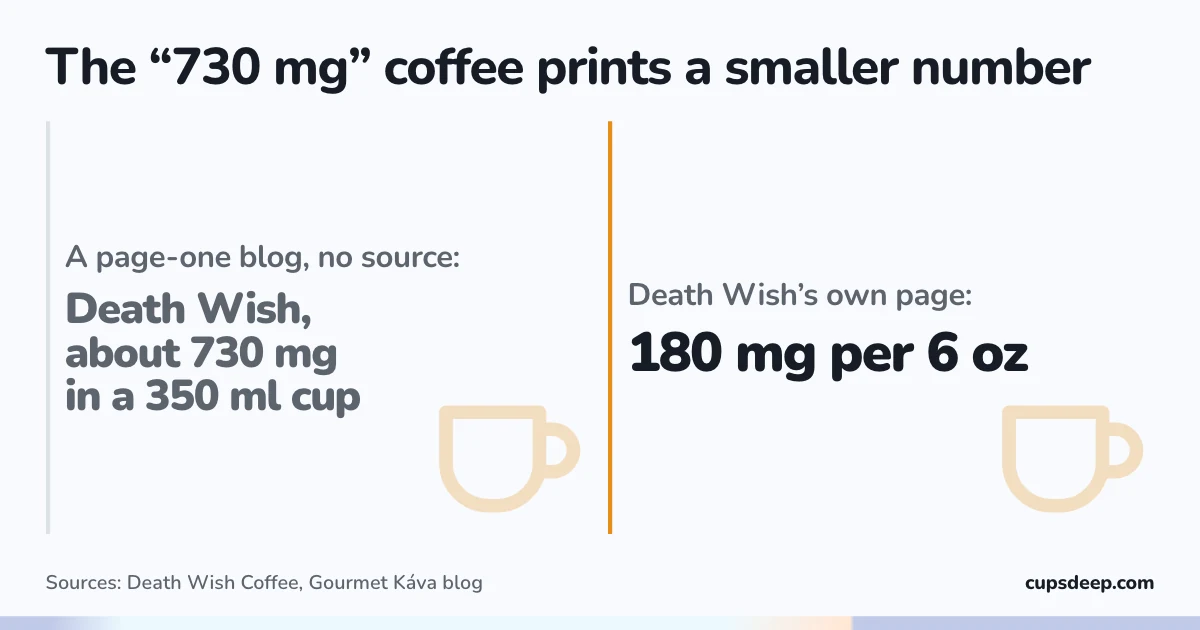
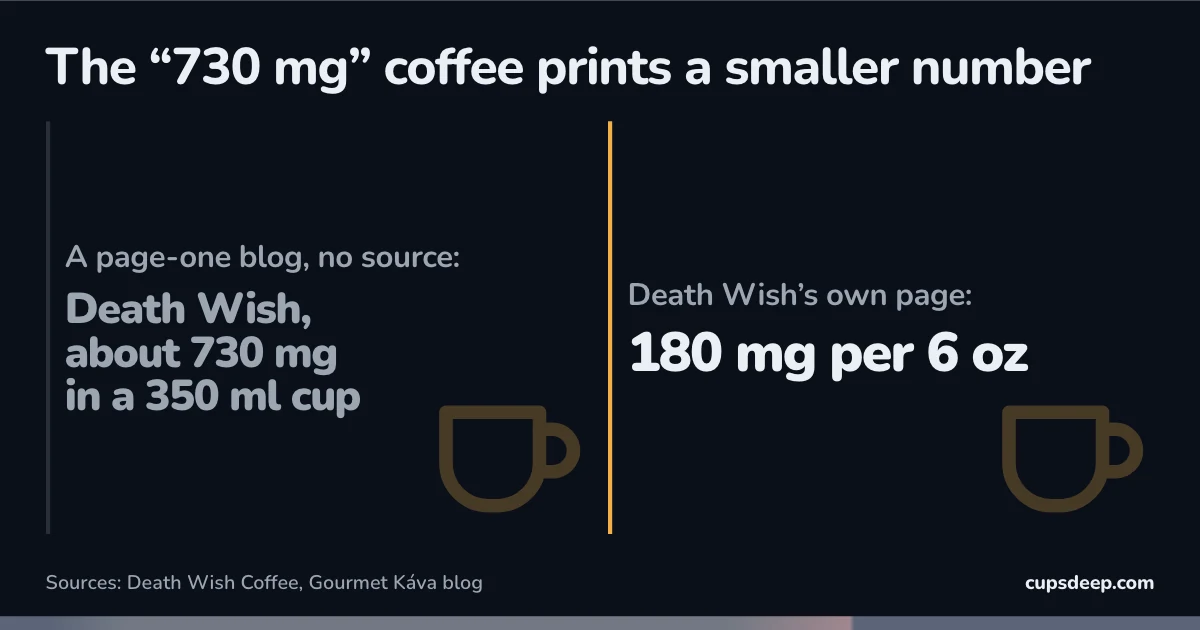
A Starbucks Venti drip states 390–490 mg. Death Wish states 180 mg per 6 oz, not the 730 mg a page-one blog gives. Ranked by the makers’ own pages.
Coffee
How much caffeine is in a cup of coffee?
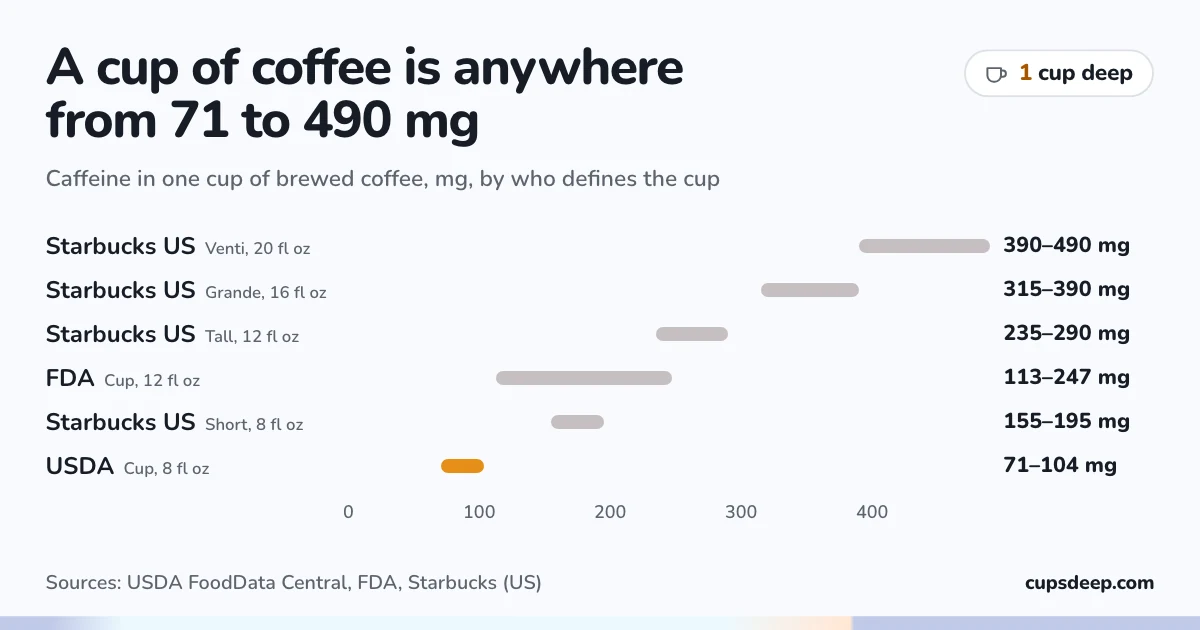
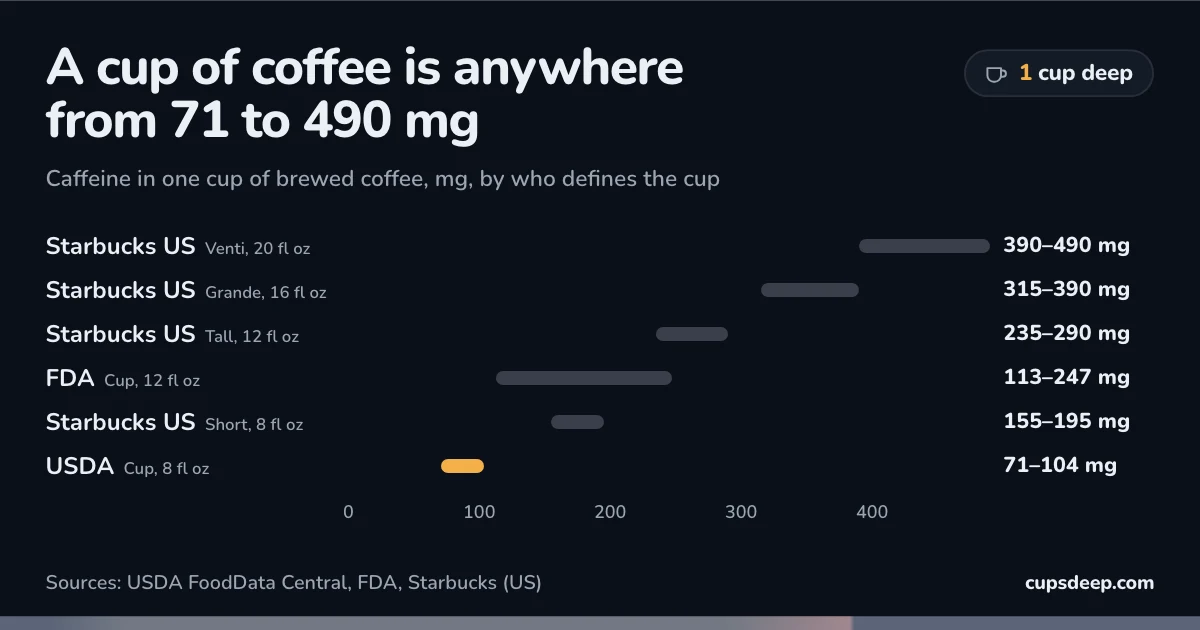
An 8 fl oz cup of brewed coffee has about 95 mg of caffeine by USDA’s figure. A Starbucks cup the same size states 155 mg to 195 mg. Tables by size and type.

Coffee
Starbucks drinks without caffeine, and the ones that only look it
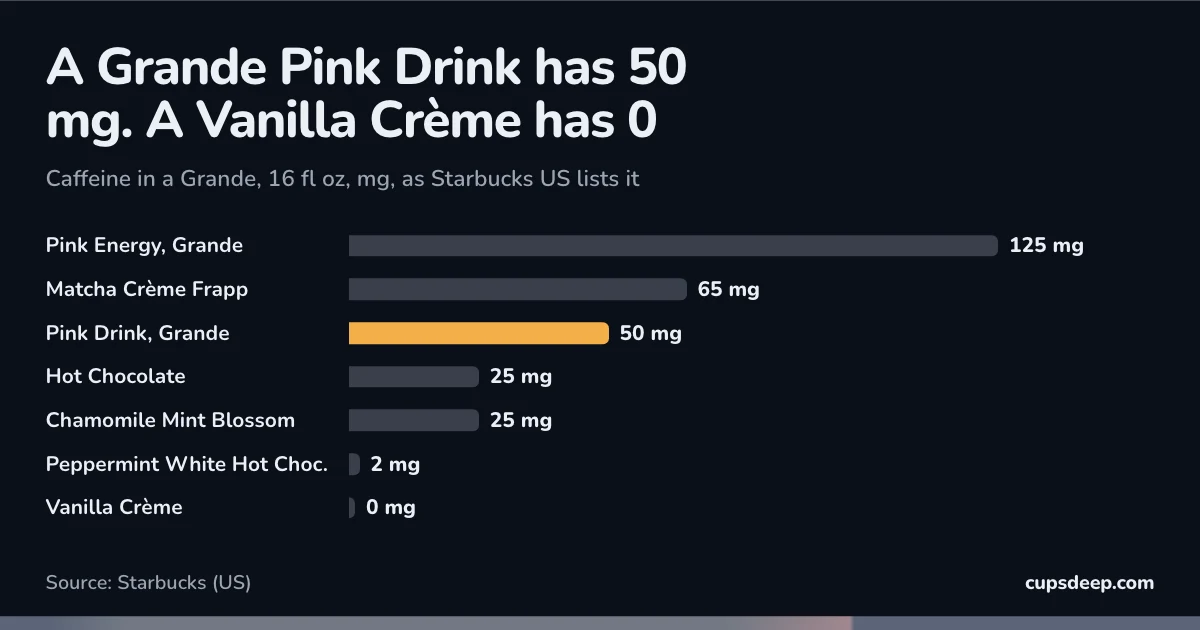
Starbucks lists Crème Frappuccinos (bar matcha), Vanilla Crème, Mint Majesty and lemonade at 0 mg. A Grande Pink Drink has 50 mg unless ordered caffeine-free.