Caffeine withdrawal: symptoms and timeline
The clock is easy to find. The odds are harder, so here are both: when it starts, when it is worst, how likely it is to be you, and why the fastest cure is the thing you just gave up.
The short answer
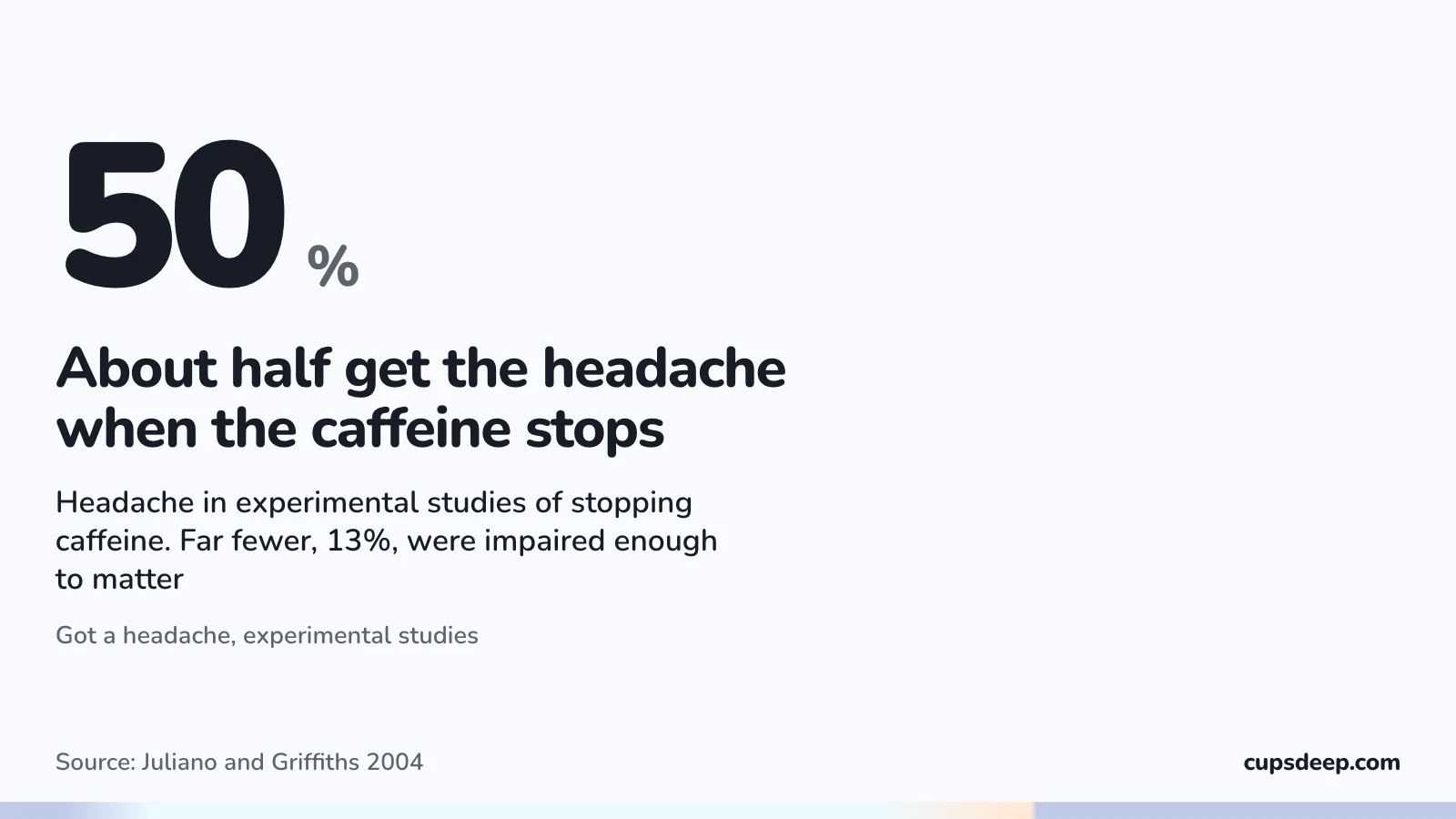
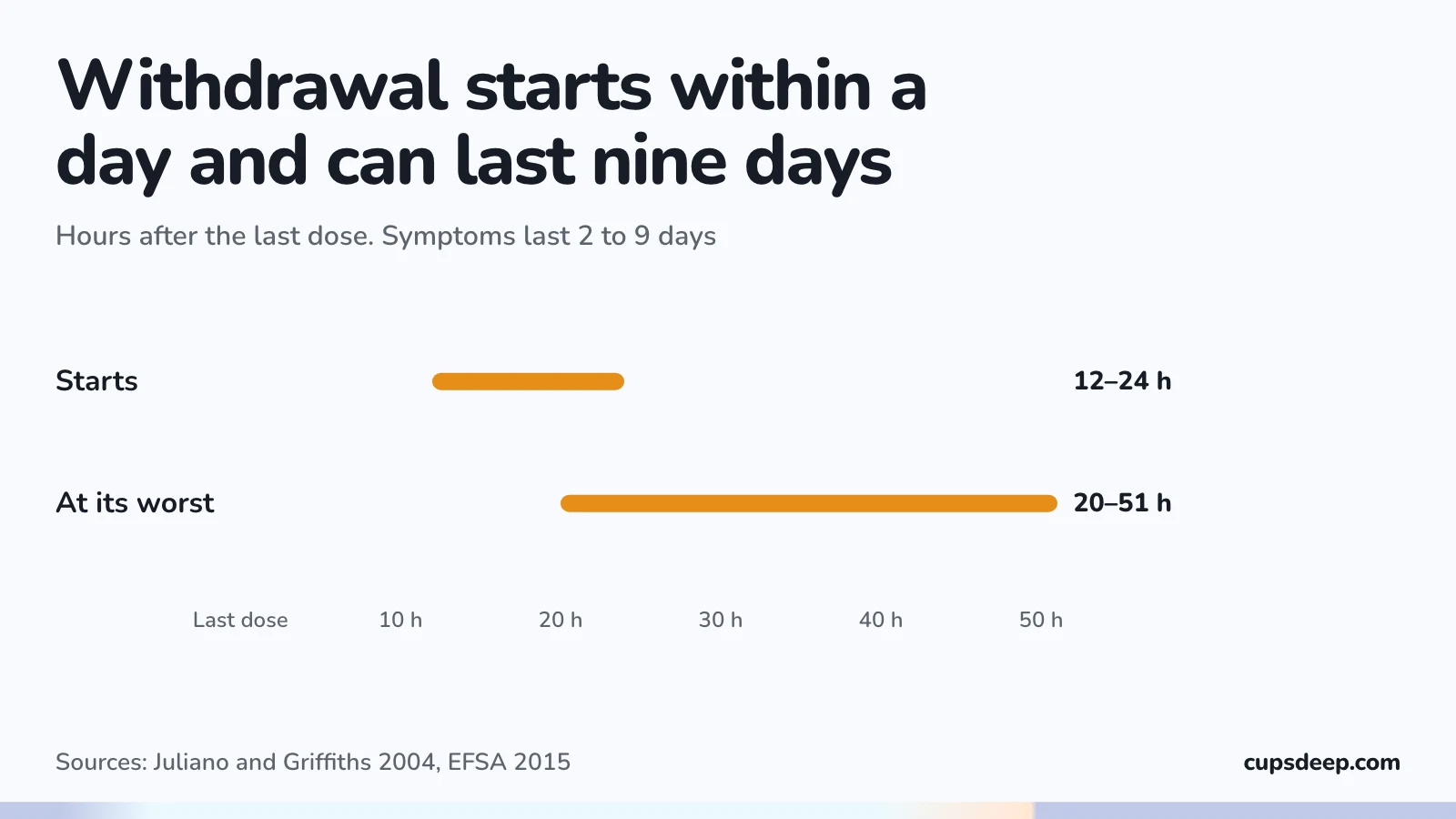
Caffeine withdrawal typically starts 12–24 hours after your last caffeine, is at its worst at 20–51 hours and is over in 2–9 days. The main symptoms are headache, fatigue, drowsiness, low mood, irritability and trouble concentrating. In experiments about half of people get the headache and 13% are impaired enough to matter, and a habit of 100 mg/day is enough to cause it.

What are the symptoms of caffeine withdrawal?
There are three piles, and they are easy to tip into one. The review that tested every claimed symptom against the evidence sorted them like this.
- Validated: headache, fatigue, decreased energy, decreased alertness, drowsiness, decreased contentedness, depressed mood, difficulty concentrating, irritability, and feeling foggy or not clearheaded.
- Likely: flu-like symptoms, nausea or vomiting, and muscle pain or stiffness.
- Not on either list: anxiety and dizziness. Both turn up in individual reports; neither made the cut.
The headache is the famous one: diffuse, throbbing, and gradual in arriving. The rest is the part people blame on Monday. And it is not in your head in the dismissive sense. The same review found that expecting to feel bad is not what mainly drives it, and it has been a formal diagnosis for years. It is also most of what people call the caffeine crash, as why caffeine makes you tired lays out.
Caffeine withdrawal is a diagnosis in the DSM-5. It requires prolonged daily use, then stopping or cutting down, followed within 24 hours by three or more of five signs: headache; marked fatigue or drowsiness; dysphoric or depressed mood or irritability; difficulty concentrating; and flu-like symptoms (nausea, vomiting, or muscle pain or stiffness). The symptoms must also cause clinically significant distress or impairment. 189
0 cups deep and it shows
How long does caffeine withdrawal last?
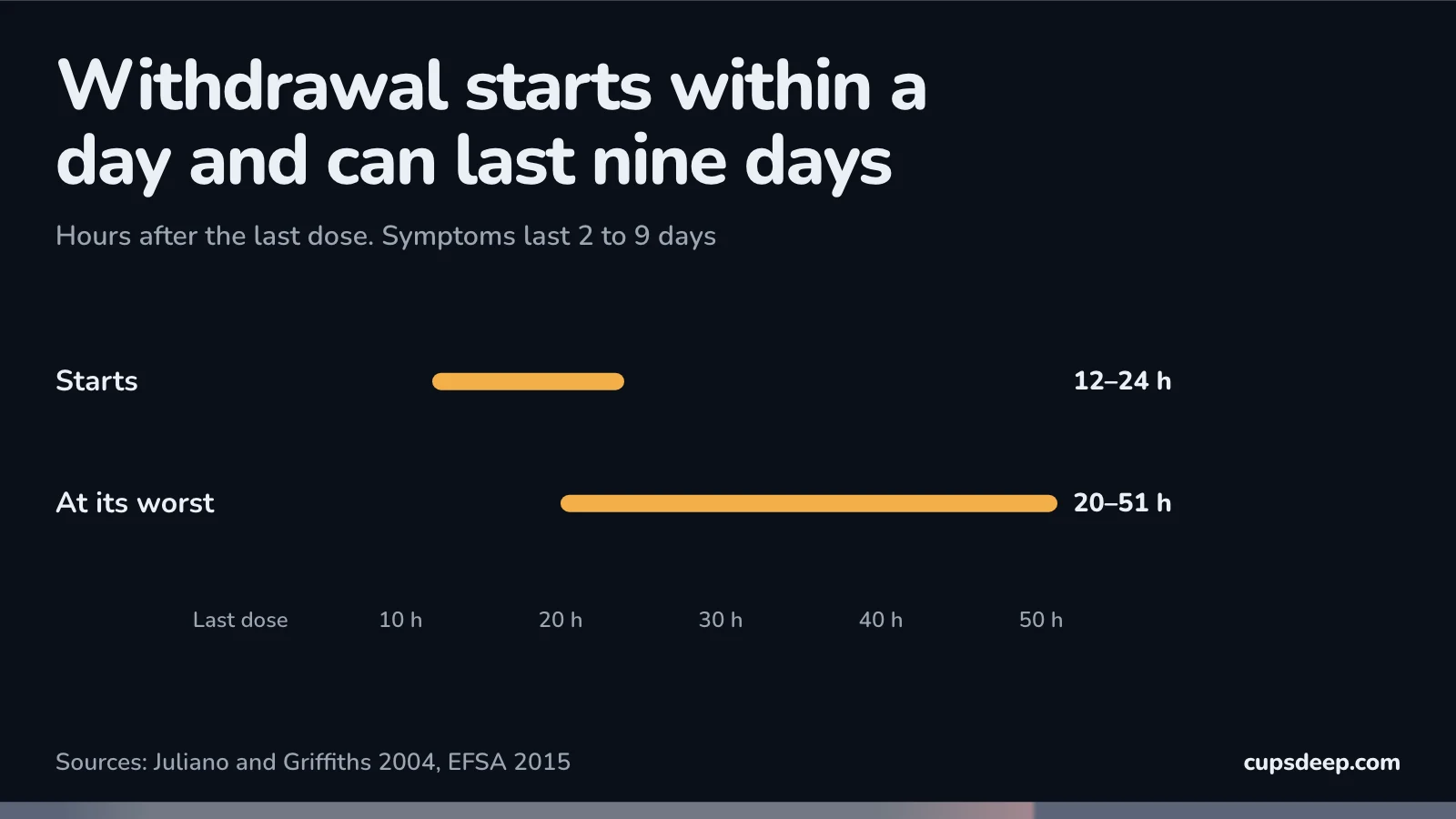
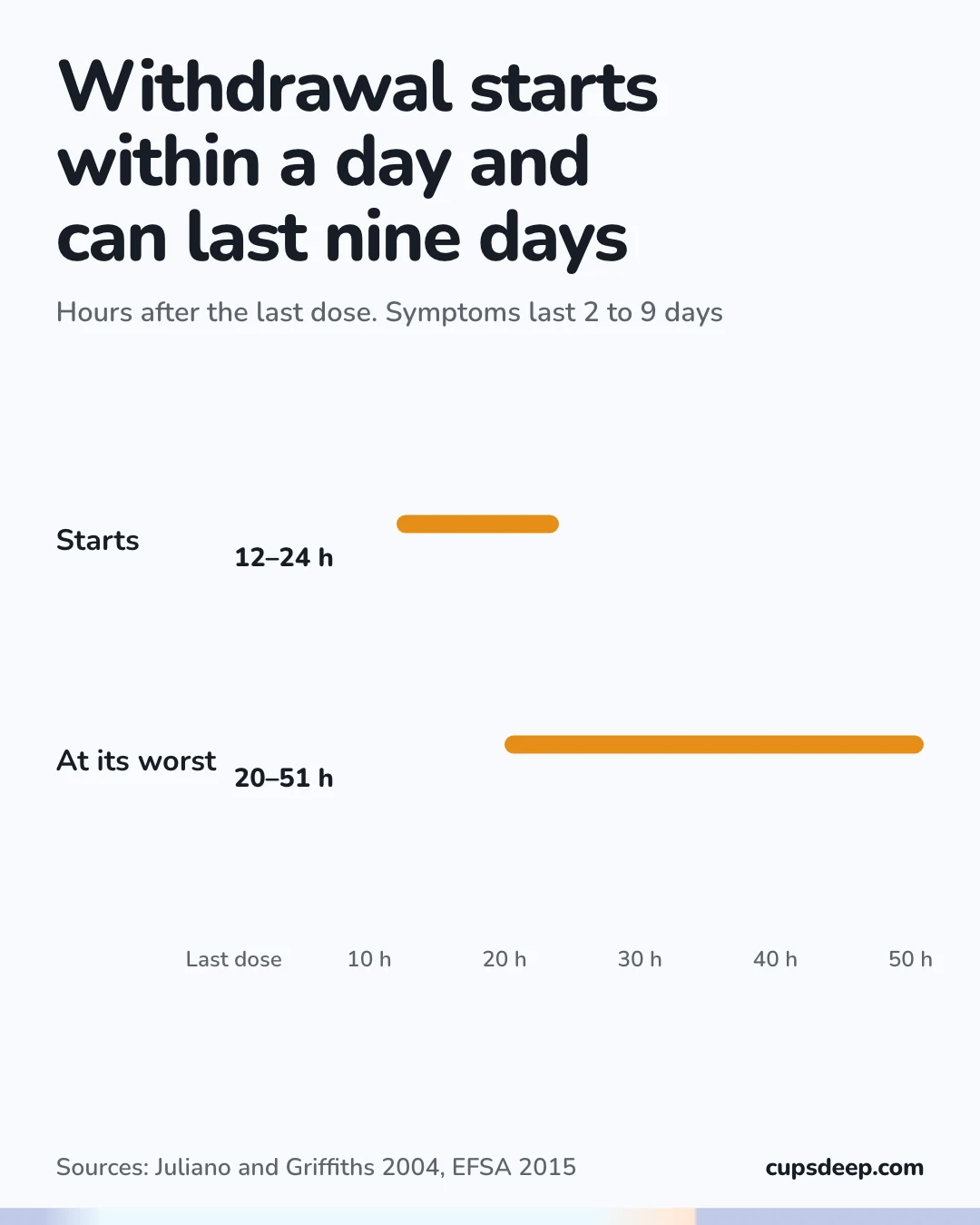
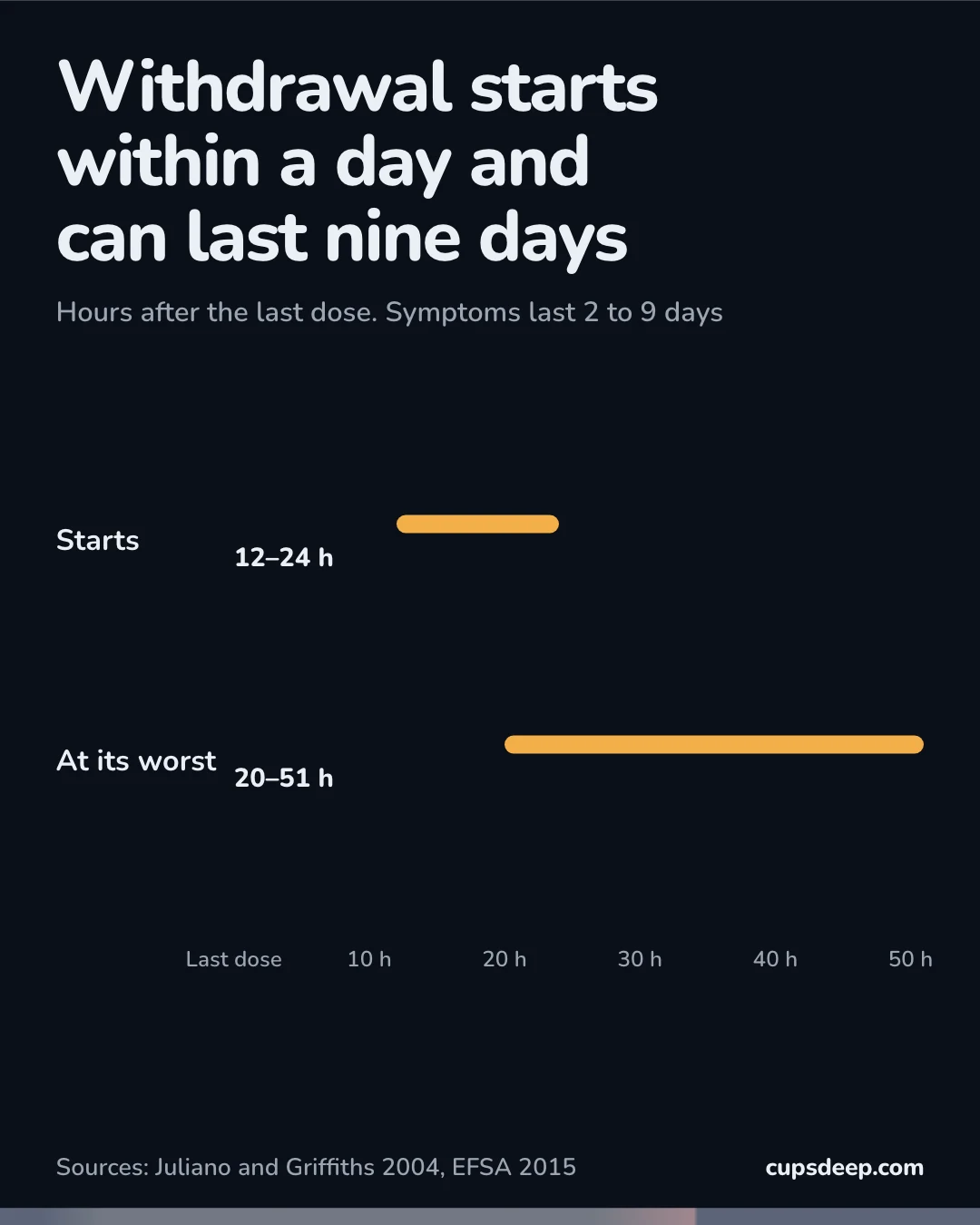
| Stage | When | How firm |
|---|---|---|
| Earliest reported start | 6 hours | One case report, a heavy user |
| Typical start | 12–24 hours | The usual window |
| Latest reported start | 43 hours | One study’s individual records |
| At its worst | 20–51 hours | The usual window |
| Over | 2–9 days | The usual total |
| Longest suggested headache | Up to 21 days | One study; a possibility, not a finding |
Starts and peaks are in hours, durations in days. All from one review of the withdrawal literature.
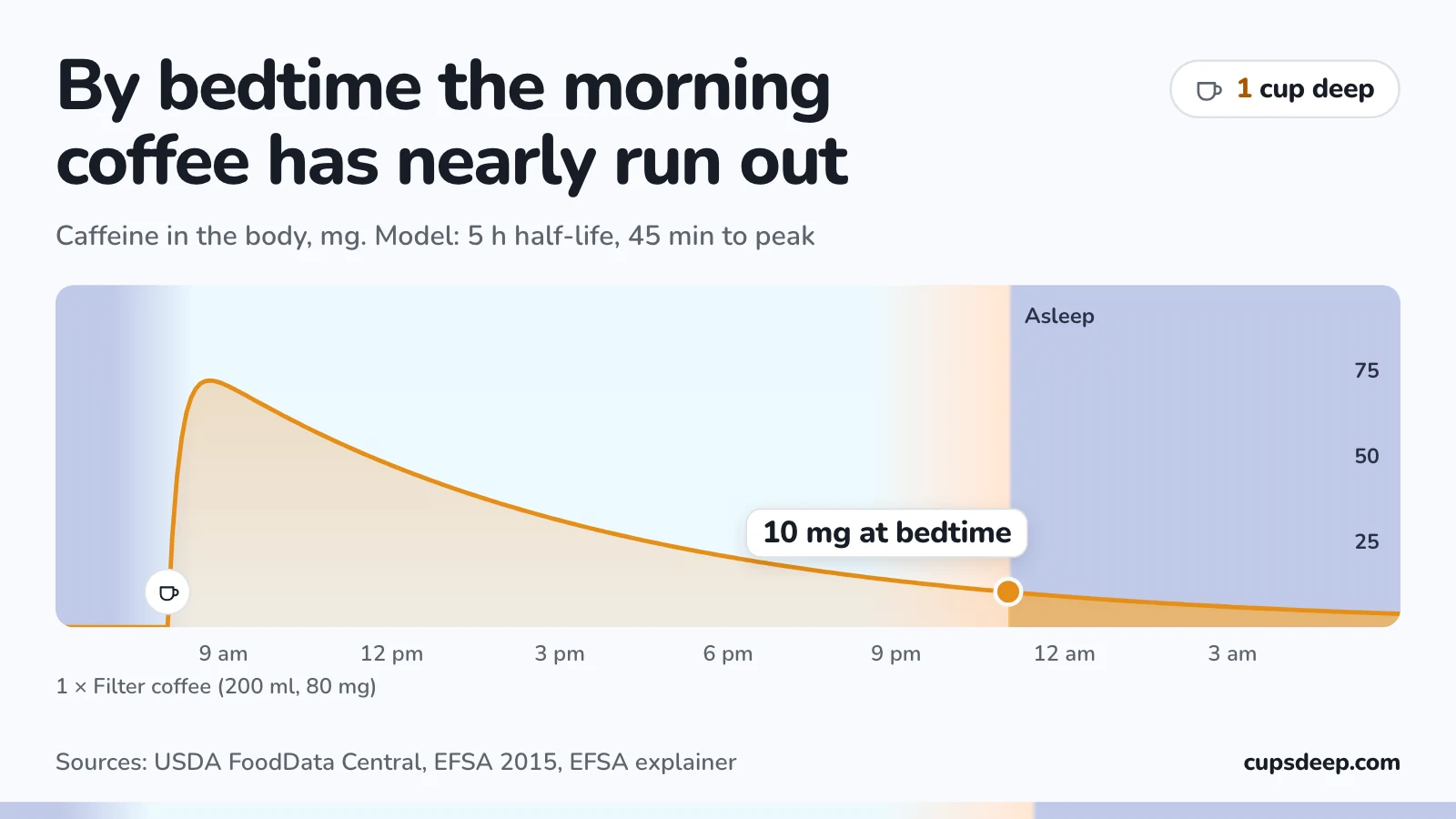
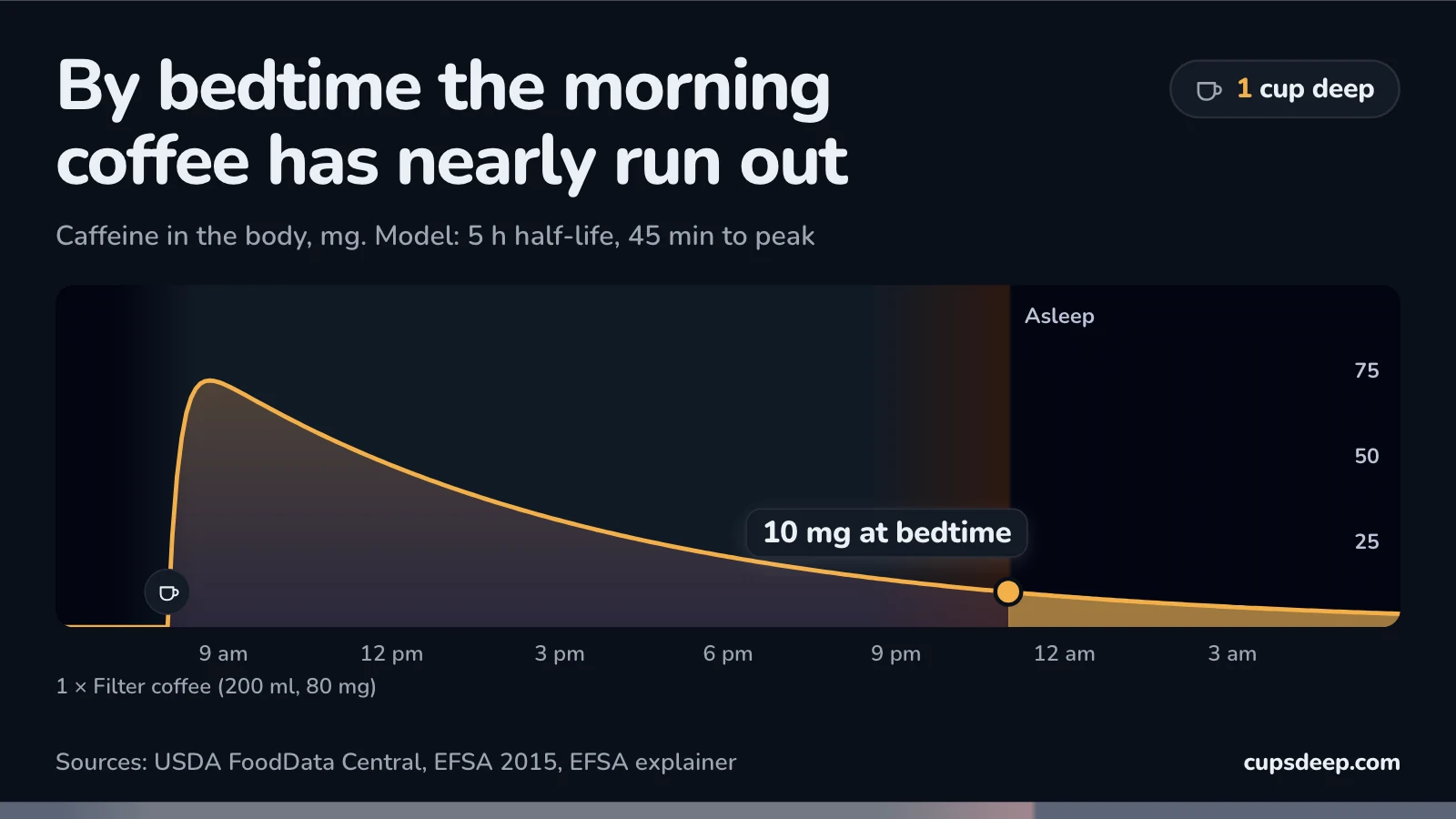
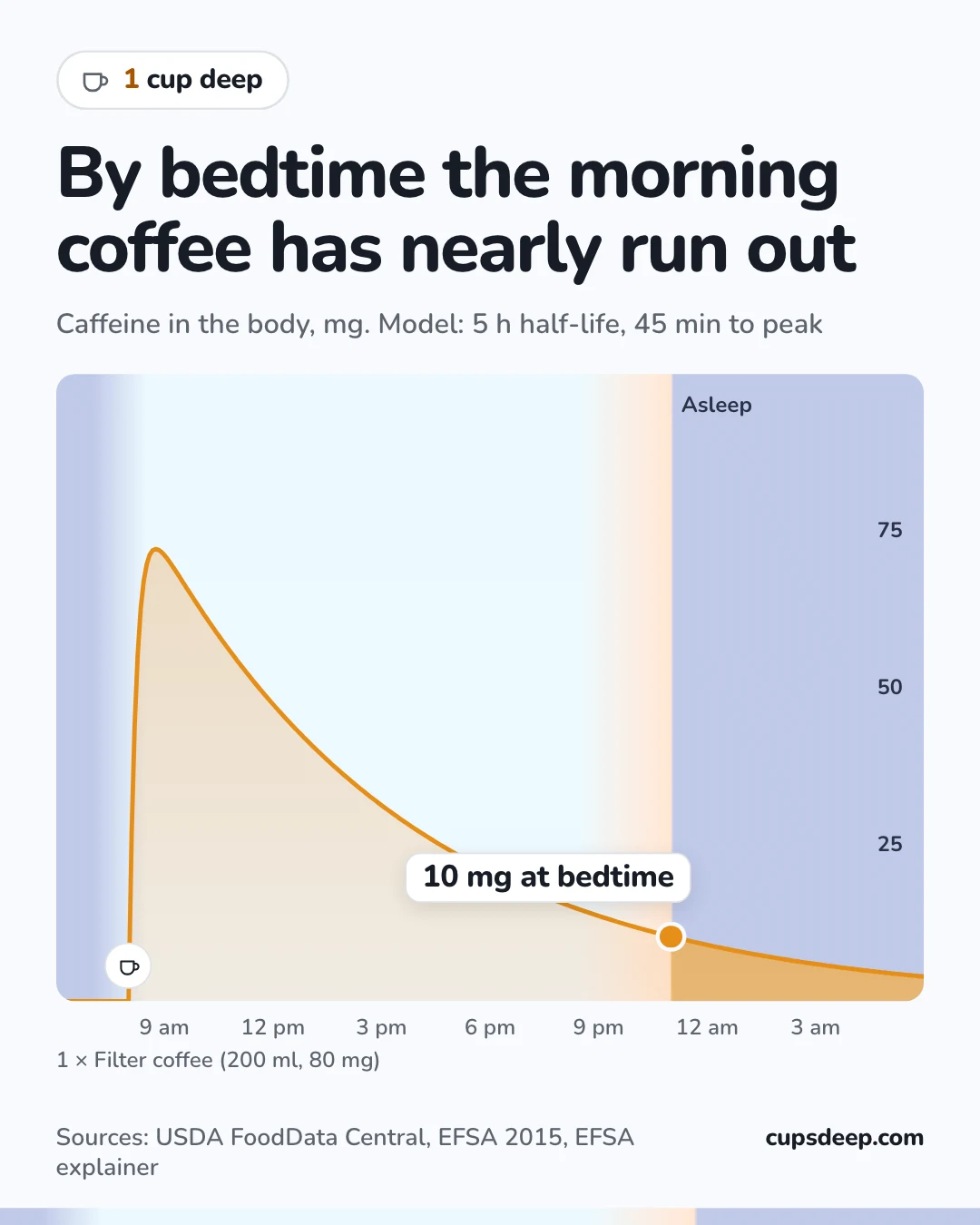
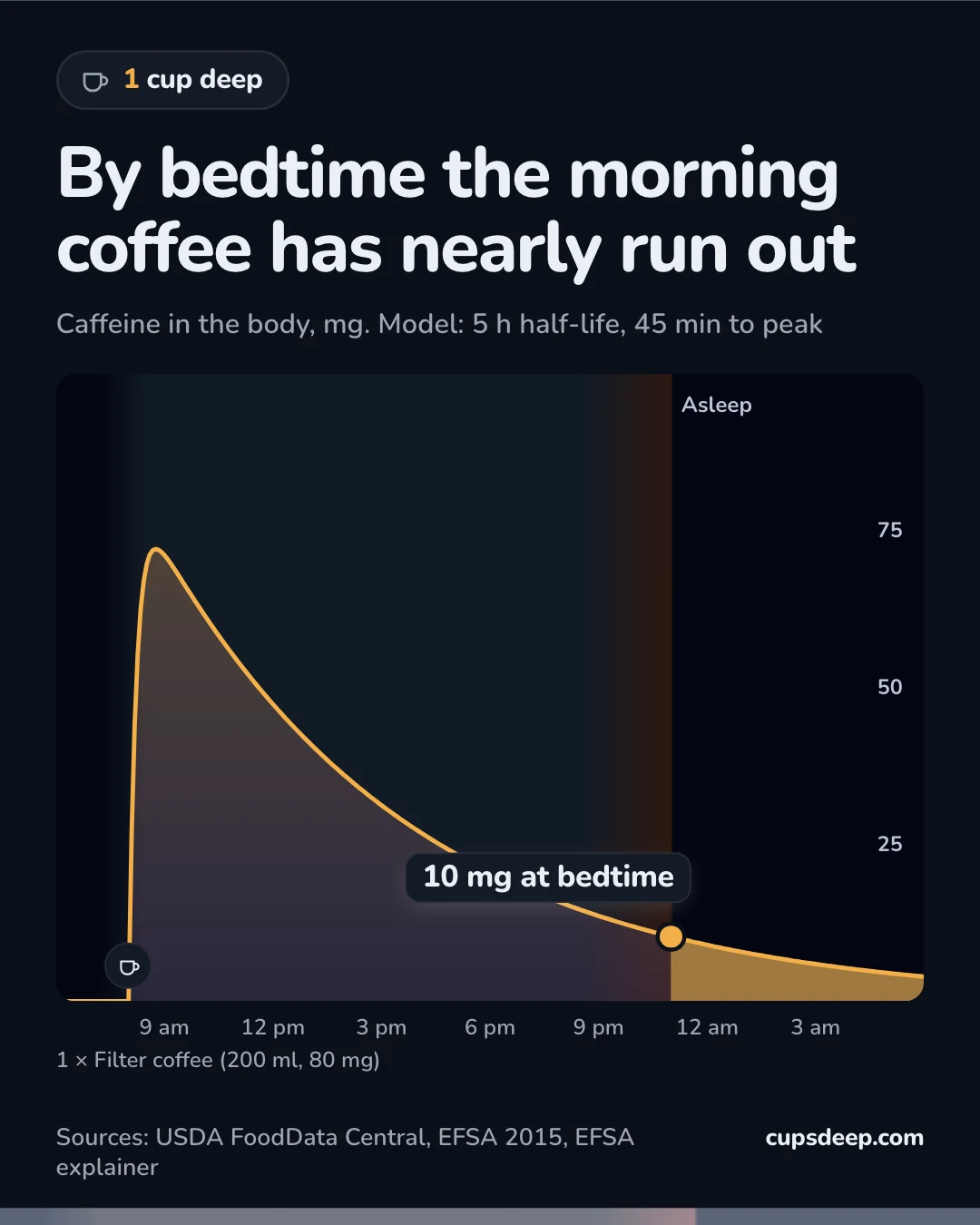
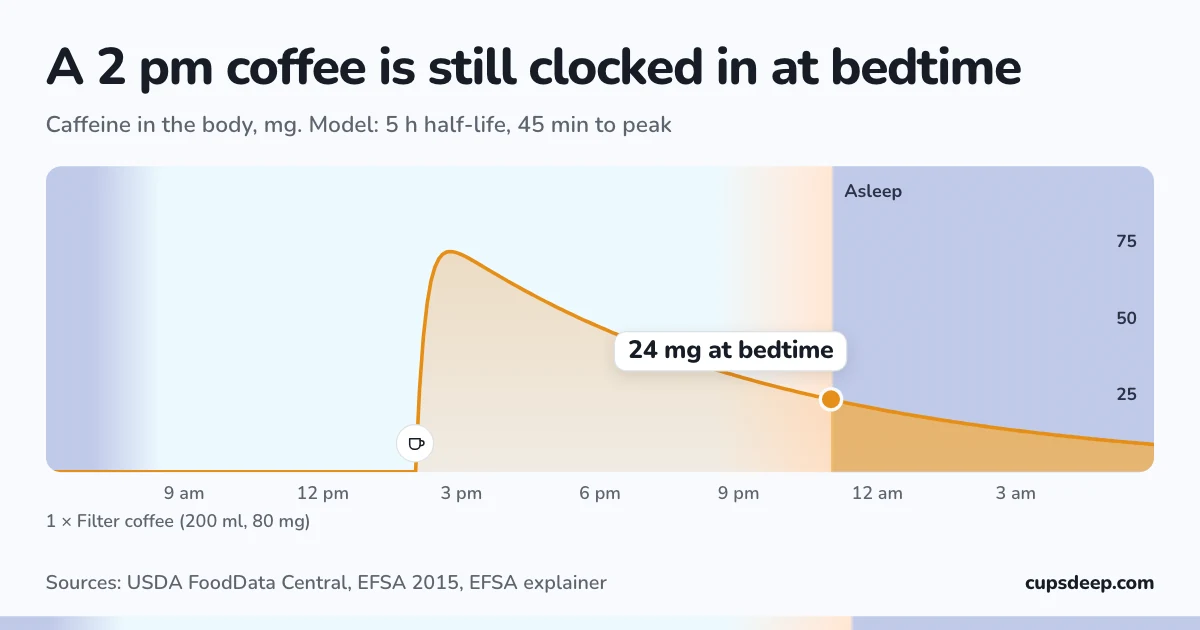
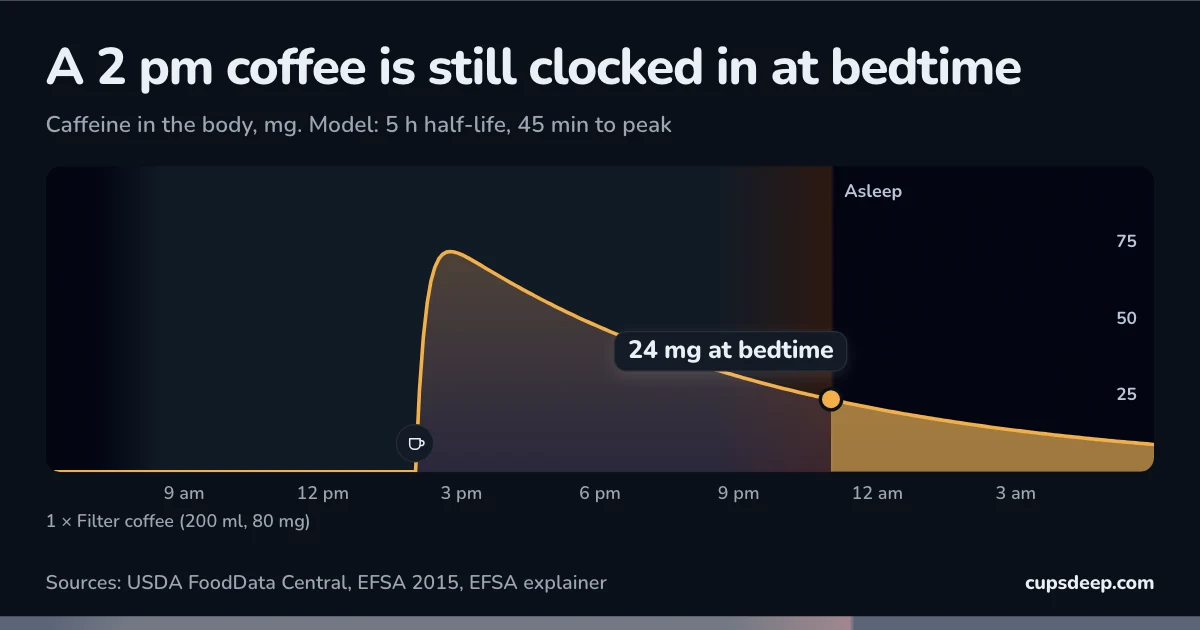
The start lines up with the arithmetic of the drug leaving. At an average half-life of 4 hours, a morning coffee is mostly gone by bedtime, and the window opens overnight. That is the likely story behind the weekend headache: sleep in, push the first cup back a few hours, and you have run a small withdrawal experiment on yourself.
My Saturday headache is Friday’s coffee sending the invoice
How likely are you to get it, and how bad?
Across the experimental studies gathered in one review, about half of the people who stopped caffeine got a headache (the review puts the incidence at 50%), and 13% had clinically significant distress or functional impairment. 27
Those are two different numbers with two different denominators, and they are easy to swap. About half is the headache, among people in experiments who stopped. It is not half of all coffee drinkers feeling something, and it is not half of people already in withdrawal. The share who are properly knocked out, to the point of distress or not functioning, is much smaller.
The averages hide a wide spread between studies. In 19 experimental studies the median share reporting a headache was 47%, from 9% to 100%. Asked in surveys, a median of 24% of caffeine users reported a withdrawal headache (7 studies, 8% to 56%). Clinically significant distress or impairment ran from about 10% to 55% across prospective experiments in ordinary volunteers, with a median of 13%; the review says that may be an underestimate for the general population. 185
So the honest answer is a range. Ask people to remember and about a quarter recall a withdrawal headache. Take the caffeine away without telling them when, and it is about half: in one such trial of 62 people, 52% had a moderate or severe headache on the placebo days, against 2% before.
How much caffeine does it take to get withdrawal?
Less than you would like. Stopping a habit as small as 100 mg/day has produced symptoms. A filter coffee is 80 mg and a double espresso is 127.2 mg, so one decent cup a day puts you about at the line. Find your own on the drinks table, or start with what is in a cup of coffee.
In double-blind experiments at 300 mg a day, withdrawal appeared after as little as 3 days of daily caffeine and not after a single day, and was somewhat more severe after 7 or 14 days. It made no difference whether the 300 mg was taken as one morning dose or as 100 mg three times a day. 186185
So it does not take years, and it does not take sipping all day. One dose every morning for 3 days is a habit as far as your body is concerned. If you have read that the threshold is 200 mg/day, that is the headache classification’s line for making a diagnosis, not the lowest dose that causes symptoms.
Why does quitting caffeine cause a headache?
Caffeine cuts blood flow in the brain. Take it every day and the body adjusts; take it away and the flow runs high. The short version is “the vessels widen”. Here are the measurements.
A 250 mg dose of caffeine cut blood flow in the brain’s grey matter by 27% in an MRI study of 45 adults: by 33% when they had gone without caffeine and by 20% in their normal caffeinated state. The more caffeine a person used each day, the more their blood flow rose when they abstained. 191
After 30 hours without caffeine, blood flow in the brains of heavy users (mean 648 mg a day) was higher than in light users (mean 41 mg a day) by 31% in front grey matter and 32% in white matter, in an MRI study of 20 people. The difference at the back of the brain was not significant. This compares two groups; it is not a rise measured within the same people. 190
We did not find a clean percentage for the rise inside the same people after stopping; the first study above tracked it and reports the direction, up, in moderate and heavy users but not light ones, and leaves the numbers in its figures. For people with migraine the stakes look higher, on thin evidence.
In a small double-blind trial in people with episodic migraine (mean intake 539 mg a day), stopping caffeine abruptly set off severe migraine attacks in seven of the nine who stayed in after one early drop-out. The trial enrolled 10 of a planned 80 people and stopped early. 195
How do you wean off caffeine without the headache?
The usual advice is to cut back gradually. This is the finding that makes it worth doing.
When people on 300 mg a day were switched blind to lower doses, intake had to fall to 100 mg a day or less before withdrawal appeared, and even 25 mg a day was enough to avoid a significant withdrawal headache. Each lower dose was tested for two days. The 25 mg figure comes from a review’s account of the experiment; the original paper’s tables were not read. 185186
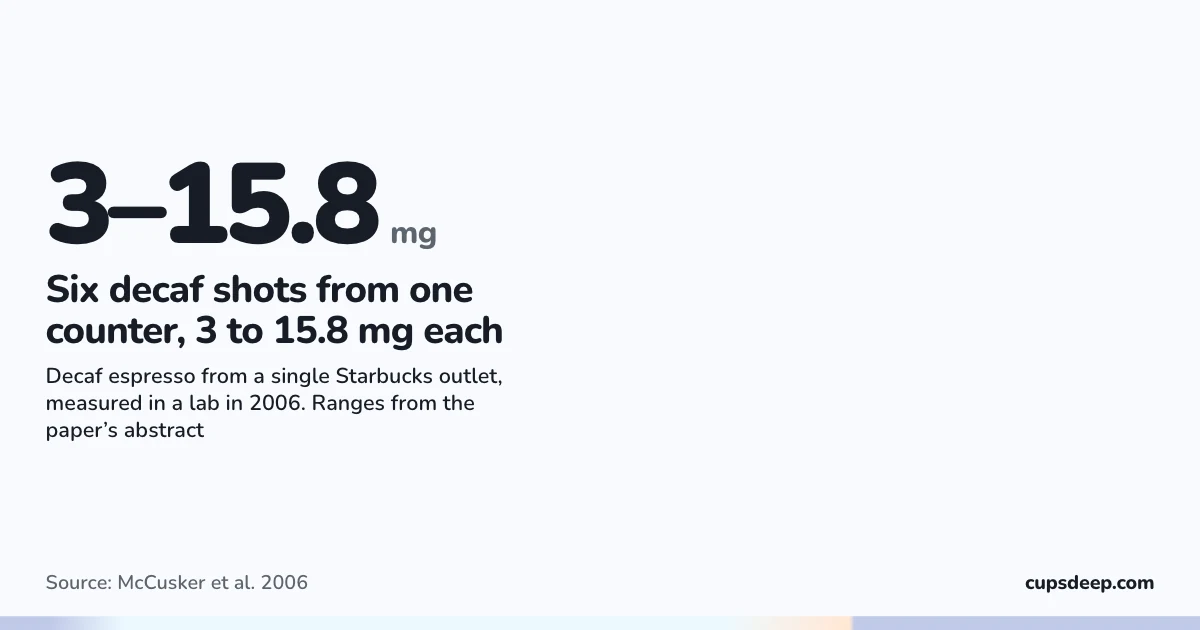
A sliver of the habit held the headache off, at least over the two days each dose was tested. 25 mg/day is about one green tea (24 mg), and more than a cup of decaf carries even at the top of its range (12.7 mg). Count the caffeine you forget, too: dark chocolate and the afternoon black tea are part of the habit. As for a schedule, here is one that has been through a randomized trial.
| Week | Daily ceiling |
|---|---|
| One | 75% of your starting intake |
| Two | 50% |
| Three | 25% |
| Four | 12.5% |
| Five | Under 50 mg/day, and nothing with more than 15 mg in it |
From a trial of 67 people who started at a mean of 666 mg/day. Those who kept their diaries cut their intake by an average of 77%. The trial counted caffeine, not headaches.
Now the awkward part: we found no trial showing that tapering produces fewer symptoms than stopping on the spot. The taper trial above measured how much people drank, not how they felt, and had nobody quitting abruptly to compare with. The only blinded head-to-head we found is a pilot: of 18 people who said they had had withdrawal before, withdrawn abruptly, 33.3% reported symptoms, and the 20 people withdrawn gradually reported minimal symptoms if any. It reported no statistics. The taper is a good bet on the dose logic, not a proven result.
I quit caffeine for a week. Ask anyone, I told them all
What gets rid of a caffeine withdrawal headache fastest?
Caffeine. That is not a joke; it is in the definition.
Taking caffeine again reverses withdrawal quickly, usually within 30 to 60 minutes and often completely, and the reversal is larger the larger the dose. The review names no smallest dose that is enough. 185
The international headache classification defines caffeine-withdrawal headache as one that develops within 24 hours of interrupting regular intake of more than 200 mg a day kept up for more than 2 weeks, and that either is relieved within 1 hour by 100 mg of caffeine or resolves within 7 days without any (or both). These are thresholds for diagnosis, not the lowest dose that produces symptoms. 188
Which makes the usual advice, take a painkiller, more interesting than it sounds. Several of the big headache brands have caffeine in them, because it helps the painkiller work.
Adding caffeine to a common painkiller (paracetamol, ibuprofen or aspirin) raised the share of people with good pain relief from 41% to 48%, in a Cochrane review of 4,262 participants. The effect was statistically significant at 100 mg of caffeine or more and not at 65 mg or less. The review covers acute pain in general, not withdrawal headache. 194
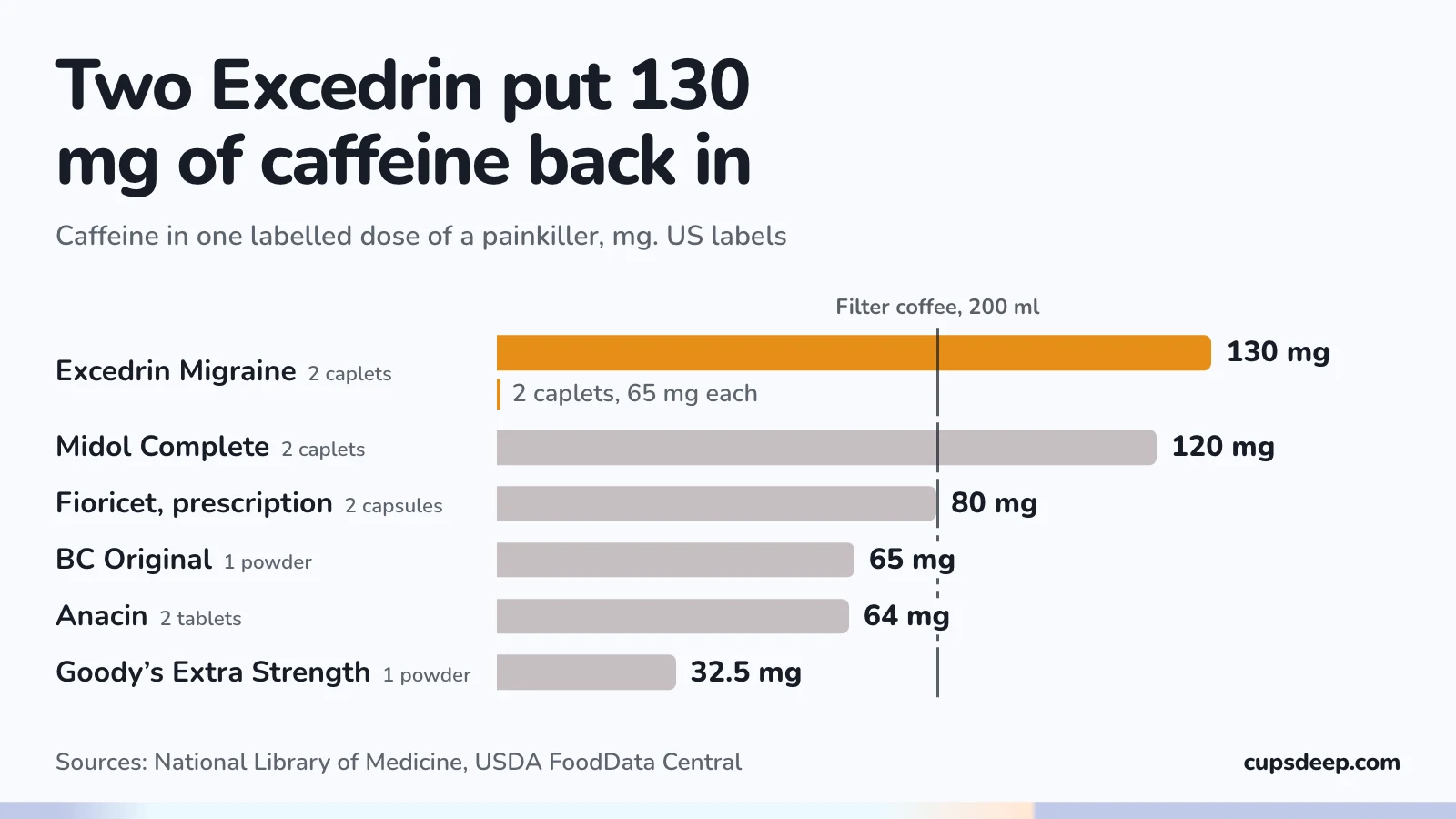
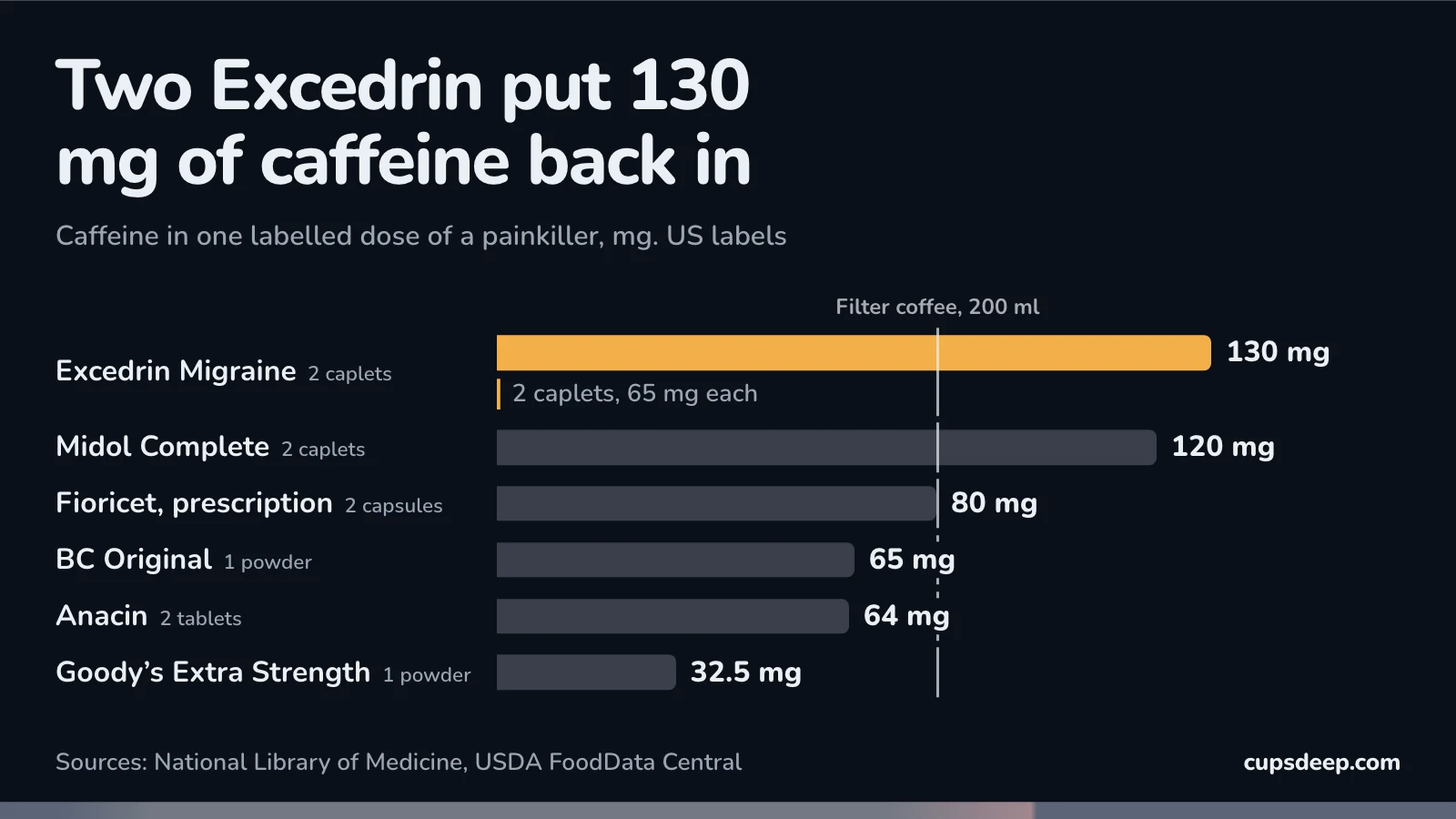
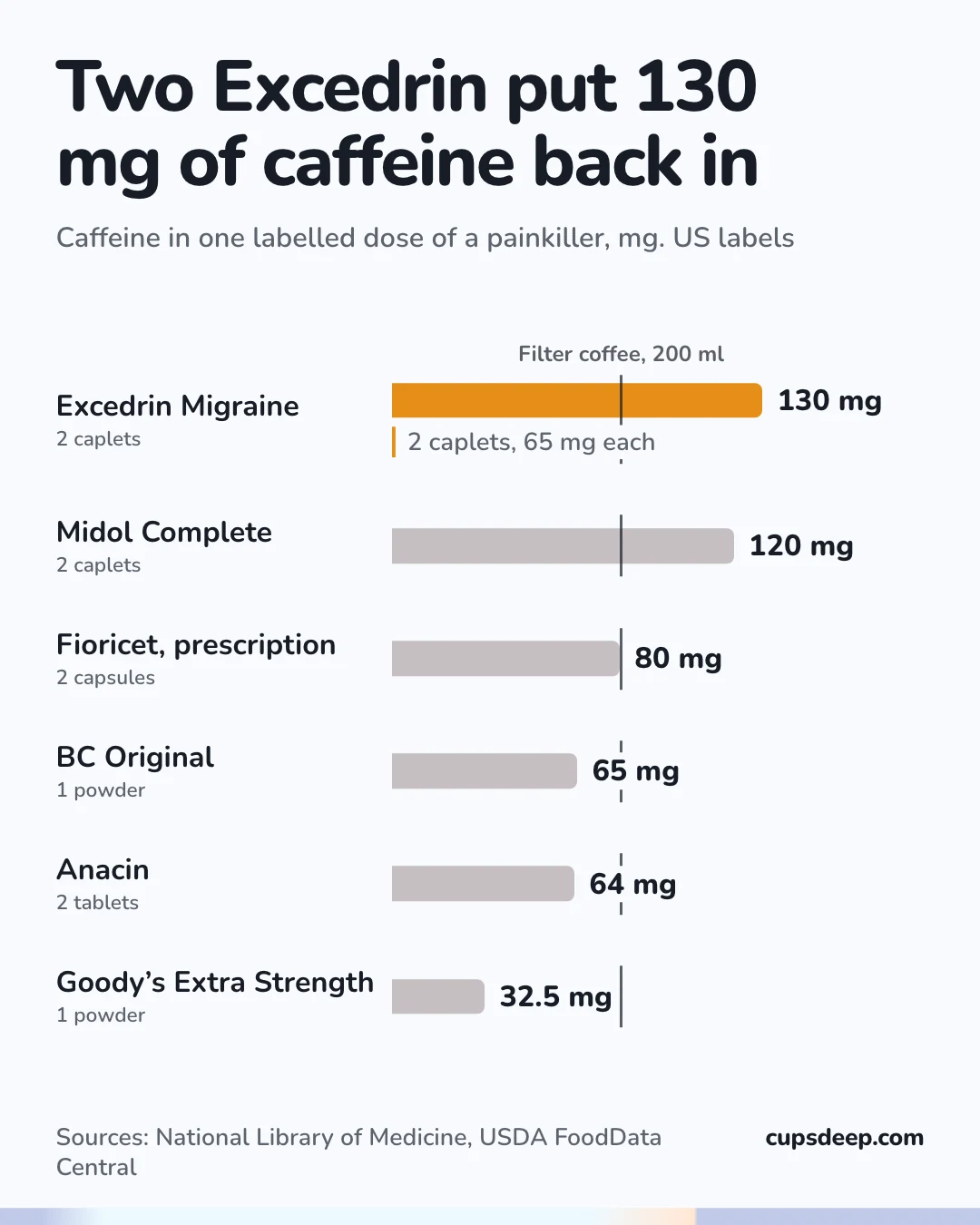
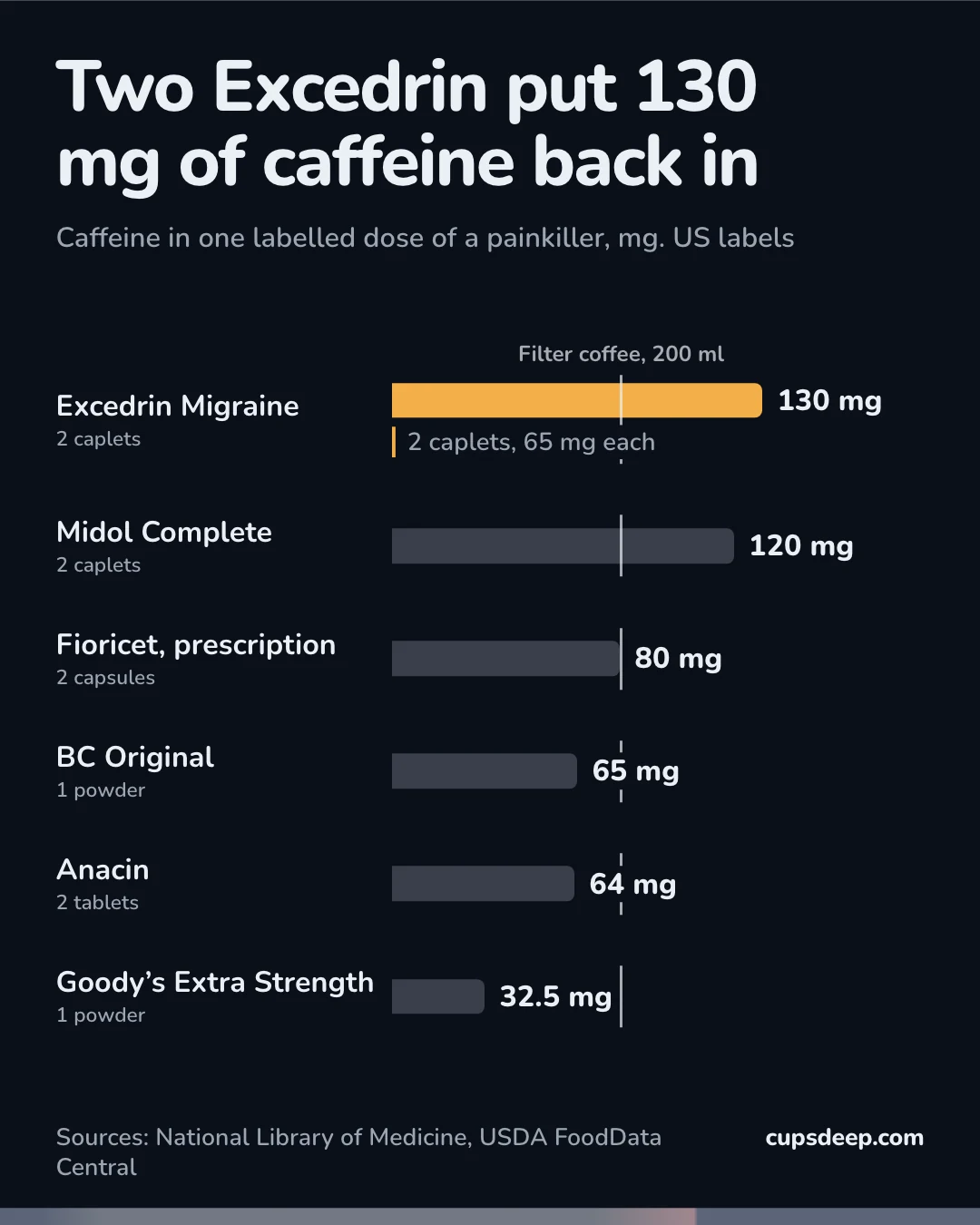
Two Excedrin Migraine caplets carry 130 mg of caffeine: more than a filter coffee, and above the line where the review found caffeine starts to help. A dose of Anacin is 64 mg, below it. That comparison is ours, made from the labels and the review. So the headache lifts, and part of the reason is that you had a coffee in tablet form. Fine if you want the day back. If the point was to get off caffeine, read the label: a painkiller with caffeine in it is a re-dose.
I quit coffee with a painkiller that turned out to be coffee
Questions people ask
How long does caffeine withdrawal last?
Typically 2–9 days. Symptoms start 12–24 hours after the last caffeine and are at their worst at 20–51 hours.
How long does a caffeine withdrawal headache last?
The international headache classification counts either: it resolves within 7 days without caffeine, or it is relieved within 1 hour of taking 100 mg of caffeine. One study has suggested headaches for up to 21 days, which the main review treats as a possibility only.
Is caffeine withdrawal real, and is it dangerous?
It is a recognized diagnosis in the DSM-5, and it goes away by itself: the typical course is 2–9 days. In experiments 13% of people had clinically significant distress or impairment. One small trial that stopped early suggests abrupt withdrawal can set off attacks in people with migraine.
Can caffeine withdrawal cause anxiety or dizziness?
Neither is among the ten symptoms the main review validated, or the three it judged likely (flu-like symptoms, nausea or vomiting, muscle pain or stiffness). The validated ones are headache, fatigue, drowsiness, low mood, irritability, fogginess and trouble concentrating.
How much caffeine a day causes withdrawal?
Stopping as little as 100 mg/day has produced symptoms, which is about one cup of coffee. In experiments, 3 days of daily caffeine at 300 mg/day was enough; one day was not.
Does Excedrin help a caffeine withdrawal headache?
A two-caplet dose of Excedrin Migraine contains 130 mg of caffeine, and caffeine reverses withdrawal, usually within 30–60 minutes. The headache definition itself counts relief within 1 hour of 100 mg of caffeine, so it is likely to help, partly because it is a re-dose of the thing you stopped.
Sources
Every number above links to the place it came from. How the numbers are chosen and checked is on the method page; the drink table is at /drinks. Written with AI agents, as the whole site is. A model of a typical body, not advice for pregnancy, illness or medication.
- Spilling the Beans: How Much Caffeine is Too Much?
- Beverages, coffee, brewed, prepared with tap water
- Beverages, coffee, brewed, espresso, restaurant-prepared
- Beverages, tea, green, brewed, regular
- Scientific Opinion on the safety of caffeine
- EFSA explains risk assessment: Caffeine
- A critical review of caffeine withdrawal: empirical validation of symptoms and signs, incidence, severity, and associated features
- Excedrin Migraine: Drug Facts (DailyMed label)
- Anacin (DailyMed label)
- Midol Complete (DailyMed label)
- BC Original (DailyMed label)
- Goodys Extra Strength (DailyMed label)
- Fioricet® Capsules (DailyMed label)
- A critical review of caffeine withdrawal: empirical validation of symptoms and signs, incidence, severity, and associated features (full text)
- Caffeine withdrawal: a parametric analysis of caffeine dosing conditions
- Withdrawal syndrome after the double-blind cessation of caffeine consumption
- 8.3.1 Caffeine-withdrawal headache, International Classification of Headache Disorders, 3rd edition
- Caffeine Use Disorder: A Comprehensive Review and Research Agenda
- Dietary caffeine consumption and withdrawal: confounding variables in quantitative cerebral perfusion studies?
- The effect of daily caffeine use on cerebral blood flow: How much caffeine can we tolerate?
- A brief manualized treatment for problematic caffeine use: A randomized control trial
- The frequency of caffeine withdrawal in a population-based survey and in a controlled, blinded pilot experiment
- Caffeine as an analgesic adjuvant for acute pain in adults
- Sudden Caffeine Withdrawal Triggers Migraine: A Randomized Controlled Trial
Keep reading
Body and sleep
How long does caffeine stay in your system?
Half of a dose of caffeine is gone in about 4 hours, 2–8 hours between people. After five half-lives, 20 hours on average, 3.1% is left.

Coffee
Does decaf coffee have caffeine?
Yes. FDA puts decaf at 2–15 mg per 8 fl oz cup, and Starbucks lists 25 mg for a grande. The lab ranges, the law and the maths.
Cans
How much caffeine is in a Monster?
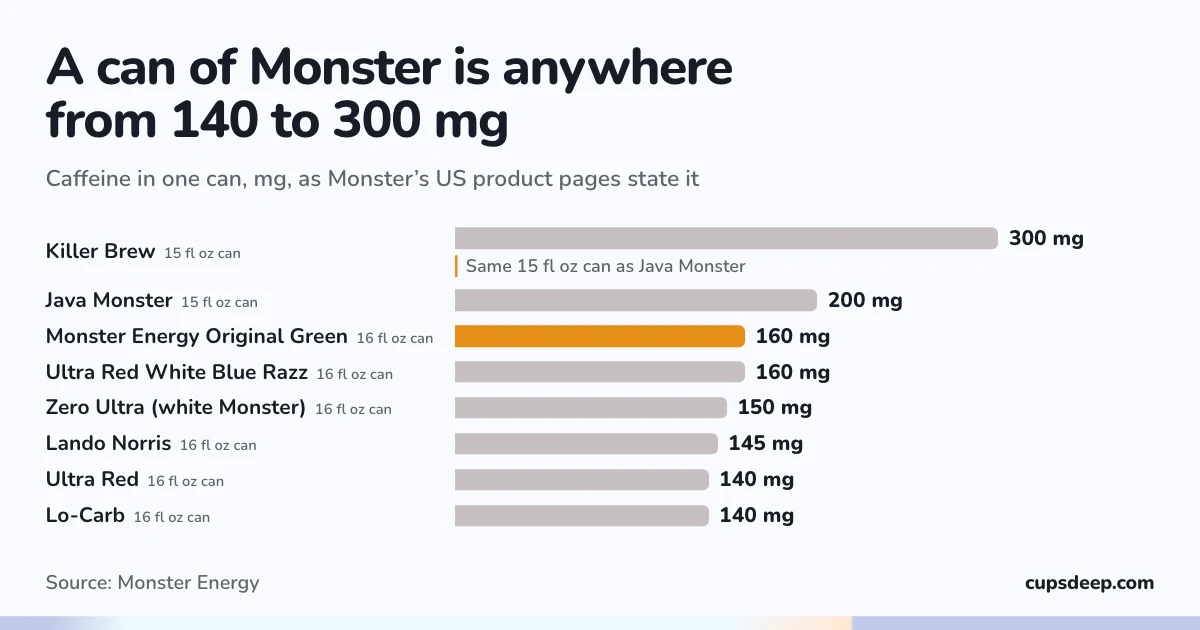
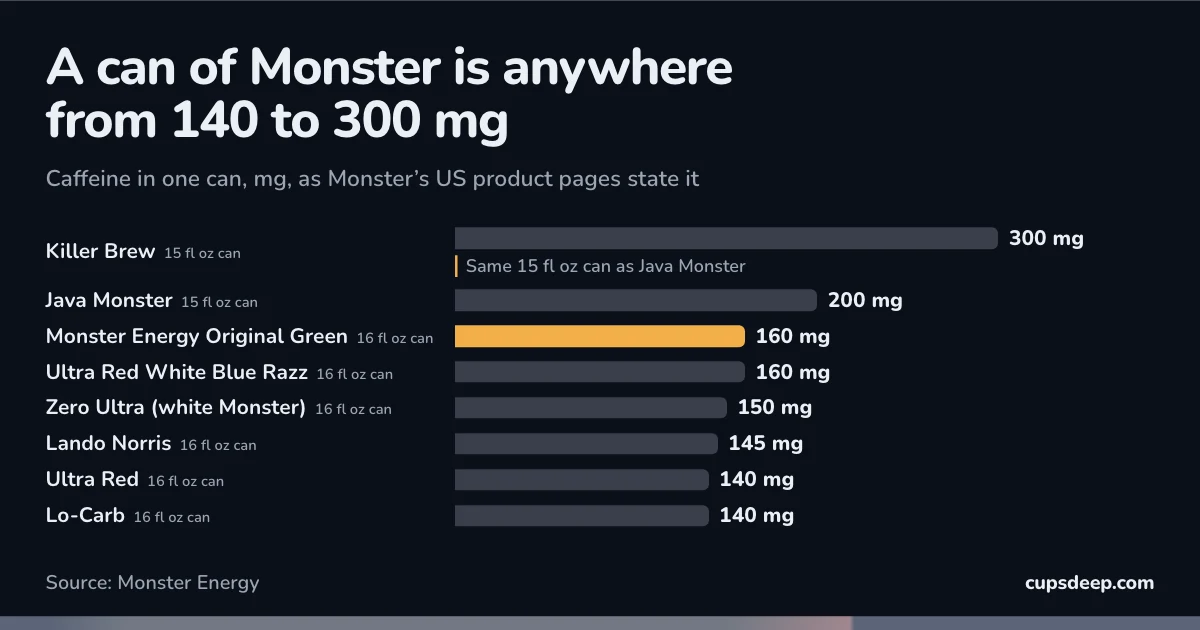
A 16 fl oz can of original Monster has 160 mg of caffeine. White Monster has 150 mg, Java Monster 200 mg and Killer Brew 300 mg.