How much caffeine is in yerba mate? (And tereré)
Some of the pages that answer this question print a number per “cup” and move on. A gourd is not a cup. It is a session: you pack it once and refill it until the thermos is empty or the conversation ends. Here is what the labs found when they measured that, where they disagree, and what the law says has to be in the leaf.
The short answer
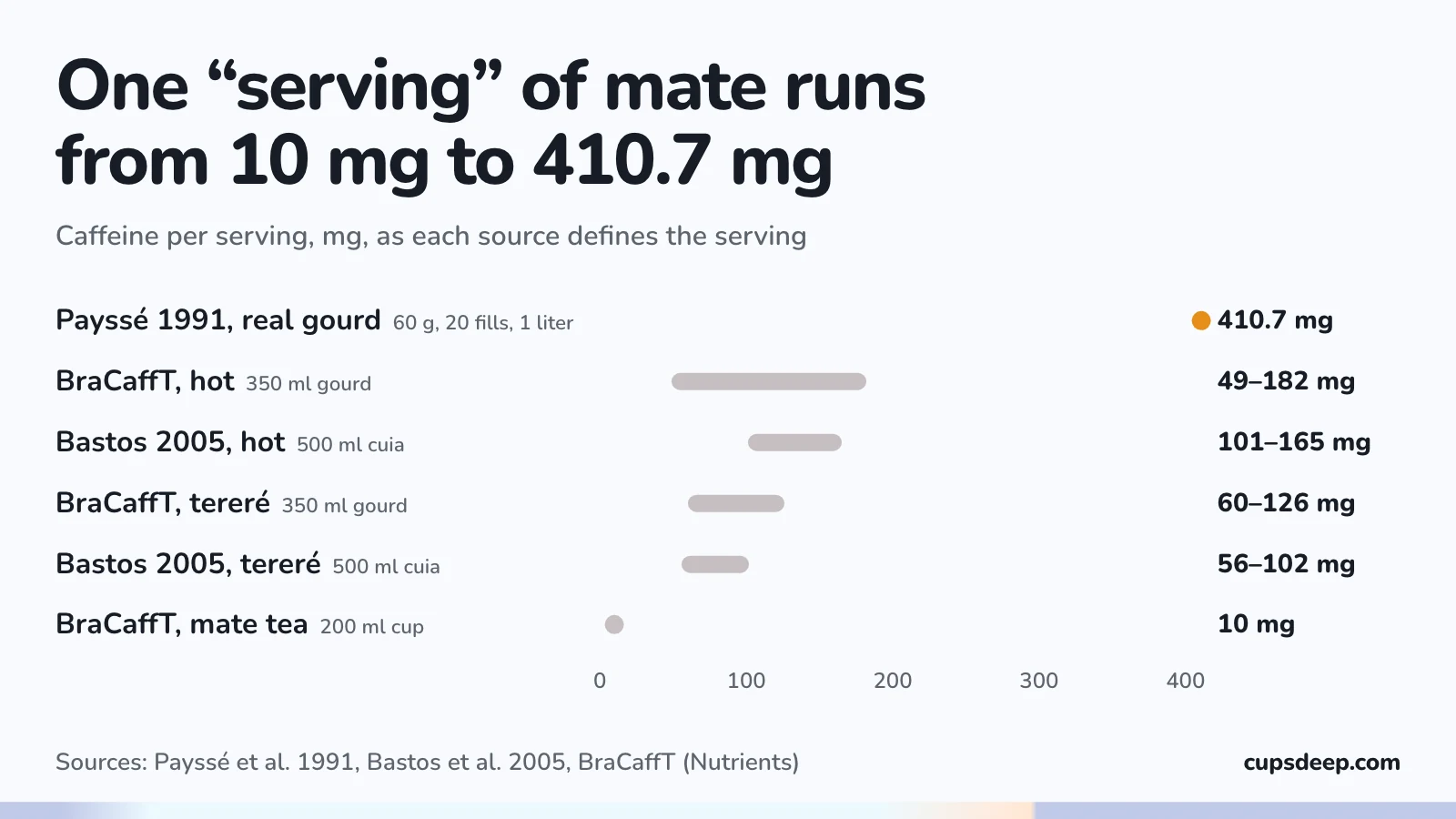
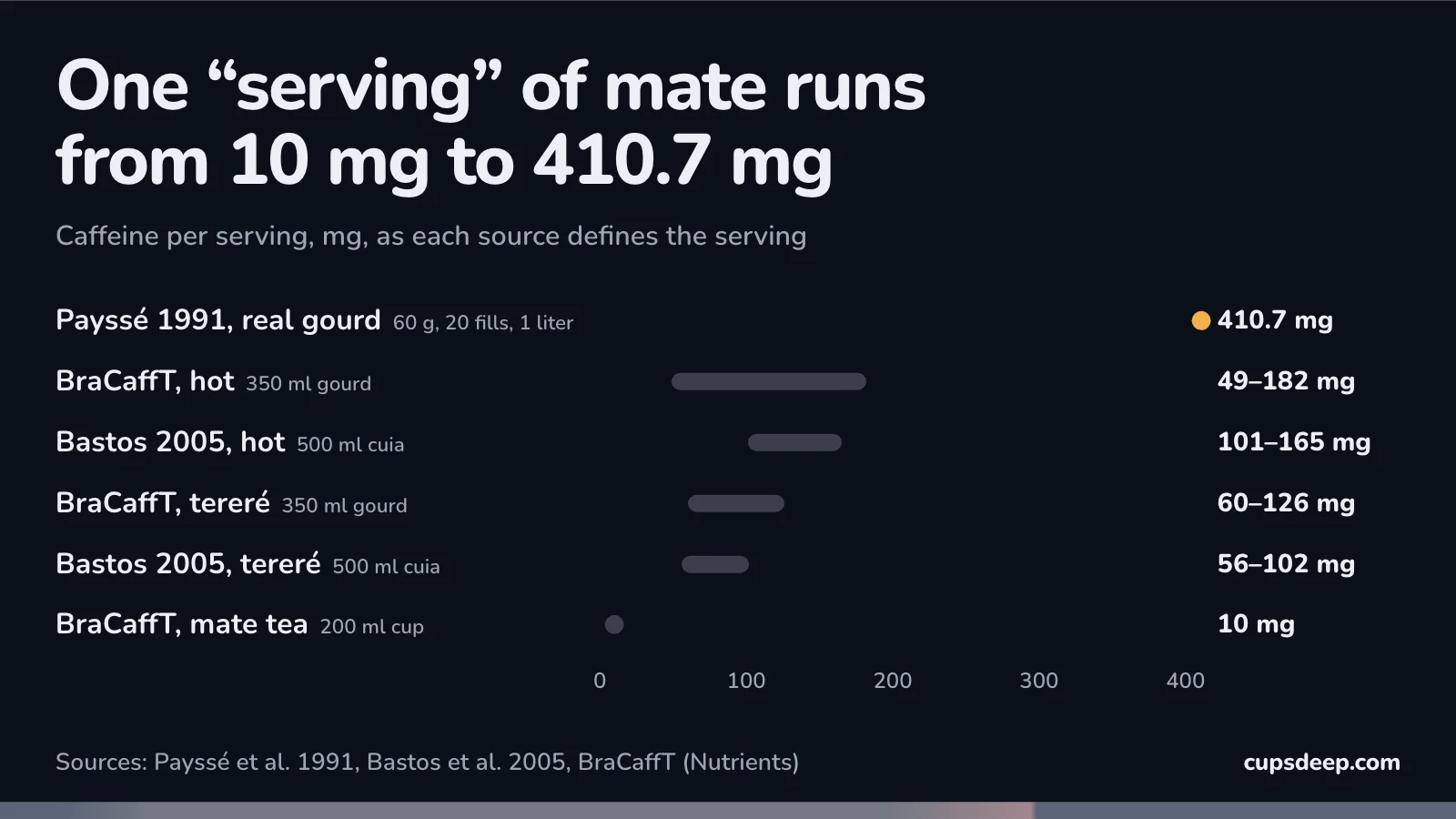
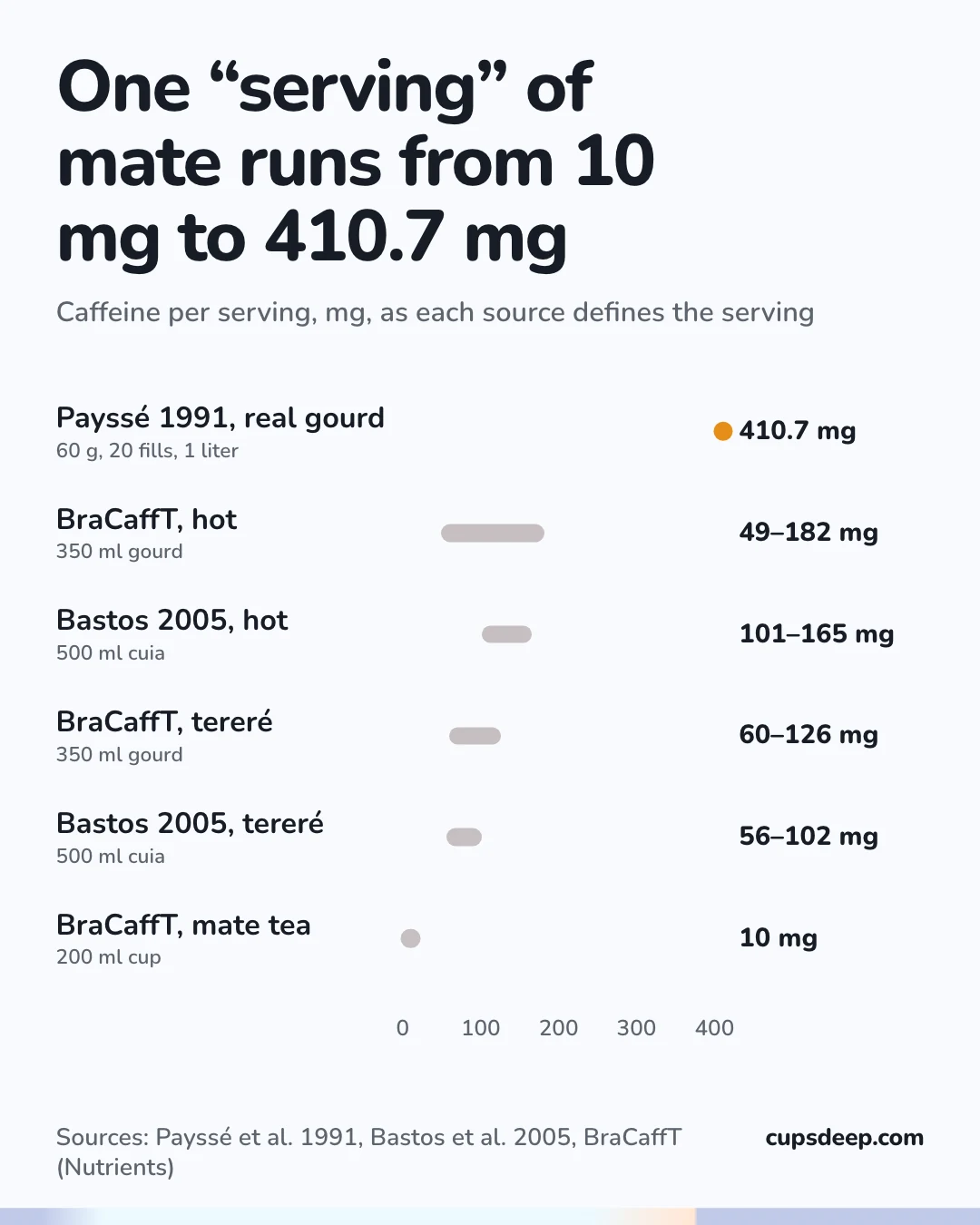
It depends on what you call one. BraCaffT, a Brazilian food table, puts a 350 ml gourd of hot mate at 91 mg and of cold tereré at 84 mg, roughly a cup of coffee each. But a gourd gets refilled: in a 1991 lab session, one gourd packed with 60 g of yerba gave 410.7 mg over 20 fills. A mate tea bag is far lighter, 13 mg in one lab’s cup.


How much caffeine is in a gourd of yerba mate?
More than a cup, because a gourd is refilled. Near the top of the results for this question sits a yerba brand’s help page with a figure for a packed gourd and no study behind it. A nutrition trade site says a cup of mate matches a cup of coffee without saying how big the cup is. A medical reference calls the caffeine high and gives no milligrams at all. None of them says what was in the gourd or how many times it was filled.
So start with one that did. In 1991, a team at the Faculty of Chemistry in Montevideo worked through a gourd the way people drink one, except that every sip went into a test tube.
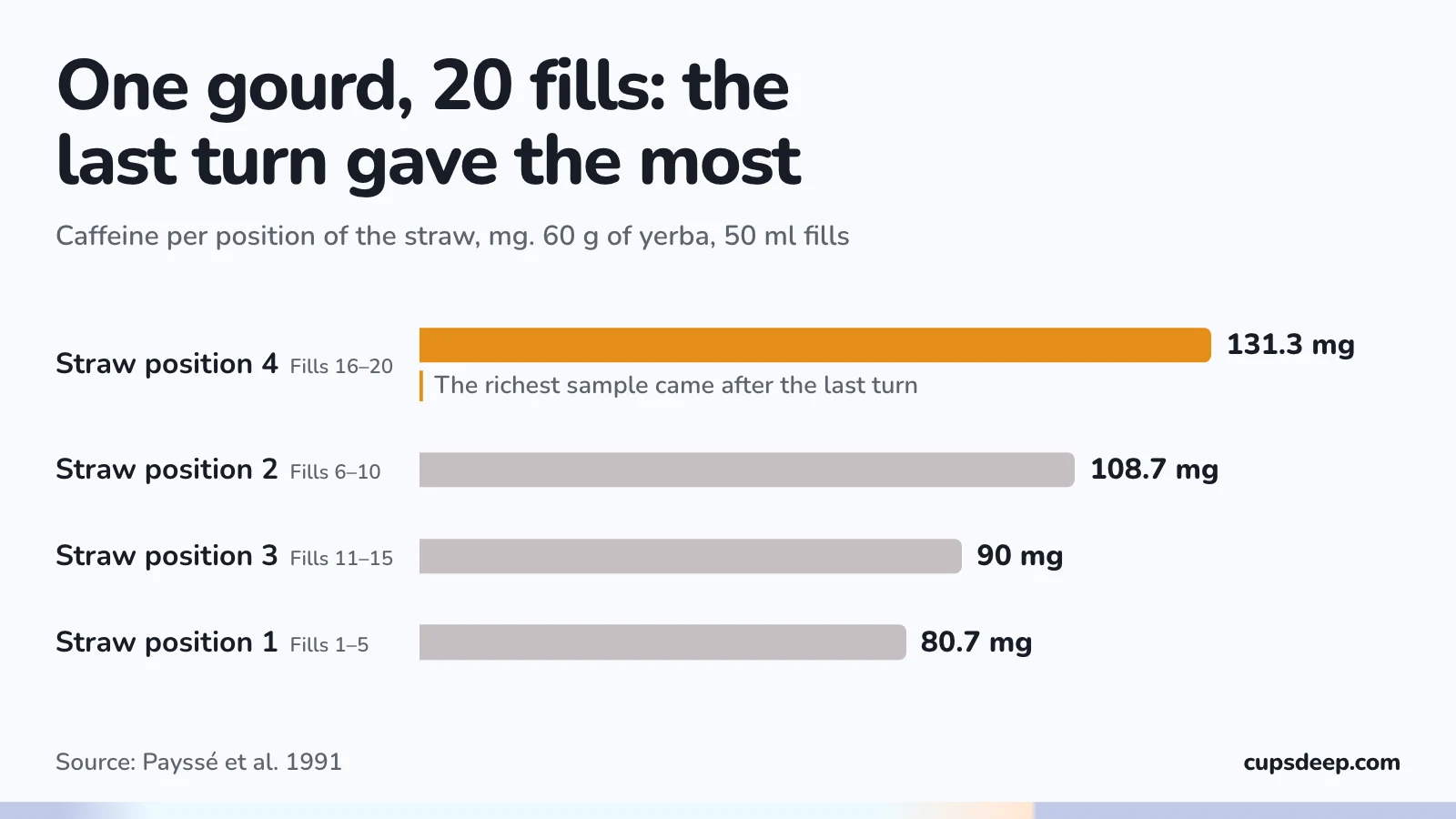
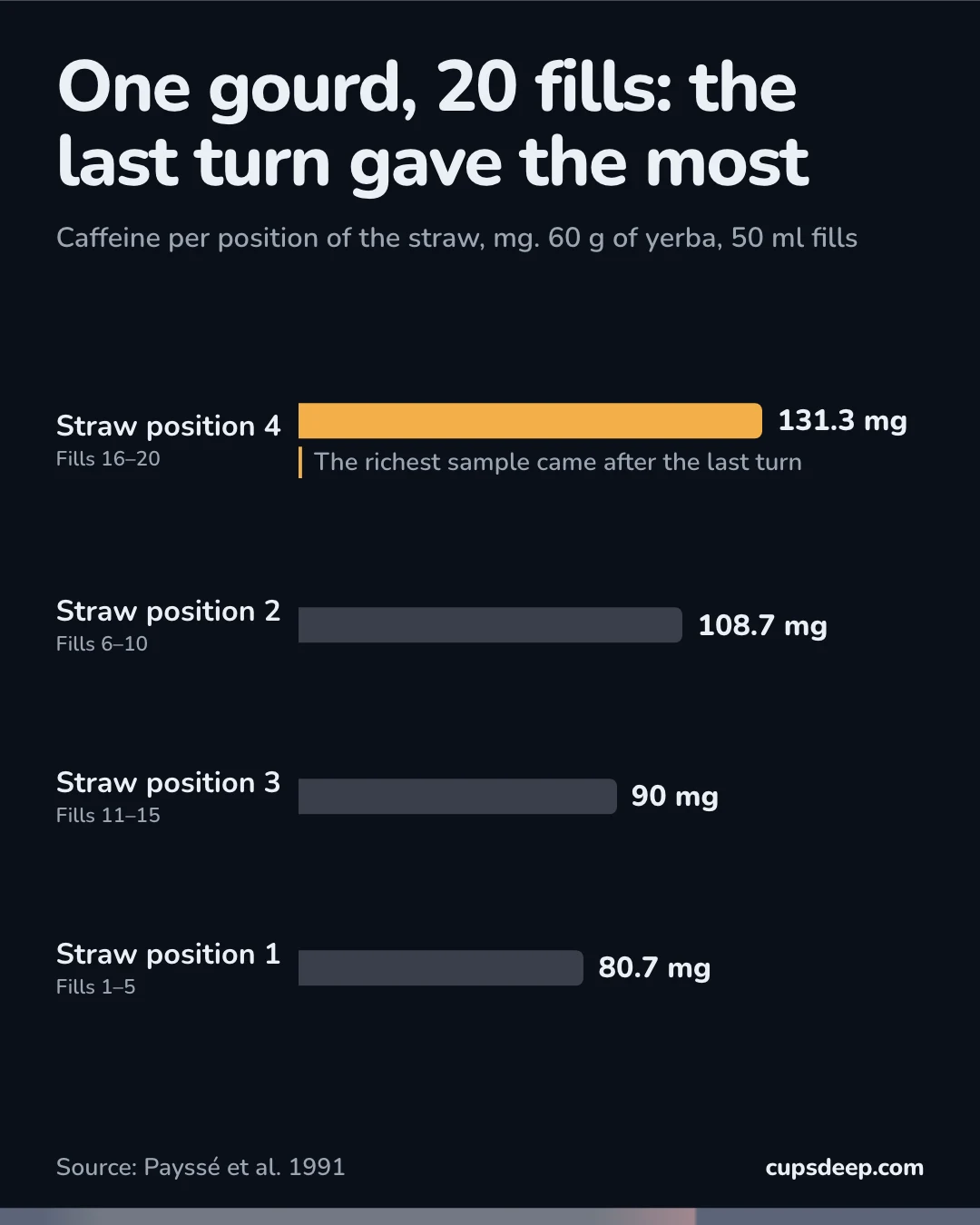
In a 1991 study from the Faculty of Chemistry in Montevideo, Uruguay, 60 g of yerba was packed into a gourd and 50 ml of hot water (90 to 95 °C) was added at a time and drawn out through the bombilla: five fills, then a quarter turn of the bombilla, at four positions, for 20 fills and 1,000 ml of drink. The drink was pooled into eight samples, two per position, of two and three sucks each, and measured by HPLC: the session extracted 410.7 mg of caffeine in total. The richest single sample, 83.0 mg in 100 ml, came just after the last turn of the bombilla. It is one gourd, one yerba and one session, in a study about mate and the drug theophylline. 580
That is 410.7 mg from one gourd, far more than BraCaffT’s 350 ml gourd at 91 mg. It is also one session with one yerba, thirty-five years ago, so treat it as what a real gourd can do, not what yours does. Other studies define a serving differently, and the serving decides the number: a lab brew scaled to a 500 ml cuia gets 135 mg, an intake estimated in one abstract, for an unstated serving, is 260 mg, and a cup of mate tea gets 13 mg in one lab and 10 mg in a Brazilian table.
| Who | Drink | Serving | Caffeine | How it was made |
|---|---|---|---|---|
| Payssé 1991, real gourd | Mate, hot | 60 g, 20 fills, 1 liter | 410.7 mg | One gourd, HPLC, 8 pooled samples over 20 fills |
| Mazzafera 1997 | Chimarrão, hot | Not stated | 260 mg | Gaucho method; estimated intake; abstract only |
| Bastos 2005, hot | Chimarrão, hot | 500 ml cuia | 135 mg (101 mg to 165 mg) | Lab brew scaled up; three brands |
| BraCaffT, hot | Chimarrão, hot | 350 ml gourd | 91 mg (49 mg to 182 mg) | Compiled from published analyses |
| Bastos 2005, tereré | Tereré, cold | 500 ml cuia | 85 mg (56 mg to 102 mg) | Lab brew at 10 °C scaled up; three brands |
| BraCaffT, tereré | Tereré, cold | 350 ml gourd | 84 mg (60 mg to 126 mg) | Compiled from published analyses |
| Yerba Madre, bag | Mate tea | 1 bag | 30 mg | Maker’s figure, “about” |
| Bastos 2005, mate tea | Mate tea | 182 ml cup | 13 mg | One bag, 5 minutes at 85 °C; four brands |
| BraCaffT, mate tea | Mate tea | 200 ml cup | 10 mg | Compiled from published analyses |
Each figure is for the serving its source names; nothing was converted. Bastos et al. give a maximum and minimum, which match their highest and lowest brand; BraCaffT’s gourd range is its per-100 ml range for 350 ml, as our drinks table holds it. Mazzafera’s abstract estimates an intake without saying what it is per, and gives no weight of yerba, water or number of refills. Yerba Madre’s figure is the maker’s own, and “about”.
Does yerba mate lose its caffeine after a few refills?
Not in the one gourd we found measured across a whole session. You hear that the first few pours carry it all and the rest is warm water with a memory. The 1991 gourd says otherwise: the bombilla was given a quarter turn every five fills, and its last position gave the most.
By position of the bombilla, the 1991 gourd gave 80.7 mg of caffeine over its first five fills, 108.7 mg over the next five, 90.0 mg over the third five and 131.3 mg over the last five, after the last turn. The last position gave the most. Each figure is our sum of the two samples the paper reports for that position. 580
The richest single sample of the whole session, 83 mg in 100 ml, came straight after the last turn of the bombilla. The paper ties the swings to where the bombilla sat and for how long. Our reading: each new position reaches yerba the water had barely touched, so any fade belongs to a bombilla that stays put. Move it, and the gourd gets a second wind.
Nobody knows how deep a gourd goes
Leave it in place and the fade is real. Meinhart et al. 2010, as Najman et al. 2024 report it, brewed chimarrão thirty times over and saw caffeine fall from 13.7–26.4 mg per 100 ml in the first brew to 1.5–6.6 mg per 100 ml by the last; the bombilla was not turned there as far as we know.
As Najman et al. 2024 report it, Meinhart et al. 2010 brewed chimarrão 30 times over and found caffeine fell from 13.7–26.4 mg per 100 ml in the first brew to 1.5–6.6 mg per 100 ml by the thirtieth; for tereré, from about 35.8 to 2.9 mg per 100 ml. Meinhart’s full paper was not read, and whether its bombilla was ever moved is not known to us. 583
Two caveats, plainly. This is one gourd, one yerba and one lab session, and its eight samples each pool two or three sucks. And the drink was poured into test tubes, not swallowed, so it says what came out of the gourd, not what reached anyone’s blood.
Does tereré have less caffeine than hot mate?
Tereré is yerba mate drunk with cold water, often over ice and herbs. Cold water does pull caffeine out of the leaf. Whether it pulls less than hot water depends on which lab you ask, and the answer turns on how each one made the drink.
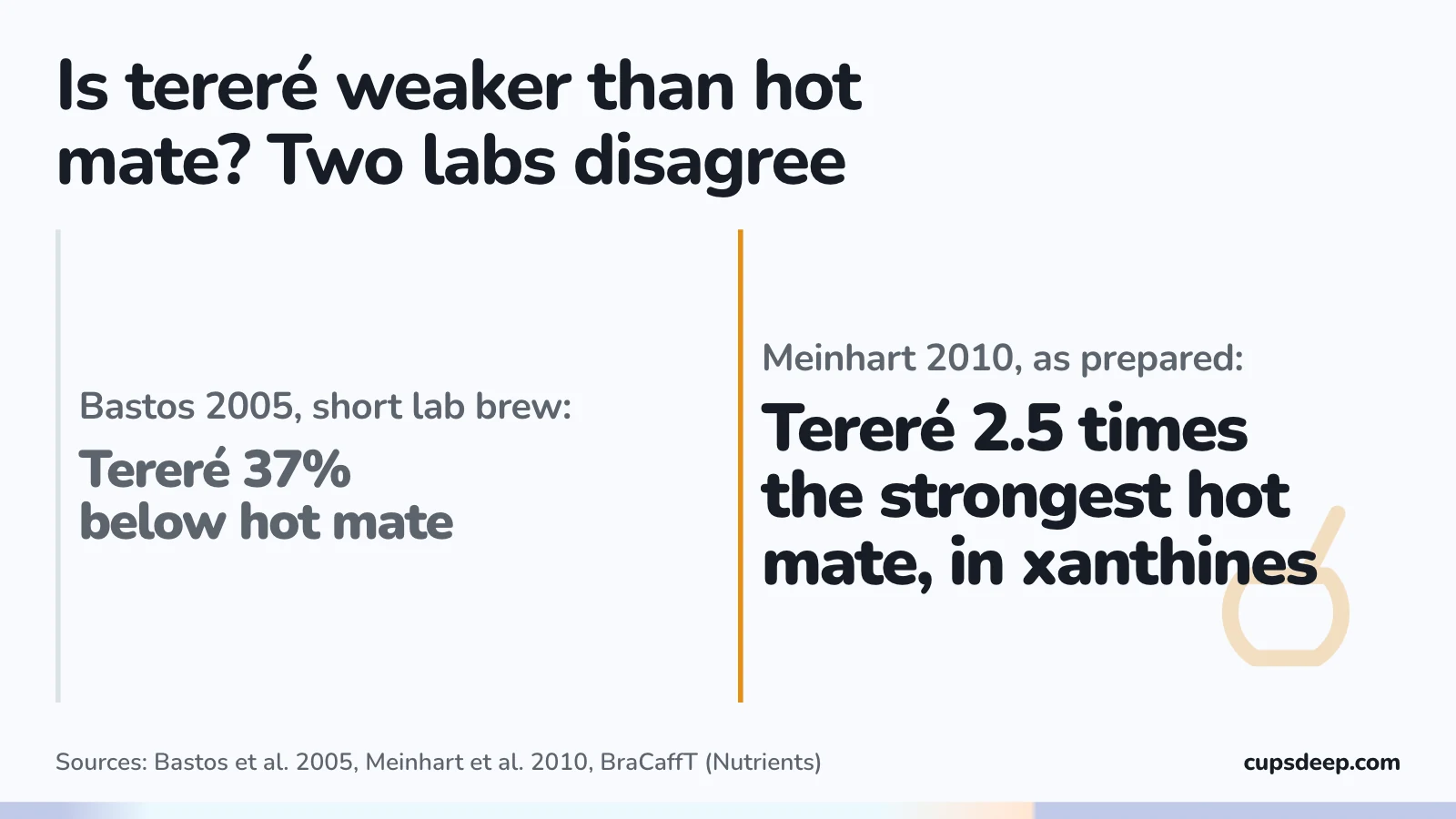
Three sources disagree on whether cold tereré carries less caffeine than hot mate. Bastos et al. 2005, with two short lab brews, found a cuia of tereré 37% lower than one of chimarrão (85 against 135 mg). Meinhart et al. 2010, simulating preparation for drinking, found tereré gave 2.5 times the xanthines of the strongest chimarrão. BraCaffT, a 2022 Brazilian table that compiles published analyses, puts the two close: chimarrão 26 and tereré 24 mg per 100 ml. 5795821
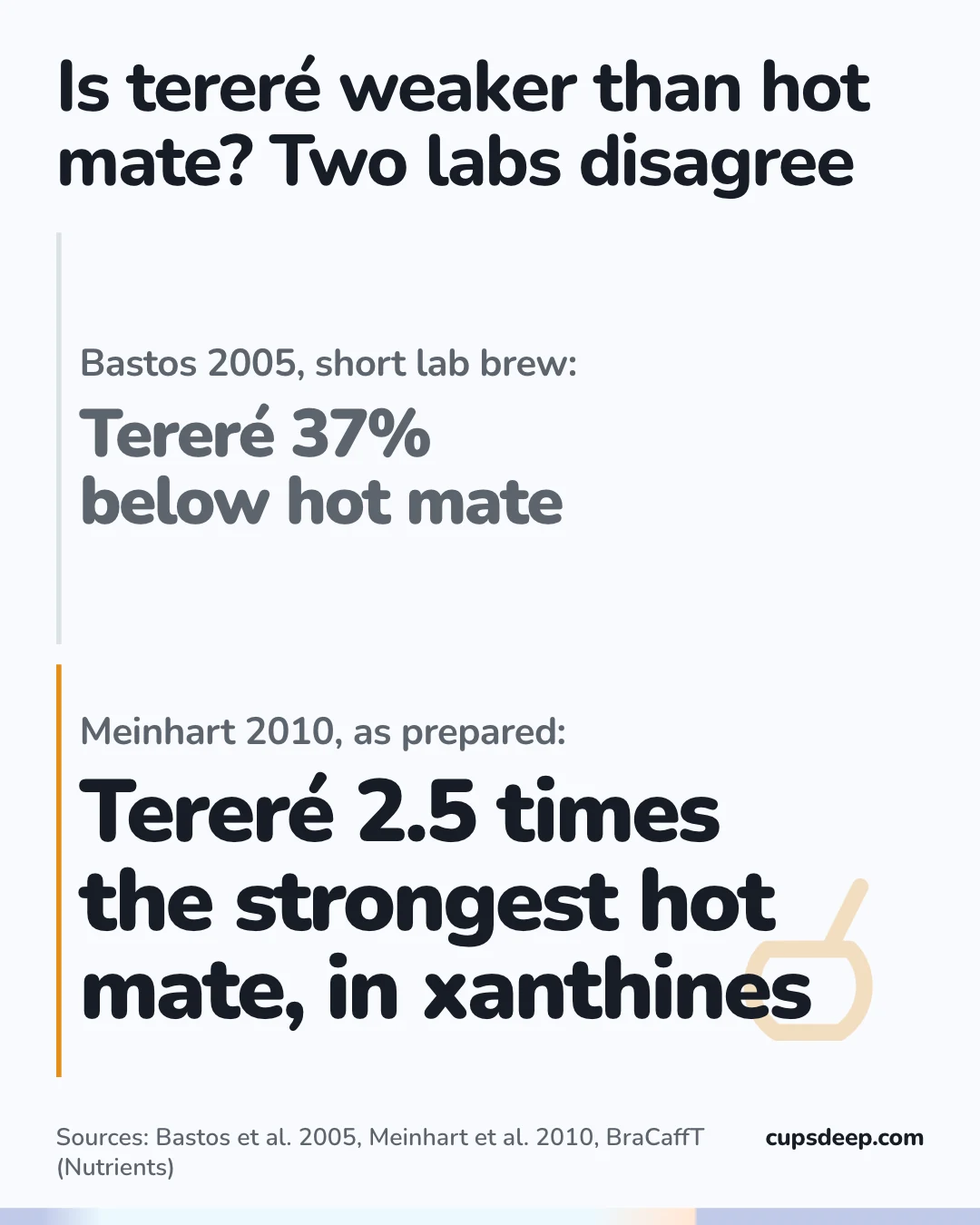
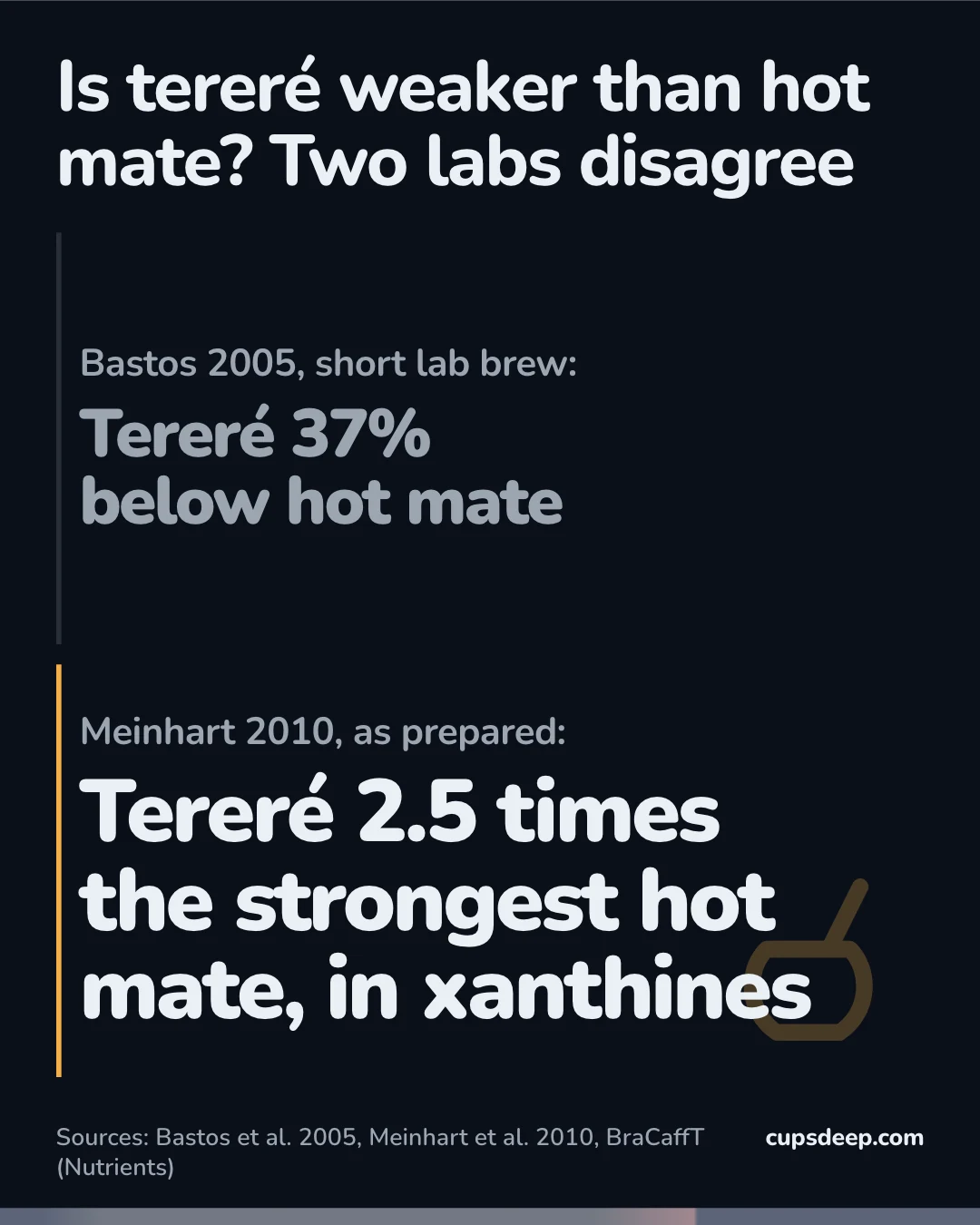
Look at the methods before picking a side. Bastos et al. gave the cold water two steps of three minutes each at lab scale. Meinhart et al. simulated the drinks as they are prepared, and their abstract calls chimarrão a partial infusion and tereré a total one. The abstract does not describe the method further, so we cannot say which set-up is closer to a real gourd; the difference in method may explain the disagreement.
A 2010 Brazilian study simulated how chimarrão, a “partial infusion” with hot water, and tereré, a “total infusion” with cold water, are prepared for drinking, using four commercial types of yerba for chimarrão. Its abstract says coarse-ground yerba gave the chimarrão highest in xanthines, the family of compounds caffeine belongs to, and that tereré gave 2.5 times as much as that. Only the abstract was read: it gives no milligram figure, and its comparison counts xanthines, not caffeine alone. 582
BraCaffT, which pools published analyses, lands in between at 26 mg per 100 ml for hot and 24 mg per 100 ml for cold. Our honest summary: tereré is not decaf, and the evidence does not show it is reliably weaker. The shop blog on page one that says cold water extracts less gives no source, and the one study that agrees with it used a short lab brew.
Cold water does not make tereré decaf. It just makes it last until dark
In Paraguay tereré goes around the circle, so caffeine intake is a group decision
Does yerba mate have more caffeine than coffee?
Gourd for cup, close: BraCaffT’s gourd of hot mate is 91 mg, and the filter coffee on our drinks table is 80 mg in 200 ml. A gourd of tereré is 84 mg. So the honest answer to “is mate stronger than coffee” is barely, per serving: 91 mg against 80 mg.
The 410.7 mg one gourd gave over a 20-fill session in the 1991 study is about 5.1 times the 80 mg in the 200 ml filter coffee on our drinks table. Our arithmetic, from one measured session. 58011
The catch is that a gourd is not a single serving. You would not pour one cup of coffee and top it up from the same grounds all afternoon, but that is exactly how a gourd is drunk. Count the session and the 1991 gourd comes to 5.1 cups of filter coffee. Mate tea in a bag is the other end: 13 mg in a 182 ml cup in one lab, 30 mg a bag by Yerba Madre’s own figure. The full coffee picture, cup sizes and all, is in how much caffeine is in a cup of coffee.
How much caffeine is in dry yerba mate?
Here the law is more precise than any brand. Argentina sets a minimum.
Argentina’s food code, the Código Alimentario Argentino, requires processed yerba mate to hold at least 0.6% caffeine, measured on the dry product (Article 1195), and at most 9.5% moisture. Article 1194 defines a yerba made with stems for tereré. 584
At Argentina’s legal minimum of 0.6% caffeine in dry yerba, each gram of dry yerba holds at least 6 mg of caffeine, so 50 g of yerba as sold, a packed gourd, holds at least about 270 mg of caffeine in the leaf (300 mg if it were bone-dry). That is caffeine in the leaf, not in the drink: how much reaches the gourd’s water depends on temperature, time and refills. Our arithmetic; the 50 g gourd is an example, not a standard. 584
The leaf figures and what comes out of the leaf sit close together. A 2024 paper says yerba usually holds 1–2% of its dry weight in caffeine, and measured 0.6–2.2% of the yerba’s dry weight coming out in its own brews, made once and twice. Yerba Madre says each 1.5 tsp serving of its loose leaf, 3 g, gives about 30 mg once prepared: by our arithmetic, about 10 mg/g of leaf reaching the drink, 1% of the leaf’s weight.
Paraguay’s own standard for yerba, NP 35 001 93, lists caffeine among the tests a yerba must pass for the national certification mark, according to the certification rules of INTN, Paraguay’s standards body. The limit itself is in the standard, which we could not obtain, so we have no Paraguayan number to give you.
A search of USDA FoodData Central for “yerba mate” on November 12, 2026 returned no record in its Foundation, SR Legacy or survey (FNDDS) data, the tables with measured or estimated nutrients, and 293 records in its branded product data. 585
The closest USDA comes is its survey food for hot herbal tea, which lists mate tea among its other names and gives it 0 mg per 100 g. That zero does not fit a gourd. It is one reason mate belongs in a caffeine table and not beside chamomile, and why the herbal tea article treats mate as the herb that brings its own.
How much caffeine is in a can of yerba mate?
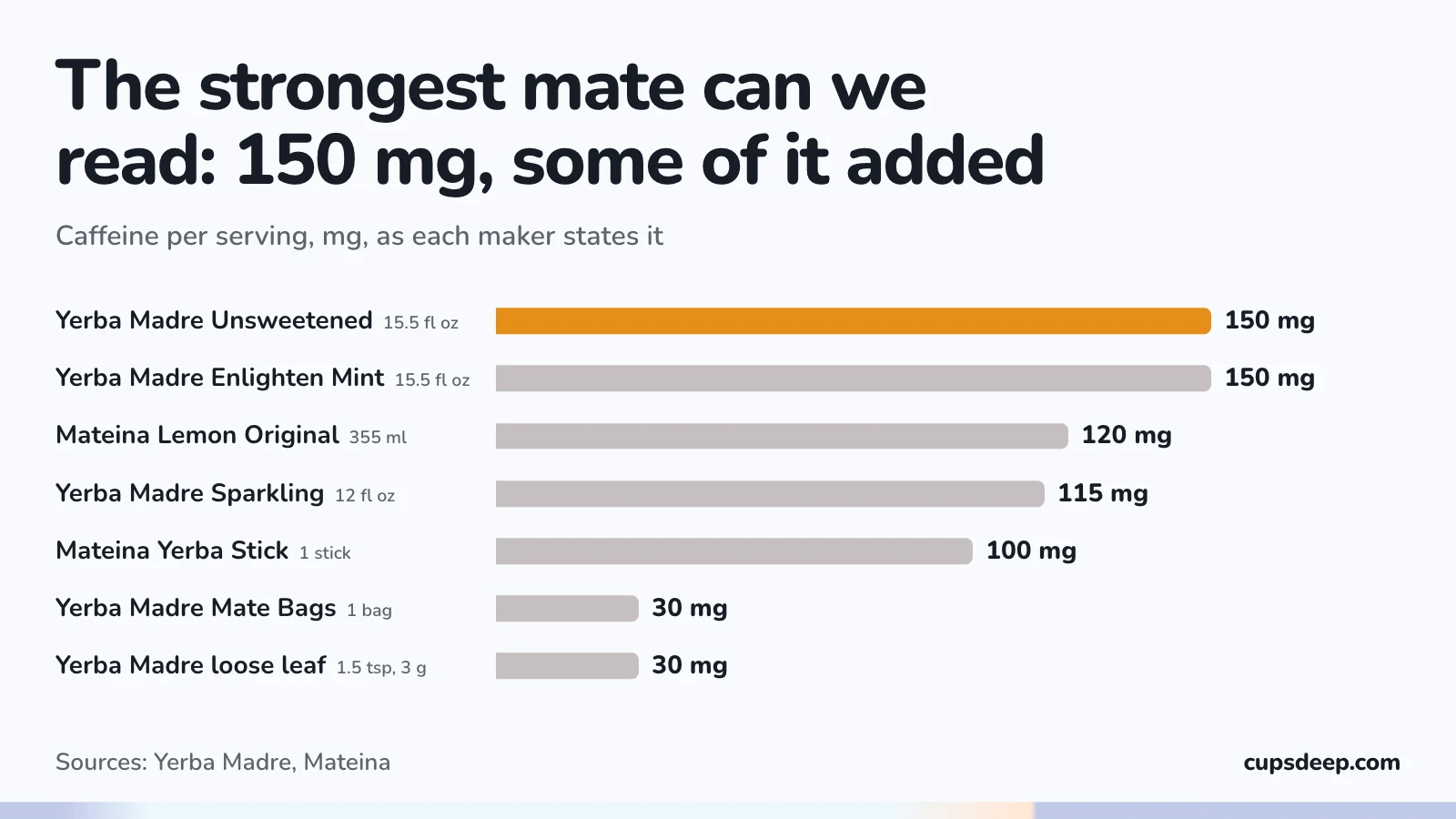
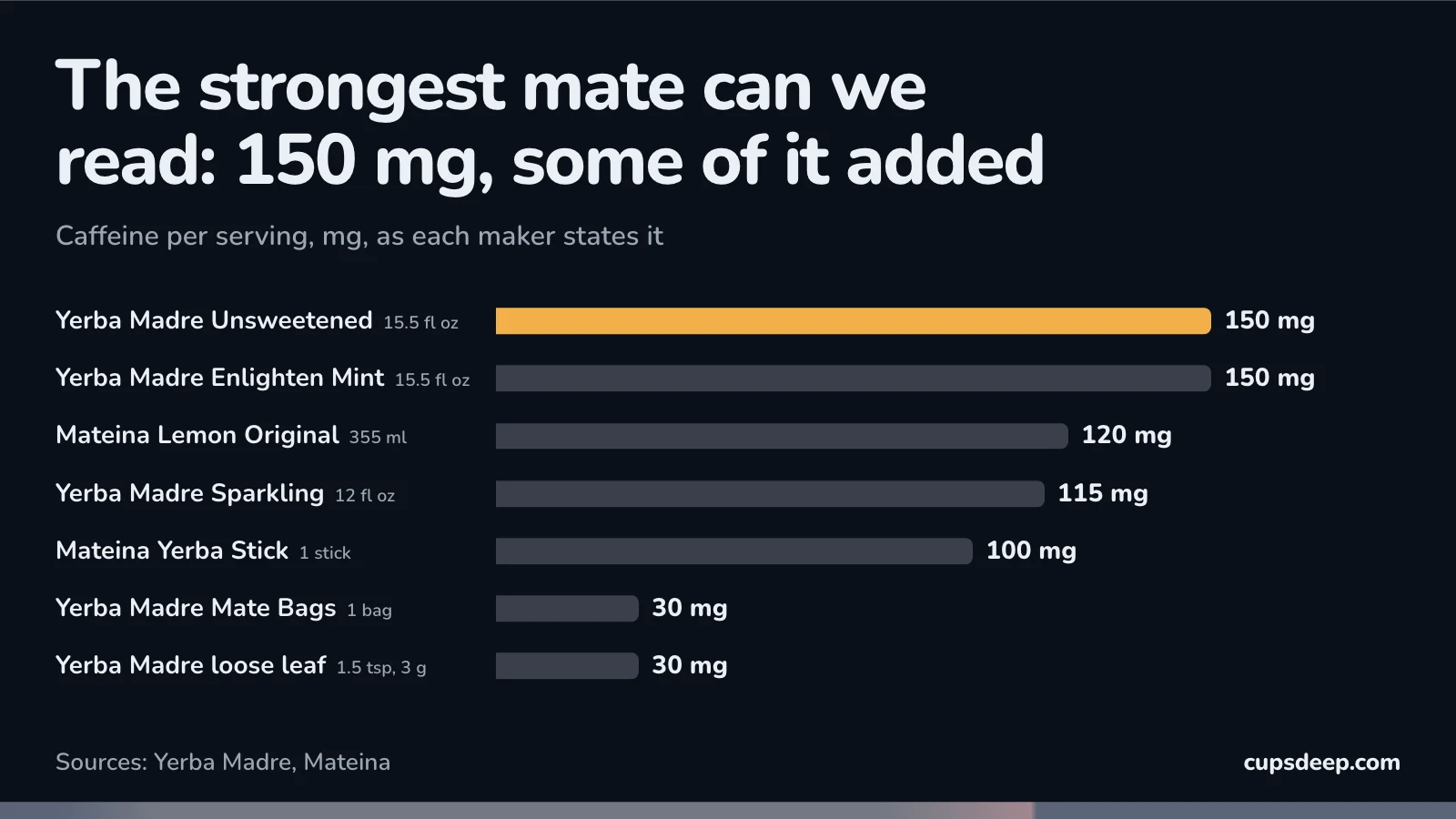
Read the ingredient list, not just the front of the can. Yerba Madre, sold by Guayakí, states 150 mg for a 15.5 fl oz can of its Unsweetened Original, and caffeine sits on the ingredient list as its own item after the brewed mate. Enlighten Mint is the same: 150 mg, organic caffeine listed, and so is the 12 fl oz Sparkling can at 115 mg. So part of what is in those cans was added, and the page does not say how much. Mateina’s ingredient lists name no caffeine; the yerba mate and its extract carry it, by the maker’s account.
Yerba Madre states 150 mg of caffeine for a 15.5 fl oz can of its Unsweetened Original, whose ingredient list ends with caffeine; the store’s data, read once and not rechecked, showed the same 150 mg on its other Higher Power cans. Its 12 fl oz Sparkling cans state 115 mg, and their ingredients also list caffeine. Mateina states 120 mg of “Mate-Derived Caffeine” for a 355 ml can, and 100 mg of “natural caffeine from organic yerba mate” for one Yerba Stick; neither Mateina ingredient list names caffeine. 587588589590
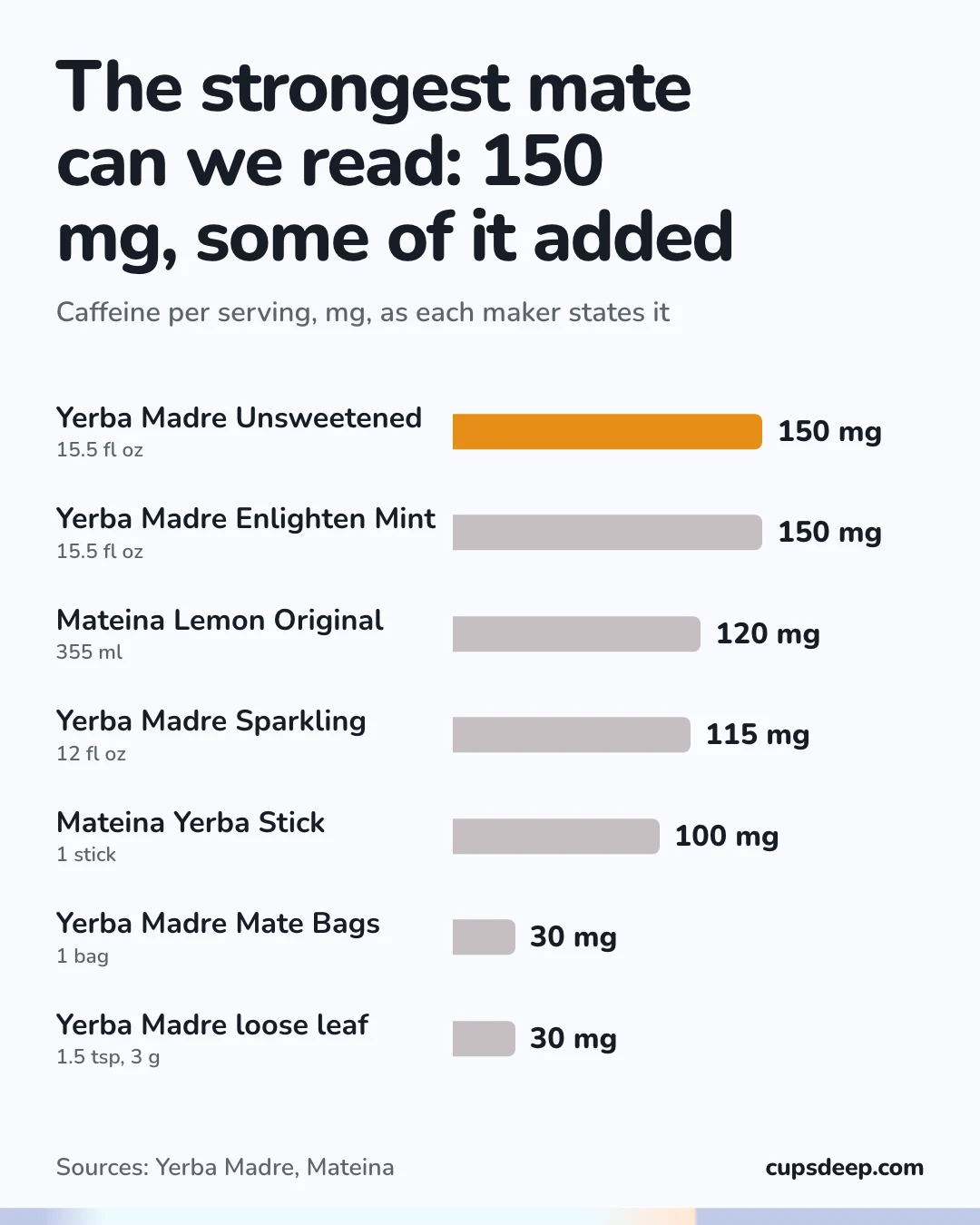
| Product | Serving | Caffeine | Caffeine added, by the ingredients |
|---|---|---|---|
| Yerba Madre Unsweetened | 15.5 fl oz | 150 mg | Yes, caffeine is listed |
| Yerba Madre Enlighten Mint | 15.5 fl oz | 150 mg | Yes, organic caffeine is listed |
| Mateina Lemon Original | 355 ml | 120 mg | No caffeine listed; maker says mate-derived |
| Yerba Madre Sparkling | 12 fl oz | 115 mg | Yes, organic caffeine is listed |
| Mateina Yerba Stick | 1 stick | 100 mg | No caffeine listed; maker says from yerba mate |
| Yerba Madre Mate Bags | 1 bag | 30 mg | No, mate only |
| Yerba Madre loose leaf | 1.5 tsp, 3 g | 30 mg | No, mate only |
| Club-Mate Original | 100 ml | 20 mg | Yes, caffeine (Koffein) is listed |
Read from each maker’s product page and store data on November 12, 2026. Our first read found the same figures on Yerba Madre’s other Higher Power and Sparkling cans; the second read could not recheck that. Club-Mate, read from its maker’s German page, gives its figure per 100 ml and none per bottle, so its row is per 100 ml and is left out of the chart.
A can of mate with caffeine on the ingredient list is mate that did not trust itself to show up alone
How much yerba mate is too much in a day?
EFSA concludes that caffeine intakes up to 400 mg a day from all sources, spread through the day, do not raise safety concerns for healthy adults, except pregnant women. FDA cites 400 mg a day for most adults as an amount not generally associated with negative effects, and notes wide variation in how sensitive people are to caffeine and how fast they eliminate it. 225
By gourds of BraCaffT’s size, that line is several gourds of hot mate away. By the 1991 session, one long gourd already passes it: 410.7 mg. Bastos et al. reached the same place from the other direction, noting that heavy chimarrão drinkers may drink more than 1.5 L a day, which corresponds to 405 mg. Neither number is a cliff, and people differ a lot in how fast they clear caffeine.
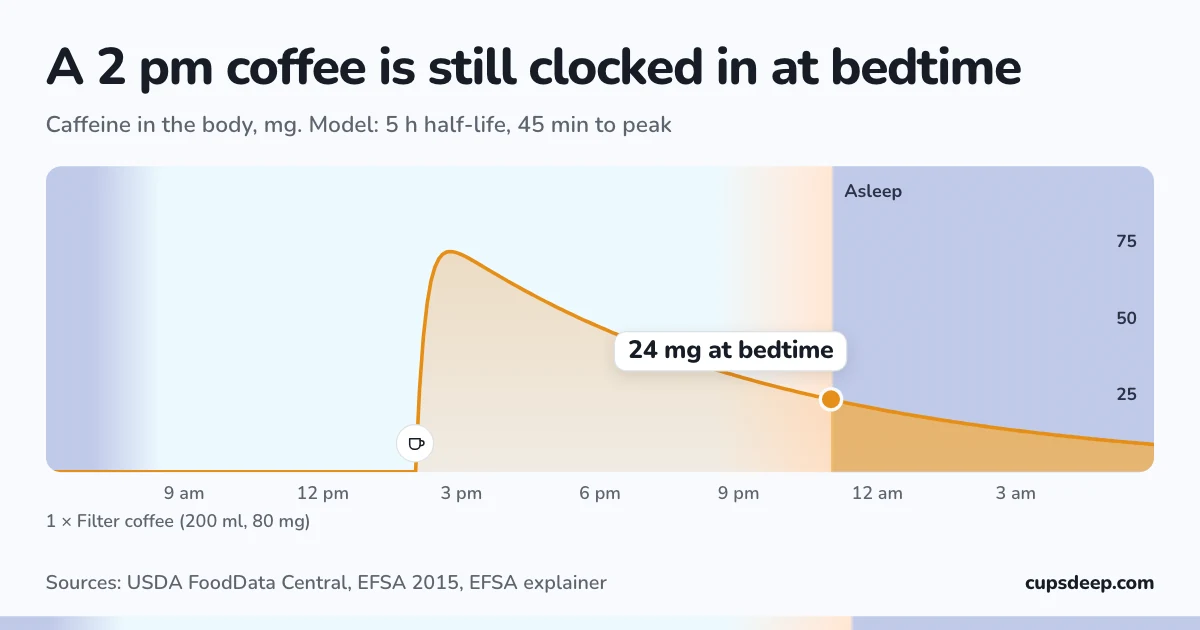
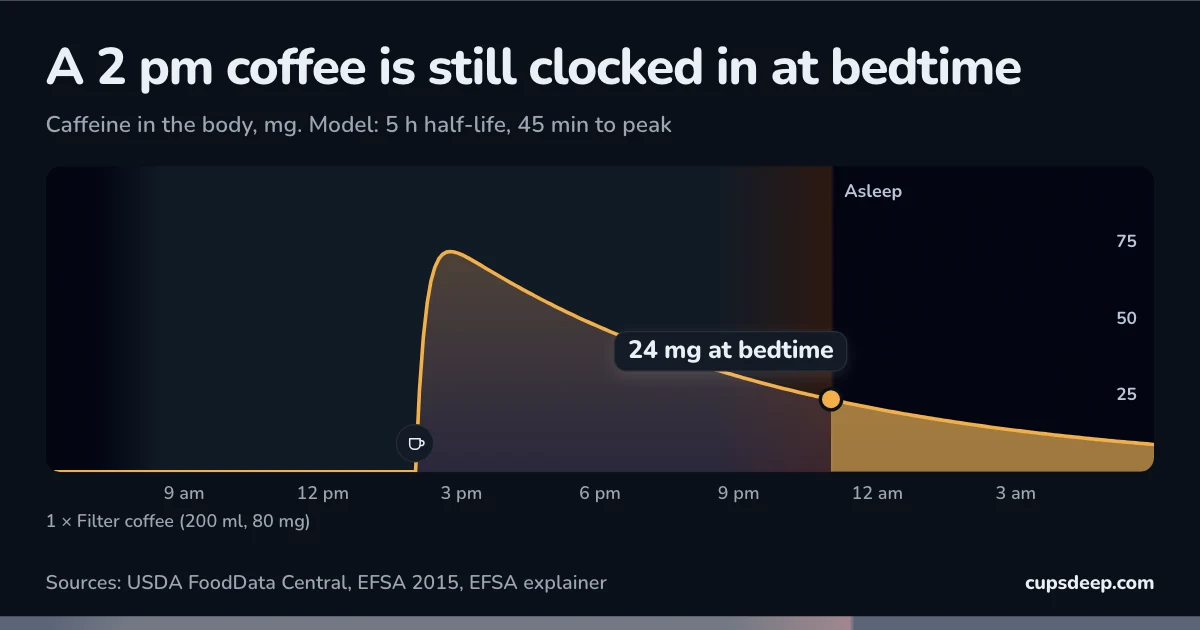
Timing matters as much as the total. Caffeine’s half-life in healthy adults averages 4 hours and runs as long as 8 hours, so a tereré at four in the afternoon is still in the room at midnight. How long caffeine stays in your system has the curve, and the method page shows what it rests on.
Questions people ask
Does yerba mate have caffeine?
Yes. Argentina’s food code requires processed yerba to hold at least 0.6% caffeine on the dry leaf, and BraCaffT puts a 350 ml gourd of hot mate at 91 mg. It is not an herbal tea in the caffeine-free sense.
Does yerba mate have more caffeine than coffee?
Per serving, about the same: 91 mg for BraCaffT’s gourd against 80 mg for a 200 ml filter coffee. Per session it can be far more, because a gourd is refilled: one measured gourd gave 410.7 mg over 20 fills, about 5.1 cups of filter coffee by our arithmetic.
Does tereré have caffeine?
Yes. Cold water still extracts it: BraCaffT puts a 350 ml gourd of tereré at 84 mg, and one lab found a 500 ml cuia at 85 mg. Whether it has less than hot mate is disputed; one study found tereré higher in xanthines, the family caffeine belongs to.
How much caffeine is in a yerba mate tea bag?
Yerba Madre says about 30 mg per bag. A lab measured a 182 ml cup of mate tea from a bag at 13 mg, and BraCaffT gives 10 mg for a 200 ml cup.
How much caffeine is in a can of Yerba Madre?
Yerba Madre states 150 mg for a 15.5 fl oz Higher Power can and 115 mg for a 12 fl oz Sparkling can. All three Yerba Madre cans we read, Higher Power and Sparkling, list caffeine as an ingredient of its own.
Does the caffeine in mate run out after a few refills?
Not in the one gourd we found measured across a whole session, where the bombilla was turned: over 20 fills, its last position gave the most, 131.3 mg by our sum. With the bombilla left in place it does fade: Meinhart et al., as Najman et al. report it, saw chimarrão fall to 1.5–6.6 mg per 100 ml by the thirtieth brew.
Sources
Every number above links to the place it came from. How the numbers are chosen and checked is on the method page; the drink table is at /drinks. Written with AI agents, as the whole site is. A model of a typical body, not advice for pregnancy, illness or medication.
- Development of a Caffeine Content Table for Foods, Drinks, Medications and Supplements Typically Consumed by the Brazilian Population (BraCaffT)
- Spilling the Beans: How Much Caffeine is Too Much?
- Beverages, coffee, brewed, prepared with tap water
- Scientific Opinion on the safety of caffeine
- Tea, ginger (FNDDS, food code 92306850)
- Yerba Madre Mate Bags (product page)
- Enlighten Mint (product page)
- The Chlorogenic Acid and Caffeine Content of Yerba Maté (Ilex paraguariensis) Beverages
- Incidencia de la Ingesta de Mate en la Terapéutica con Teofilina
- Maté drinking: caffeine and phenolic acid intake
- Methylxanthines and phenolics content extracted during the consumption of mate (Ilex paraguariensis St. Hil) beverages
- Changes in the Physicochemical and Bioactive Properties of Yerba Mate Depending on the Brewing Conditions
- Código Alimentario Argentino, Capítulo XV: Productos estimulantes o fruitivos (updated December 2025)
- FoodData Central search: “yerba mate”, all data types
- Yerba Madre Traditional Loose Leaf (product page)
- Unsweetened Original Yerba, Higher Power Cans (product page)
- Sparkling Enlighten Mint (product page)
- Lemon Original Yerba Mate Drink (product page)
- Yerba Stick, Lemon Lime (product page)
- Club-Mate products page (Produkte)
Keep reading
Tea and mate
Does herbal tea have caffeine?
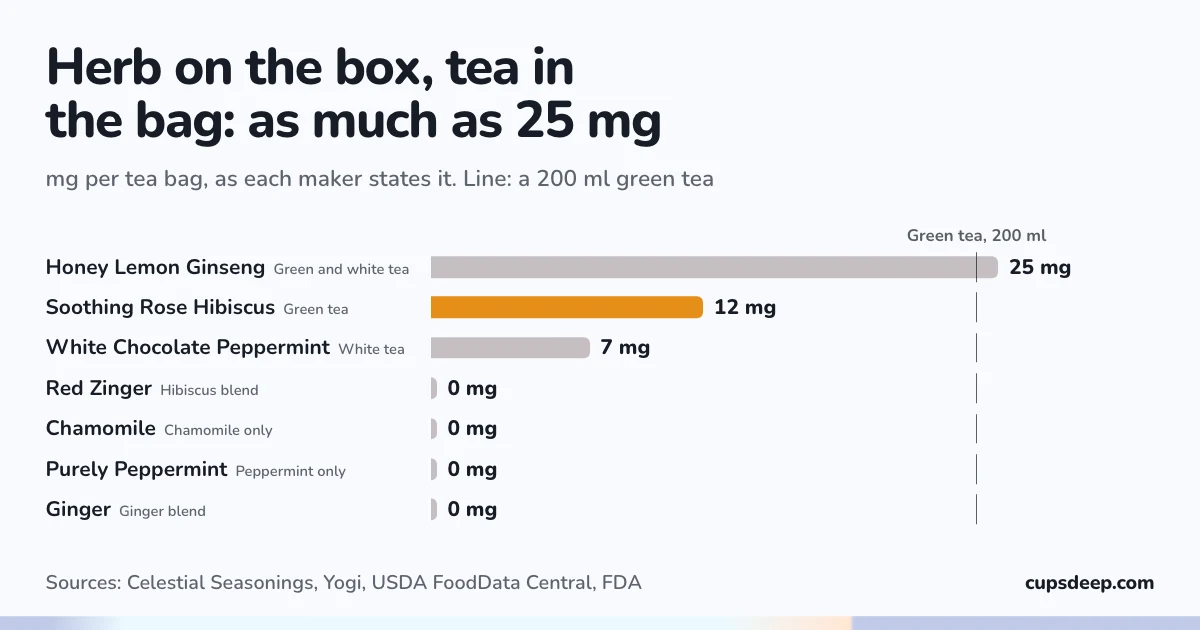
Chamomile, peppermint, hibiscus, rooibos and ginger tea: no caffeine, by USDA and the makers. Some herb-named blends hide tea; the strongest we found, 25 mg.
Coffee
How much caffeine is in a cup of coffee?
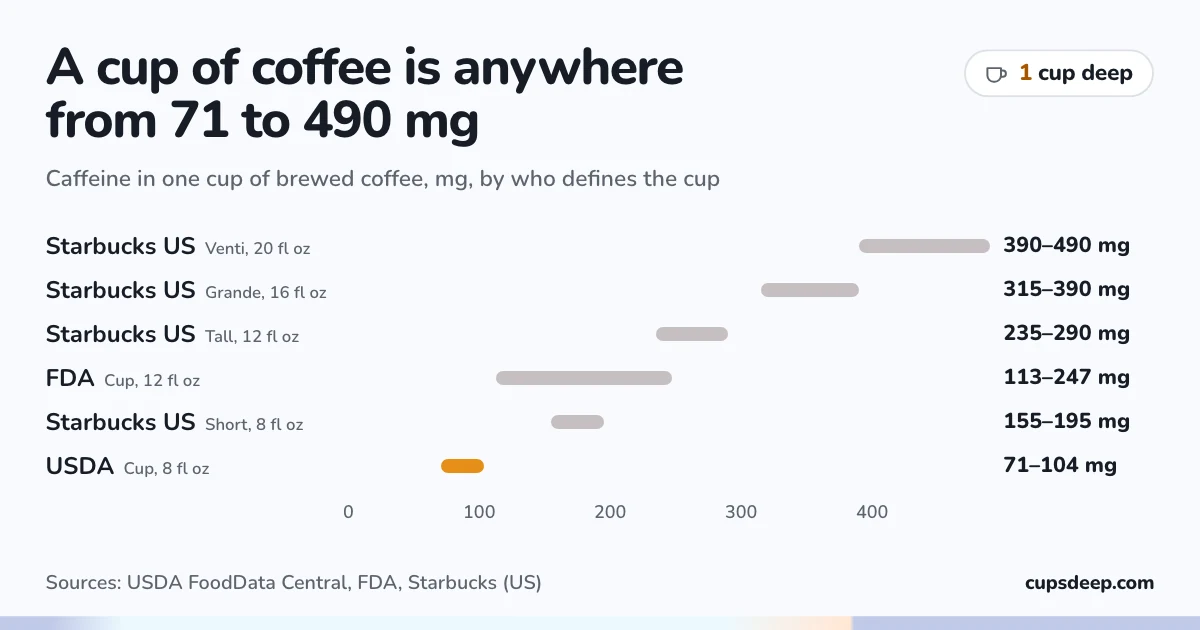
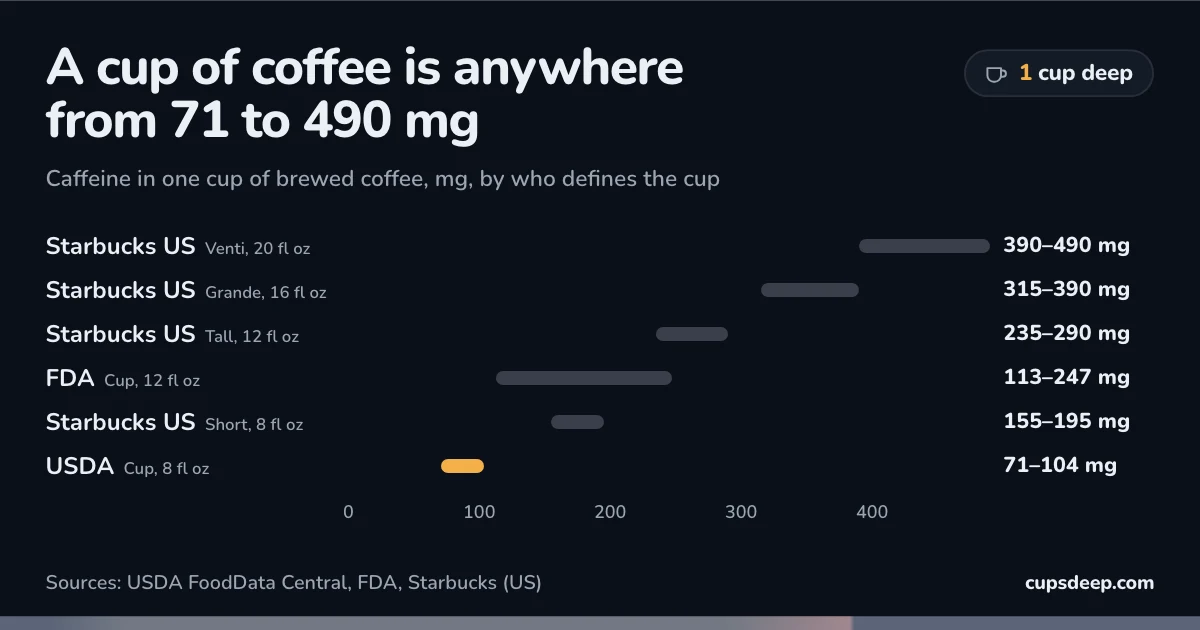
An 8 fl oz cup of brewed coffee has about 95 mg of caffeine by USDA’s figure. A Starbucks cup the same size states 155 mg to 195 mg. Tables by size and type.
Body and sleep
How long does caffeine stay in your system?
Half of a dose of caffeine is gone in about 4 hours, 2–8 hours between people. After five half-lives, 20 hours on average, 3.1% is left.