How much caffeine is in a cup of coffee?
There is no such thing as a cup of coffee. There is a lab’s cup, a regulator’s cup and the bucket with your name misspelled on it, and they do not hold the same thing. Here is each one, with its source.
The short answer
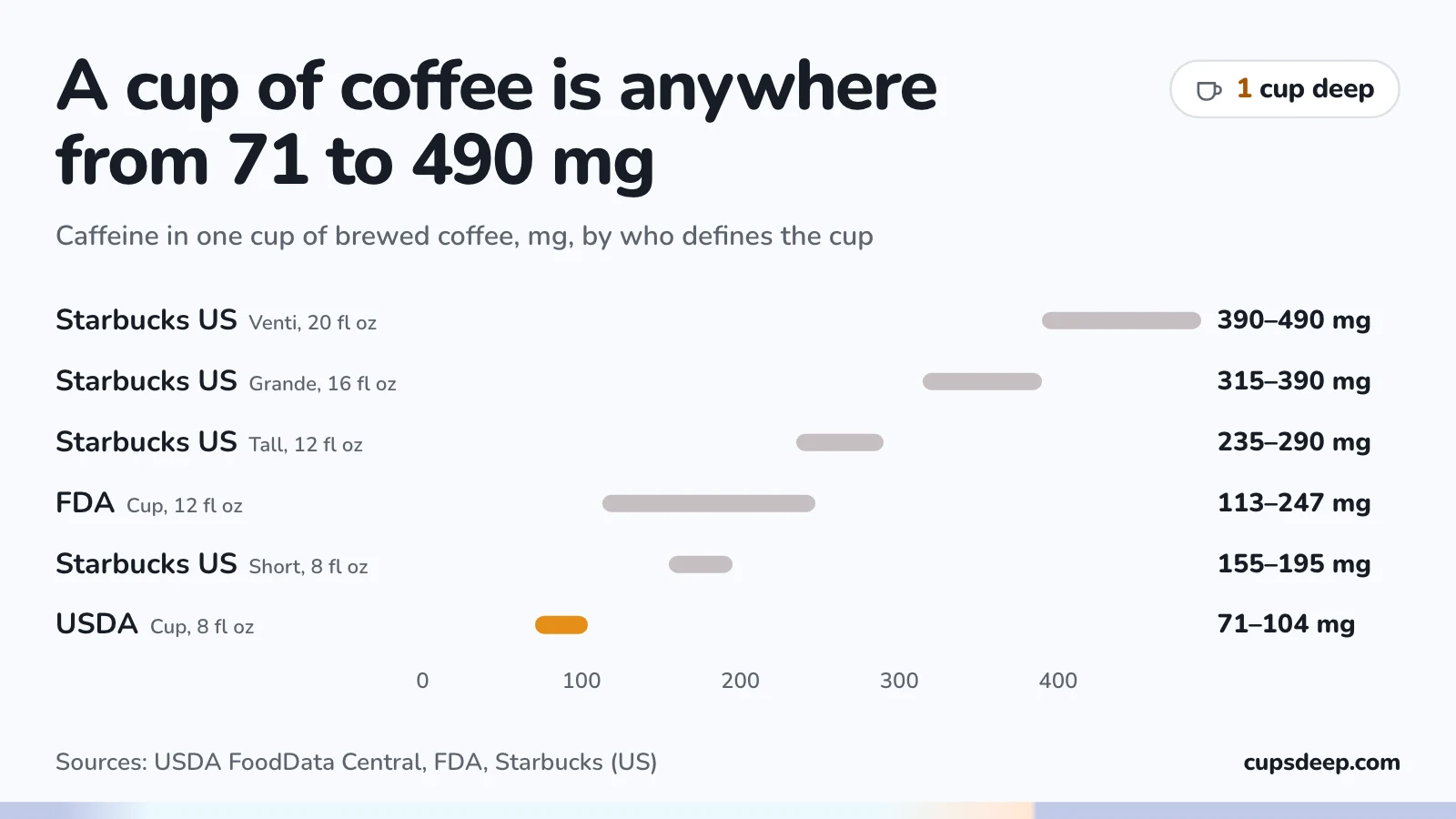
An 8 fl oz cup of brewed coffee has about 95 mg of caffeine. That is USDA’s figure, 40 mg per 100 g multiplied by its 237 g cup, and its own samples put the cup anywhere from 71 mg to 104 mg. The cup you buy is bigger and can be much stronger: FDA gives 113–247 mg for 12 fl oz, and Starbucks states 155 mg to 195 mg for its 8 fl oz Short.
Where does the usual figure come from?
USDA's record for brewed coffee gives 40 mg of caffeine per 100 g, from eight samples that ran from 30 to 44, and its cup is 8 fl oz weighing 237 g. Multiplied out, that is about 95 mg a cup, and 71 to 104 mg across the samples. The multiplication is ours: the record we read gives the figure per 100 g, not per cup. 1151
It is a good number for what it measures: 8 samples of plain brewed coffee, analyzed in a lab and filed in a government database, poured into a cup most people would call small. Quoted without its source or its cup size, it reads like a promise about your mug. It was never that.
A 2014 study measured 104 espresso coffees bought in coffee shops in Scotland, Italy and Spain, with a few cappuccinos and instant coffees, and found 48 to 317 mg of caffeine per serving. It concluded that the term “one cup of coffee” is not a reproducible measurement. This is read from the abstract only. 54
“I’ve only had two cups” is a statement about crockery
How much caffeine is in a 12, 16 or 20 oz coffee?
Nobody orders eight ounces. So here is the same question at the sizes people drink, three ways: USDA’s coffee scaled up at about 11.8 mg per fl oz, FDA’s typical range, and what Starbucks states for its brewed coffee.
| Cup size | At USDA’s strength | FDA’s typical range | Starbucks brewed coffee |
|---|---|---|---|
| 8 fl oz | 95 mg | 75–165 mg | 155 mg to 195 mg |
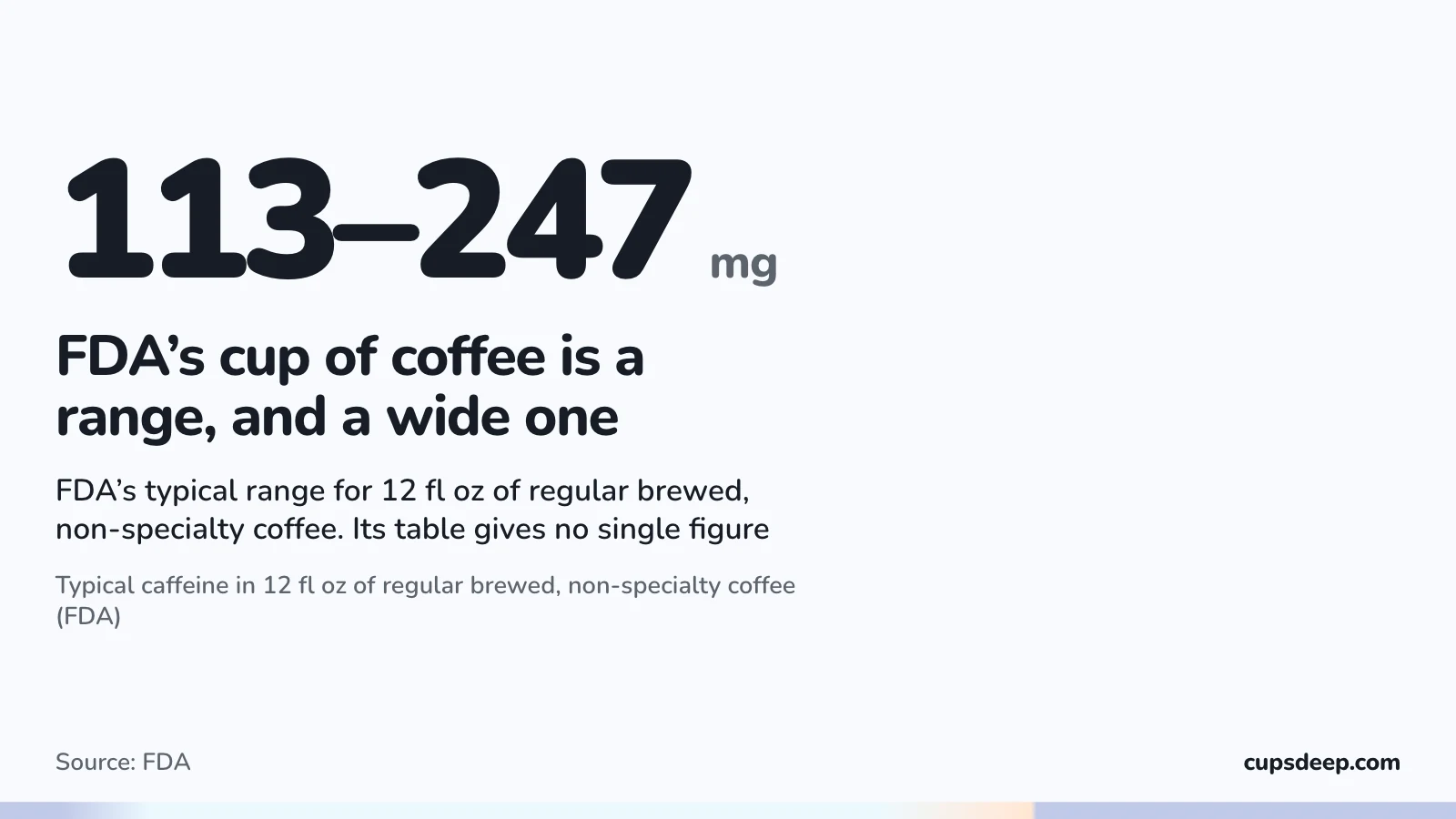
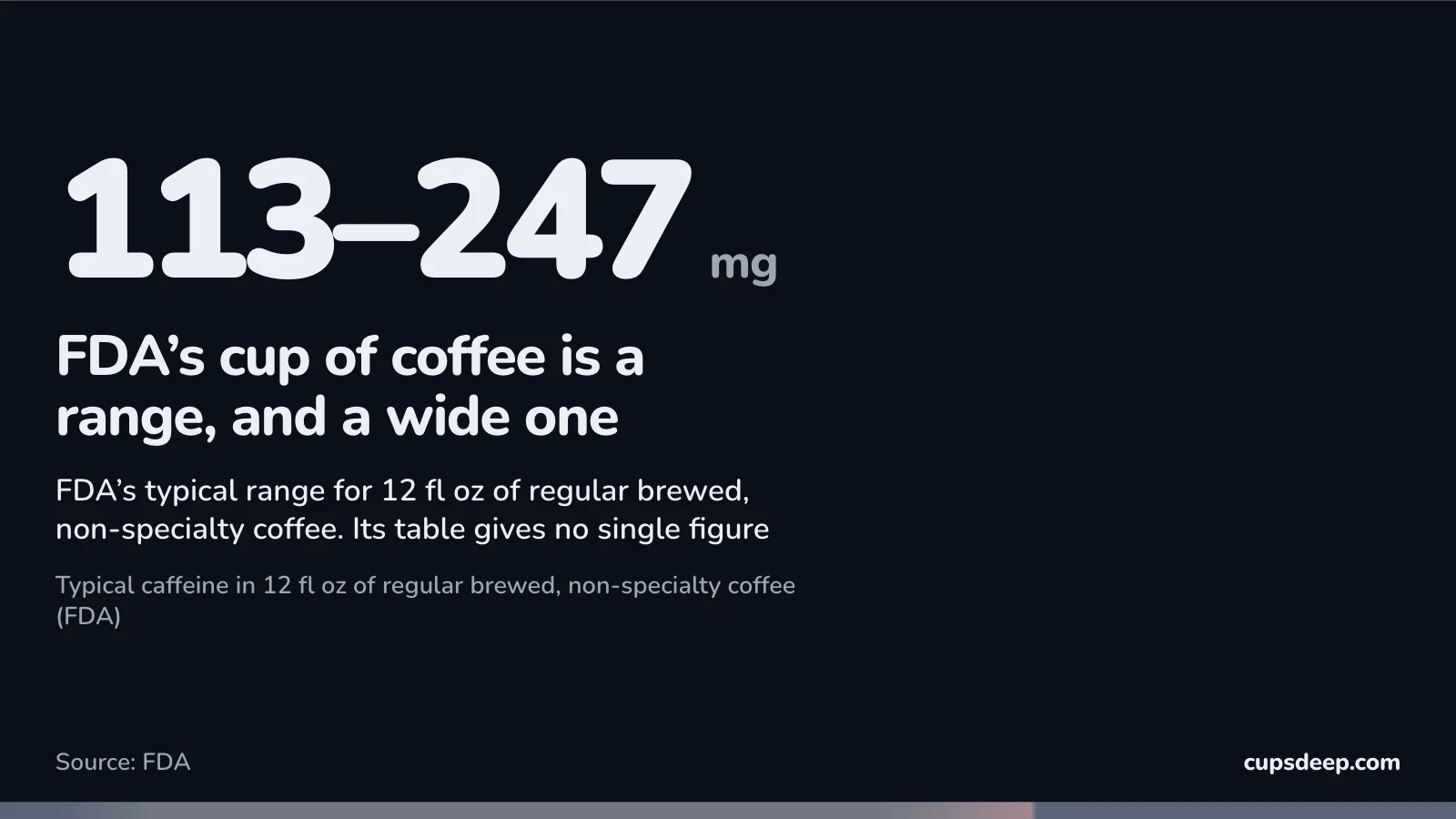
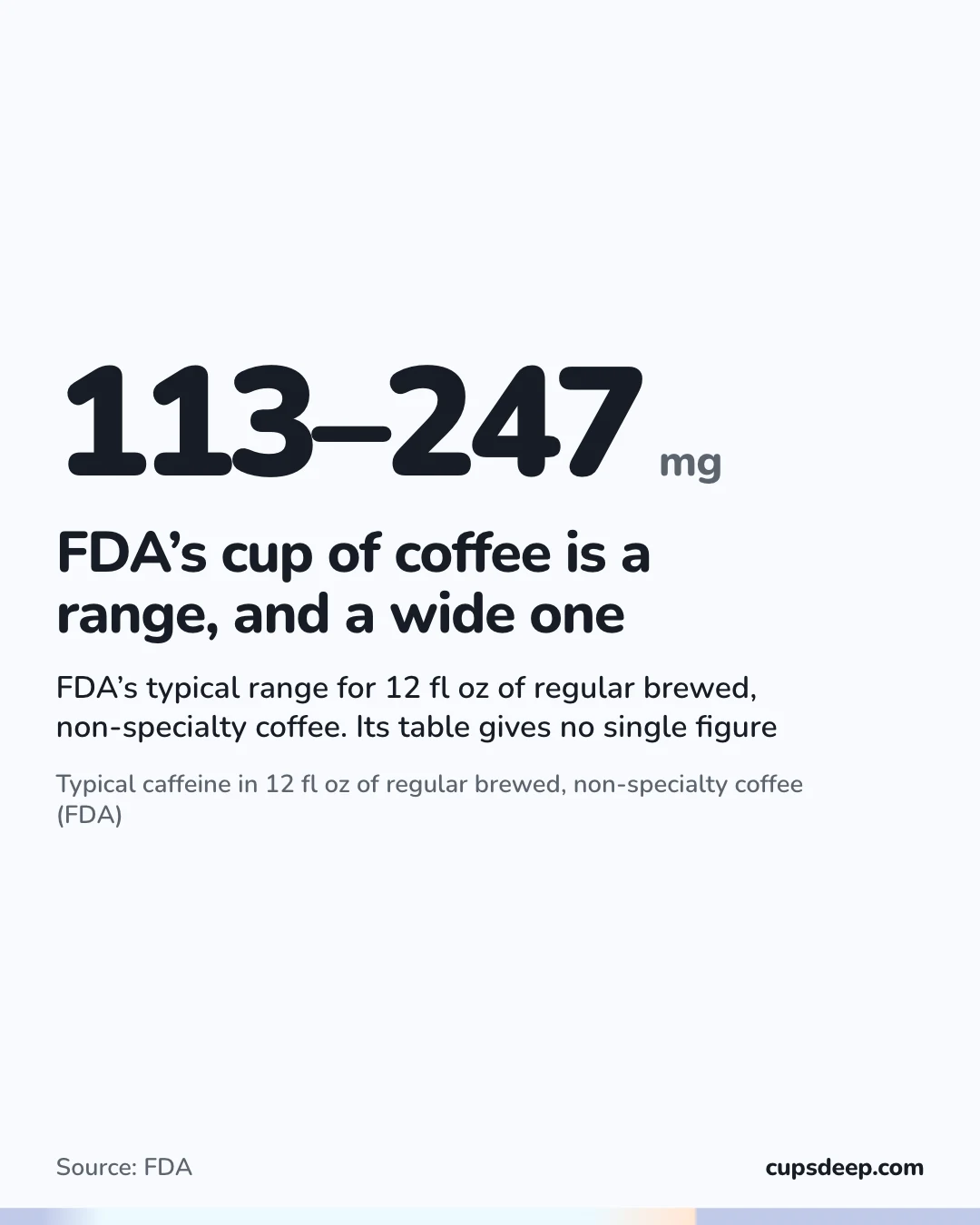
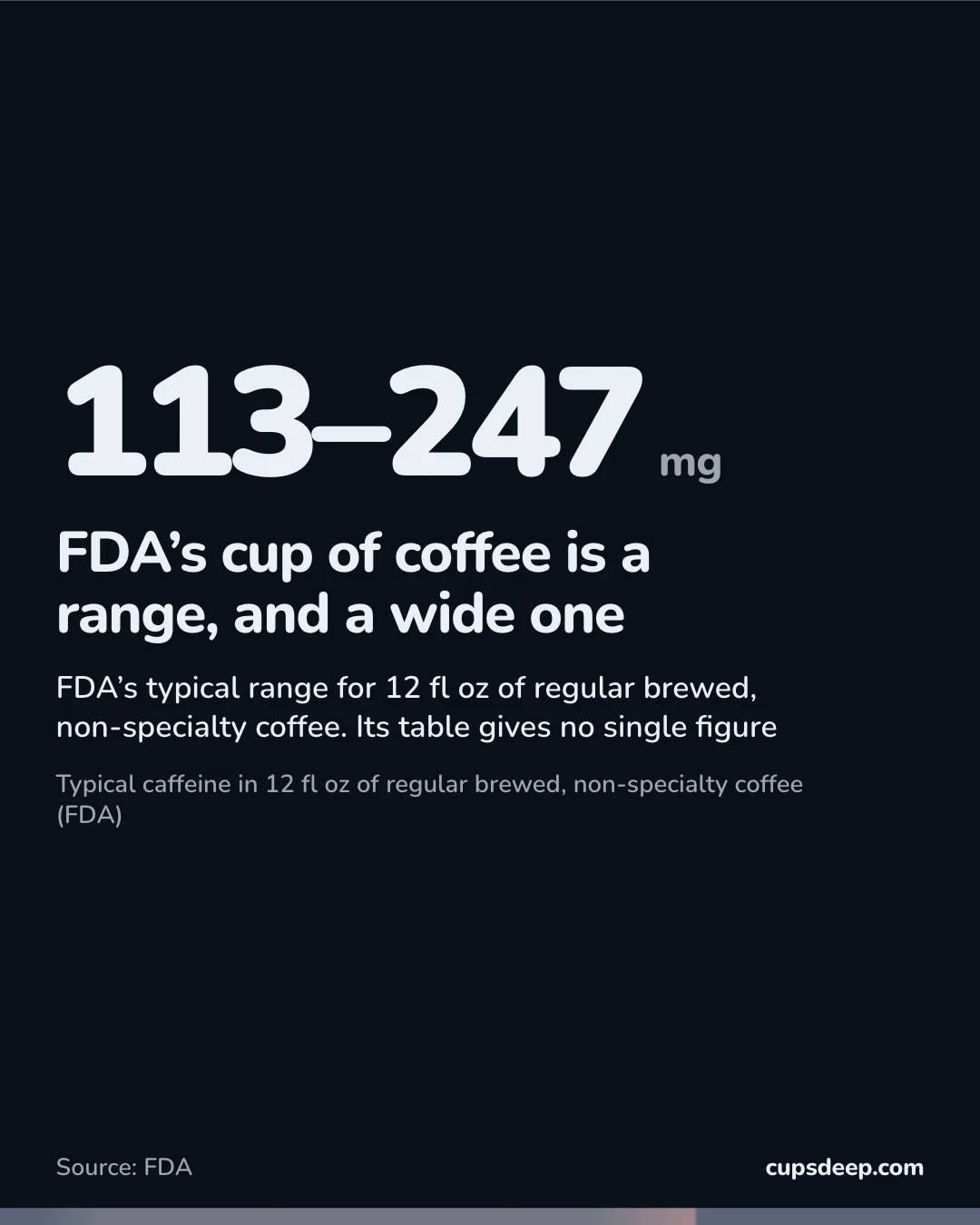
| 12 fl oz | 142 mg | 113–247 mg | 235 mg to 290 mg |
| 16 fl oz | 189 mg | No figure | 315 mg to 390 mg |
| 20 fl oz | 237 mg | No figure | 390 mg to 490 mg |
The USDA column is our multiplication from its figure per hundred grams. FDA states only the twelve-ounce range; the eight-ounce row is that range scaled down by us. FDA’s range is for what it calls regular brewed, non-specialty coffee. Starbucks figures are as stated on its United States menu for Pike Place Roast.
Read across any row. At every size, the Starbucks cup holds more than one and a half times what the USDA cup does, and its smallest size already clears the whole of USDA’s range for a cup. Per hundred millilitres, USDA’s coffee is about 40 mg per 100 g, since coffee weighs about what water does. Iced coffee and cold brew get their own comparison in cold brew vs iced coffee.
Venti is Italian for “I’ll sleep on Thursday”
Why does the same coffee from the same shop change?
In a 2003 lab study of specialty coffees, the same coffee bought from the same outlet on six consecutive days held 259 to 564 mg of caffeine per dose. Across the caffeinated coffees it tested, the abstract gives 58 to 259 mg per dose, and a mean of 188 mg (standard deviation 36) for brewed specialty coffee in a 16 oz cup. This is read from the abstract only, which does not name the outlet or the coffee, or give the serving size of the six-day samples. 53
Same order, same counter, six days running, and the strongest cup held more than twice the weakest. I have only the abstract, so I cannot tell you which shop or how big the cup was, and I will not guess. The point survives without it: a menu figure describes cups like these, not the one in your hand.
How much caffeine is in instant, espresso, decaf and pods?
| Type | Serving | Caffeine | Who says |
|---|---|---|---|
| Brewed | 8 fl oz | 95 mg (71–104 mg) | USDA, multiplied out by us |
| Instant | 6 fl oz | 46.5 mg | USDA, a recipe calculation |
| Espresso | 1 shot, 30 ml | 63.6 mg | USDA |
| Decaf, brewed | 8 fl oz | 2–15 mg | FDA |
| Pod, Keurig K-Cup | 8 fl oz | 75–150 mg | Keurig Canada |
| Pod, Nespresso espressos and lungos | One capsule | 50–100 mg | Nespresso USA |
| Pod, Nespresso Vertuo coffee | 7.77 fl oz | 170–200 mg | Nespresso USA |
| Chain, Starbucks brewed | Short, 8 fl oz | 155 mg to 195 mg | Starbucks US |
| Chain, Starbucks latte | Tall, 12 fl oz | 75 mg | Starbucks US |
| Chain, Starbucks decaf brewed | Short, 8 fl oz | 15 mg | Starbucks US |
Servings are each source’s own and are not the same size. USDA’s instant serving is six ounces; scaled to eight by us it is about 62 mg. The pod figures are the makers’ own statements, not lab results.
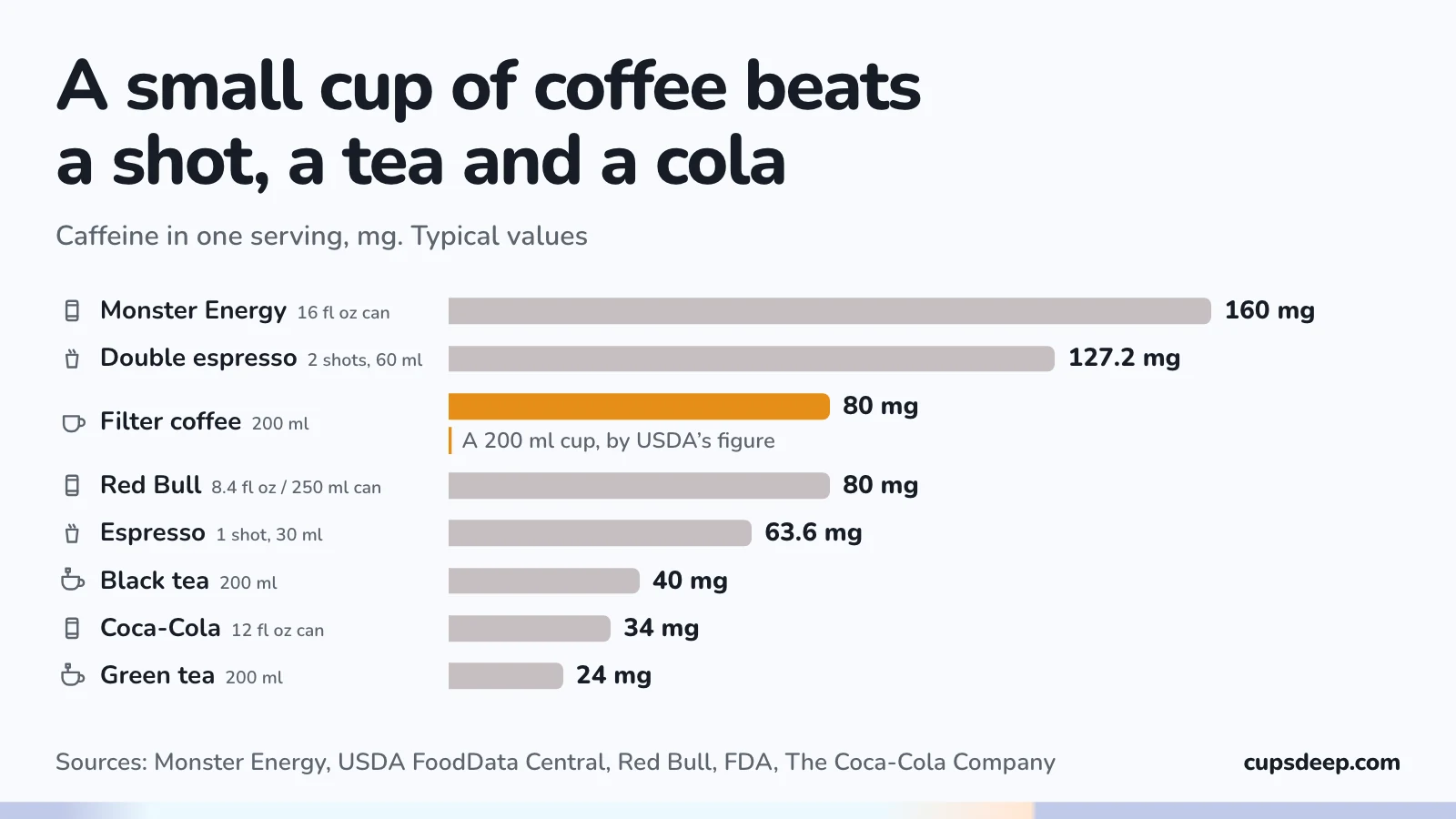
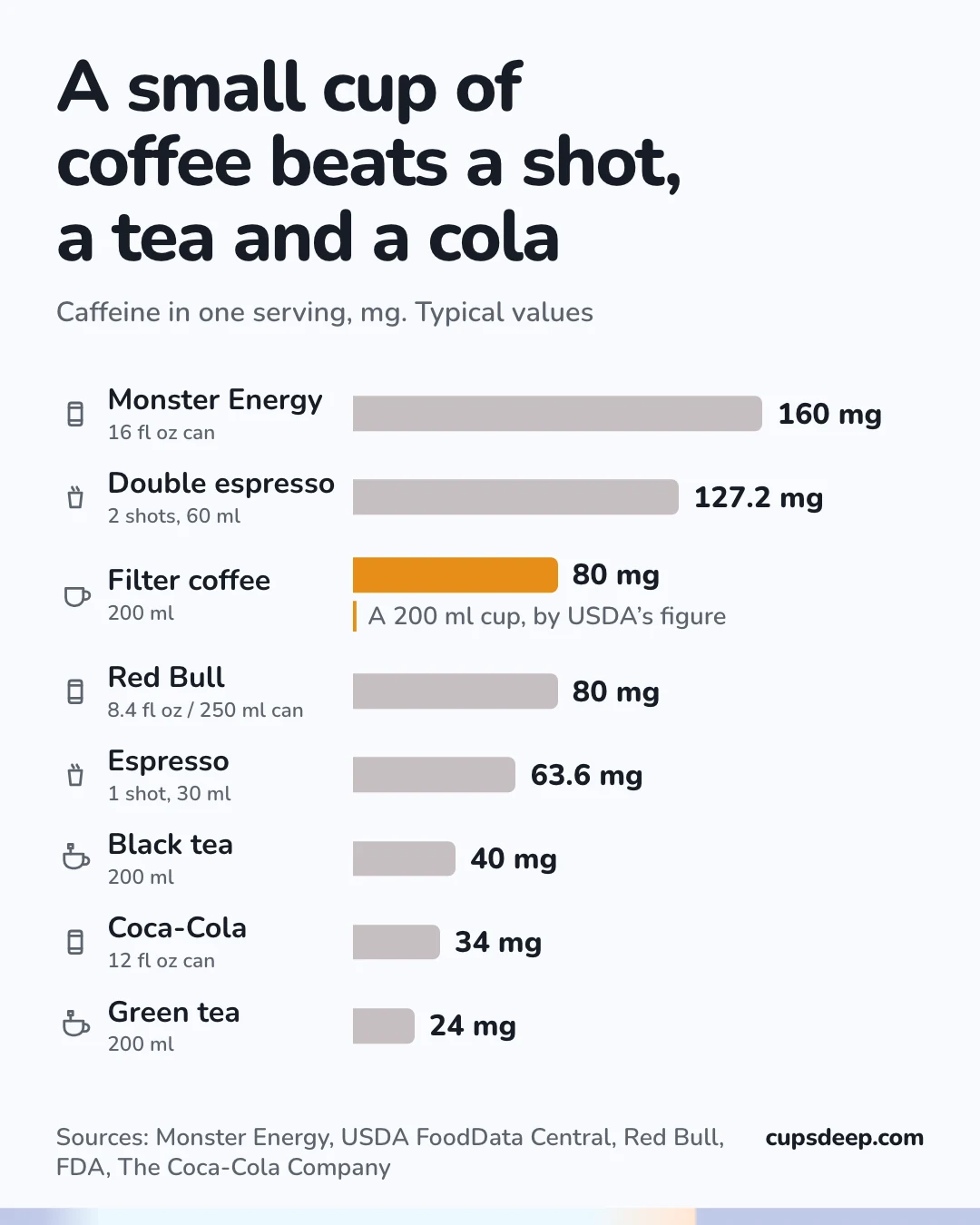
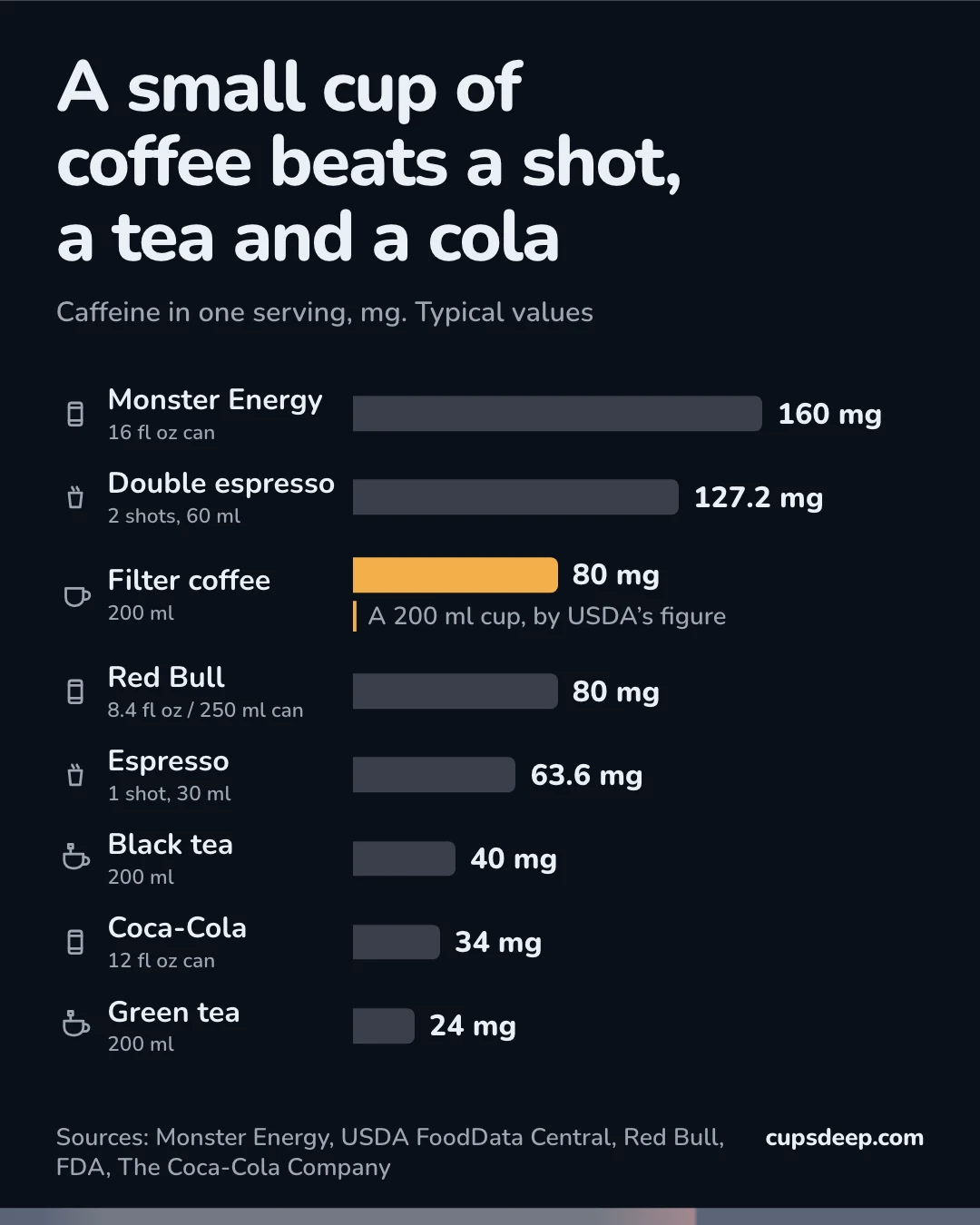
Two things in that table surprise people. A shot of espresso is stronger by the sip and weaker by the serving: there is less in one shot than in a small cup of brewed coffee. And milk adds volume, not caffeine, which is why a tall Starbucks latte states the same figure as its single espresso and less than half of its smallest brewed coffee.

Dunkin’ and McDonald’s are missing on purpose. The copy of Dunkin’s nutrition guide we could read has no caffeine column, and we could not open McDonald’s United States menu at all, so we print no figure for either. Decaf is in the table because it is not zero, whatever the process: Swiss Water decaf included.
What changes the caffeine in a cup?
Four things. The order is our reading, from single studies that were not designed to be compared:
- How much coffee goes in. Caffeine comes out of the grounds, so more grounds per cup is more caffeine. One lab brewing strong, at one part coffee to ten of water, measured the equivalent of 199–251 mg per 8 fl oz from a French press. That is one coffee in one lab, set beside USDA’s figure from another, so treat the gap as a direction.
- The species. Green arabica beans run 0.9–1.5% caffeine by dry weight and robusta 1.2–2.4%, in a review that compiled other people’s measurements. By that pair of ranges the two overlap, so robusta is not reliably double. The same review also prints a narrower pair, 0.9–1.2% and 1.6–2.4%, that does not overlap. Nespresso puts its strongest espresso capsules down to robusta.
- The brew. In that strong recipe, a day-long cold brew came out at 234–291 mg per 8 fl oz, a little above the hot version of the same coffee, a gap the study found clear only for the coarse grinds.
- The roast, last. Across five roast levels and three brew times, one study found 134–165 mg per 8 oz cup for one coffee and 145–165 mg for another. Lighter roasts came out slightly higher in its long brews; measured another way, darker ones did.
Dark roast isn’t stronger. It’s just louder
How many cups of coffee is the daily limit?
The adult daily line of 400 mg/day, divided by the USDA cup, is about four cups. FDA does its own arithmetic on the same page as the limit and gets about two to three cups of 12 fl oz. By Starbucks’ stated range, one Venti brewed coffee can reach it alone. The single dose and the day, side by side, are in when a dose counts as a lot, and whether all those cups dry you out is in does coffee dehydrate you.
Coffee is rarely the whole day. The other usual suspects have their own pages: a Monster, a Coke Zero, matcha and chai, and what happens when you stop is under caffeine withdrawal.
400 mg a day is a guideline the way a speed limit is
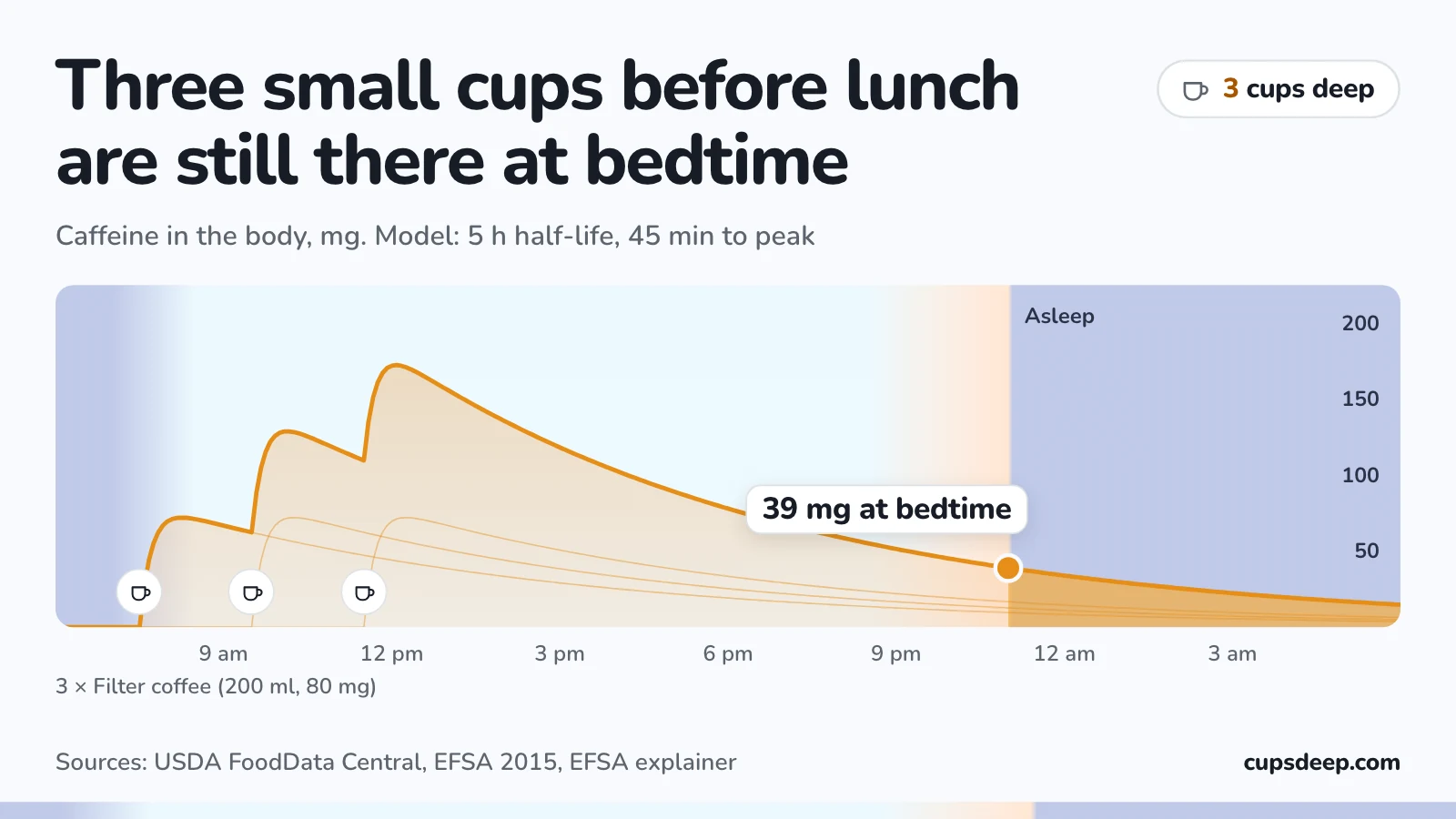
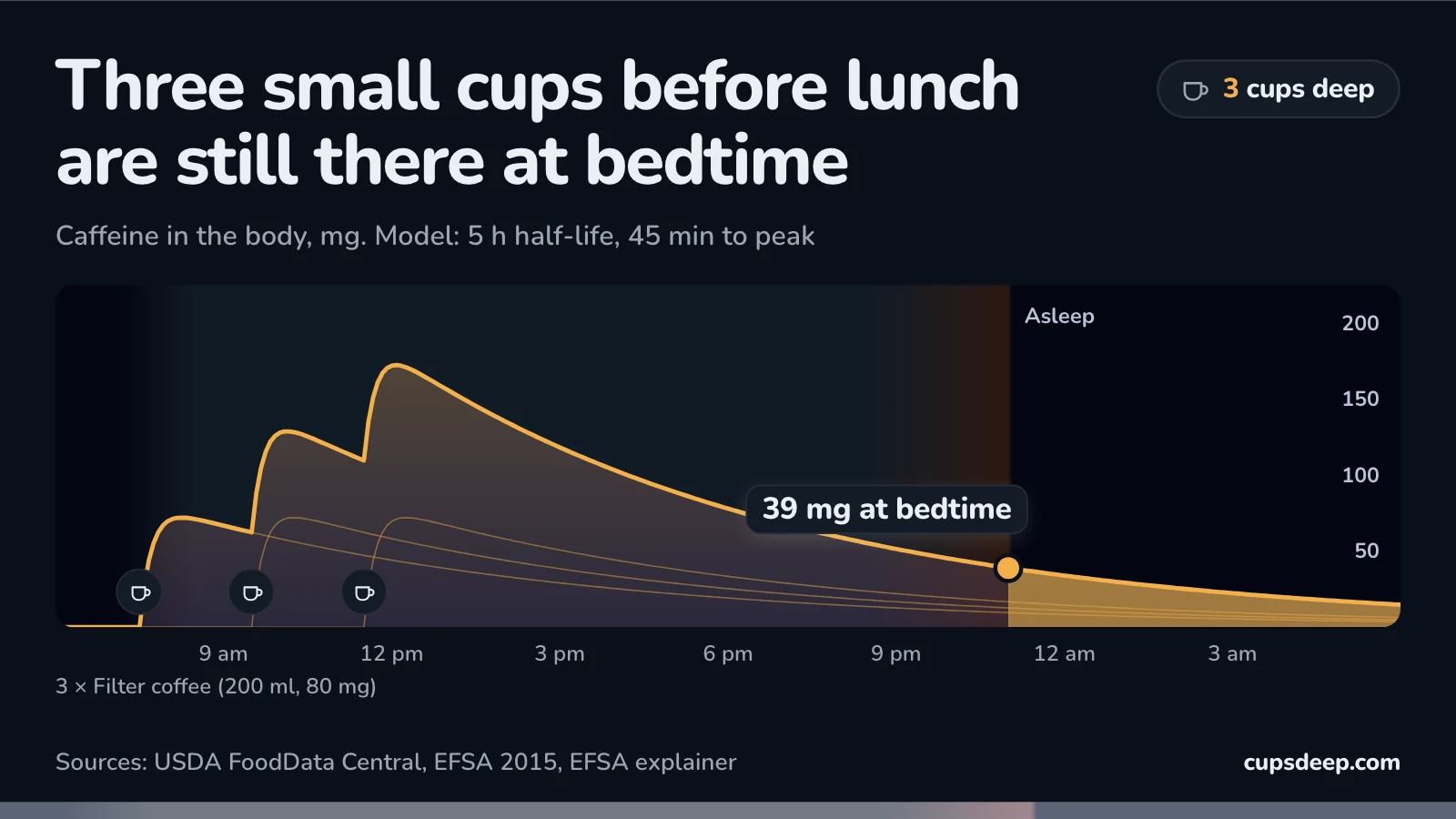
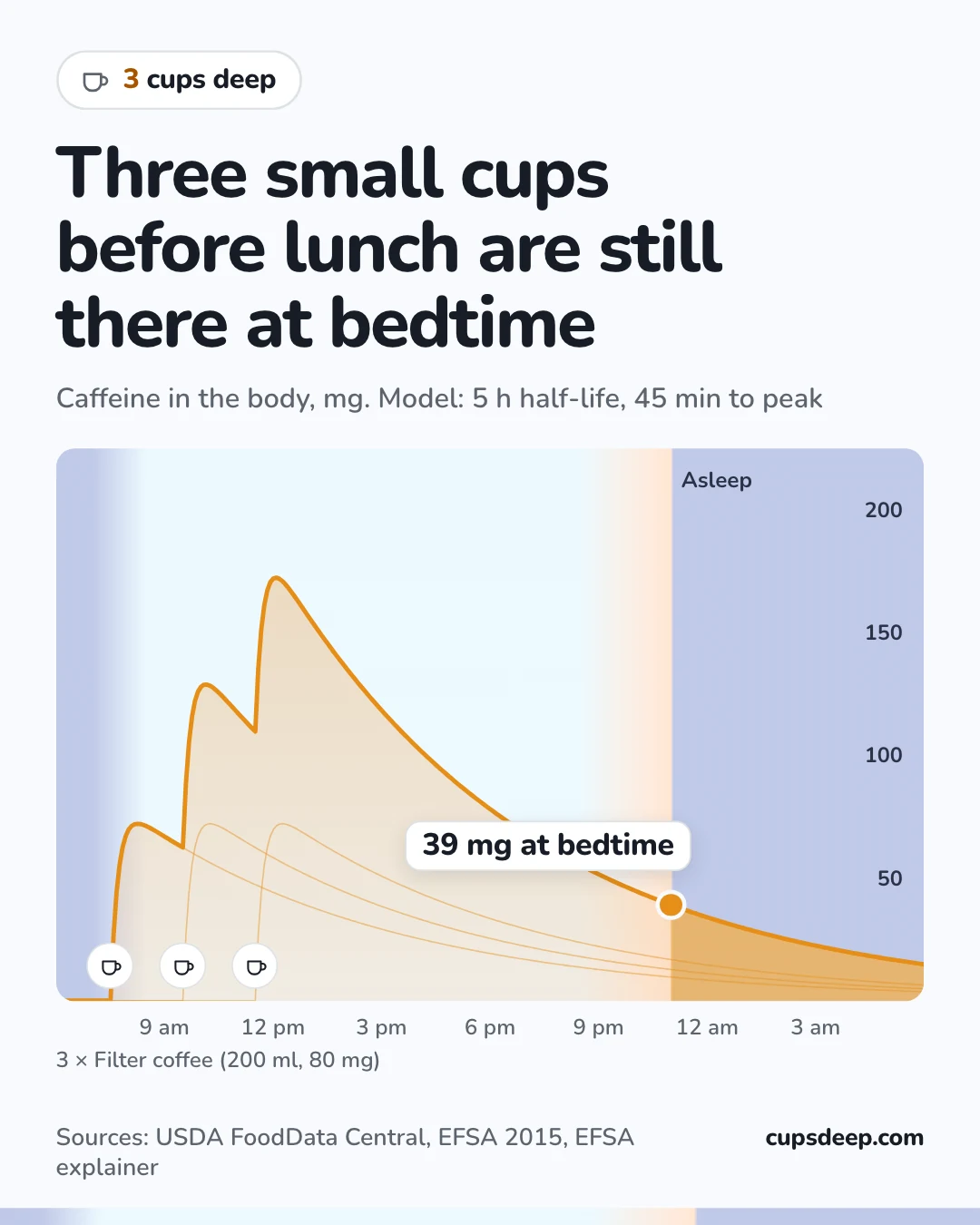
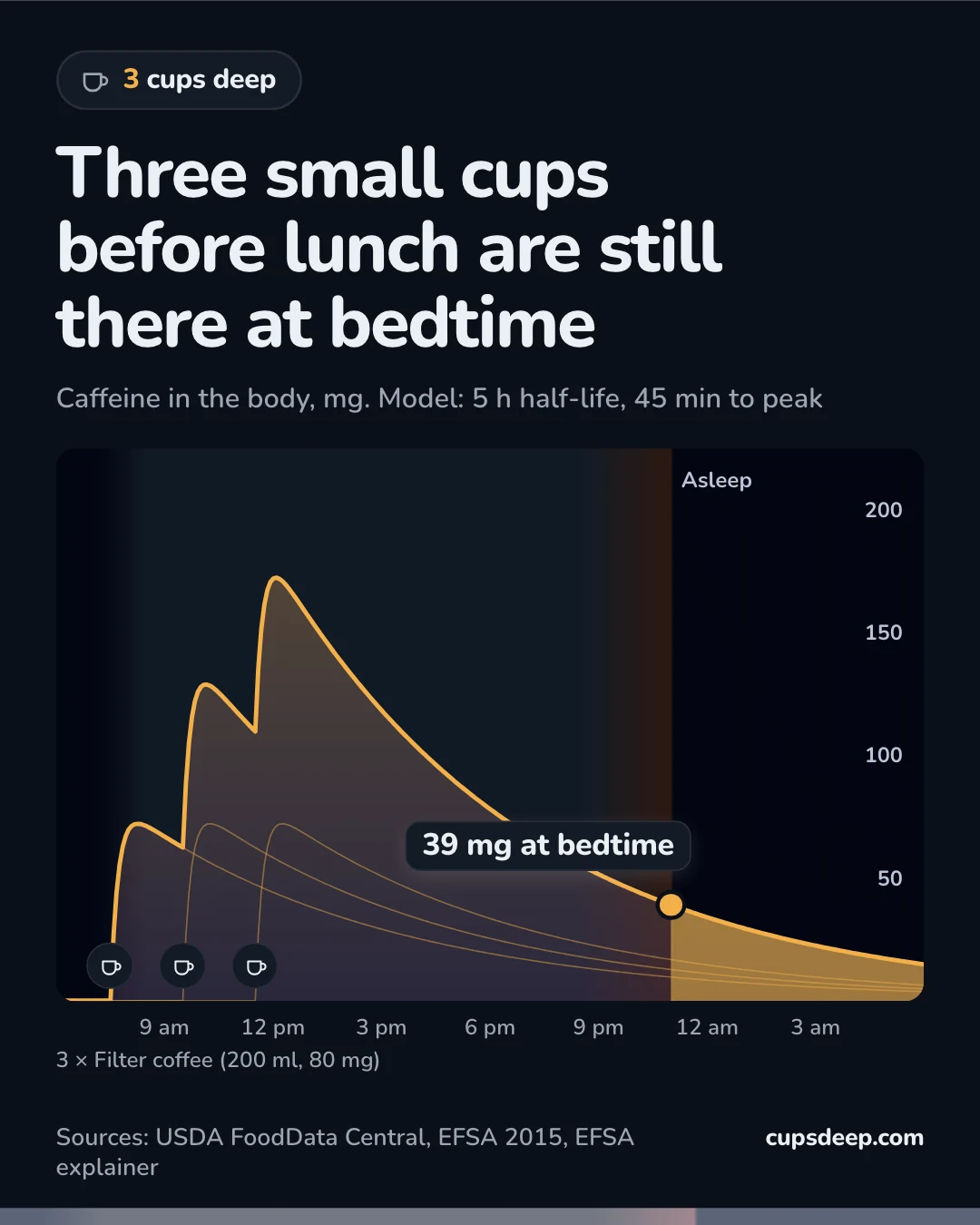
The total is half the question. The other half is when, because caffeine leaves slowly: the half-life averages 4 hours, so a late-morning cup is still partly there at night. That average is the source’s; the instrument’s default is five hours, and you can drag it. The sums behind our chart are on the method page.
Questions people ask
How much caffeine is in an 8 oz cup of coffee?
About 95 mg by USDA’s figure for brewed coffee, with its samples spanning 71–104 mg. A Starbucks Short, the same 8 fl oz, is stated at 155 mg to 195 mg.
How much caffeine is in a 12 oz cup of coffee?
FDA gives a typical range of 113–247 mg for 12 fl oz of regular brewed, non-specialty coffee. A Starbucks Tall brewed coffee is stated at 235 mg to 290 mg.
Does espresso have more caffeine than a cup of coffee?
Per sip, yes; per serving, usually no. One shot of espresso is about 63.6 mg by USDA’s figure, against about 95 mg for an 8 fl oz cup of brewed coffee.
How much caffeine is in a cup of instant coffee?
USDA’s figure works out to about 46.5 mg for its 6 fl oz serving, or about 62 mg scaled to 8 fl oz. It is a calculation from the powder, not a lab measurement of the drink.
Does dark roast coffee have more caffeine than light roast?
Barely either way. One study found 134–165 mg per 8 oz cup across five roast levels and three brew times of the same coffee, with light to medium roasts slightly higher in long brews. How much coffee goes into the cup matters far more.
How many cups of coffee a day is safe?
FDA cites 400 mg/day for most adults as an amount not generally associated with negative effects, and says that is about two to three cups of 12 fl oz. It also notes that people differ widely in how sensitive they are.
Sources
Every number above links to the place it came from. How the numbers are chosen and checked is on the method page; the drink table is at /drinks. Written with AI agents, as the whole site is. A model of a typical body, not advice for pregnancy, illness or medication.
- What is caffeine?
- Coca-Cola (US), 12 fluid ounce can: SmartLabel nutrition facts
- Spilling the Beans: How Much Caffeine is Too Much?
- Monster Energy Original Green
- How much caffeine is in a can of Red Bull Energy Drink?
- Red Bull Energy Drink: Ingredients
- Beverages, coffee, brewed, prepared with tap water
- Beverages, coffee, brewed, espresso, restaurant-prepared
- Beverages, tea, green, brewed, regular
- Beverages, tea, black, brewed, prepared with tap water
- Scientific Opinion on the safety of caffeine
- EFSA explains risk assessment: Caffeine
- Medium Roast - Pike Place Roast: nutrition (starbucks.com, United States)
- Decaf Roast - Pike Place Roast: nutrition (starbucks.com, United States)
- Caffè Latte: nutrition (starbucks.com, United States)
- Beverages, coffee, brewed, prepared with tap water (FDC 171890, NDB 14209): full record with portions and sample counts
- Beverages, coffee, instant, regular, prepared with water
- Caffeine content of specialty coffees
- Variations in caffeine and chlorogenic acid contents of coffees: what are we drinking?
- Influence of Various Factors on Caffeine Content in Coffee Brews
- Caffeine content in filter coffee brews as a function of degree of roast and extraction yield
- The Effect of Time, Roasting Temperature, and Grind Size on Caffeine and Chlorogenic Acid Concentrations in Cold Brew Coffee
- How much caffeine is in each capsule? (Nespresso USA customer FAQ)
- K-Cup pods support FAQ: How much caffeine is in each K-Cup pod?
Keep reading
Coffee
How much caffeine is in a shot of espresso?
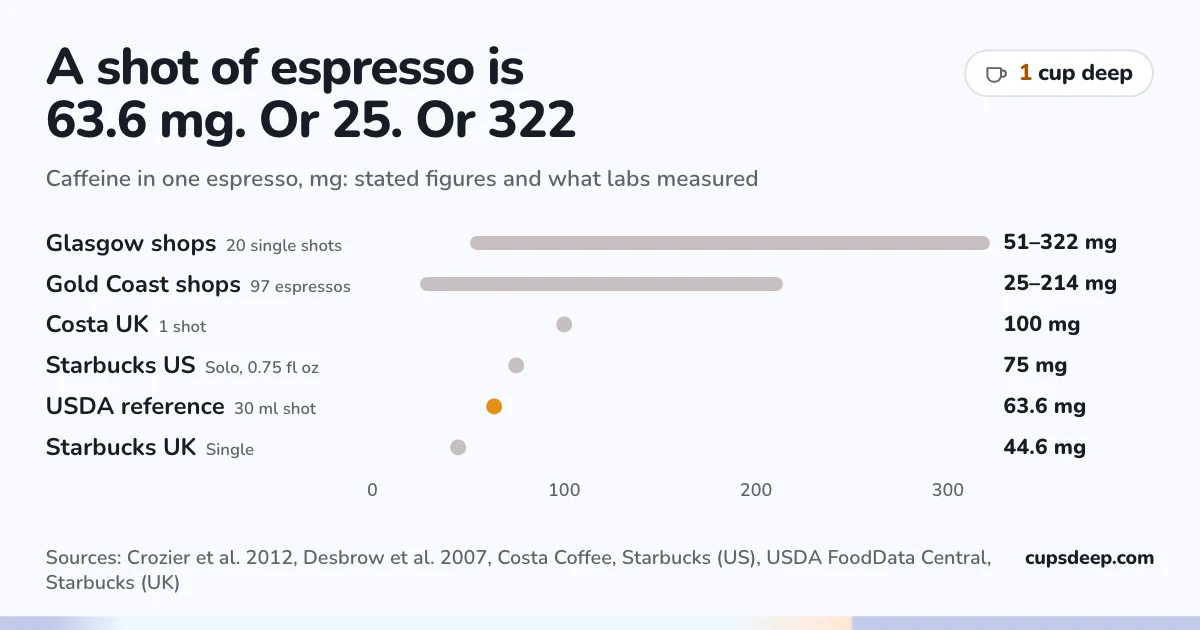
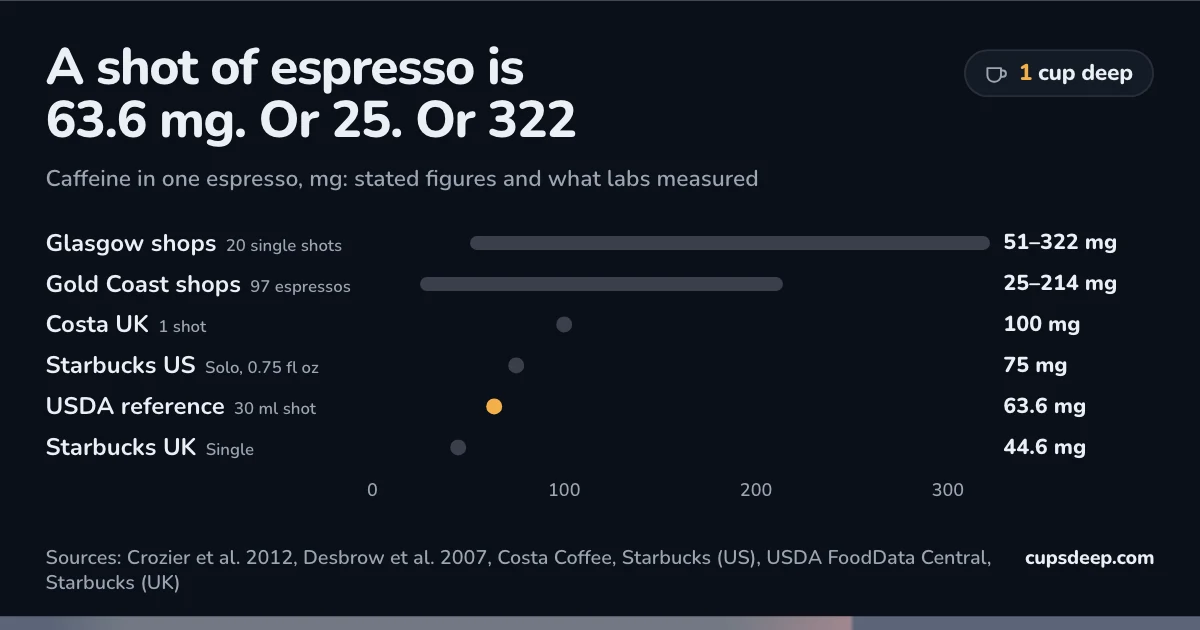
A shot of espresso is 63.6 mg by the USDA’s figure. Chains state 44.6 mg to 100 mg, and labs that bought real shots found 25 mg to 322 mg.

Coffee
Does decaf coffee have caffeine?
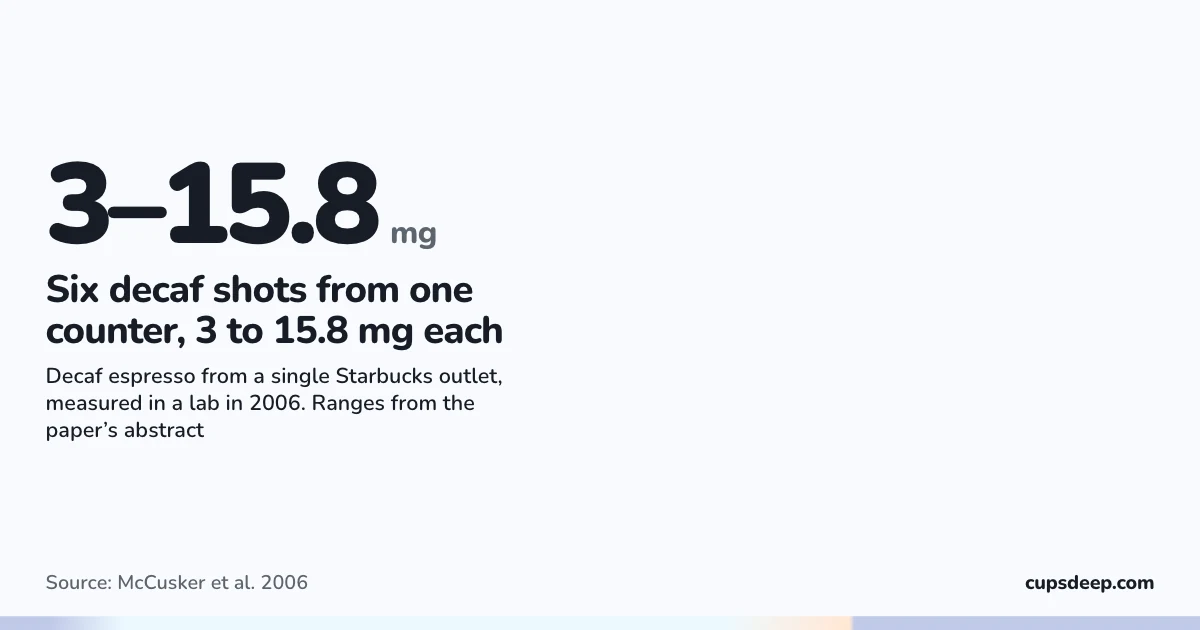
Yes. FDA puts decaf at 2–15 mg per 8 fl oz cup, and Starbucks lists 25 mg for a grande. The lab ranges, the law and the maths.
Coffee
Cappuccino vs latte: what is the difference?
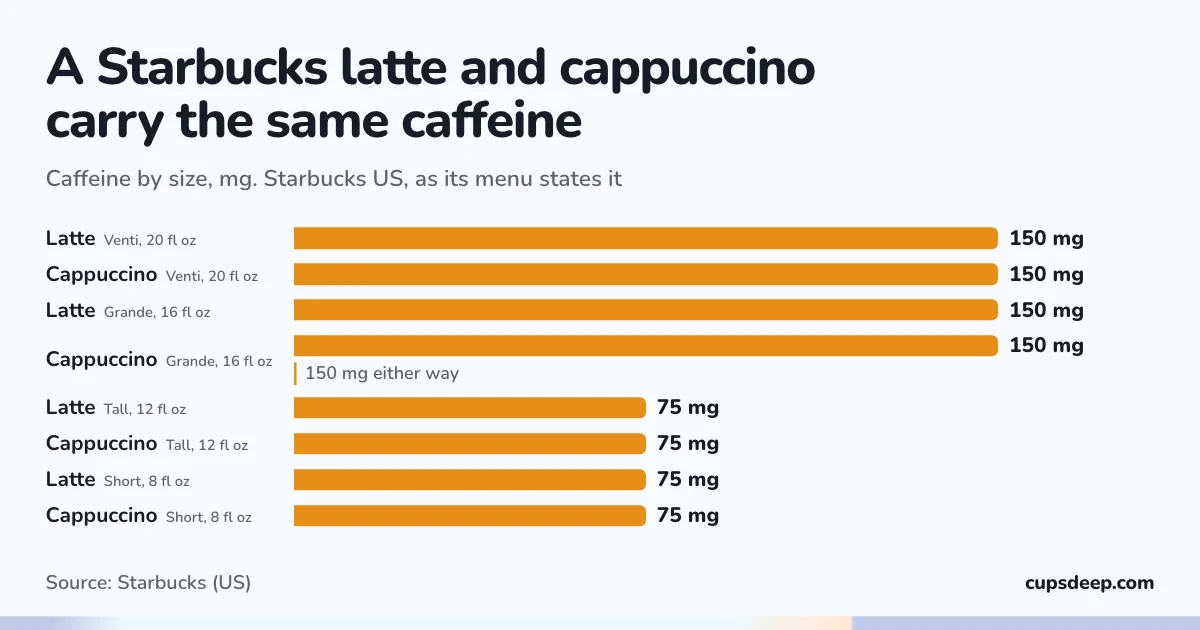
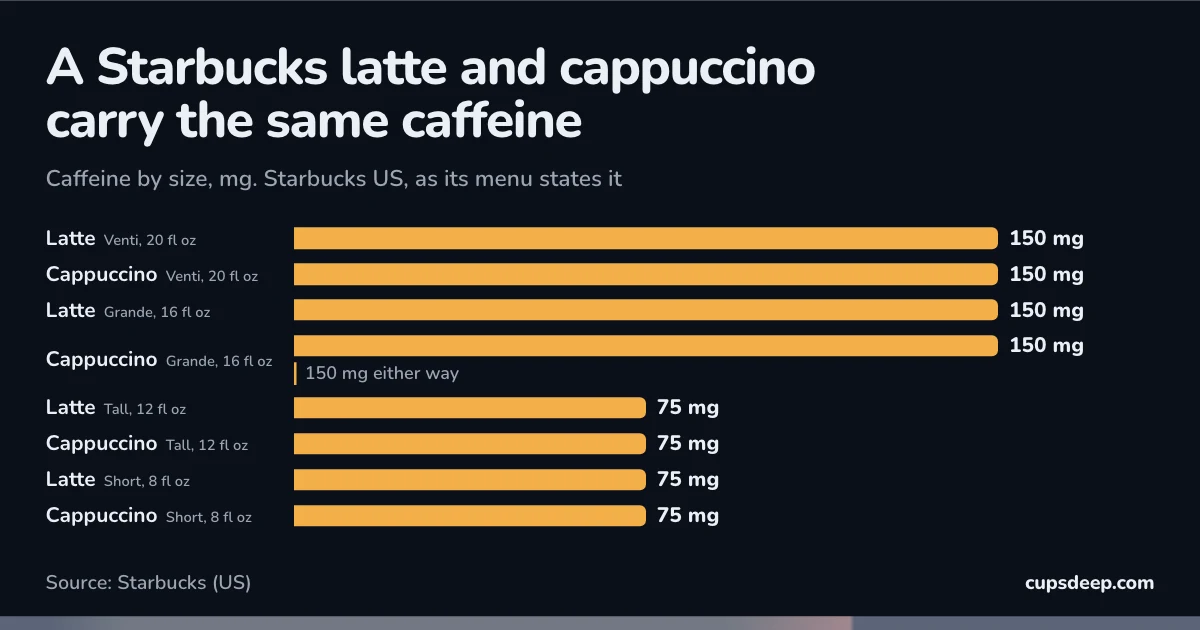
Cappuccino vs latte: same espresso, different milk. At Starbucks both hold 150 mg at Grande; the latte is 190 kcal, the cappuccino 140 kcal. At Costa, not so.