How much caffeine is in a shot of espresso?
The reference number describes a shot that a lot of cafés stopped pulling years ago. Here is the label, what labs found when they bought real shots over the counter, and why the two sit so far apart: grams of coffee, not adjectives.
The short answer
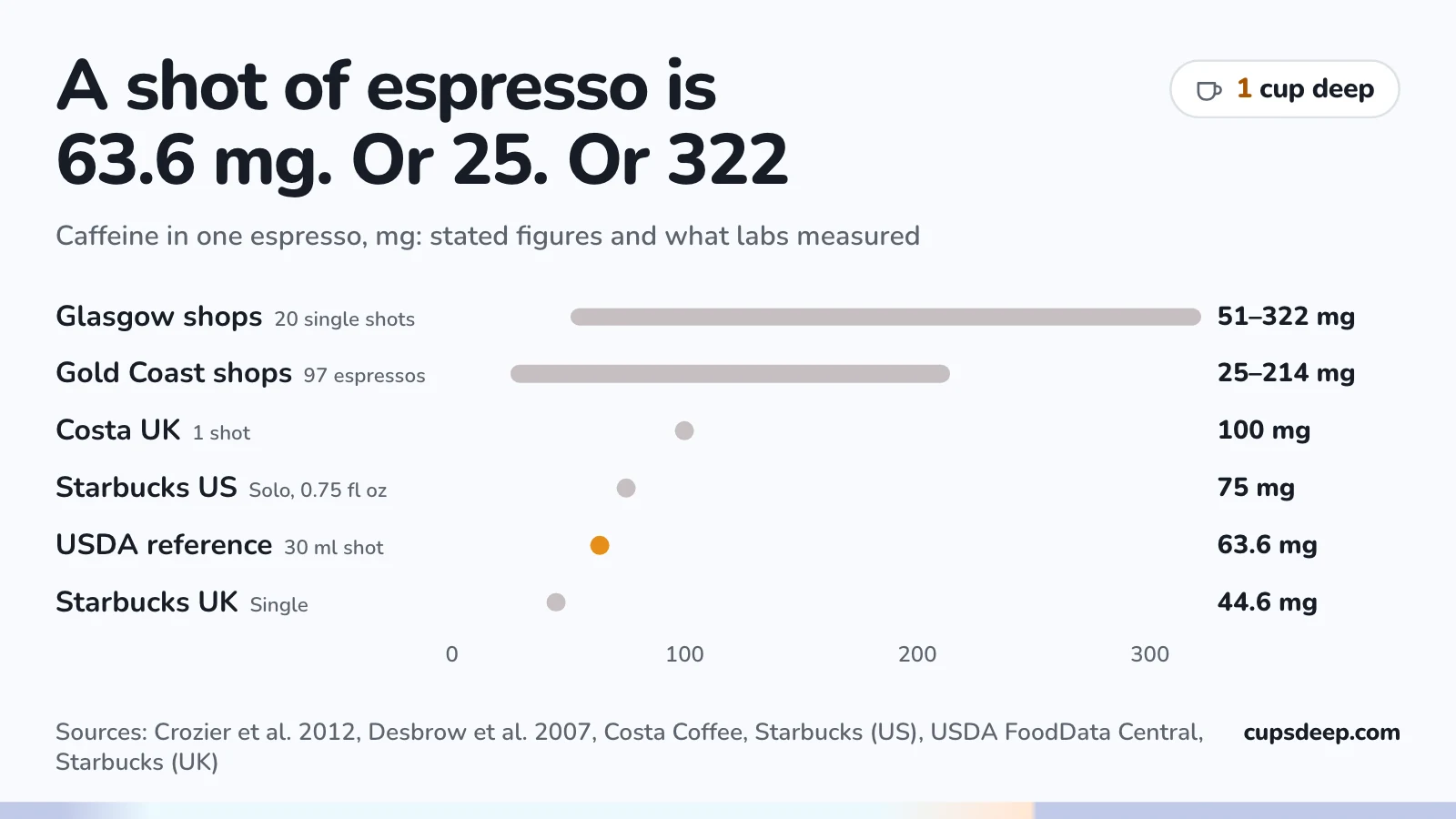
A shot of espresso has about 63.6 mg of caffeine. That is the USDA’s figure for a 30 ml shot, about 1 fl oz, and a double is 127.2 mg. Chains state anything from 44.6 mg to 100 mg for one shot, and labs that bought espressos in shops measured from 25 mg to 322 mg, mostly because of how much coffee went into the basket.
How much caffeine is in one shot of espresso?
The reference number is 63.6 mg. It comes from the USDA’s food database, which lists restaurant espresso at 212 mg per 100 g; a 30 ml shot of that, about 1 fl oz, works out to 63.6 mg. The entry rests on two data points and gives no range. It is a reference point, not a promise about your cup.
Shots mostly add up the way you would expect; Costa’s three is the odd one out, at 325 mg. The catch is whose shot you are adding.
| Shots | USDA reference | Starbucks US, stated | Costa UK, stated |
|---|---|---|---|
| One | 63.6 mg | 75 mg | 100 mg |
| Two | 127.2 mg | 150 mg | 200 mg |
| Three | 190.8 mg | 225 mg | 325 mg |
| Four | 254.4 mg | 300 mg | 400 mg |
The USDA column is one reference value multiplied, 30 ml a shot; five such shots come to 318 mg. Starbucks US states its sizes in fluid ounces, 0.75 fl oz a shot. Costa states caffeine by number of shots and gives no volume.
How much caffeine is in the espresso you are actually handed?
A database gives you a reference value. A handful of research teams did the other thing: walked into shops, ordered an espresso like anyone else, and took it to a lab.
Single-shot espressos bought from 20 shops in the west end of Glasgow held 51 to 322 mg of caffeine a serving, with a median of 140 mg, in cups of 23 to 70 ml. Four of the 20 held more than 200 mg. The authors name the amount of coffee used as the likely main reason for the spread. 60
97 espressos bought from coffee vendors on the Gold Coast, Australia, averaged 106 mg of caffeine a serve and ran from 25 to 214 mg. 24.7% of them held 120 mg or more. Read from the abstract only. 61
| Where and when | What was bought | Caffeine per serving |
|---|---|---|
| Glasgow, 2012 | Single shots from 20 shops | 51–322 mg, median 140 mg |
| Gold Coast, Australia, 2007 | 97 espressos | 25–214 mg, mean 106 mg |
| Australia, 2012 | 131 espressos | Mean 107 mg; the abstract gives no range |
| Scotland, Italy and Spain, 2014 | 104 espressos, plus a few cappuccinos and instant coffees | 48–317 mg across the coffees in the study |
| Maryland, US, 2003 | Six espressos of 40–170 ml | 58–185 mg |
Only the Glasgow paper was read in full. The Australian and three-country studies were read as abstracts and Maryland from the university’s release, so their methods are not checked here. Servings were whatever each shop poured: Glasgow’s cups ran 23–70 ml.
None of these is a national average. Each is one set of shops in one year. They still agree on the part that matters: the middle of what shops serve sits well above the reference shot, and the strongest single in Glasgow carried about five reference shots’ worth. The shot’s length matters too: a shorter ristretto pulled from the same dose carries less, and a Starbucks US flat white makes up for it with one more shot than the latte.
The textbook shot is mostly served in textbooks
Why do the numbers for one shot disagree?
Grams. A shot is not a unit of caffeine. It is whatever the person at the machine put in the basket.
The heritage Specialty Coffee Association of America definition of espresso is a 25 to 35 ml drink made from 7 to 9 g of coffee, or 14 to 18 g for a double. In the association’s March 2017 survey of 275 respondents, about three quarters of them in the US, the average shot started from an 18 to 20 g dose and weighed 36.5 g in the cup, and most used an 18 g basket; of those who did not know their basket’s size in grams, over three quarters used a double. 66
So the textbook single is 7–9 g of coffee, and Italy’s own trade rulebook still says 7–9 g a cup. The shot a modern barista calls normal starts from 18–20 g, which the old definition would file as a generous double. The USDA’s 63.6 mg fits the small shot. The Glasgow team got to the same place from the other end: they named the amount of coffee used as the likely main reason their shops were so far apart.
I ordered a single. The barista heard a dare
Two more things get the blame. The first is roast, and the evidence on it points both ways.
Two papers from the same research group point different ways on roasting. In a 2014 roasting experiment, read as an abstract only, caffeine was stable while higher roasting temperatures destroyed chlorogenic acids. A 2012 paper, read in full, found caffeine in brews falling after roasting, though more slowly than the chlorogenic acids, and says caffeine is lost through sublimation. 5460
What the Glasgow authors do say is where roast ranks: they list roasting among the lesser reasons for their spread, behind the amount of coffee.
Dark roast tastes stronger. So does burnt toast
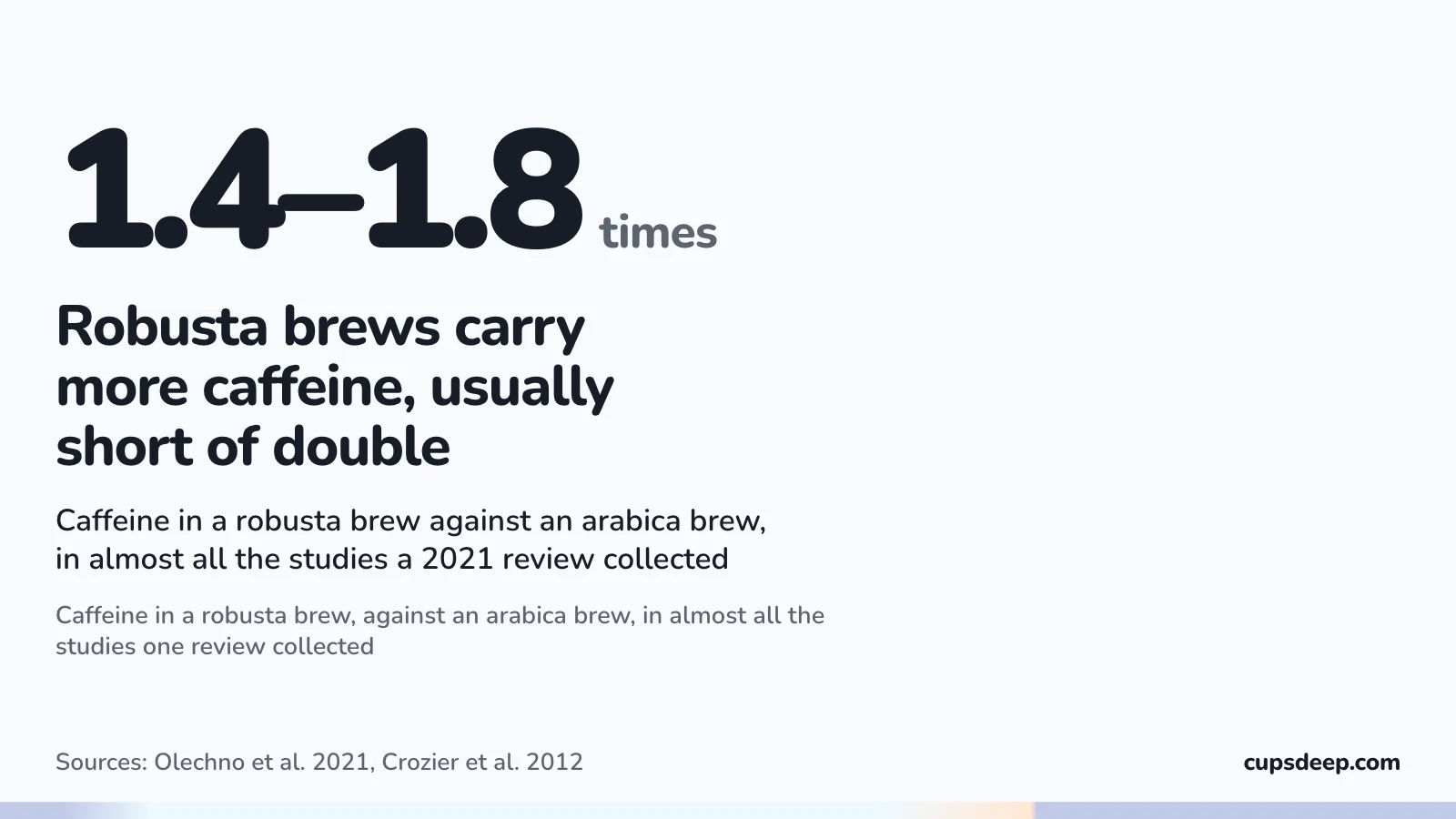
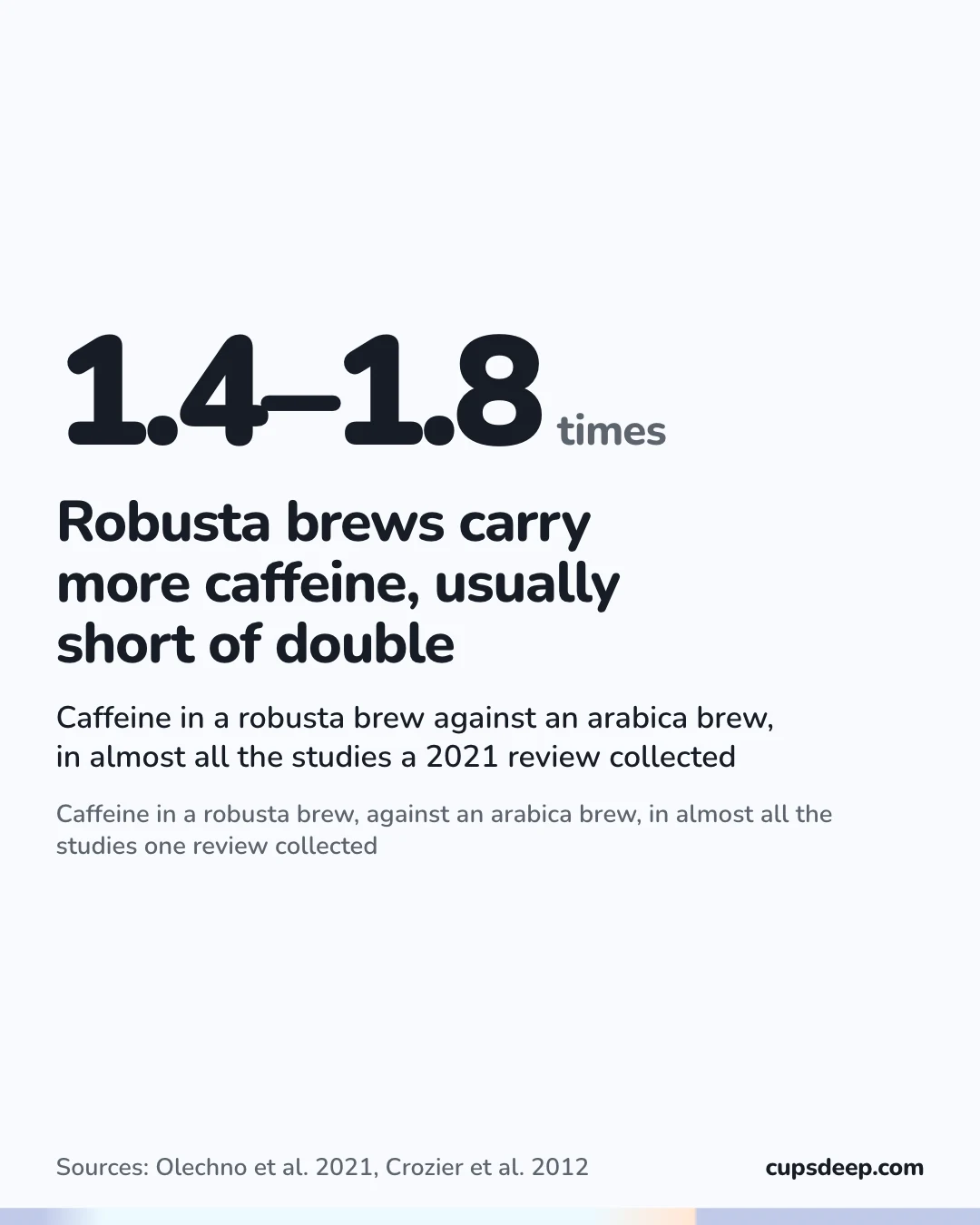
The second is robusta, and here too our sources do not say the same thing. The Glasgow paper says robusta beans contain almost twice as much caffeine as arabica. A 2021 review puts green arabica beans at 0.9–1.5% caffeine by dry weight and robusta beans at 1.2–2.4%, and almost all the brewing studies it collected found robusta brews holding about 1.4–1.8 times the caffeine of arabica brews; a few found less of a gap. More, and worth knowing if your blend has it. In the cup, in these studies, usually short of double. What that means for the bags sold as the strongest coffee in the world is in which coffee has the most caffeine.
How much caffeine is in a Starbucks shot, and is blonde stronger?
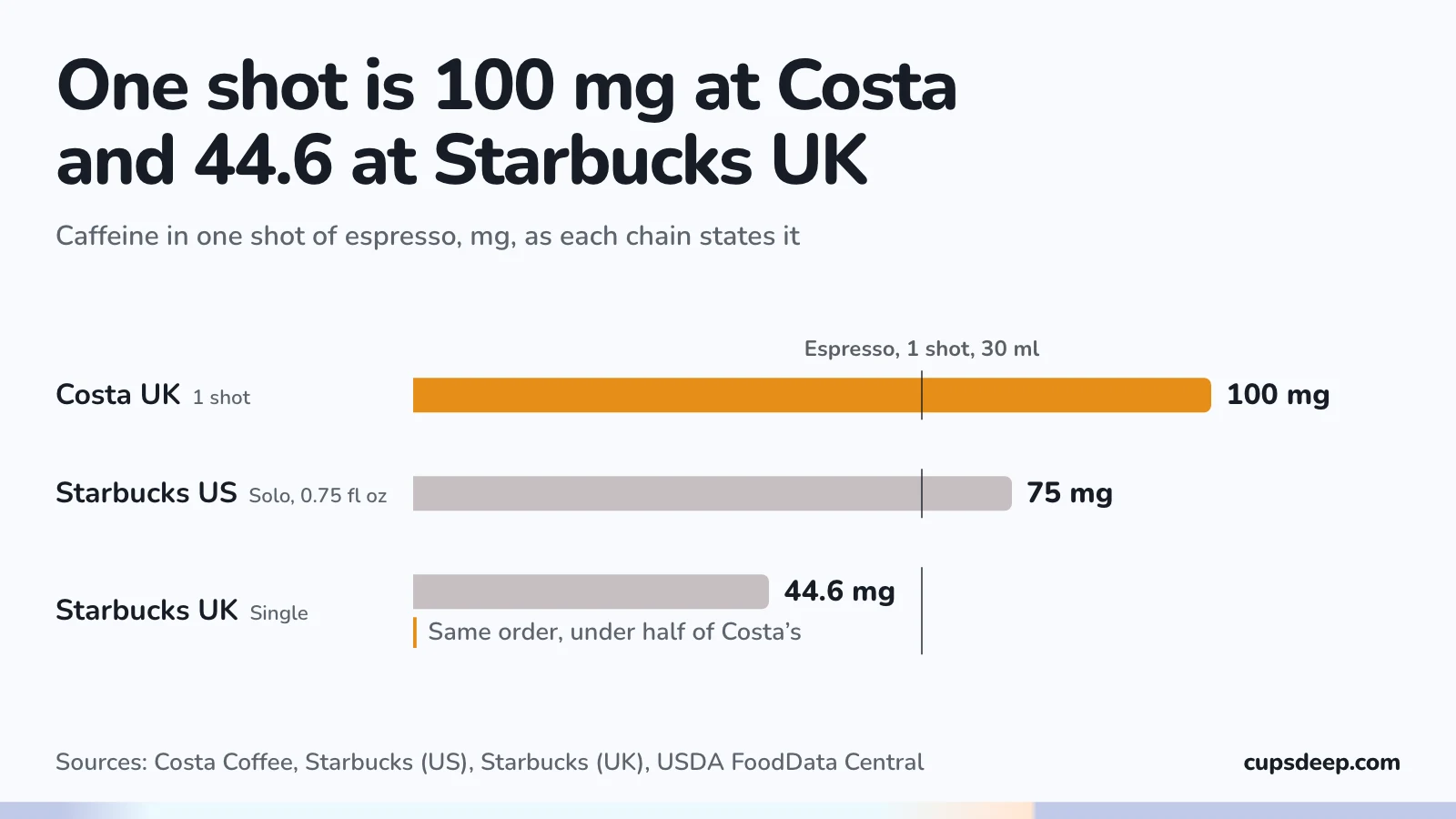
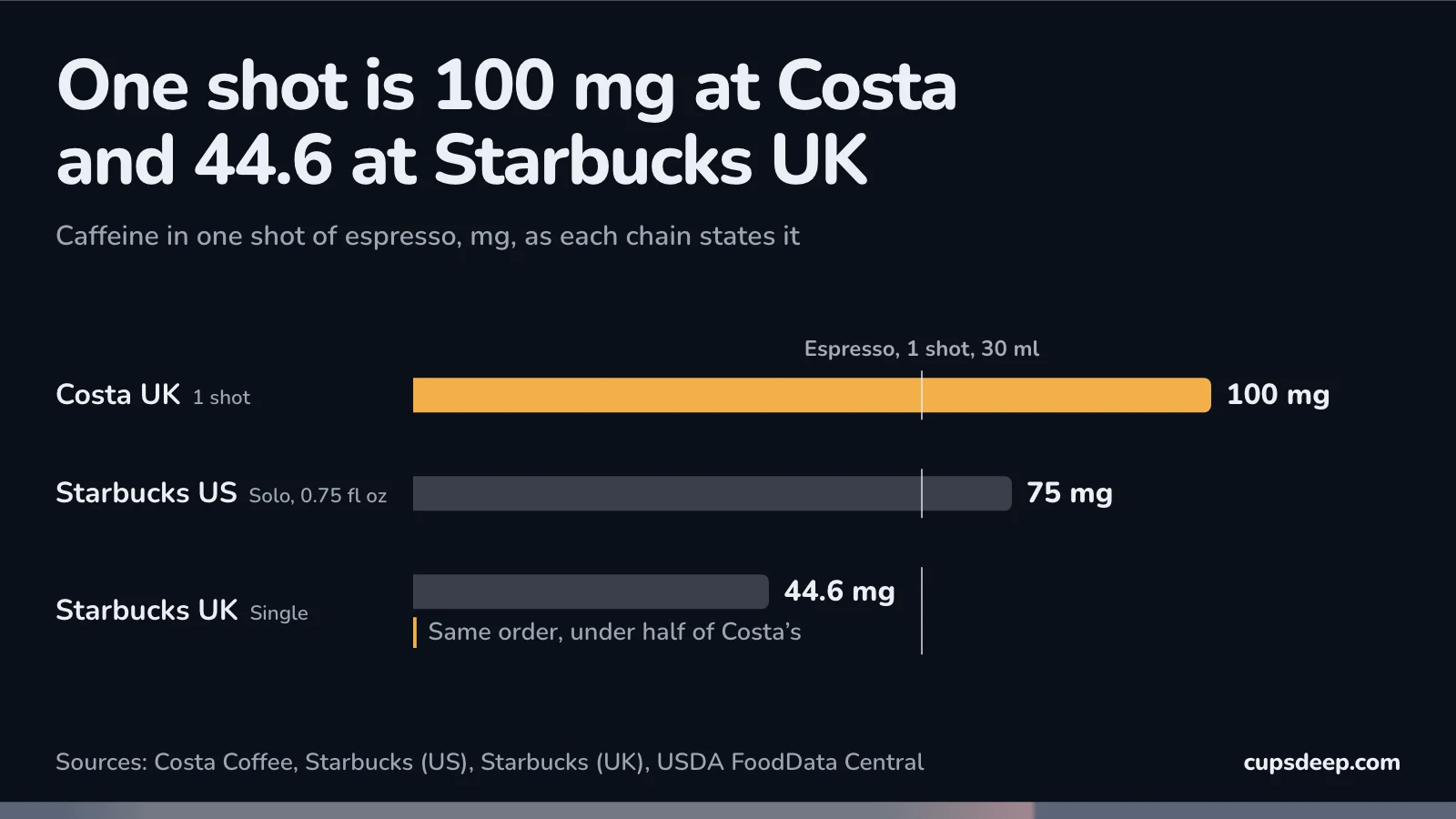
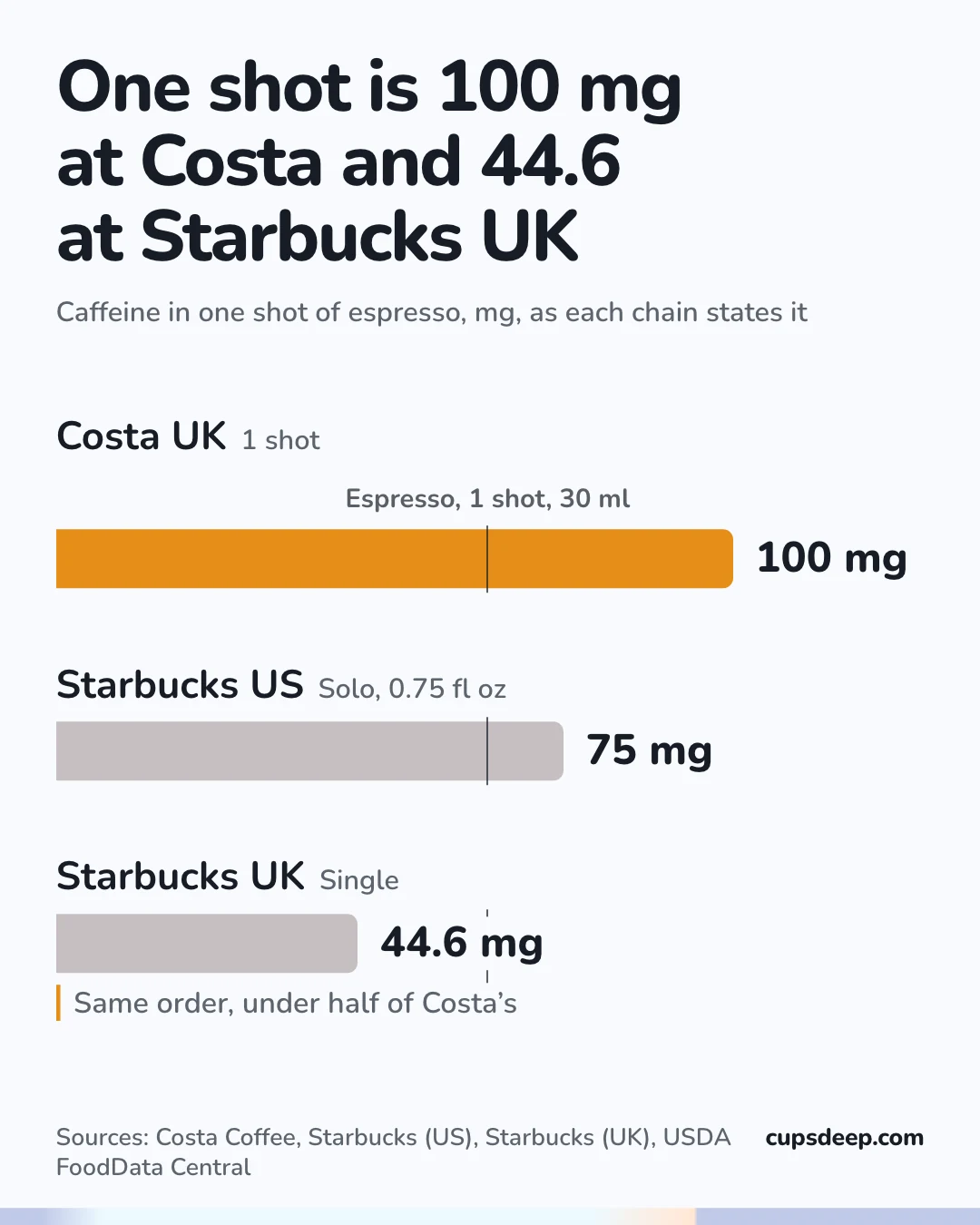
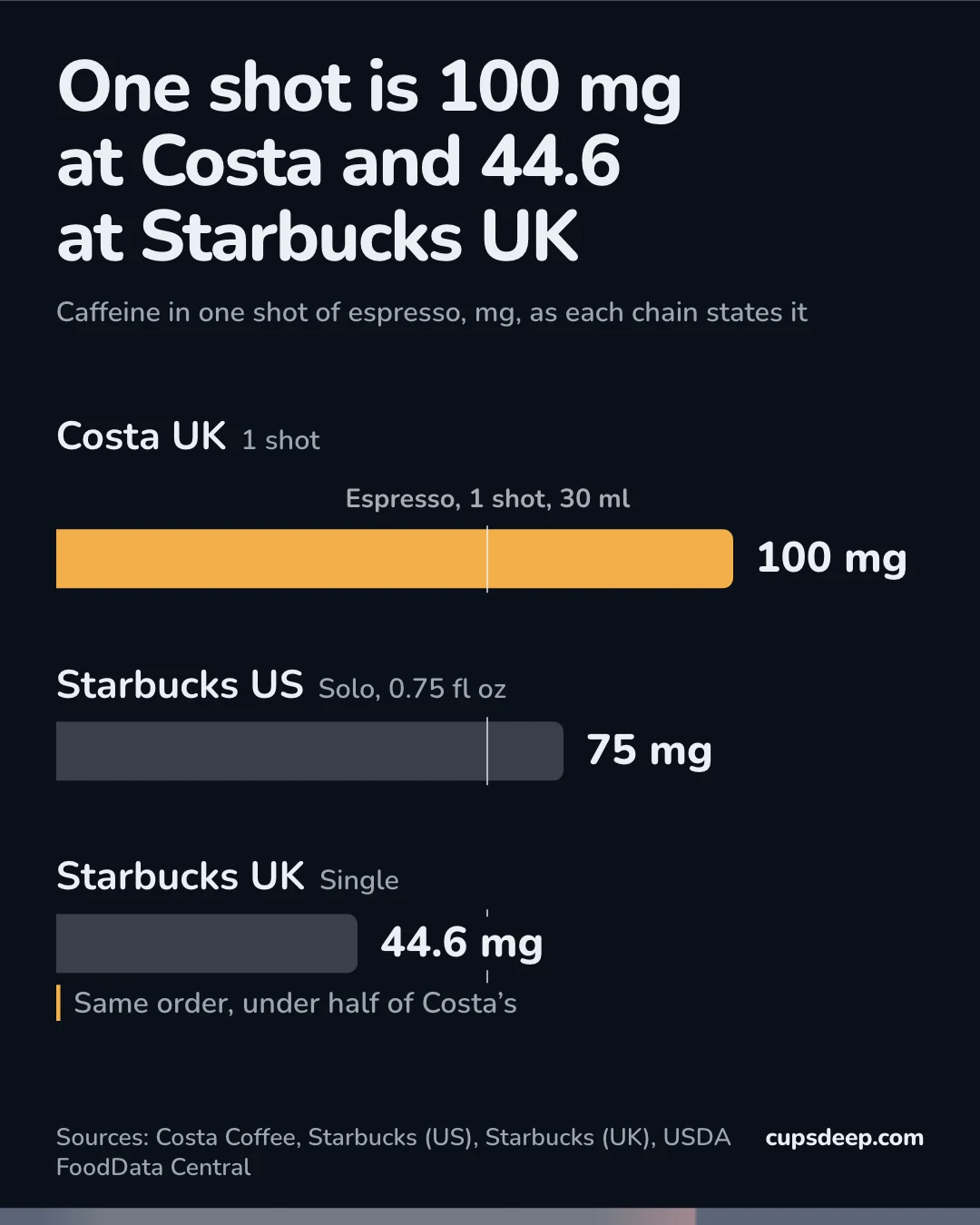
Starbucks US states 75 mg for a solo, 150 mg for a doppio and 225 mg for a triple. Starbucks UK states 44.6 mg for a single and 89.1 mg for a doppio. Costa states 100 mg for one shot. Three official answers to the same order, and none of them is wrong. They are different shots.
Starbucks US publishes no caffeine figure for a solo shot of Blonde espresso. Derived from its Blonde Vanilla Latte, a Blonde shot is 85 mg: the one-shot sizes state 85 mg and the two-shot sizes 170 mg. That is 10 mg more than the 75 mg Starbucks states for a regular solo espresso. 6447
So yes, blonde is a little stronger by Starbucks’ own numbers, and note the word derived: we found no figure from Starbucks for a blonde shot on its own. Starbucks does not say why it is higher, and the two roast papers above do not settle whether the roasting is the reason. The shots inside milk drinks follow the same sums, which is how a medium Costa cappuccino ends up at three shots; see cappuccino vs latte.
Does espresso have more caffeine than a cup of coffee?
Per sip, yes. Per cup, usually not. Weight for weight the USDA has espresso at 212 mg per 100 g and brewed coffee at 40 mg per 100 g, so espresso is 5.3 times as concentrated. But you drink far less of it: one reference shot is 63.6 mg, and a 200 ml cup of filter coffee is 80 mg.
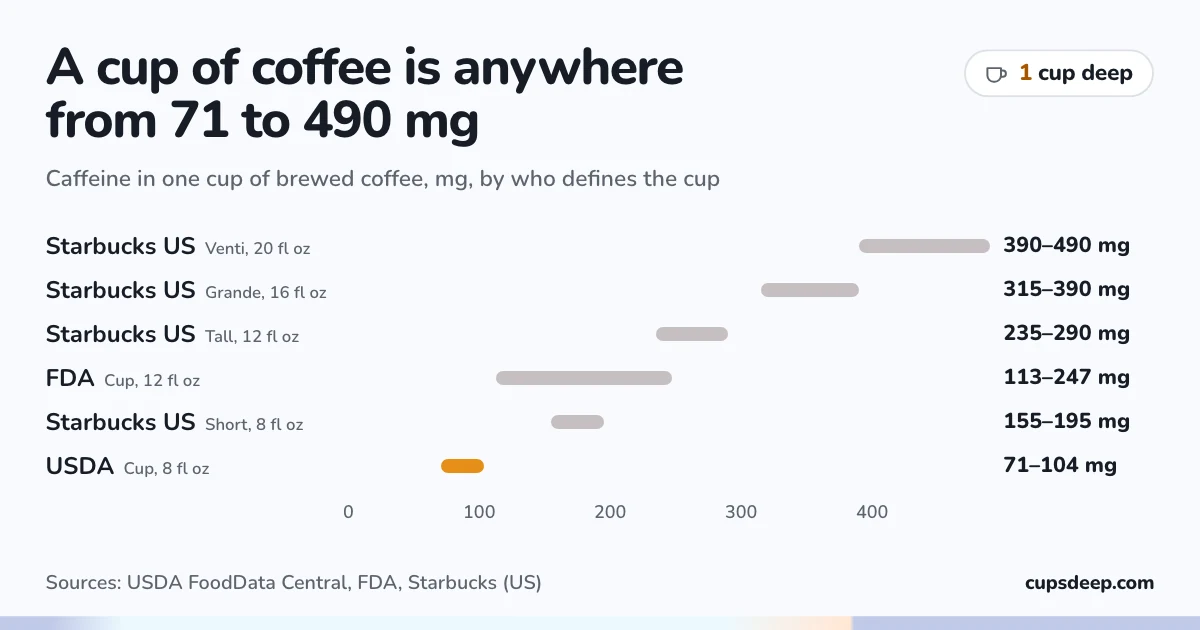
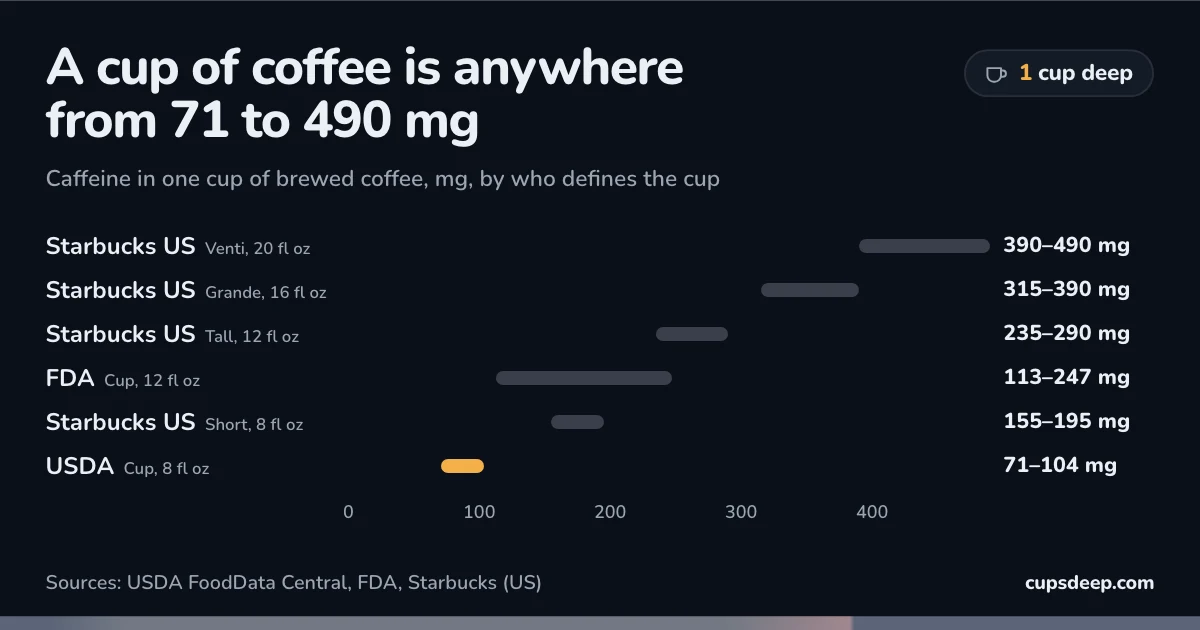
At a chain the gap is wider. A Starbucks US doppio is 150 mg; a grande brewed coffee there is stated as 315 mg to 390 mg. EFSA’s guide table lands in the same place with different cups: an espresso of 60 ml at 80 mg and a 200 ml filter coffee at 90 mg. Note that EFSA’s espresso is twice the size of the USDA’s. Everyone means something different by the word. The full spread for brewed coffee is in how much caffeine is in a cup of coffee, and every drink we chart is on the drinks page.
How much caffeine is in a decaf shot, or a pod?
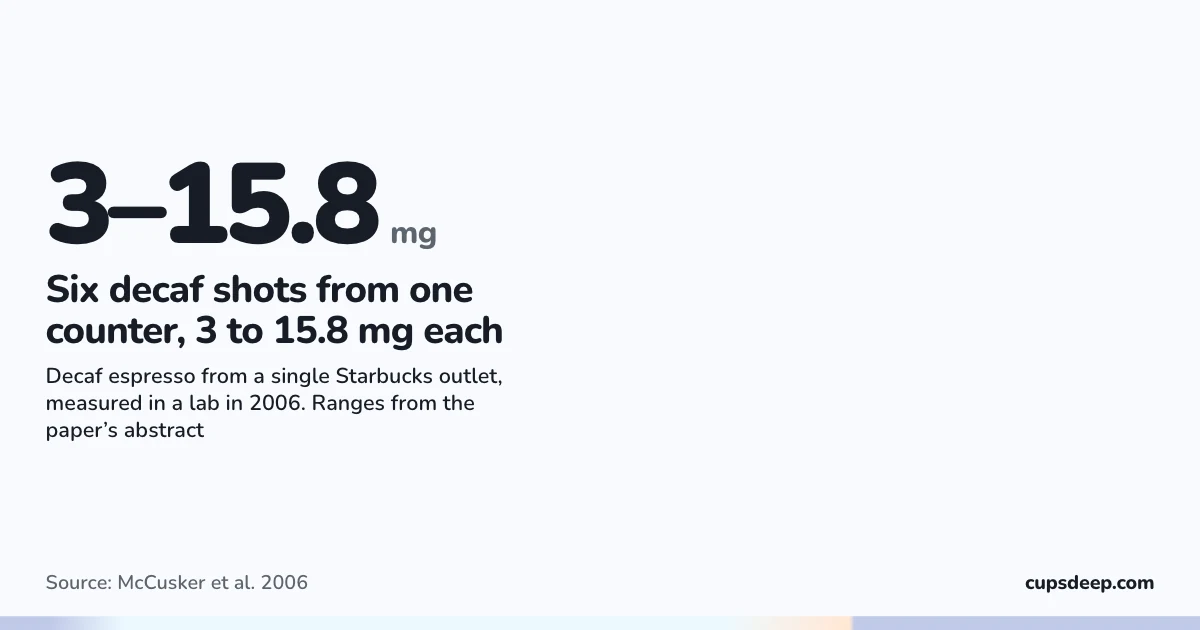
Six decaffeinated espresso shots collected from one Starbucks outlet held 3.0 to 15.8 mg of caffeine a shot when measured in a lab. Read from the abstract only. 63
Costa states 2 mg for two decaf shots. Starbucks US states no figure for a decaf espresso shot at all, so the lab number above, six shots from one shop measured for a 2006 paper, is the only one we found for it. Small, but not zero, and it adds up if decaf is how you drink six of them. More in does decaf coffee have caffeine.
Decaf knows what it did
Pods are a shot with a label, and the label has the same problem. Nespresso’s US site says most of its espresso capsules give 50–100 mg a cup, with robusta-heavy exceptions at 120 mg and 150 mg. An Australian lab that measured Nespresso pods, most of them at two serve sizes, found 19–147 mg a serve, which was 51–162% of the values the maker gave there. It did not test the United States range above. That study was read as an abstract only.
How many shots of espresso is too many?
It depends on whose shot, which is the whole point of this page. EFSA’s line for healthy adults is 400 mg/day from all sources, spread through the day, and 200 mg in one go. Six reference shots come to 381.6 mg. Four Costa shots are 400 mg on their own. A Starbucks US triple, at 225 mg, is over the single-dose line in one cup.
In pregnancy EFSA’s line is 200 mg/day. In Glasgow, 4 espressos from those 20 shops were over that as one single shot, and nobody ordering them could have known.
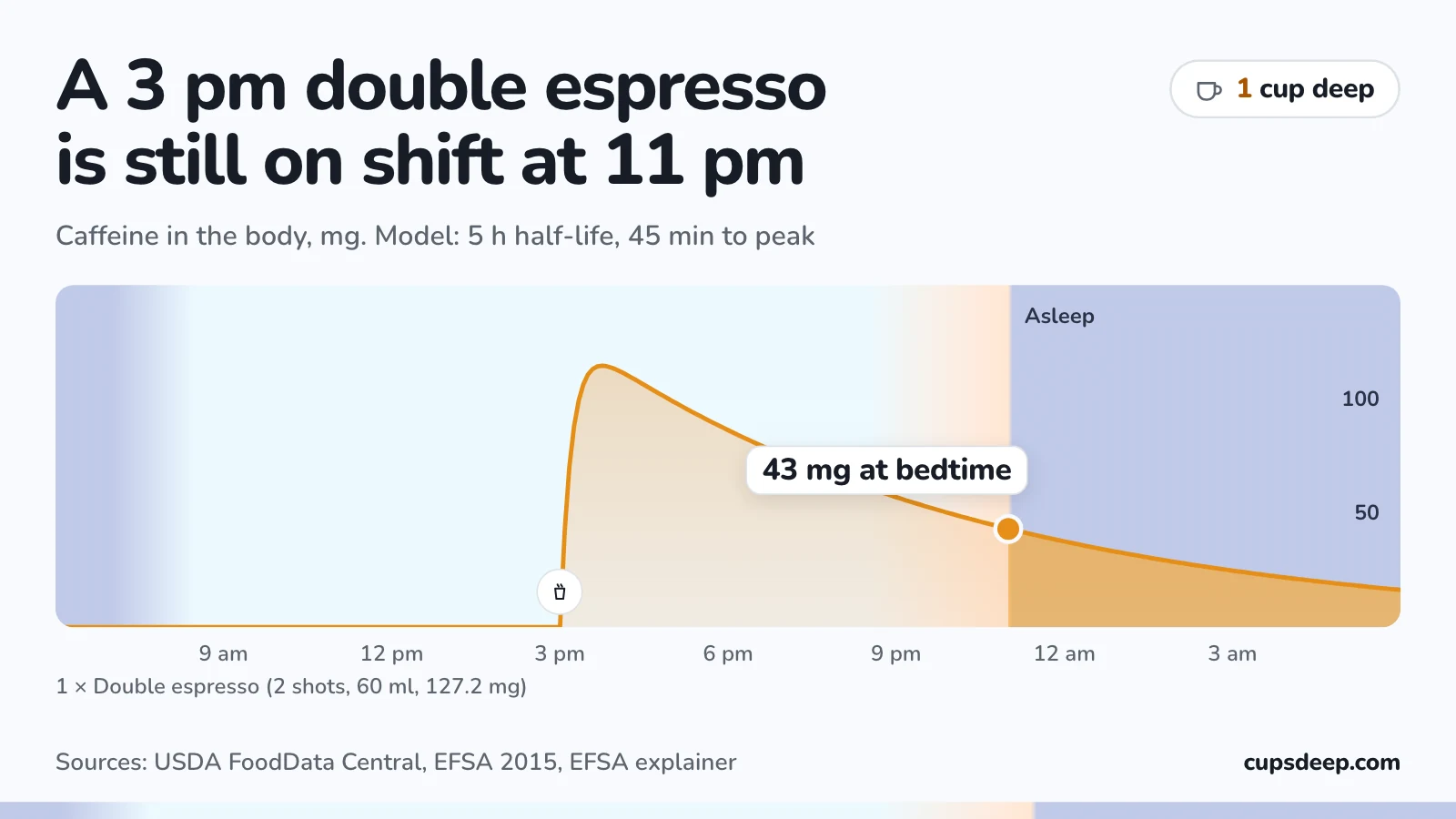
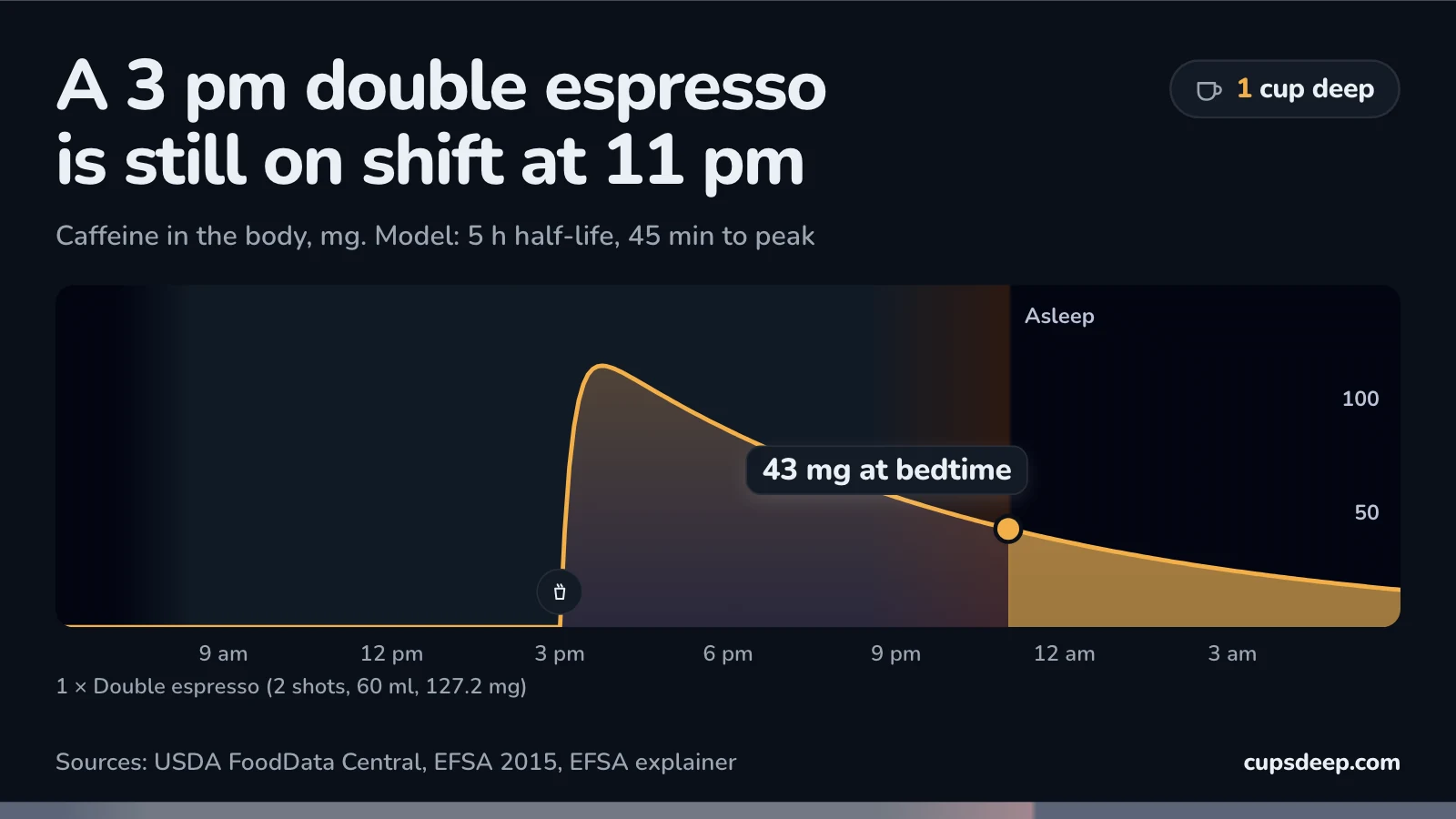
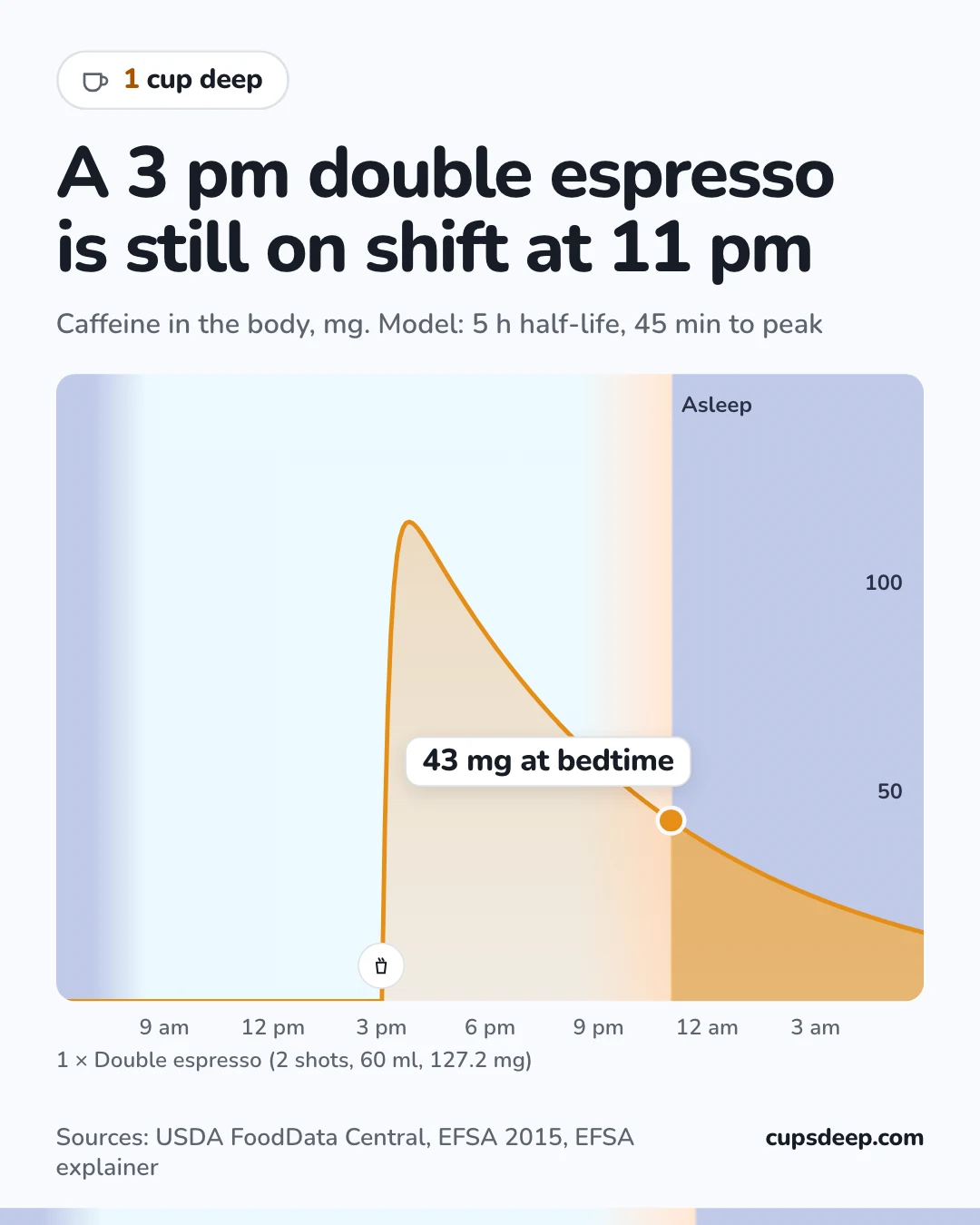
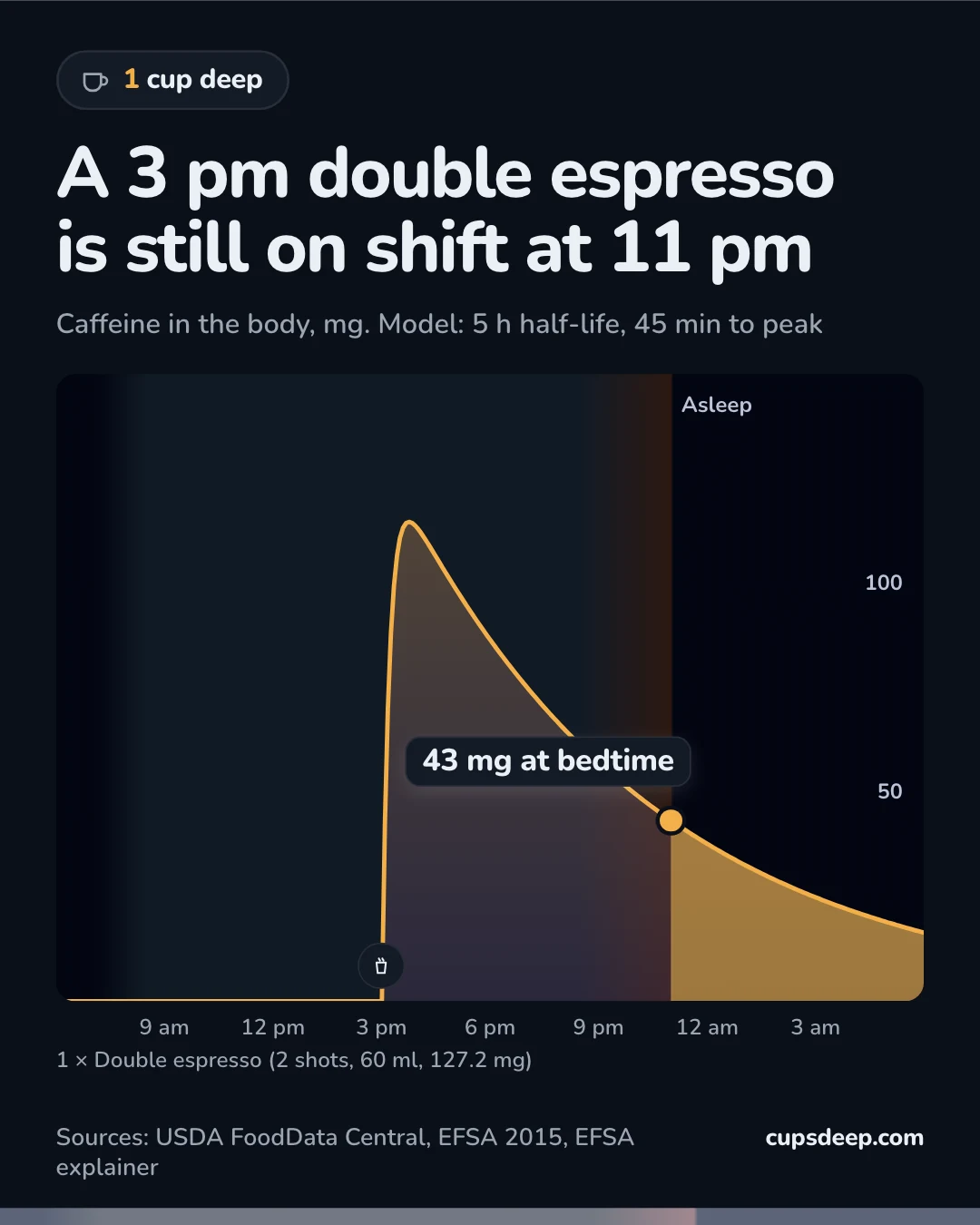
Then there is the clock. EFSA notes that 100 mg close to bedtime may delay sleep and shorten it in some adults, and half of a dose is still in a healthy adult about 4 hours later. That is the average in the source; the instrument’s default is five hours, and you can drag it. The arithmetic is in how long caffeine stays in your system, and the model behind the chart is on the method page.
Questions people ask
How much caffeine is in a double shot of espresso?
By the USDA’s reference value, 127.2 mg for two 30 ml shots. Starbucks US states 150 mg for a doppio and Costa states 200 mg for two shots.
How much caffeine is in a Starbucks espresso shot?
Starbucks US states 75 mg for a solo shot of 0.75 fl oz and 150 mg for a doppio. Starbucks UK states 44.6 mg for a single.
Does blonde espresso have more caffeine than regular?
At Starbucks US, yes, slightly. Starbucks publishes no figure for a solo Blonde shot, but its one-shot Blonde Vanilla Latte is stated at 85 mg, which gives a derived 85 mg a shot against 75 mg for the regular solo.
Does espresso have more caffeine than coffee?
By weight, yes: the USDA lists espresso at 212 mg per 100 g and brewed coffee at 40 mg per 100 g. By serving, usually no: a 30 ml shot is 63.6 mg and a 200 ml cup of filter coffee is 80 mg.
How much caffeine is in a decaf espresso shot?
A lab that collected six decaf shots from one Starbucks measured 3–15.8 mg a shot, a figure read from the study’s abstract. Costa states 2 mg for two decaf shots.
Does dark roast espresso have less caffeine?
Probably not by much, and the evidence is mixed. In one roasting experiment, read as an abstract, caffeine stayed stable while other compounds were lost; an earlier paper from the same group found caffeine in brews falling after roasting. The Glasgow authors rank roast below the grams of coffee that go into the shot.
Sources
Every number above links to the place it came from. How the numbers are chosen and checked is on the method page; the drink table is at /drinks. Written with AI agents, as the whole site is. A model of a typical body, not advice for pregnancy, illness or medication.
- Beverages, coffee, brewed, prepared with tap water
- Beverages, coffee, brewed, espresso, restaurant-prepared
- Scientific Opinion on the safety of caffeine
- EFSA explains risk assessment: Caffeine
- Medium Roast - Pike Place Roast: nutrition (starbucks.com, United States)
- Espresso: nutrition (starbucks.com, United States)
- Nutrition & Allergen Guide, Holiday Beverages, November 2026 - January 2027 (Starbucks UK)
- Information for customers in UK Costa stores, Festive 2026 (store allergen guide)
- Caffeine content of specialty coffees
- Variations in caffeine and chlorogenic acid contents of coffees: what are we drinking?
- Influence of Various Factors on Caffeine Content in Coffee Brews
- How much caffeine is in each capsule? (Nespresso USA customer FAQ)
- Espresso coffees, caffeine and chlorogenic acid intake: potential health implications (Crozier, Stalmach, Lean, Crozier; Food & Function 2012;3(1):30-33)
- An examination of consumer exposure to caffeine from retail coffee outlets (Desbrow, Hughes, Leveritt, Scheelings; Food Chem Toxicol 2007;45(9):1588-92)
- An examination of consumer exposure to caffeine from commercial coffee and coffee-flavoured milk (Desbrow, Henry, Scheelings; J Food Compos Anal 2012;28(2):114-118, doi 10.1016/j.jfca.2012.09.001)
- Caffeine content of decaffeinated coffee (McCusker, Fuehrlein, Goldberger, Gold, Cone; J Anal Toxicol 2006;30(8):611-3)
- Starbucks Blonde Vanilla Latte: product data (starbucks.com, United States)
- Caffeine content of Nespresso pod coffee (Desbrow, Hall, Irwin; Nutr Health 2019;25(1):3-7)
- Defining the Ever-Changing Espresso, 25 Magazine, Issue 3 (2018)
- Disciplinare Caffè Espresso Italiano Tradizionale (2018)
- Caffeine (topic page)
Keep reading
Coffee
How much caffeine is in a cup of coffee?
An 8 fl oz cup of brewed coffee has about 95 mg of caffeine by USDA’s figure. A Starbucks cup the same size states 155 mg to 195 mg. Tables by size and type.
Coffee
Cappuccino vs latte: what is the difference?
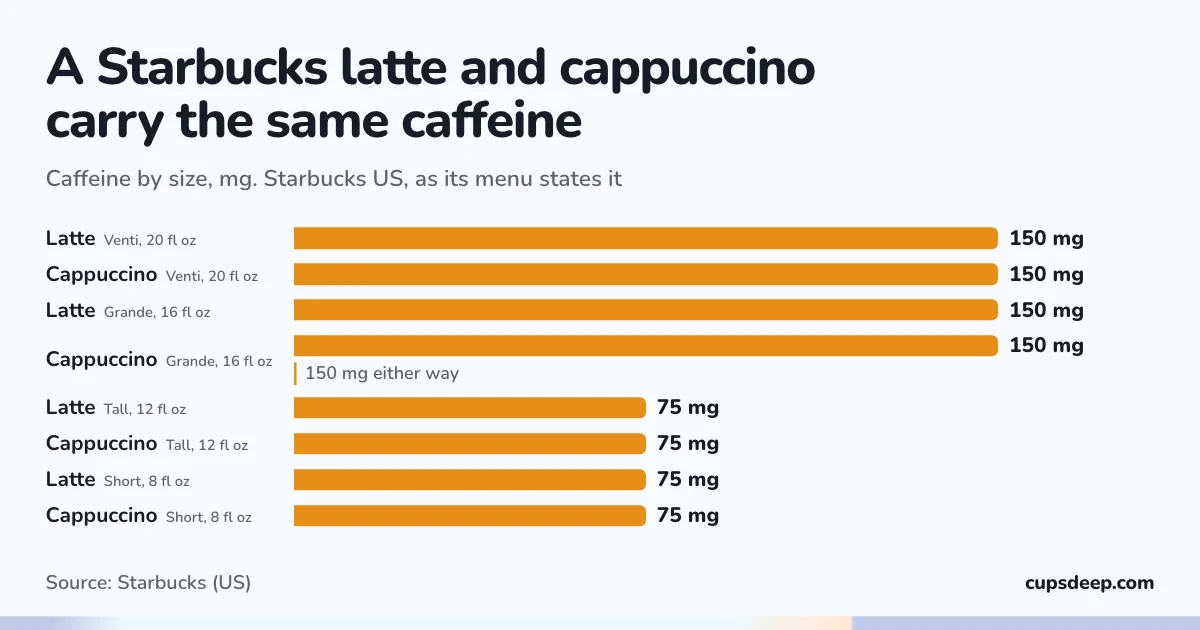
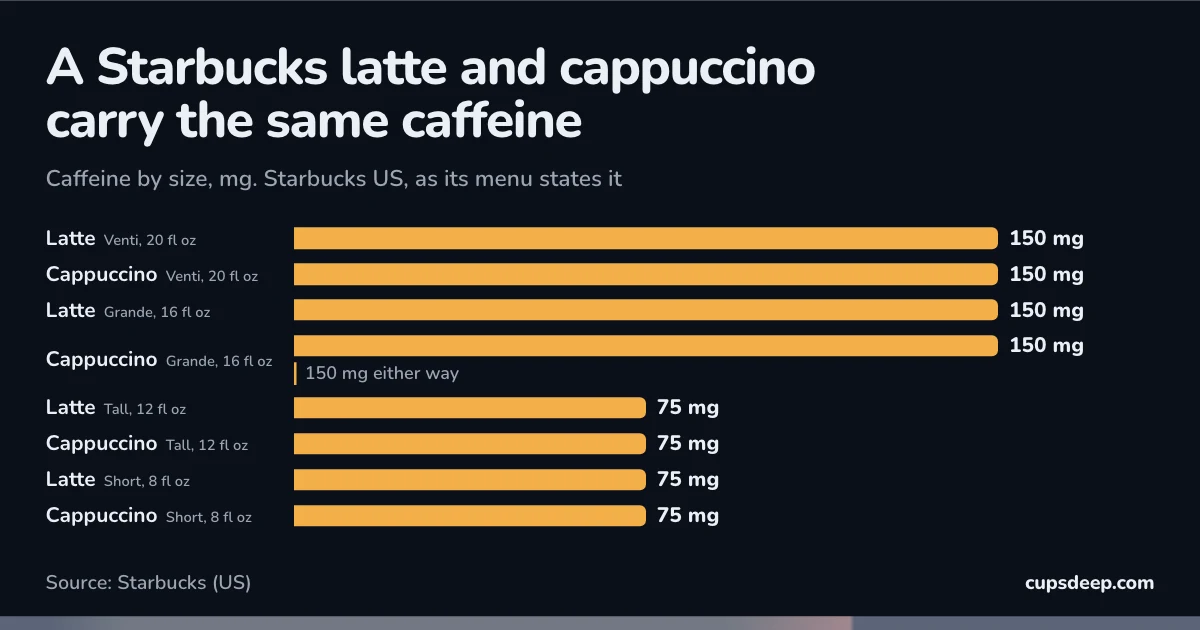
Cappuccino vs latte: same espresso, different milk. At Starbucks both hold 150 mg at Grande; the latte is 190 kcal, the cappuccino 140 kcal. At Costa, not so.

Coffee
Does decaf coffee have caffeine?
Yes. FDA puts decaf at 2–15 mg per 8 fl oz cup, and Starbucks lists 25 mg for a grande. The lab ranges, the law and the maths.