How much caffeine is in a Red Bull?
Less than you think per can, more than you think per fridge. Every product page on Red Bull’s US site was read for this, all four can sizes, every Edition, Sugarfree and Zero, and then held up against Red Bull’s own coffee chart, a USDA lab-analyzed record and four health authorities: EFSA, FDA, Health Canada and the EU.
The short answer
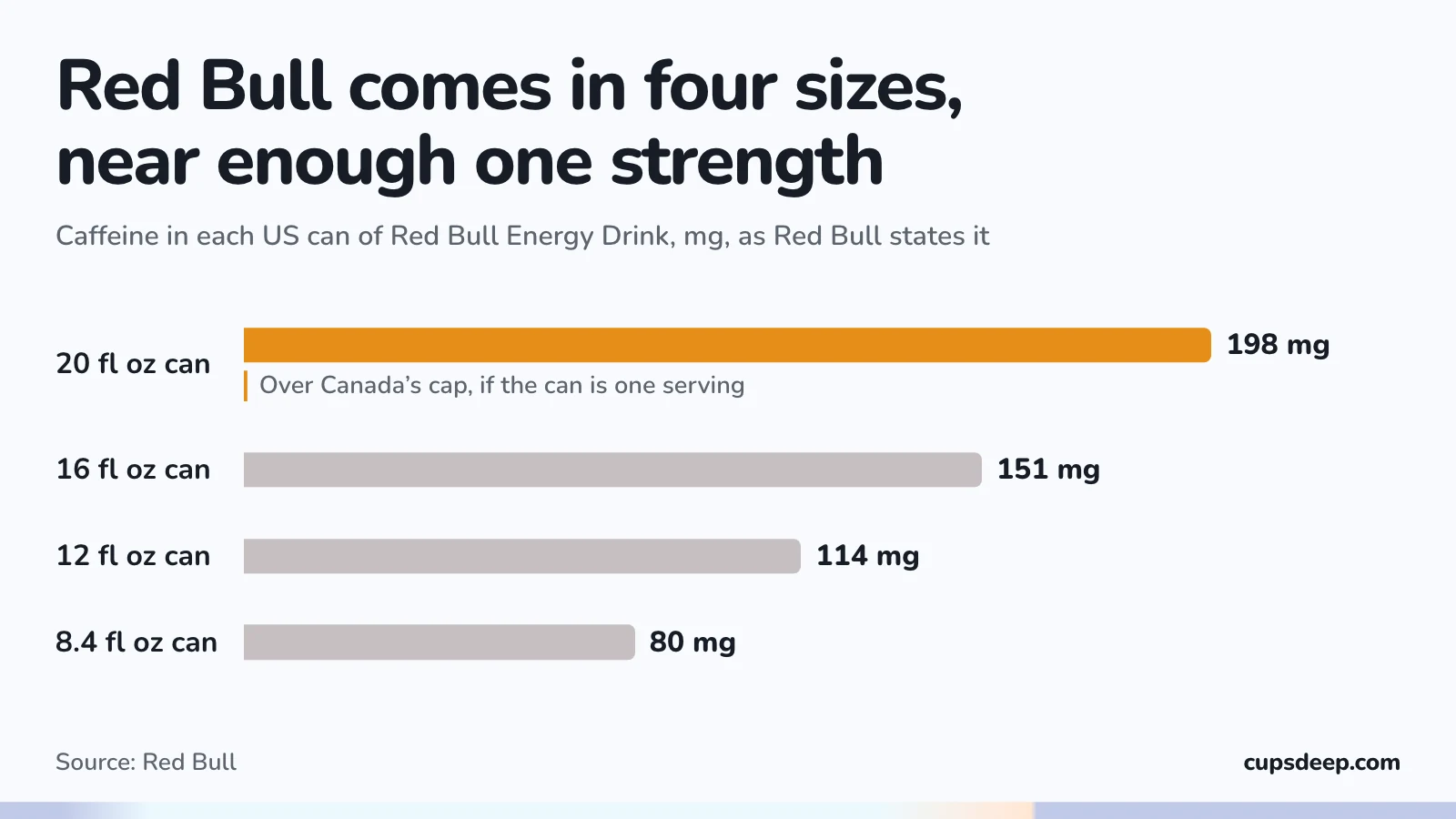
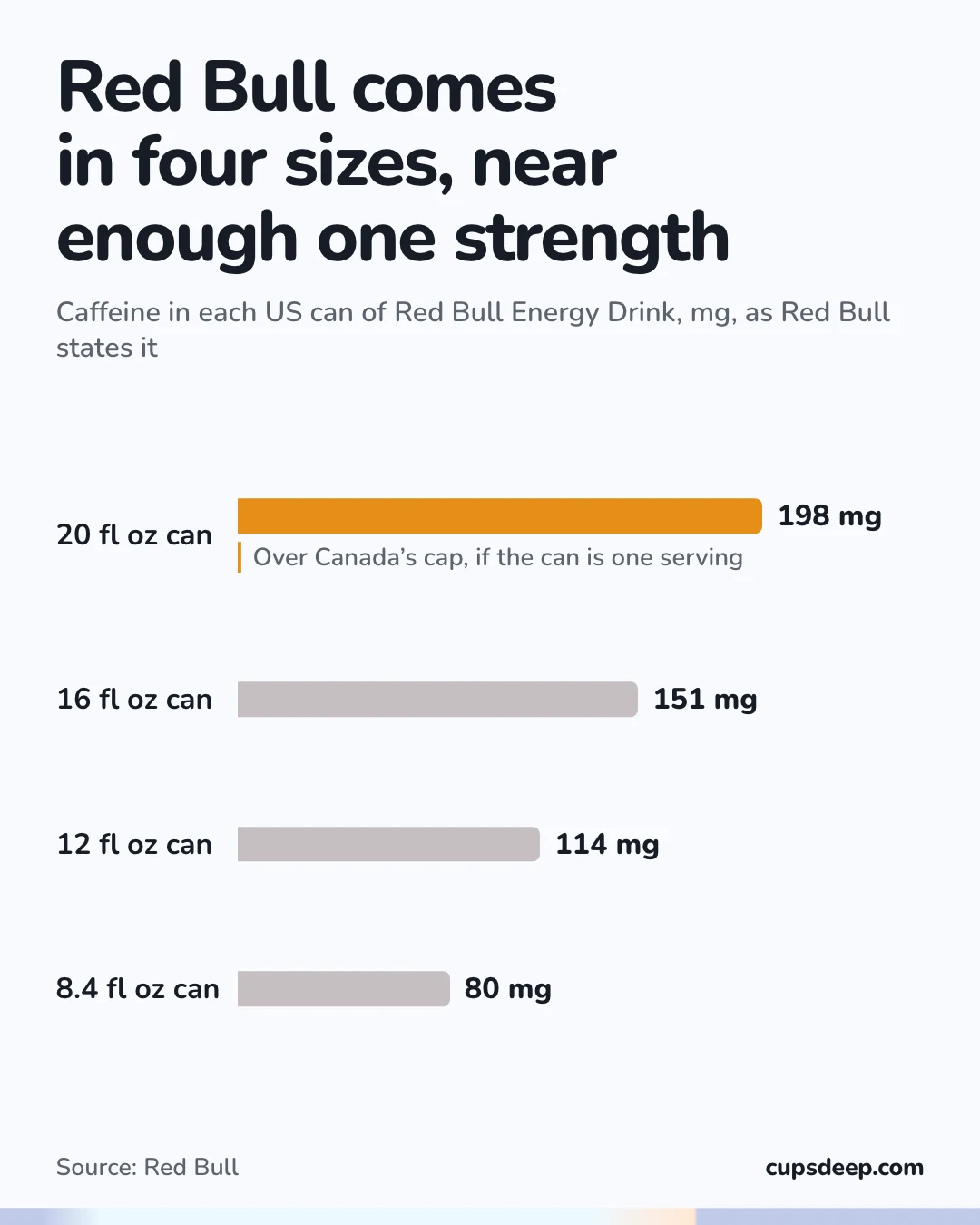
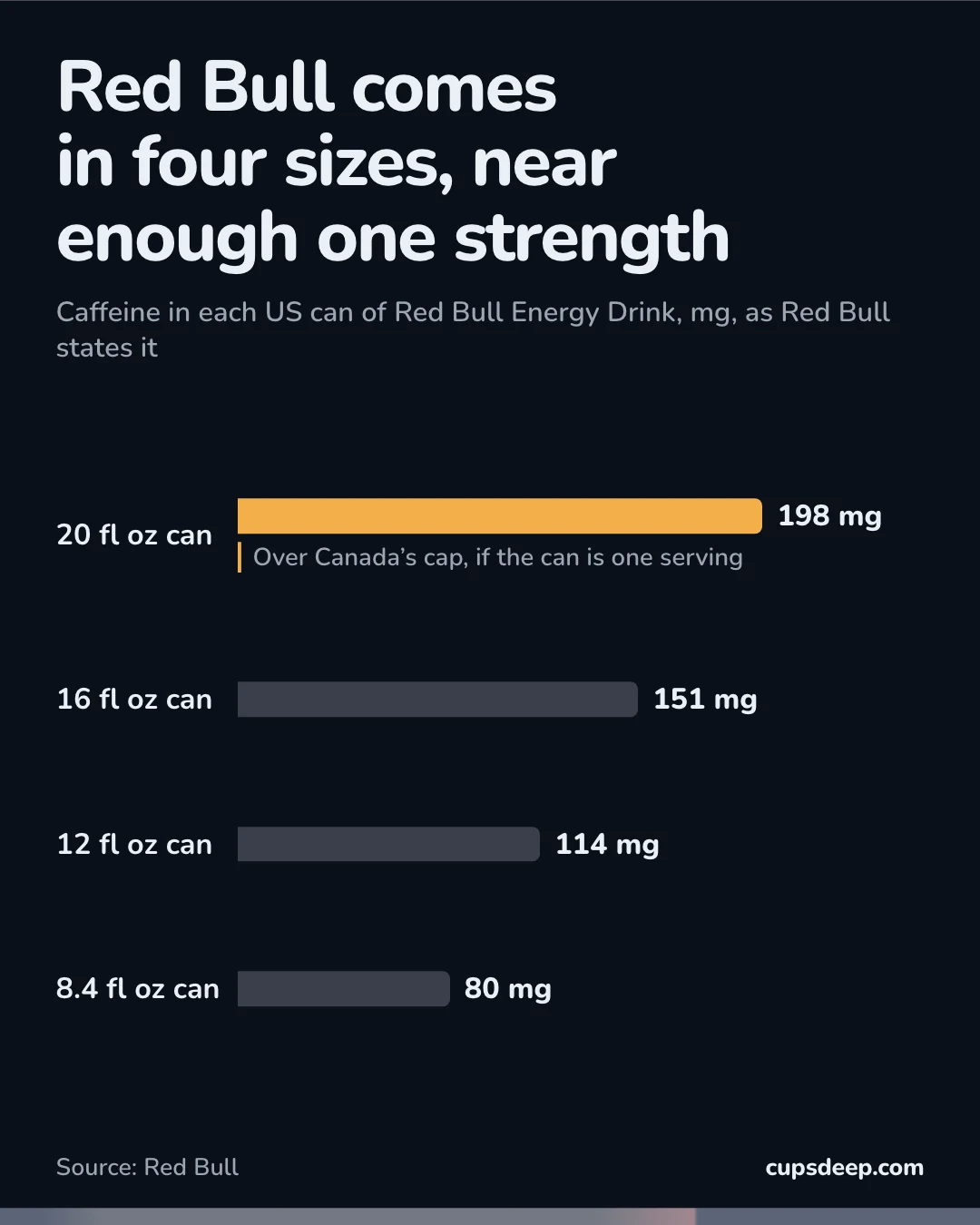
An 8.4 fl oz can of Red Bull has 80 mg of caffeine, by Red Bull’s own figure. The bigger US cans scale up: 114 mg in 12 fl oz, 151 mg in 16 fl oz and 198 mg in 20 fl oz. Flavor and sugar change nothing: Sugarfree, Zero and every Edition state the same 80 mg per small can.

How much caffeine is in a Red Bull, by can size?
The classic slim can is 8.4 fl oz and holds 80 mg. From there Red Bull sells three bigger cans in the US, and the caffeine rises roughly in step with the liquid. By our arithmetic every size lands between 9.4 mg per fl oz and 9.9 mg per fl oz. A bigger Red Bull is mostly more Red Bull, and only the biggest can is a touch stronger.
| Drink | Can | Caffeine | Per fl oz (our arithmetic) |
|---|---|---|---|
| Red Bull Energy Drink | 8.4 fl oz can | 80 mg | 9.5 mg per fl oz |
| Red Bull Energy Drink | 12 fl oz can | 114 mg | 9.5 mg per fl oz |
| Red Bull Energy Drink | 16 fl oz can | 151 mg | 9.4 mg per fl oz |
| Red Bull Energy Drink | 20 fl oz can | 198 mg | 9.9 mg per fl oz |
| Red Bull Sugarfree | 8.4 fl oz can | 80 mg | 9.5 mg per fl oz |
| Red Bull Sugarfree | 12 fl oz can | 114 mg | 9.5 mg per fl oz |
| Red Bull Sugarfree | 16 fl oz can | 151 mg | 9.4 mg per fl oz |
| Red Bull Sugarfree | 20 fl oz can | 198 mg | 9.9 mg per fl oz |
The original’s four figures are from Red Bull’s US caffeine FAQ; Sugarfree’s from its own FAQ, which gives the same four. Per fl oz is the caffeine divided by the can size, rounded to one decimal: our sum, not Red Bull’s.
Keep an eye on the 20 fl oz can. It is the one that walks right up to the limits further down this page, and in one country over them, if the can counts as one serving.
Do Sugarfree, Zero and the Red Bull Editions have the same caffeine?
On 11 November 2026, all 20 product pages on Red Bull’s US site, Red Bull Energy Drink, Sugarfree, Zero and 17 Editions (11 with sugar, 6 sugar-free), state 80 mg of caffeine per 8.4 fl oz can. The Energy Drink and Sugarfree pages list 8.4, 12, 16 and 20 fl oz cans; Zero and the Editions list 8.4 and 12 fl oz, and none of those pages states the caffeine in its 12 fl oz can. 268269270271272273274275276277278279280281282283284285286287
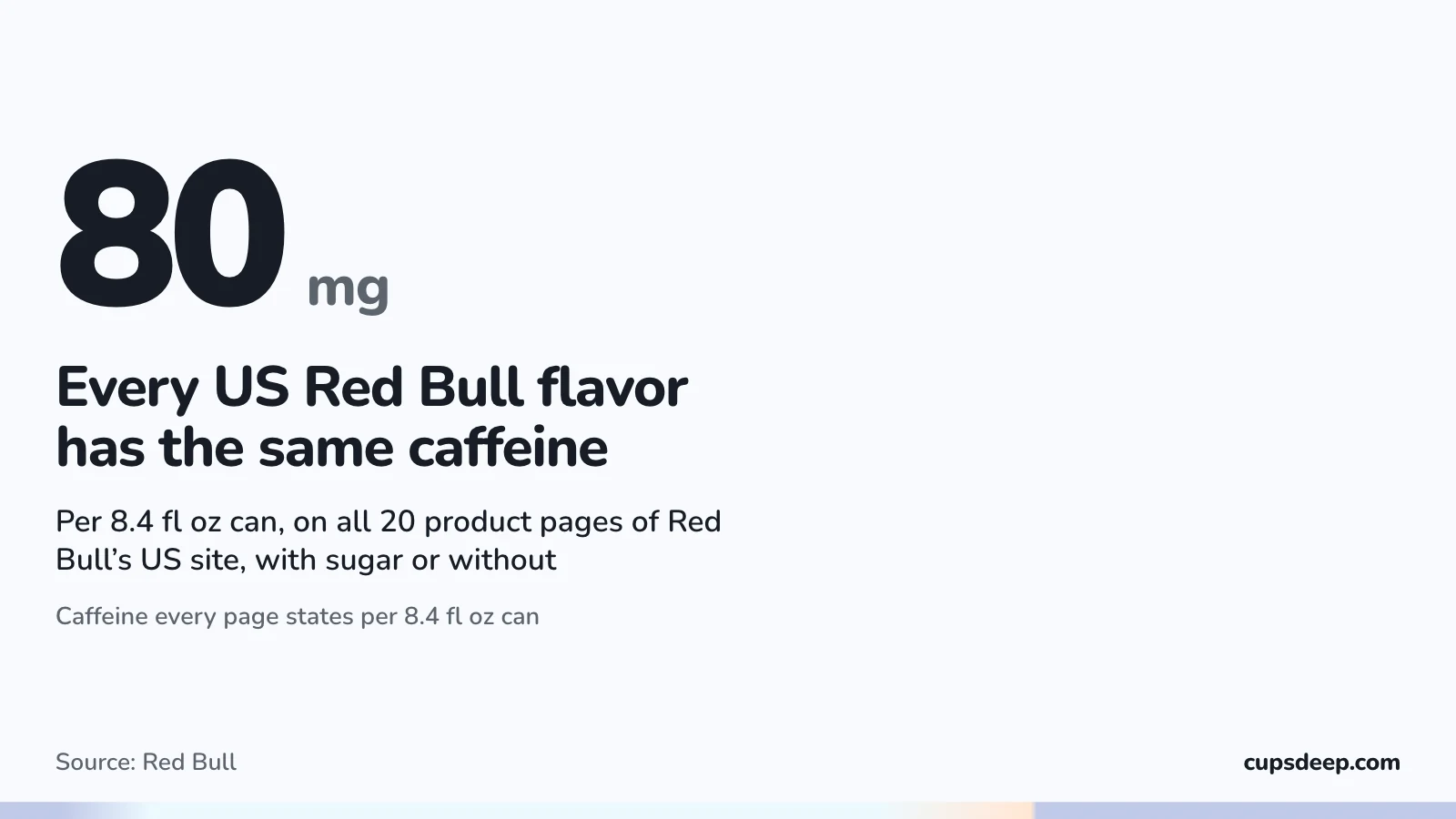
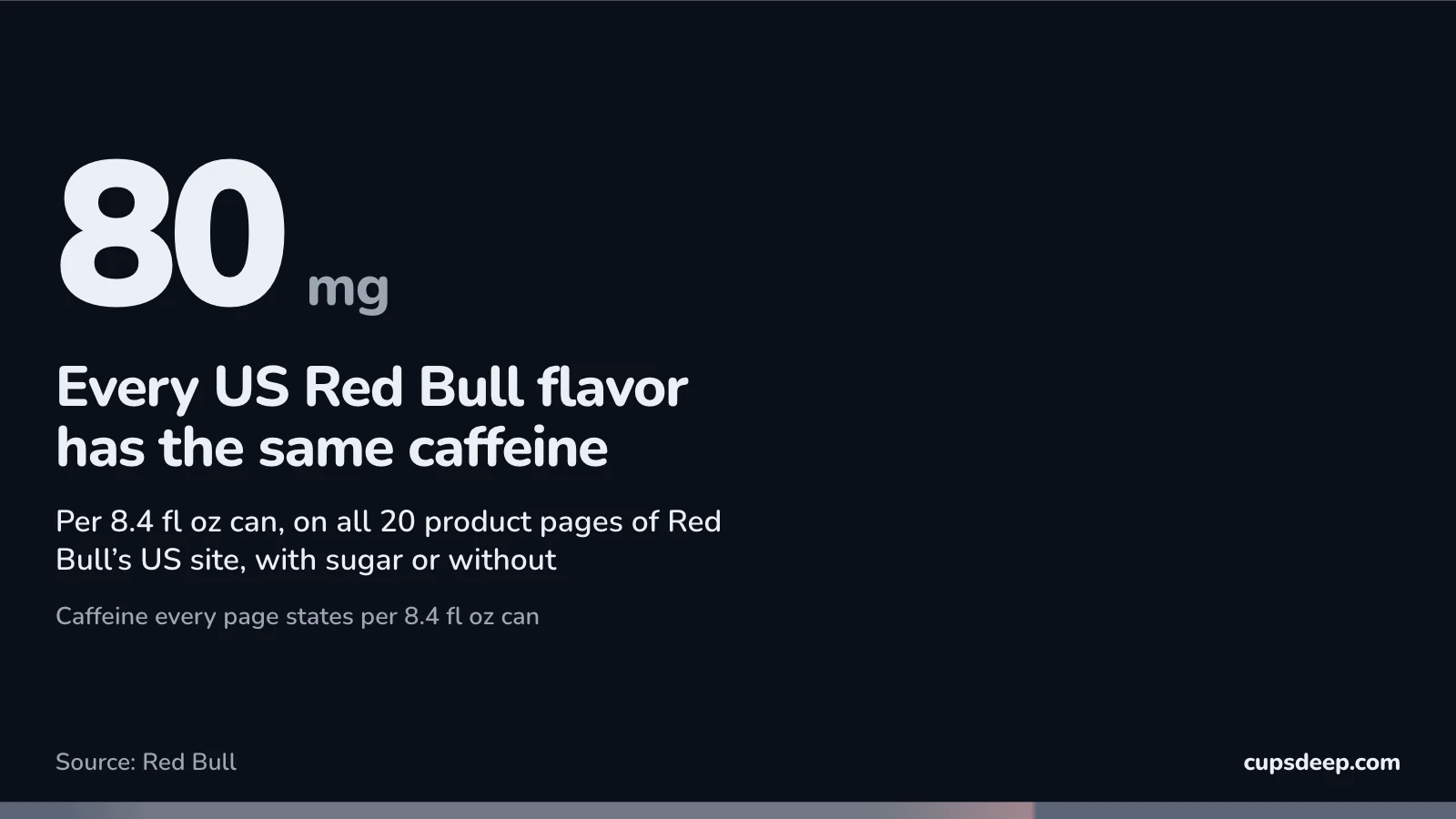
Watermelon, juneberry, white peach, pistachio: the flavor moves, the caffeine does not. Red Bull’s own product pages say so, one by one.
Red Bull says “All Red Bull Editions contain the same functional ingredients as Red Bull Energy Drink: caffeine, taurine and B-group vitamins”, and that some Editions, “often released seasonally”, are sold “only for a limited time”. 292
Every US Red Bull flavor is the same dose in a costume
| Drink | Flavor | Caffeine per 8.4 fl oz can | Sizes the page lists |
|---|---|---|---|
| Red Bull Energy Drink | None named | 80 mg | 8.4, 12, 16 and 20 fl oz |
| Red Bull Sugarfree | None named | 80 mg | 8.4, 12, 16 and 20 fl oz |
| Red Bull Zero | None named | 80 mg | 8.4 and 12 fl oz |
| Red Edition | Watermelon | 80 mg | 8.4 and 12 fl oz |
| Yellow Edition | Tropical | 80 mg | 8.4 and 12 fl oz |
| Sea Blue Edition | Juneberry | 80 mg | 8.4 and 12 fl oz |
| Coconut Edition | Coconut Berry | 80 mg | 8.4 and 12 fl oz |
| Peach Edition | White Peach | 80 mg | 8.4 and 12 fl oz |
| Pink Edition | Wild Berries | 80 mg | 8.4 and 12 fl oz |
| Amber Edition | Strawberry Apricot | 80 mg | 8.4 and 12 fl oz |
| Apple Edition | Fuji Apple & Ginger | 80 mg | 8.4 and 12 fl oz |
| Iced Edition | Iced Vanilla Berry | 80 mg | 8.4 and 12 fl oz |
| Winter Edition | Pistachio & Berries | 80 mg | 8.4 and 12 fl oz |
| Summer Edition | Sudachi Lime | 80 mg | 8.4 and 12 fl oz |
| Sea Blue Edition Sugarfree | Juneberry | 80 mg | 8.4 and 12 fl oz |
| Peach Edition Sugarfree | White Peach | 80 mg | 8.4 and 12 fl oz |
| Pink Edition Sugarfree | Wild Berries | 80 mg | 8.4 and 12 fl oz |
| Iced Edition Sugarfree | Iced Vanilla Berry | 80 mg | 8.4 and 12 fl oz |
| Winter Edition Sugarfree | Pistachio & Berries | 80 mg | 8.4 and 12 fl oz |
| Summer Edition Sugarfree | Sudachi Lime | 80 mg | 8.4 and 12 fl oz |
Each figure is the one the product page states, for an 8.4 fl oz can. Zero and the Editions also come in a 12 fl oz can, and their pages state no caffeine for it. The original’s 12 fl oz figure is probably close, but it is not stated for these drinks, so it is not printed here.
So Sugarfree versus Zero is a question about sweeteners, and sugar versus no sugar is a question about sugar. The caffeine does not care which can you picked.
Per 8.4 fl oz can, Red Bull states 26 g of sugars for Red Bull Energy Drink, 27 g for the Red Edition and 0 g for Sugarfree and for Zero, and 80 mg of caffeine for all four. Sugarfree is sweetened with acesulfame potassium and sucralose; Zero with monk fruit extract, sucralose and erythritol. 10291289290
Is a Red Bull stronger than a cup of coffee?
Red Bull’s answer is no: it calls the small can about the same as a cup of home-brewed coffee. Then it prints a chart, on the same page, that disagrees.
Red Bull’s US ingredients page says the 80 mg of caffeine in an 8.4 fl oz can of Red Bull Energy Drink “is about the same amount as in a cup of home-brewed coffee”. The chart beside that sentence gives home-brewed coffee as “~95 mg” per 8 fl oz, and names its source as the “USDA National Nutrient Database for Standard References”. Red Bull’s US caffeine FAQ uses the same “about the same” wording. 109
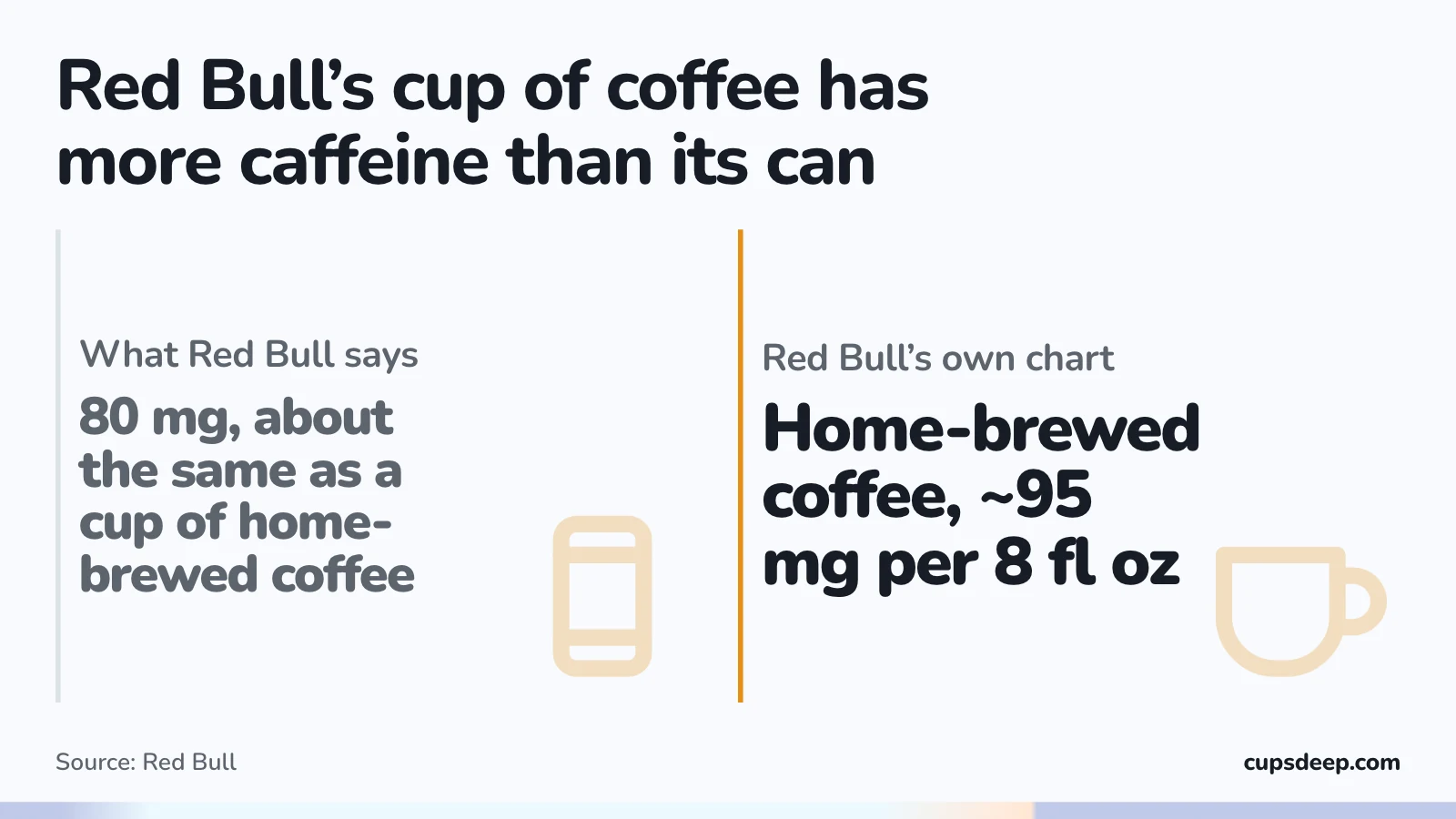
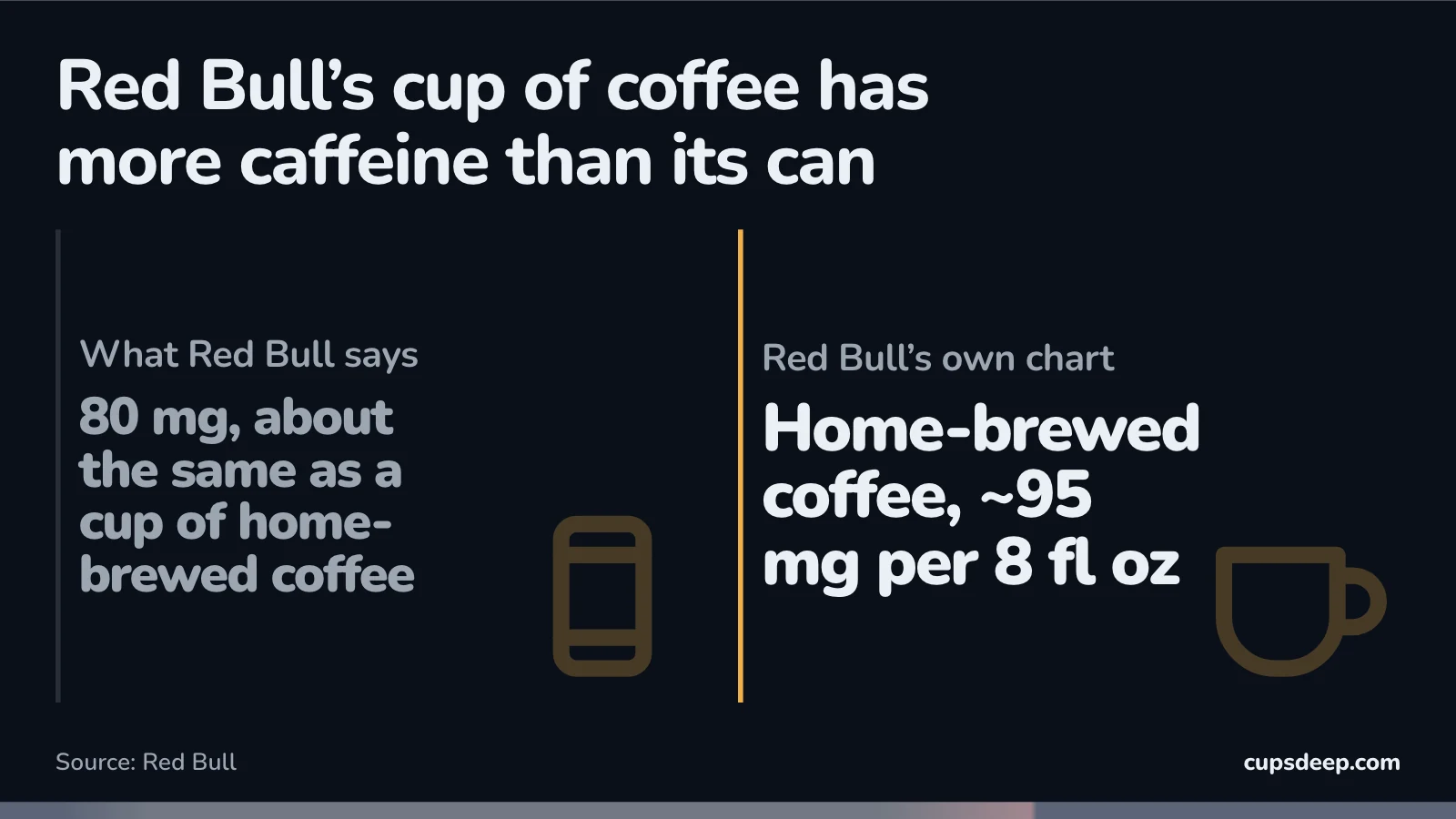
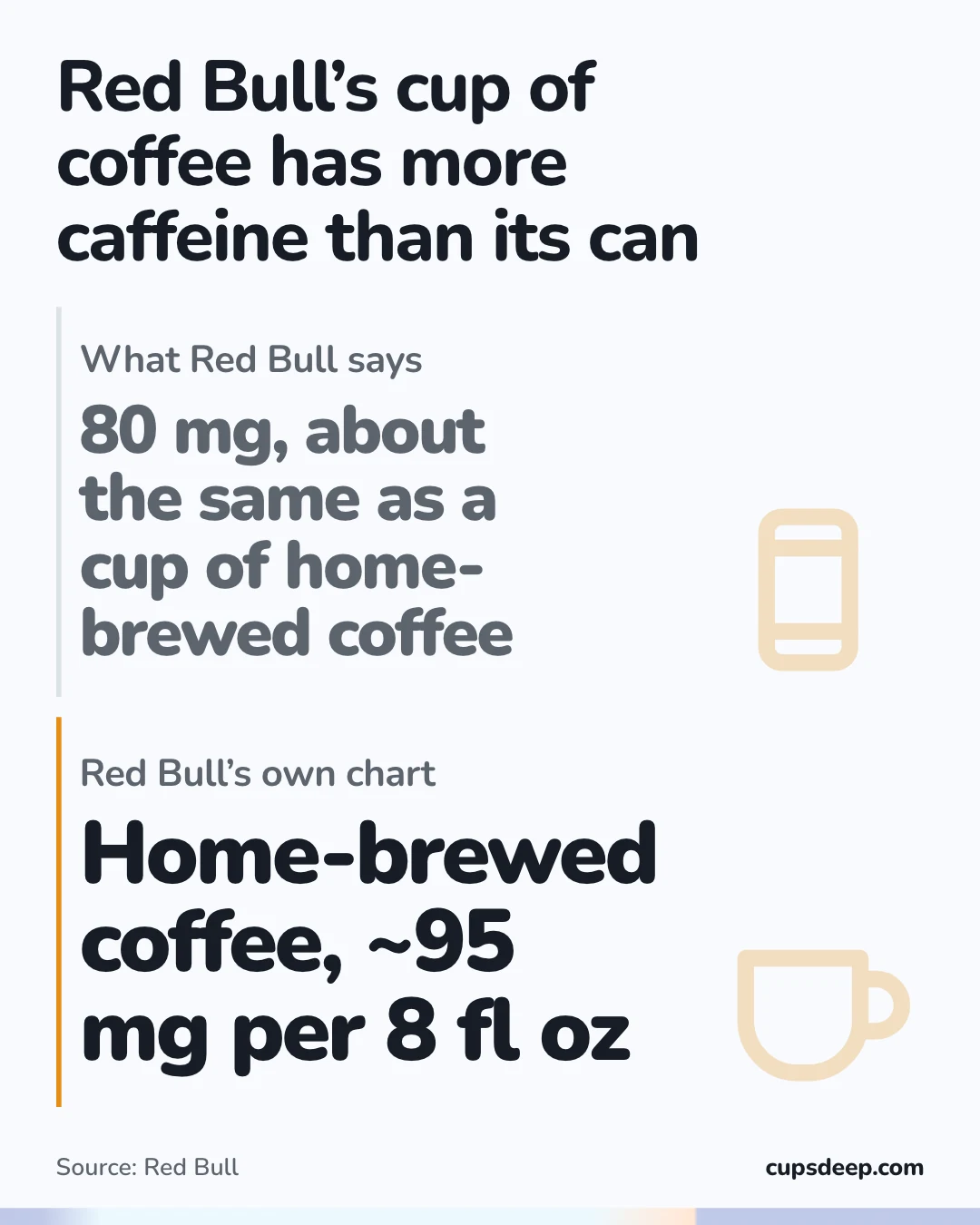
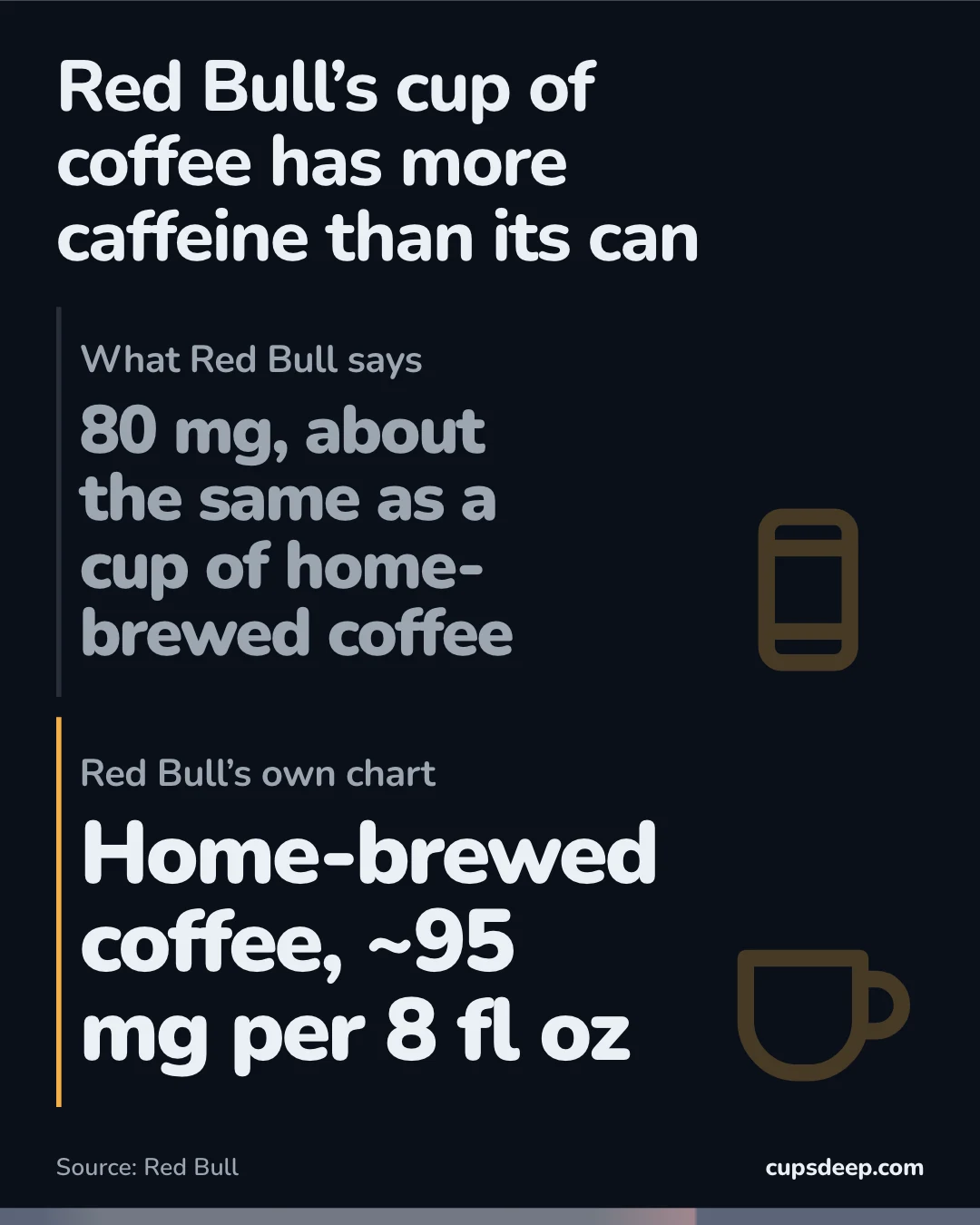
By Red Bull’s own US chart, a cup of home-brewed coffee (~95 mg per 8 fl oz) holds 15 mg more caffeine than the 80 mg can Red Bull calls about the same, so the can is about 84% of the chart’s cup. Red Bull’s 50 mg Pakistan drink, also “about the same” as a cup of coffee, holds 30 mg less than the US can. These differences are our arithmetic. 10293
Red Bull says a can is about the same as a cup of coffee, then prints a chart where the coffee wins
To be fair to the can, the cup decides it. The 95 mg on Red Bull’s chart matches USDA’s brewed coffee: 95 mg (71–104 mg) for an 8 fl oz cup by our arithmetic, and anywhere from 71 mg to 104 mg across USDA’s samples. Our own filter coffee is a smaller 200 ml cup at 80 mg, and against that cup the can really is the same. Against a mug, it loses. Both are on the drinks page.
And the phrase travels. Red Bull’s Pakistan site sells a different drink and uses the same comparison for it.
Red Bull’s Pakistan site sells Red Bull Stimulant Drink and says “The 50 mg of caffeine contained in one 250 ml can of Red Bull Stimulant Drink is about the same amount as in a cup of coffee.” 293
Red Bull’s “cup of coffee” changes size at the border
Red Bull vs Monster: which has more caffeine?
Per can, Monster, because the usual Monster is about twice the size: 160 mg in 16 fl oz against 80 mg in 8.4 fl oz. Put them in the same 16 fl oz can and the gap almost closes.
In the same 16 fl oz can, Red Bull states 151 mg of caffeine and Monster states 160 mg: a difference of 9 mg. 69
Per fl oz, by our arithmetic, that is 10 mg per fl oz for Monster against 9.4 mg per fl oz for Red Bull. Nearly the same drink, in different clothes. Every Monster is in its own article, and the rest of the fridge is in which energy drink has the most caffeine. The one thing stronger per sip than any can is not a can: it is the energy shot.
Is the caffeine on a Red Bull label accurate?
A label is a claim. USDA’s nutrient database holds an analyzed record for Red Bull, and it is public, so the claim can be checked against something other than Red Bull.
USDA’s analyzed record for Red Bull, published in 2019, gives 29 mg of caffeine per 100 g from 3 samples that ran from 29 to 30, and weighs the 8.4 fl oz can at 258 g. Multiplied out, that is about 74.8 mg a can, 77.4 mg at the highest sample, against the 80 mg on Red Bull’s label: 93.5% of the label, or 5.2 mg short. The multiplication is ours; USDA gives the figure per 100 g. 2969
| What | Caffeine |
|---|---|
| Red Bull’s label | 80 mg |
| USDA’s samples, on USDA’s can (our arithmetic) | 74.8 mg |
| Highest USDA sample, same can (our arithmetic) | 77.4 mg |
USDA gives 29 mg per 100 g from three samples and weighs the can at 258 g. The multiplication is ours. The record was published in 2019; it does not tell us when the cans were bought.
So the lab came in a little under the label, not over it. Three samples is a small lab, and the record is for the original only. If you were hoping the can was secretly stronger than it says, USDA did not find that.
How many Red Bulls a day is safe?
EFSA concludes that caffeine intakes up to 400 mg a day from all sources, spread through the day, do not raise safety concerns for healthy adults, except pregnant women. FDA cites 400 mg a day for most adults as an amount not generally associated with negative effects, and notes wide variation in how sensitive people are to caffeine and how fast they eliminate it. 225
Against the 400 mg a day that EFSA and FDA cite for healthy adults, five 8.4 fl oz cans of Red Bull make exactly 400 mg, two 16 fl oz cans make 302 mg and three make 453 mg, and two 20 fl oz cans make 396 mg. These are sums of Red Bull’s own per-can figures and count nothing else drunk that day. 922
Five small cans land exactly on the line, which is a lot of small cans. The bigger cans get there faster. For one sitting, EFSA’s figure is 200 mg, and Red Bull’s biggest can stops just short of it, at 198 mg.
Red Bull’s US 20 fl oz can, at 198 mg, is 2 mg under the 200 mg single dose that EFSA says raises no safety concern for healthy non-pregnant adults, and, if the can is one serving, 18 mg over the 180 mg per serving Health Canada allows in an energy drink. The caffeine page on Red Bull’s Canadian site gives figures for 250, 355 and 473 ml cans only. The differences are our arithmetic. 922297294
Health Canada restricts the caffeine from all sources in a caffeinated energy drink to 180 mg per serving. Every such drink sold in Canada must say “high caffeine content” on the label, with the statements “Not recommended for those under 14 years old, pregnant or breastfeeding women or individuals sensitive to caffeine” and “Do not drink more than X serving(s) per day”. 297
Red Bull’s biggest can is over Canada’s limit if it’s one serving. I drink it in the car like a smuggler
Europe does not cap the can. It makes it say so next to the name.
In the European Union a drink with more than 150 mg of caffeine per liter, other than a coffee or tea named as such, must carry the words “High caffeine content. Not recommended for children or pregnant or breast-feeding women” in the same field of vision as its name, followed in brackets by the caffeine per 100 ml. It is a label rule, not a cap. 212
Red Bull’s New Zealand panel gives 32 mg of caffeine per 100 ml, which is 320 mg per liter, about 2.1 times the 150 mg per liter above which EU law requires the “High caffeine content” warning. The conversion and the ratio are our arithmetic. 295212
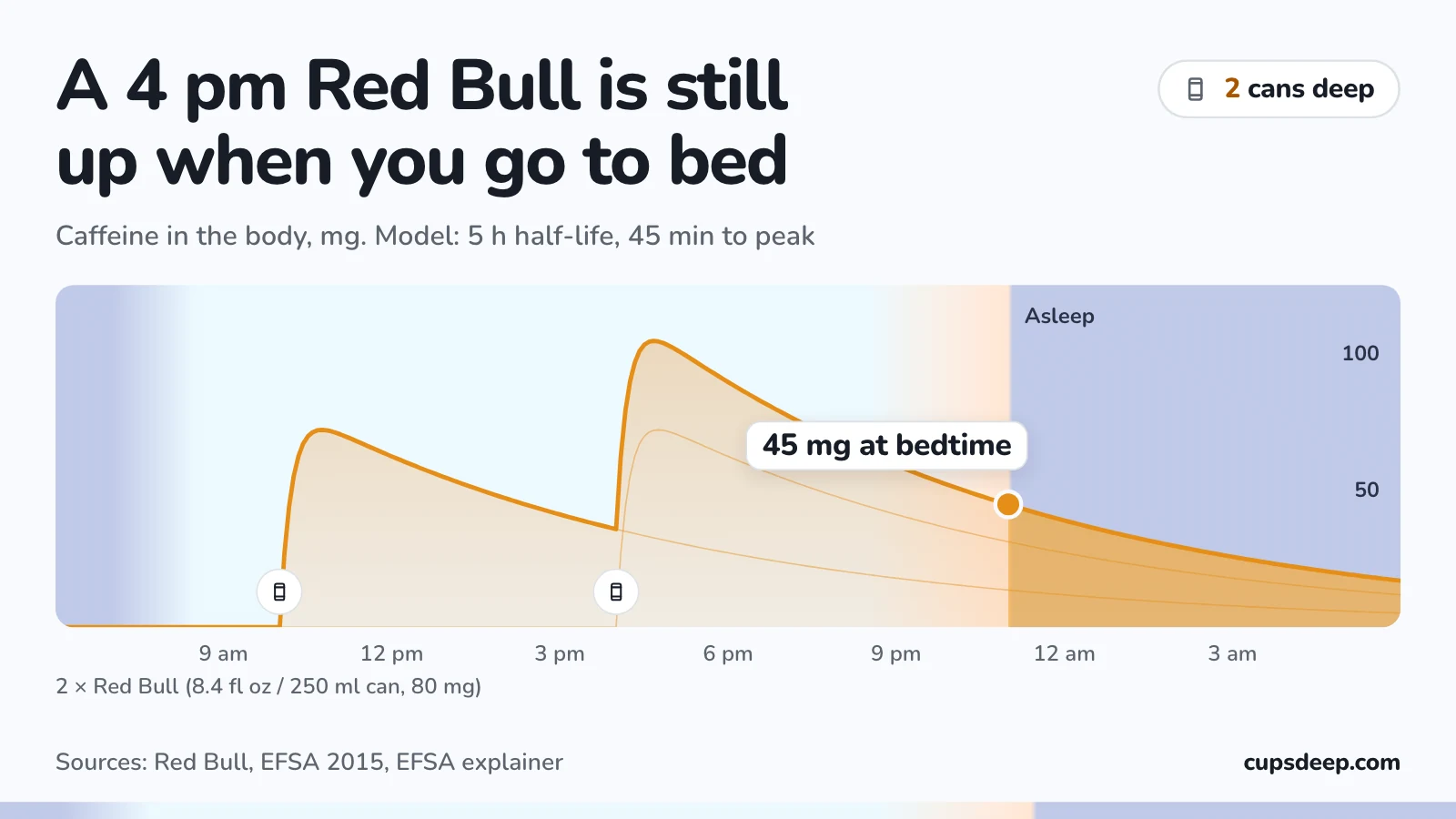
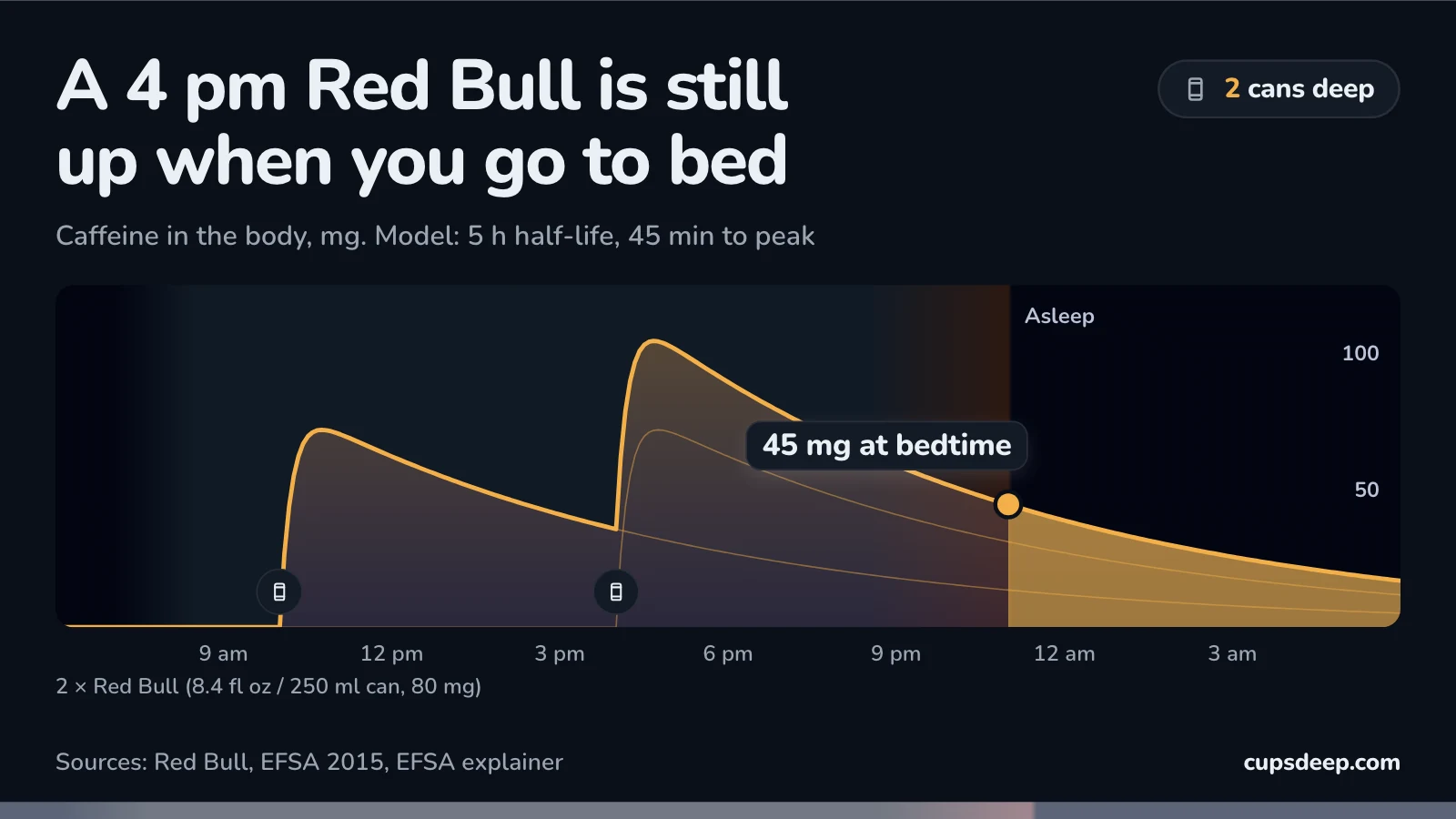
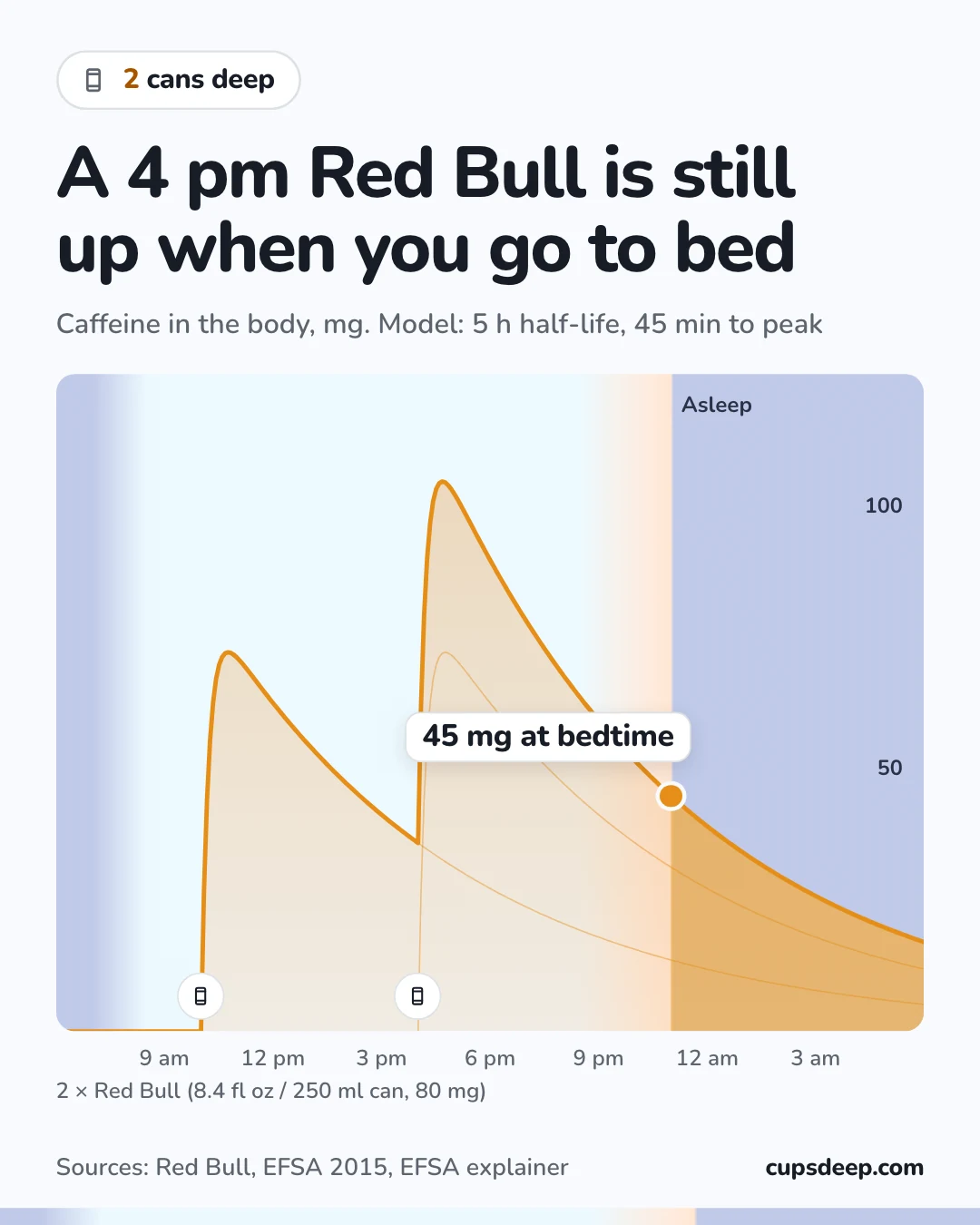
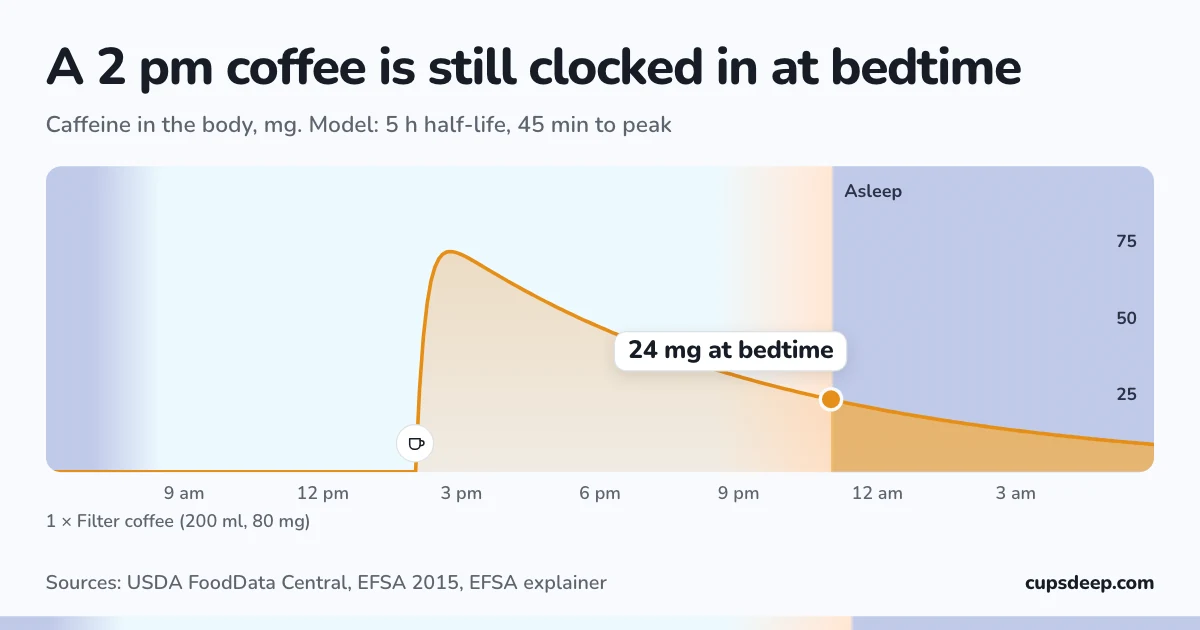
None of these numbers is a cliff. People clear caffeine at very different speeds, and the better question than how many is when. Caffeine’s half-life in healthy adults averages 4 hours and runs as long as 8 hours, so the afternoon can is still around at midnight. More on that in how long caffeine stays in your system.

Questions people ask
How much caffeine is in a sugar-free Red Bull?
The same as the original. Red Bull Sugarfree states 80 mg for an 8.4 fl oz can, 114 mg for 12 fl oz, 151 mg for 16 fl oz and 198 mg for 20 fl oz. Red Bull Zero states 80 mg for an 8.4 fl oz can.
How much caffeine is in a 12 oz Red Bull?
Red Bull Energy Drink states 114 mg for a 12 fl oz can, and Sugarfree states 114 mg. Zero and the Editions also come in 12 fl oz, but their pages state caffeine only for the 8.4 fl oz can, 80 mg.
Does Red Bull Zero have less caffeine than regular Red Bull?
No. Red Bull Zero states 80 mg per 8.4 fl oz can, the same as Red Bull Energy Drink. It differs in sugar (0 g against 26 g) and in sweeteners, not in caffeine.
How much caffeine is in a 250 ml can of Red Bull?
Red Bull’s Canadian site states 80 mg for a 250 ml can, 114 mg for 355 ml and 151 mg for 473 ml. Its New Zealand panel gives 32 mg per 100 ml, which is the same strength.
Is a 20 oz Red Bull too much caffeine?
It is 198 mg, which is 2 mg under the 200 mg single dose EFSA says raises no safety concern for healthy non-pregnant adults, and, if the can is one serving, 18 mg over the 180 mg per serving Health Canada allows in an energy drink. Our arithmetic.
How many Red Bulls can you drink in a day?
Against the 400 mg/day a day EFSA and FDA cite for healthy adults, five 8.4 fl oz cans make 400 mg and two 20 fl oz cans make 396 mg, counting nothing else you drank that day.
Sources
Every number above links to the place it came from. How the numbers are chosen and checked is on the method page; the drink table is at /drinks. Written with AI agents, as the whole site is. A model of a typical body, not advice for pregnancy, illness or medication.
- Spilling the Beans: How Much Caffeine is Too Much?
- Monster Energy Original Green
- How much caffeine is in a can of Red Bull Energy Drink?
- Red Bull Energy Drink: Ingredients
- Beverages, coffee, brewed, prepared with tap water
- Scientific Opinion on the safety of caffeine
- EFSA explains risk assessment: Caffeine
- Regulation (EU) No 1169/2011 on the provision of food information to consumers, consolidated text of 1 January 2018, Annex III point 4.1
- Red Bull Energy Drink (product page, redbull.com, United States)
- Red Bull Sugarfree (product page, redbull.com, United States)
- Red Bull Zero (product page, redbull.com, United States)
- Red Bull Red Edition (product page, redbull.com, United States)
- Red Bull Yellow Edition (product page, redbull.com, United States)
- Red Bull Sea Blue Edition (product page, redbull.com, United States)
- Red Bull Coconut Edition (product page, redbull.com, United States)
- Red Bull Peach Edition (product page, redbull.com, United States)
- Red Bull Pink Edition (product page, redbull.com, United States)
- Red Bull Amber Edition (product page, redbull.com, United States)
- Red Bull Apple Edition (product page, redbull.com, United States)
- Red Bull Iced Edition (product page, redbull.com, United States)
- Red Bull Winter Edition (product page, redbull.com, United States)
- Red Bull Summer Edition (product page, redbull.com, United States)
- Red Bull Sea Blue Edition Sugarfree (product page, redbull.com, United States)
- Red Bull Peach Edition Sugarfree (product page, redbull.com, United States)
- Red Bull Pink Edition Sugarfree (product page, redbull.com, United States)
- Red Bull Iced Edition Sugarfree (product page, redbull.com, United States)
- Red Bull Winter Edition Sugarfree (product page, redbull.com, United States)
- Red Bull Summer Edition Sugarfree (product page, redbull.com, United States)
- How much caffeine is in a can of Red Bull Sugarfree?
- Red Bull Sugarfree: Ingredients
- Red Bull Zero: Ingredients
- The Red Bull Red Edition: Ingredients
- What are Red Bull Editions?
- Red Bull Stimulant Drink (redbull.com, Pakistan)
- How much caffeine is in a can of Red Bull Energy Drink? (redbull.com, Canada)
- Red Bull Energy Drink: Ingredients (redbull.com, New Zealand)
- Beverages, Energy drink, RED BULL (SR Legacy, FDC 173210, NDB 14154)
- Caffeinated energy drinks
Keep reading
Cans
How much caffeine is in a Monster?
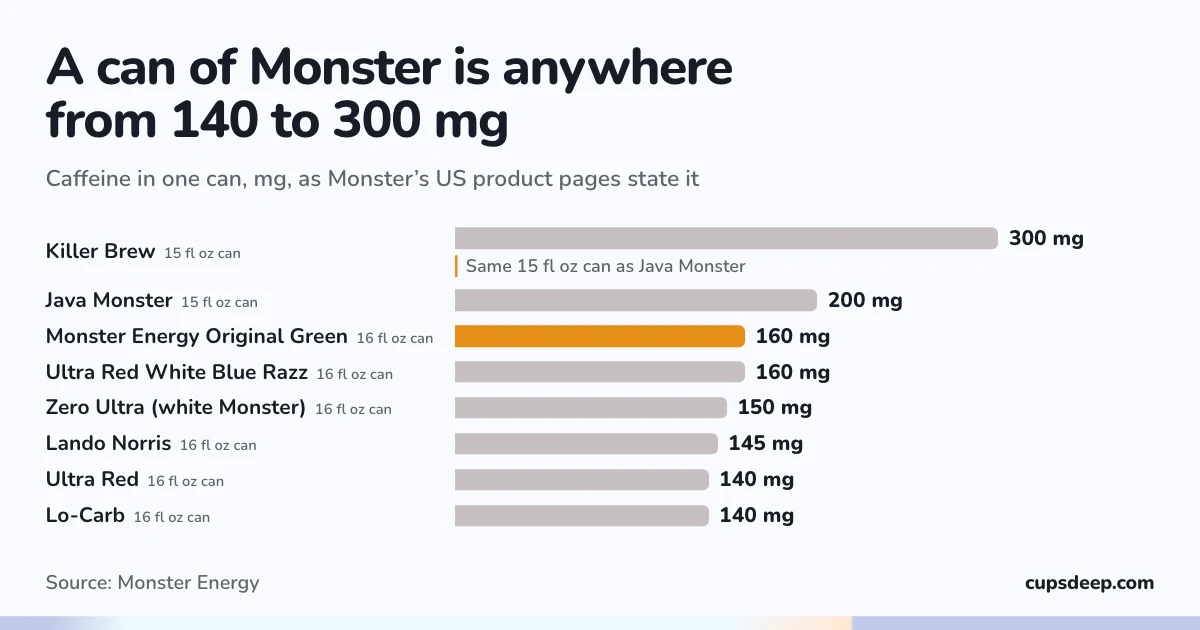
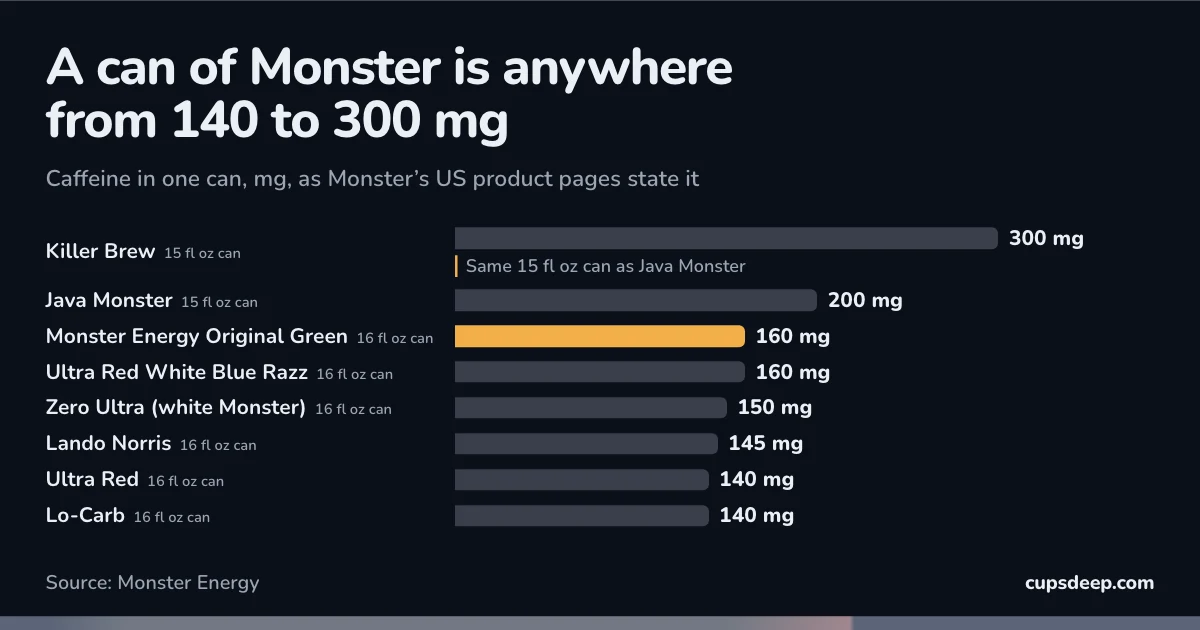
A 16 fl oz can of original Monster has 160 mg of caffeine. White Monster has 150 mg, Java Monster 200 mg and Killer Brew 300 mg.

Cans
Which energy drink has the most caffeine?
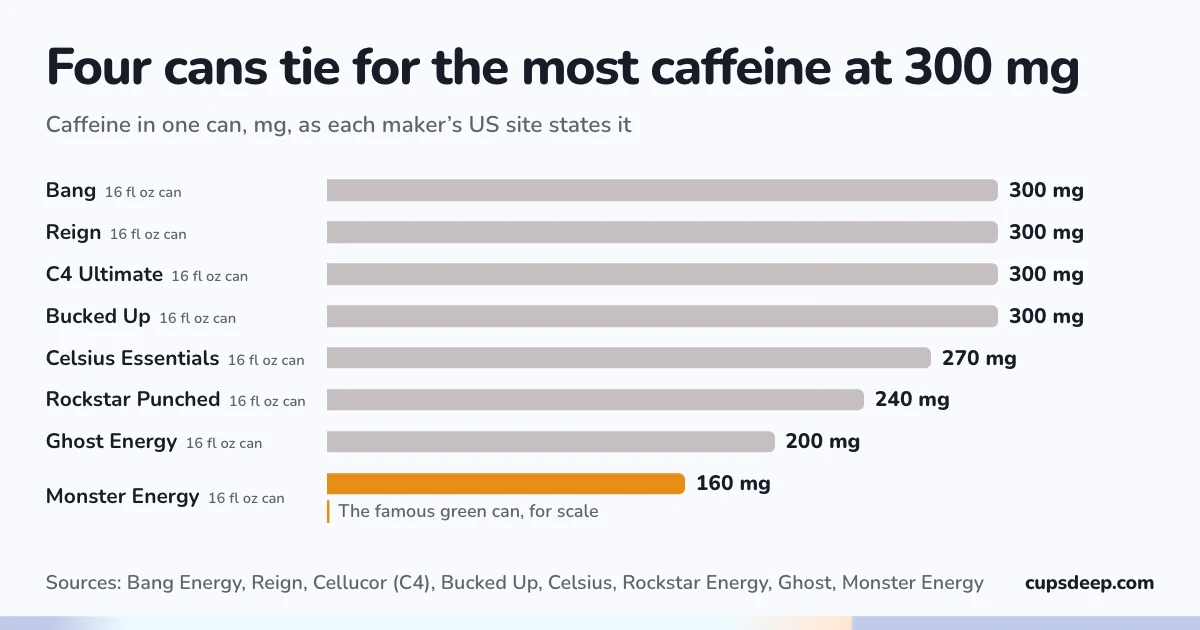
Four US cans tie at 300 mg in 16 fl oz: Bang, Reign, C4 Ultimate and Bucked Up. Per fl oz, Killer Brew wins. Each can by its maker, plus the legal caps.
Body and sleep
How long does caffeine stay in your system?
Half of a dose of caffeine is gone in about 4 hours, 2–8 hours between people. After five half-lives, 20 hours on average, 3.1% is left.