Does green tea have caffeine?
Yes, and less of the story is about the leaf than the tea shops tell you. The big levers are how long the bag sits in the cup, how much leaf went in, and whether you bought it in a bottle. Here are the measured numbers, and the line tea pages love that one lab does not back.
The short answer
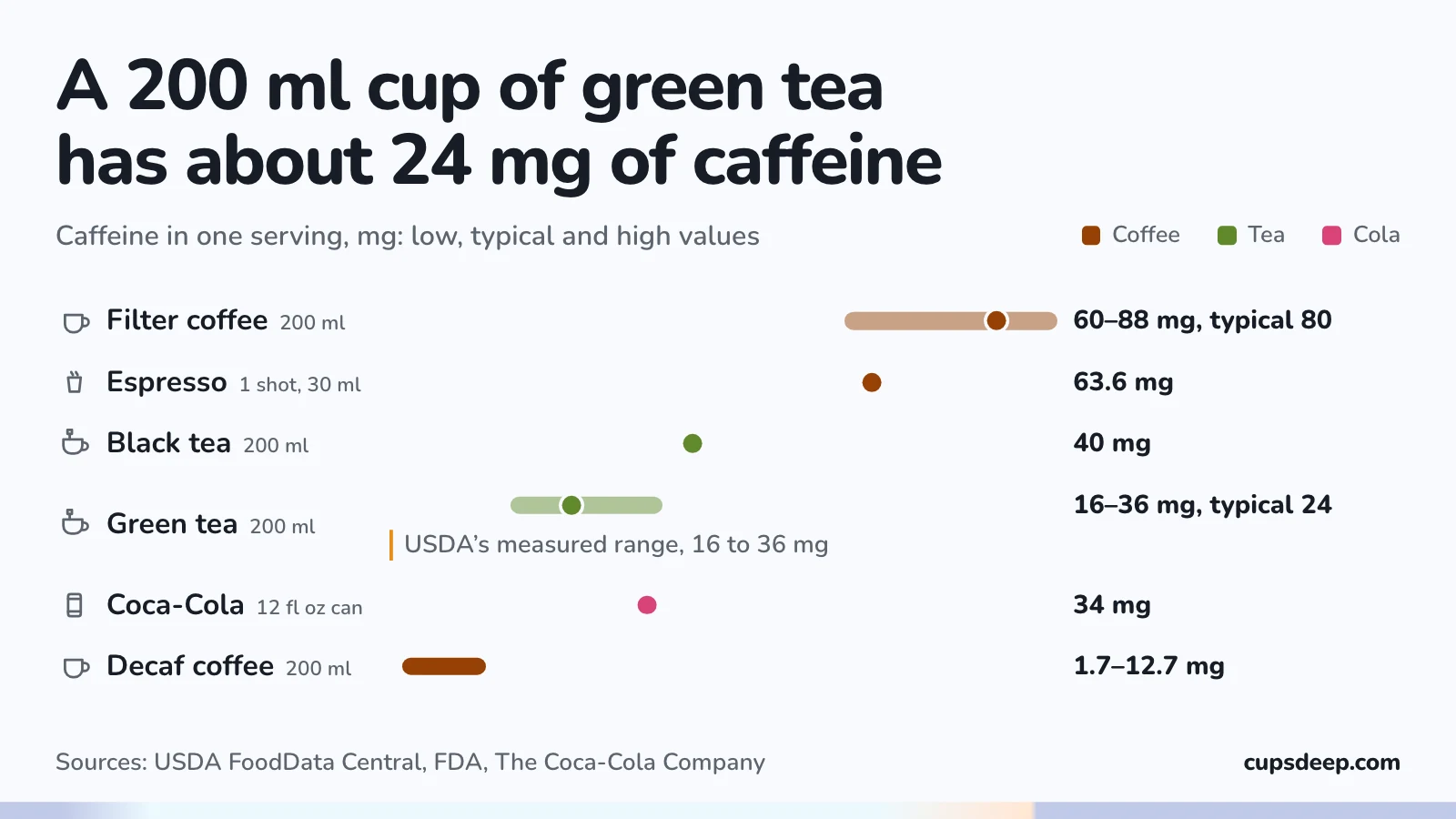
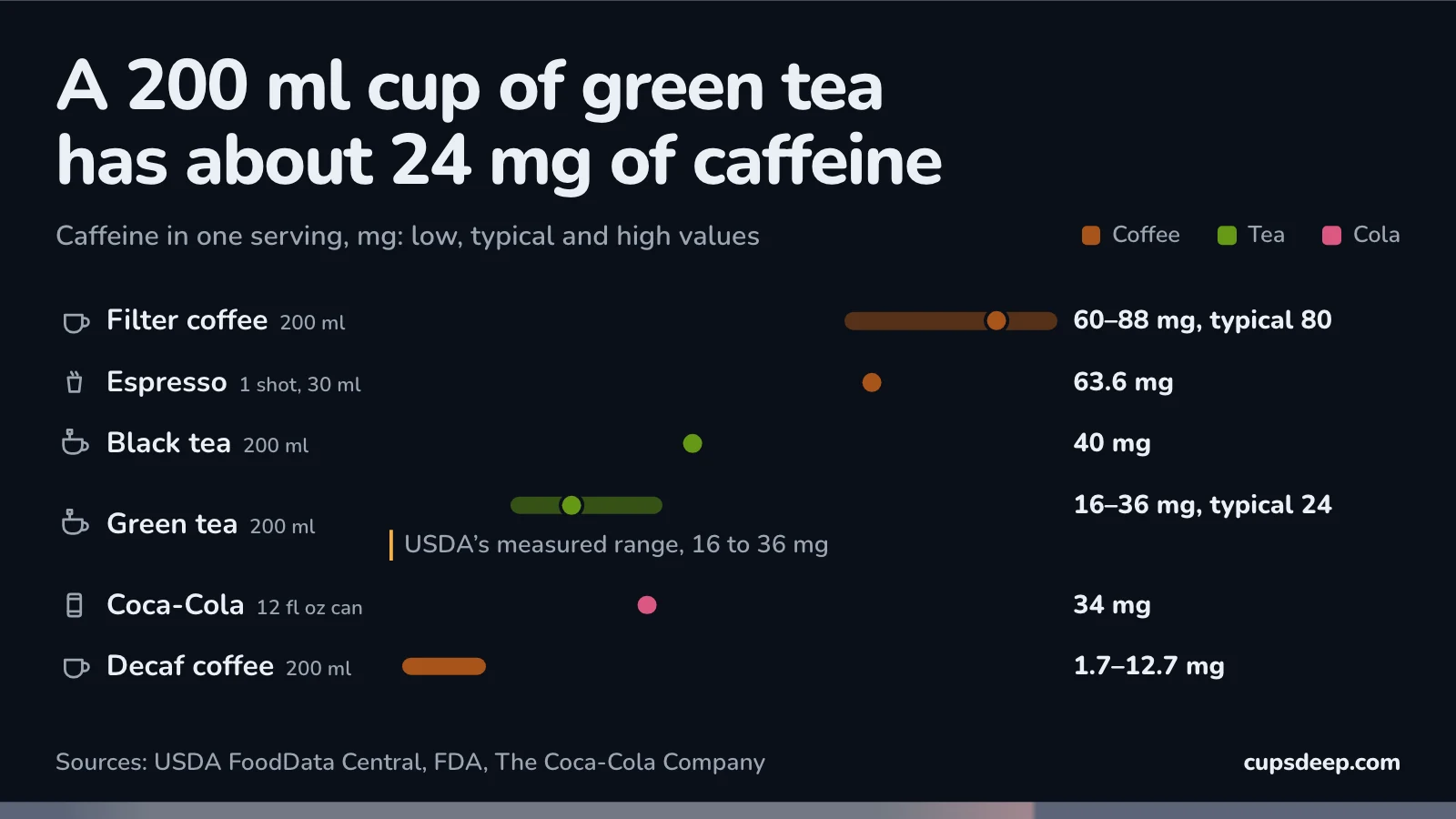
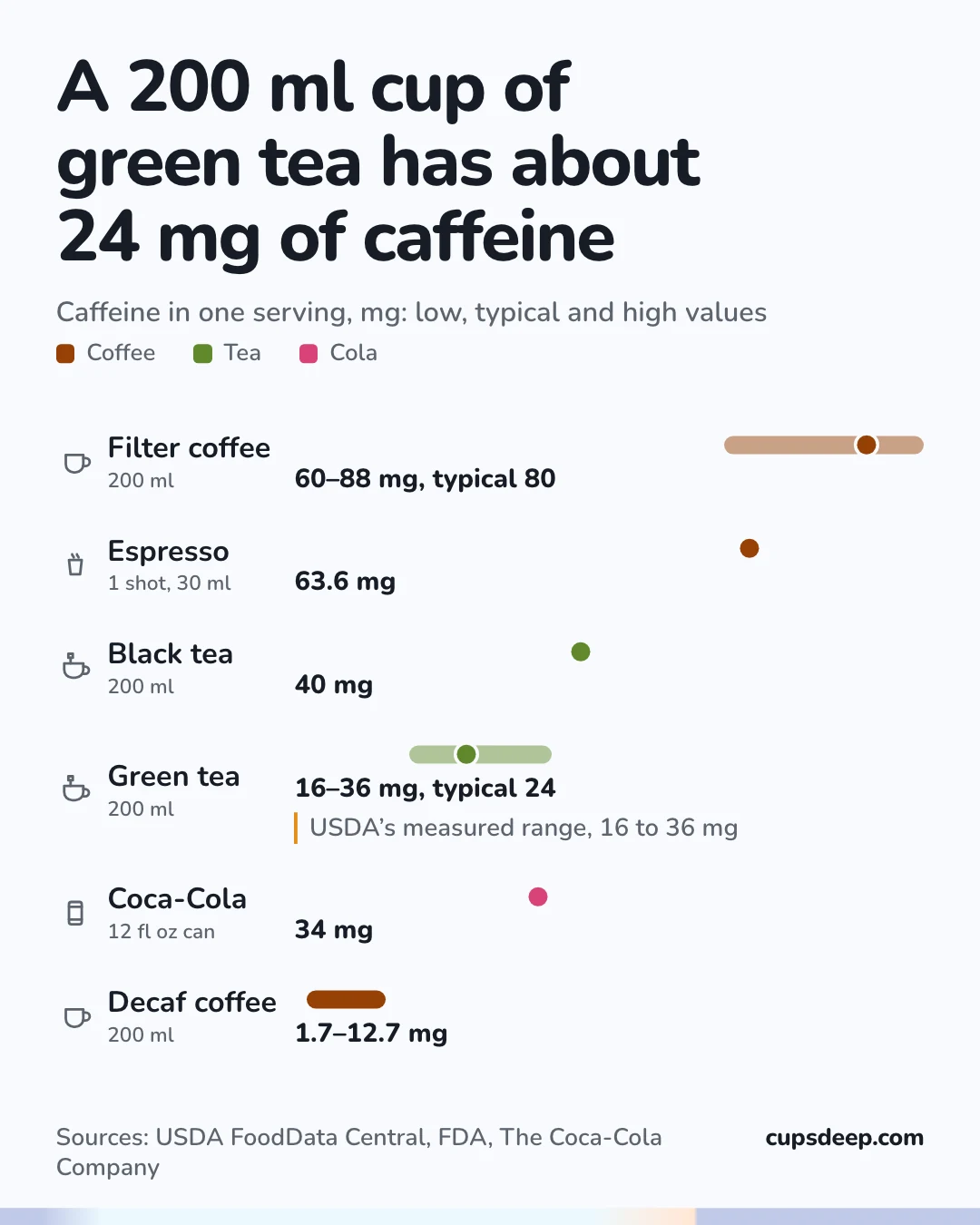
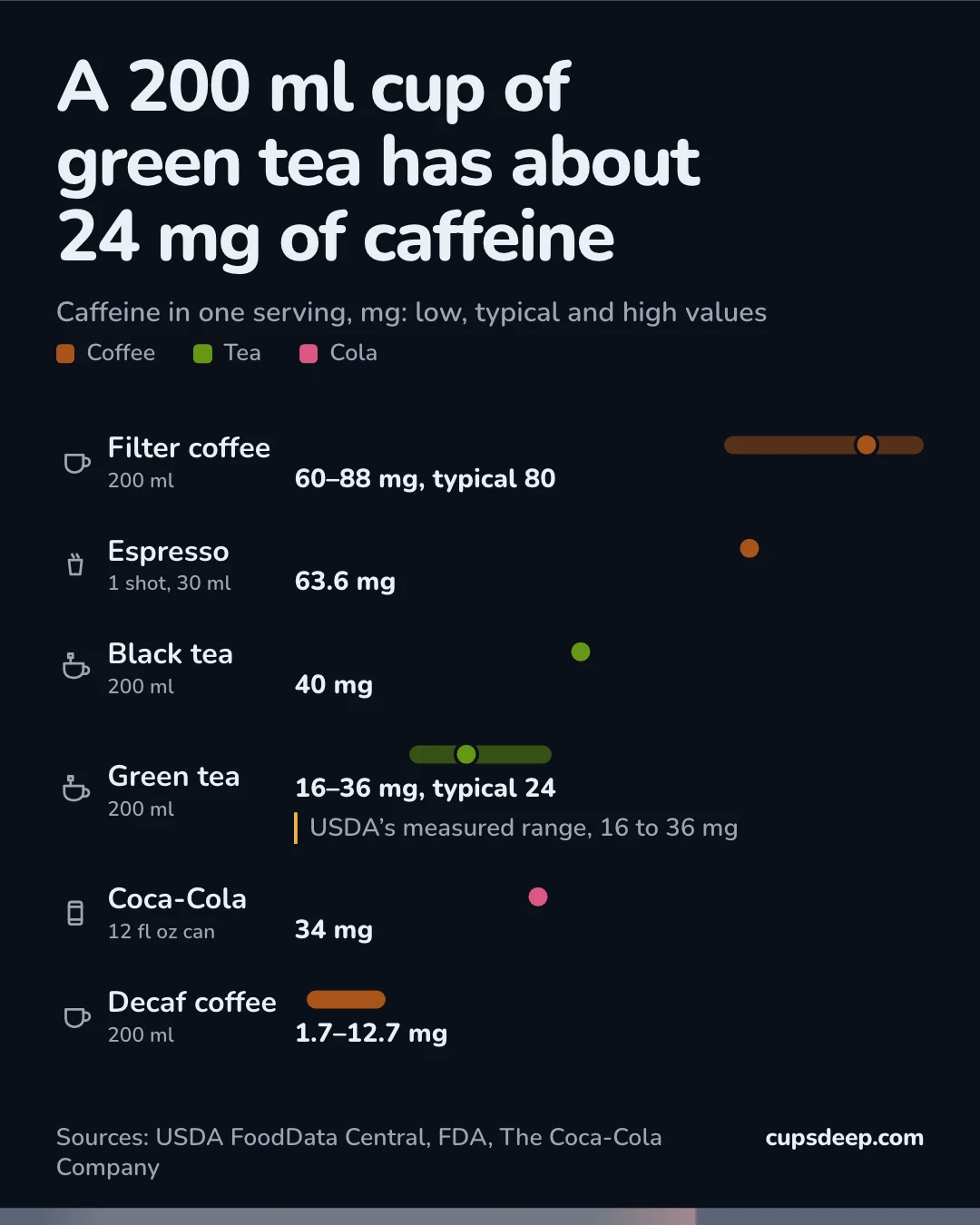
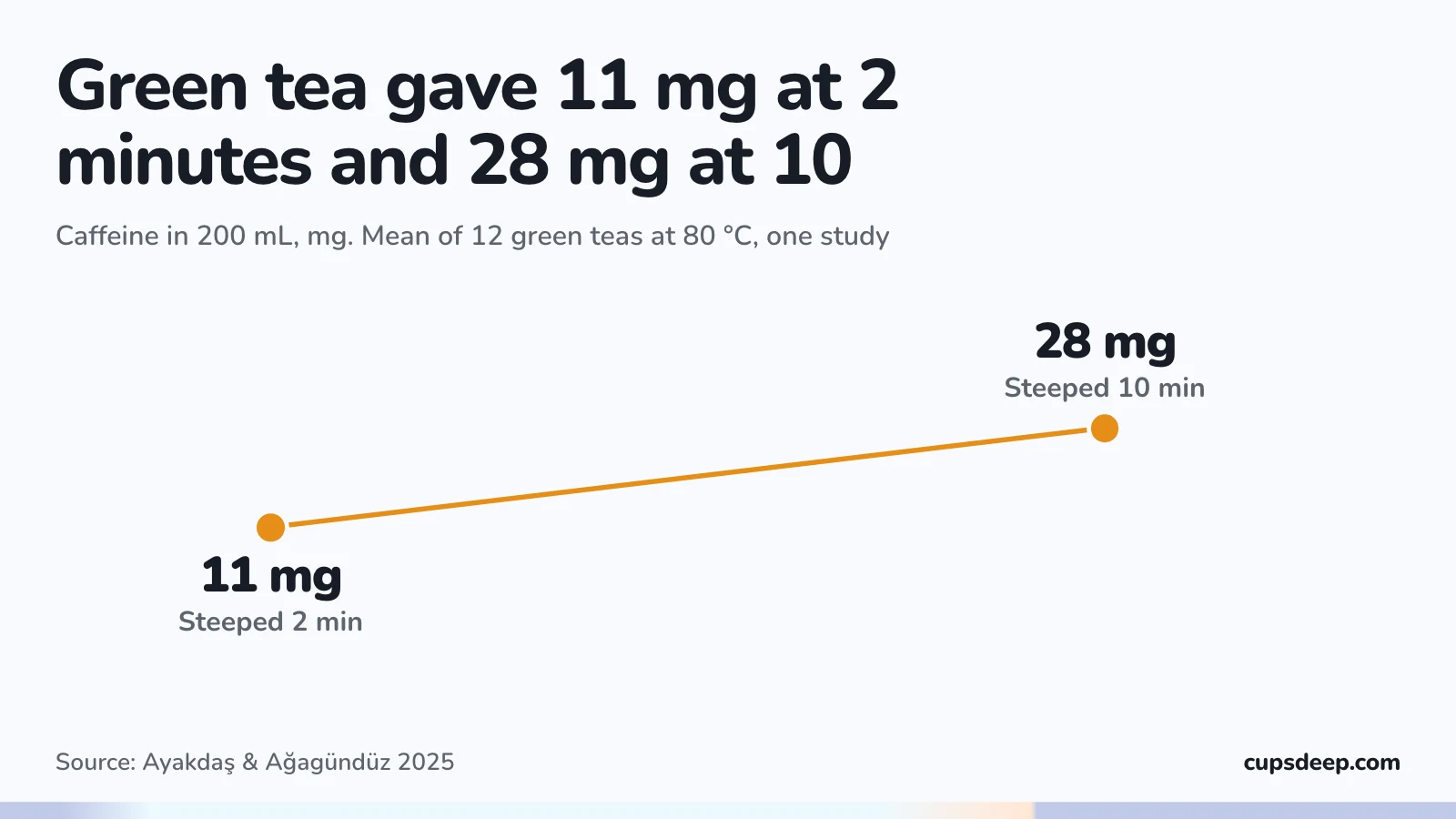
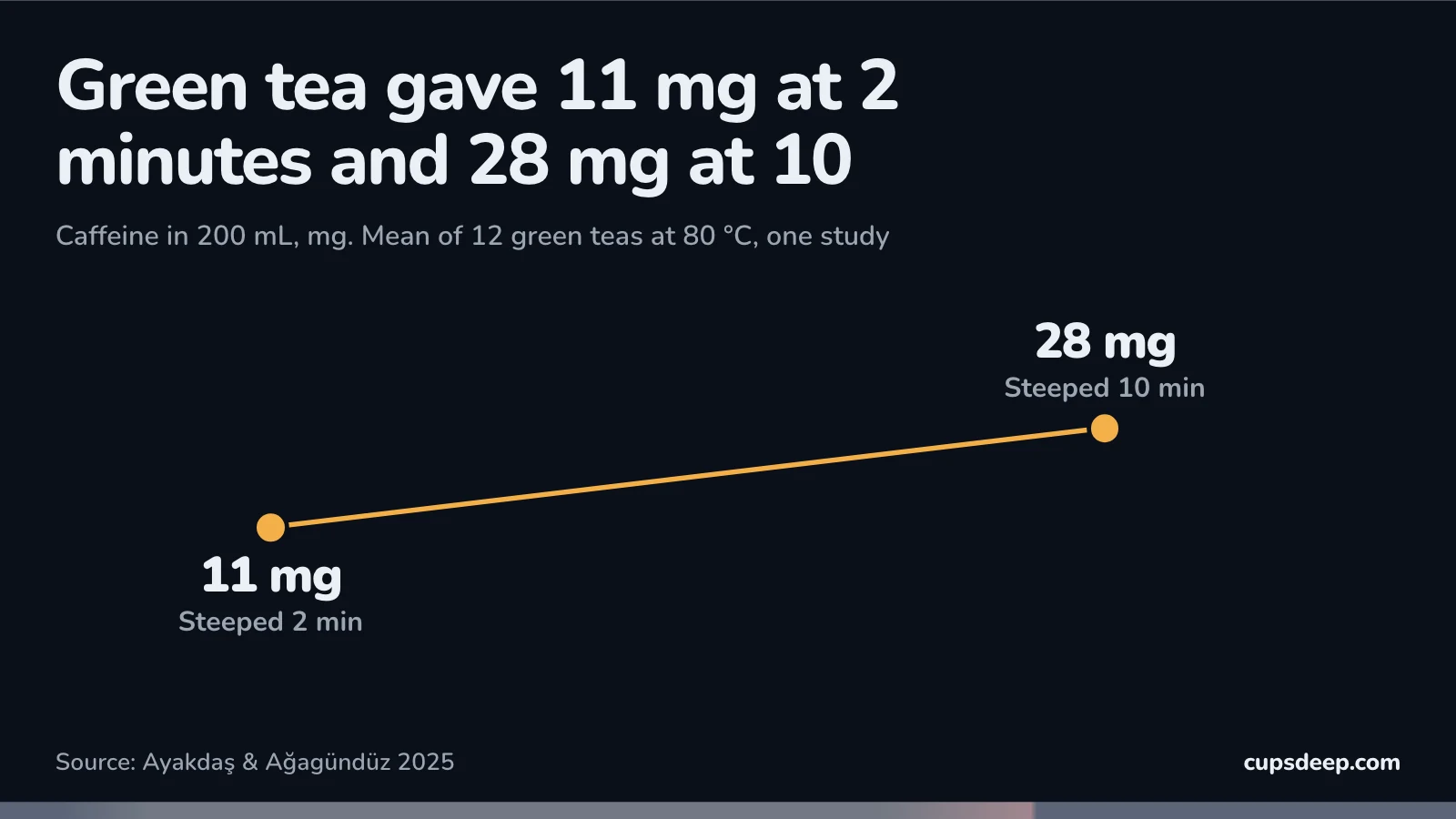
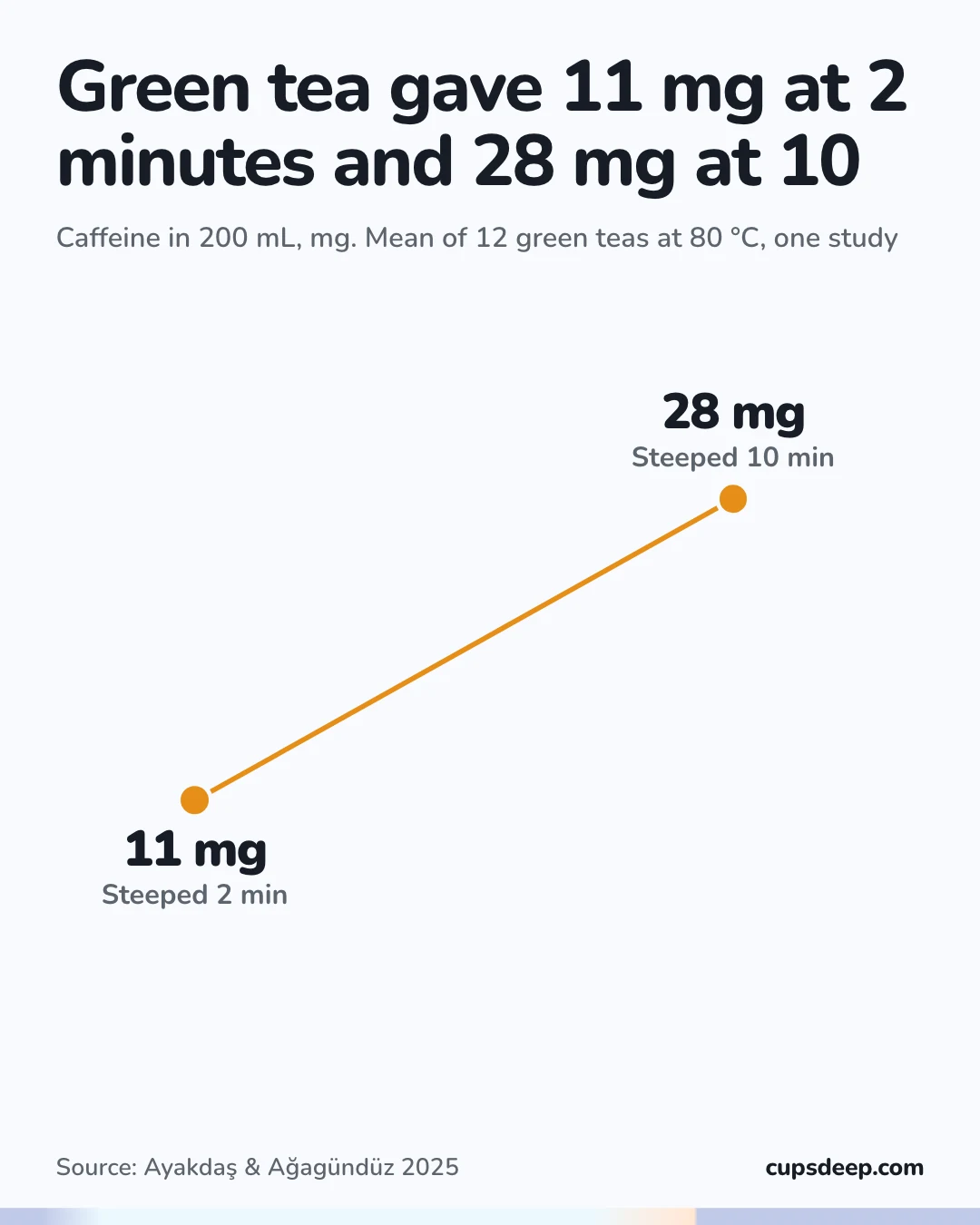
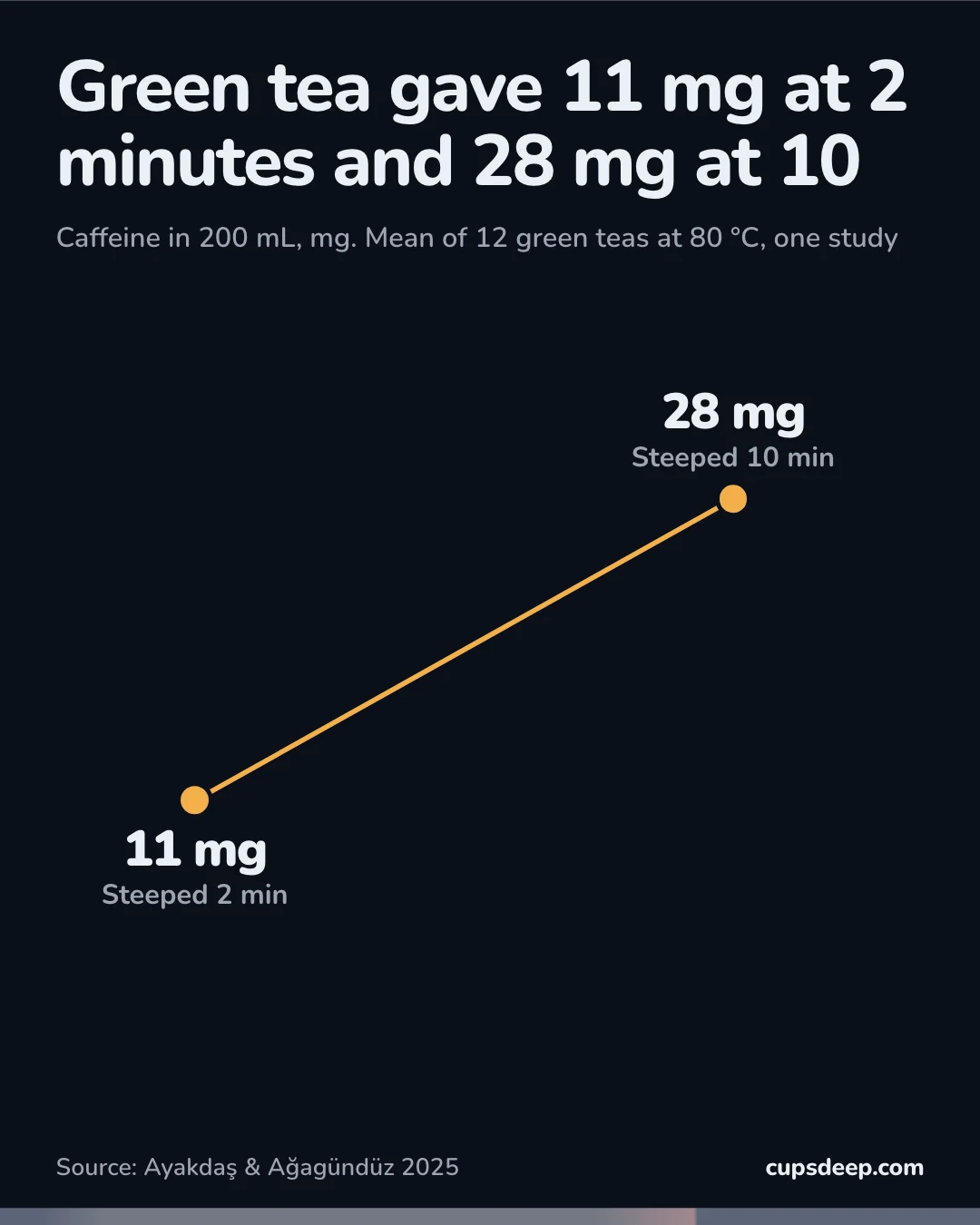
Yes. A 200 ml cup of brewed green tea has about 24 mg of caffeine by USDA’s measurements, with a range of 16–36 mg: under a third of a filter coffee at 80 mg. Steep time moves it most. In one lab, green tea went from 11 mg after two minutes to 28 mg after ten, the same as black tea brewed the same way at 80 °C.
How much caffeine is in a cup of green tea?
USDA puts brewed green tea at 12 mg per 100 g. Its survey database repeats its laboratory entry, so that is one measurement, not two. In a 200 ml cup that is about 24 mg, and the lab’s own range puts the same cup anywhere from 16 mg to 36 mg. That is the number on our drinks table.
FDA puts it differently, at 37 mg for 12 fl oz. Here are both on the same 8 fl oz cup.
Put on an 8 fl oz cup, USDA’s 12 mg per 100 g comes to about 28 mg and FDA’s 37 mg per 12 fl oz to about 25 mg. These are our sums, not figures either source states. 135
The two agencies land a few milligrams apart, which for tea is agreement. The tea makers’ own figures run wider. Twinings says its figures vary with the blend, the amount of tea in the bag, the country of origin and the steep time.
| Maker | Serving | Caffeine |
|---|---|---|
| Twinings (US) | 1 tea bag in 200 ml (7 oz) | 19 mg to 45 mg |
| Twinings (UK) | A cup made with 200 ml of water | Around 30 mg to 40 mg |
| Bigelow | 8 oz cup | 25 mg to 50 mg |
| Tazo Organic Zen | None stated | 31 mg to 45 mg, a band on Tazo’s caffeine guide |
| Lipton | A brewed cup, no size given | 45 mg |
Each maker’s own page, read on 11 November 2026. Twinings calls its figures guidance. Bigelow groups matcha in with its green teas. Tazo prints a band, not a figure, and names no serving.
Twinings US and Bigelow hold USDA’s 8 fl oz figure (28 mg) inside their ranges. Twinings UK and Tazo start above it, and Lipton’s single figure is near the top of everyone’s, for a cup Lipton does not measure out.
Does green tea have more caffeine than coffee or black tea?
Than coffee, no. A 200 ml filter coffee is about 80 mg and a single espresso 63.6 mg. Green tea is the small dose here, and the coffee article has the big ones.
Than black tea, it depends on who you ask and how long you leave the bag in. Tea pages love the line that black tea has about twice the caffeine of green. FDA’s own figures say roughly that: 37 mg for green tea and 71 mg for black, per 12 fl oz. Lipton says 45 mg against 55 mg, which is closer. Bigelow gives green 25 mg to 50 mg and black 30 mg to 60 mg, ranges that overlap from 30 mg to 50 mg.
Then one lab brewed both side by side, 2 g of tea in 200 mL of water, and timed it.
One 2025 study (Ayakdaş and Ağagündüz) steeped 2 g of tea in 200 mL of water and measured the caffeine after 2, 5 and 10 minutes. Green tea, a mean of 12 green teas bought in Istanbul in 2023 (Table 1 lists them under six brand codes, though the methods say each sample was from a different brand), gave 11 mg after 2 minutes, 23 mg after 5 and 28 mg after 10 at 80 °C, and 15, 25 and 27 mg at 100 °C. Black tea, a mean of 41, gave 14, 23 and 28 mg at 80 °C and 17, 23 and 27 mg at 100 °C. Green tea came out below black only at 2 minutes, at either temperature; the results text reports the gap at 80 °C as significant, though Table 2’s footnote gives p > 0.05 for teas compared under the same conditions. In green tea, 2 minutes gave significantly less than 5 or 10, and 5 and 10 minutes did not differ significantly. One laboratory’s set of teas. 120
| Steep | Green, 80 °C | Black, 80 °C | Green, 100 °C | Black, 100 °C |
|---|---|---|---|---|
| Two minutes | 11 mg | 14 mg | 15 mg | 17 mg |
| Five minutes | 23 mg | 23 mg | 25 mg | 23 mg |
| Ten minutes | 28 mg | 28 mg | 27 mg | 27 mg |
Means from Table 2 of Ayakdaş and Ağagündüz, 2025: 12 green teas bought in Istanbul and 41 black teas, most of them from Turkey. Each mean is printed in the paper with its spread, which is wide.
In this lab, green tea came out below black only at two minutes, by a few milligrams, and nowhere near half. Steep for five minutes or longer and green and black come out within a couple of milligrams of each other, at either temperature. One lab and one basket of teas bought in Turkey is not the last word, and FDA’s figures say otherwise. But it is a measurement, and “half” on a tea shop’s page is not.
Green tea has half the caffeine of black tea, as long as you pull the bag early and nobody checks
Does steeping green tea longer or hotter make it stronger?
Longer, yes. Hotter, not significantly in either lab. Time is the lever: in the study above, green tea at two minutes held significantly less caffeine than at five or ten, and five and ten minutes did not differ significantly. Most of what the leaf will give, it gives in the first five minutes.
Temperature is the lever tea pages talk about, and neither of two labs found a significant effect on the caffeine in green tea.
Two labs found no significant effect of water temperature on the caffeine in green tea. Ayakdaş and Ağagündüz (2025) write that brewing temperature made a statistically significant difference only in oolong tea; their green teas still went from 11 to 15 mg per 200 mL at 2 minutes between 80 and 100 °C, a rise the paper calls not statistically significant. Saklar and colleagues (2015) brewed one Turkish green tea at three temperatures: caffeine reached 10.24 mg per 100 ml at 75 °C, 11.36 mg at 85 °C and 10.34 mg at 95 °C. 298120
So the usual advice to brew green tea cooler is about taste, and it is good advice for taste. In these labs it did not change the caffeine significantly. Pulling the bag early did.
The bag itself may matter too. At 2 g per 200 mL, the six bagged green teas in that 2025 study gave more caffeine than the six loose-leaf ones, at least in cooler water. They were different products, and the bags were dipped several times before steeping.
| Water and time | Cup bag | Loose leaf |
|---|---|---|
| 80 °C, five minutes | 28 mg | 17 mg |
| 80 °C, ten minutes | 36 mg | 19 mg |
| 100 °C, five minutes | 28 mg | 20 mg |
| 100 °C, ten minutes | 33 mg | 22 mg |
Means from Table 3 of Ayakdaş and Ağagündüz, 2025. The table marks the two gaps at 80 °C as statistically significant and the two at 100 °C as not. The same paper’s discussion says the serving type made no significant difference in green tea. We cite the table and flag the contradiction; we could not resolve it.
The paper lists leaf particle size and the bag itself among the possible reasons. Take the direction with some salt: it is one lab, the bagged and loose teas were different teas handled differently, the spread in each mean is wide, and the authors disagree with their own table.
And the second cup from the same leaves is not decaf. A 2025 study brewed 17 loose-leaf green teas twice each.
A 2025 study brewed 17 loose-leaf green teas twice each, as their labels instructed. The second infusion held a median 83% of the first infusion’s caffeine, and never less than 62%. Theanine fell further, to a median 58%. 299
The second steep is a free refill, and my sleep was not told
Which green tea has the most caffeine, and which has the least?
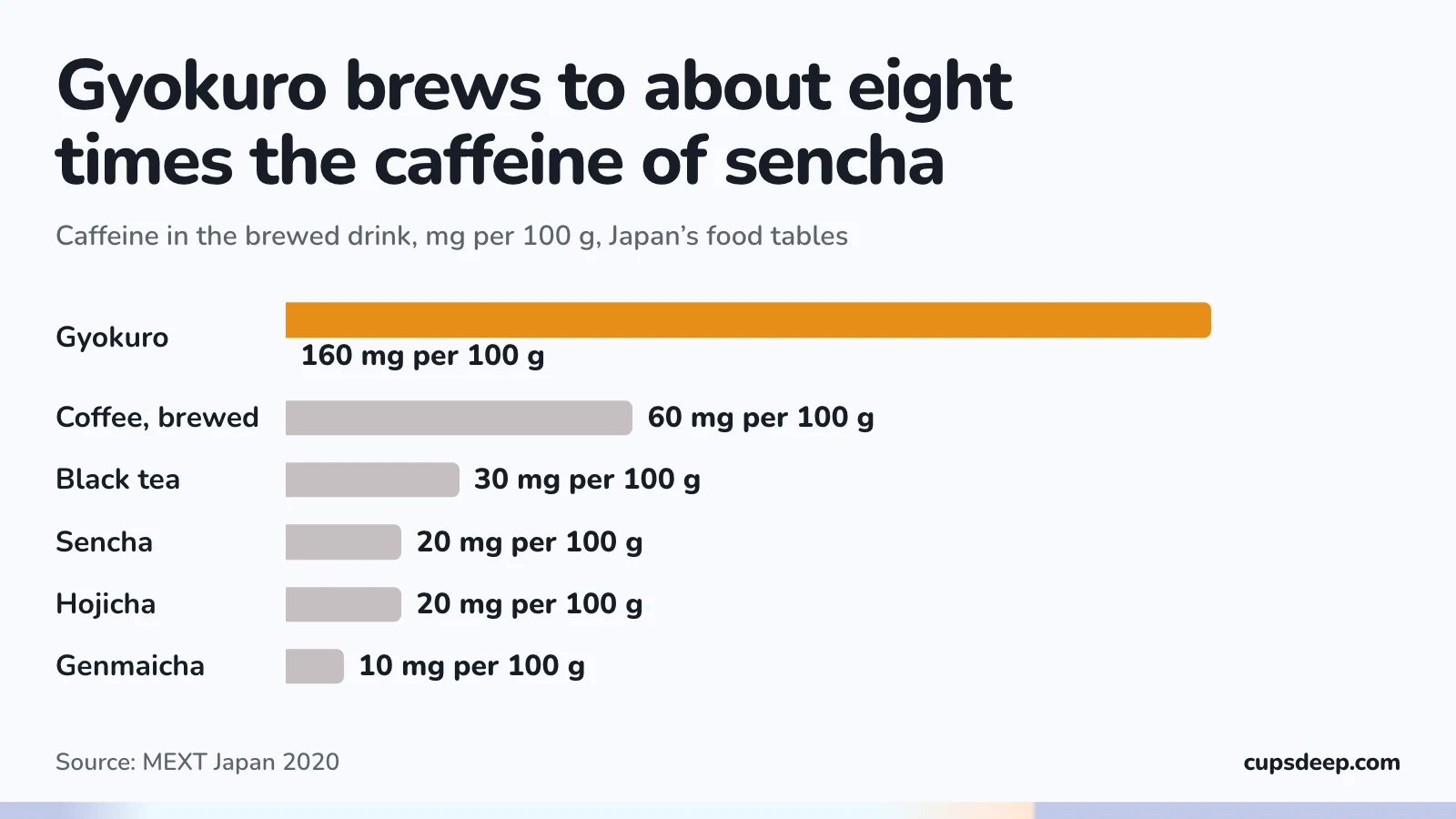
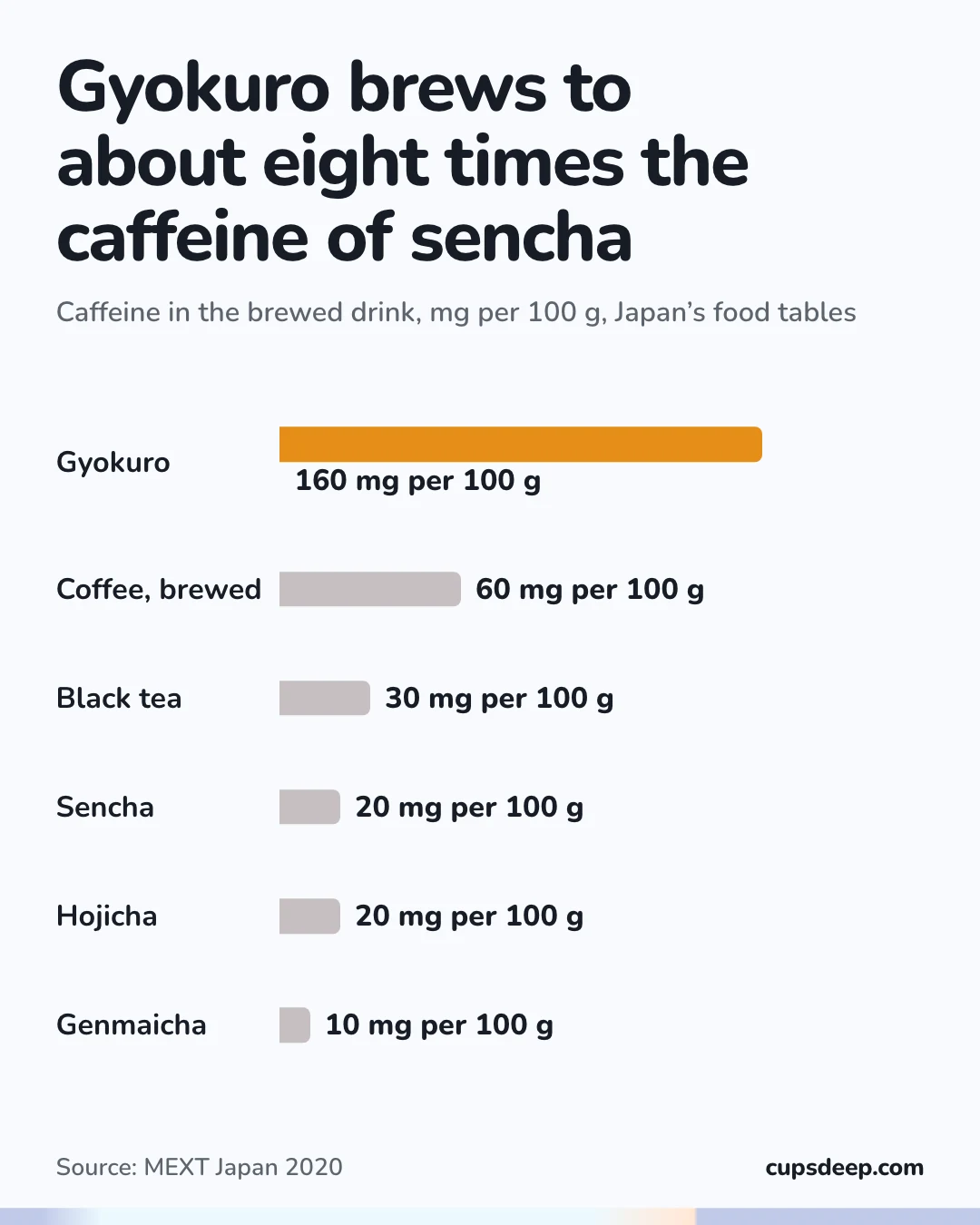
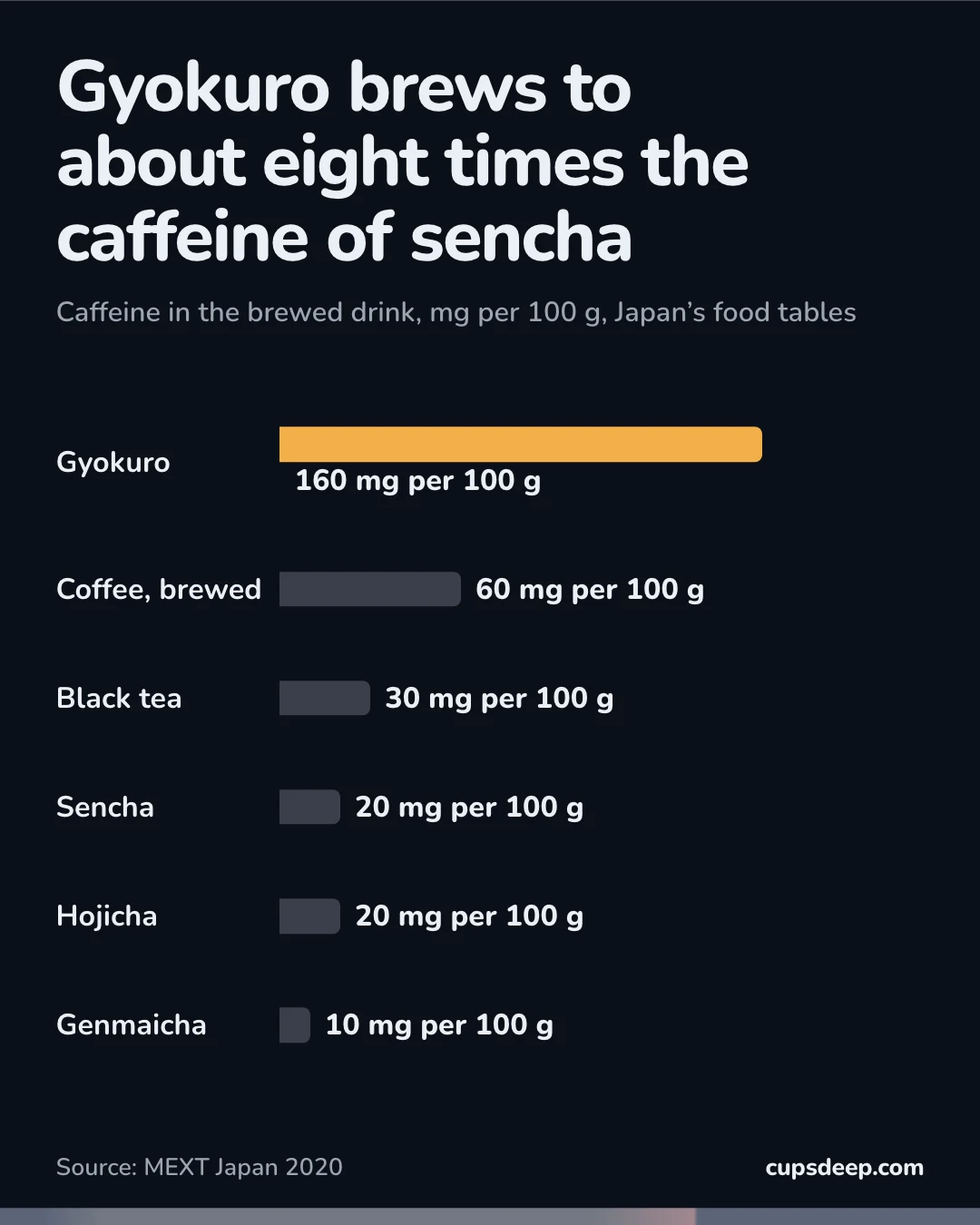
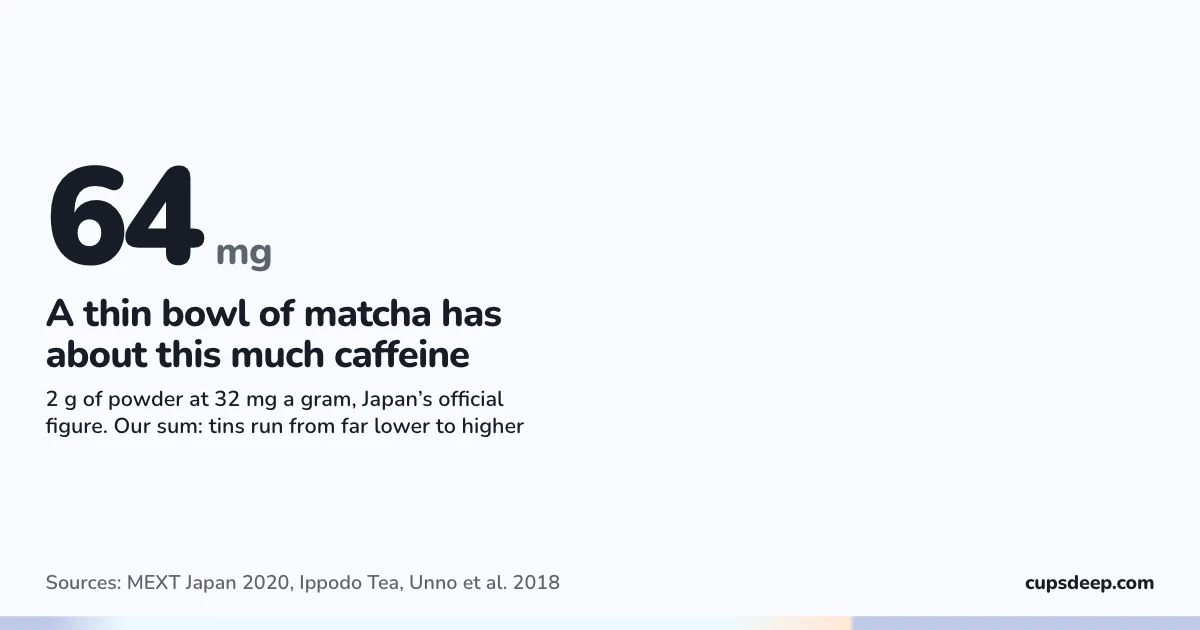
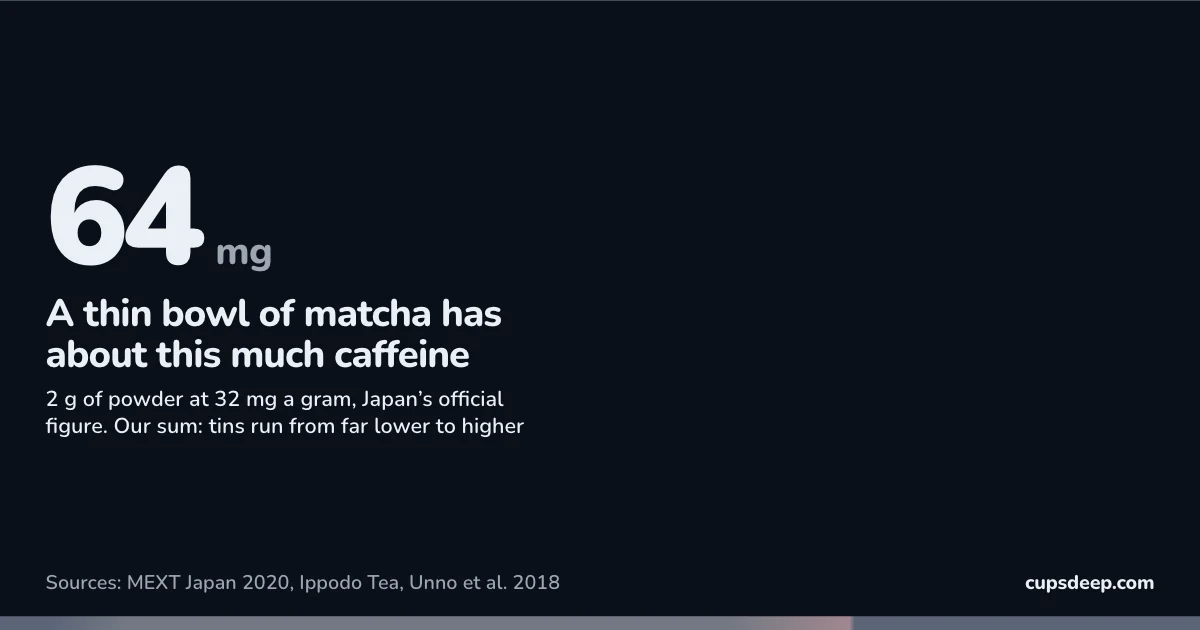
Matcha and gyokuro sit at the top; bancha, genmaicha and kamairicha at the bottom. Japan’s oolong row is here too; oolong and white tea have their own article, and so does the South American cup, yerba mate. Matcha is its own case, because you drink the whole leaf: a thin bowl is about 64 mg, as the matcha article works out. For brewed teas, Japan’s official food tables brew each one by a recipe they state.

| Drink | Caffeine | How the tables brew it |
|---|---|---|
| Gyokuro | 160 mg per 100 g | 10 g leaf, 60 mL water at 60 °C, 2.5 min |
| Coffee, brewed | 60 mg per 100 g | 10 g ground coffee, 150 mL hot water |
| Black tea | 30 mg per 100 g | 5 g leaf, 360 mL boiling water, 1.5 to 4 min |
| Sencha | 20 mg per 100 g | 10 g leaf, 430 mL water at 90 °C, 1 min |
| Hojicha | 20 mg per 100 g | 15 g leaf, 650 mL water at 90 °C, 0.5 min |
| Oolong | 20 mg per 100 g | 15 g leaf, 650 mL water at 90 °C, 0.5 min |
| Genmaicha | 10 mg per 100 g | 15 g leaf, 650 mL water at 90 °C, 0.5 min |
| Bancha | 10 mg per 100 g | 15 g leaf, 650 mL water at 90 °C, 0.5 min |
| Kamairicha | 10 mg per 100 g | 10 g leaf, 430 mL water at 90 °C, 1 min |
Standard Tables of Food Composition in Japan 2020, eighth revised edition. A hundred grams of a drink is close to a hundred milliliters. The tables give no cup size.
Japan’s Standard Tables of Food Composition (2020) give gyokuro leaf 3.5 g of caffeine per 100 g (35 mg per gram) and brewed gyokuro 0.16 g per 100 g, brewed with 10 g of leaf in 60 mL of water at 60 °C for 2.5 minutes. Sencha is brewed with 10 g of leaf in 430 mL at 90 °C for 1 minute. 90
Gyokuro leaf is strong to begin with, at 35 mg/g against sencha leaf’s 23 mg/g, and then it is brewed like an espresso of tea: a lot of leaf in a little water. By our sums, the brew is about 8 times as strong as sencha and 2.7 times as strong as the tables’ coffee, weight for weight, and much of that is the recipe, at 7.2 times as much leaf per milliliter as sencha.
I switched to green tea to cut down. Then I found gyokuro. Cutting down is going great
At the other end, genmaicha is cut with toasted rice, and the tables brew it and bancha for seconds in a lot of water. Genmaicha and bancha, at 10 mg per 100 g, are half of sencha by the tables. Hojicha, roasted, measures the same as sencha, and Ito En’s bottled hojicha states the same 60 mg as its green teas. If you want green tea at night, genmaicha and bancha are the honest candidates. They still have caffeine.
How much caffeine is in bottled green tea?
Anywhere from a few milligrams to more than a can of Red Bull, and the strength varies more than the size: from 0.7 mg per fl oz to 5.9 mg per fl oz, by our sums. These are the green teas US shoppers can find, at the caffeine each maker states. Fermented into kombucha, tea keeps some of its caffeine.
| Drink | Serving | Caffeine | Per fl oz, our sum |
|---|---|---|---|
| Ito En Oi Ocha Bold | 16.9 fl oz bottle | 100 mg | 5.9 mg per fl oz |
| Ito En Oi Ocha Unsweetened | 16.9 fl oz bottle | 60 mg | 3.6 mg per fl oz |
| Ito En Organic Green Tea | 16.9 fl oz bottle | 60 mg | 3.6 mg per fl oz |
| Ito En Hojicha | 16.9 fl oz bottle | 60 mg | 3.6 mg per fl oz |
| Ito En Matcha Genmaicha | 16.9 fl oz bottle | 60 mg | 3.6 mg per fl oz |
| Starbucks Iced Green Tea | Grande, 16 fl oz | 25 mg to 30 mg | 1.6 mg per fl oz to 1.9 mg per fl oz |
| Starbucks Iced Green Tea Lemonade | Grande, 16 fl oz | 25 mg to 30 mg | 1.6 mg per fl oz to 1.9 mg per fl oz |
| Starbucks Emperor’s Clouds & Mist | Grande, 16 fl oz, hot | 16 mg to 25 mg | 1 mg per fl oz to 1.6 mg per fl oz |
| AriZona Green Tea | 12 oz | 8 mg to 10 mg | 0.7 mg per fl oz to 0.8 mg per fl oz |
| For contrast: Starbucks Royal English Breakfast (black) | Grande, 16 fl oz, hot | 40 mg | 2.5 mg per fl oz |
Each maker’s own page, read on 11 November 2026. Ito En and Starbucks call their figures approximate. AriZona states its figure per 12 oz and does not say which can or bottle. Per fluid ounce is our arithmetic. Pure Leaf, Snapple and Gold Peak are missing because we found no maker page with a figure.
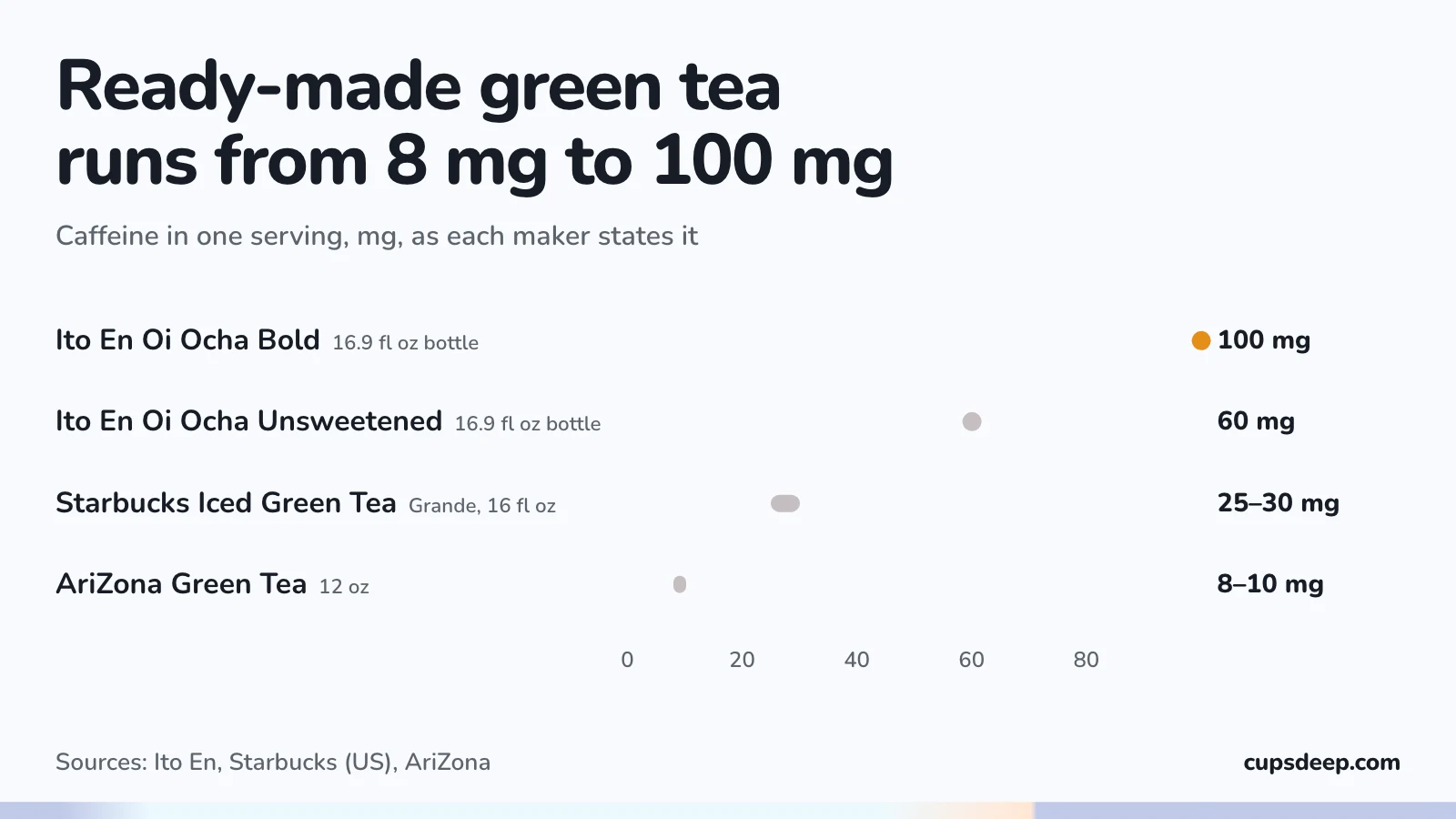
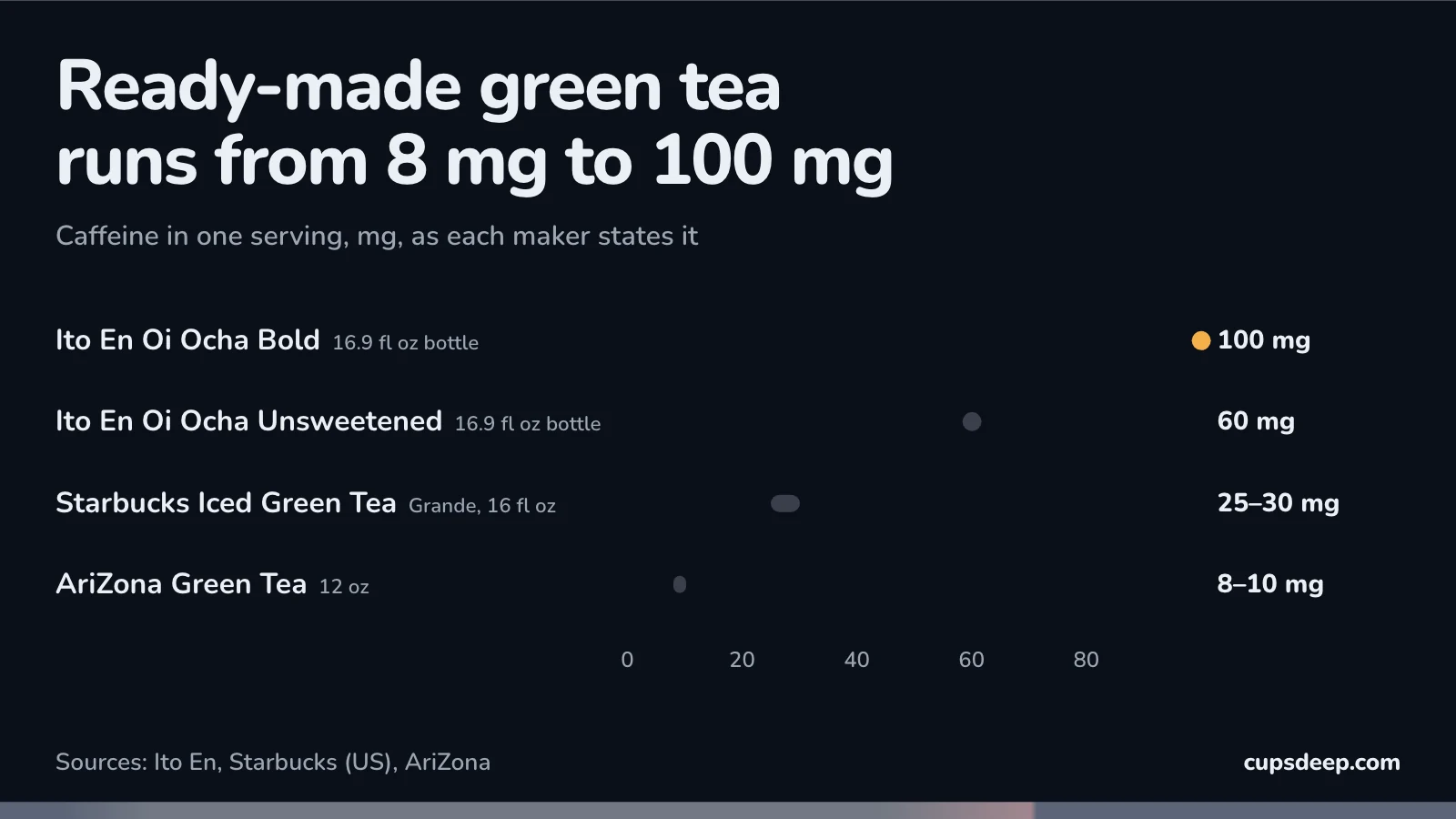
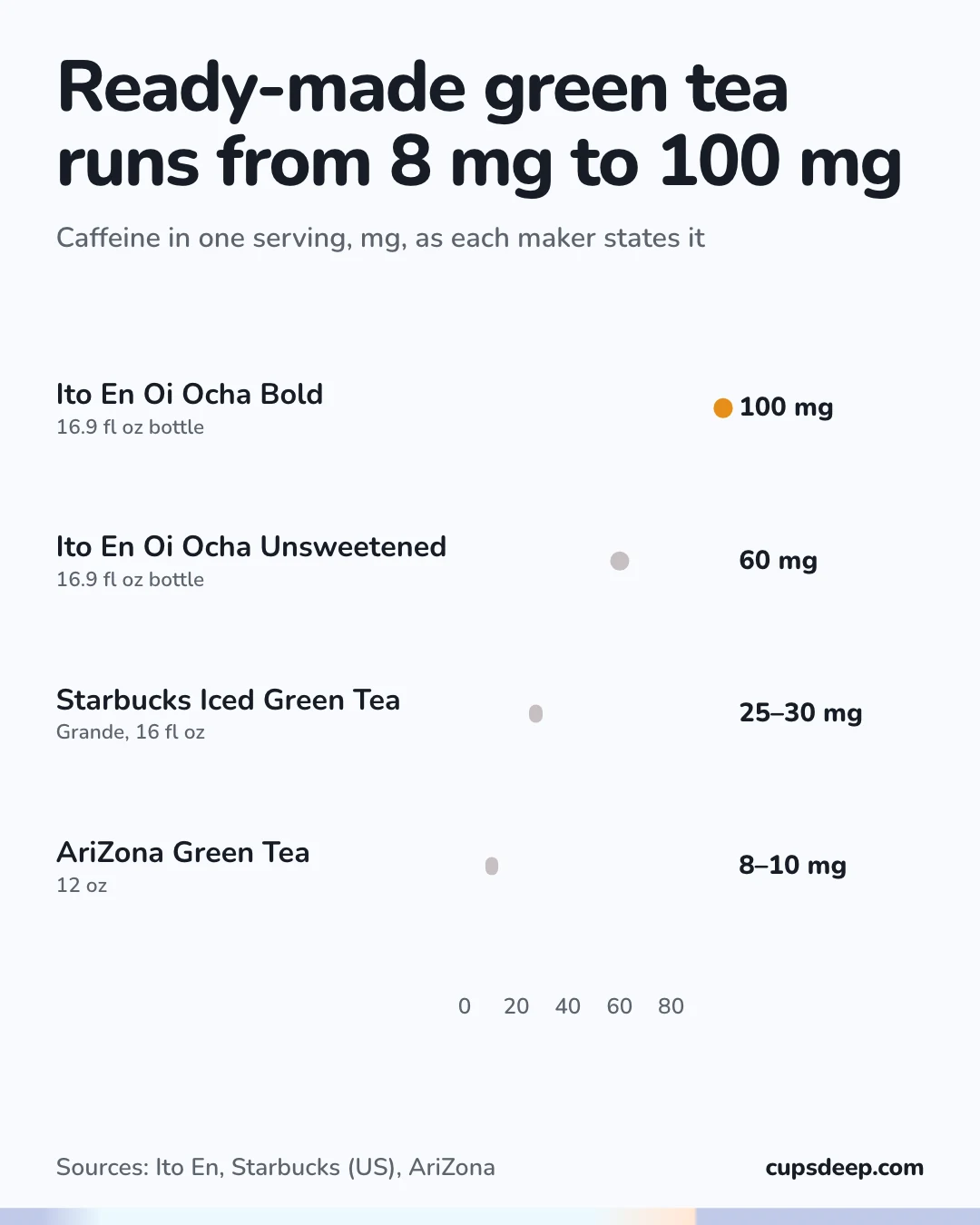
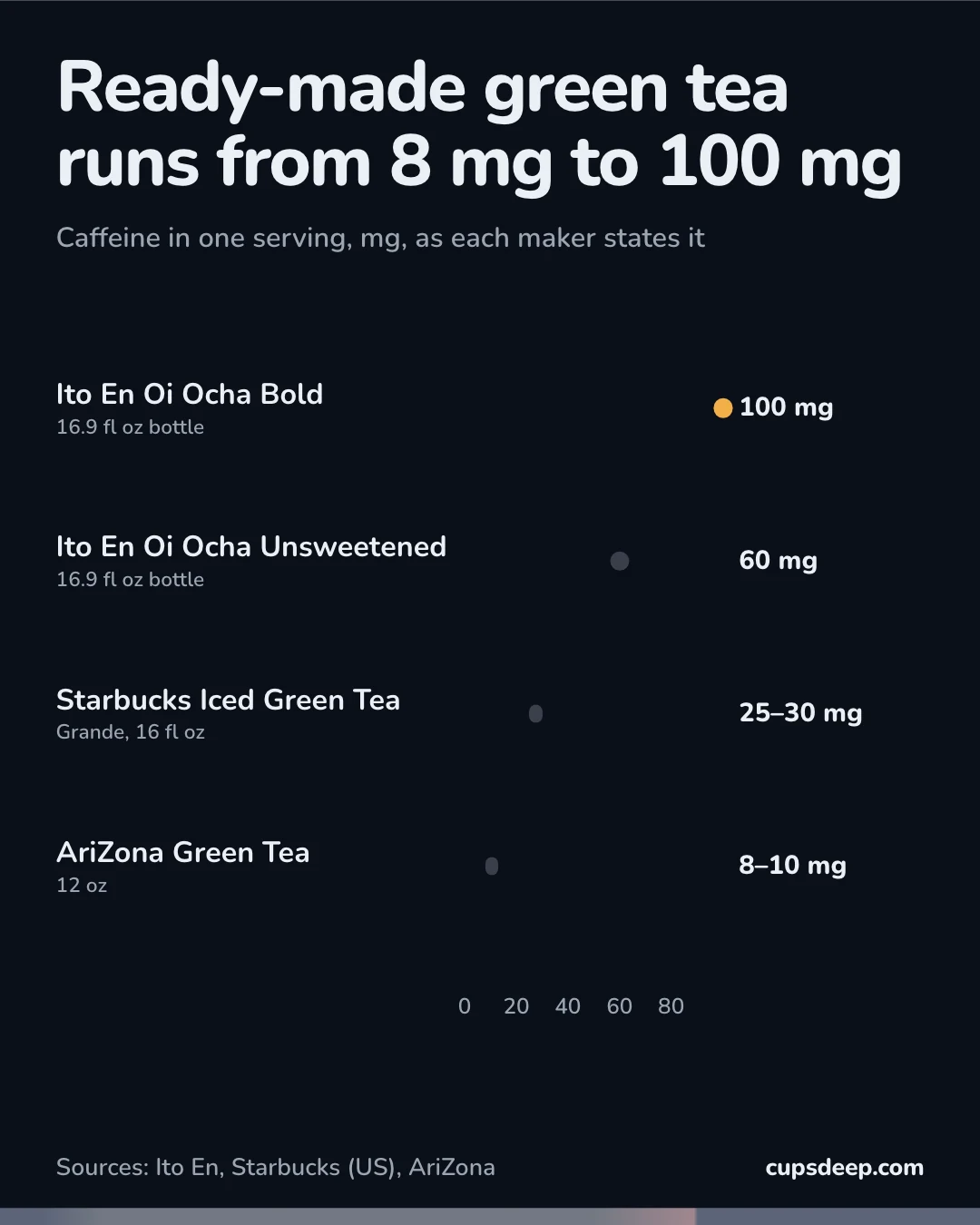
Oi Ocha Bold is the outlier: 100 mg in a bottle, more than an 8.4 fl oz can of Red Bull at 80 mg. The ordinary unsweetened bottles sit at 60 mg, more than two 200 ml cups of brewed green tea in one go. AriZona, per fluid ounce, is the weakest tea on the list.
USDA’s survey food database gives bottled iced green tea 5 mg of caffeine per 100 g, the unsweetened version 12 mg and the diet version 4 mg. The 5 mg entry (2710533) is the sweetened kind: its only ingredient is SR 14206, “Beverages, tea, green, ready-to-drink, sweetened”, and it carries 5.32 g of sugars and 27 kcal per 100 g. The unsweetened entry’s ingredient is SR 14261. 317318319
At USDA’s own weight for a 16.9 fl oz can or bottle, its figures give unsweetened bottled green tea about 61 mg and the sweetened kind about 26 mg. Our sums. 318317
USDA’s unsweetened figure, scaled to a bottle by our sum, lands within a milligram of what Ito En states. Sweetened bottles, by USDA’s average, carry less than half that. USDA does not say why.
Does decaf green tea or green tea extract have caffeine?
Decaf green tea has a little. USDA lists it at zero, but that zero is imputed, not measured. A lab that measured decaf teas put them under a ceiling, not at zero, and the makers state a few milligrams.
USDA lists decaffeinated brewed green tea at 0 mg of caffeine per 100 g, in its older reference table and in its survey food table. The SR Legacy value is marked “Other procedure used from imputing” (not analytical), and the survey entry 2710491 takes its value from that same SR entry (14260). 314316
In a 2008 lab study of brewed teas, the decaffeinated teas held less than 12 mg of caffeine per 6 or 8 oz serving, and no caffeine was detected in the herbal teas. The 12 mg is an upper bound: the abstract does not say caffeine was found in every decaffeinated tea. Only the abstract was read. 89
Bigelow puts its decaffeinated teas at 1 mg to 8 mg a cup. That is a small dose. It is not nothing, for the same reason decaf coffee is not nothing.
Green tea supplements are the wild card. USDA bought 32 of them and measured. Most are sold for the catechins; two in the sample had caffeine added, and most labels gave no caffeine figure at all.
USDA measured 32 green tea dietary supplements, two lots each, in three labs. Caffeine ran from 0.1 to 130 mg per serving, with a median of 11 mg, and from 0.25 to 130 mg per day at the label’s dose, median 22 mg. The 130 mg product (GTP24) lists added caffeine and claims 120 mg on its label; two products in the sample had caffeine added. Among products with no caffeine figure on the label, the highest was 32.9 mg a serving (GTP08). Eight products labeled decaffeinated, or below 4 mg, averaged 2.9 mg a day (0.4 to 12). Of the 9 products that claimed a caffeine figure on the label, results ran from 84% below to 70% above it. 320
Read the top of that range again, because it is not what it looks like. One product had 130 mg in a serving, more than a 200 ml filter coffee, but its label claimed 120 mg and listed added caffeine. Among products whose labels gave no caffeine figure, the highest was 32.9 mg a serving. And the products that did state a figure missed it by up to 84% one way and 70% the other.
Will green tea keep you awake?
One cup, probably not much. It is caffeine and it behaves like caffeine: it peaks 30 minutes to 120 minutes after you drink it, and half of it is still in you about 4 hours later, longer for some people.
A single 100 mg dose of caffeine, about 1.4 mg/kg body weight for a 70 kg adult, may increase the time it takes to fall asleep and reduce sleep duration in some adults, particularly when taken close to bedtime. 2223
A single cup is well under that dose. The trap is the green tea habit: a cup at breakfast, one mid-morning, one in the afternoon slump and one after dinner because it feels virtuous. Each is small, and they stack. Tea also brings L-theanine, the amino acid tea tins often credit with calm; one lab found 12–17.4 mg of it in a 200 mL green tea, alongside 11.4–27.3 mg of caffeine. Whether that dose of theanine takes the edge off caffeine is not settled; the matcha article has the trials we found.
For the whole day, EFSA’s line is 400 mg/day for healthy adults and 200 mg/day in pregnancy, from all sources. By USDA’s cup, that adult line is a lot of green tea. The evening cup is the one that counts, and the method page shows how the model behind the instrument handles it.
Questions people ask
Does green tea have caffeine?
Yes. USDA measured brewed green tea at about 24 mg in a 200 ml cup, with a range of 16–36 mg. FDA gives 37 mg per 12 fl oz. Decaffeinated green tea is close to none, and even that is not always zero.
Does green tea have more caffeine than coffee?
No. A 200 ml filter coffee is about 80 mg and the same cup of green tea about 24 mg. Gyokuro, brewed strong and small, is the exception per sip: Japan’s food tables put it at 160 mg per 100 g against 60 mg per 100 g for brewed coffee.
How much caffeine is in a green tea bag?
Twinings US states 19 mg to 45 mg for one bag in 200 ml, and Bigelow 25 mg to 50 mg for an 8 oz cup. In one lab, 2 g of bagged green tea in 80 °C water gave 28 mg after five minutes and 36 mg after ten: most of it comes in the first five minutes, but the bags kept giving more.
Does green tea have less caffeine than black tea?
Sometimes. FDA gives green tea 37 mg and black 71 mg per 12 fl oz. But in one lab that brewed both the same way, green tea came within a couple of milligrams of black tea once both steeped five minutes or more: 23 mg against 23 mg per 200 mL at five minutes.
Does decaf green tea have caffeine?
A little. USDA lists decaffeinated green tea at 0 mg per 100 g, an imputed figure, but a lab study found decaffeinated teas held under 12 mg a serving, and Bigelow states 1 mg to 8 mg a cup for its decaf teas.
Sources
Every number above links to the place it came from. How the numbers are chosen and checked is on the method page; the drink table is at /drinks. Written with AI agents, as the whole site is. A model of a typical body, not advice for pregnancy, illness or medication.
- What is caffeine?
- Coca-Cola (US), 12 fluid ounce can: SmartLabel nutrition facts
- Spilling the Beans: How Much Caffeine is Too Much?
- How much caffeine is in a can of Red Bull Energy Drink?
- Beverages, coffee, brewed, prepared with tap water
- Beverages, coffee, brewed, espresso, restaurant-prepared
- Beverages, tea, green, brewed, regular
- Beverages, tea, black, brewed, prepared with tap water
- Scientific Opinion on the safety of caffeine
- EFSA explains risk assessment: Caffeine
- Caffeine content of brewed teas (Chin, Merves, Goldberger, Sampson-Cone, Cone; J Anal Toxicol 2008;32(8):702-4)
- Standard Tables of Food Composition in Japan 2020 (Eighth Revised Edition), main table
- FAQs: How much caffeine does tea contain?
- Ayakdaş G, Ağagündüz D. Determination of L-Theanine and Caffeine Contents in Tea Infusions with Different Fermentation Degrees and Brewing Conditions Using the Chromatographic Method. Foods 2025;14(13):2313. doi:10.3390/foods14132313
- Saklar S, Ertas E, Ozdemir IS, Karadeniz B. Effects of different brewing conditions on catechin content and sensory acceptance in Turkish green tea infusions. J Food Sci Technol 2015;52(10):6639-6646
- Zimmermann BF, Drees A. Let’s have another cup of green tea! Heliyon 2025;11(4):e42651. doi:10.1016/j.heliyon.2025.e42651
- Caffeine in green tea
- Caffeine in tea (updated 29 April 2026)
- Organic Zen (green tea bags, product page data)
- FAQs
- Oi Ocha Unsweetened Green Tea
- Oi Ocha Bold Green Tea
- Organic Green Tea
- Hojicha Roasted Green Tea
- Matcha Genmaicha Green Tea
- FAQs
- Iced Green Tea, nutrition
- Iced Green Tea Lemonade, nutrition
- Emperor’s Clouds & Mist, nutrition
- Royal English Breakfast Tea, nutrition
- Beverages, tea, green, brewed, decaffeinated (SR Legacy 171910)
- Tea, hot, leaf, green (FNDDS 2021-2023, food code 92303010)
- Tea, hot, leaf, green, decaffeinated (FNDDS 2021-2023, food code 92303100)
- Tea, iced, bottled, green (FNDDS 2021-2023, food code 92309500)
- Tea, iced, bottled, green, unsweetened (FNDDS 2021-2023, food code 92309520)
- Tea, iced, bottled, green, diet (FNDDS 2021-2023, food code 92309510)
- Green Tea Dietary Supplement Pilot Study, Research Summary (Andrews et al., August 2017, modified May 2018)
Keep reading
Tea and mate
Does matcha have caffeine?
Yes. Matcha powder is about 32 mg/g: 64 mg in a thin 2 g bowl, 128 mg in a thick one. A Starbucks grande matcha latte is 65 mg.

Tea and mate
Does chai have caffeine?
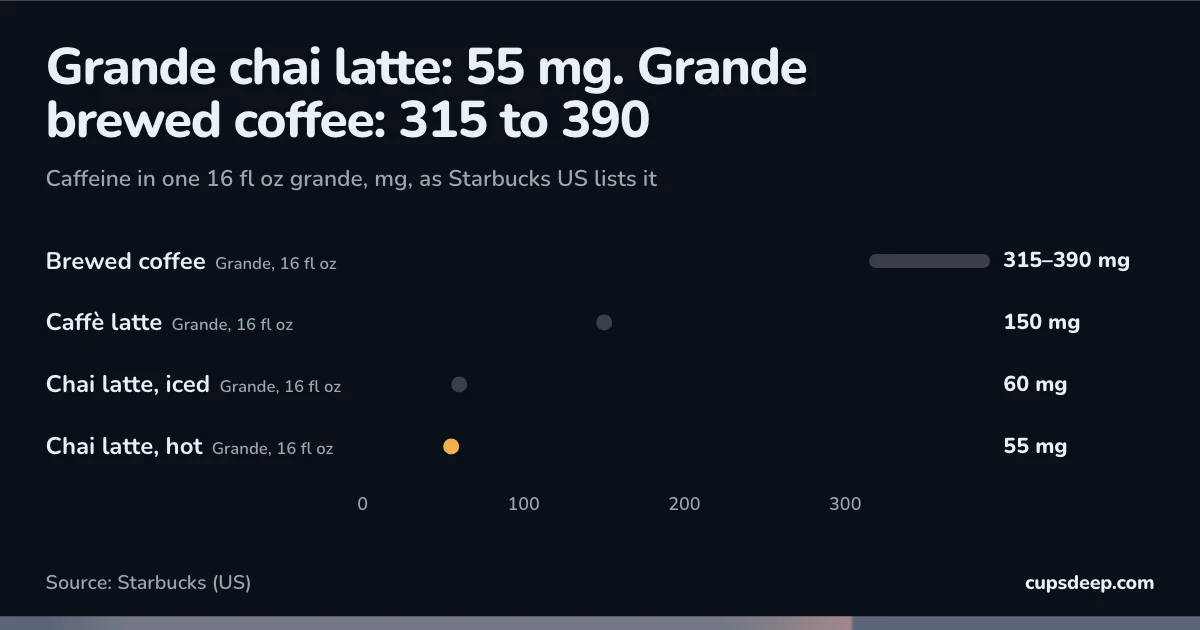
Yes. Chai is spiced black tea. A Starbucks grande chai latte lists 55 mg, a brewed cup is about 40 mg, and rooibos chai has none.
Body and sleep
How long does caffeine stay in your system?
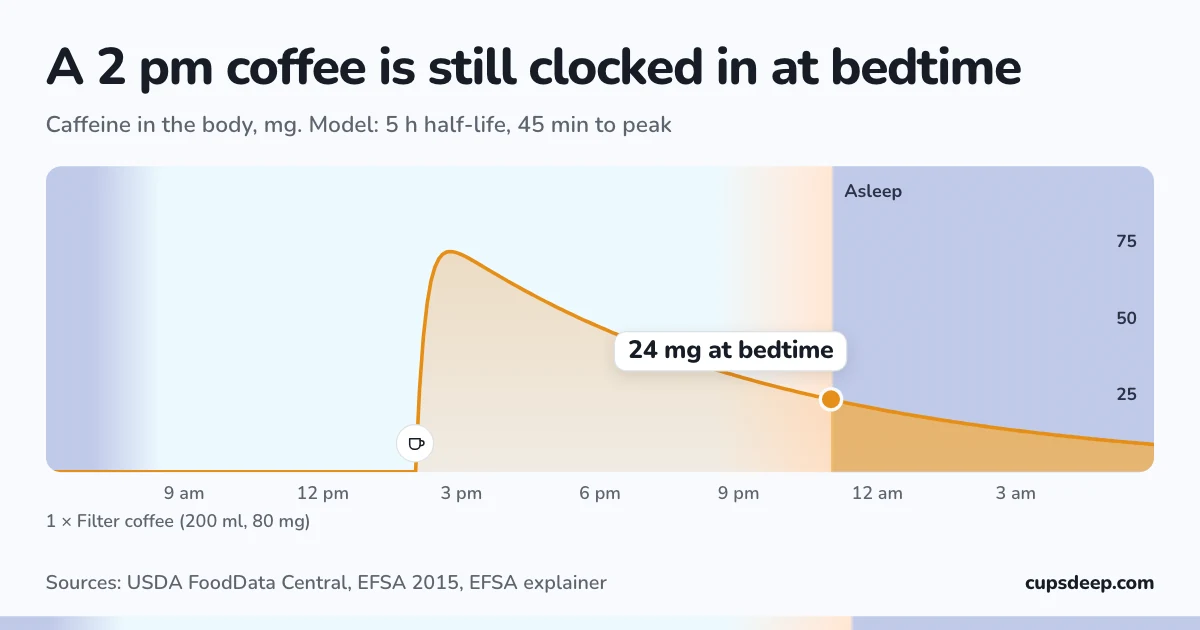
Half of a dose of caffeine is gone in about 4 hours, 2–8 hours between people. After five half-lives, 20 hours on average, 3.1% is left.