Does black tea have caffeine?
Yes, and it is the caffeine people forget to count, because it comes in a mug and not a cardboard cup. A cup is about half a filter coffee. The trouble is the refills, the mug that nobody measures, and the bottles, which run from a rumor of tea to more than a shot of espresso. Here is every number, with the page it came from.
The short answer
Yes. A 200 ml cup of brewed black tea has about 40 mg of caffeine by USDA’s measurements, half of a filter coffee at 80 mg. Earl Grey is black tea too: Starbucks lists a Grande at about 40 mg. The bottled iced teas we list run from 14 mg to 76 mg a bottle, by the makers’ own figures.
How much caffeine is in a cup of black tea?
USDA measured brewed black tea and the figure comes to about 40 mg in a 200 ml cup, the number on our drinks table. FDA gives 71 mg for 12 fl oz. Put both on the same 8 fl oz cup and they agree.
Put on an 8 fl oz cup, USDA’s 20 mg of caffeine per 100 g of brewed black tea and FDA’s 71 mg per 12 fl oz both come to about 47 mg. These are our sums, not figures either source states. 145
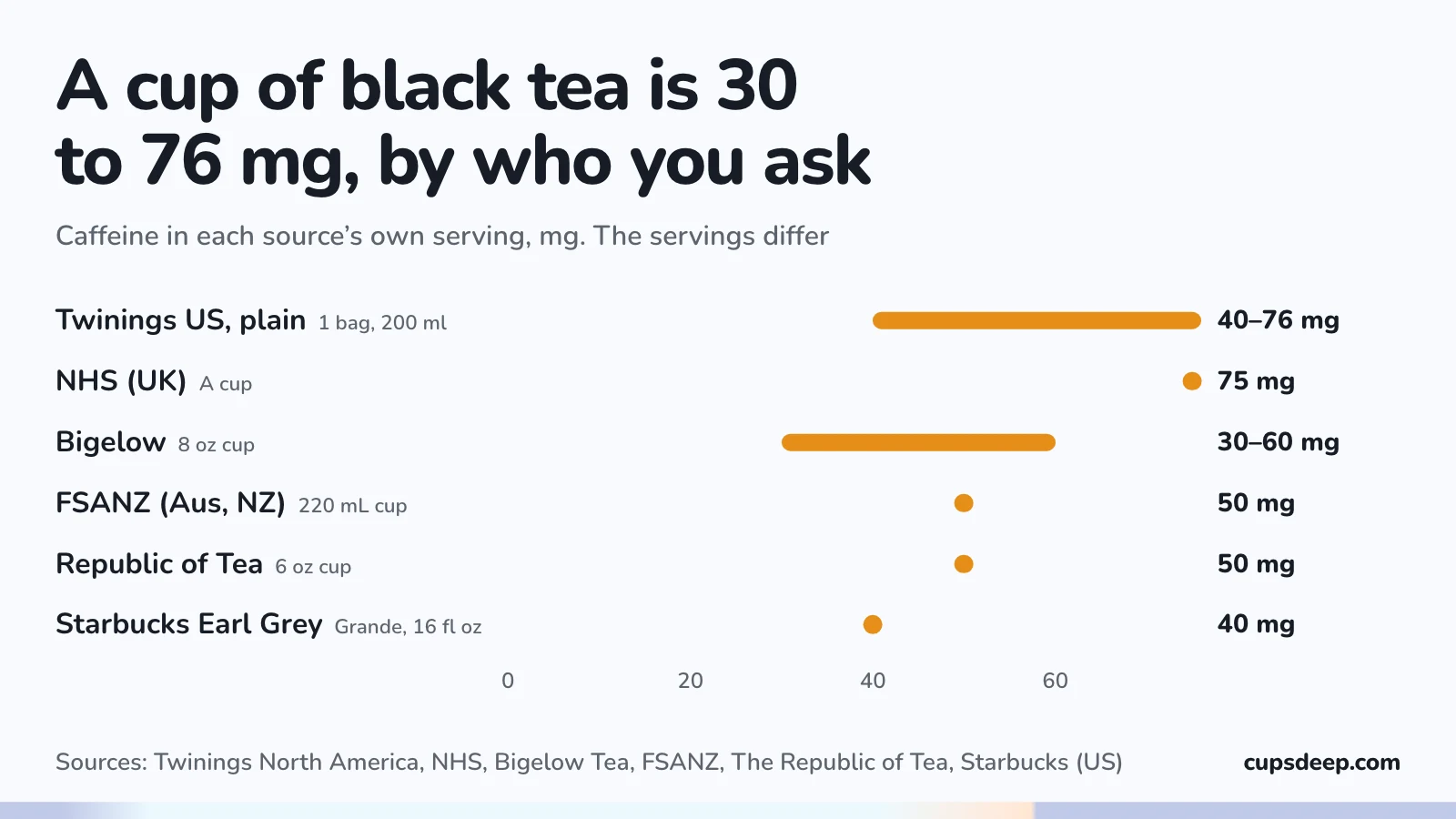
Other governments land higher. The NHS puts a cup of tea at 75 mg and the UK Food Standards Agency a mug at about 75 mg, and neither names a size. Food Standards Australia New Zealand says 50 mg for a 220 mL cup. The tea makers state their own, each for a cup of its own size.
| Who | Serving, as they state it | Caffeine |
|---|---|---|
| Twinings US, unflavored black tea | 1 bag, 200 ml | 40 mg to 76 mg |
| Twinings US, flavored black tea | 1 bag, 200 ml | 31 mg to 45 mg |
| Twinings UK, standard black tea | A cup | An average of 50 mg |
| Bigelow black teas | 8 oz cup | 30 mg to 60 mg |
| Lipton black tea | A cup, no size | 55 mg |
| The Republic of Tea, “the average black tea” | 6 oz cup | About 50 mg |
| Starbucks Royal English Breakfast | Grande, 16 fl oz | About 40 mg |
| Starbucks Earl Grey | Grande, 16 fl oz | About 40 mg |
| NHS (UK), black or green | A cup | 75 mg |
| Food Standards Agency (UK) | A mug | About 75 mg |
| FSANZ (Australia, New Zealand) | 220 mL cup | 50 mg |
| FDA (US) | 12 fl oz | 71 mg |
| A lab, brewed teas of every kind | 6 or 8 oz | 14 mg to 61 mg |
Each source’s own page, read between November 10 and November 12, 2026. Nothing is converted: every figure is for the serving its source names. Twinings calls its figures guidance; Starbucks calls its approximate. The lab is Chin and colleagues, 2008, who found no trend by variety of tea.
Much of the spread is serving, bag and steep, not only the leaf. Twinings US says a longer steep pulls more caffeine out, and that the size of the cup does not change the caffeine: the bag gives what it gives, and more water only spreads it thinner. So a British mug at 75 mg and an American cup at 47 mg are not necessarily in conflict. Twinings’ own top figure, 76 mg for one bag of plain black tea, is above both.
One government page puts the top of its range well above the rest, and it is worth knowing which, because it gets quoted.
Victoria’s Better Health Channel lists black tea at 65 to 105 mg of caffeine per 250 ml and ties no source to that line. Its low end is above FSANZ’s 50 mg for a 220 mL cup, and its high end is above every other figure in our table of a cup of black tea. 361
FSANZ, the food regulator for Australia and New Zealand, says 50 mg for a cup only a little smaller, and the top of the Victorian range is above every other figure in our table. We show it because it is out there. We would not plan a day on it.
Does Earl Grey tea have caffeine?
Yes. Earl Grey is black tea flavored with bergamot, and black tea has caffeine. Here is what three makers put in theirs.
Earl Grey is black tea with bergamot as a flavoring, by its makers’ ingredient lists: Twinings US lists “Black tea”, “Natural flavours” and “Bergamot peel”; Tazo lists organic black tea and organic bergamot oil; Starbucks lists water, black tea, bergamot essence and lavender flowers. None of the three states a caffeine figure for bergamot, and we found no measurement of one. 366364362
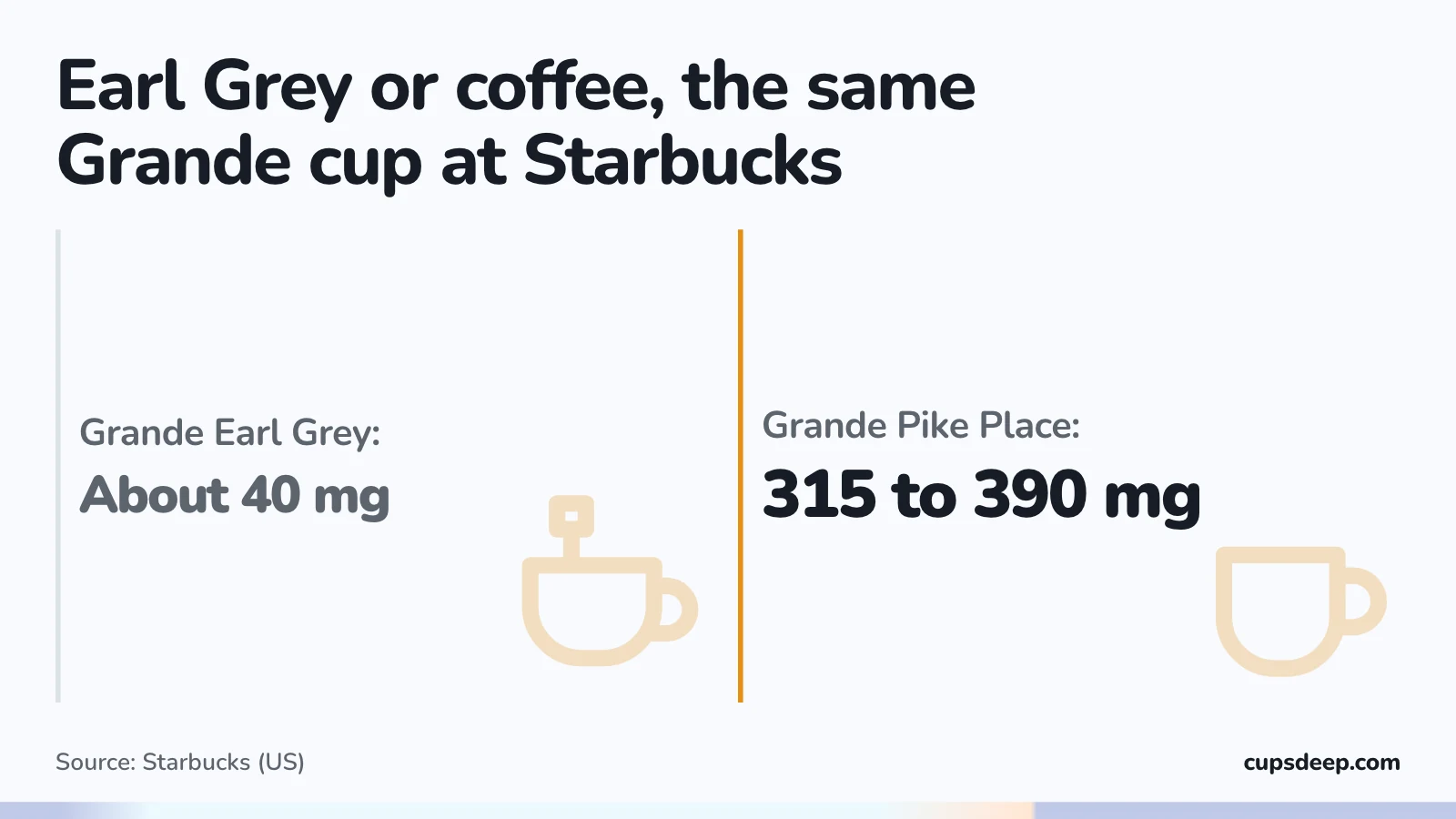
How much depends on whose. Starbucks lists a Grande Earl Grey, brewed from two bags, at about 40 mg, the same as its Royal English Breakfast. Twinings does not name Earl Grey on its caffeine page, but by its ingredient list it is a flavored black tea, and for those Twinings US states 31 mg to 45 mg a bag, a lower range than the 40 mg to 76 mg it gives plain black tea. It does not say why.
Tazo goes the other way. It puts its Organic Earl Grey in the top band of its caffeine guide, 61 mg or more, with no serving named. So Tazo’s Earl Grey band starts above where Twinings’ flavored black teas top out. Same name on the box, a different band, and Tazo tells you to steep it 7–10 minutes.

Earl Grey is black tea wearing cologne. The caffeine did not leave the room
Starbucks lists a Grande London Fog Latte at about 40 mg too, the same as the plain tea. We found no measurement of whether milk changes the caffeine in a cup of tea, so we will not tell you it does.
And bergamot itself? It is a citrus fruit, and none of the three makers above gives it a caffeine figure. On their lists, the tea in Earl Grey is the black tea. Decaf Earl Grey exists for the same reason decaf anything exists, and it is covered below.
Does black tea have more caffeine than coffee or green tea?
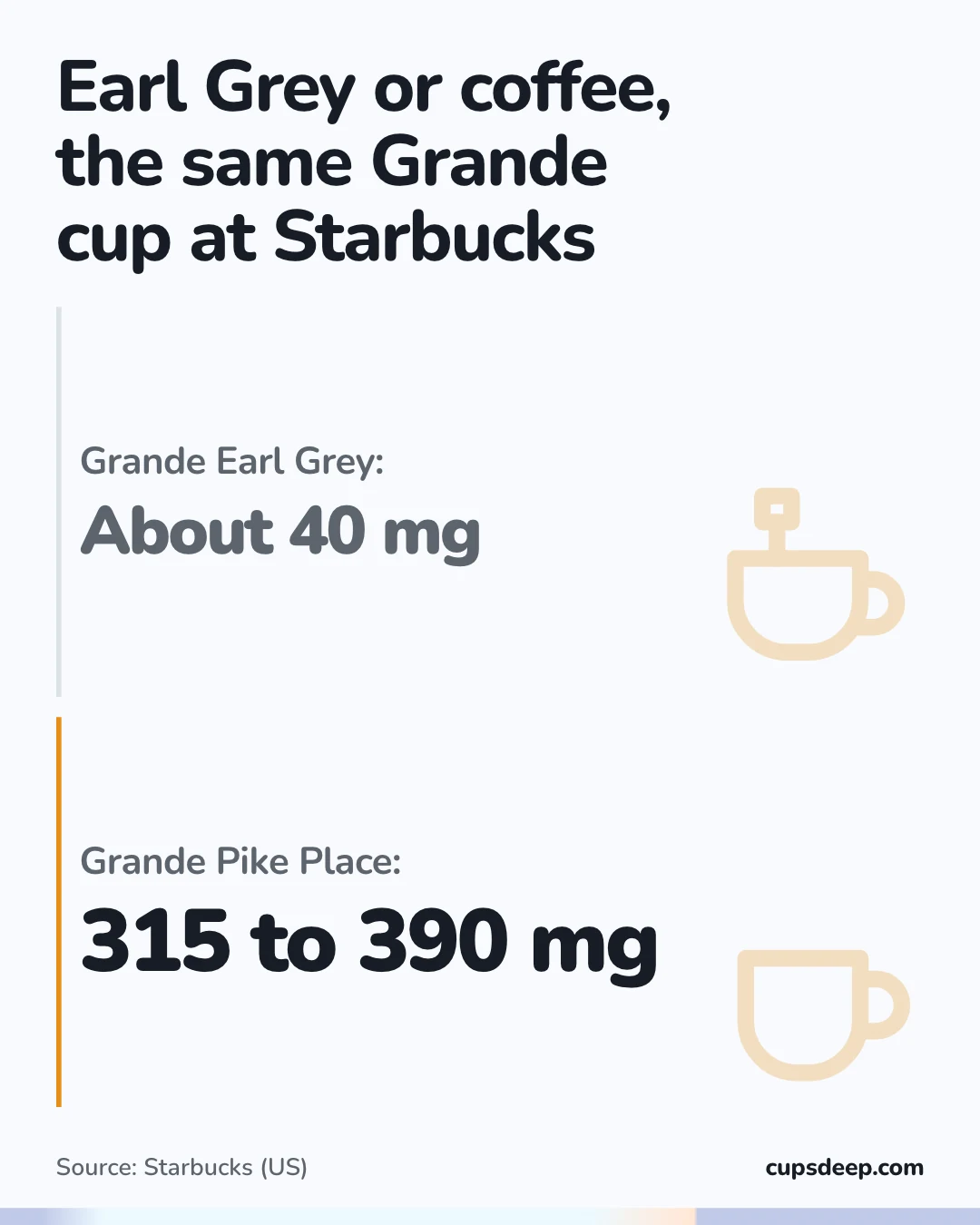
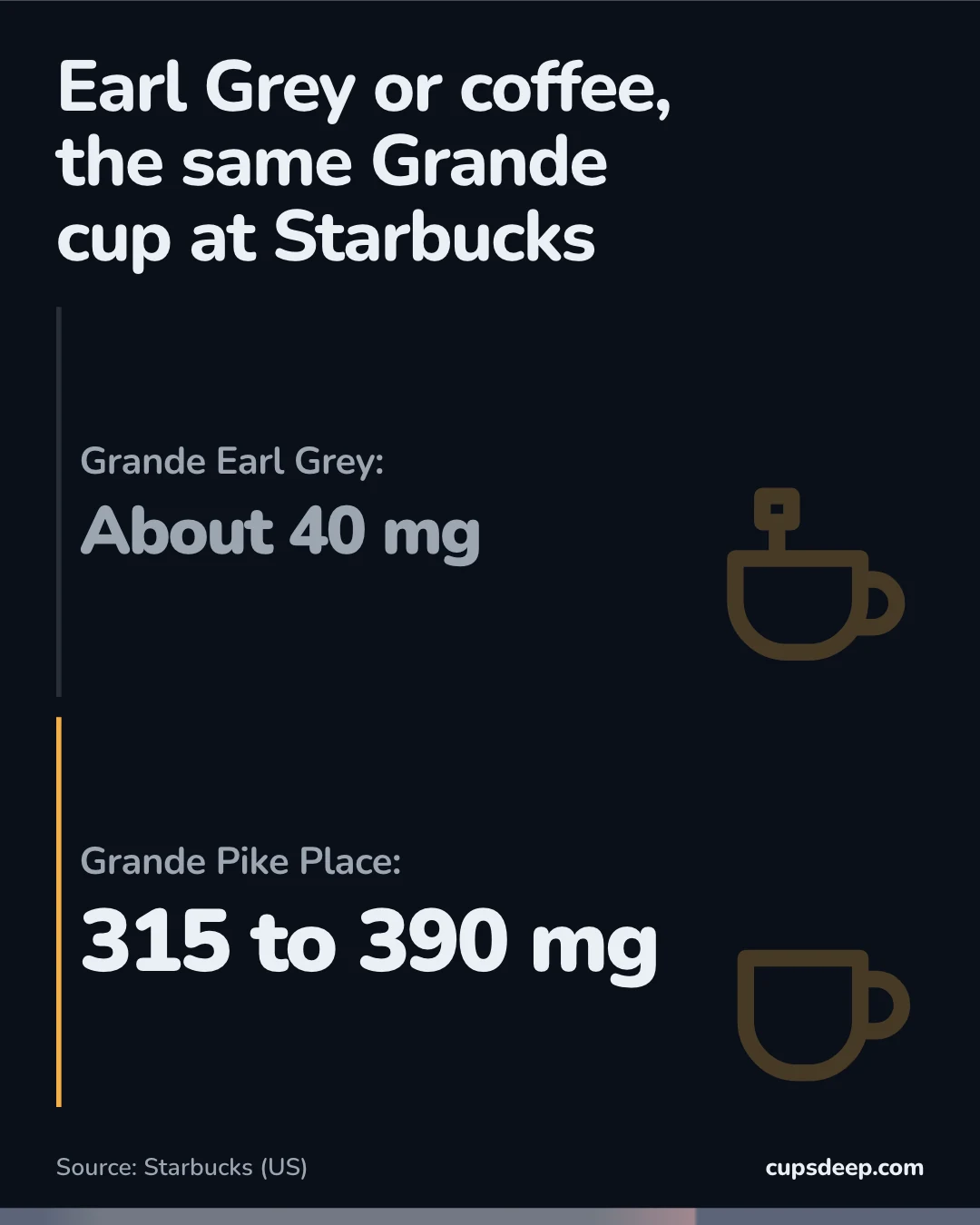
Than coffee, no, not cup for cup. A 200 ml filter coffee is about 80 mg, twice the black tea, and a single espresso is 63.6 mg. The Republic of Tea puts it the same way round, 50 mg for its average black tea against 125 mg for coffee, per 6 oz. At Starbucks the gap is wider still: 40 mg for a Grande Earl Grey, 315–390 mg for a Grande Pike Place. The coffee article has the big numbers.
Than green tea, usually, by the cup: USDA’s cups give black tea 40 mg and green 24 mg, FDA gives 71 mg against 37 mg, and The Republic of Tea 50 mg against 25 mg. In the leaf, two labs disagree on how big the gap is.
A 2002 study of teas commonly consumed in the UK, bought from local supermarkets, found 22 to 28 mg of caffeine per gram of dry black tea, significantly more than the 11 to 20 mg per gram of the green teas. 372
A 2016 study of 37 commercial teas gives a mean of 17.73 mg of caffeine per gram for its black teas and 16.28 mg per gram for its green teas, in the abstract; the paper’s body text gives the black tea mean as 17.77. 373
In the first lab, dry black tea held clearly more caffeine than green. In the second, the two means sit within a couple of milligrams per gram. Neither abstract gives a black-against-green figure per cup, and we will not make one up for them. Oolong and white tea, which sit between and around the two, are in their own article. The green tea article has a third lab that brewed both side by side and timed them, where the gap mostly closed after five minutes. So “black tea has twice the caffeine of green” is true of some sources’ cups and not of others, and in our opinion the clock on your counter matters at least as much as the color of the leaf.
Does steeping black tea longer give you more caffeine?
Yes. Twinings US says so on its caffeine page, and one lab timed it with black tea, in bags and loose, at 100 °C.
One 2025 study steeped 2 g of black tea in 200 mL of water at 100 °C. Cup tea bags, a mean of 12 teas, gave 23 mg of caffeine after 2 minutes, 33 mg after 5 and 39 mg after 10. Loose leaf, a mean of 19 teas, gave 18, 22 and 24 mg. These are one laboratory's plain black teas, not chai blends. 120
| Steep | Tea bags, mean of 12 | Loose leaf, mean of 19 |
|---|---|---|
| Two minutes | 23 mg | 18 mg |
| Five minutes | 33 mg | 22 mg |
| Ten minutes | 39 mg | 24 mg |
Ayakdaş and Ağagündüz, 2025: black teas bought in Turkey, most of them Turkish. The bags and the loose teas were different products.
Two things stand out. The bags gave more than the loose leaf at every time, and they kept giving: 23 mg at two minutes became 39 mg at ten, while the loose leaf moved far less. This is one lab and two different sets of tea, so take the direction, not the gap.
In practice, the person who leaves the bag in until the mug is cold is drinking a different tea from the person who dunks it twice. The chai article uses the same study, because chai is mostly this tea in a costume.
How much caffeine is in bottled iced tea like Pure Leaf or Gold Peak?
From a few milligrams to more than a shot of espresso. Per serving, as each maker states it, the rows below run from 8 mg to 76 mg. Per fluid ounce, by our sums, they run from 0.7 mg per fl oz to 4.1 mg per fl oz: one bottle can be several times as strong as another, ounce for ounce. Black tea is also the base of most milk teas, and what a shop’s boba carries is its own question.
| Drink | Serving the figure is for | Caffeine | Per fl oz, our sum |
|---|---|---|---|
| Pure Leaf Zero Sugar Sweet Tea | 1 bottle, 18.5 fl oz | 76 mg | 4.1 mg per fl oz |
| Pure Leaf Extra Sweet Tea | 1 bottle, 18.5 fl oz | 60 mg | 3.2 mg per fl oz |
| Pure Leaf Unsweetened Black Tea | 1 bottle, 18.5 fl oz | 54 mg | 2.9 mg per fl oz |
| Pure Leaf Unsweetened Black Tea | 1 bottle, 16.9 fl oz | 50 mg | 3 mg per fl oz |
| Pure Leaf Sweet Tea | 1 bottle, 18.5 fl oz | 54 mg | 2.9 mg per fl oz |
| Pure Leaf Lemon | 1 bottle, 18.5 fl oz | 52 mg | 2.8 mg per fl oz |
| Pure Leaf Sweet Assam Black, chilled | 12 fl oz serving | 42 mg | 3.5 mg per fl oz |
| Pure Leaf Unsweet Darjeeling Black, chilled | 12 fl oz serving | 38 mg | 3.2 mg per fl oz |
| Gold Peak Sweet Tea | 16.9 fl oz, on an 18.5 fl oz panel | 44 mg | 2.6 mg per fl oz |
| Gold Peak Extra Sweet Tea | 1 bottle, 18.5 fl oz | 44 mg | 2.4 mg per fl oz |
| Gold Peak Slightly Sweet Tea | 12 fl oz serving | 33 mg | 2.8 mg per fl oz |
| Snapple teas | 16 fl oz | Around 30 mg | About 1.9 mg per fl oz |
| Lipton Iced Tea Lemon | 1 bottle, 16.9 fl oz | 21 mg | 1.2 mg per fl oz |
| Brisk Lemon Iced Tea | 1 bottle, 20 fl oz | 18 mg | 0.9 mg per fl oz |
| Brisk Lemon Iced Tea | 1 bottle, 16 fl oz | 14 mg | 0.9 mg per fl oz |
| Brisk Lemon Iced Tea | 1 can, 12 fl oz | 11 mg | 0.9 mg per fl oz |
| AriZona Sweet Tea | 12 oz | 9 mg to 11 mg | 0.8 mg per fl oz to 0.9 mg per fl oz |
| AriZona Unsweetened Tea | 12 oz | 8 mg to 10 mg | 0.7 mg per fl oz to 0.8 mg per fl oz |
PepsiCo’s product facts table (Pure Leaf, Lipton, Brisk), the Nutrition Facts panels on Coca-Cola’s Gold Peak page, AriZona’s FAQ and Snapple’s FAQ, read on November 12, 2026. The larger Pure Leaf and Gold Peak bottles state caffeine per 12 fl oz serving, not per bottle. AriZona names no can or bottle. Snapple gives one approximate figure for its teas in general. Gold Peak Unsweetened and Zero Sugar Sweet Tea print no caffeine, so they are missing.
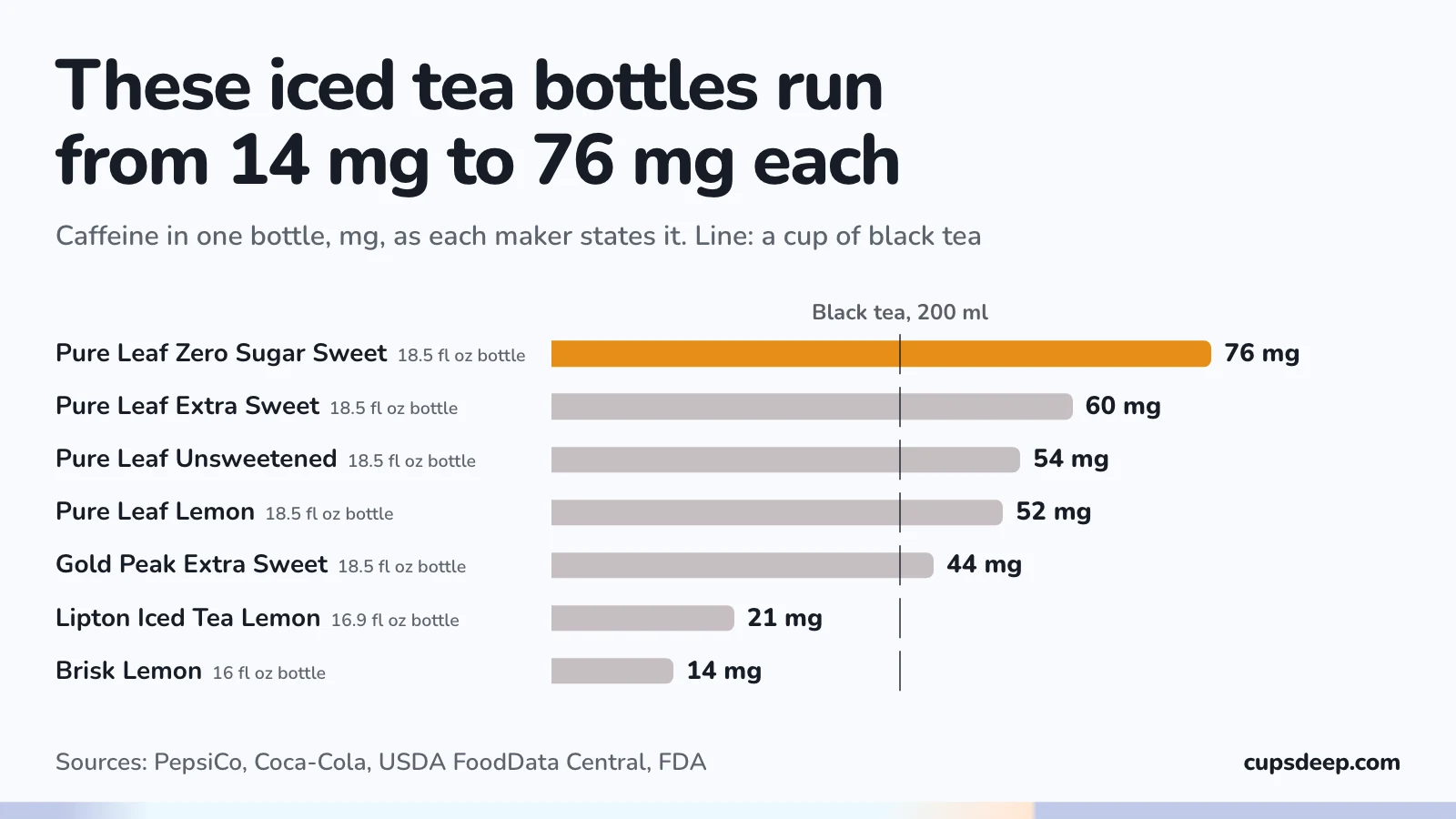
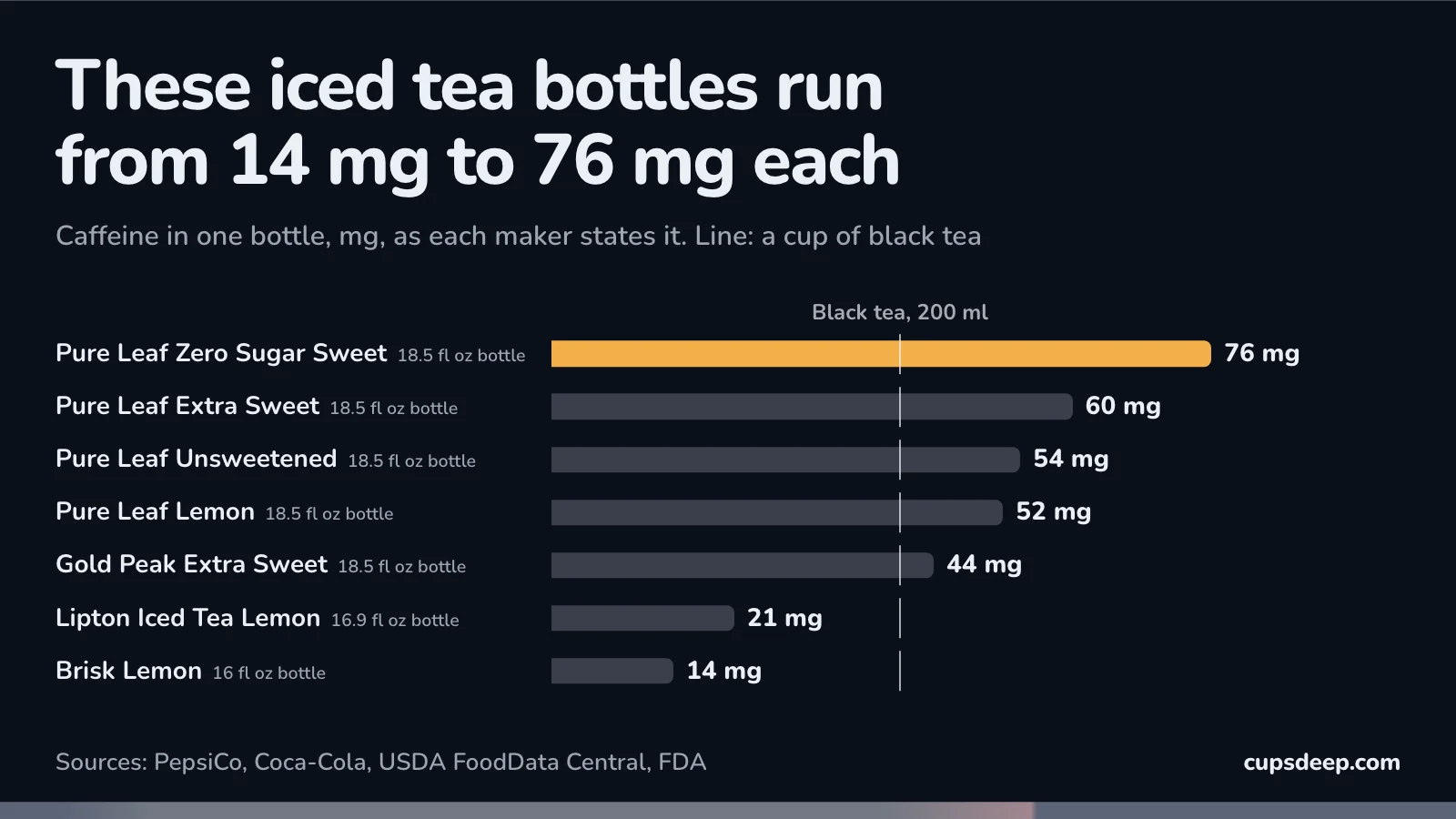
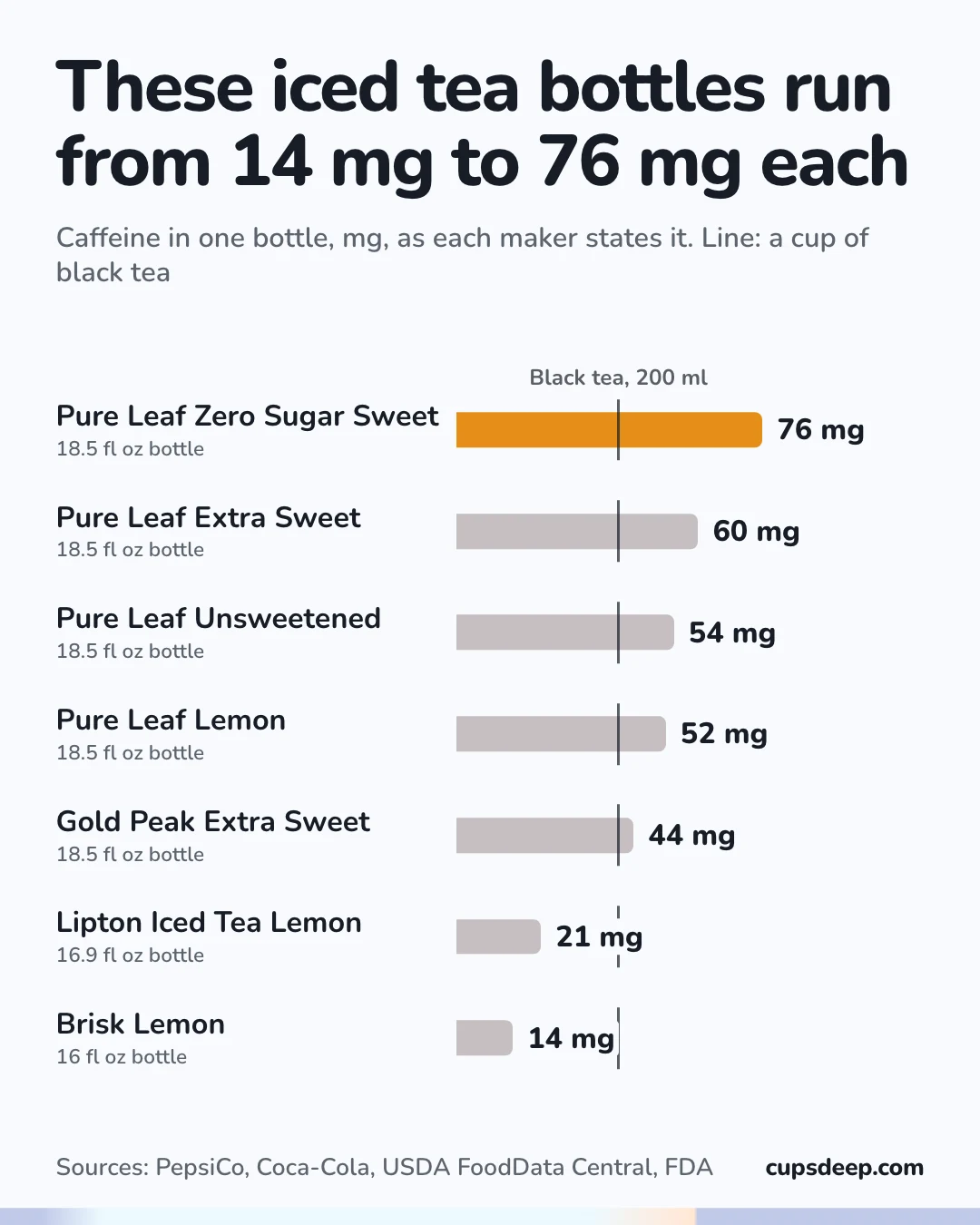
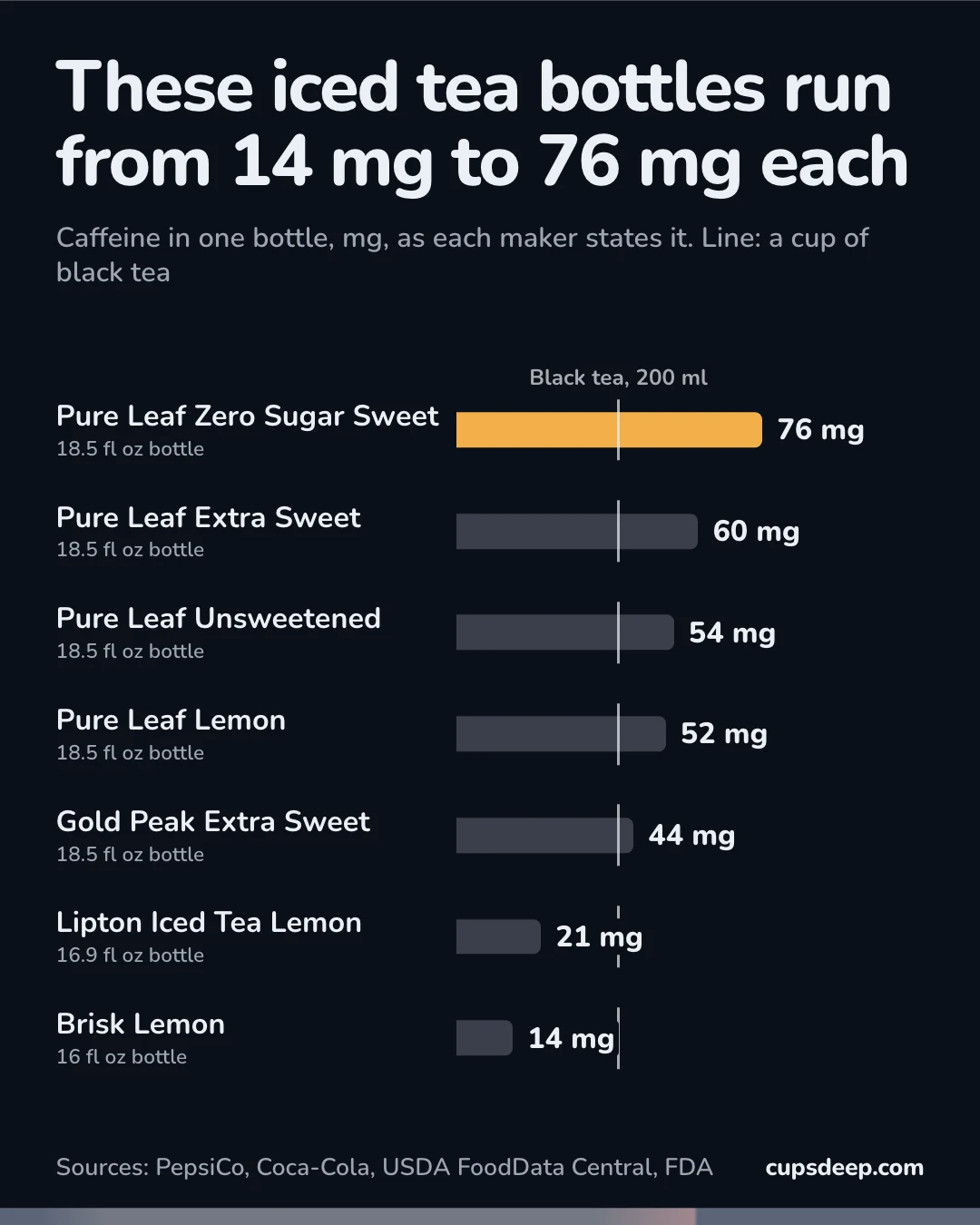
Pure Leaf Zero Sugar Sweet Tea tops the list at 76 mg, more than the regular Sweet Tea in the same size bottle at 54 mg, and more than a single espresso at 63.6 mg. PepsiCo gives no reason for the gap. Pure Leaf is also the only maker here that names where the tea is from: 42 mg for the Assam and 38 mg for the Darjeeling, per 12 fl oz. That is two bottles, not a law about Assam and Darjeeling.
Gold Peak’s labels need reading twice. The Sweet Tea panel is for an 18.5 fl oz bottle, one serving, and its caffeine line reads “44 mg/ 16.9 fl oz”: a figure for less tea than the bottle the panel describes. The Extra Sweet panel, same bottle, reads 44 mg for 18.5 fl oz. The Unsweetened and Zero Sugar Sweet panels give no caffeine at all.
At the bottom, AriZona states 9 mg to 11 mg for 12 oz of its Sweet Tea and 8 mg to 10 mg for Unsweetened, and Brisk 11 mg for a 12 fl oz can. Snapple says its teas have “around” 30 mg per 16 fl oz, an approximate figure for every flavor at once. Bottled green tea has its own list in the green tea article.
I switched from coffee to iced tea to cut down. The bottle did not get the memo
Which black tea has the most caffeine, and does decaf have any?
English Breakfast is the one people ask about. Starbucks lists its Royal English Breakfast at about 40 mg for a Grande, and Tazo puts its Organic Awake English Breakfast in its top band, 61 mg or more. Neither maker says what in the blend makes its number.
The real outliers are black teas with extra caffeine. Their makers say so, they are not ordinary black tea, and they belong next to the energy drinks more than the teapot.
Some black teas have extra caffeine, by their makers’ own words. Bigelow says its Peak Energy black tea “includes extra L-Theanine and Caffeine” and contains 75 mg per 8 oz cup; The Republic of Tea says its HiCAF Cinnamon Toast Black Tea contains 116 mg per 6 oz cup, and that its HiCAF teas are intensified with green tea extract and pure caffeine. 367369
The Republic of Tea says its HiCAF range goes up to 150 mg per 6 oz cup, intensified with green tea extract and pure caffeine. At 116 mg, the Cinnamon Toast cup alone beats a 200 ml filter coffee at 80 mg, in less water.
At the other end, decaf black tea is low, not zero. The Republic of Tea says 2–4 mg remain in a 6 oz cup of its decaf tea, and Twinings UK puts a typical decaf bag at about 3 mg. USDA lists decaffeinated hot black tea at 1 mg per 100 g. A lab that measured decaf teas put them all under 12 mg a serving, a ceiling, not a figure.
Small doses. Not nothing, for the same reasons decaf coffee is not nothing.
How many cups of black tea a day is too much?
On the daily total, a lot of tea. EFSA’s line for healthy adults is 400 mg/day from all sources, and in pregnancy 200 mg/day; the NHS also says not more than 200 mg/day in pregnancy.
At USDA’s 40 mg for a 200 ml cup, 10 cups of black tea reach the 400 mg a day that EFSA says raises no safety concern for healthy adults who are not pregnant. At the NHS’s 75 mg a cup, the 200 mg pregnancy limit is reached at about 2.7 cups. Our sums. 1422358
So it takes 10 cups at USDA’s size to reach the adult line, before any coffee or cola. At the NHS’s figure, about 2.7 cups reach the pregnancy line. Mugs, strong bags and long steeps all move these sums the wrong way.
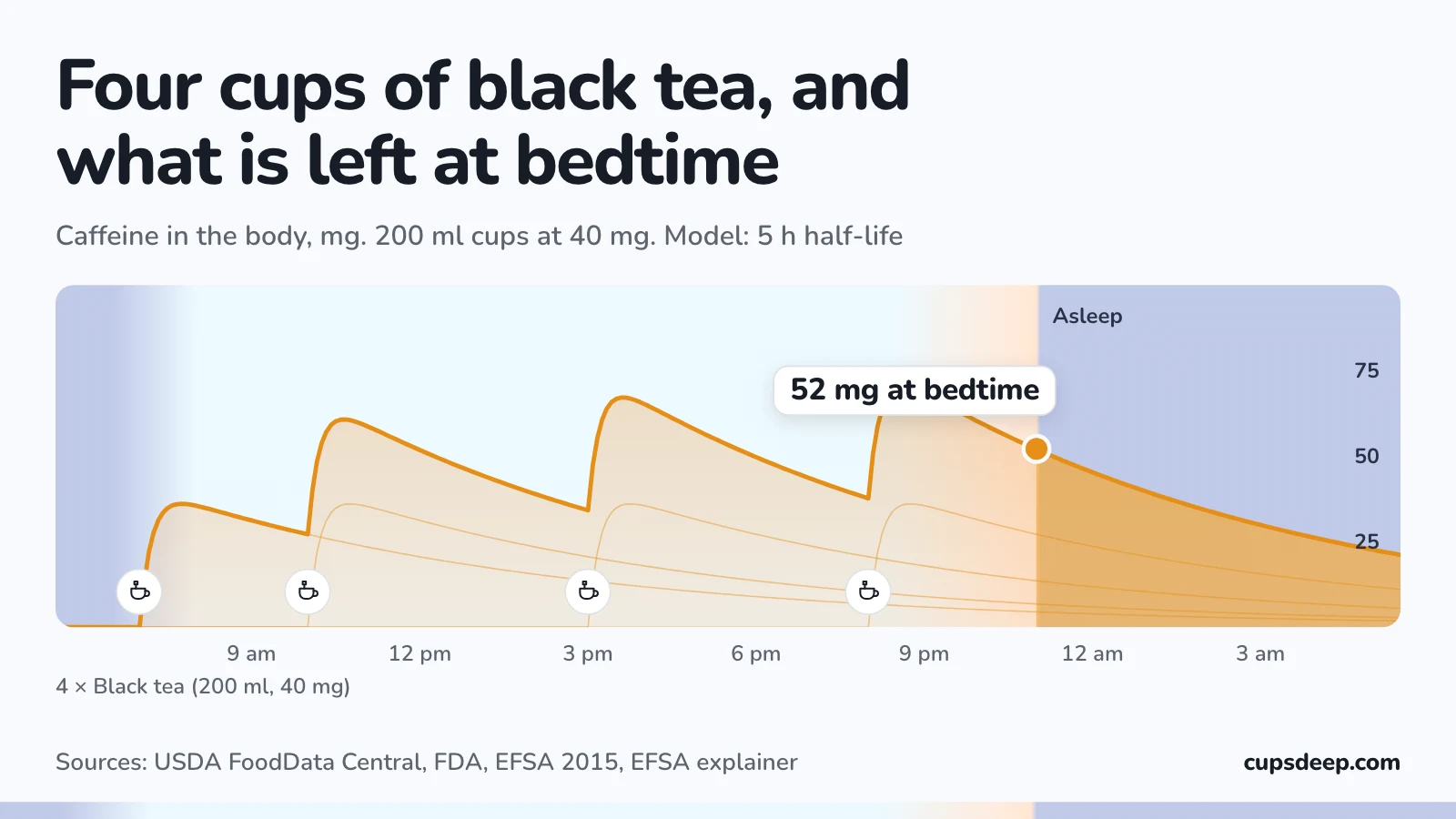
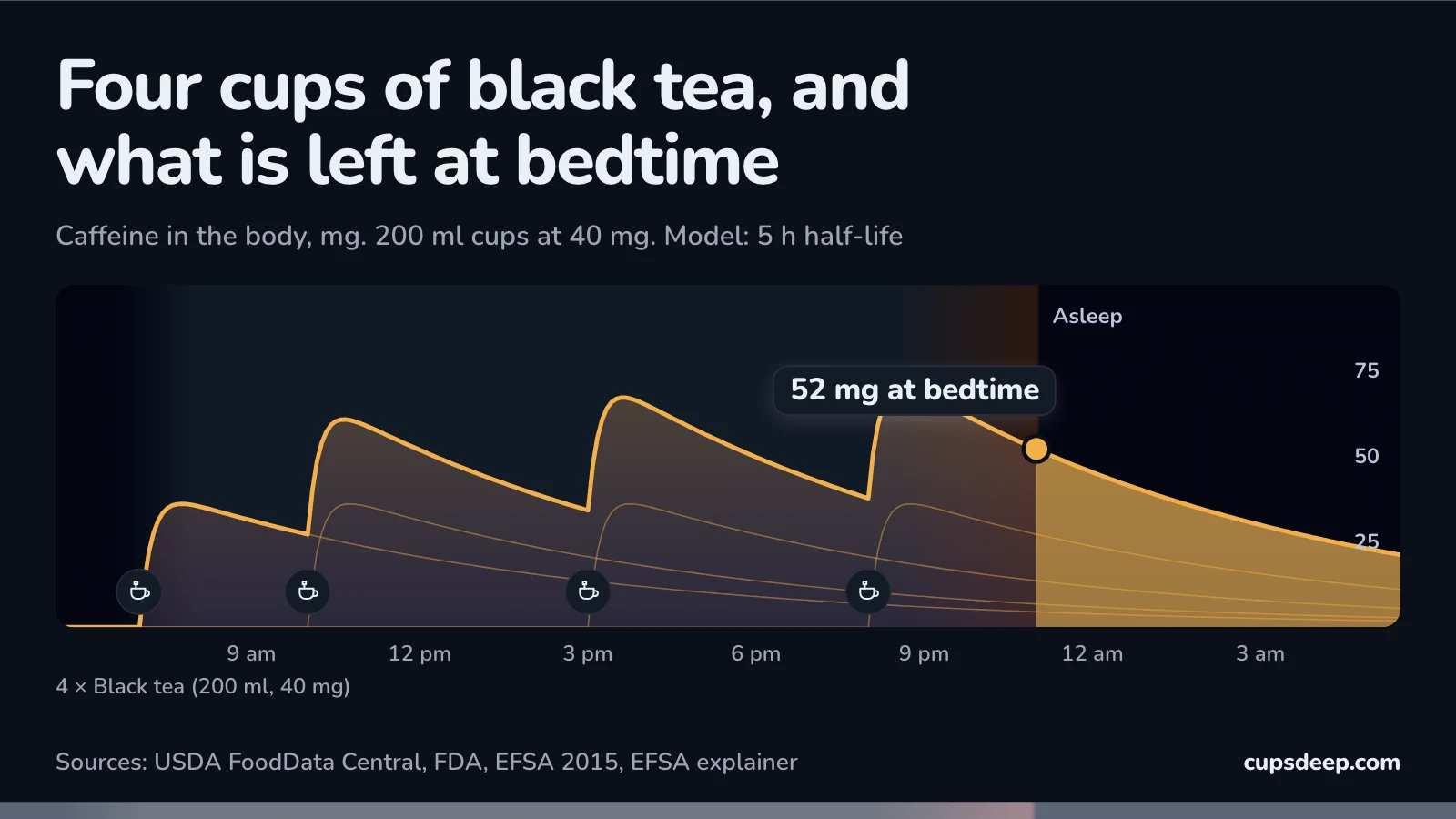
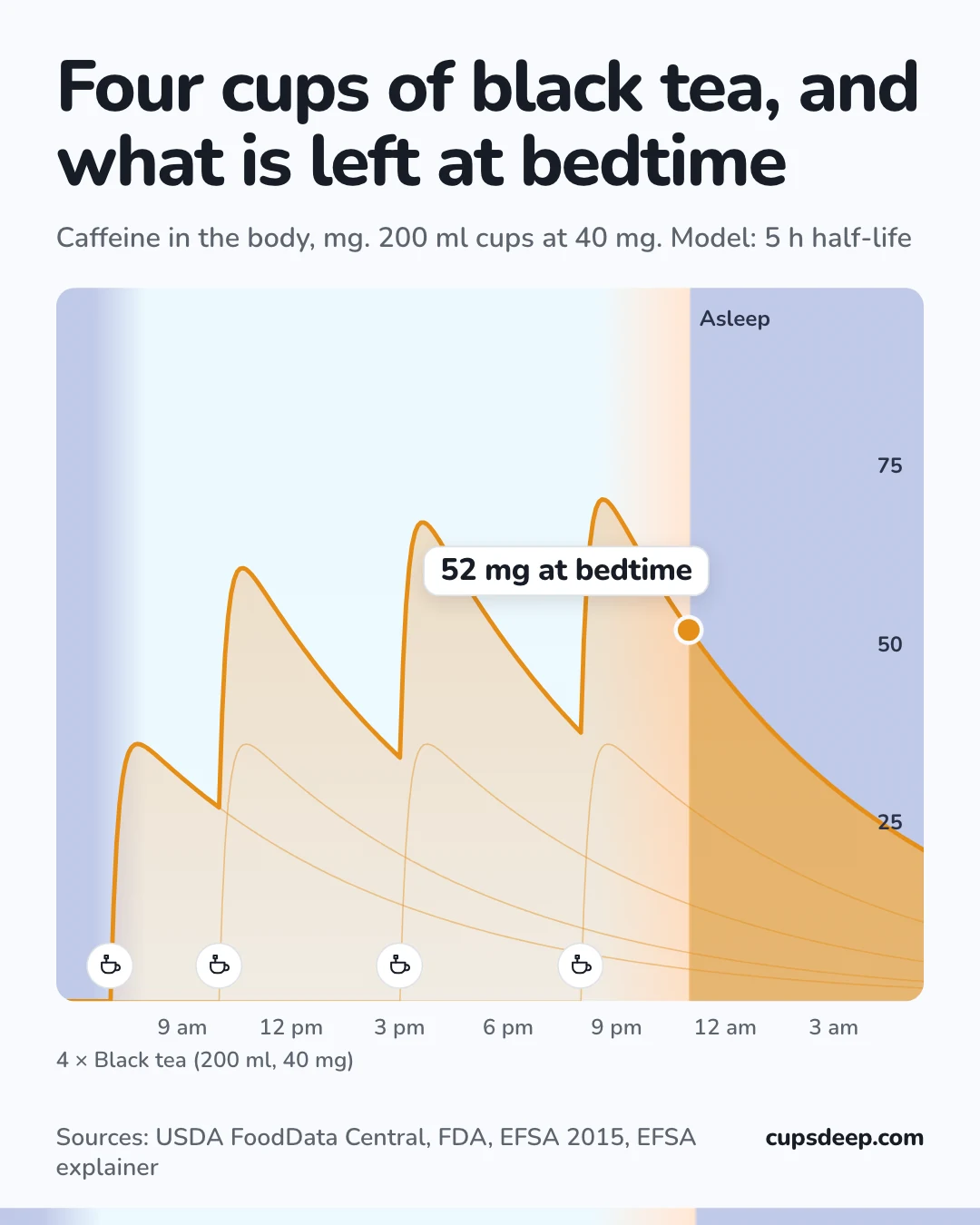
Timing is the other half. Caffeine peaks 30 minutes to 120 minutes after you drink it, and half of it is still in you about 4 hours later, longer for some people.
A single 100 mg dose of caffeine, about 1.4 mg/kg body weight for a 70 kg adult, may increase the time it takes to fall asleep and reduce sleep duration in some adults, particularly when taken close to bedtime. 2223
A single cup of black tea is well under that dose, and one meta-analysis found no bedtime cut-off for a cup at 47 mg: its model could not show a loss of sleep at that dose, which is not the same as showing there is none. The habit is what adds up. Tea at breakfast, mid-morning, mid-afternoon and after dinner is four small doses stacked on one evening.

Builder’s tea is not a drink. It is a shift pattern
Questions people ask
Does black tea have caffeine?
Yes. USDA measured brewed black tea at about 40 mg in a 200 ml cup, and FDA gives 71 mg per 12 fl oz. The UK’s NHS says 75 mg for a cup of tea. Decaf black tea has a few milligrams, not zero.
Does Earl Grey tea have caffeine?
Yes, because it is black tea flavored with bergamot. Starbucks US lists a Grande Earl Grey at about 40 mg. Twinings US gives 31 mg to 45 mg a bag for flavored black teas, and Tazo puts its Organic Earl Grey in its top band, 61 mg or more.
How much caffeine is in English Breakfast tea?
Starbucks US lists a Grande Royal English Breakfast at about 40 mg. Tazo places its Organic Awake English Breakfast in its top caffeine band, 61 mg or more, with no serving named. Twinings US gives 40 mg to 76 mg for one bag of plain black tea.
Does black tea have more caffeine than coffee?
No. A 200 ml filter coffee is about 80 mg and the same cup of black tea about 40 mg. At Starbucks US a Grande Earl Grey is about 40 mg and a Grande Pike Place 315–390 mg. Black teas with extra caffeine can be the exception: The Republic of Tea states 116 mg for a 6 oz cup of its HiCAF Cinnamon Toast.
How much caffeine is in Pure Leaf or Gold Peak tea?
PepsiCo states 54 mg for an 18.5 fl oz bottle of Pure Leaf Unsweetened, 54 mg for Sweet Tea and 76 mg for Zero Sugar Sweet Tea. Gold Peak’s panels give 44 mg for an 18.5 fl oz Extra Sweet Tea, and the same 44 mg for Sweet Tea, stated per 16.9 fl oz.
Does decaf black tea have caffeine?
A little. The Republic of Tea says 2–4 mg remain in a 6 oz cup of its decaf tea, Twinings UK puts a typical decaf bag at about 3 mg, and USDA lists decaffeinated hot black tea at 1 mg per 100 g.
Sources
Every number above links to the place it came from. How the numbers are chosen and checked is on the method page; the drink table is at /drinks. Written with AI agents, as the whole site is. A model of a typical body, not advice for pregnancy, illness or medication.
- Spilling the Beans: How Much Caffeine is Too Much?
- Beverages, coffee, brewed, prepared with tap water
- Beverages, coffee, brewed, espresso, restaurant-prepared
- Beverages, tea, green, brewed, regular
- Beverages, tea, black, brewed, prepared with tap water
- Scientific Opinion on the safety of caffeine
- EFSA explains risk assessment: Caffeine
- Medium Roast - Pike Place Roast: nutrition (starbucks.com, United States)
- Caffeine content of brewed teas (Chin, Merves, Goldberger, Sampson-Cone, Cone; J Anal Toxicol 2008;32(8):702-4)
- Tea, hot, leaf, black, decaffeinated (FNDDS 2021-2023, food code 92302500)
- FAQs: How much caffeine does tea contain?
- Frequently Asked Questions
- Ayakdaş G, Ağagündüz D. Determination of L-Theanine and Caffeine Contents in Tea Infusions with Different Fermentation Degrees and Brewing Conditions Using the Chromatographic Method. Foods 2025;14(13):2313. doi:10.3390/foods14132313
- The effect of caffeine on subsequent sleep: A systematic review and meta-analysis
- Caffeine - PepsiCo Product Facts
- Caffeine in tea (updated 29 April 2026)
- FAQs
- FAQs
- Royal English Breakfast Tea, nutrition
- Foods to avoid in pregnancy
- Food supplements containing caffeine
- Caffeine
- Caffeine
- Earl Grey Tea: Nutrition
- London Fog Latte: Nutrition
- Organic Earl Grey Black Tea (page data)
- Twinings Earl Grey Black Tea
- Peak Energy Plus Extra L-Theanine and Caffeine Black Tea
- Which Tea Has The Most Caffeine?
- HiCAF Cinnamon Toast Black Tea Bags
- Gold Peak Tea: Varieties & Nutrition Facts
- FAQ
- Total phenol, catechin, and caffeine contents of teas commonly consumed in the United Kingdom (Khokhar, Magnusdottir; J Agric Food Chem 2002;50(3):565-70)
- Theanine and Caffeine Content of Infusions Prepared from Commercial Tea Samples (Boros et al.; Pharmacogn Mag 2016;12(45):75-9)
Keep reading
Tea and mate
Does green tea have caffeine?
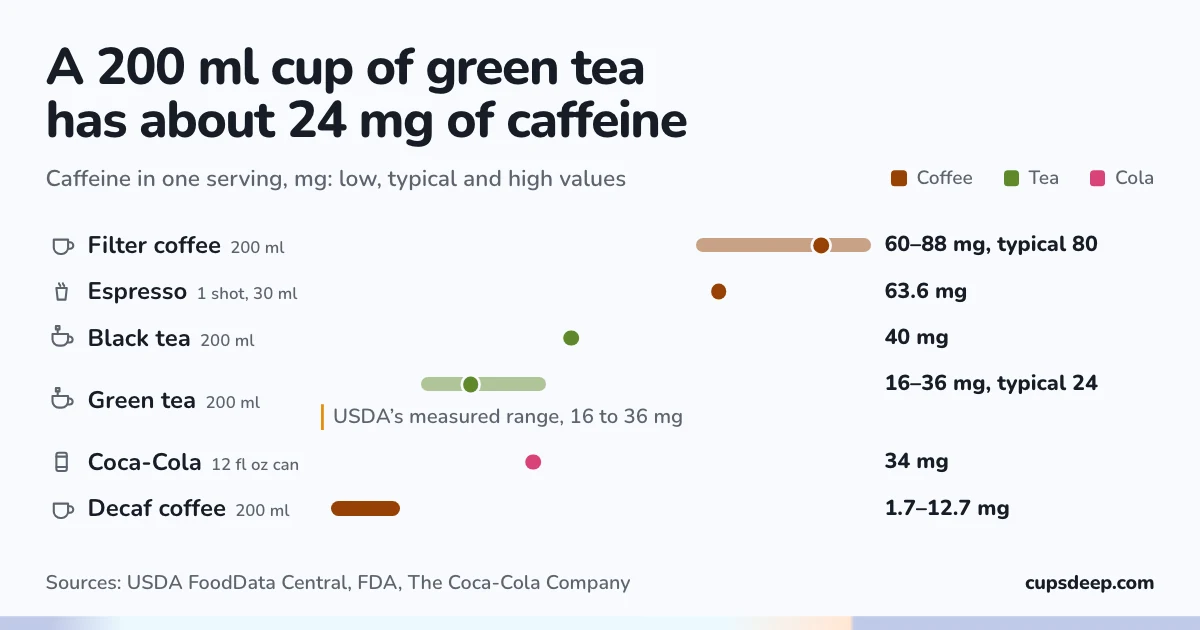
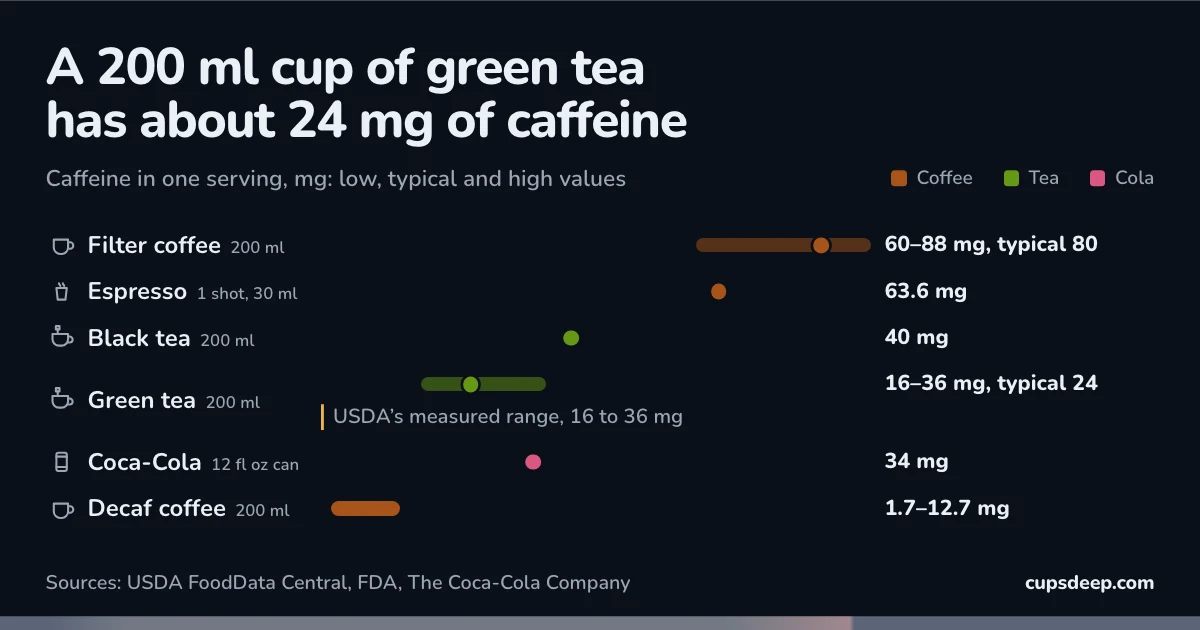
Yes: about 24 mg in a 200 ml cup, by USDA. How long you steep it, the bag, gyokuro and bottled teas from Ito En to AriZona, all with sources.

Tea and mate
Does chai have caffeine?
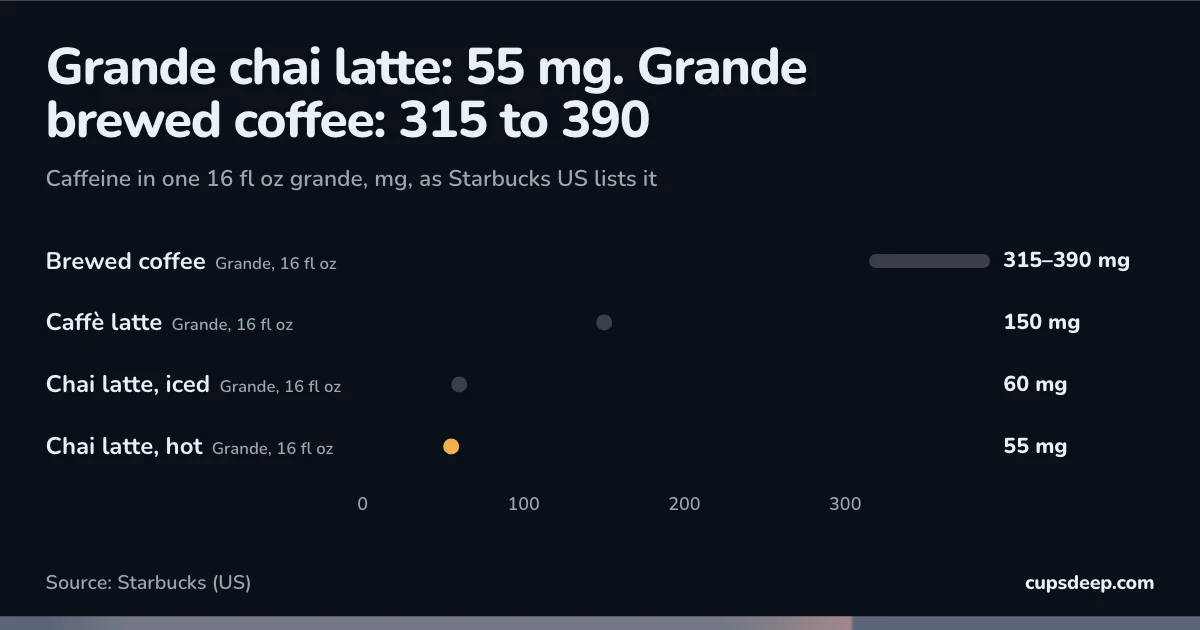
Yes. Chai is spiced black tea. A Starbucks grande chai latte lists 55 mg, a brewed cup is about 40 mg, and rooibos chai has none.
Coffee
How much caffeine is in a cup of coffee?
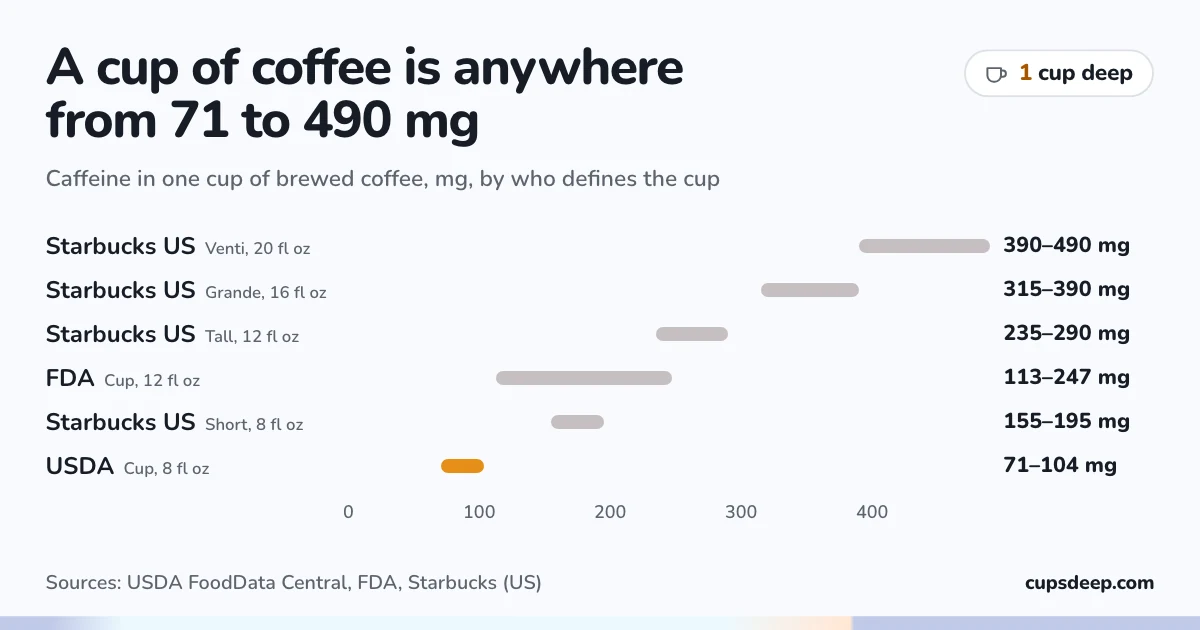
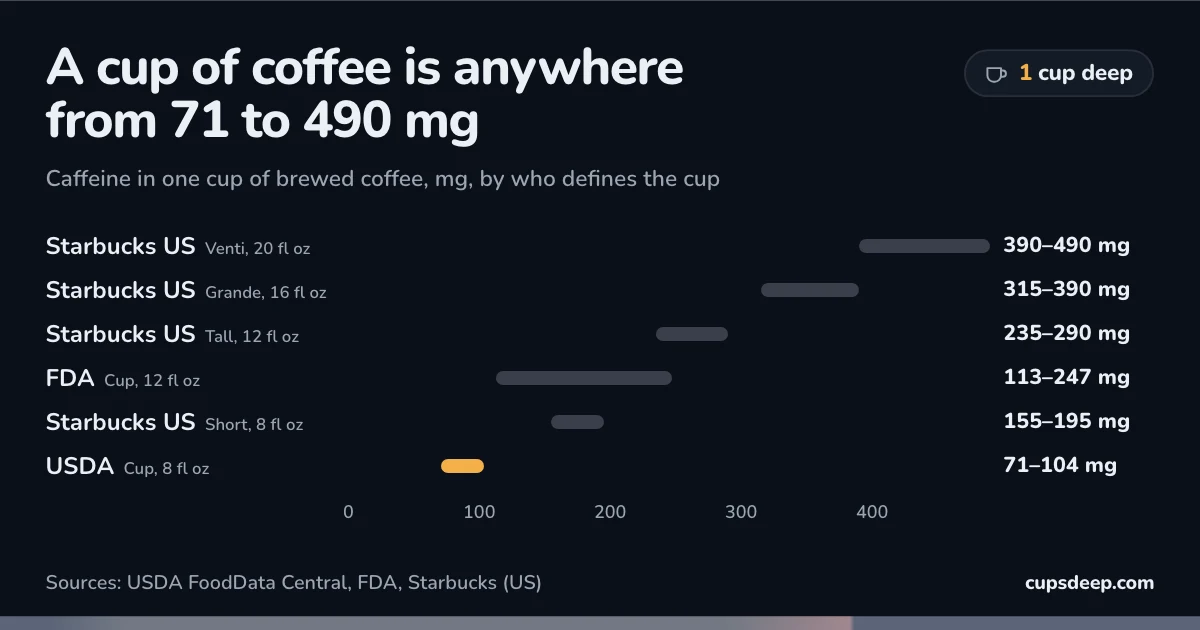
An 8 fl oz cup of brewed coffee has about 95 mg of caffeine by USDA’s figure. A Starbucks cup the same size states 155 mg to 195 mg. Tables by size and type.