Does coffee dehydrate you?
Everyone has heard that coffee dehydrates you, and everyone has noticed the bathroom trips. Here is what happens when someone actually measures the urine: how much caffeine it takes, how habit may change the answer, the trial where one coffee cost more water than it held, and who paid for the main trials.
The short answer
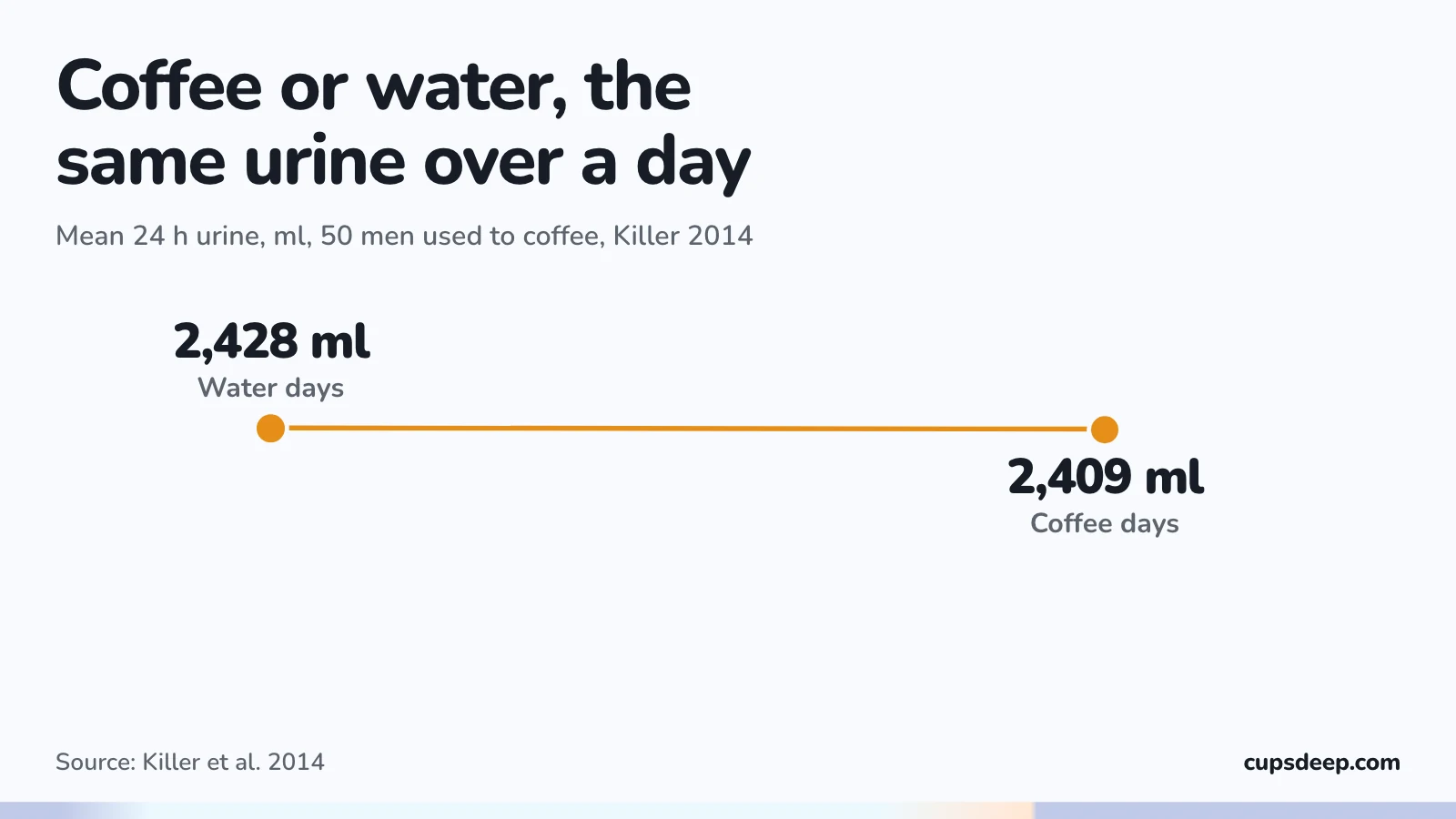
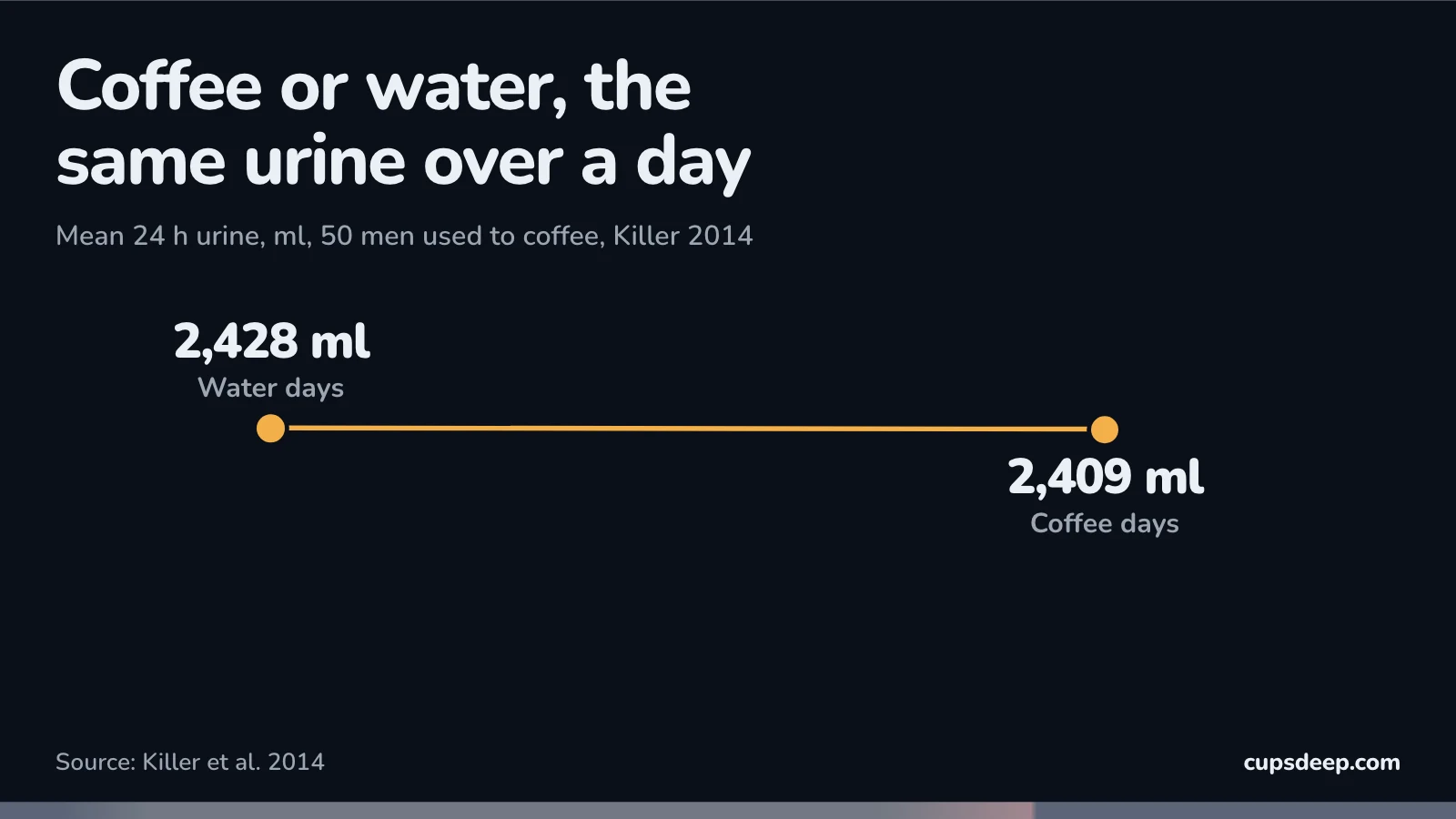
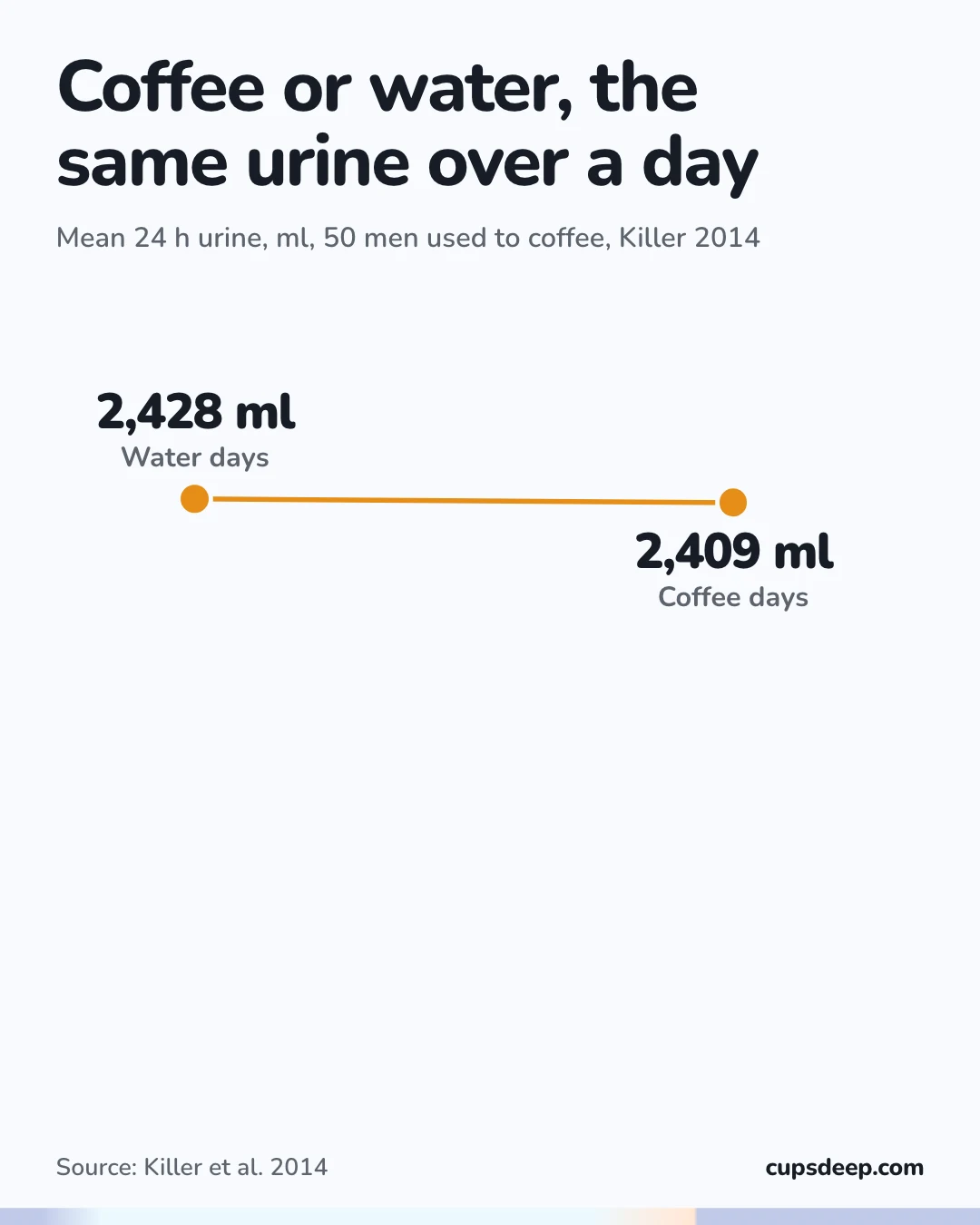
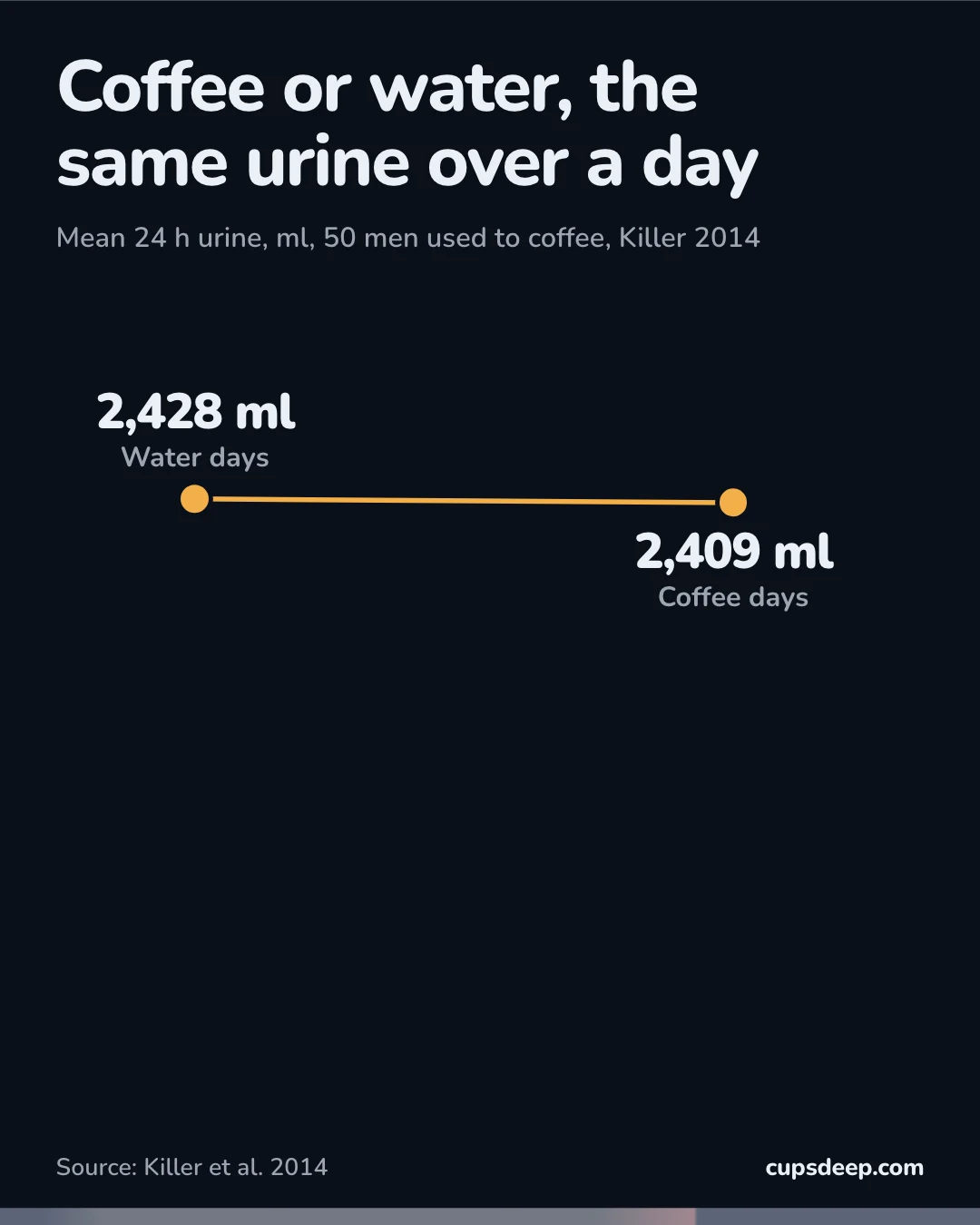
Not at everyday doses. In a 2014 trial, 50 men used to coffee drank four mugs of coffee a day, with caffeine averaging 308 mg a day, and passed 2,409 ml of urine a day, against 2,428 ml on water days. Extra urine has shown up after big single doses, at least 250–300 mg, mostly in people who had been off caffeine, and the Institute of Medicine says caffeinated drinks appear to count toward your daily water like non-caffeinated drinks, unless evidence of deficits in heavy habitual drinkers turns up.
Does coffee dehydrate you?
Not in the best test we found of how people actually drink it. A trial in Birmingham, England, took men who already drank coffee every day, controlled what they ate and how much they moved, and ran them through two three-day stretches: one on coffee, one on the same amount of water. Then it measured their urine, their blood and the water in their bodies.
In a counterbalanced crossover trial by Killer, Blannin and Jeukendrup (2014), 50 men who habitually drank 3 to 6 cups of coffee a day spent three days drinking four 200 ml mugs of black coffee a day, at 4 mg of caffeine per kg of body weight, and three days drinking four mugs of water instead, with food and activity controlled. Caffeine averaged 308 mg a day (204.4 to 453). 24 h urine volume, measured on the first two days of each trial, did not differ: 2,409 ml on coffee against 2,428 ml on water. Total body water, measured with deuterium oxide, did not differ either (51.5 against 51.4 kg); the paper’s Figure 2, which shows it, gives n = 25 without saying why. Urinary sodium was higher on coffee, and body mass fell a little on both trials. The authors conclude that coffee, in moderation, gives caffeine-habituated men similar hydrating qualities to water. The Institute for Scientific Information on Coffee (ISIC) funded the study, and the paper describes ISIC as “a non-profit organisation, devoted to the study and disclosure of science related to coffee and health” and says the funders had no role in study design, data collection and analysis, decision to publish, or preparation of the manuscript. One author, Jeukendrup, declared that he is employed by PepsiCo. 608
Two things make this the study to start with. It tested coffee, not caffeine pills, at about the low end of what its men already drank: 308 mg a day on average, or about 77 mg a mug by our arithmetic, close to a 200 ml filter coffee at 80 mg. And it measured total body water directly, with a tracer, rather than guessing from urine alone. Body water averaged 51.5 kg on coffee and 51.4 kg on water (Figure 2, 25 men).
It has limits, and they are worth knowing. Everyone in it was a man, and everyone was used to coffee. That body water figure covers only those men, not everyone who finished, and the paper does not say why. Urinary sodium was a little higher on coffee days. None of that changes the urine result.
I blamed the coffee for every trip to the bathroom. In fairness to the coffee, it was also the liquid
How much caffeine does it take to make you pee more?
The review’s figure is per sitting, not per day. A 2003 review put it this way.
A review by Maughan and Griffin (2003) of the literature from 1966 to 2002 says that acute ingestion of caffeine in large doses, at least 250 to 300 mg (which it equates to 2 to 3 cups of coffee or 5 to 8 cups of tea), results in a short-term rise in urine output in people who have been deprived of caffeine for days or weeks. It says a profound tolerance develops, so the effect is much diminished in people who regularly drink tea or coffee, and that the caffeine in standard servings of tea, coffee and soft drinks appears to have no diuretic action. Read as an abstract only. 611
The authors of a 2016 hydration trial repeat it: under 250–300 mg in one go is unlikely to do anything measurable to your urine, and above about 300 mg an effect is likely. Here are the top doses, and the next one down where a study gave several, with what happened.
| Trial arm | Caffeine | Who | Urine against the control |
|---|---|---|---|
| Seal 2017, high dose | 537 mg | Adults drinking 1–3 coffees a day, off caffeine for 24 h | More: 613 ml against 356 ml after water |
| Maughan 2019, top dose | 400 mg | Active men, mean habit 206 mg a day | No difference |
| Passmore 1987, top dose | 360 mg | Men on ~240 mg a day for 5 days, then off caffeine for 24 h | More, the only dose that differed significantly |
| Seal 2017, low dose | 269 mg | Adults drinking 1–3 coffees a day, off caffeine for 24 h | No more: 316 ml against 356 ml after water |
| Maughan 2016, coffee | 212 mg | Fasted, euhydrated men | No difference |
| Passmore 1987, next dose down | 180 mg | Men on ~240 mg a day for 5 days, then off caffeine for 24 h | No significant rise |
Seal gave one 200 ml coffee and collected urine for 3 hours; Maughan gave a liter over half an hour and collected for 4 hours; Passmore is the Institute of Medicine’s account of the study, not the paper. The designs differ, so the rows are not a like-for-like comparison.
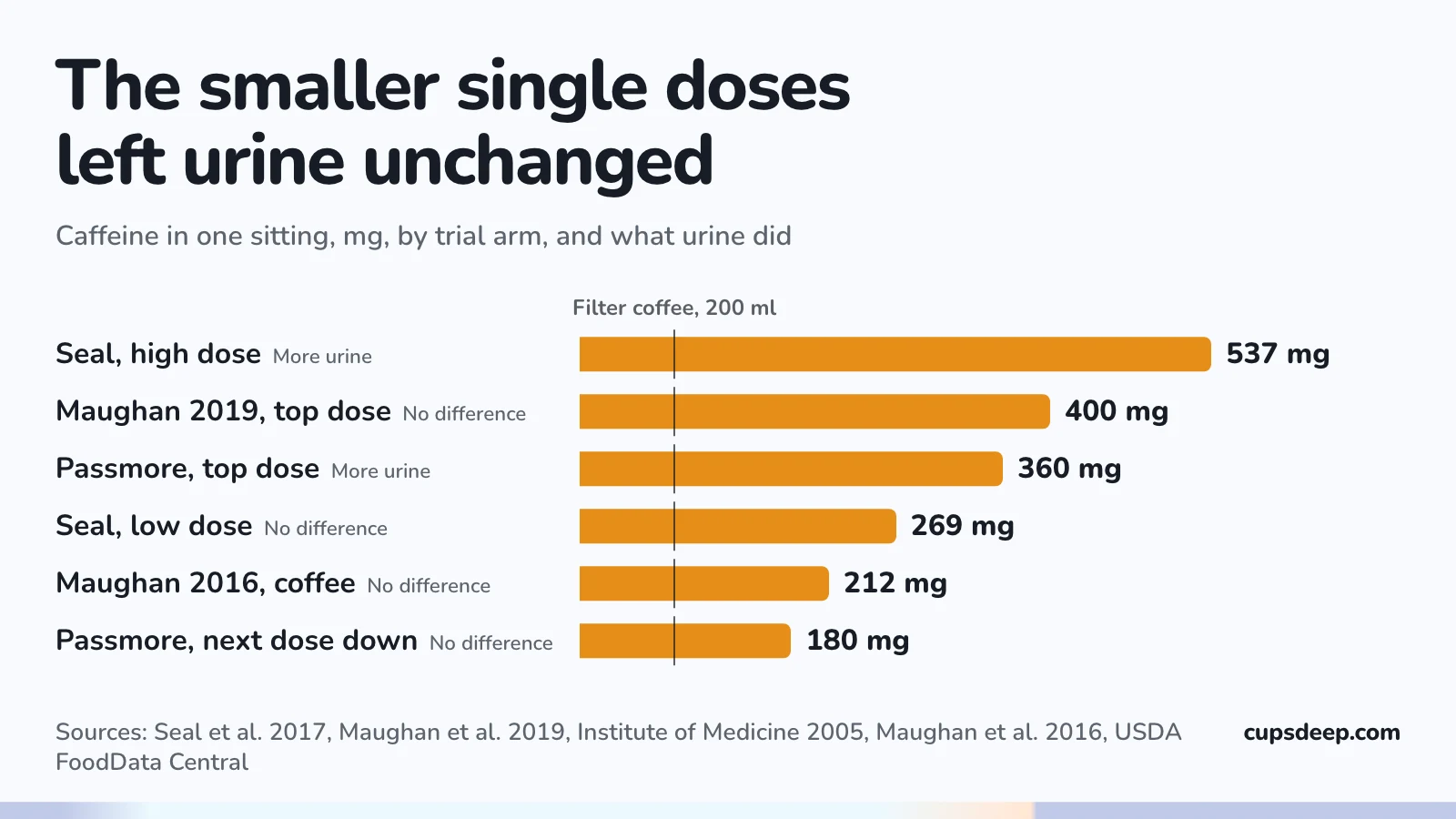
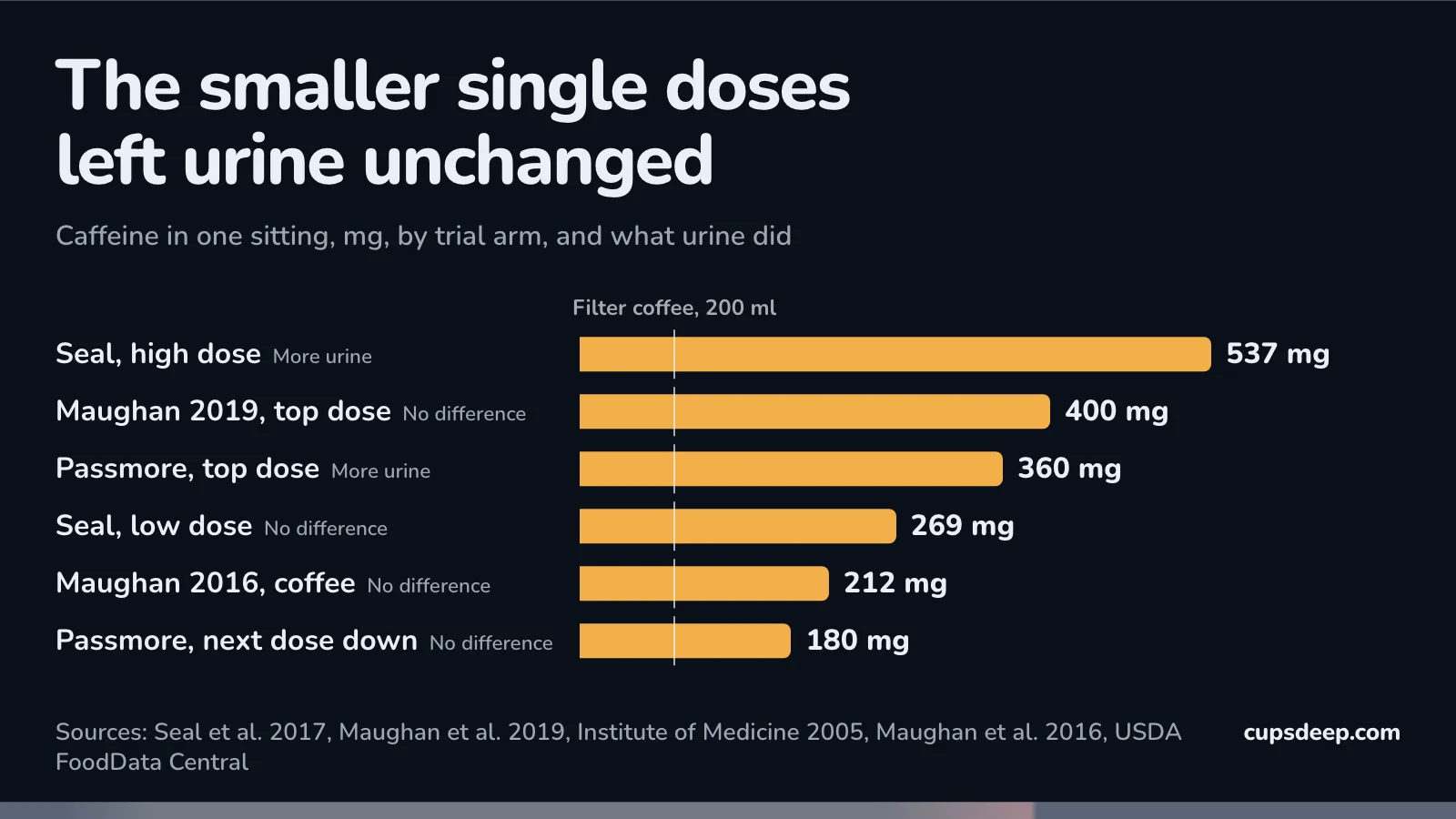
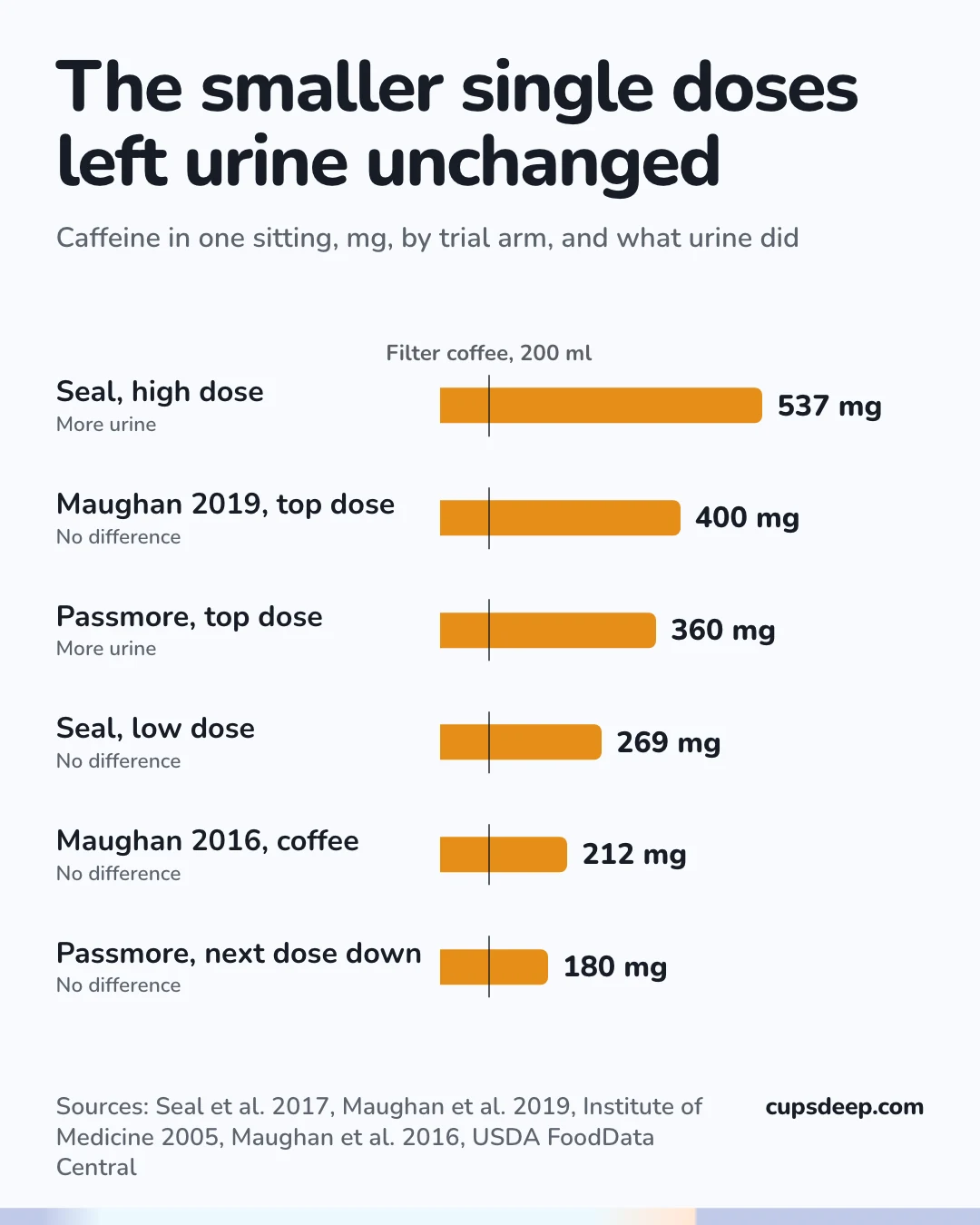
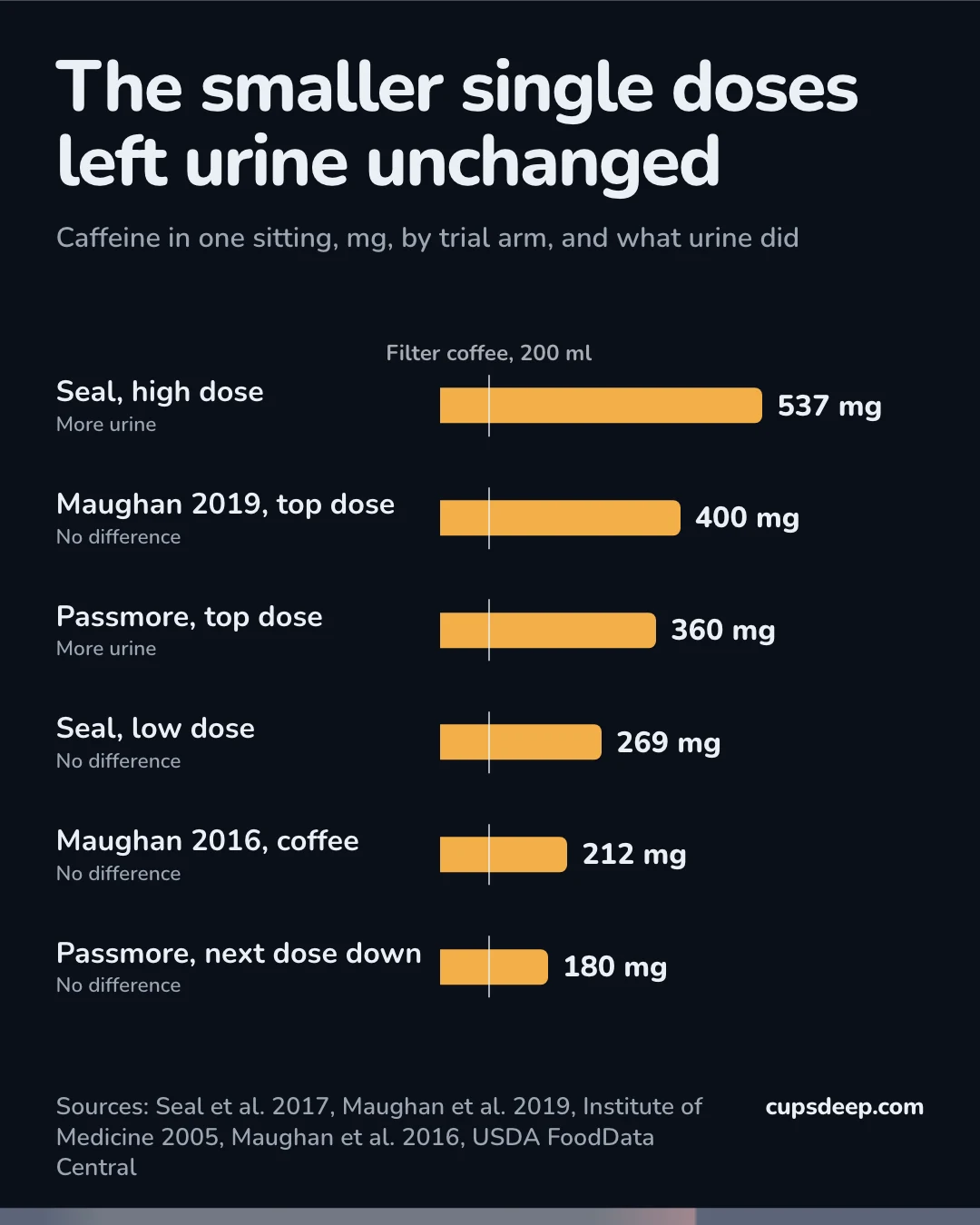
Note that the trials do not all agree. 400 mg in a liter of drink did nothing measurable in one 2019 trial, while 360 mg did something in an older one. The older study took caffeine away for 24 hours first, after 5 days on about 240 mg a day. The newer one asked for an overnight fast of at least 8 hours and says nothing else about caffeine. Seal’s volunteers, who did show extra urine at 537 mg, had also gone 24 hours without it. A day off is shorter than the “days or weeks” the review describes, and none of these studies was built to test habit.
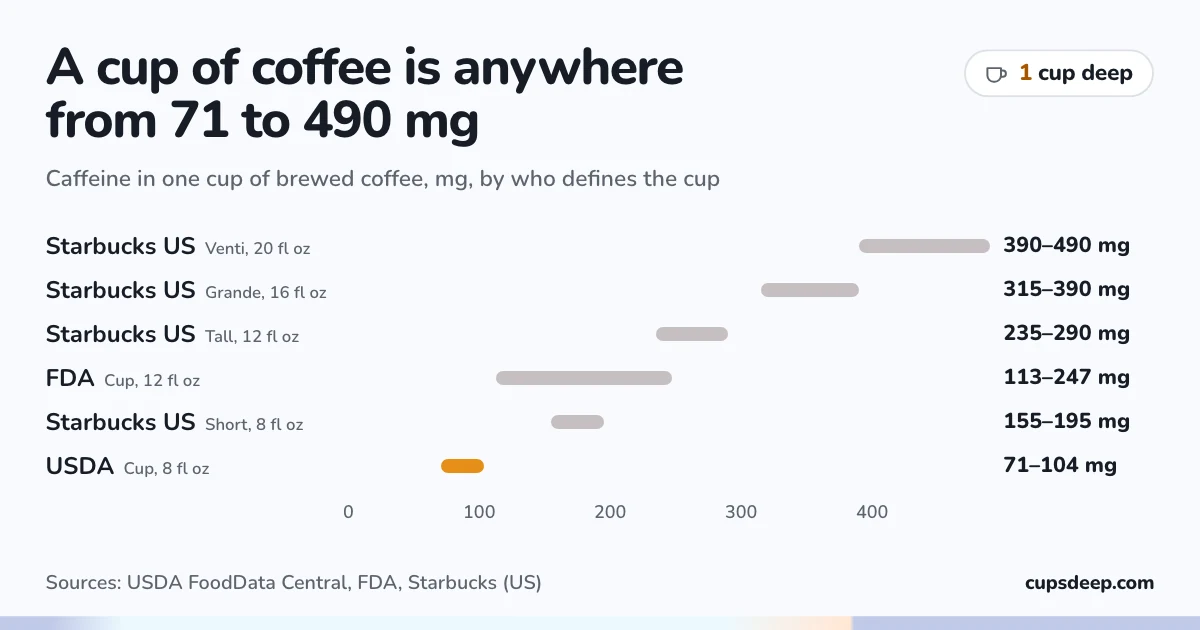
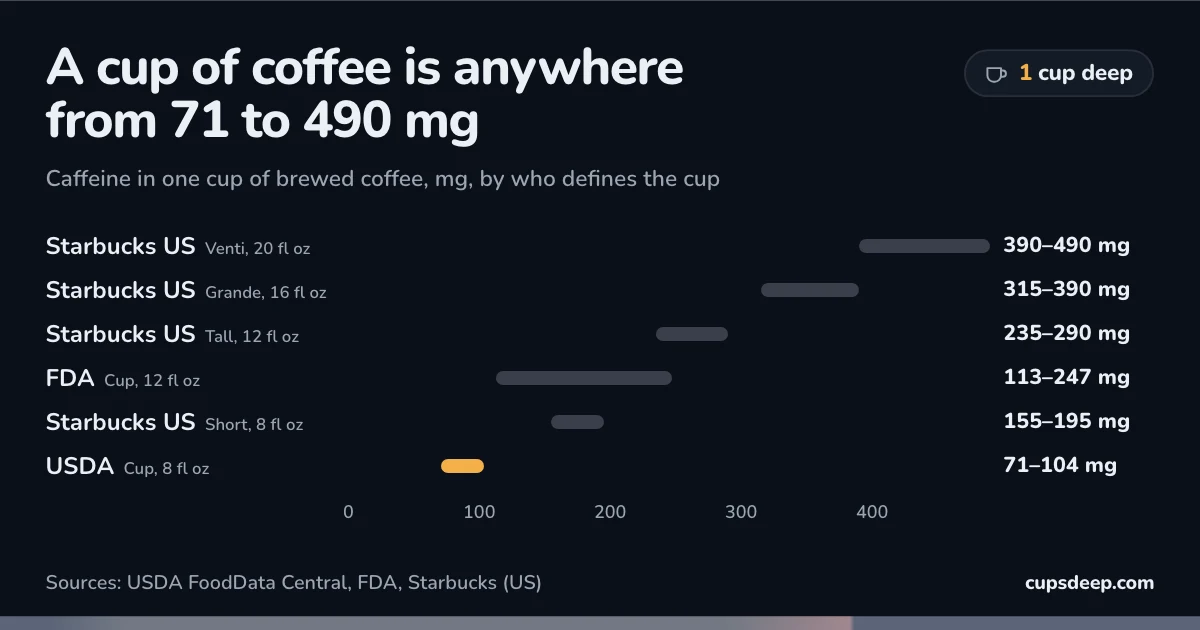
Now the arithmetic, which is ours. A USDA cup of brewed coffee (8 fl oz) is 94.8 mg, about 32% of the top of that band, and it takes 2.6–3.2 cups to reach it. A Starbucks US Grande brewed coffee (Blonde, Pike Place or dark roast) is 315–390 mg, so one of them is above the band on its own. Strength varies more than you would think; what is in a cup of coffee and the strongest coffees have the spread.
A Grande is not a cup of coffee. It is a dose study with a lid
Does coffee dehydrate you more if you don’t drink it often?
That is what the 2003 review concludes. The review above says the effect shows up in people deprived of caffeine for days or weeks and is much diminished in regular tea and coffee drinkers. The clearest positive result we found is a study that took caffeine away first.
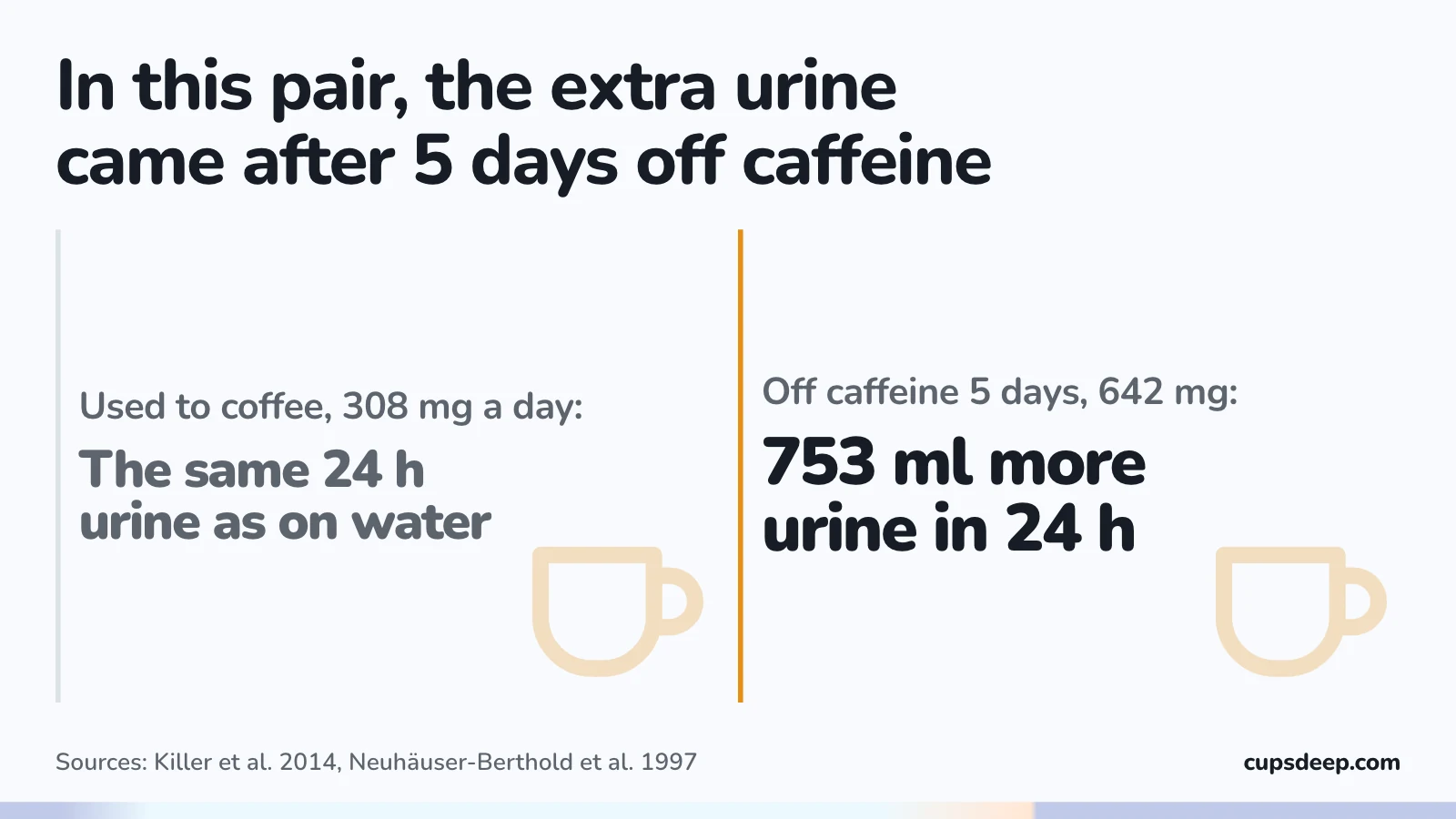
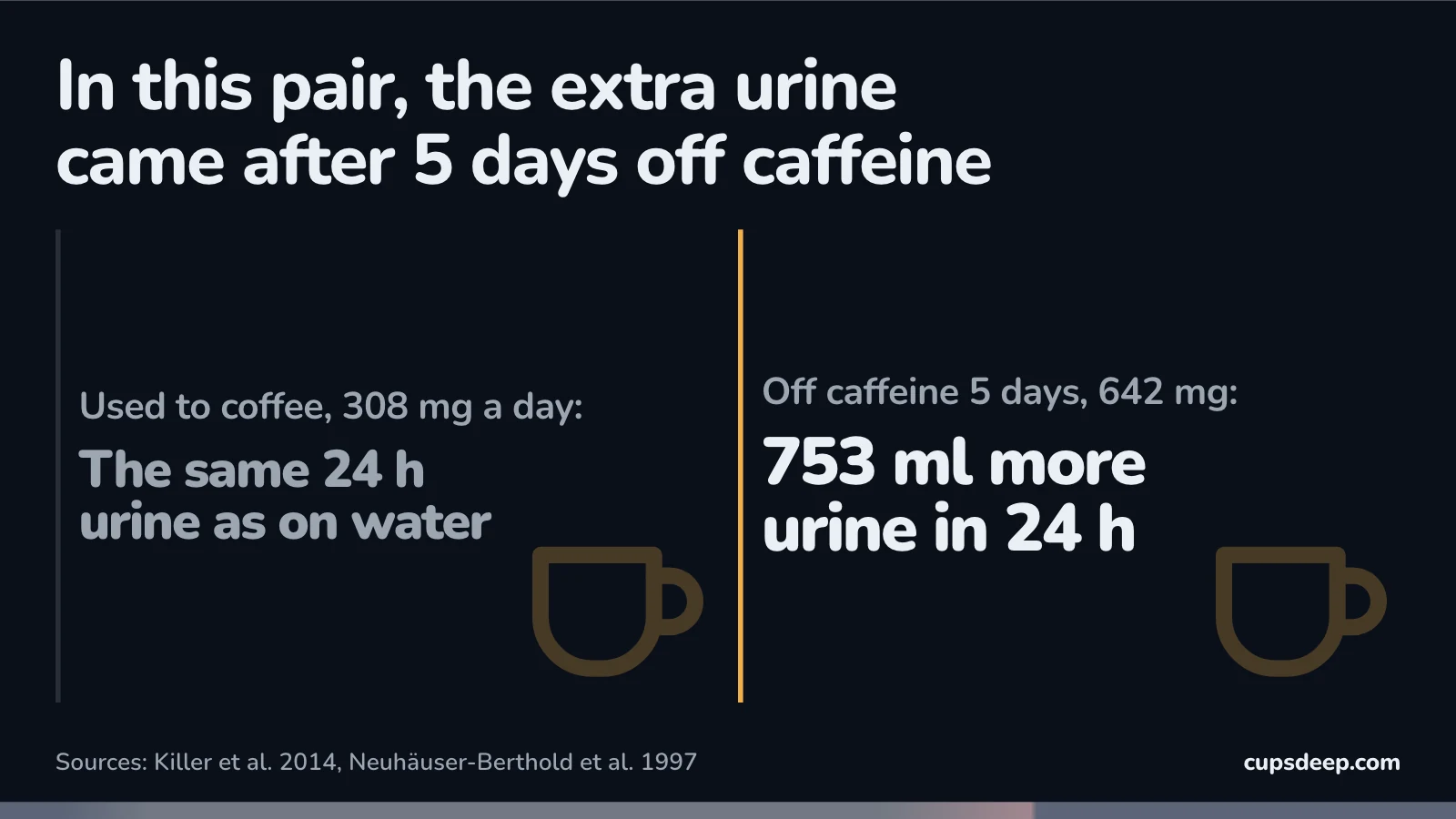
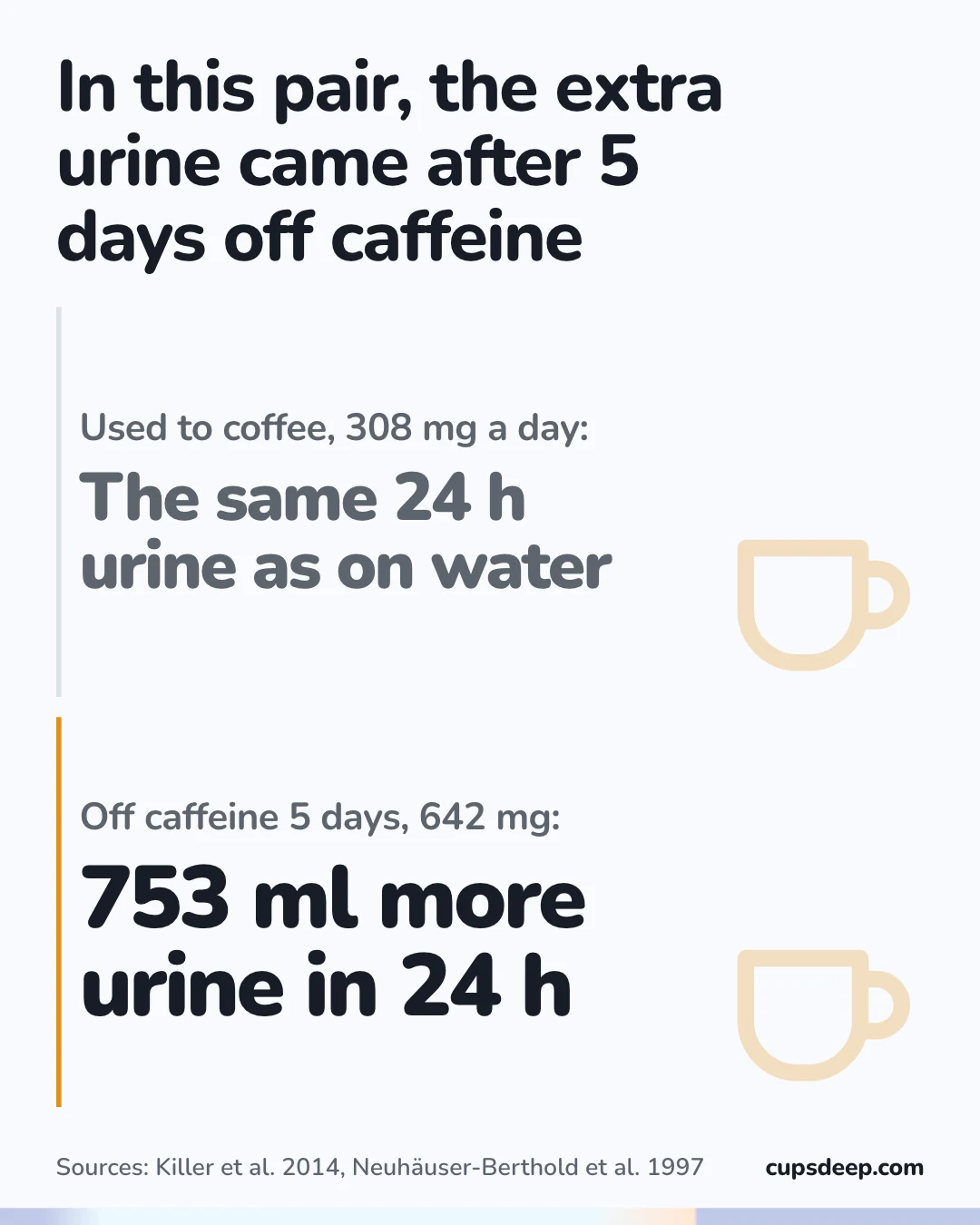
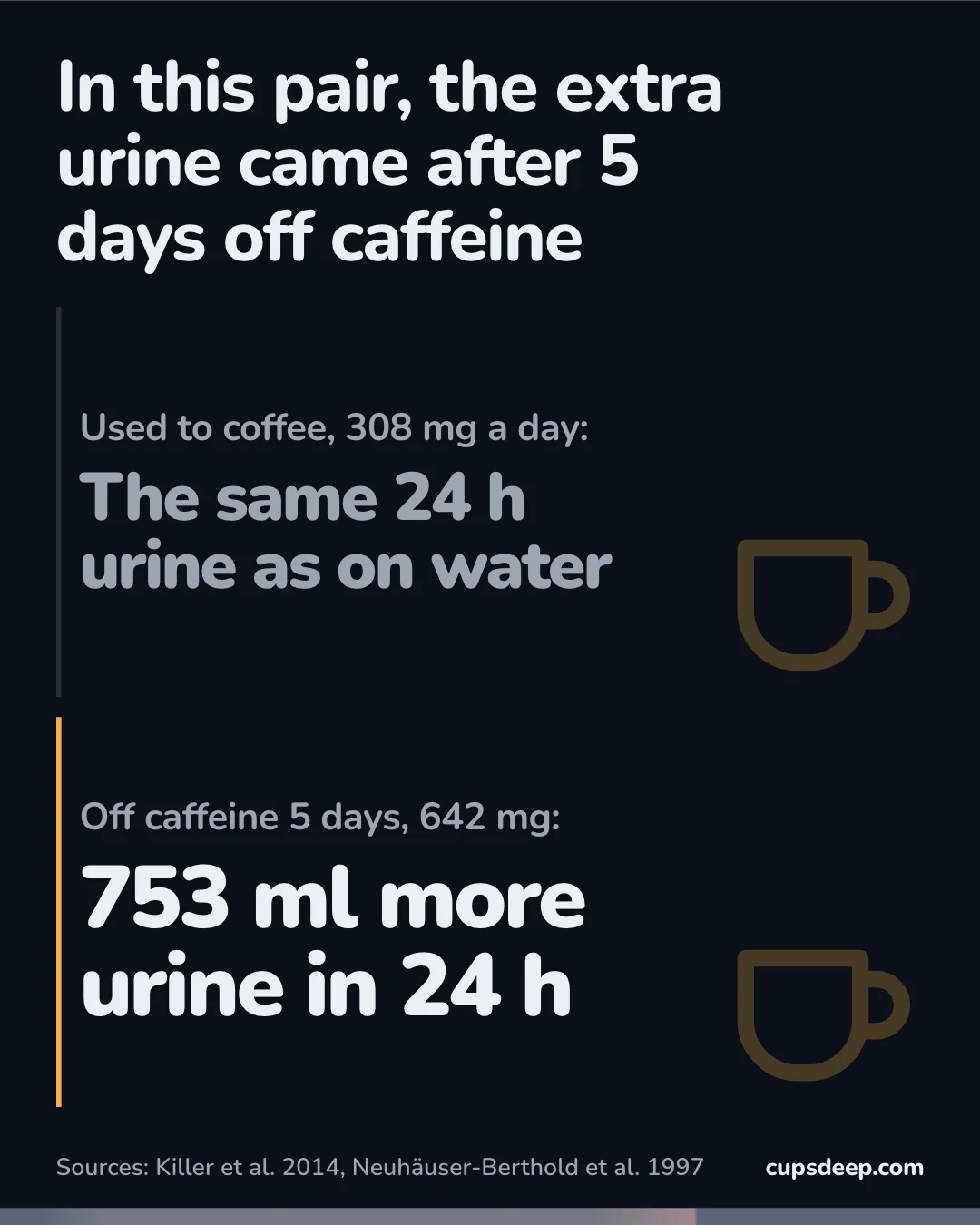
In a study by Neuhäuser-Berthold and colleagues (1997), 12 healthy volunteers abstained from caffeine and the other methylxanthines for 5 days and ate a standardized diet. On the second test day part of their mineral water was replaced by 6 cups of coffee holding 642 mg of caffeine, with the same total fluid. 24-hour urine rose by 753 ml, body weight fell by 0.7 kg and total body water, measured by bioelectrical impedance, fell by 1.1 kg or 2.7%. The Institute of Medicine, describing the study, calls the rise in urine 41% and says the volunteers normally drank caffeinated drinks. Read as an abstract only, which states no funding. 613616
On the other side, a trial that kept men on controlled caffeine for 11 days found no difference in any hydration marker it reported, even in the group whose dose was doubled for the second stretch.
In a trial by Armstrong and colleagues (2005), healthy young men took 3 mg of caffeine per kg of body weight a day for 6 days, then 0 (20 men), 3 (20 men) or 6 mg per kg a day (19 men) in capsules for 5 more days, with no other caffeine. Body mass, 24-hour urine volume and the urine and blood markers of hydration did not differ between the doses and stayed within normal clinical ranges; the authors report no evidence of hypohydration in any group. Read as an abstract only, which states no funding. 614
Pooled across studies, the effect is real but small. A 2015 meta-analysis of 16 studies, at a median dose of 300 mg, found caffeine raised urine by 109 ml on average, or 16%. The abstract reports a larger effect in women than in men, and an effect that was significant at rest but not during exercise. In the full paper, dose did not explain the differences between studies. Tolerance turns up elsewhere too: why caffeine makes you tired covers it for alertness, and caffeine withdrawal covers what happens when the habit stops.
My kidneys have seen so much coffee they no longer comment on it. Tolerance is the only training plan I have ever stuck to
Can coffee make you lose more water than you drank?
In one trial we read, yes, at 537 mg in one cup. The 1997 study above also ended its coffee day with a negative fluid balance, but its volunteers had been off caffeine for 5 days. This one tested people who drink one to three coffees a day, after 24 hours without caffeine.
In a crossover trial by Seal and colleagues (2017), 10 healthy adults (8 men, 2 women), habitual drinkers of 1–3 cups of coffee a day, drank 200 ml of water, or 200 ml of instant coffee at 3 or 6 mg of caffeine per kg of body weight, on separate mornings after 24 hours without caffeine, and urine was collected for 3 h. The doses came to 269 mg and 537 mg of caffeine. After the high dose urine was 613 ml, against 356 ml after water (257 ml more, by our arithmetic) and 316 ml after the low dose. The authors conclude that 6 mg per kg as coffee can induce an acute diuretic effect, while 3 mg per kg did not disturb fluid balance in healthy casual coffee drinkers at rest. The study was funded by the Graduate Program of the Department of Nutrition and Dietetics at Harokopio University; one author is a scientific consultant for the Gatorade Sports Science Institute and another was a scientific consultant for Quest Diagnostic and has active grants with Danone Research. 612
By our arithmetic from the means in Seal 2017, the high-dose coffee left 257 ml more urine over 3 h than water did, more than the 200 ml of coffee drunk, while the low dose left 40 ml less than water. These are differences between group means, not a figure the paper reports. 612
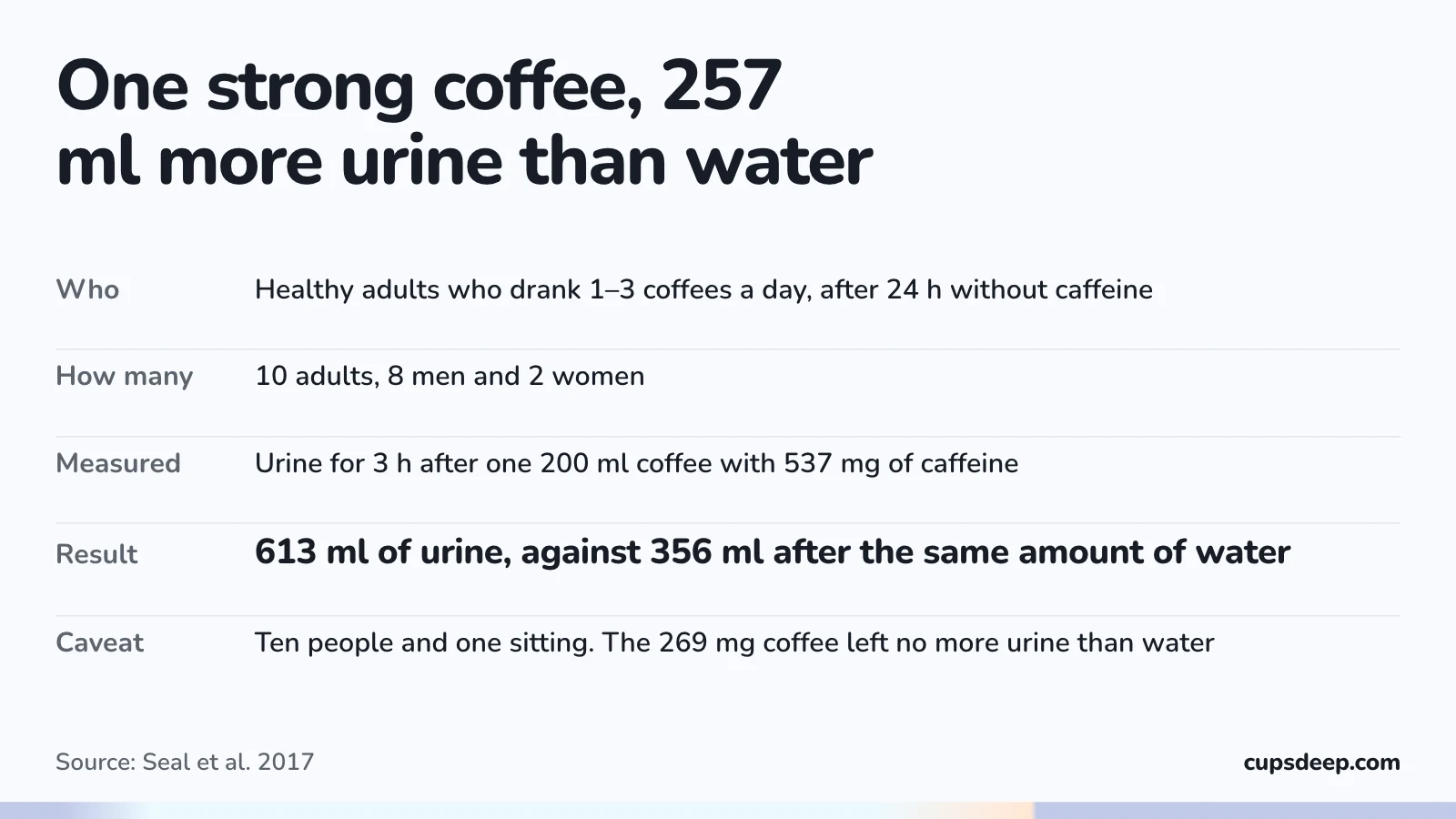
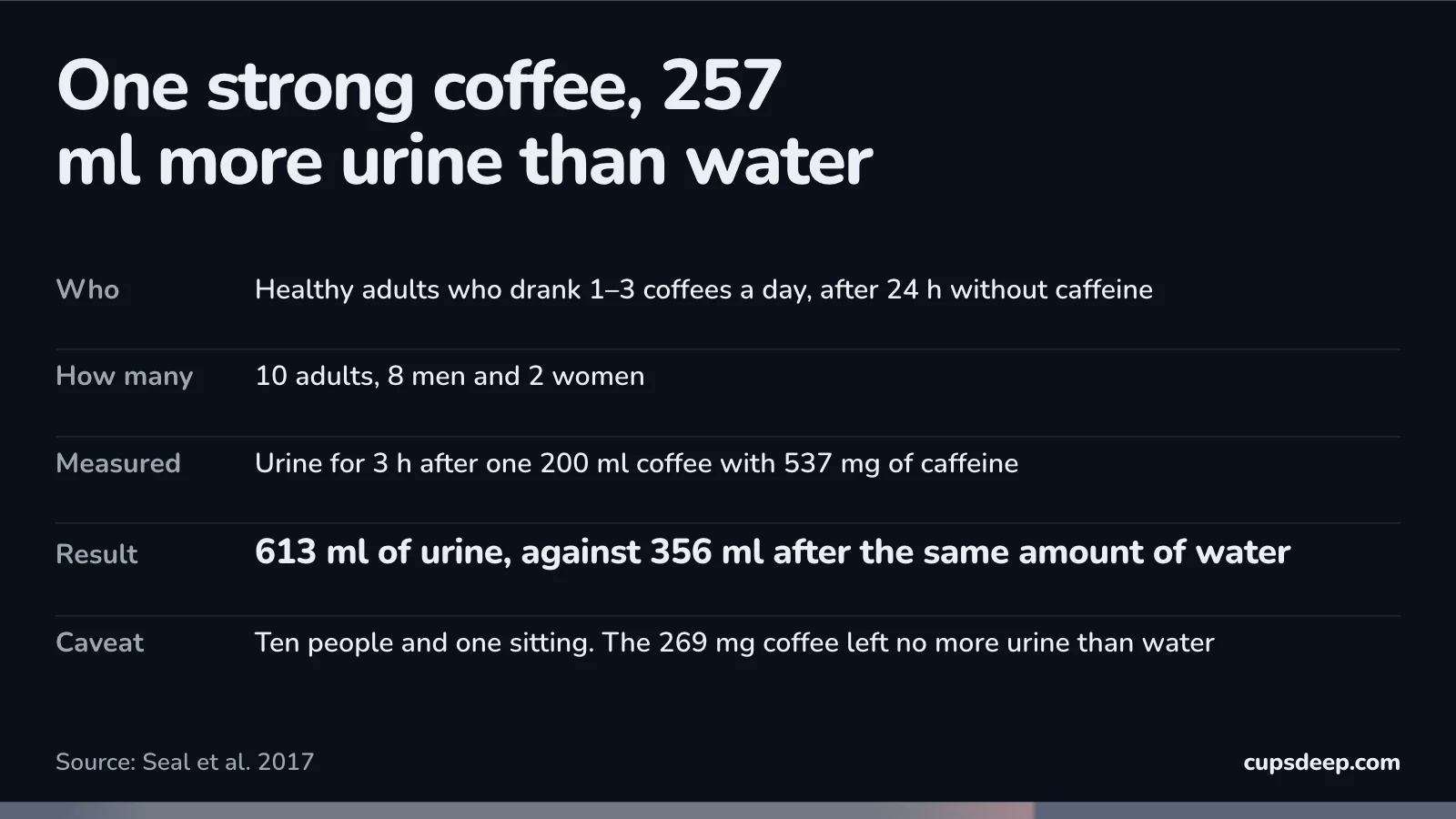
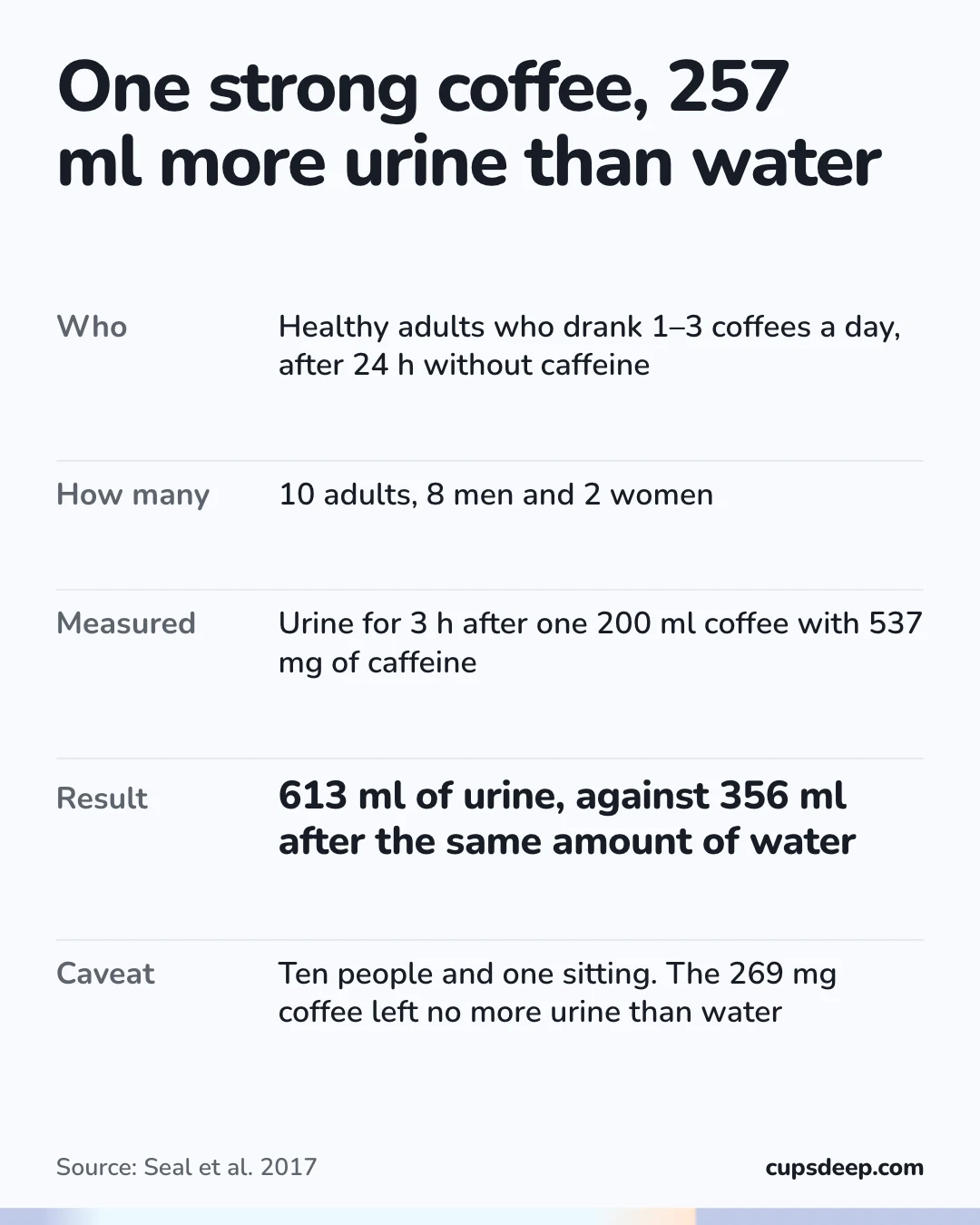
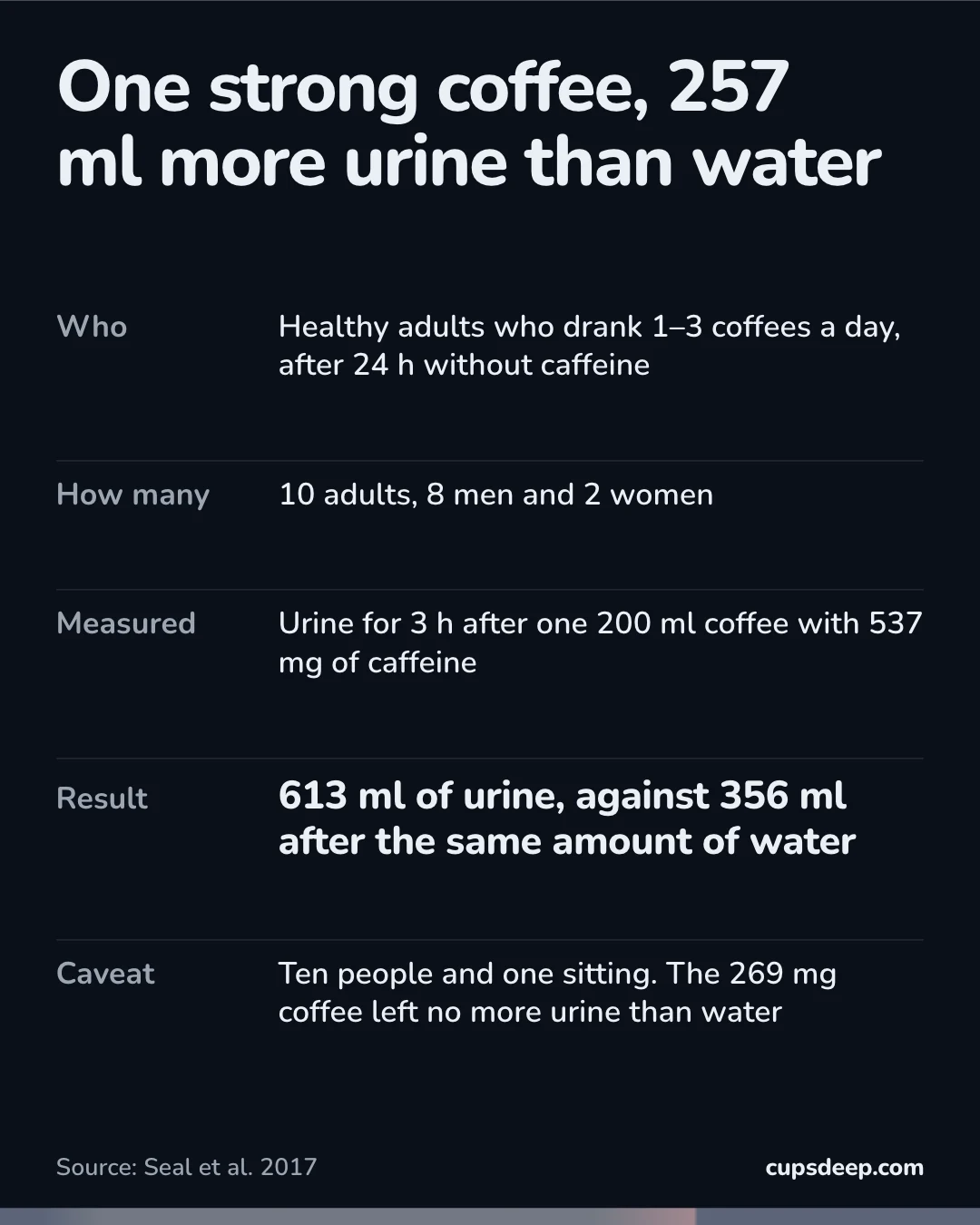
Put the high dose in cups: 537 mg is about 5.7 cups of USDA brewed coffee, squeezed into one 200 ml drink, by our arithmetic. The same people at 269 mg produced no more urine than water. That is the dose gap the review describes, inside a single study, in daily coffee drinkers who had skipped caffeine for 24 hours, a shorter break than the review’s days or weeks. It is also 10 adults, measured for 3 hours, which is a reason to treat it as one result and not a rule.
Does coffee count toward your daily water intake?
The US reference values say yes. This is the Institute of Medicine’s line from its water report, the report that sets the US Adequate Intake for water.
The Institute of Medicine’s 2005 water report says the data on caffeine are inconsistent, that higher doses (above 180 mg a day) have been shown to increase urine output, perhaps transiently, and concludes: “unless additional evidence becomes available indicating cumulative total water deficits in individuals with habitual intakes of significant amounts of caffeine, caffeinated beverages appear to contribute to the daily total water intake similar to that contributed by noncaffeinated beverages.” 616
Note the conditions in that sentence. It holds unless new evidence turns up of cumulative water deficits in heavy habitual drinkers, and the same paragraph says doses above 180 mg a day have been shown to raise urine output, perhaps for a short time. Since then, the 2014 trial above found no deficit at 308 mg a day, and a 2019 trial concluded that drinks with up to 400 mg of caffeine can count toward daily fluid targets.
The Institute of Medicine sets the Adequate Intake of total water, from drinking water, other drinks and food, at 3.7 L a day for men and 2.7 L for women aged 19 to 30, from the median intake in US survey data. Drinks of all kinds supplied 3.0 L for the men and 2.2 L for the women, about 81% of the total. The report says the AI should not be interpreted as a specific requirement. 616
Those are totals, from food as well as drinks, set from what Americans were already taking in. In one 2016 trial, a liter of coffee left no more urine over 4 hours than a liter of still water. Milk and an oral rehydration solution were the only drinks that left less. The paper shows coffee’s hydration index only as a bar in a chart, so we do not print a number for it.
Who paid for the coffee hydration studies?
Several were funded by bodies devoted to coffee or hydration research, and the papers say who. Here is what each paper states, so you can weigh it. We are not saying any result is wrong because of who paid for it.
| Study | Funded by, in the paper’s words | Also declared |
|---|---|---|
| Killer 2014 | Institute for Scientific Information on Coffee (ISIC), “a non-profit organisation, devoted to the study and disclosure of science related to coffee and health”, which had no role in study design, data collection and analysis, decision to publish, or preparation of the manuscript | One author employed by PepsiCo |
| Maughan 2016 | A grant from the European Hydration Institute | The lead author was chair of its scientific advisory board; another author had received its funding for other hydration research in the past 3 years |
| Maughan 2019 | In part by the European Hydration Institute, which had no role in design, analysis or writing | The lead author had chaired its scientific advisory board; another author had received its funding for other hydration research in the past 3 years |
| Seal 2017 | The graduate program of the nutrition department at Harokopio University | One author consults for the Gatorade Sports Science Institute; another was a scientific consultant for Quest Diagnostic and has active grants with Danone Research |
| Neuhäuser-Berthold 1997 | Not stated in the abstract we read | Not read |
| Armstrong 2005 | Not stated in the abstract we read | Not read |
ISIC is the Institute for Scientific Information on Coffee; EHI is the European Hydration Institute. We read Killer, Maughan and Seal in full and the other two as abstracts only, so a blank there means we did not see it, not that there is none.
The ISIC- and EHI-funded trials found no extra urine at 308 mg a day and up to 400 mg at once. The university-funded trial found extra urine at 537 mg and none at 269 mg. The doses differ, so this does not show whether funding mattered. Of the two abstracts with no funding statement, Neuhäuser-Berthold found extra urine and Armstrong found none.
Questions people ask
Does caffeine dehydrate you?
Not at everyday doses in people used to it. Caffeine raises urine for a short time after a large single dose, at least 250–300 mg, mainly in people who have been off it for days or weeks, according to a review of the studies. Men who drank coffee daily and took about 308 mg a day in a 2014 trial passed the same amount of urine a day as on water.
Is coffee a diuretic?
Caffeine is a mild one. A 2015 meta-analysis of 16 studies found caffeine raised urine by 109 ml on average, at a median dose of 300 mg, and the effect was not significant during exercise. Ordinary servings of coffee, tea and soda appear to have no diuretic action, a 2003 review says.
How many cups of coffee before it dehydrates you?
The single dose a 2003 review links to extra urine, in people off caffeine, is at least 250–300 mg, which it equates to 2–3 cups of coffee. The Institute of Medicine calls the 360 mg that raised urine in one study “equivalent to four cups of regular brewed coffee”. By our arithmetic the review’s band is 2.6–3.2 cups of USDA brewed coffee at once, and one Starbucks US Grande brewed coffee (315–390 mg) is above it. Habitual drinkers on about 308 mg a day, spread over four mugs, showed no difference from water.
Is coffee as hydrating as water?
In two trials, about the same. In three-day trials, men used to coffee passed 2,409 ml of urine a day on coffee and 2,428 ml on water, and their body water did not differ. In another trial a liter of coffee left no more urine over 4 hours than a liter of still water.
Does coffee count as water intake?
The Institute of Medicine says caffeinated drinks “appear to contribute to the daily total water intake similar to that contributed by noncaffeinated beverages”, unless new evidence shows deficits in heavy habitual drinkers. Its Adequate Intake of total water, from food and drinks, is 3.7 L a day for men and 2.7 L a day for women aged 19 to 30.
Does caffeine dehydrate you during exercise?
The pooled evidence says the effect fades. A 2015 meta-analysis found caffeine’s effect on urine was significant at rest but not during exercise, and called it a minor diuretic effect “negated by exercise”. It reported women as more susceptible than men.
Sources
Every number above links to the place it came from. How the numbers are chosen and checked is on the method page; the drink table is at /drinks. Written with AI agents, as the whole site is. A model of a typical body, not advice for pregnancy, illness or medication.
- Beverages, coffee, brewed, prepared with tap water
- Blonde Roast – Starbucks Christmas Blonde: product data (starbucks.com, United States), holiday 2026 edition
- No Evidence of Dehydration with Moderate Daily Coffee Intake: A Counterbalanced Cross-Over Study in a Free-Living Population
- A randomized trial to assess the potential of different beverages to affect hydration status: development of a beverage hydration index (author’s accepted manuscript)
- Sucrose and sodium but not caffeine content influence the retention of beverages in humans under euhydrated conditions (author’s manuscript)
- Caffeine ingestion and fluid balance: a review
- Coffee with High but Not Low Caffeine Content Augments Fluid and Electrolyte Excretion at Rest
- Coffee consumption and total body water homeostasis as measured by fluid balance and bioelectrical impedance analysis
- Fluid, electrolyte, and renal indices of hydration during 11 days of controlled caffeine consumption
- Caffeine and diuresis during rest and exercise: A meta-analysis
- Dietary Reference Intakes for Water, Potassium, Sodium, Chloride, and Sulfate, chapter 4: Water
Keep reading
Coffee
How much caffeine is in a cup of coffee?
An 8 fl oz cup of brewed coffee has about 95 mg of caffeine by USDA’s figure. A Starbucks cup the same size states 155 mg to 195 mg. Tables by size and type.
Body and sleep
Why does caffeine make me tired?
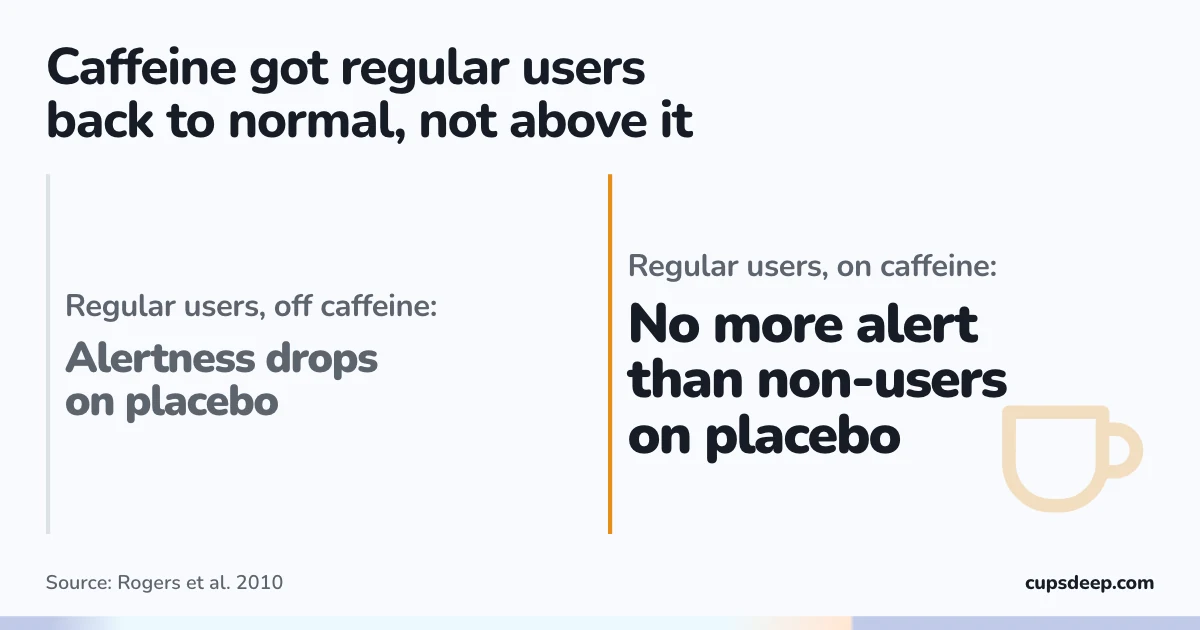
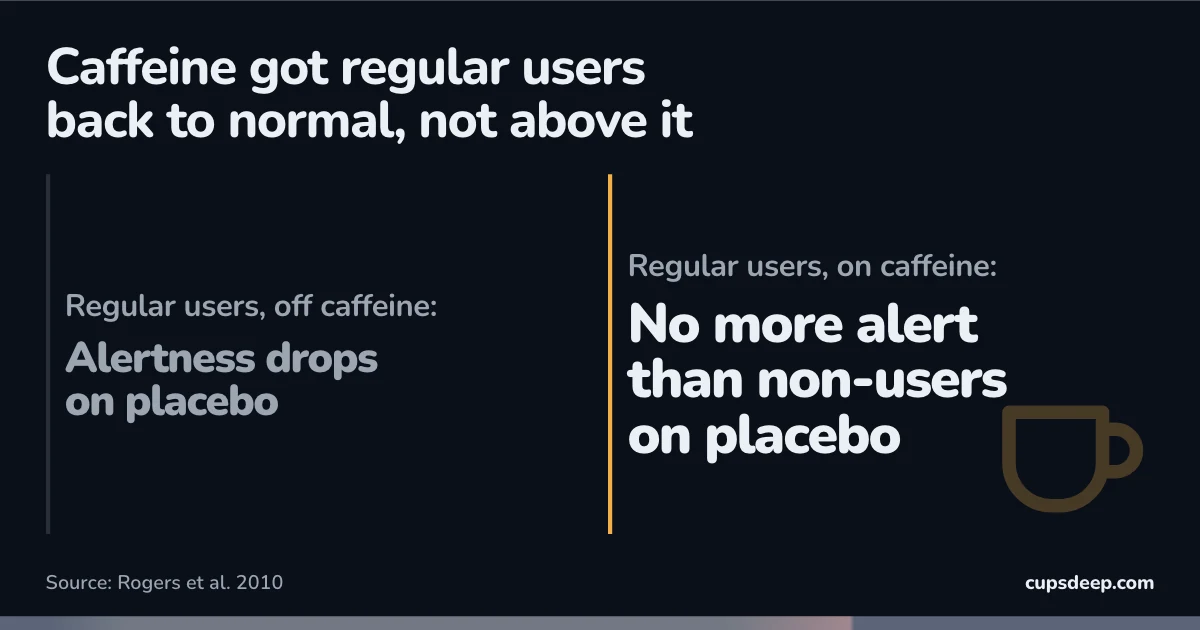
For daily drinkers the crash is mostly withdrawal: in a trial of 379 people, caffeine got regular users back to normal, not above it. Sugar and sleep, too.
Body and sleep
Caffeine withdrawal: symptoms and timeline
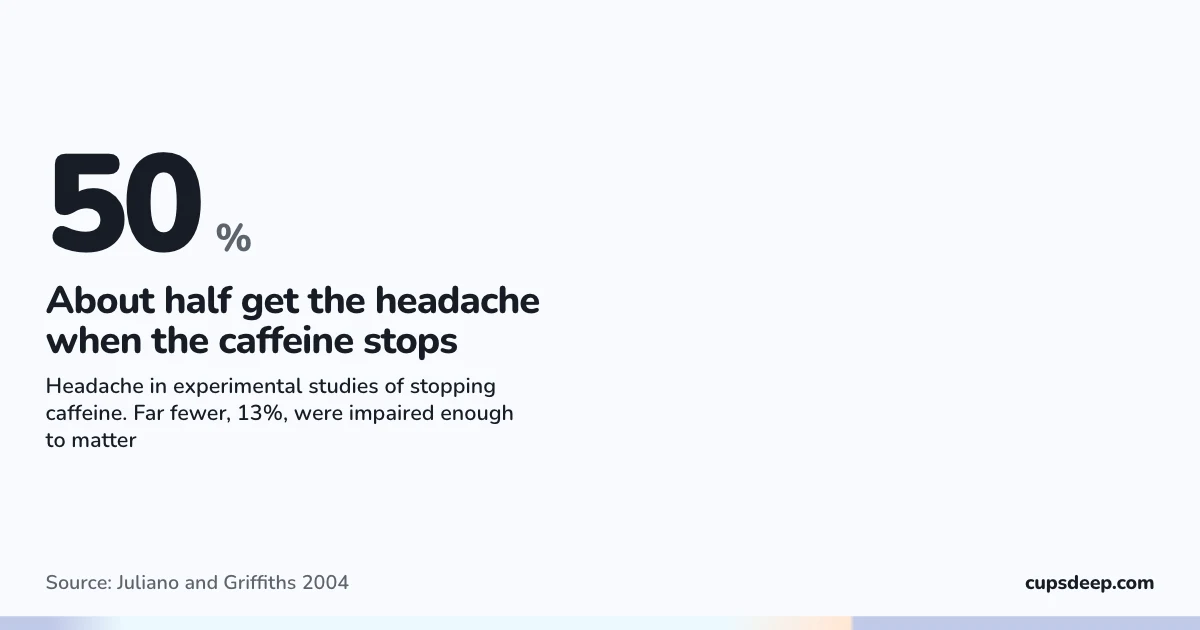
Caffeine withdrawal starts 12–24 hours after the last cup, peaks at 20–51 hours and lasts 2–9 days. About half get the headache. The odds and the fix.