Cappuccino vs latte: what is the difference?
You are ordering foam, not caffeine. The two names tell you what was done to the milk and nothing about the dose, which is set by a number the menu rarely prints: the shots.
The short answer
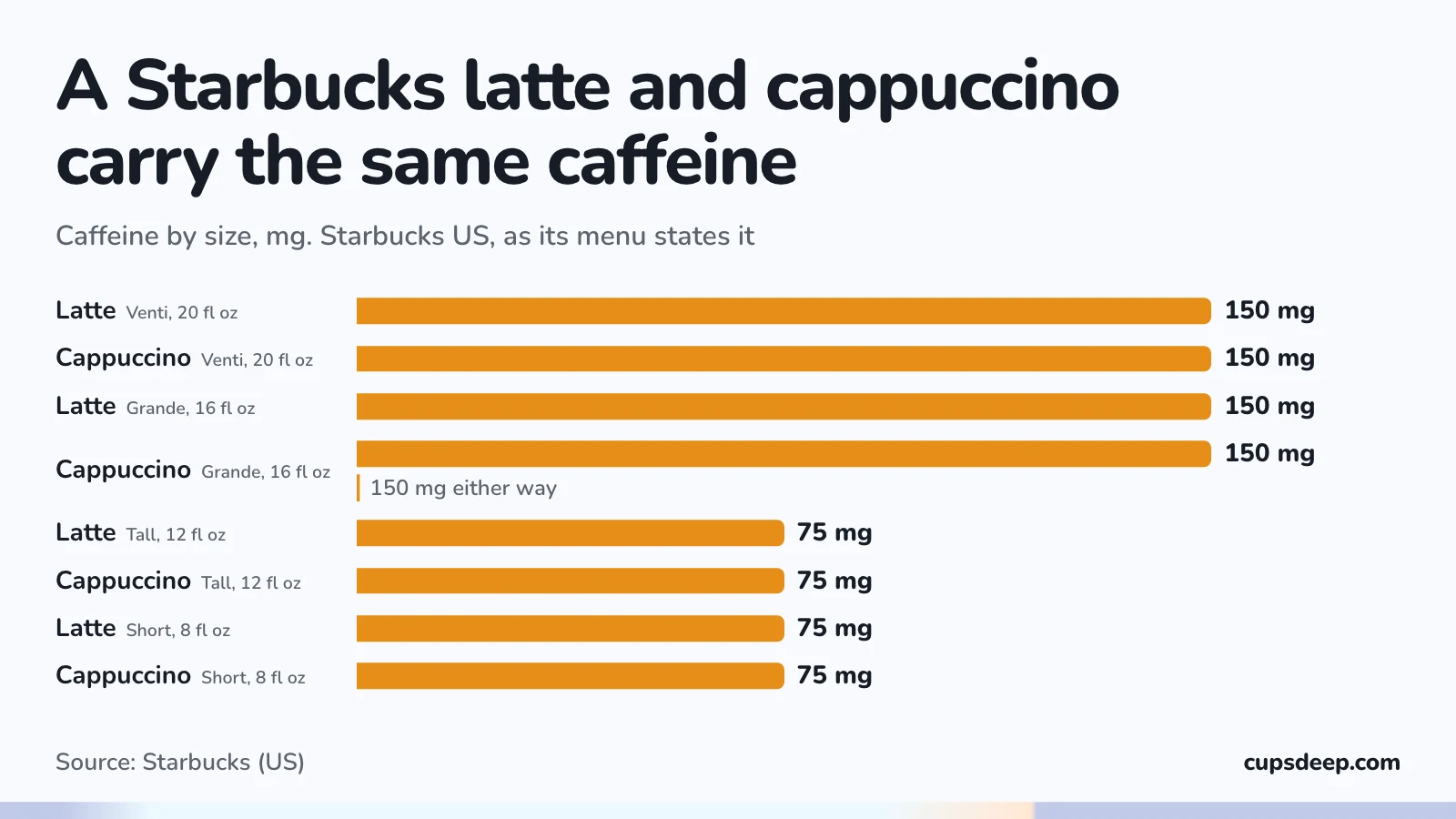
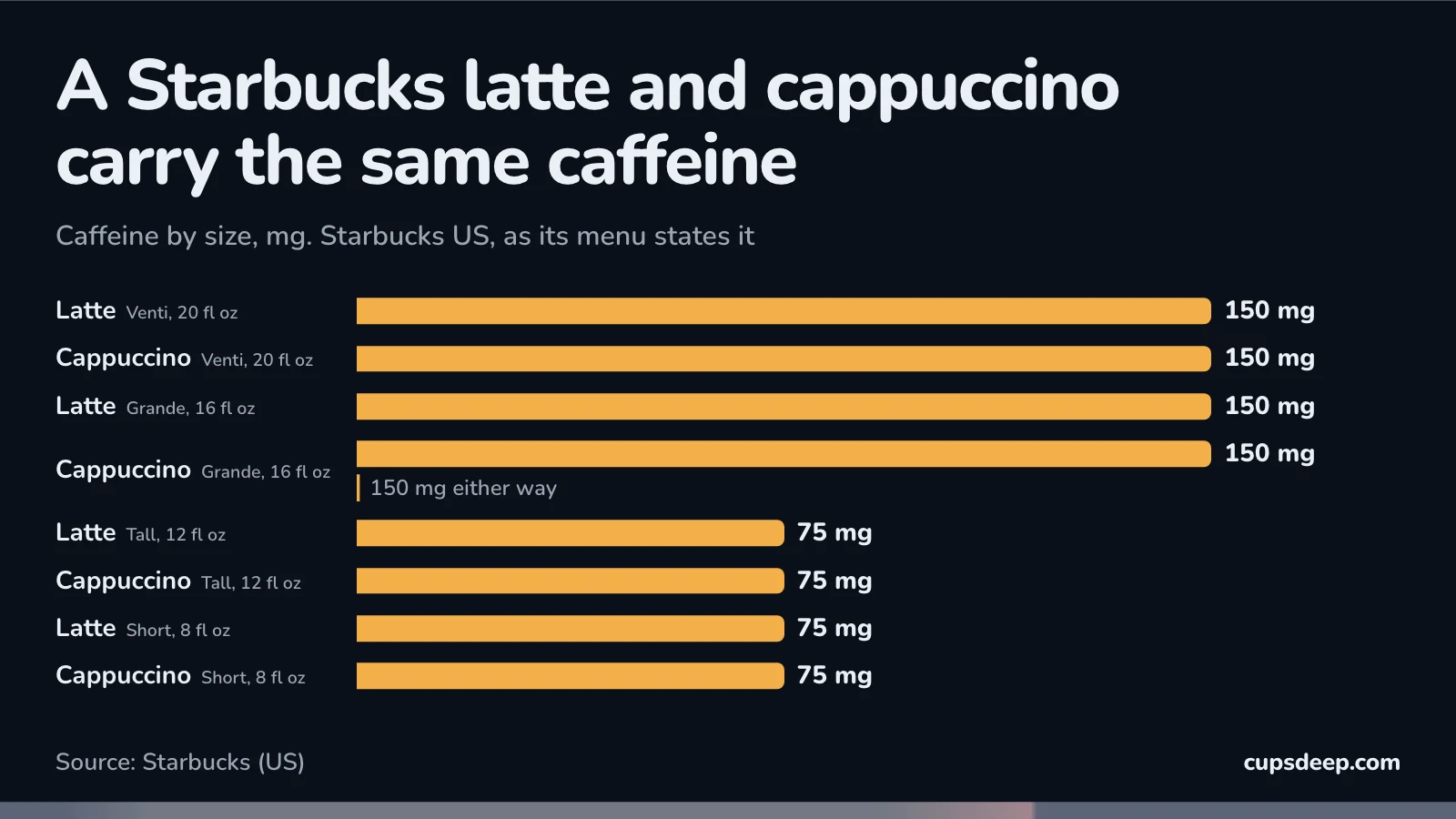
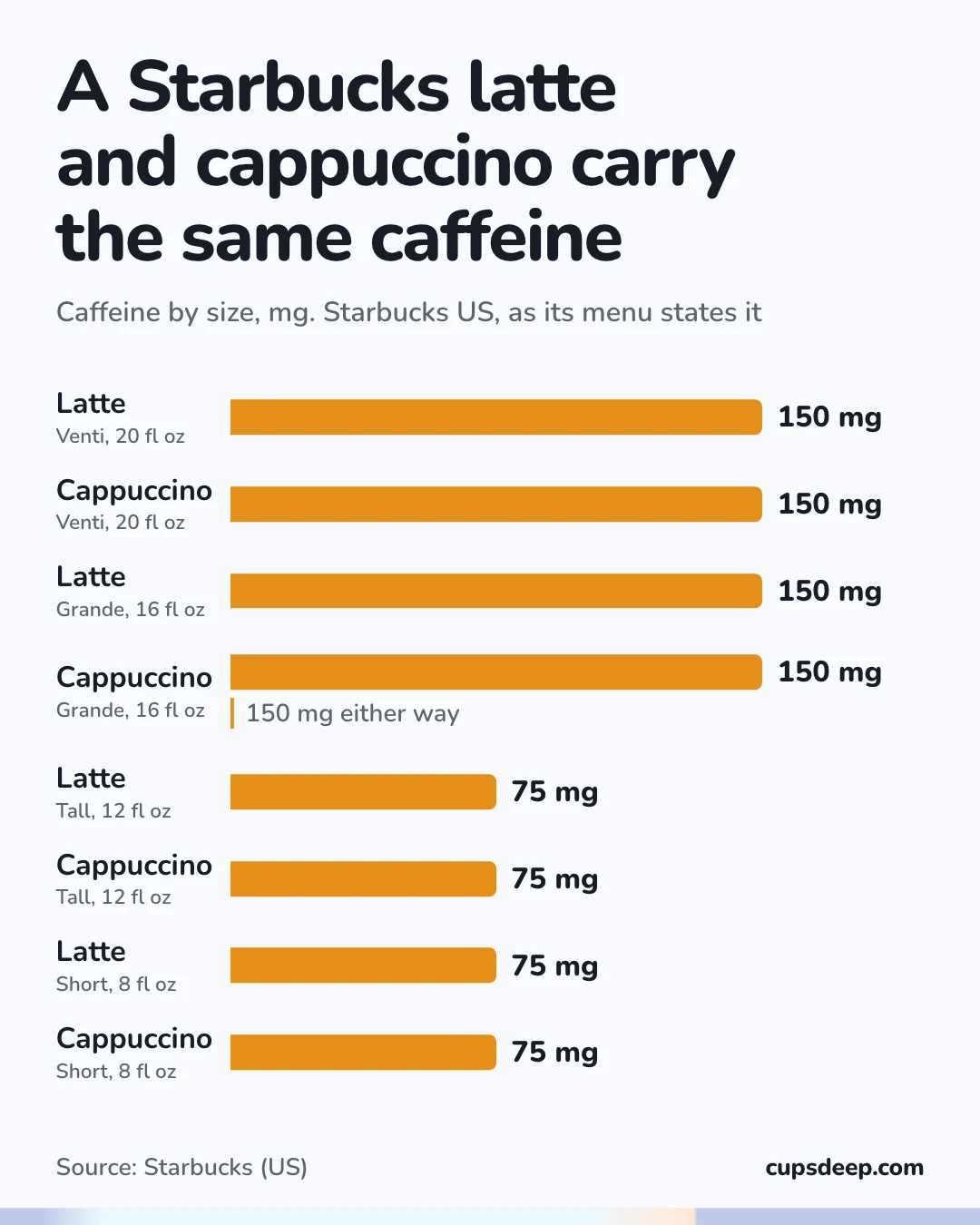
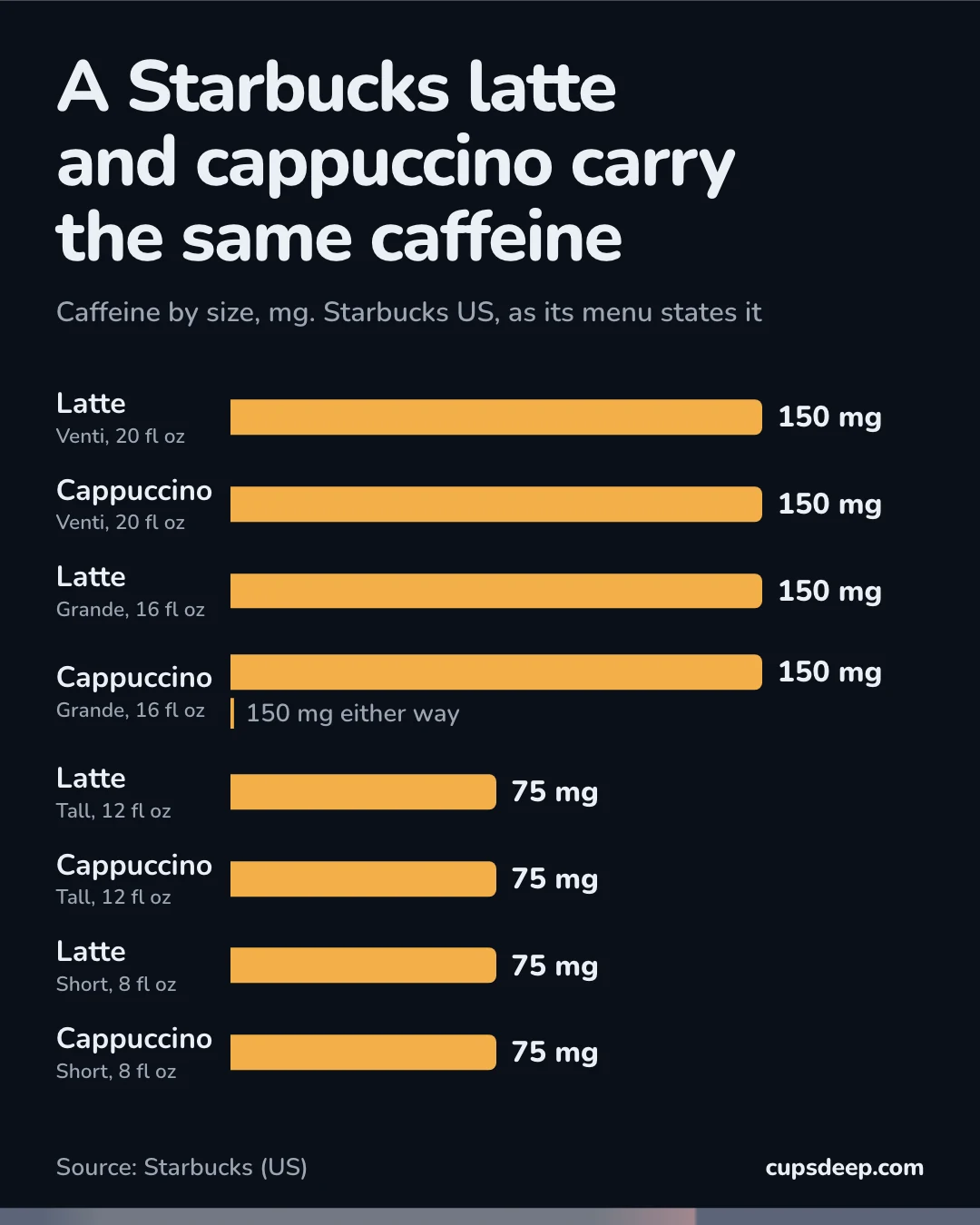
A cappuccino and a latte are the same espresso under different milk: a latte is mostly steamed milk with a thin layer of foam, a cappuccino is less milk under a thick one. The caffeine follows the shots, not the name. At Starbucks in the US both carry 75 mg at Tall and 150 mg at Grande, and the cappuccino has fewer calories; at Costa the cappuccino gets an extra shot at medium and large, so there it is the stronger drink.
What is the difference between a cappuccino and a latte?
Milk, and what was done to it. Both start as espresso. For a latte the barista adds a lot of steamed milk and finishes with a thin layer of foam. For a cappuccino the milk is stretched with more air, so the cup holds less liquid milk under a thick cap of foam. Same coffee, same machine, same shot. A cappuccino tastes stronger because there is less milk in the way, not because there is more coffee in it.
A cappuccino is a latte that skipped lunch
So a latte has more milk, always. Which one has more caffeine is a different question, and the name cannot answer it. The café decides how many shots go into each size, and cafés do not agree.
Which has more caffeine, a cappuccino or a latte?
At Starbucks in the US, neither. The chain publishes its recipes, and a latte and a cappuccino get the same shots at every size: one in a Short or a Tall, two in a Grande or a Venti. So the caffeine matches too: 75 mg for either at Tall, 150 mg for either at Grande.
| Drink and size | Shots | Caffeine | Calories |
|---|---|---|---|
| Latte, Short, 8 fl oz | One | 75 mg | 100 kcal |
| Latte, Tall, 12 fl oz | One | 75 mg | 150 kcal |
| Latte, Grande, 16 fl oz | Two | 150 mg | 190 kcal |
| Latte, Venti, 20 fl oz | Two | 150 mg | 250 kcal |
| Cappuccino, Short, 8 fl oz | One | 75 mg | 70 kcal |
| Cappuccino, Tall, 12 fl oz | One | 75 mg | 100 kcal |
| Cappuccino, Grande, 16 fl oz | Two | 150 mg | 140 kcal |
| Cappuccino, Venti, 20 fl oz | Two | 150 mg | 200 kcal |
| Flat white, Short, 8 fl oz | Two | 130 mg | 110 kcal |
| Flat white, Tall, 12 fl oz | Two | 130 mg | 170 kcal |
| Flat white, Grande, 16 fl oz | Three | 195 mg | 220 kcal |
| Flat white, Venti, 20 fl oz | Three | 195 mg | 290 kcal |
Hot drinks in Starbucks’ default recipes, as the chain states them. Starbucks calls its caffeine figures approximate. The latte and the cappuccino are made with reduced-fat milk (the two-percent kind); the flat white is made with whole milk and ristretto shots, so its calories are not like-for-like. Another milk changes the calories and leaves the caffeine alone.
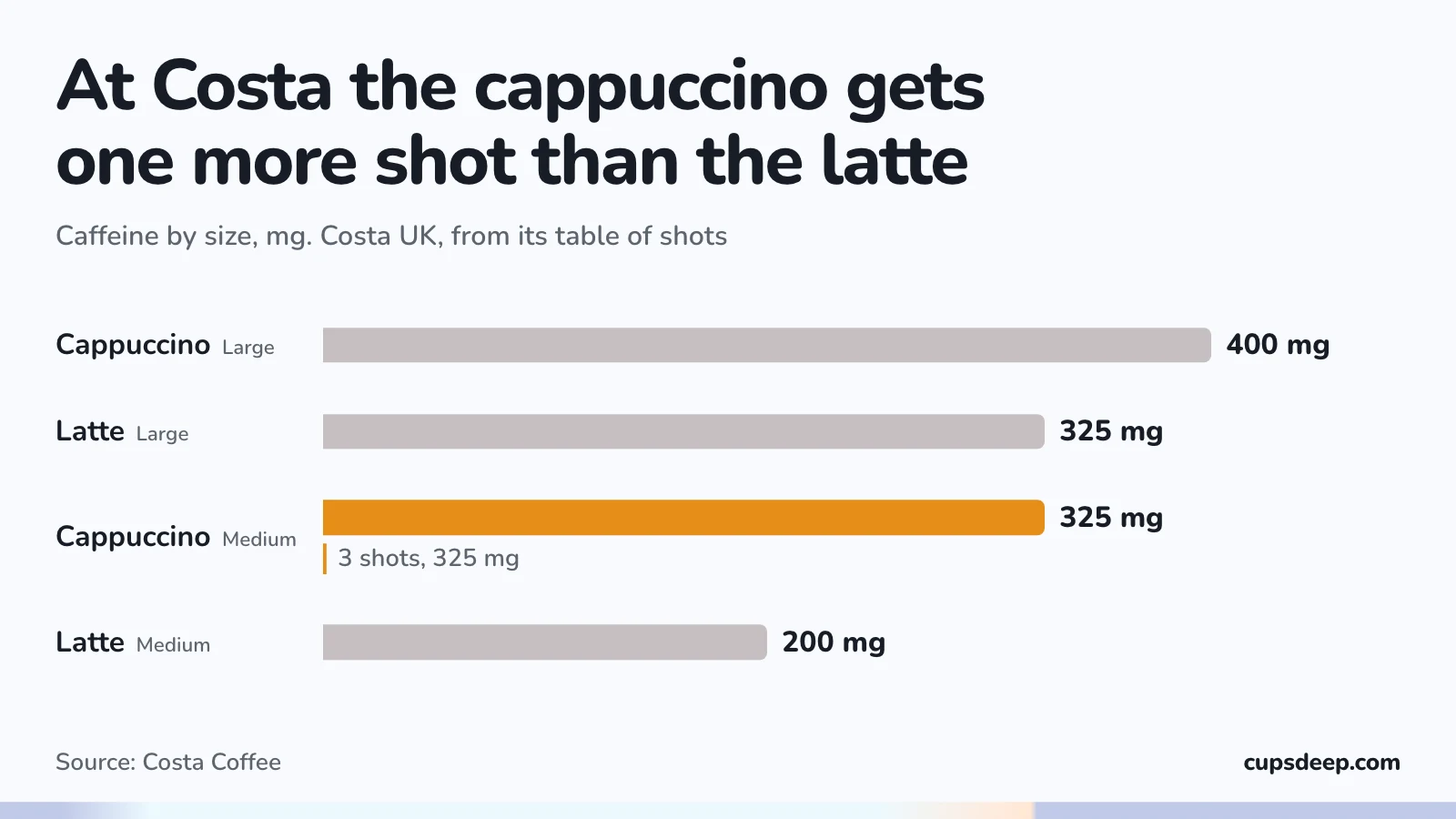
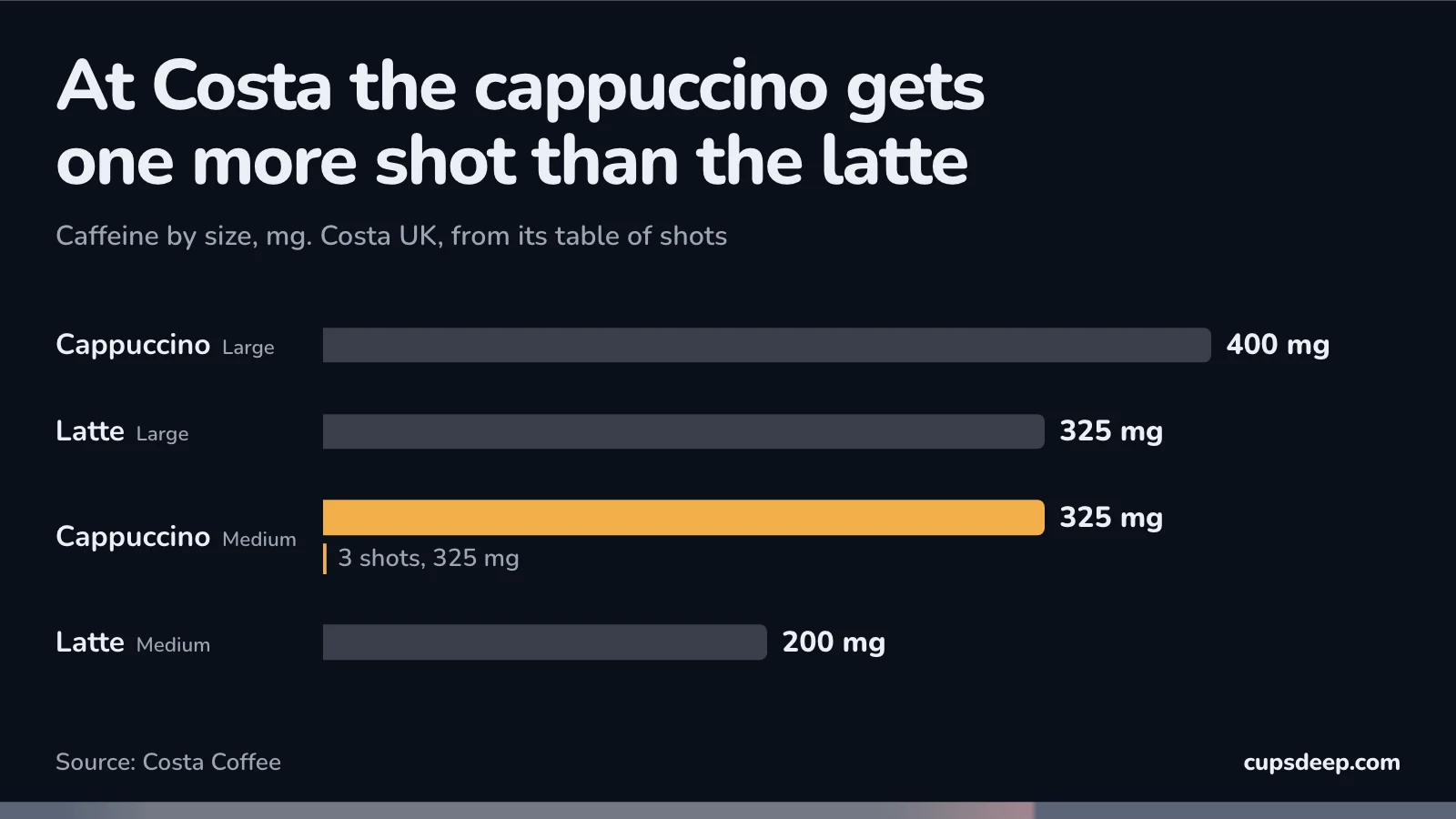
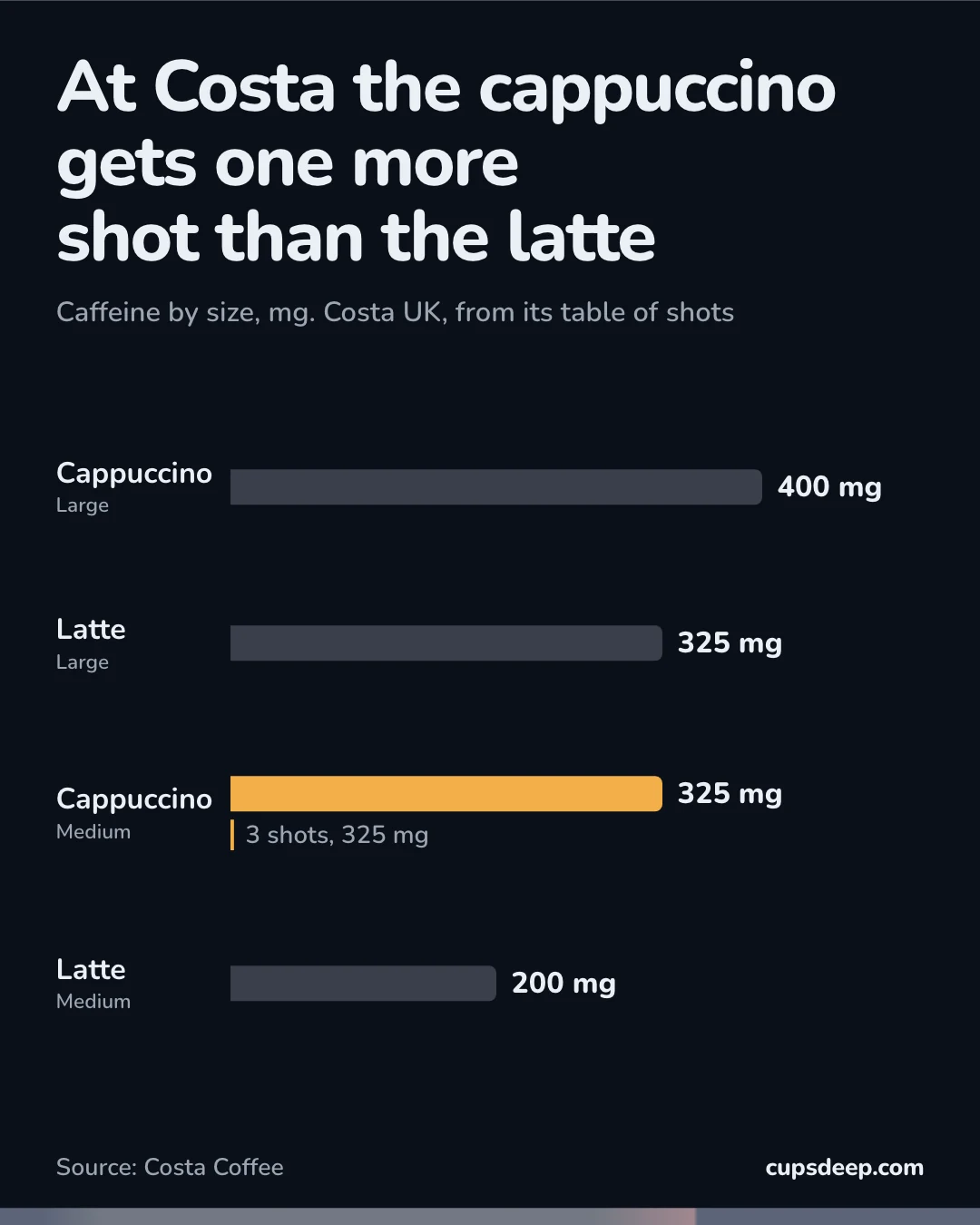
Now cross the street. Costa in the UK builds the two drinks differently: a medium latte gets two shots and a medium cappuccino three, which is 200 mg against 325 mg. At large it is 325 mg against 400 mg. Small is stranger still: the cappuccino is 200 mg, and the latte is 100 mg if you sit down and 200 mg if you take it away.

Starbucks in the UK goes back to matching them, at lower numbers: 89.1 mg for either drink at Tall or Grande. Three menus, the same two words, three answers. The rule that survives all of them: count the shots, ignore the name and ignore the cup. If the menu does not say, ask. It is the one question at the counter that changes your afternoon.
Does a bigger latte have more caffeine?
Only when the size crosses a shot. The Starbucks ladder is a staircase with two steps. A Short and a Tall latte both hold 75 mg; a Grande and a Venti both hold 150 mg. Going from 12 fl oz to 16 fl oz doubles the caffeine. Going from 16 fl oz to 20 fl oz adds milk and nothing else.
A Venti is a Grande with more milk and more confidence
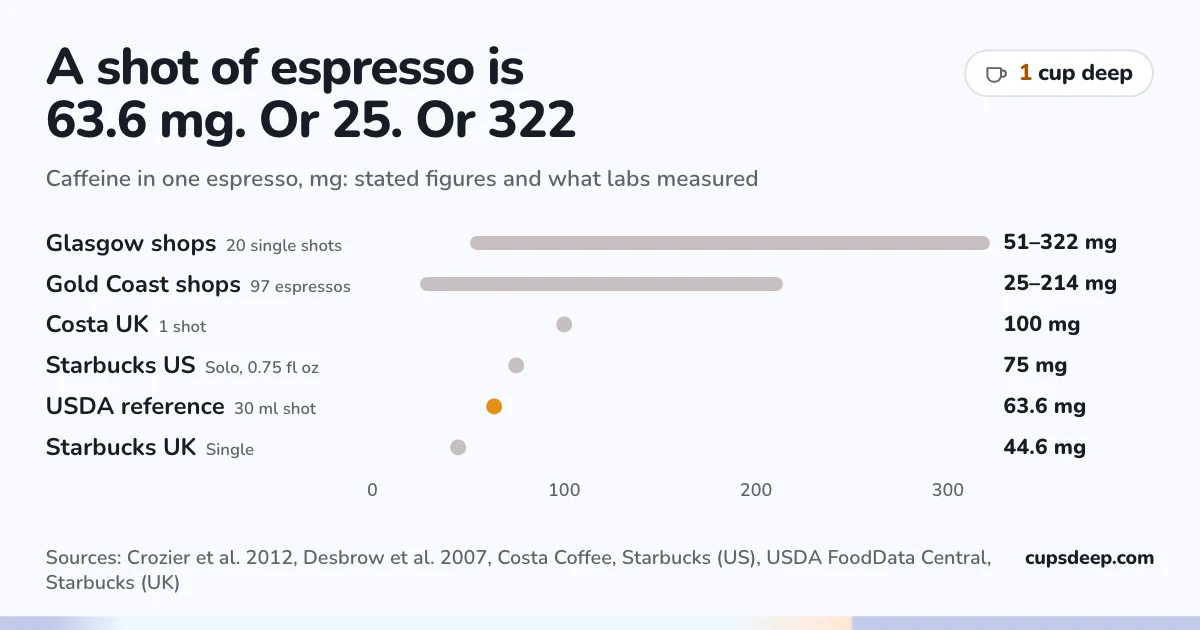
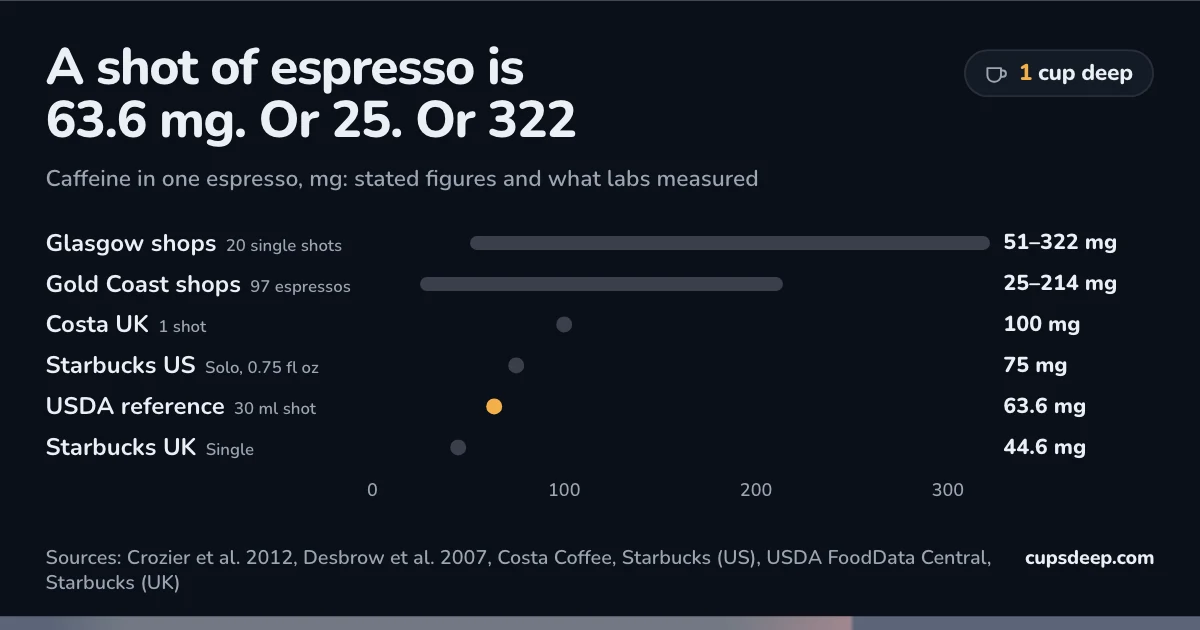
Nor is a shot one fixed amount. The laboratory average we use is 63.6 mg for a shot; Starbucks states 75 mg for one of its own in the US and 44.6 mg in the UK, and Costa states 100 mg. The long version is in how much caffeine is in a shot of espresso, and the filter-coffee side of it in how much caffeine is in a cup of coffee.
Which has more calories, a latte or a cappuccino?
The latte, because the calories are the milk and the latte has more of it. The espresso itself is close to nothing: 2.7 kcal a shot.
At Starbucks in the US a Grande latte has 50 kcal more than a Grande cappuccino, with the same two shots, the same 150 mg of caffeine and the same 2% milk. The gap is 30 kcal at Short and 50 kcal at Tall and Venti. 69704445
Foam is milk with air in it, so a cup finished with foam holds less milk than a cup finished with liquid. That is the entire calorie difference. Dunkin’ shows the same pattern with whole milk.
| Size | Hot latte | Cappuccino |
|---|---|---|
| Small | 120 kcal | 80 kcal |
| Medium | 170 kcal | 120 kcal |
| Large | 230 kcal | 160 kcal |
Read in an archived copy of Dunkin’s own nutrition guide, captured in August 2026, because its US site refuses visitors from outside the United States. The guide gives no cup volumes and no caffeine, so there is no Dunkin’ caffeine figure on this page.
Is a flat white stronger than a latte?
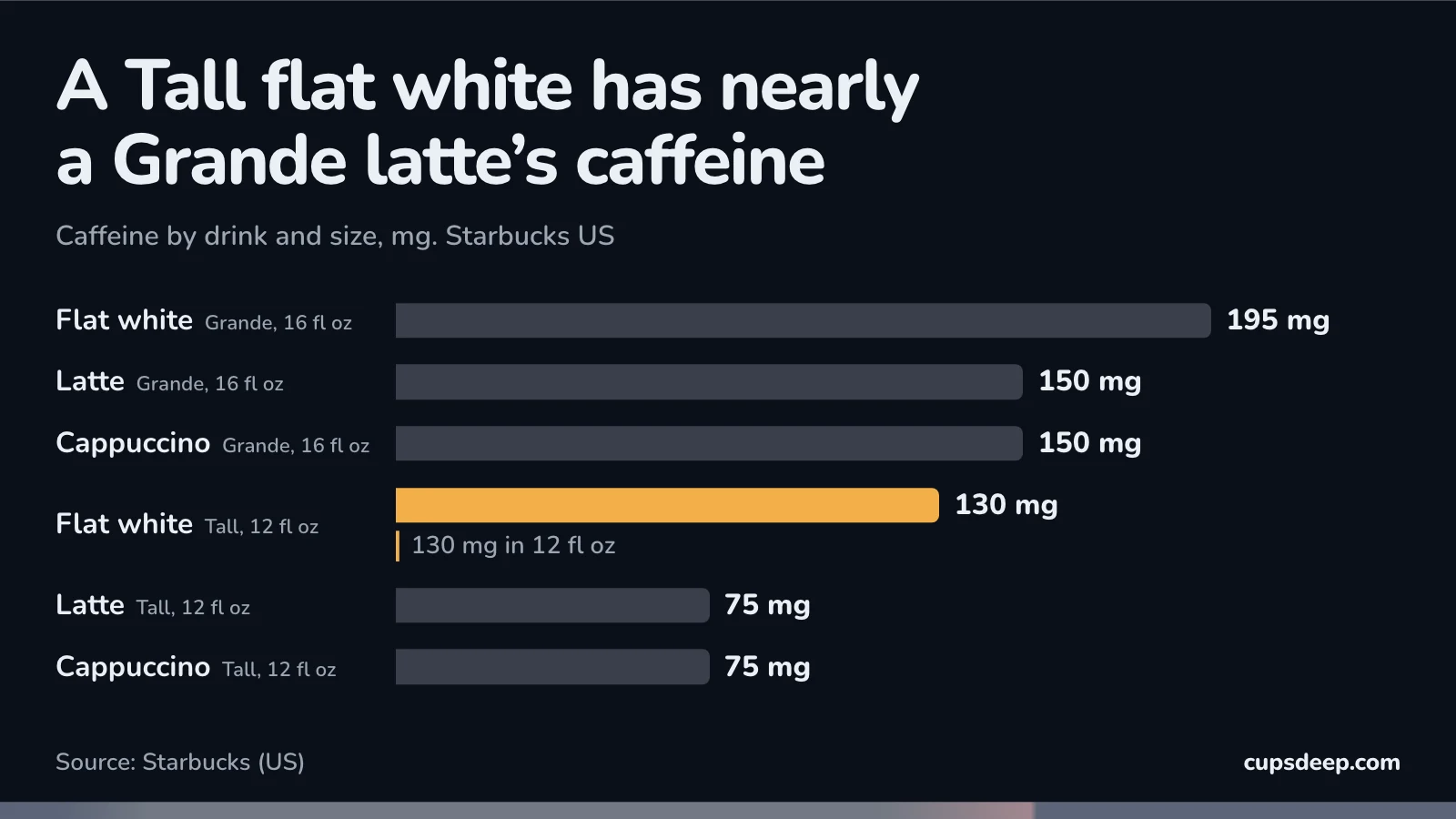
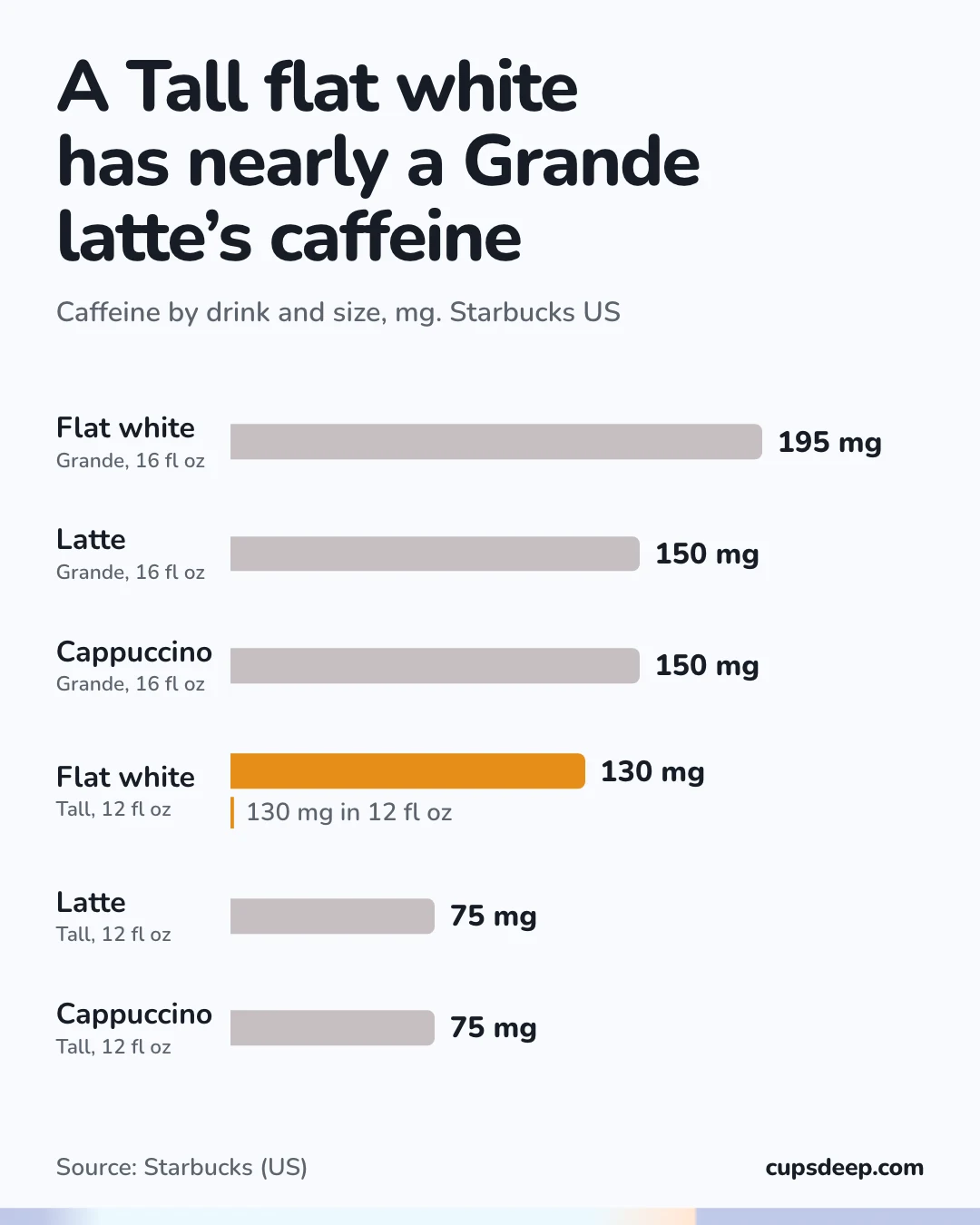
At the chains, yes, and by more than its size suggests. A Starbucks US flat white is made with ristretto shots and gets one more of them than the latte at every size: two in a Short or a Tall, three in a Grande or a Venti. The iced versions, the other chains and why a ristretto shot is the weaker shot are in flat white vs latte.
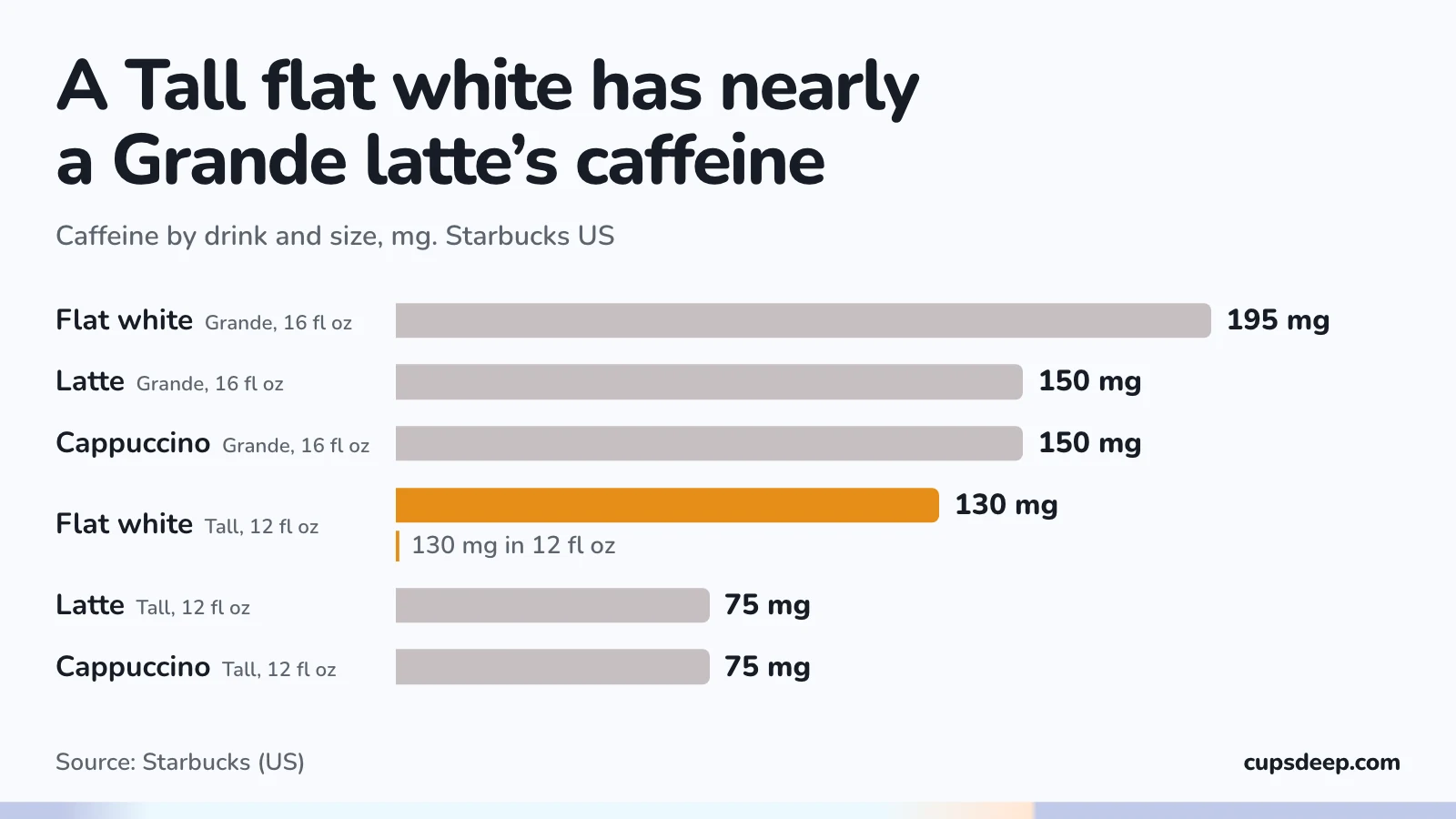
A Starbucks US flat white carries 1.73 times the caffeine of a latte at Tall (130 mg against 75 mg) and 1.3 times at Grande (195 mg against 150 mg). That works out at about 65 mg for each of its ristretto shots, against the 75 mg Starbucks states for one espresso. Starbucks calls its caffeine figures approximate. 46444771

Costa sells its flat white in one small size, with three short shots and 241 mg: more than its medium latte. Starbucks in the UK lists it only as a Short, at 89.1 mg against 44.6 mg for the Short latte.
The flat white is the quiet one. It’s always the quiet one
What is a real cappuccino, by the book?
Smaller than anything a chain sells. Two bodies have written a cappuccino down, and neither describes a 20 fl oz cup.
Italy’s espresso institute certifies a cappuccino as 25 ml of espresso and 100 ml of milk. Its 2006 brochure adds that the 100 ml is measured cold and is steamed to about 125 ml and about 55 °C, then poured into a cup of 150 to 160 ml; those details were read only in a copy of the brochure on a third-party site. 7273
The 2015 World Barista Championship rules defined a cappuccino as one single shot of espresso with textured milk and foam, served in a 150 to 180 ml cup, and asked for at least 1 cm of foam for a good score. The rule is historical and was read in an archived copy of the rulebook. 75
The 2026 World Barista Championship rules do not contain the word cappuccino. They define a milk beverage as one single shot of espresso and steamed milk, with no volume stated, and an espresso as around 30 ml. 74
Somewhere between those two rulebooks the competition deleted the word. I could not read the editions in between, so I cannot give the year. And I found no definition of a latte or a flat white in either: not the Italian institute’s, not the championship’s. Those two are whatever the café says they are.
The familiar rule of equal thirds of espresso, milk and foam is in neither rulebook. The institute’s own recipe is 25 ml of espresso to 100 ml of milk, which steaming takes to about 125 ml. That is also the only sourced figure I could find for how much milk grows when it is foamed; the tidy percentages I came across carried no source that I could find.
Equal thirds is a rule the way a horoscope is a forecast
A dry cappuccino has more foam and less liquid milk; a wet one leans the other way, toward a latte. Neither rulebook defines either term. On temperature, the one sourced figure is the institute’s: milk steamed to about 55 °C. Whichever you order, the caffeine stays for hours after the foam is gone, and how long it stays has its own page.
Questions people ask
Which is stronger, a cappuccino or a latte?
A cappuccino tastes stronger, because it has less milk for the same espresso. In caffeine they are equal wherever the café uses the same shots: at Starbucks US both have 150 mg at Grande. At Costa the cappuccino gets an extra shot at medium and large, so there it is stronger in both senses.
Does a cappuccino have caffeine?
Yes. It is espresso and milk. A Starbucks US cappuccino has 75 mg at Short or Tall and 150 mg at Grande or Venti; a medium Costa cappuccino has 325 mg.
Does a latte or a cappuccino have more milk?
A latte. A cappuccino swaps part of the milk for foam, which is milk with air in it. At Starbucks US that is worth 50 kcal at Grande: 190 kcal for the latte against 140 kcal for the cappuccino, both with reduced-fat milk.
Sources
Every number above links to the place it came from. How the numbers are chosen and checked is on the method page; the drink table is at /drinks. Written with AI agents, as the whole site is. A model of a typical body, not advice for pregnancy, illness or medication.
- Beverages, coffee, brewed, espresso, restaurant-prepared
- Caffè Latte: nutrition (starbucks.com, United States)
- Cappuccino: nutrition (starbucks.com, United States)
- Flat White: nutrition (starbucks.com, United States)
- Espresso: nutrition (starbucks.com, United States)
- Nutrition & Allergen Guide, Holiday Beverages, November 2026 - January 2027 (Starbucks UK)
- Information for customers in UK Costa stores, Festive 2026 (store allergen guide)
- Caffè Latte: product data (starbucks.com, United States)
- Cappuccino: product data (starbucks.com, United States)
- Flat White: product data (starbucks.com, United States)
- Certified Italian Espresso (Espresso Italiano Certificato)
- Espresso and Cappuccino: Certified Italian Espresso and Cappuccino (supplement to L'Assaggio no. 16, December 2006)
- 2026 World Barista Championship Official Rules and Regulations
- 2015 World Barista Championship Official Rules and Regulations
- Dunkin' Nutrition Guide (PDF, United States), last updated 07-08-2026
Keep reading
Coffee
How much caffeine is in a shot of espresso?
A shot of espresso is 63.6 mg by the USDA’s figure. Chains state 44.6 mg to 100 mg, and labs that bought real shots found 25 mg to 322 mg.
Coffee
How much caffeine is in a cup of coffee?
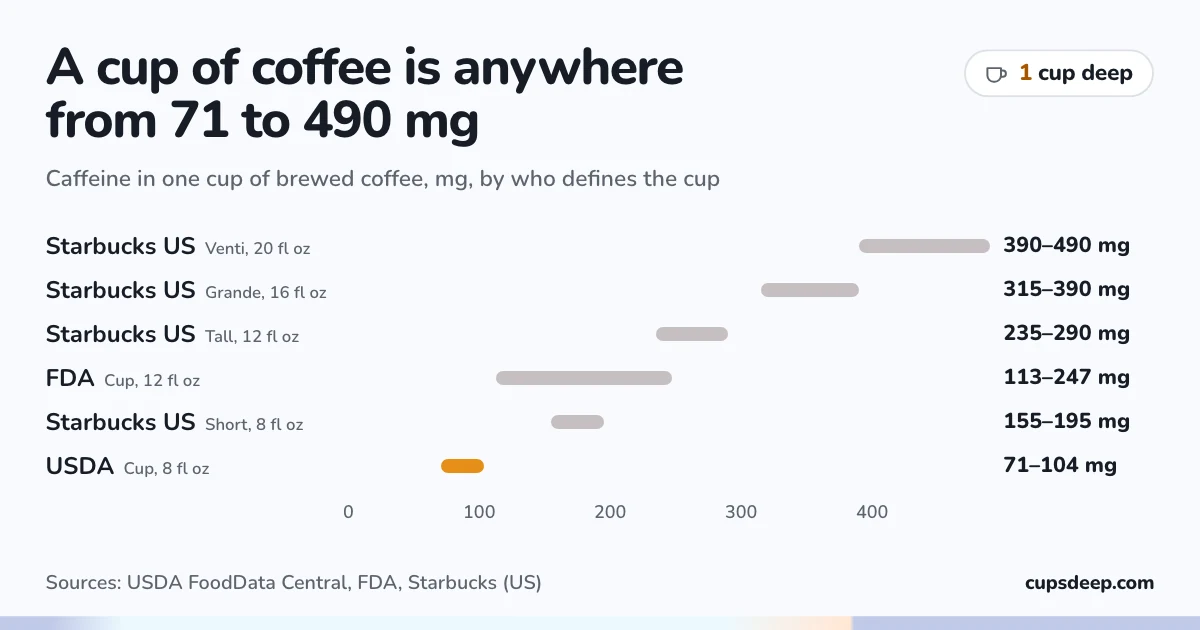
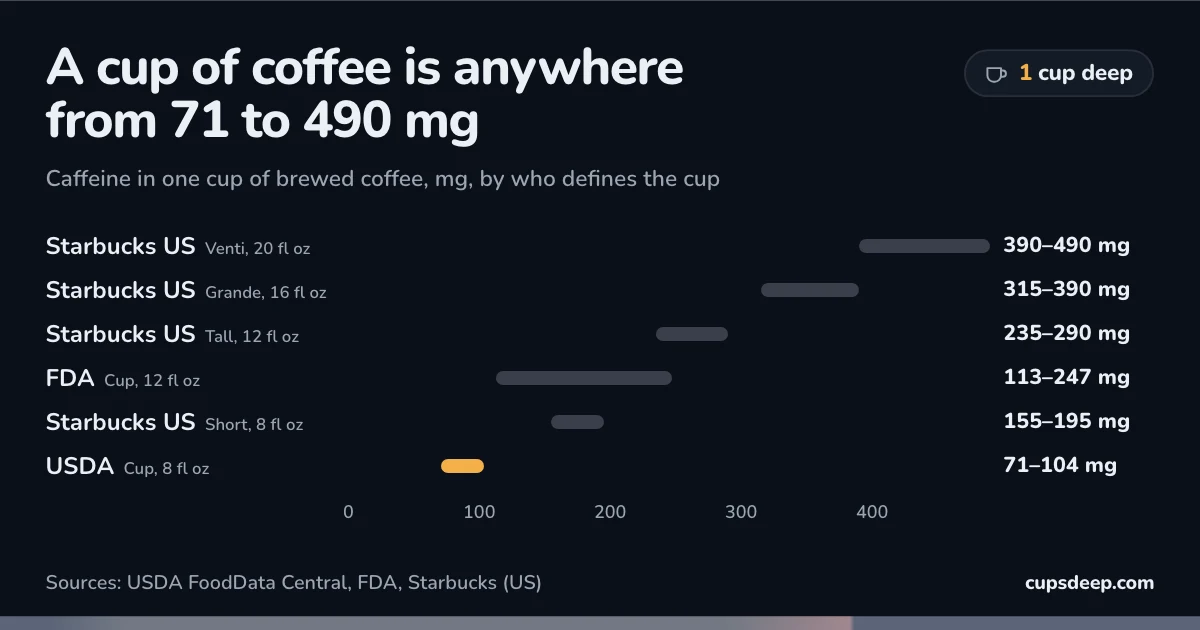
An 8 fl oz cup of brewed coffee has about 95 mg of caffeine by USDA’s figure. A Starbucks cup the same size states 155 mg to 195 mg. Tables by size and type.

Tea and mate
Does chai have caffeine?
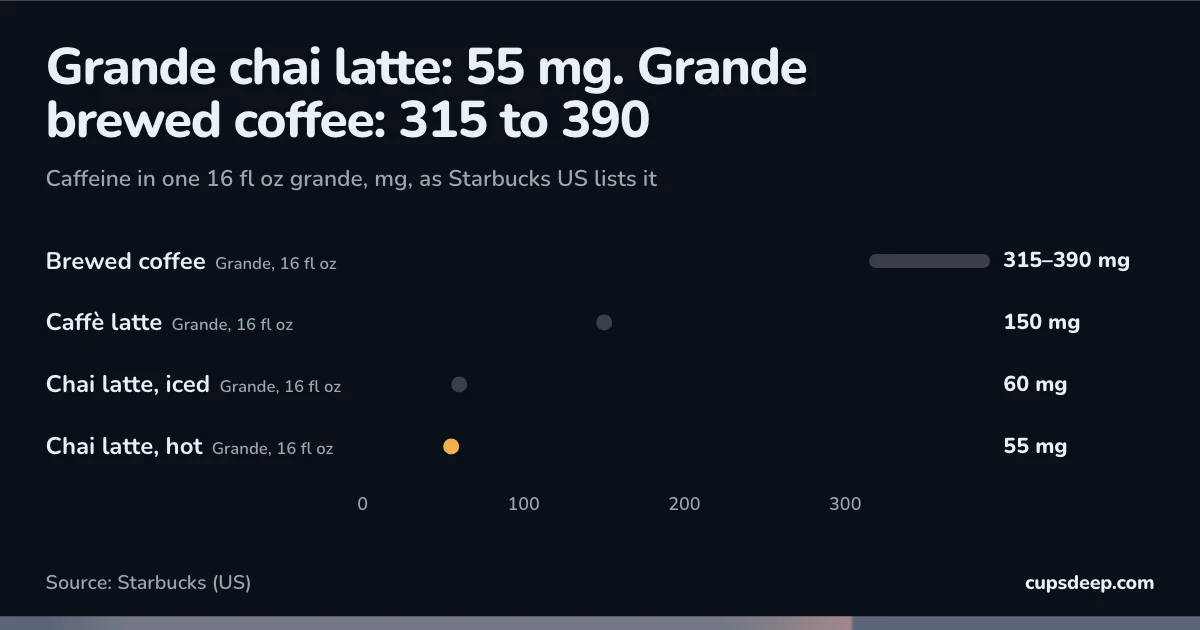
Yes. Chai is spiced black tea. A Starbucks grande chai latte lists 55 mg, a brewed cup is about 40 mg, and rooibos chai has none.