Is 200 mg of caffeine a lot?
It is a number three rulebooks agree on, and the pages we read for it leave out FDA’s own pill and powder figures. Here is what each agency actually says about it, which figures are for one sitting and which are for a whole day, and how many of the drinks you own it takes to get there.
The short answer
It is one full dose. EFSA says single doses up to 200 mg raise no safety concern for healthy adults who are not pregnant, and FDA’s rule for caffeine pills sets their dose at 100–200 mg. It is half of the 400 mg a day that EFSA, FDA and Health Canada name for adults, and about 2.1 cups of USDA’s brewed coffee by our arithmetic.

Is 200 mg of caffeine a lot?
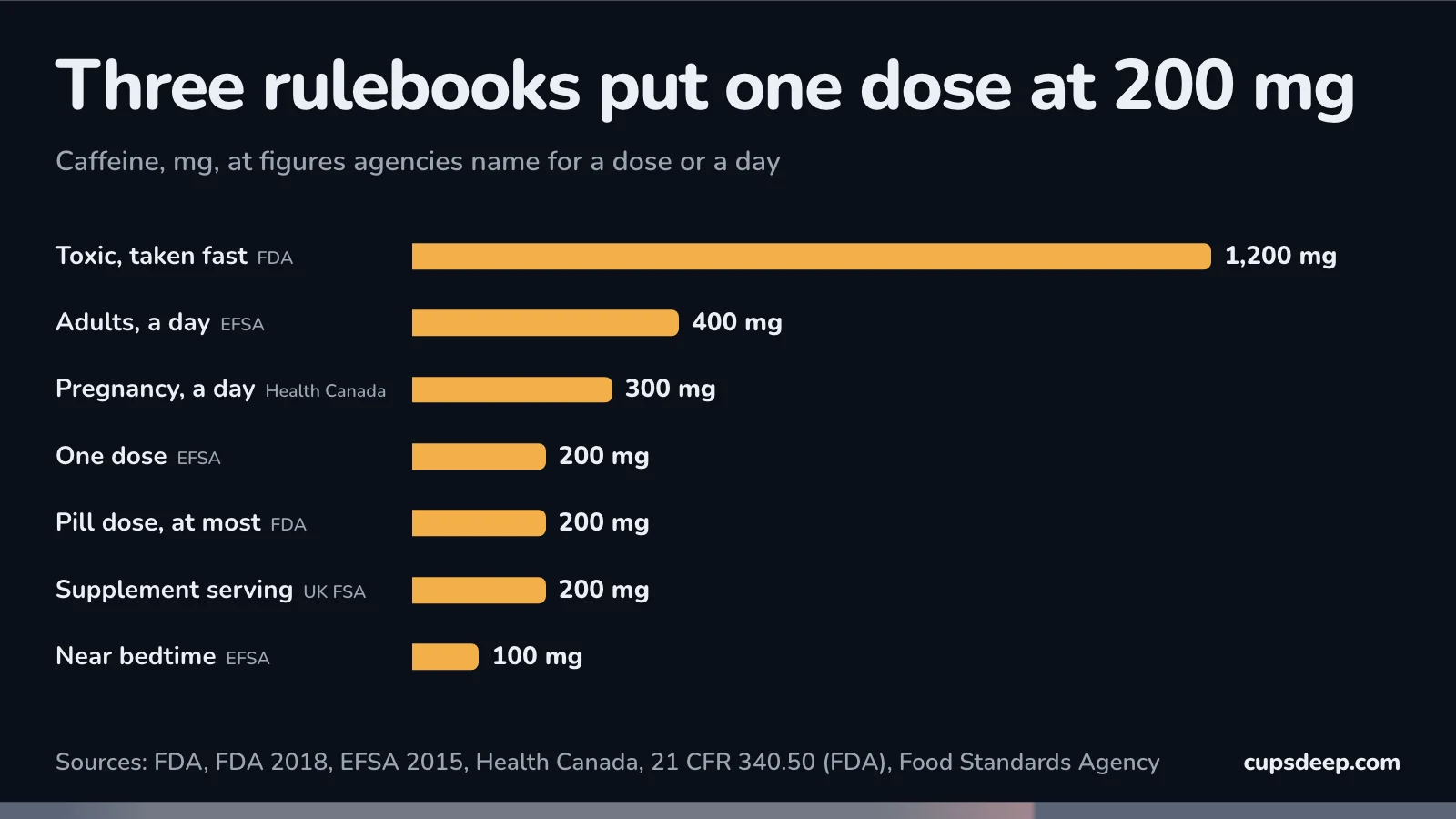
For one sitting, it is the largest dose the European Food Safety Authority says raises no safety concern. That makes 200 mg the upper edge of what EFSA vouches for in one sitting, not a typical cup and not a danger line. EFSA’s words are below, and they come with a body weight attached.
EFSA concludes that single doses of caffeine up to 200 mg, about 3 mg/kg body weight for a 70 kg adult, from all sources do not raise safety concerns for healthy non-pregnant adults. The same amount does not raise safety concerns when taken less than two hours before intense exercise in normal environmental conditions, but no studies are available in pregnant women or in middle-aged or elderly people undertaking intense exercise. Given caffeine's different kinetics in pregnancy, EFSA says these single-dose levels may not apply to pregnant women who exercise. 22
What the pages we read for this question leave out is that the same number turns up in the US rules. FDA’s rule sets the label for over-the-counter caffeine pills, the NoDoz and Vivarin kind, and the dose it sets tops out at the same figure.
FDA’s rule for over-the-counter stimulant drugs, the caffeine pills sold to keep you awake, sets the directions for adults and children 12 and over as “100 to 200 milligrams not more often than every 3 to 4 hours”. The same rule makes the label say “The recommended dose of this product contains about as much caffeine as a cup of coffee” and “Do not give to children under 12 years of age.” 604
So the top of the legal pill dose is EFSA’s single dose. NoDoz Maximum Strength and Vivarin each state 200 mg a unit on their own labels. And the label is required to call that dose about a cup of coffee, which we will come back to, because whether that is true depends on the cup.
The pill label says about as much caffeine as a cup of coffee. It does not say whose cup
The number shows up a third time on caffeine powder. FDA’s 2018 guidance says powder labels often suggest servings of 50–200 mg, and that the top of that, 200 mg, is 1/16 of a teaspoon. The UK Food Standards Agency, writing about supplements, uses 200 mg for a single serving too.
The UK Food Standards Agency’s guidance on caffeine supplements says: “Avoid consuming supplements at doses greater than 200mg of caffeine per a single serving or over 400mg of caffeine in servings throughout the day.” It quotes EFSA that single doses and habitual intakes up to 200 mg in breastfeeding women “do not give rise to safety concerns for breastfed infants”. 359
Is 400 mg of caffeine a day too much?
Not by the agencies’ reading, for healthy adults who are not pregnant: 400 mg a day is the figure EFSA, FDA, Health Canada and the UK Food Standards Agency all use. The difference that matters is one that most of the pages we read blur. 200 mg is a figure for one sitting; 400 mg is a figure for the whole day, spread out. Of the agencies below, EFSA and the UK guidance give both; FDA’s only single-dose figure is for pills.
EFSA concludes that caffeine intakes up to 400 mg a day from all sources, spread through the day, do not raise safety concerns for healthy adults, except pregnant women. FDA cites 400 mg a day for most adults as an amount not generally associated with negative effects, and notes wide variation in how sensitive people are to caffeine and how fast they eliminate it. 225
| Who says it | One dose | A day, healthy adults | A day, pregnancy |
|---|---|---|---|
| EFSA (EU) | 200 mg | 400 mg | 200 mg |
| UK Food Standards Agency, on supplements | 200 mg | 400 mg | Points to the NHS: 200 mg/day |
| FDA (US) | None given for food. Pills: 100–200 mg | 400 mg | None given |
| Health Canada | None given | 400 mg | 300 mg |
| ACOG (US obstetricians) | None given | Not covered | Less than 200 mg a day |
| Food Standards Australia New Zealand | None given | None set | None set |
Each cell is the agency’s own figure, from its own page. FDA’s pill dose is a labeling rule for stimulant drugs, not a food guideline. FSANZ says there is no recognized health-based guidance value for caffeine. The NHS figure is for pregnancy; the UK supplement guidance links to it.
Food Standards Australia New Zealand says: “There is no recognised health-based guidance value, such as an Acceptable Daily Intake, for caffeine.” A FSANZ expert working group in 2000 found “evidence of increased anxiety levels in children at intakes of about 3 mg of caffeine per kilogram of bodyweight per day”, which FSANZ puts at 120 mg a day for children aged 9 to 13 (“approximately two cans of cola”) and about 240 mg a day for adults (“approximately three cups of instant coffee”). 360
Note what FDA’s daily figure is and is not. FDA calls 400 mg “an amount not generally associated with negative effects” for most adults, about two to three 12-fluid-ounce cups of coffee, and adds that people vary widely in how sensitive they are and how fast they clear it. Its consumer page gives no single-dose figure. FDA backs its number with a 2017 review, which tested the evidence against Health Canada’s figures.
A 2017 systematic review in Food and Chemical Toxicology (Wikoff and colleagues), covering studies from 2001 to June 2015, tested the evidence against Health Canada’s figures. It concluded that up to 400 mg a day in healthy adults is not associated with overt adverse effects, that up to 300 mg a day in healthy pregnant women is “generally not associated with adverse reproductive and developmental effects”, and that 2.5 mg per kg a day “remains an appropriate recommendation” for children and adolescents, on limited data. 607
The daily figure is a budget and the single dose is a speed limit. I have been pulled over by neither, which is not the same as obeying them
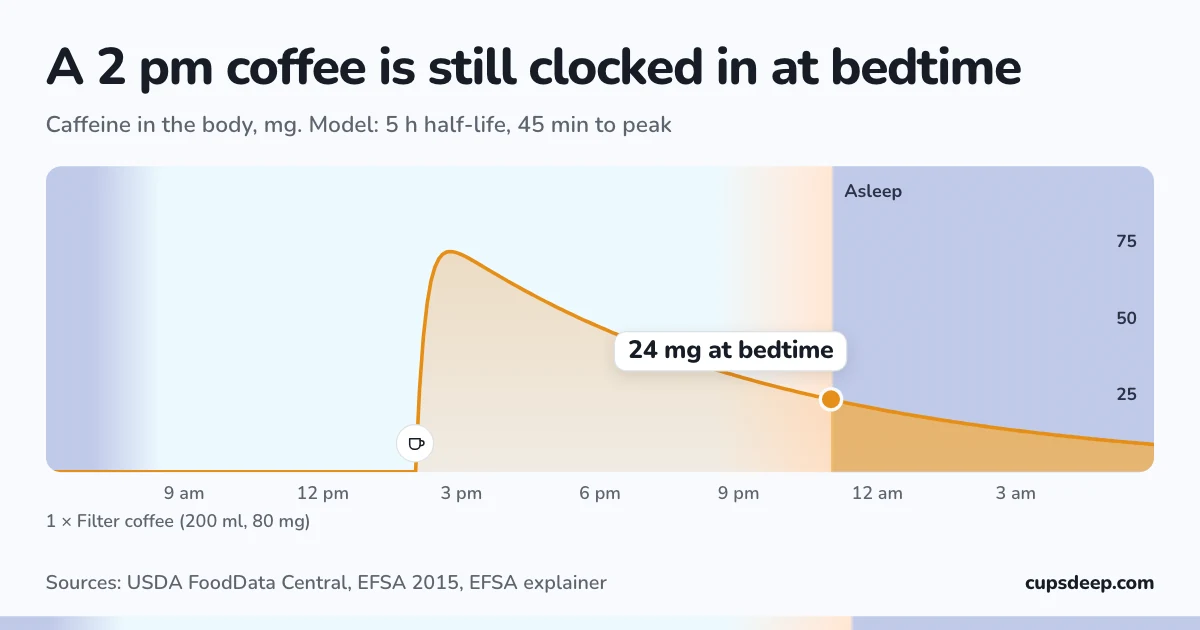
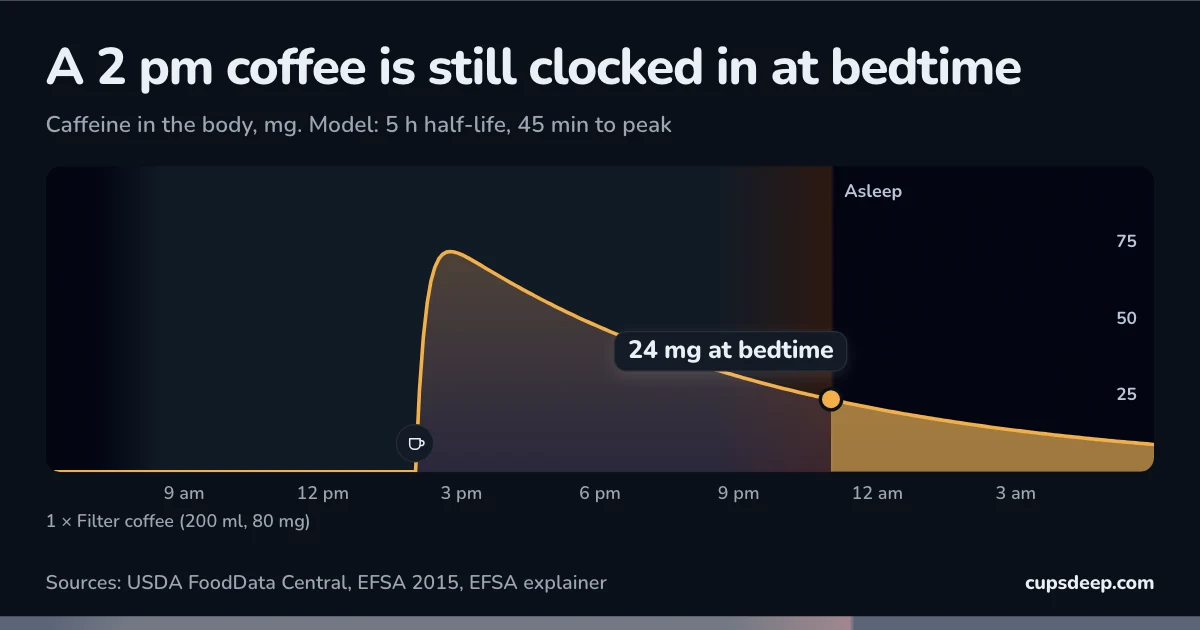
One reason the timing matters: caffeine leaves slowly. In healthy adults the half-life averages 4 hours and runs from 2 hours to 8 hours, so a second dose lands on what is left of the first. How long caffeine stays in your system has the arithmetic, and the method page shows how the curve below is drawn.
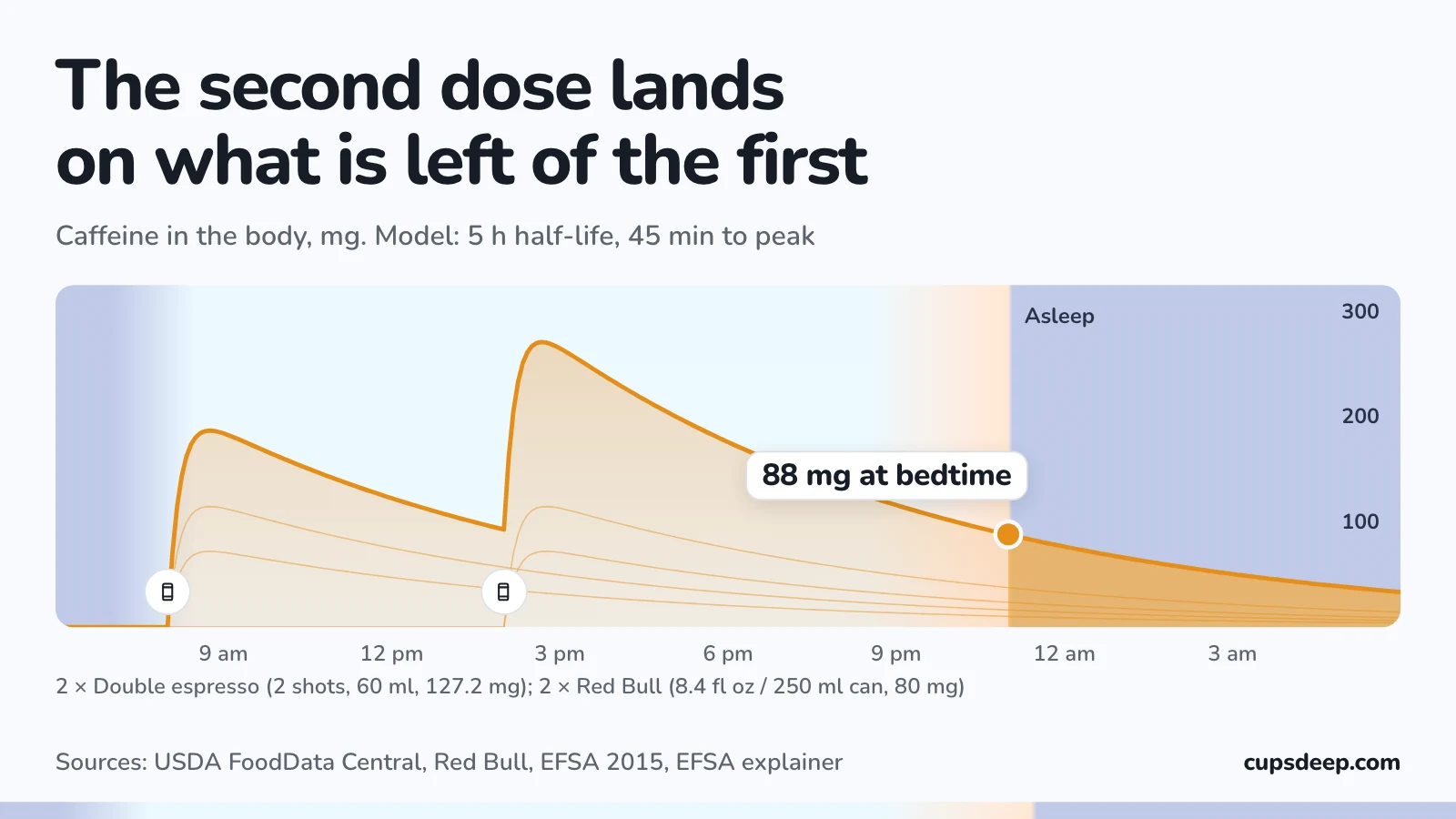
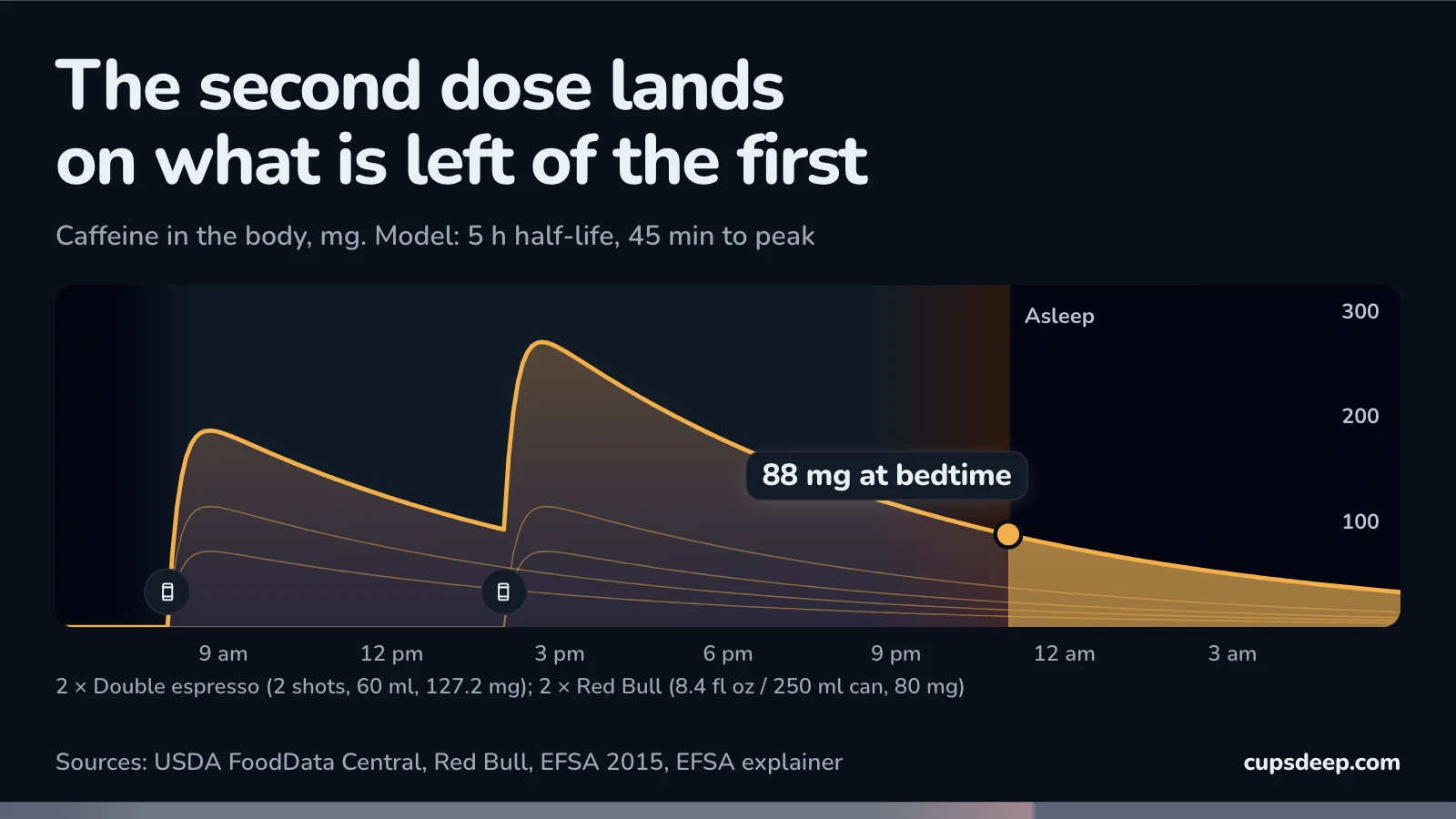
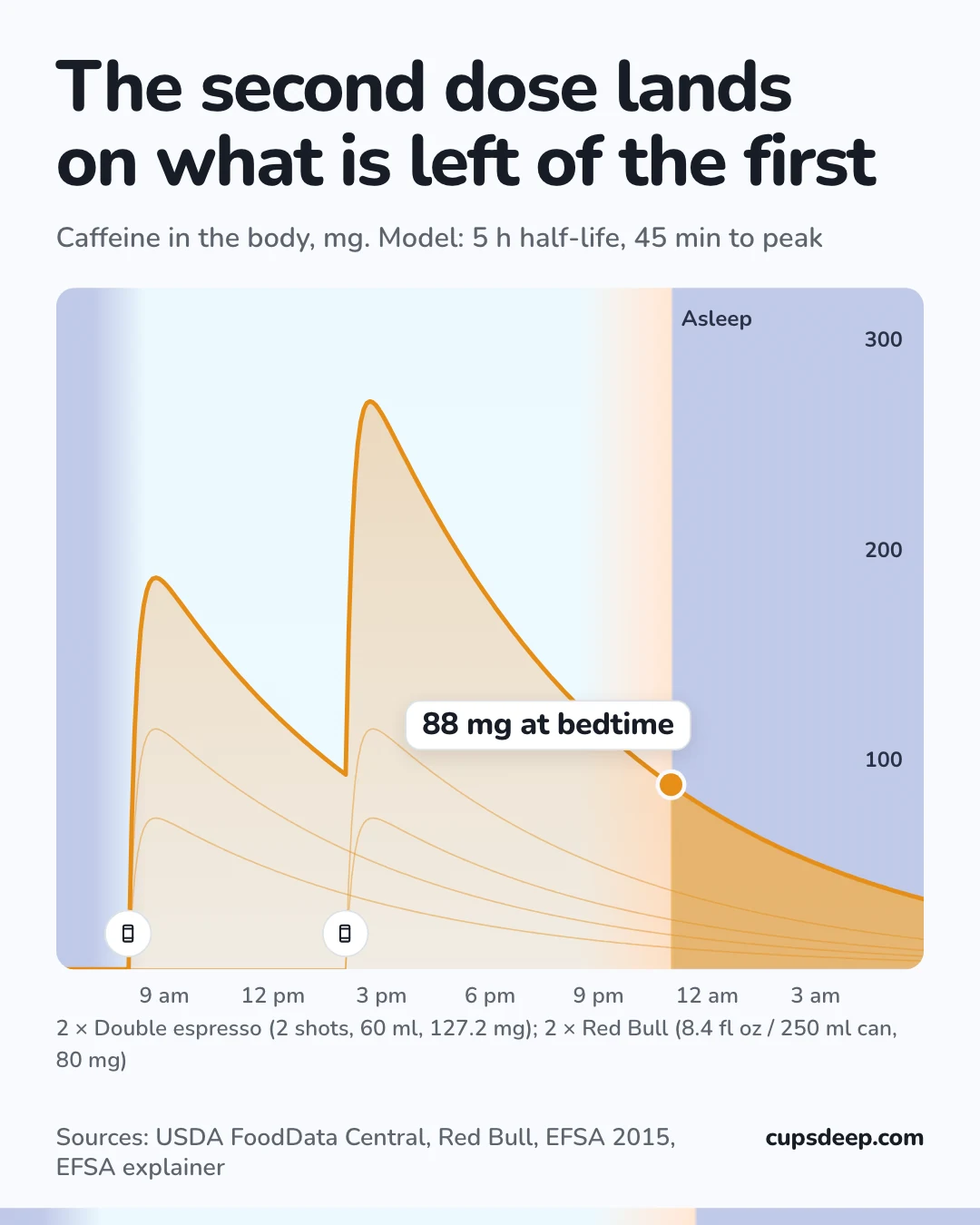
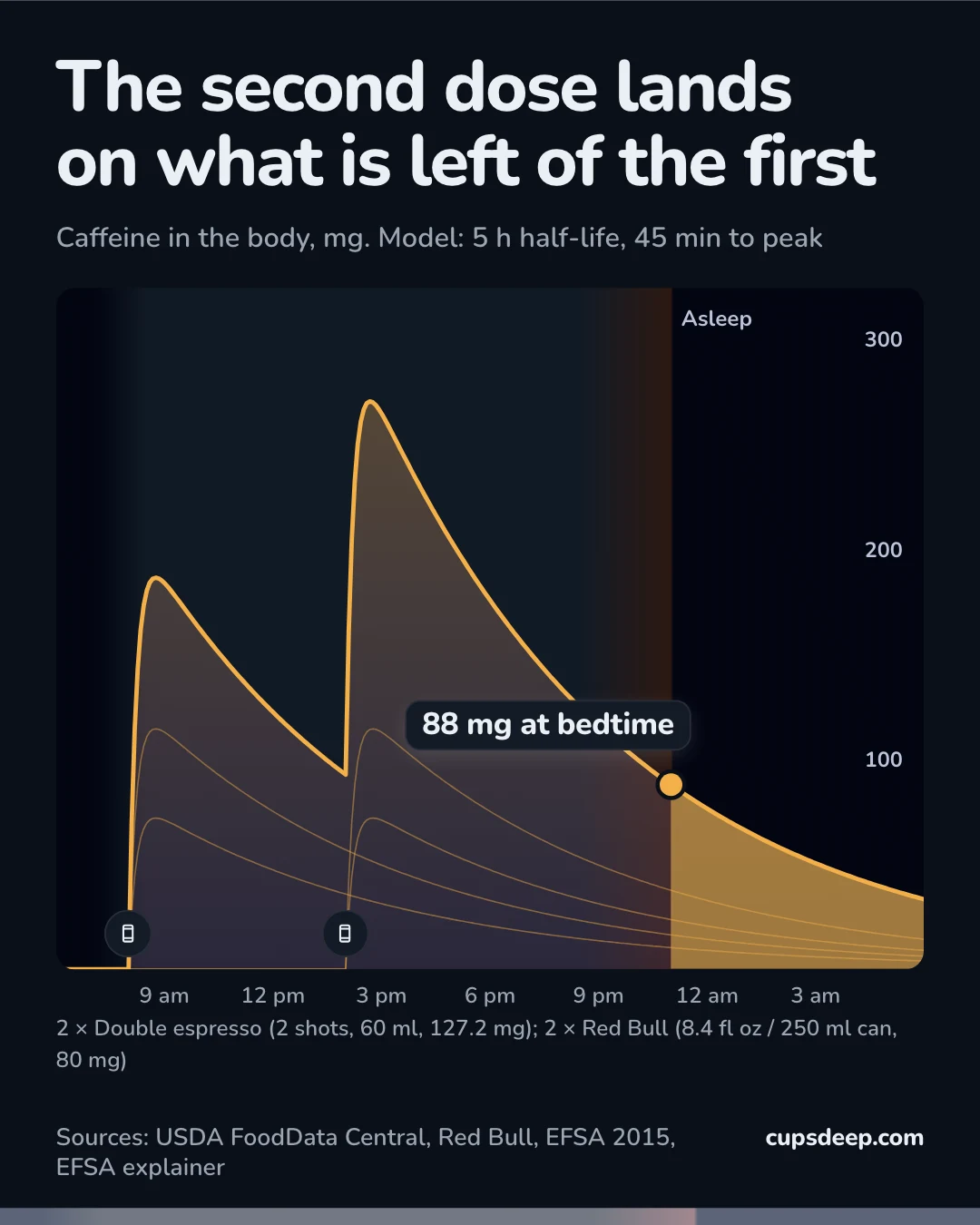
A single 100 mg dose of caffeine, about 1.4 mg/kg body weight for a 70 kg adult, may increase the time it takes to fall asleep and reduce sleep duration in some adults, particularly when taken close to bedtime. 2223
How many cups of coffee is 200 mg of caffeine?
About two, if the cup is USDA’s: its 8 fl oz cup of brewed coffee works out at about 95 mg, so 200 mg is 2.1 cups and 400 mg is 4.2 cups. Our arithmetic, like every count in the table. The figures each drink is counted from are on the drinks page.
| Drink | Caffeine each | To reach 200 mg | To reach 400 mg |
|---|---|---|---|
| Brewed coffee, USDA 8 fl oz cup | 95 mg | 2.1 cups | 4.2 cups |
| Filter coffee, 200 ml | 80 mg | 2.5 cups | 5 cups |
| Espresso, single shot | 63.6 mg | 3.1 shots | 6.3 shots |
| Red Bull, 8.4 fl oz | 80 mg | 2.5 cans | 5 cans |
| Monster Energy, 16 fl oz | 160 mg | 1.25 cans | 2.5 cans |
| Coca-Cola, 12 fl oz | 34 mg | 5.9 cans | 11.8 cans |
| Diet Coke, 12 fl oz | 46 mg | 4.3 cans | 8.7 cans |
| Pepsi, 12 fl oz | 38 mg | 5.3 cans | 10.5 cans |
| Mountain Dew, 12 fl oz | 54 mg | 3.7 cans | 7.4 cans |
| Dr Pepper, 12 fl oz | About 41 mg | 4.9 cans | 9.8 cans |
| Celsius, 12 fl oz | 200 mg | 1 can | 2 cans |
| NoDoz or Vivarin | 200 mg | 1 pill | 2 pills |
Counts are our arithmetic: the target divided by the drink’s figure, rounded to one decimal (Monster’s is exact), counting nothing else drunk that day. Each drink’s figure is its maker’s own, or USDA’s for coffee. Keurig Dr Pepper gives its figure as approximate.
So the cup-of-coffee sentence on a pill label fits the bottom of the pill dose, and only a big cup at the top. FDA’s own range for a 12 fl oz regular brewed coffee is 113–247 mg, which a pill of 200 mg sits inside. Against USDA’s 8 fl oz cup, one pill of 200 mg is two cups and change, and FDA’s own guidance on concentrated caffeine puts a typical 8 oz cup of ground coffee at about 95 mg.
Coffee-shop sizes get there faster. Starbucks states 155 mg to 195 mg for a Short brewed coffee and 235 mg to 290 mg for a Tall, so the Tall is past 200 mg on its own. A Venti is 390 mg to 490 mg, a single cup whose range straddles 400 mg. Which coffee has the most caffeine ranks the rest.
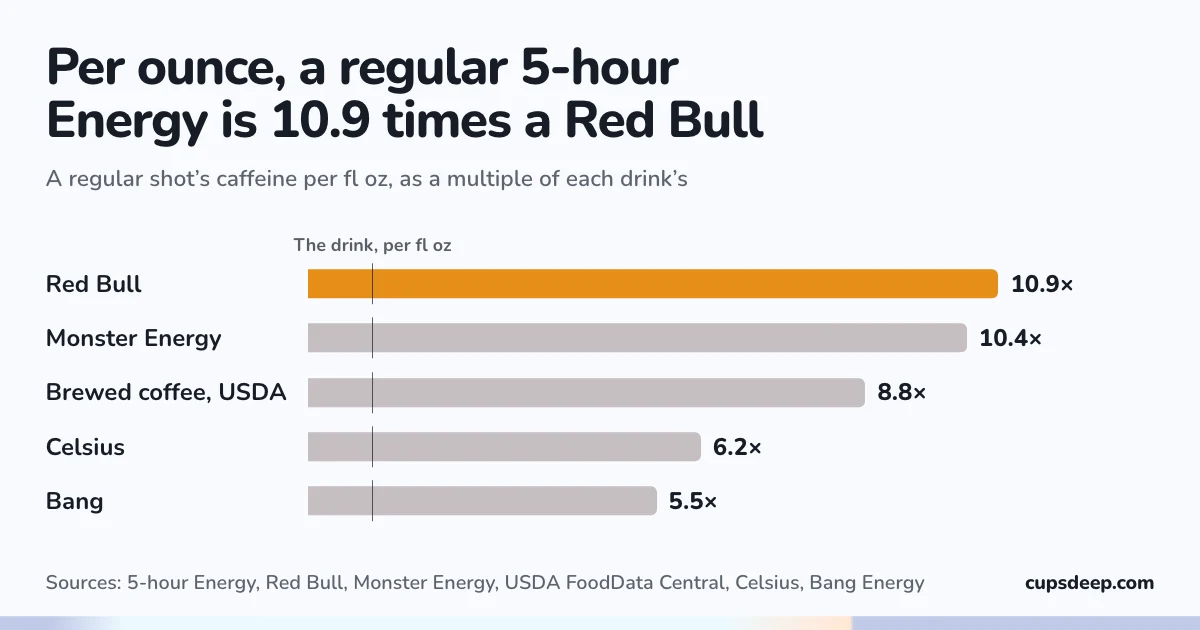
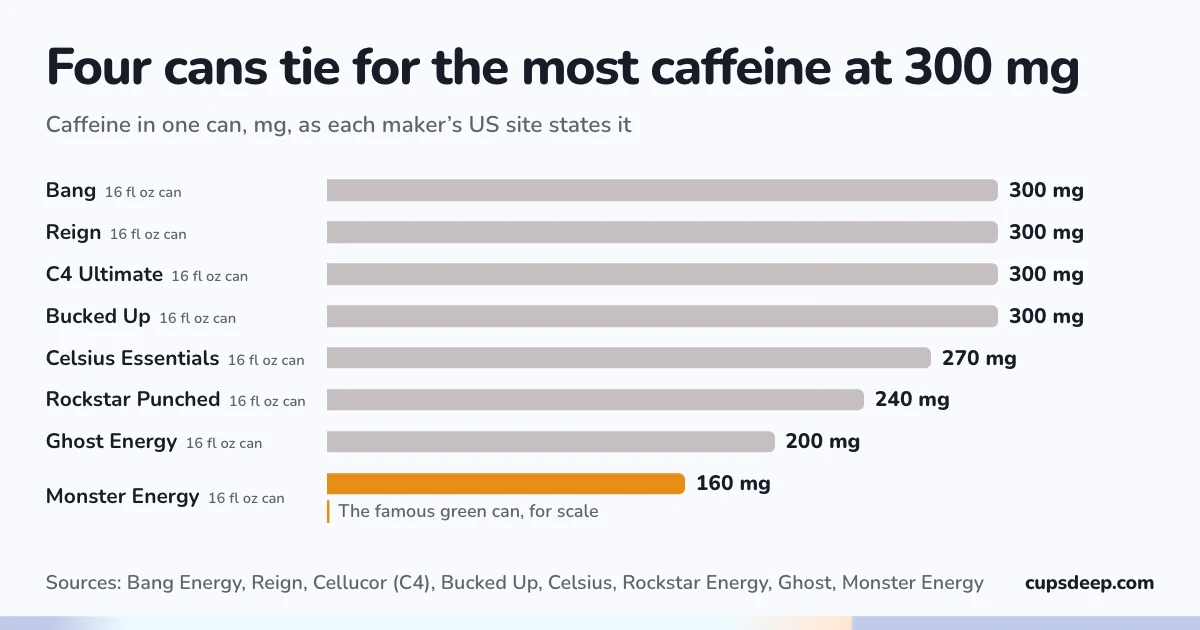
Cans are blunter. Celsius, Alani Nu, Ghost and three other cans in our list, in 12 fl oz and 16 fl oz sizes, state exactly 200 mg, so one is the whole single dose; which energy drink has the most caffeine lists them. Red Bull’s biggest US can stops 2 mg short of it. A regular 5-hour Energy shot is 200 mg, the same number again.
Is 200 mg a lot for your body weight?
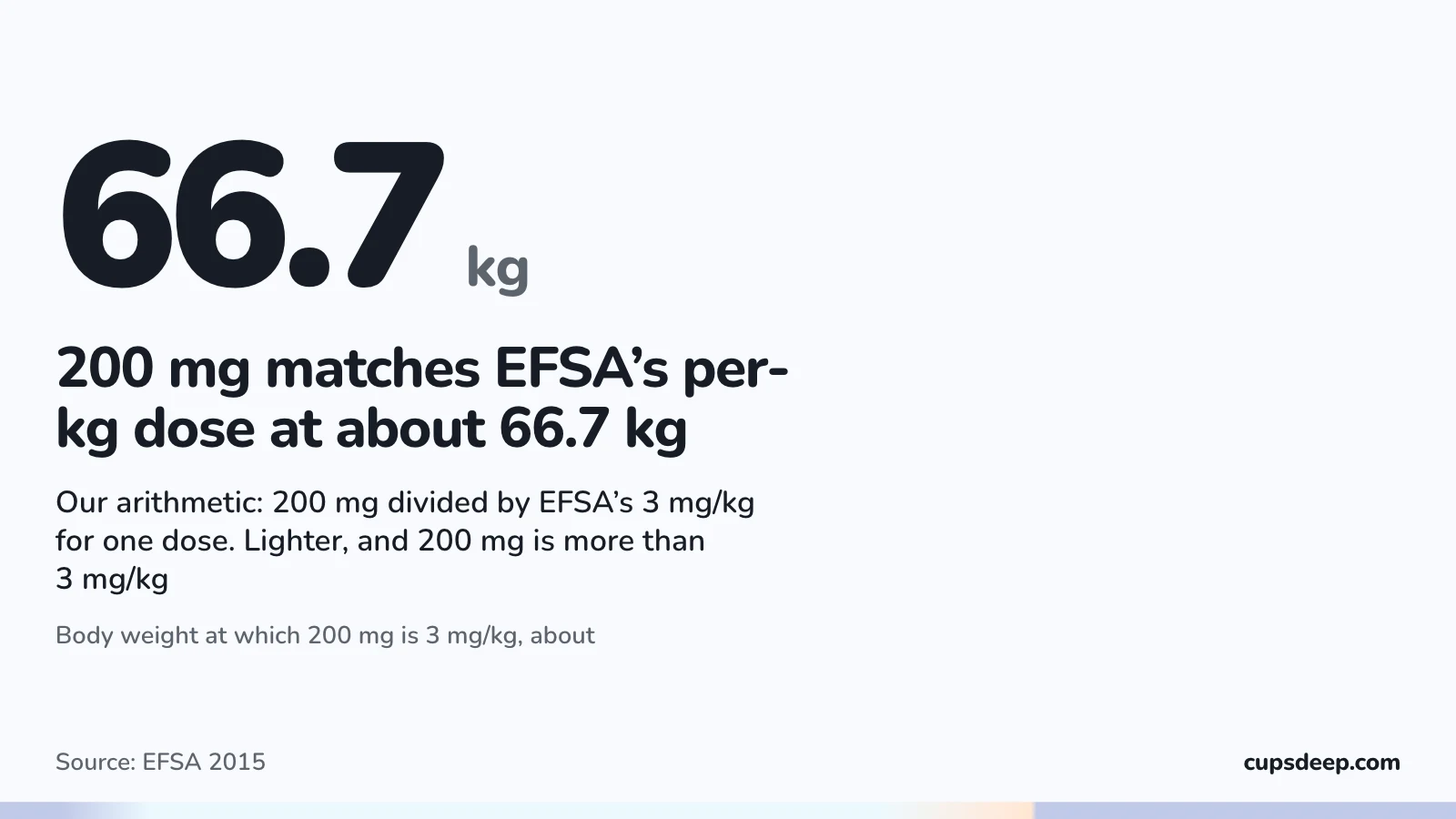
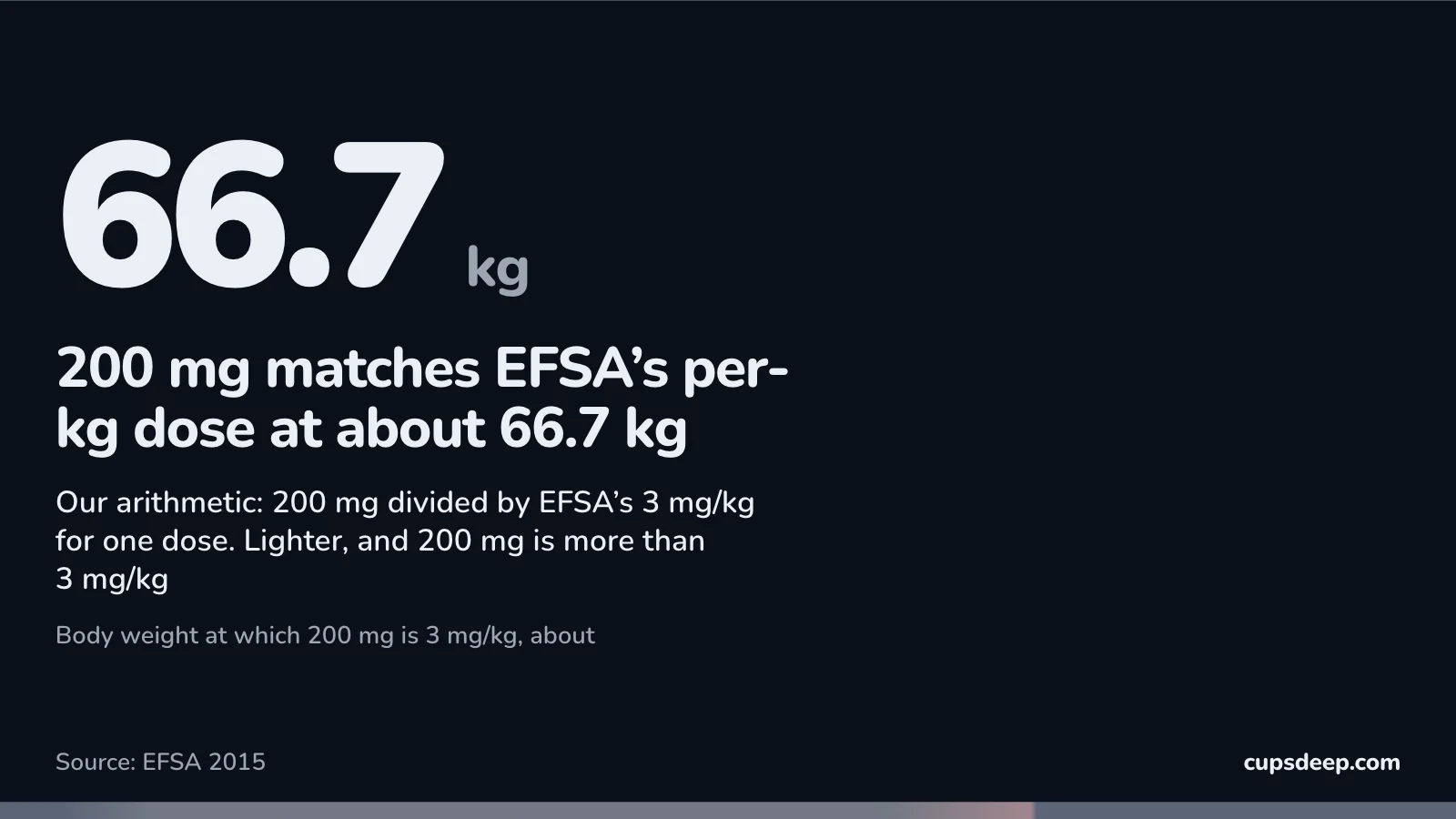
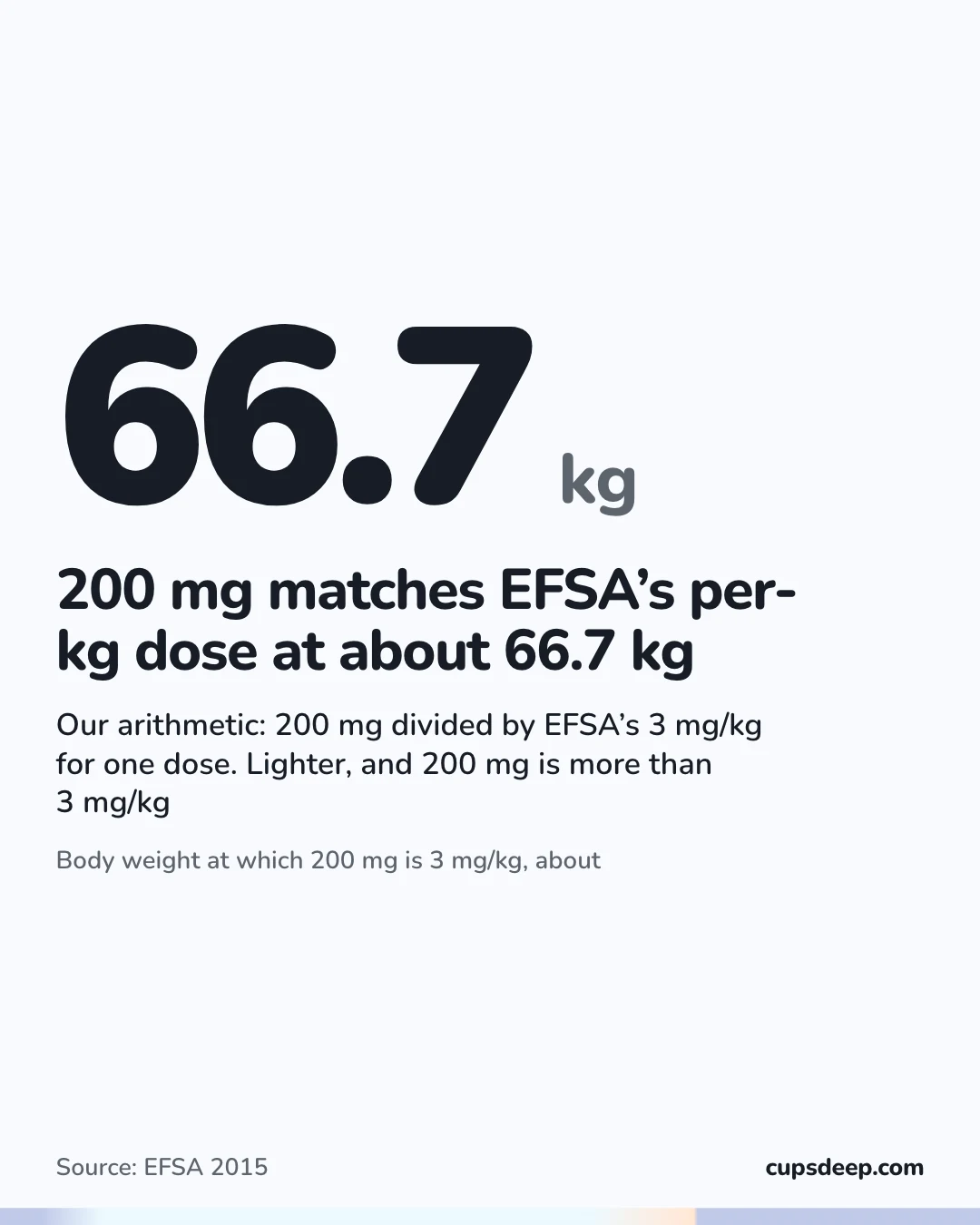
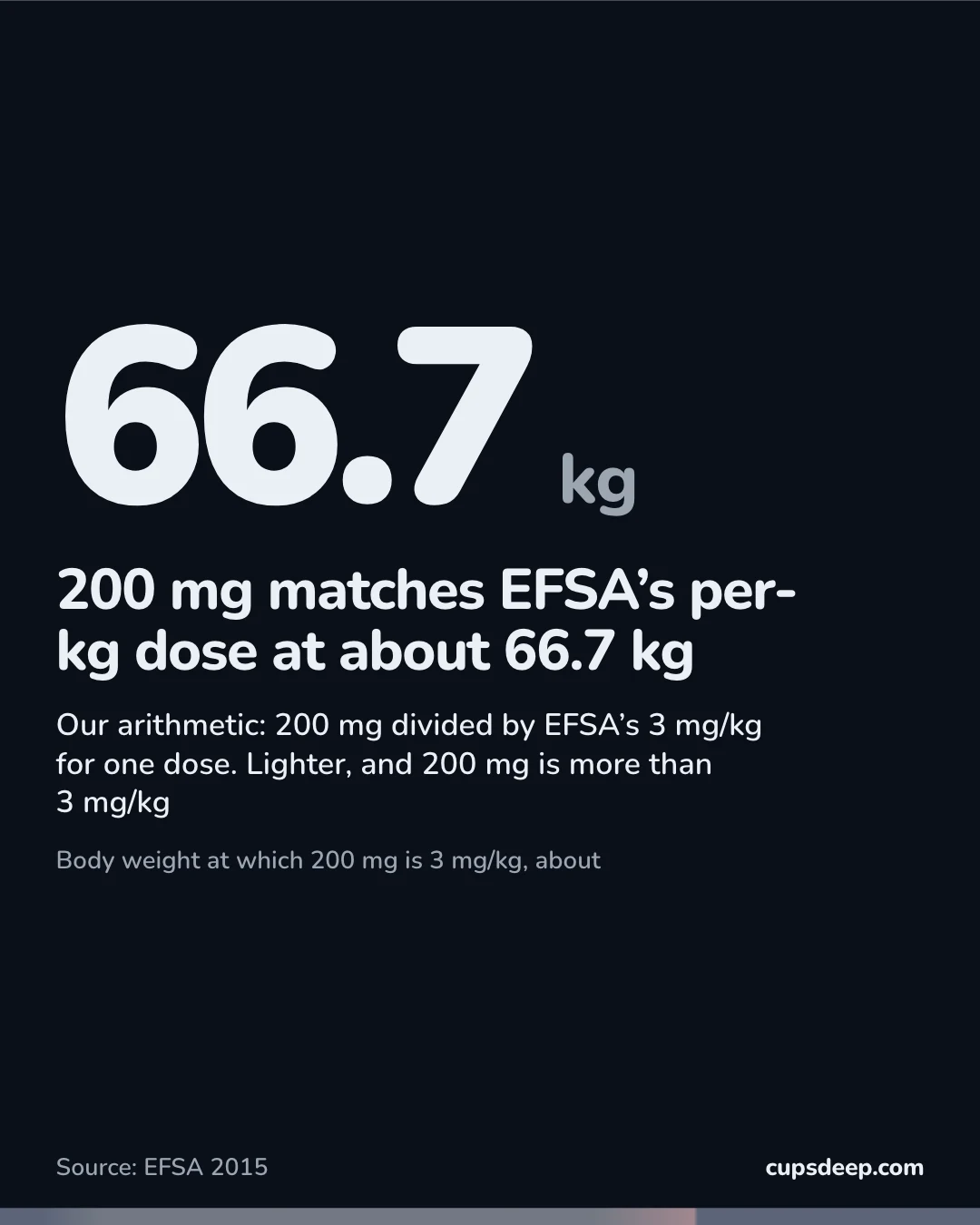
EFSA gives its single dose as about 3 mg/kg body weight for a 70 kg adult. Turn that around and 200 mg equals EFSA’s per-kg figure at about 66.7 kg (about 147 lb). Below that weight, the same dose is more than that per kilogram. The division is ours; EFSA states the per-kg figure and the 70 kg adult, nothing more.
Health Canada’s Table 1, “Recommended maximum caffeine daily intake”, lists 400 mg for adults (18 years and over); 300 mg each for people planning to become pregnant, people who are pregnant and people who are breastfeeding; and 2.5 mg per kg of body weight for children and adolescents (up to 18 years). A footnote says the figure for children “is based on limited data”, was applied to adolescents as “a precautionary approach”, and that healthy older and heavier adolescents (14 to 18) “may be able to consume caffeine in a similar manner to healthy adults”. 88
For anyone under 18, EFSA and Health Canada work per kilogram, and they do not agree on how much. EFSA applies the adult 3 mg/kg body weight per day to children and adolescents; Health Canada uses 2.5 mg per kg of body weight. By our arithmetic 200 mg reaches Health Canada’s figure at 80 kg. A 50 kg teenager’s day comes to 125 mg on Health Canada’s figure and 150 mg on EFSA’s, which is less than one of the cans above that state 200 mg. Health Canada adds that healthy older and heavier teens may handle caffeine much as adults do, and calls applying the children’s figure to teens a precautionary approach.
EFSA found the evidence for children and adolescents insufficient to derive a safe caffeine intake. It uses the adult single-dose level of no concern, 3 mg/kg body weight, as the basis for both single doses and daily intake in this group. As in adults, about 1.4 mg/kg may lengthen the time to fall asleep and shorten sleep in some children and adolescents, particularly close to bedtime. 22
Is 200 mg of caffeine a day OK when pregnant?
Here the agencies split into two camps, and the split is the most useful thing on this page. EFSA and the NHS put the line at 200 mg a day, and ACOG calls less than 200 mg a day moderate. Health Canada puts it at 300 mg, and the review FDA cites found the evidence supports up to 300 mg. FDA itself gives no number.
EFSA concludes that for pregnant women, caffeine intakes up to 200 mg a day from all sources, spread through the day, do not raise safety concerns for the fetus. The line rests on prospective cohort studies showing a dose-dependent link between caffeine intake in pregnancy and the risk of birth-weight outcomes such as fetal growth retardation and being small for gestational age. 22
ACOG’s Committee Opinion 462 (August 2010, reaffirmed 2026) says: “Moderate caffeine consumption (less than 200 mg per day) does not appear to be a major contributing factor in miscarriage or preterm birth. The relationship of caffeine to growth restriction remains undetermined.” 606
The NHS says not to have more than 200 mg/day in pregnancy. Health Canada’s table gives 300 mg for people planning to become pregnant, pregnant or breastfeeding, and the 2017 review FDA leans on used the same 300 mg. For breastfeeding, the UK guidance quotes EFSA that single doses and habitual intakes up to 200 mg raise no safety concern for breastfed infants.
FDA’s consumer page gives no caffeine figure for pregnancy. It recommends that people who are pregnant, trying to become pregnant or breastfeeding talk to a health care provider about whether they need to limit caffeine. It says a 2017 systematic review by the Institute for the Advancement of Food and Nutrition Sciences “confirmed the safety of the 400 milligrams a day level for most adults.” 5
Pregnancy also slows how fast caffeine leaves; EFSA reports half-lives of 6–16 hours in pregnant women. We set the agencies side by side and pick none of them: which figure applies to you is a question for whoever is looking after your pregnancy, which is also what FDA says.
How much caffeine is too much at once?
FDA gives two figures above the daily one. Its 2018 guidance gives them while explaining why it treats bulk caffeine powder as a problem: a serving is a sliver, and a mistake is a spoonful.
FDA’s 2018 guidance says toxic effects, including tachycardia, ventricular arrhythmia and seizures, are observed at about 1,200 mg, and that a life-threatening dose of caffeine “is typically estimated at between 10,000 and 14,000 mg”, “although smaller doses can be life-threatening in certain individuals (such as children or other sensitive populations)”. 605
Our arithmetic against FDA’s figures: FDA’s toxic 1,200 mg is six doses of 200 mg, its life-threatening 10,000 to 14,000 mg is 50 to 70 of them, and its teaspoon of pure powder, about 3,200 mg, is 16, which matches FDA’s 1/16 of a teaspoon for a 200 mg serving of the powder. 6055
Put another way, by our sums: FDA’s toxic figure is 6 doses of 200 mg, and a teaspoon of the pure powder, about 3,200 mg, is 16 doses. That is the whole case against loose caffeine powder in one division.
A labeled serving of caffeine powder can be a sixteenth of a teaspoon. My kitchen measures in glugs
None of this makes 200 mg a small dose. EFSA’s 100 mg near bedtime is half of it, and the withdrawal some people get when they stop is a reminder that a daily dose does something. It makes 200 mg a known, measured, ordinary amount: one pill, one big cup, one large can.
Questions people ask
Is 200 mg of caffeine a lot at once?
It is the most EFSA says raises no safety concern in one sitting for healthy adults who are not pregnant: single doses up to 200 mg, about 3 mg/kg body weight for a 70 kg adult. It is also the top of the dose FDA sets for caffeine pills, 100–200 mg.
How many cups of coffee is 200 mg of caffeine?
About 2.1 cups of brewed coffee in USDA’s 8 fl oz cup, at about 95 mg a cup, or 2.5 cups of our 200 ml filter coffee. FDA’s range for a 12 fl oz brewed coffee is 113–247 mg, so one large cup can reach it. These counts are our arithmetic.
Is 400 mg of caffeine a day too much?
For healthy adults who are not pregnant, EFSA, FDA, Health Canada and the UK Food Standards Agency all use 400 mg a day, from all sources. EFSA’s figure is for intake spread through the day, and FDA notes that sensitivity varies widely. It is 5 cans of 8.4 fl oz Red Bull, by our arithmetic.
How much caffeine is safe during pregnancy?
The agencies differ. EFSA and the NHS say up to 200 mg/day; ACOG calls less than 200 mg a day moderate. Health Canada says 300 mg. FDA gives no figure and recommends asking a health care provider.
How much caffeine is toxic?
FDA estimates that toxic effects such as seizures can be observed with rapid consumption of around 1,200 mg, and its 2018 guidance puts a life-threatening dose at 10,000–14,000 mg, with smaller doses dangerous for some people, such as children.
Sources
Every number above links to the place it came from. How the numbers are chosen and checked is on the method page; the drink table is at /drinks. Written with AI agents, as the whole site is. A model of a typical body, not advice for pregnancy, illness or medication.
- What is caffeine?
- Spilling the Beans: How Much Caffeine is Too Much?
- Monster Energy Original Green
- Pepsi - 12 fl oz (PepsiCo Product Facts)
- How much caffeine is in a can of Red Bull Energy Drink?
- Red Bull Energy Drink: Ingredients
- Beverages, coffee, brewed, prepared with tap water
- Beverages, coffee, brewed, espresso, restaurant-prepared
- Scientific Opinion on the safety of caffeine
- EFSA explains risk assessment: Caffeine
- NoDoz Alertness Aid Maximum Strength (DailyMed label)
- Medium Roast - Pike Place Roast: nutrition (starbucks.com, United States)
- Caffeine in Foods
- Diet Coke - Flavors, Nutrition Facts, Caffeine & More (US)
- Mountain Dew - 12 fl oz (PepsiCo Product Facts)
- Dr Pepper 12 fl oz - Keurig Dr Pepper Product Facts
- Essential Facts
- Foods to avoid in pregnancy
- Food supplements containing caffeine
- Caffeine
- Berry Flavor Regular Strength 5-hour ENERGY Shots
- 21 CFR 340.50, Labeling of stimulant drug products
- Highly Concentrated Caffeine in Dietary Supplements: Guidance for Industry
- Moderate Caffeine Consumption During Pregnancy, Committee Opinion Number 462
- Systematic review of the potential adverse effects of caffeine consumption in healthy adults, pregnant women, adolescents, and children
Keep reading
Body and sleep
How long does caffeine stay in your system?
Half of a dose of caffeine is gone in about 4 hours, 2–8 hours between people. After five half-lives, 20 hours on average, 3.1% is left.
Cans
How much caffeine is in a 5-hour Energy?
A Regular Strength 5-hour Energy has 200 mg of caffeine, Extra Strength 230 mg, in a 1.93 fl oz bottle. Per ounce, that is over ten times a Red Bull.

Cans
Which energy drink has the most caffeine?
Four US cans tie at 300 mg in 16 fl oz: Bang, Reign, C4 Ultimate and Bucked Up. Per fl oz, Killer Brew wins. Each can by its maker, plus the legal caps.