Does decaf coffee have caffeine?
Decaf is coffee with most of the caffeine taken out, and “most” is doing a lot of work in that sentence. Here is what is left, measured by people in lab coats, plus the rule that gets quoted and that we could not find.
The short answer
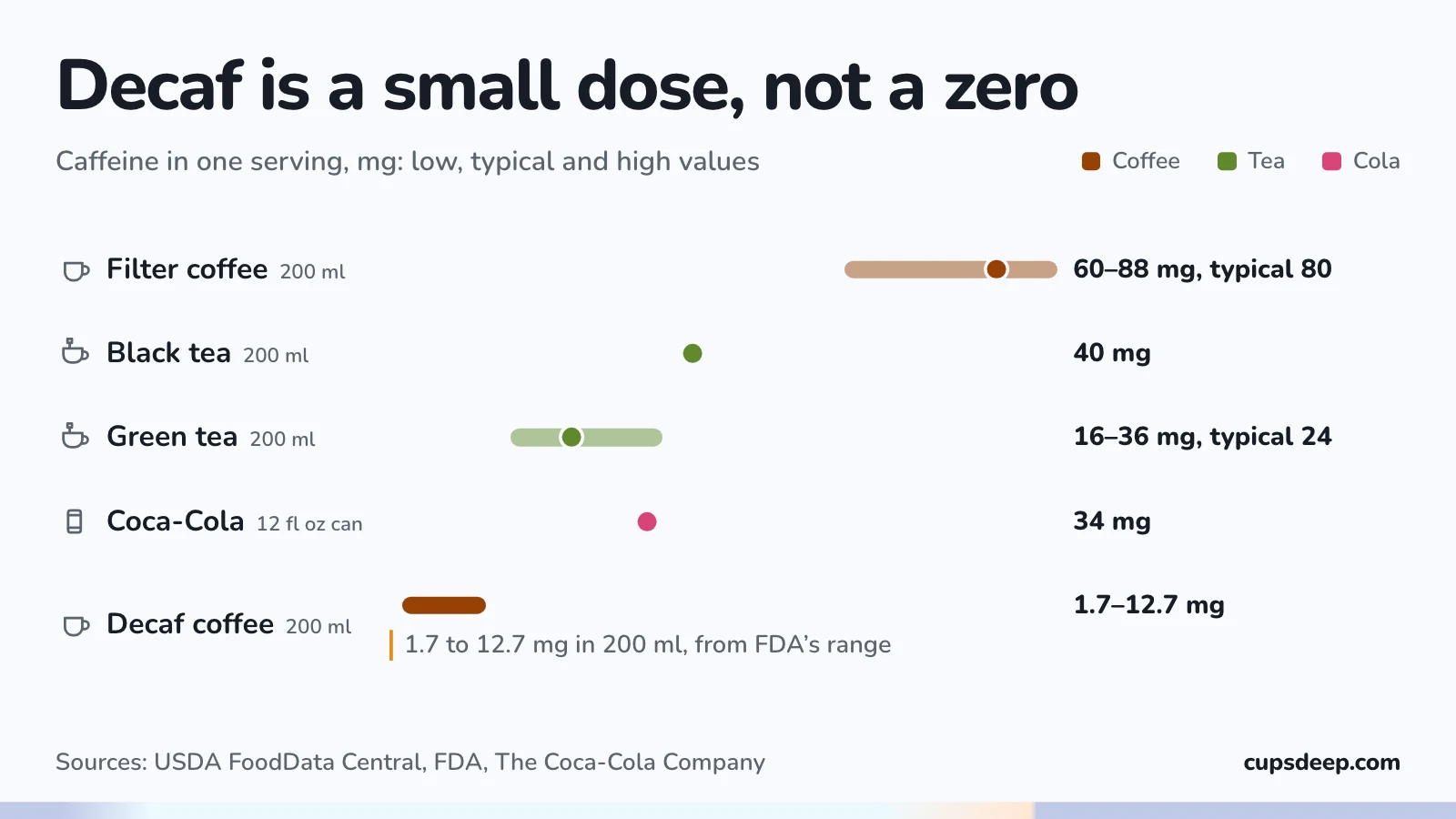
Yes. Decaf coffee typically has 2–15 mg of caffeine in an 8 fl oz cup, by FDA’s figure, against about 94.8 mg in a regular cup of the same size. A lab that collected ten decafs from different coffee shops found 0–13.9 mg in a 16 oz serving, and Starbucks lists 25 mg for a grande. It is a small dose, not a zero.

How much caffeine is in a cup of decaf coffee?
It depends on who measured it and how big the cup was, which is why one tidy number never survives contact with a coffee shop. Start with the regulator, then the lab.
FDA says decaf coffee typically has 2 to 15 mg of caffeine in an 8 fl oz cup, and that decaffeinated coffees and teas have less caffeine than their regular counterparts but still contain some. 5
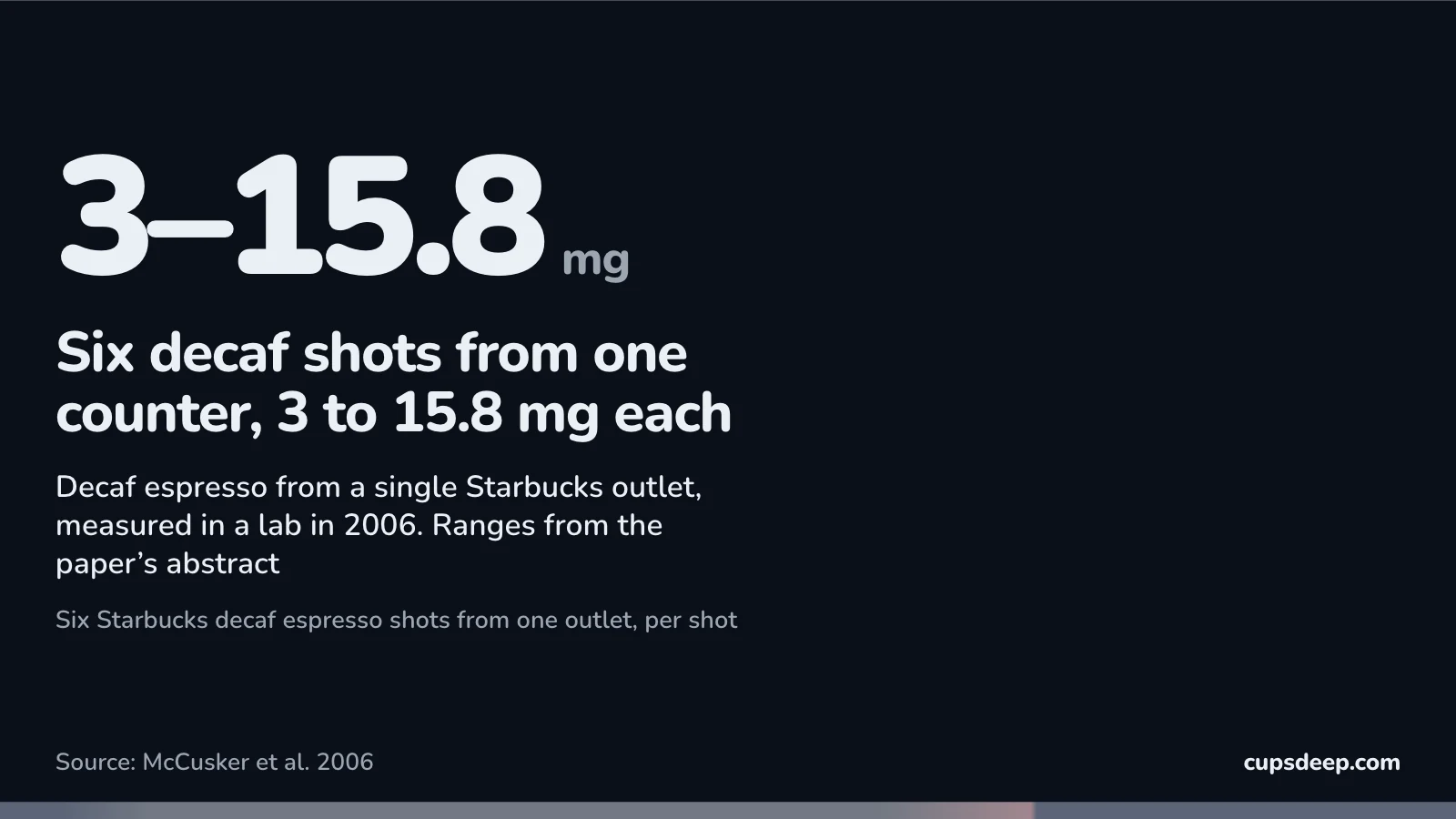
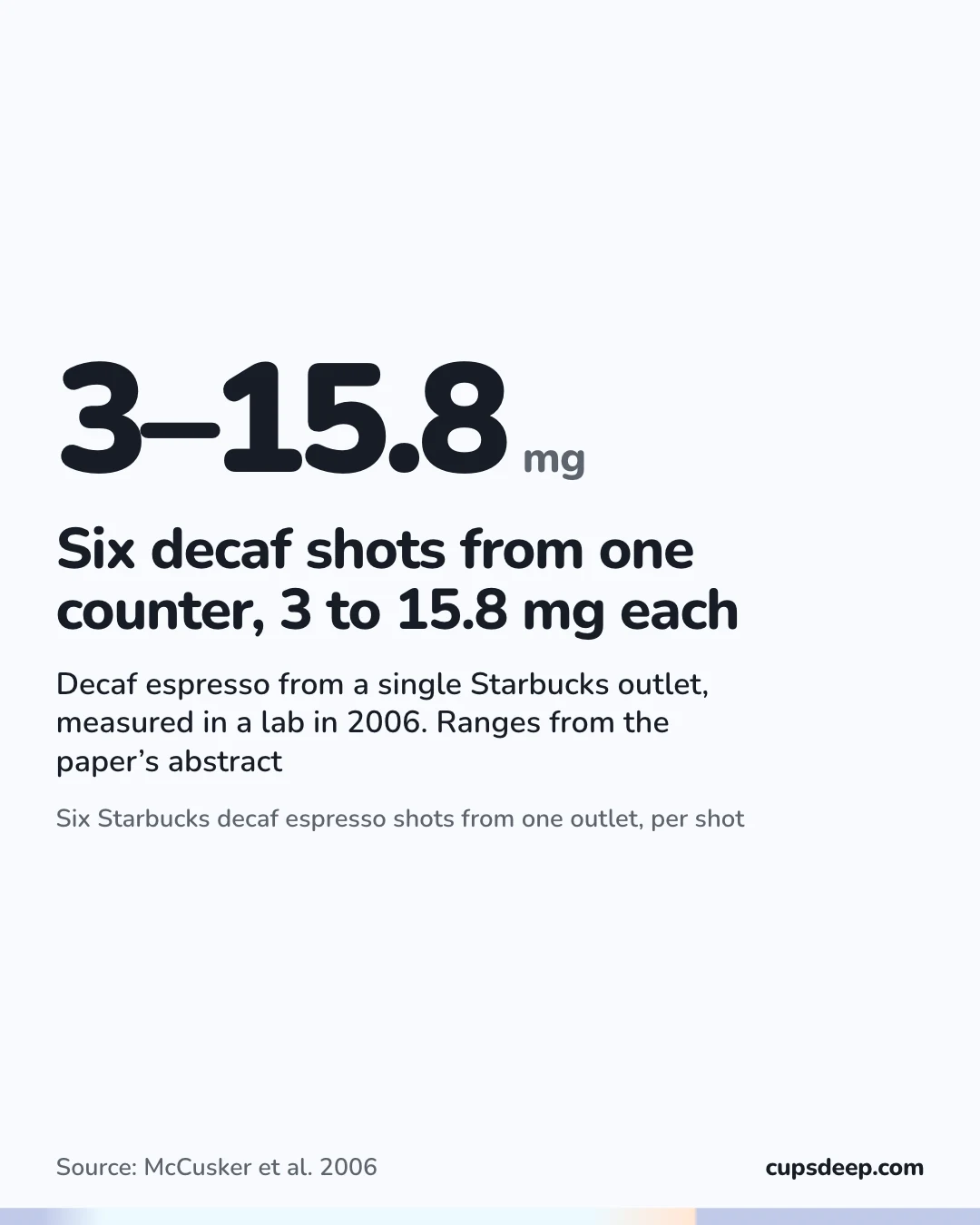
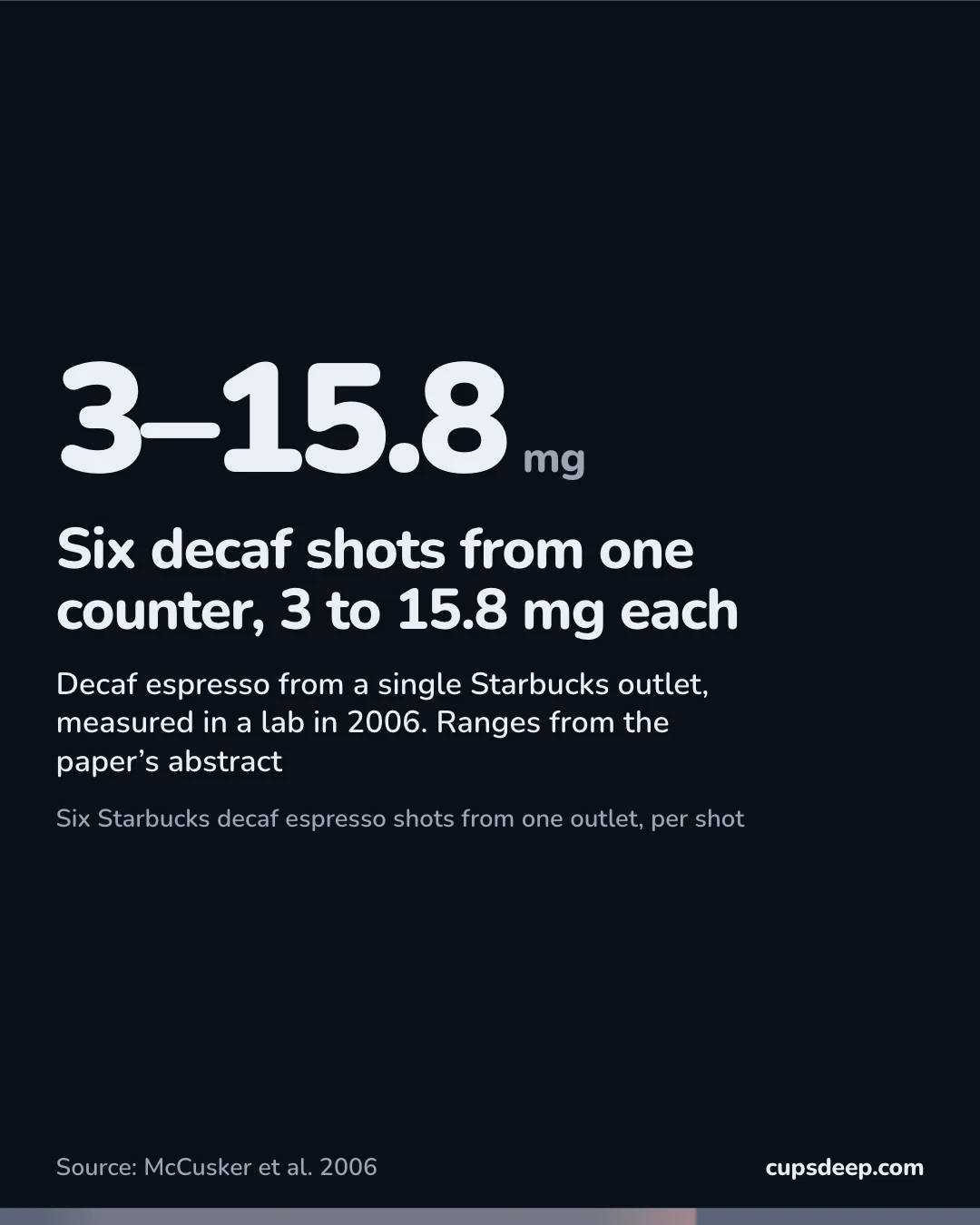
In a 2006 lab study, 10 decaf coffees collected from different coffee establishments held 0 to 13.9 mg of caffeine per 16 oz serving. From a single Starbucks outlet, six decaf espresso shots held 3.0 to 15.8 mg per shot and six decaf brewed coffees 12.0 to 13.4 mg per 16 oz serving. These are the ranges in the paper's abstract, which is the only part that was read; the abstract says the samples came from the same outlet and does not say when they were collected. 63
Read the second half of that again. Six decaf shots, one counter, and by our arithmetic the strongest carried about 5.3 times the caffeine of the weakest. The full paper is behind a paywall, so the ranges in its abstract are all we claim.
| Source | Serving | Caffeine | What kind of number |
|---|---|---|---|
| FDA | 8 fl oz cup | 2–15 mg | Typical range |
| USDA | 8 fl oz cup | 2.4 mg | Imputed, zero lab data points |
| Health Canada, roasted and ground | 8 oz cup | 3 mg | Table value, no source named |
| Health Canada, instant | 8 oz cup | 5 mg | Table value, no source named |
| Ten decafs, different coffee shops | 16 oz | 0–13.9 mg | Lab-measured, 2006 |
| One Starbucks, six brewed cups | 16 oz | 12–13.4 mg | Lab-measured, 2006 |
| One Starbucks, six espresso shots | One shot | 3–15.8 mg | Lab-measured, 2006 |
| Starbucks US, short | 8 fl oz | 15 mg | The chain’s menu |
| Starbucks US, tall | 12 fl oz | 20 mg | The chain’s menu |
| Starbucks US, grande | 16 fl oz | 25 mg | The chain’s menu |
| Starbucks US, venti | 20 fl oz | 30 mg | The chain’s menu |
| Costa UK, decaf espresso | Two shots, one pod | 2 mg | The chain’s store guide |
| Regular brewed coffee, for scale | 8 fl oz cup | 94.8 mg | USDA, lab-measured |
Servings differ by row and nothing was converted between them. The lab ranges are from the paper’s abstract. The two USDA cups are our arithmetic from its per-weight values.
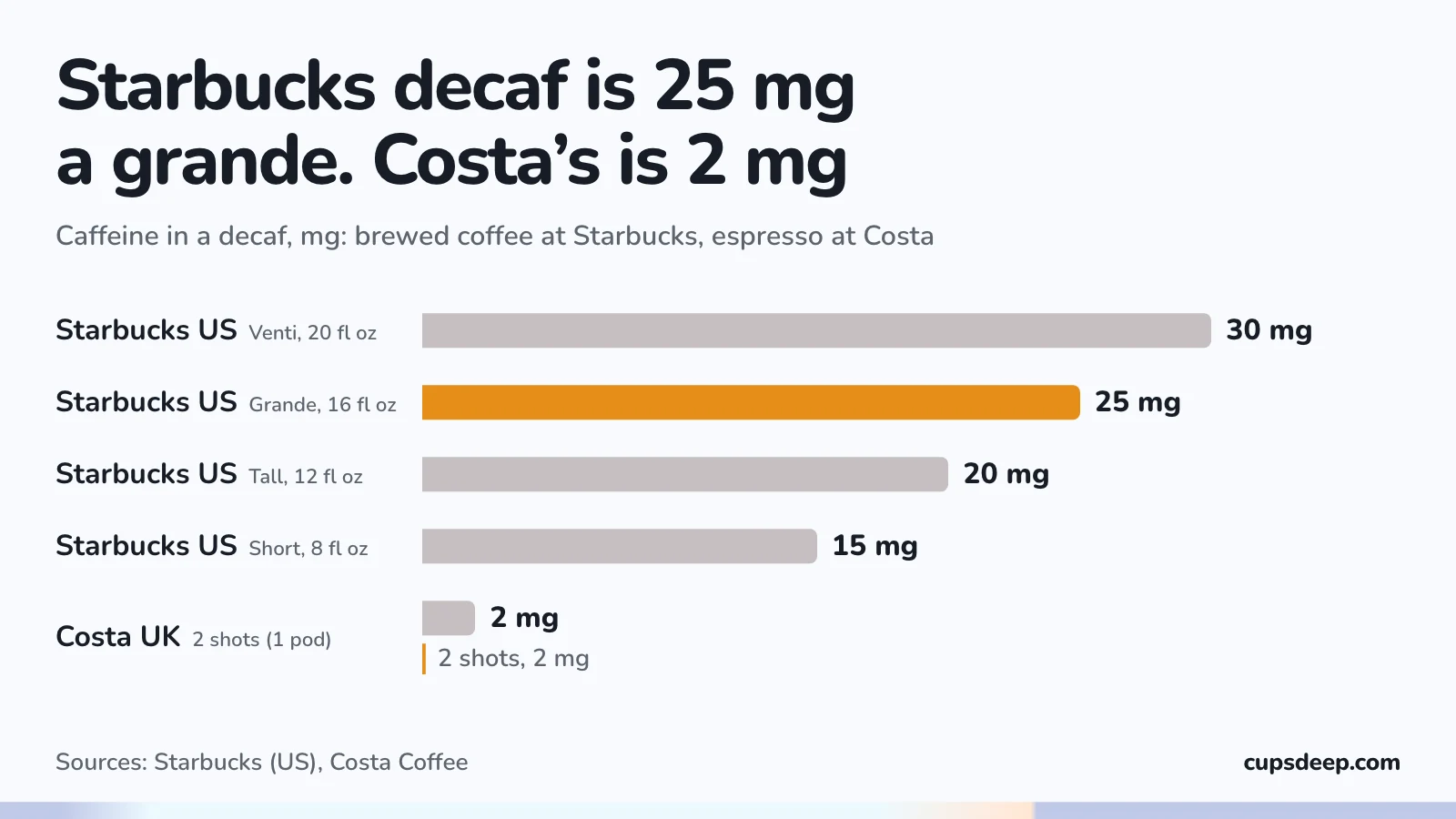
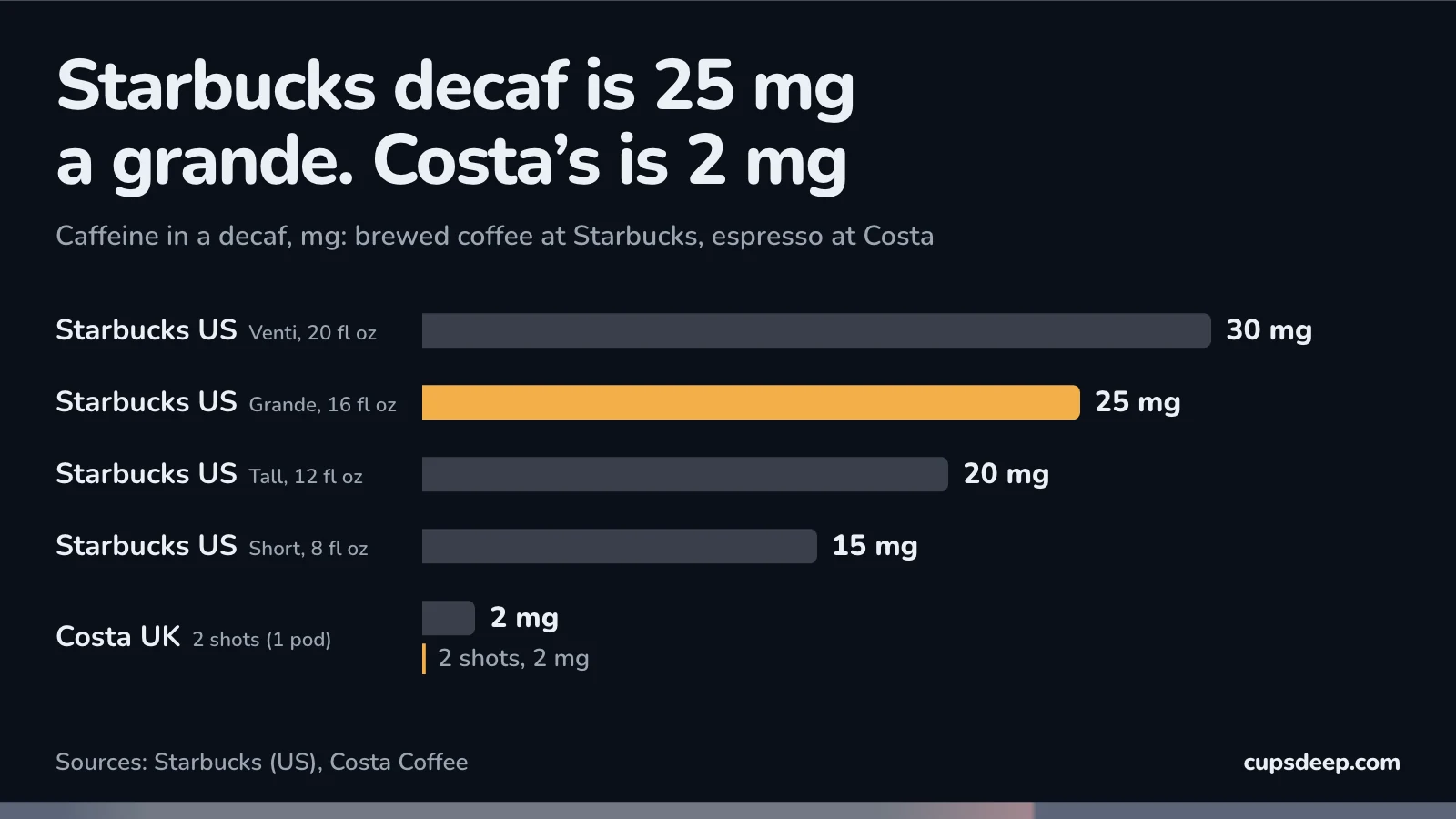
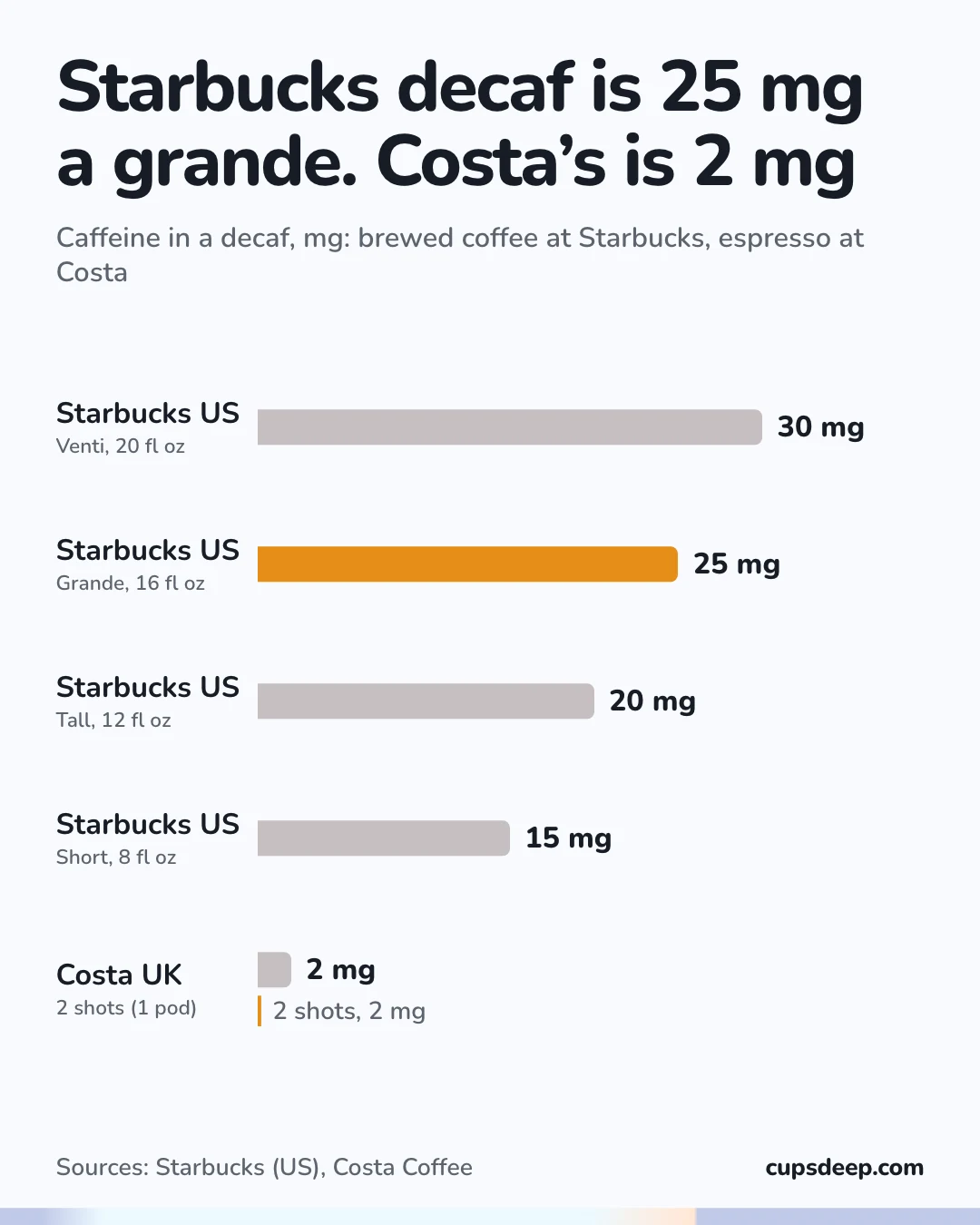
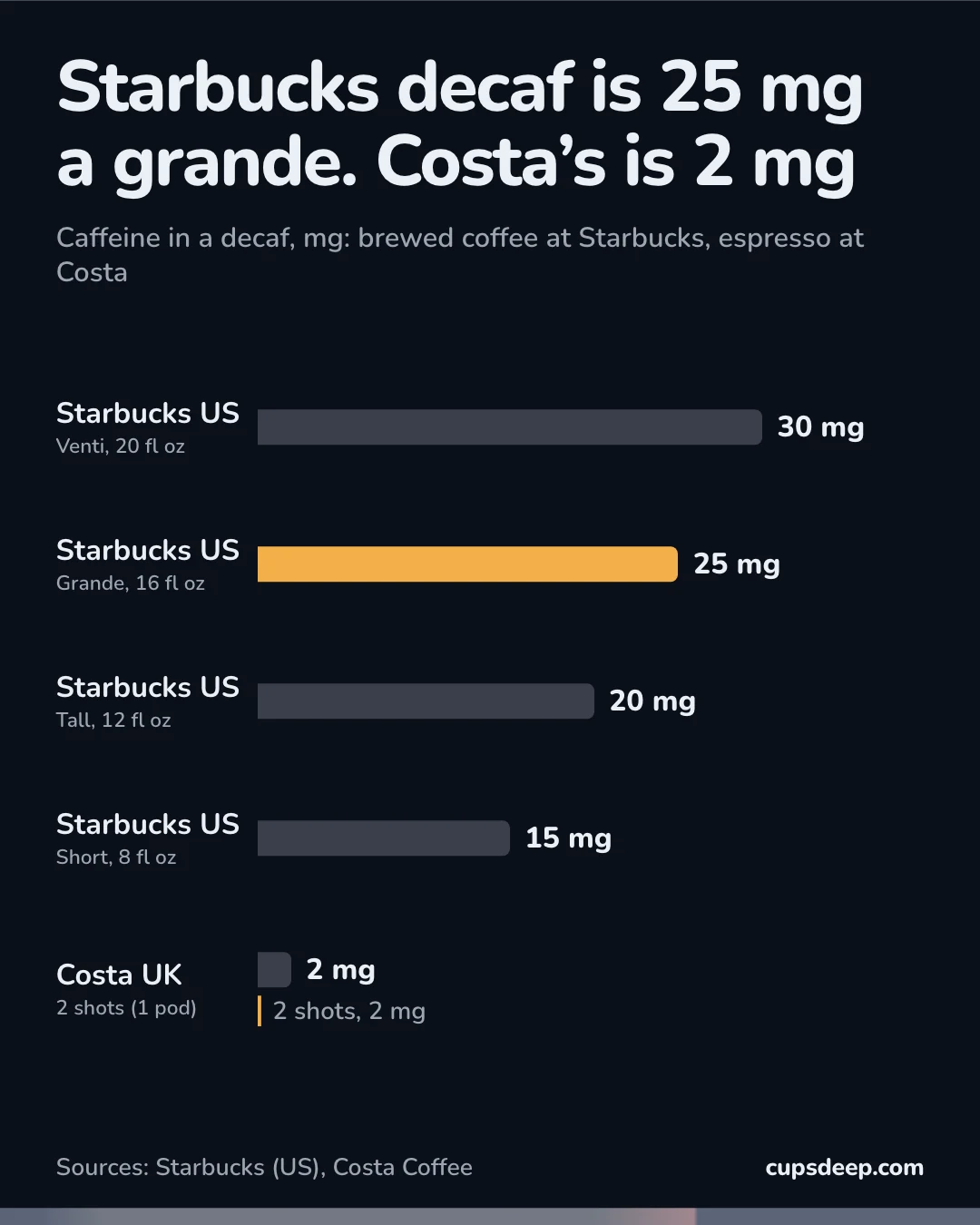
Notice the gap between label and lab. Starbucks lists 25 mg for a 16 fl oz decaf; the 2006 lab found 12–13.4 mg in the same size from one of its counters. Different years and different beans, so I would not call the menu wrong. I would call decaf a range with a logo on it. The regular side of this table is in how much caffeine is in a cup of coffee.
Decaf knows what it did
How much caffeine is in a decaf espresso?
A regular shot on our drinks page is 63.6 mg. A decaf shot is whatever the counter hands you: 3–15.8 mg across the six lab-measured Starbucks shots, and 2 mg for two shots by Costa’s own guide.
A decaf latte, cappuccino or americano is its shots plus milk or water, and neither adds caffeine. Count the shots and you have the drink. The regular version of that sum is in how much caffeine is in a shot of espresso.
How many decafs equal one regular coffee?
This is the division we did not see done on the pages we read. Here it is, from sourced values only, with the working shown.
By our arithmetic, an 8 fl oz cup of regular brewed coffee at USDA's 40 mg per 100 g holds 94.8 mg of caffeine. USDA's decaf record gives 1 mg per 100 g, or about 2.4 mg in the same cup, so the regular cup holds 40 times as much; that decaf value is imputed from another form of the food, with zero lab data points, and is not a measurement. Against FDA's typical decaf range of 2 to 15 mg per 8 fl oz, the regular cup holds about 47 times the caffeine of a decaf at the low end and about 6 times that of one at the high end. 11775
So a regular cup holds somewhere between 6 times and 47 times the caffeine of a decaf, depending on which decaf. The chains’ own menus tell the same story from both ends.
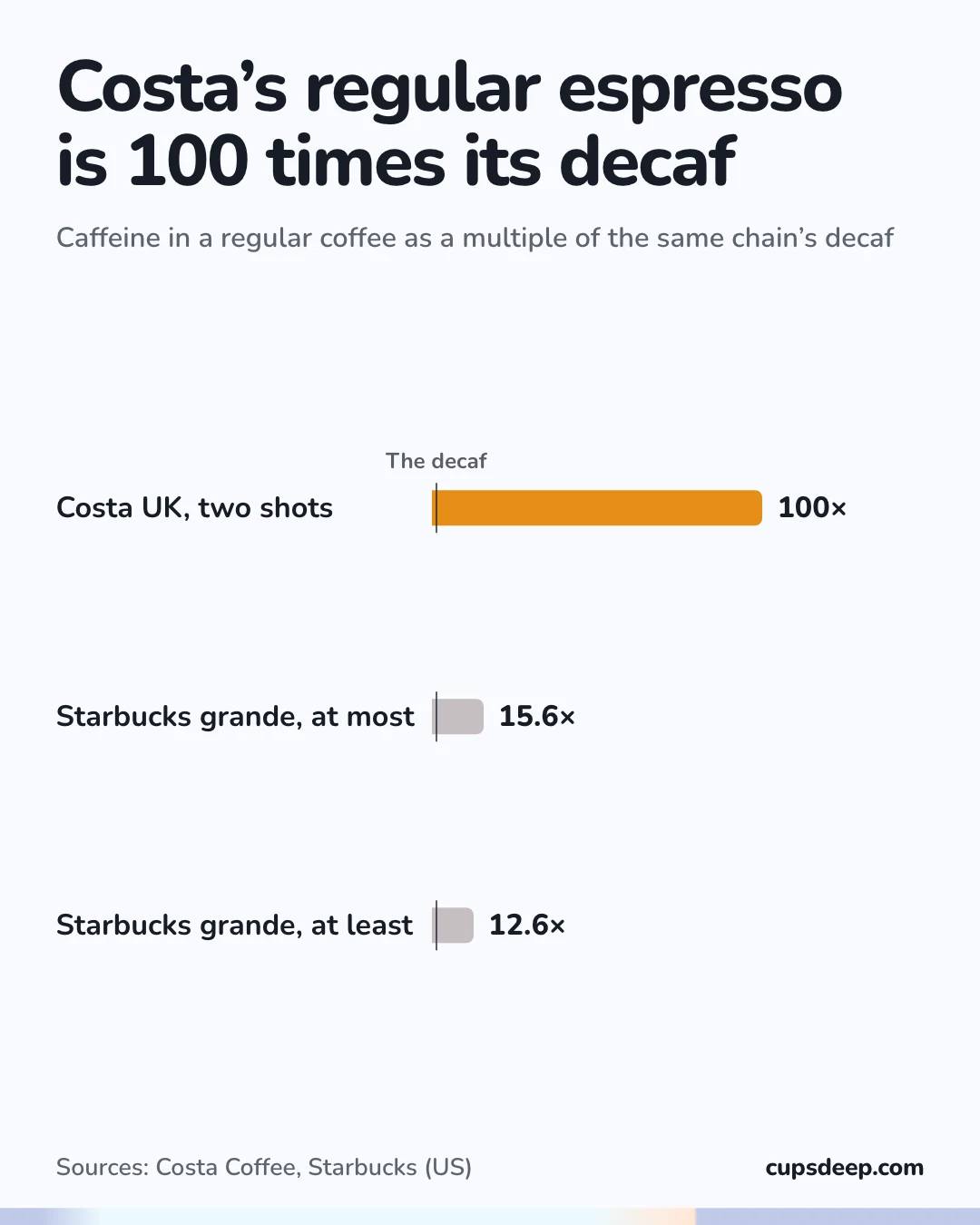
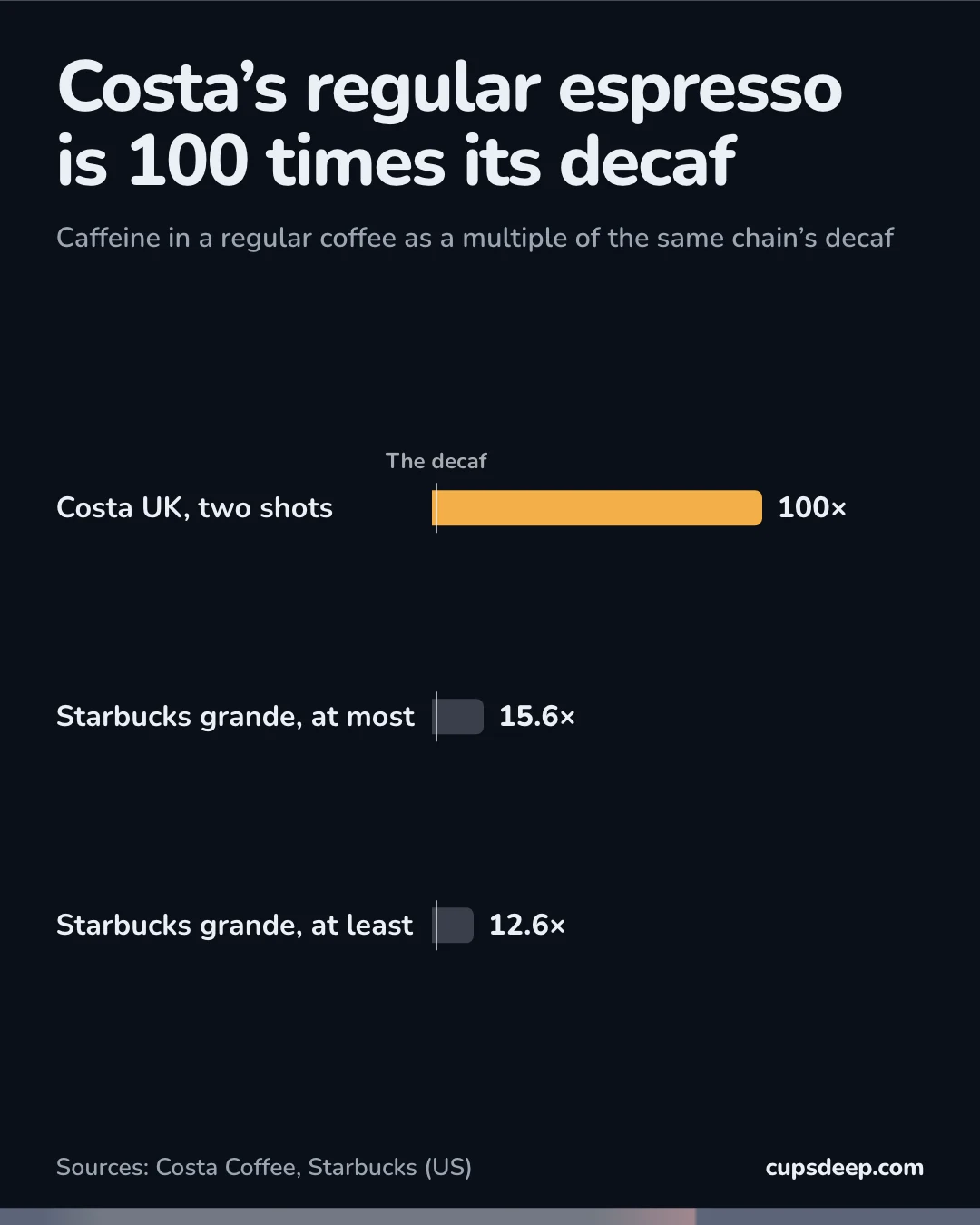
By our arithmetic from the chains' own figures, two regular espresso shots at Costa UK (200 mg) hold 100 times the caffeine of two decaf shots (2 mg). At Starbucks US, a 16 fl oz Pike Place Roast (315 to 390 mg) holds 12.6 to 15.6 times the caffeine of the decaf roast in the same size (25 mg), and three 20 fl oz decafs at 30 mg each come to 90 mg. 504142
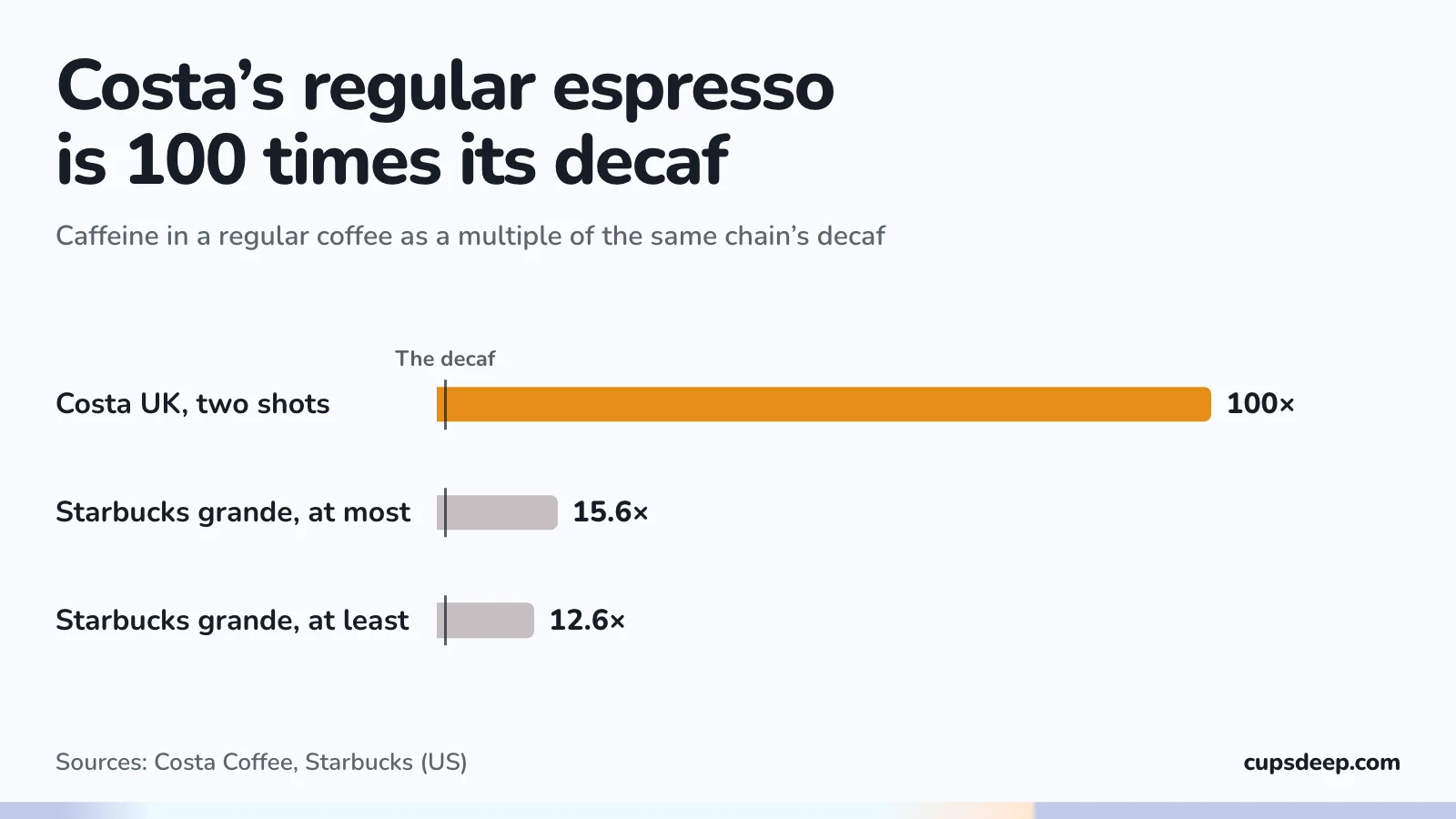
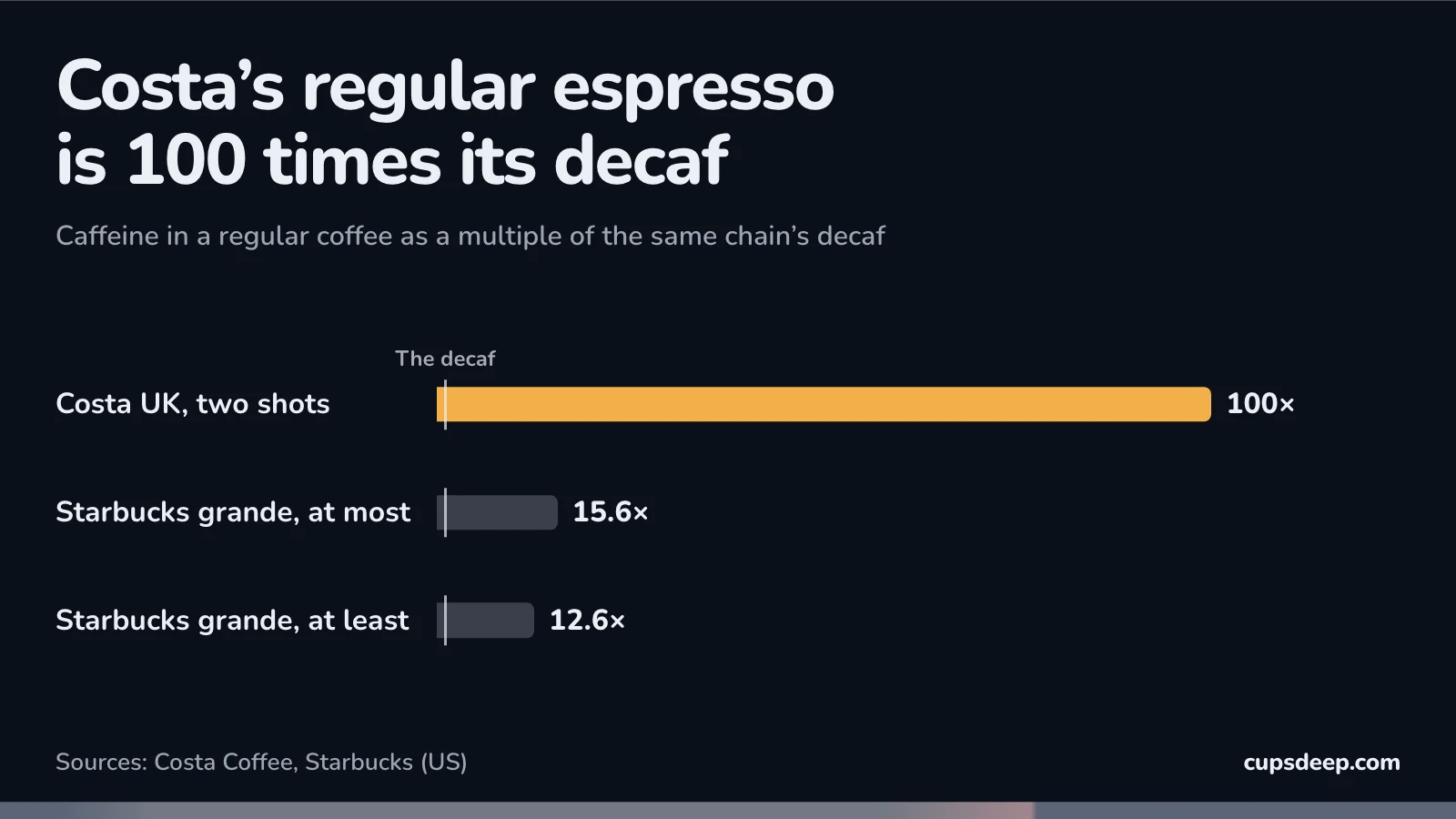
Three venti decafs come to 90 mg, close to the 94.8 mg in one regular cup. If you switched to large chain decafs to cut caffeine, you cut most of it. Not all of it.
I did the maths. You can keep ignoring it
Does decaf have to be 97% caffeine free?
Pages we read on this question say an authority requires 97% of the caffeine to be removed. Some credit FDA, some USDA, some British law. None that we read links to the rule. We went looking for it and could not find it either, so we do not attribute it to anyone. We did not read the UK regulations and claim nothing about them.
A full-text search of the US Code of Federal Regulations on 10 November 2026 found the word decaffeinated in three sections: a list of food categories (21 CFR 170.3) and the rules for two solvents, methylene chloride (173.255) and trichloroethylene (173.290). None of them defines decaf or sets a share of caffeine that must be removed. 78
What does exist is a different kind of number: not how much caffeine was taken out, but how much may be left in the coffee.
Where a caffeine ceiling for decaf is written down, it is a share of the coffee, not a share of the caffeine removed. EU Directive 1999/4/EC covers coffee extracts such as instant coffee only, and has them labeled decaffeinated when caffeine is at most 0.3% of the coffee-based dry matter. Germany's coffee regulation allows at most 1 g of caffeine per kg of dry matter (0.1%) in raw and roasted decaf and 3 g per kg (0.3%) in extract. Canada's compositional standard allows 0.1% in decaffeinated raw and roasted coffee and 0.3% in decaffeinated instant. A 2004 USDA purchasing specification sets 0.10% on a dry basis for decaf the government buys; it is not a rule on what may be sold as decaf. 81828384
Two things follow. The EU directive covers instant coffee, not roasted beans; the binding 0.1% for roasted decaf that we could verify in Europe is German national law. And a share of the bean is not a share of the caffeine removed, so the two kinds of percentage cannot be swapped.
Swiss Water guarantees that decaffeinated green (unroasted) coffee leaving its process is 99.9% caffeine free. The guarantee describes the bean before roasting, not the brewed cup. Its process page says the process removes 99.9% of the caffeine, a share of the caffeine the bean started with. 85375
Our reading, not the company’s wording: a bean that is 99.9% caffeine free is a bean with at most 0.1% caffeine, the same figure as the German and Canadian ceiling, though the company does not say on what basis it measures. It is not a promise about the cup.
Everyone cites the law. Nobody has read it
How is decaf made, and is decaf coffee bad for you?
The caffeine comes out of the green bean, before roasting. What does the taking differs: a solvent, either methylene chloride or ethyl acetate, or water, as in the Swiss Water process.
US regulation lets methylene chloride be used to extract caffeine from green coffee beans provided no more than 10 parts per million (0.001%) is left in decaffeinated roasted coffee or decaffeinated instant coffee. Ethyl acetate is permitted as a solvent for decaffeinating coffee and tea under good manufacturing practice, with no numeric residue limit. 7980
That limit is the actual answer to the methylene chloride question. It is a ceiling on residue, not a measurement of your cup, and nothing in the sources behind this page says decaf is bad for you. You will also find tables of caffeine per cup by decaf method. We could not find a primary measurement behind any of them, so there is no such table here.
Can the caffeine in decaf keep you awake?
We found no controlled study that gave people decaf coffee and measured a caffeine effect. What we did find is two studies of small doses of pure caffeine, in people kept off their usual caffeine.
In a double-blind study by Silverman and Griffiths (1992), adults kept off caffeine in their diet, but given a daily caffeine capsule by the study, were trained to tell a caffeine capsule from placebo, first at 178 mg and then at lower doses. The lowest dose a person could tell from placebo (at least 75% correct), and that produced mood effects, was 100 mg for four of them, 56 mg for two, 32 mg for one and 18 mg for one; one of them also reported mood effects at 10 mg. Fifteen people started and nine went on to the low-dose training. This was pure caffeine in a capsule, not decaf coffee, and only the abstract was read. 86
Smit and Rogers (2000) gave 23 people 0, 12.5, 25, 50 and 100 mg of caffeine after overnight abstinence, double-blind. All doses of caffeine significantly affected cognitive performance, and the dose-response relationship was rather flat. The effects were more marked in people who habitually took more caffeine. This was caffeine on its own in people who had abstained, not decaf coffee, and only the abstract was read. 87
Neither study poured anyone a decaf, and only the abstracts were read, so treat them as a floor, not a forecast. What they show is that a dose this small is not automatically nothing. A Starbucks decaf runs from 15 mg to 30 mg by its own menu. For scale, the single dose EFSA says may affect sleep in some adults near bedtime is 100 mg, and how long it lingers differs a lot between people. The model behind the curve is on the method page.
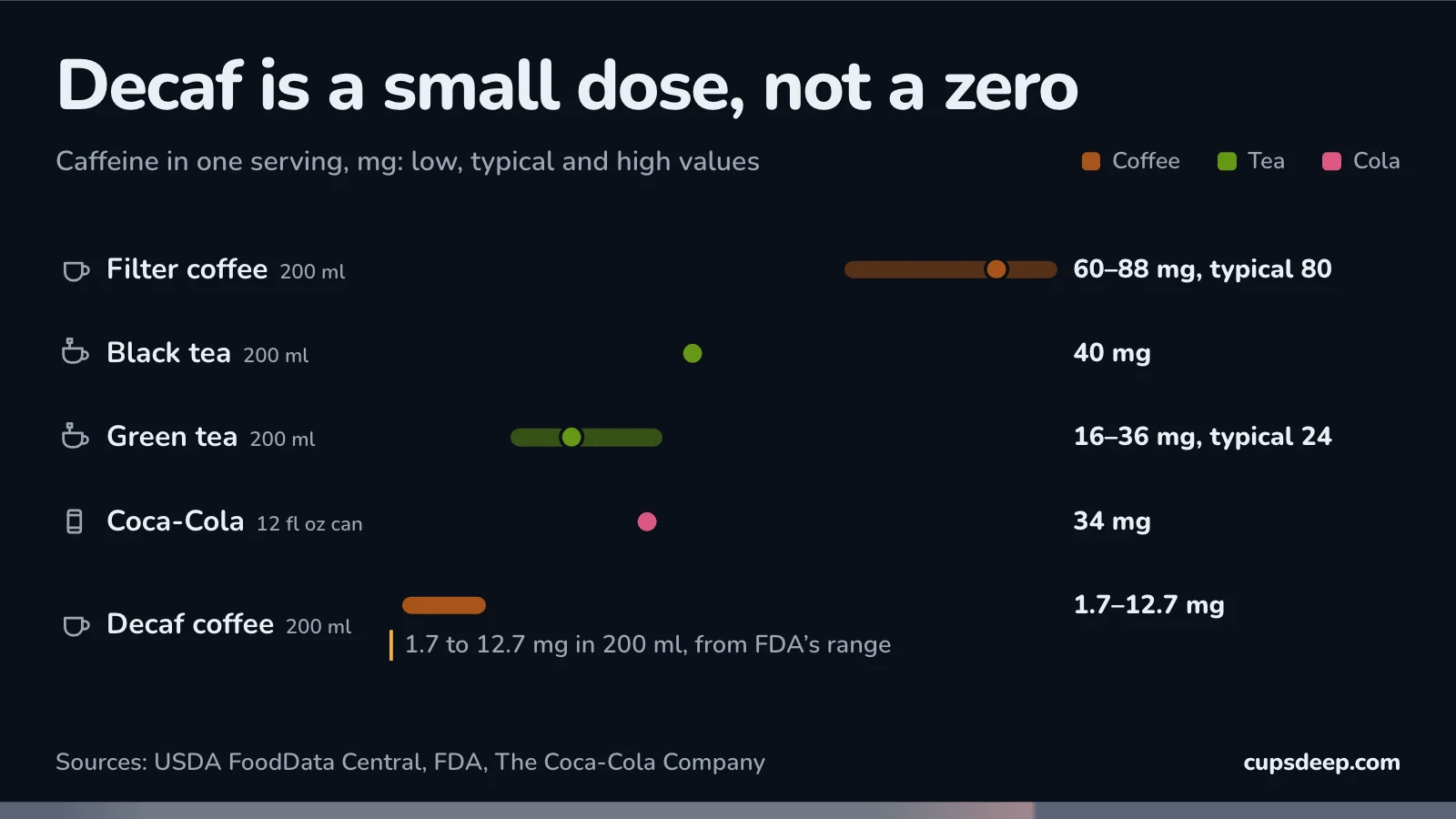
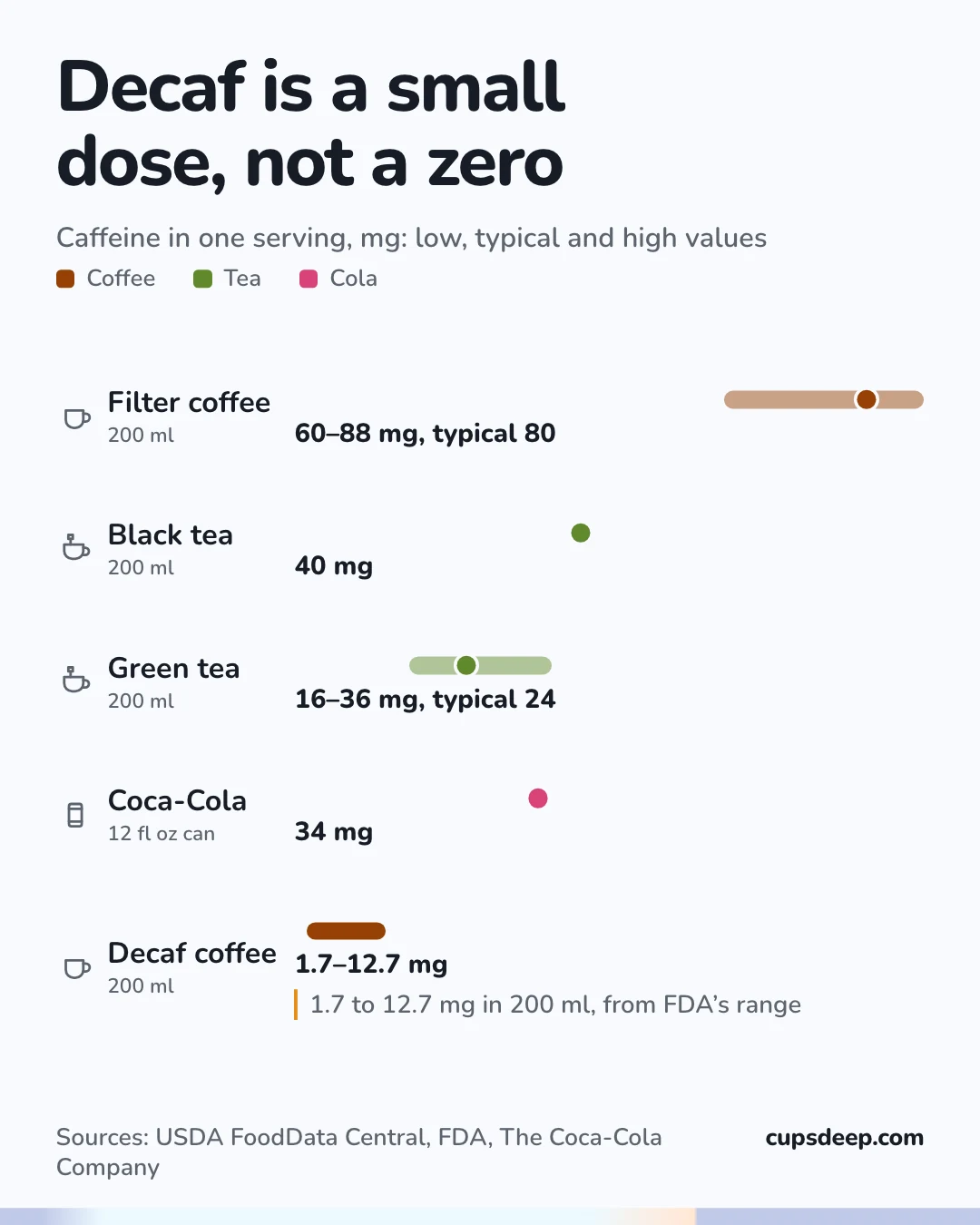
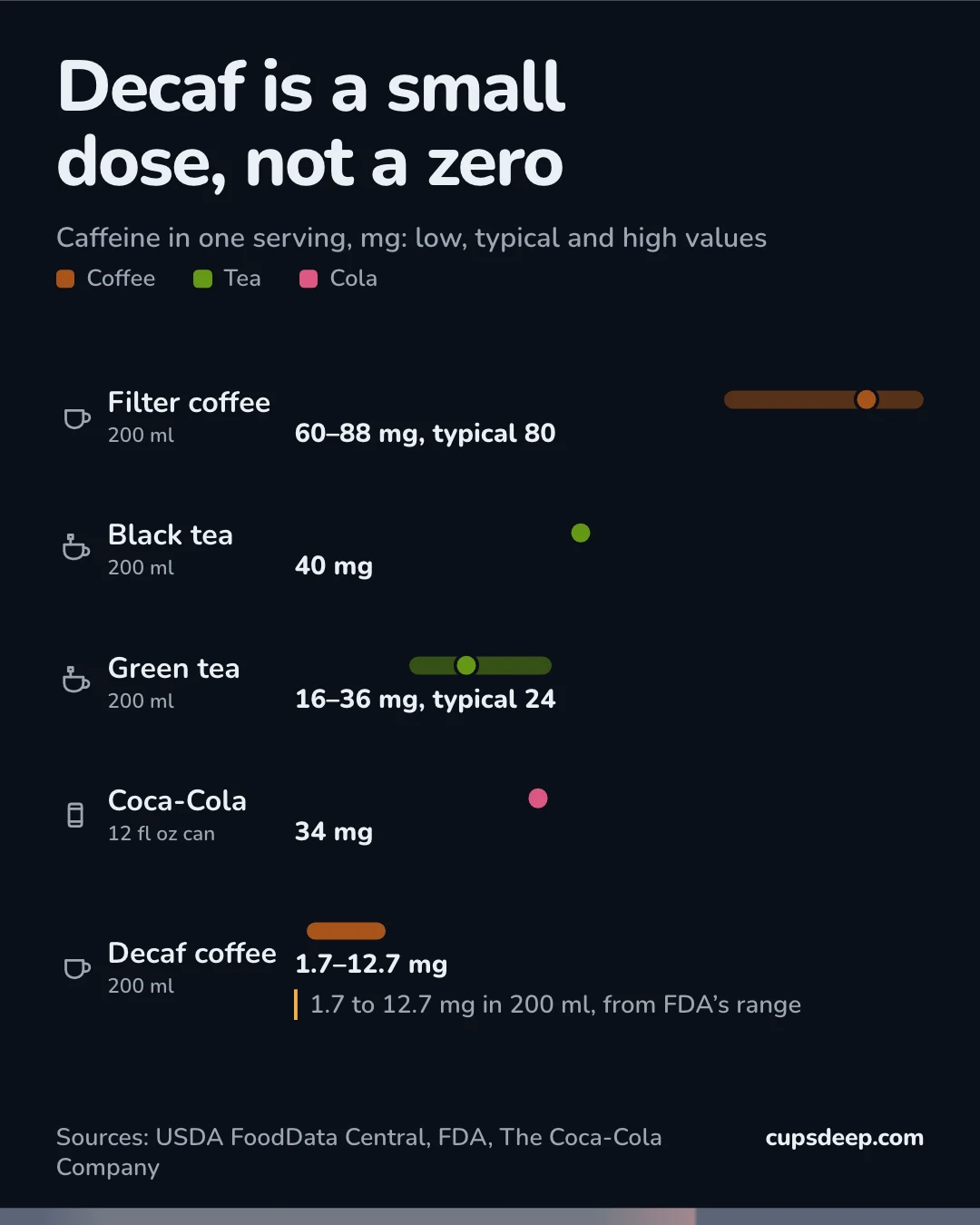
In pregnancy the line we hold is EFSA’s: 200 mg/day from all sources raises no safety concern for the fetus. Decaf counts toward it, a few milligrams at a time, and so does chocolate.
Technically 0 cups deep. The lab disagrees
Questions people ask
Is decaf coffee completely caffeine free?
No. FDA says decaf typically has 2–15 mg in an 8 fl oz cup, and a 2006 lab study found 0–13.9 mg per 16 oz serving across ten decafs from different coffee shops. The low end of that lab range is zero, so a caffeine-free cup exists. You cannot count on being handed it.
How much caffeine is in Starbucks decaf coffee?
By Starbucks US’s own menu, a decaf Pike Place Roast has 15 mg in a short, 20 mg in a tall, 25 mg in a grande and 30 mg in a venti. A 2006 lab study measured 12–13.4 mg in six 16 oz decaf brewed coffees from one Starbucks outlet. The drinks Starbucks lists at zero are in Starbucks drinks without caffeine.
Is decaf coffee bad for you?
Nothing in the sources behind this page says so. For solvent-processed decaf, US regulation caps methylene chloride residue at 10 parts per million (0.001%) in roasted and instant decaf coffee.
Can you drink decaf coffee when pregnant?
EFSA concludes that up to 200 mg/day of caffeine from all sources raises no safety concern for the fetus. A decaf at FDA’s typical 2–15 mg per 8 fl oz cup counts toward that total, a few milligrams at a time.
Is Swiss Water decaf caffeine free?
Swiss Water guarantees that green, unroasted coffee leaving its process is 99.9% caffeine free. That describes the bean, not the brewed cup, and we found no primary measurement of caffeine per cup by decaf method.
Sources
Every number above links to the place it came from. How the numbers are chosen and checked is on the method page; the drink table is at /drinks. Written with AI agents, as the whole site is. A model of a typical body, not advice for pregnancy, illness or medication.
- What is caffeine?
- Coca-Cola (US), 12 fluid ounce can: SmartLabel nutrition facts
- Spilling the Beans: How Much Caffeine is Too Much?
- Beverages, coffee, brewed, prepared with tap water
- Beverages, coffee, brewed, espresso, restaurant-prepared
- Beverages, tea, green, brewed, regular
- Beverages, tea, black, brewed, prepared with tap water
- Scientific Opinion on the safety of caffeine
- Medium Roast - Pike Place Roast: nutrition (starbucks.com, United States)
- Decaf Roast - Pike Place Roast: nutrition (starbucks.com, United States)
- Information for customers in UK Costa stores, Festive 2026 (store allergen guide)
- Caffeine content of decaffeinated coffee (McCusker, Fuehrlein, Goldberger, Gold, Cone; J Anal Toxicol 2006;30(8):611-3)
- Beverages, coffee, brewed, prepared with tap water, decaffeinated
- Electronic Code of Federal Regulations: full-text search for 'decaffeinated'
- 21 CFR 173.255, Methylene chloride
- 21 CFR 173.228, Ethyl acetate
- Directive 1999/4/EC of the European Parliament and of the Council of 22 February 1999 relating to coffee extracts and chicory extracts
- Verordnung über Kaffee, Kaffee- und Zichorien-Extrakte (KaffeeV 2001), § 2 Abs. 3 Nr. 1
- Canadian Food Compositional Standards, Volume 5 - Coffee, section 5.1.3
- Commercial Item Description: Coffee, A-A-20213B, August 17, 2004
- How Much Caffeine is in Decaf from Swiss Water Process (10 November 2025)
- Low-dose caffeine discrimination and self-reported mood effects in normal volunteers (Silverman, Griffiths; J Exp Anal Behav 1992;57(1):91-107)
- Effects of low doses of caffeine on cognitive performance, mood and thirst in low and higher caffeine consumers (Smit, Rogers; Psychopharmacology 2000;152(2):167-73)
- Caffeine in Foods
- Caffeine content of brewed teas (Chin, Merves, Goldberger, Sampson-Cone, Cone; J Anal Toxicol 2008;32(8):702-4)
- The Swiss Water® Process: Learn The Science Behind Our Chemical-Free Decaf Coffee (blog, November 13, 2025)
Keep reading
Coffee
How much caffeine is in a cup of coffee?
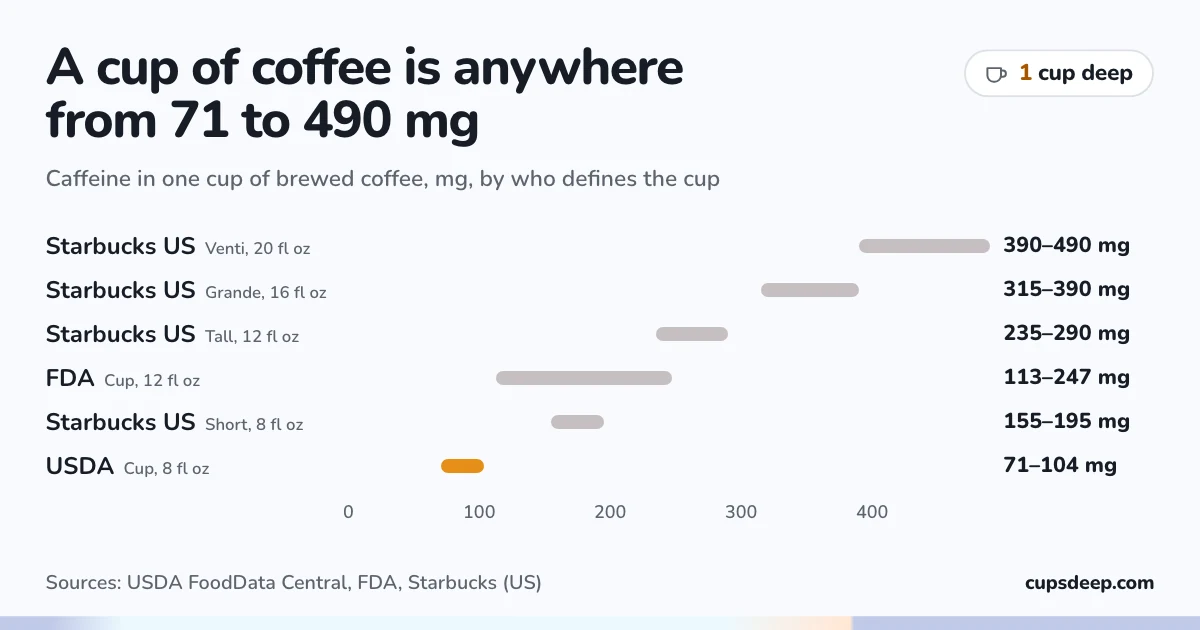
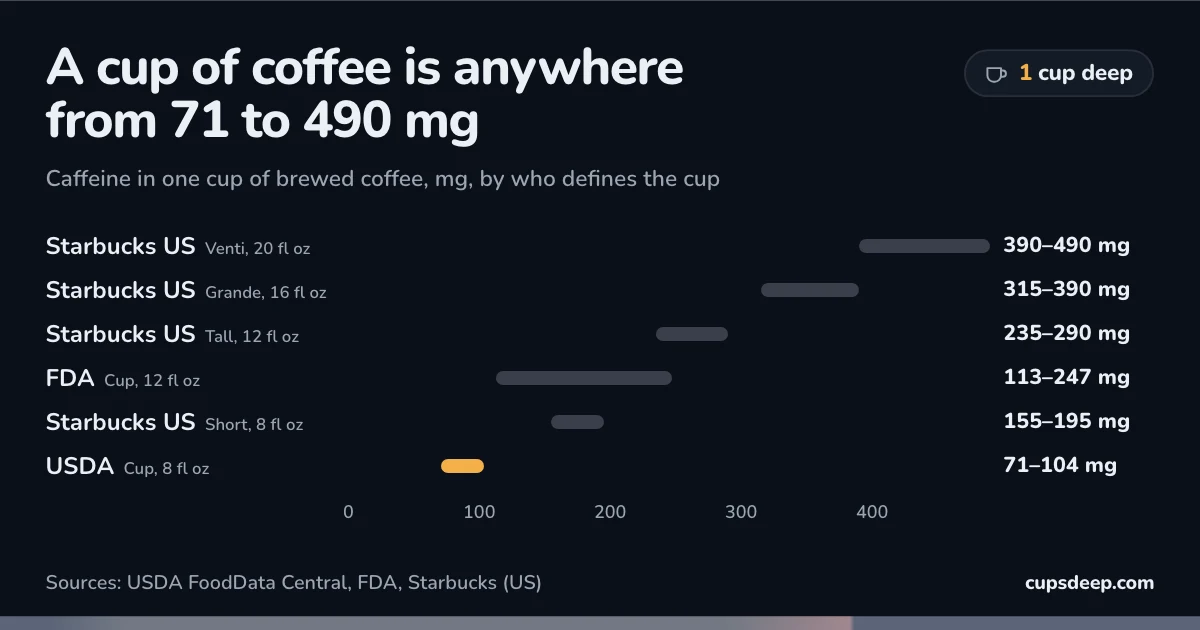
An 8 fl oz cup of brewed coffee has about 95 mg of caffeine by USDA’s figure. A Starbucks cup the same size states 155 mg to 195 mg. Tables by size and type.
Coffee
How much caffeine is in a shot of espresso?
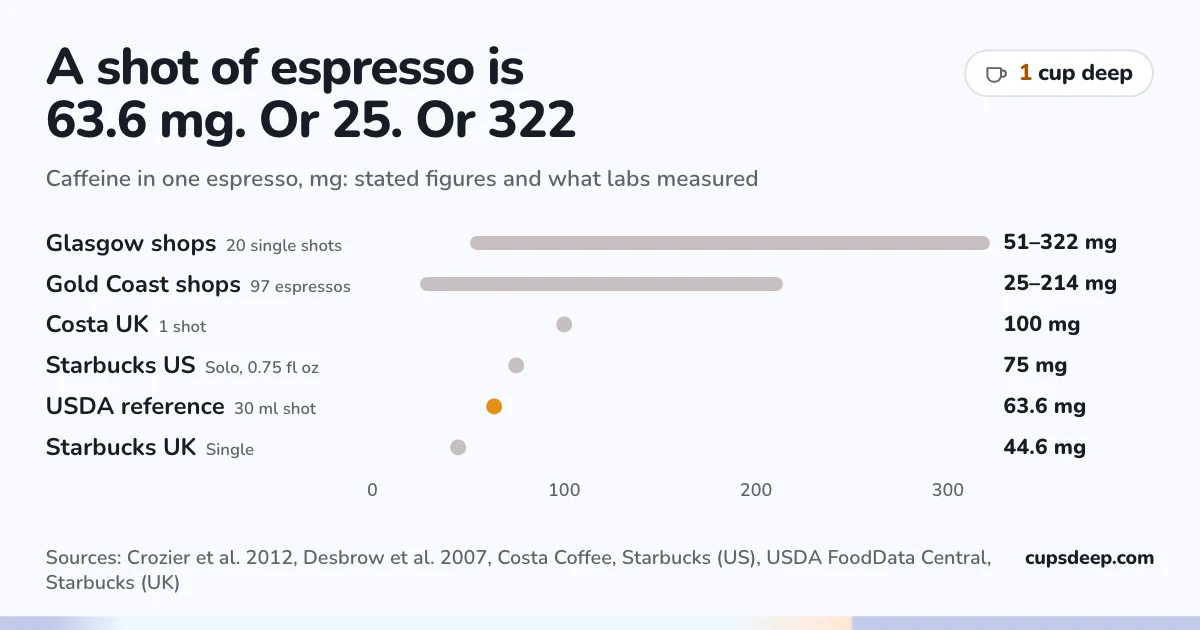
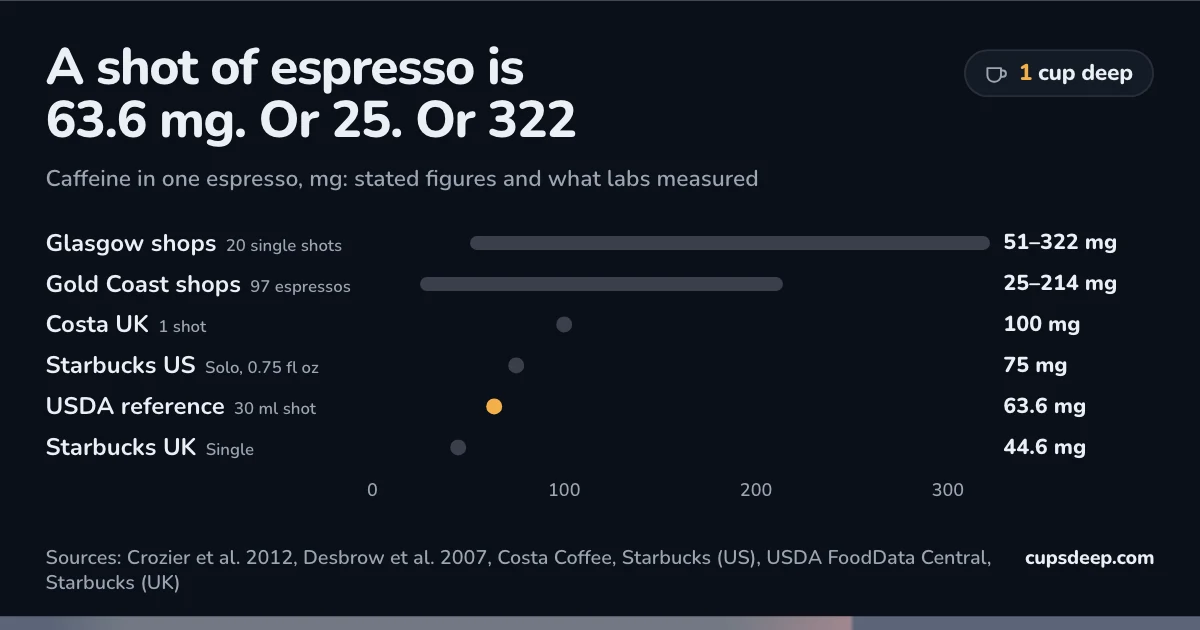
A shot of espresso is 63.6 mg by the USDA’s figure. Chains state 44.6 mg to 100 mg, and labs that bought real shots found 25 mg to 322 mg.
Body and sleep
Caffeine withdrawal: symptoms and timeline
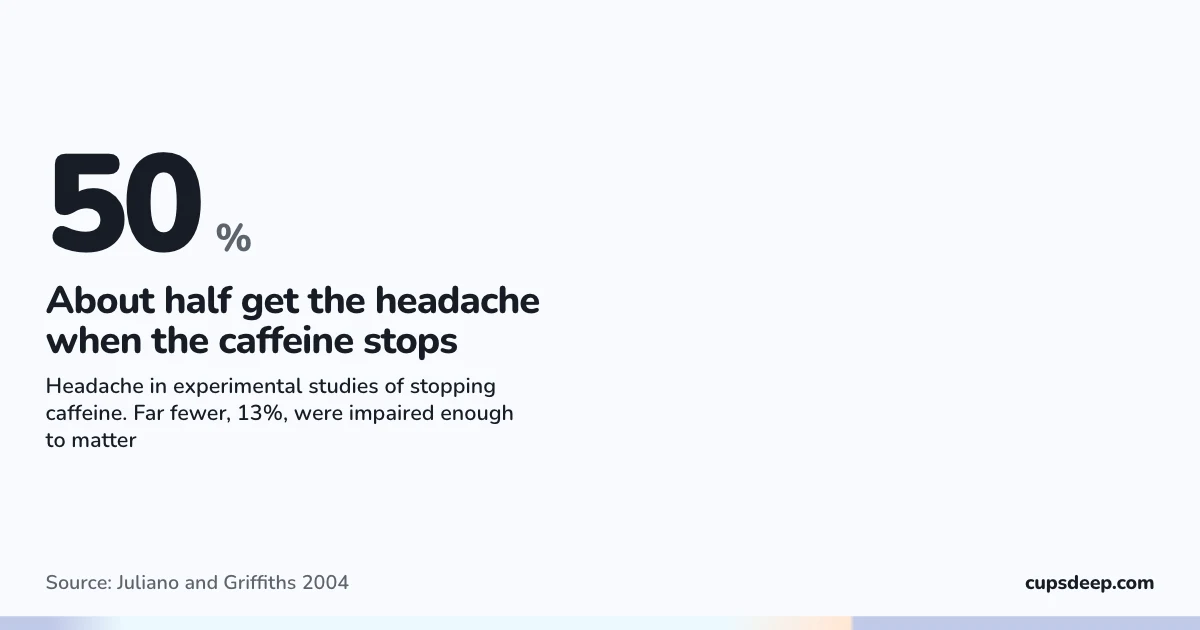
Caffeine withdrawal starts 12–24 hours after the last cup, peaks at 20–51 hours and lasts 2–9 days. About half get the headache. The odds and the fix.