Does oolong tea have caffeine? (And white tea)
Both do. Oolong and white tea come from the same plant as green and black, and that plant makes caffeine. The Republic of Tea will tell you white tea has the least caffeine of all true teas. None of the four lab papers we read found it lowest overall: two found it higher than green, one about the same, and one says it depends on your kettle. Here is every number, with the page it came from, and what each one actually measured.
The short answer
Yes, both. USDA measured brewed oolong at 16 mg per 100 g, about 38 mg in its 240 g cup by our sum. White tea has caffeine too: Twinings US states 25 mg to 30 mg a bag, and one lab got 5.8 mg to 31 mg from the same white teas, depending on how they were brewed.
How much caffeine is in a cup of oolong tea?
USDA has a measured figure: 16 mg per 100 g for brewed oolong. It rests on 2 data points, which is thin, but it is a measurement.
At USDA’s 16 mg of caffeine per 100 g, USDA’s own 240 g cup of hot oolong tea holds about 38 mg, a 200 ml cup, the size on our drinks table, about 32 mg, and a 6 fl oz cup about 28 mg. These are our sums, not figures USDA states. 414415
Japan’s food composition tables, which brew their oolong hot and fast, put it at 20 mg per 100 g (15 g leaf, 650 mL water at 90 °C, 0.5 min). So two governments land close together. The makers state their own, each for a serving of its own.
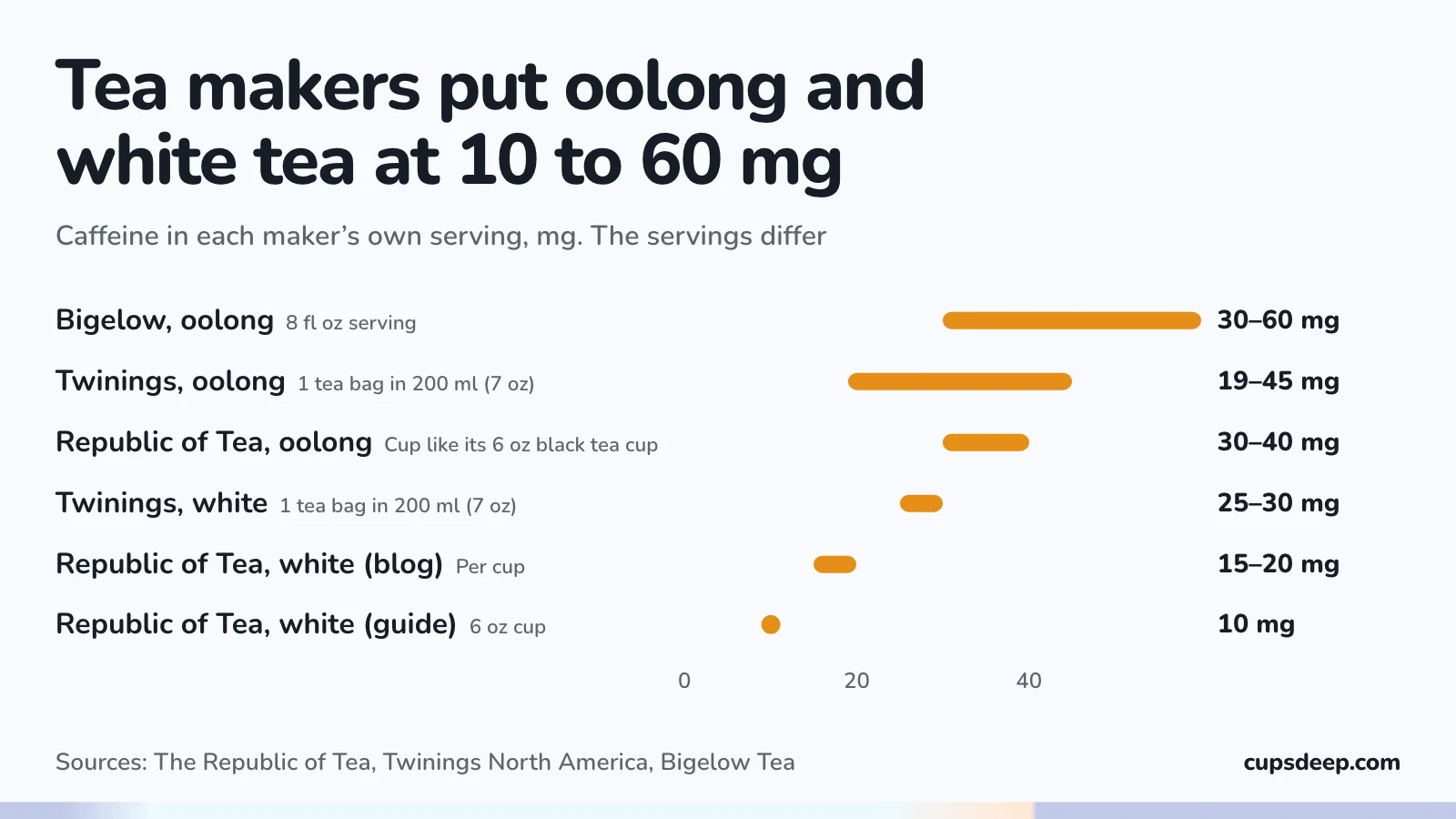
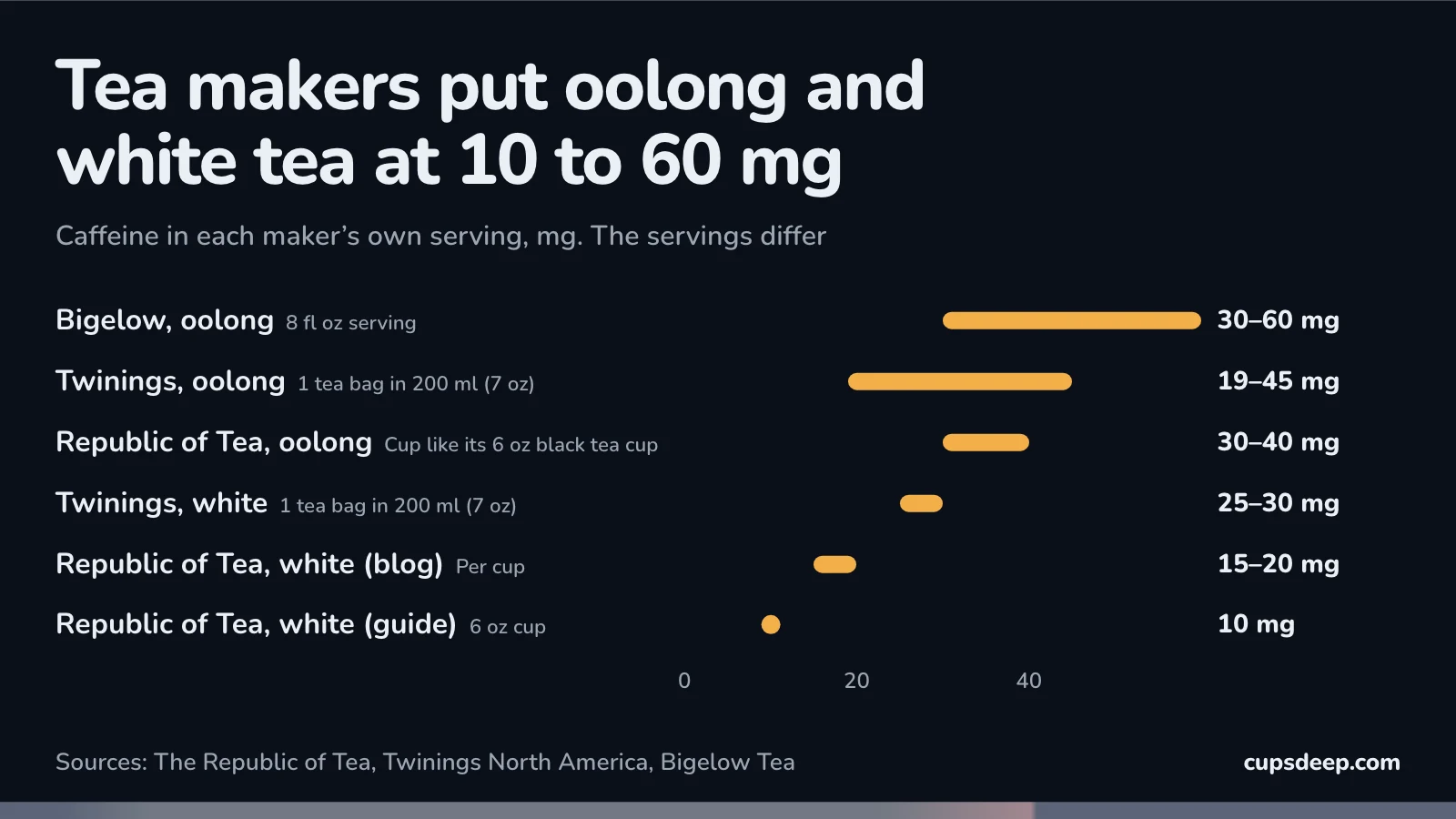
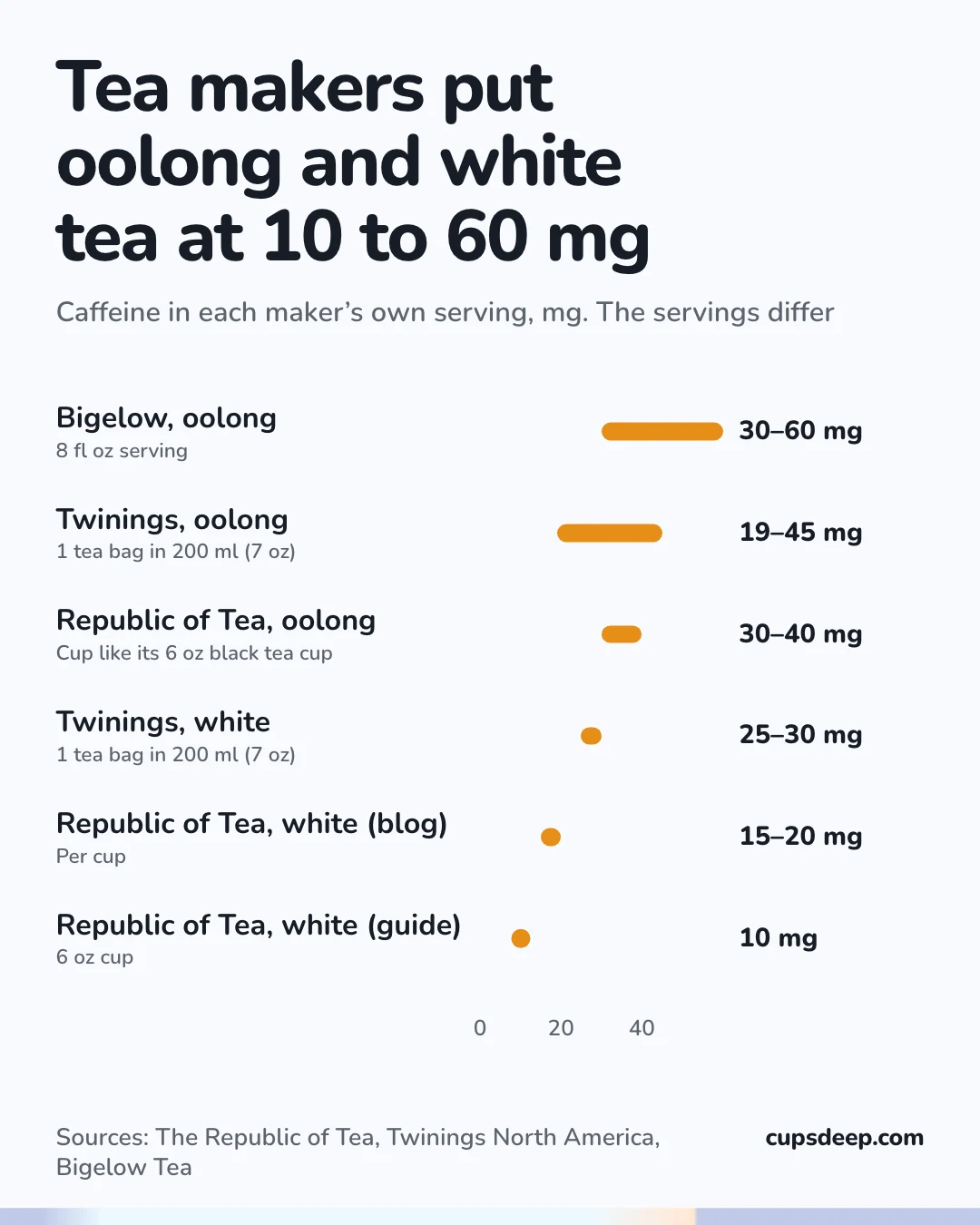
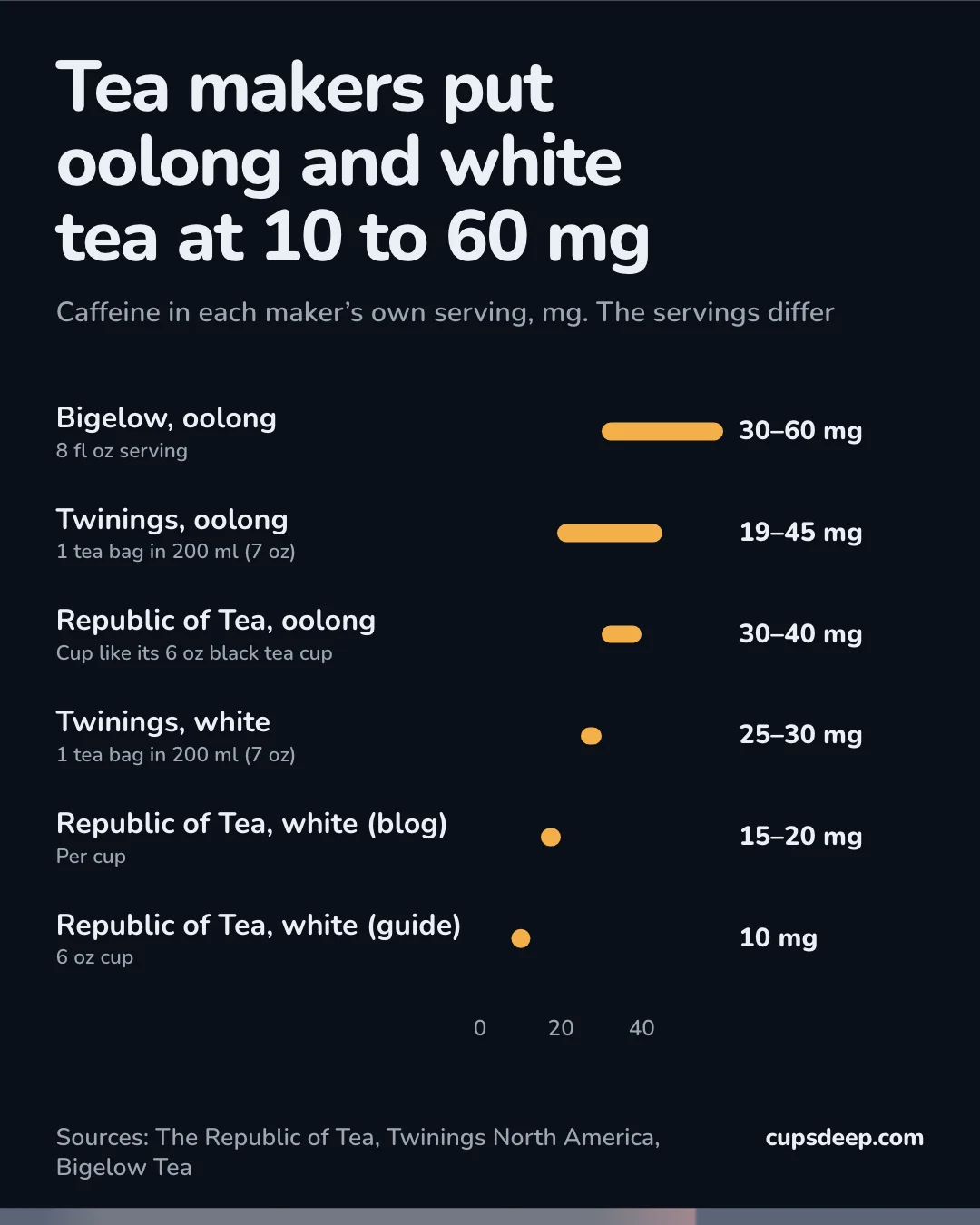
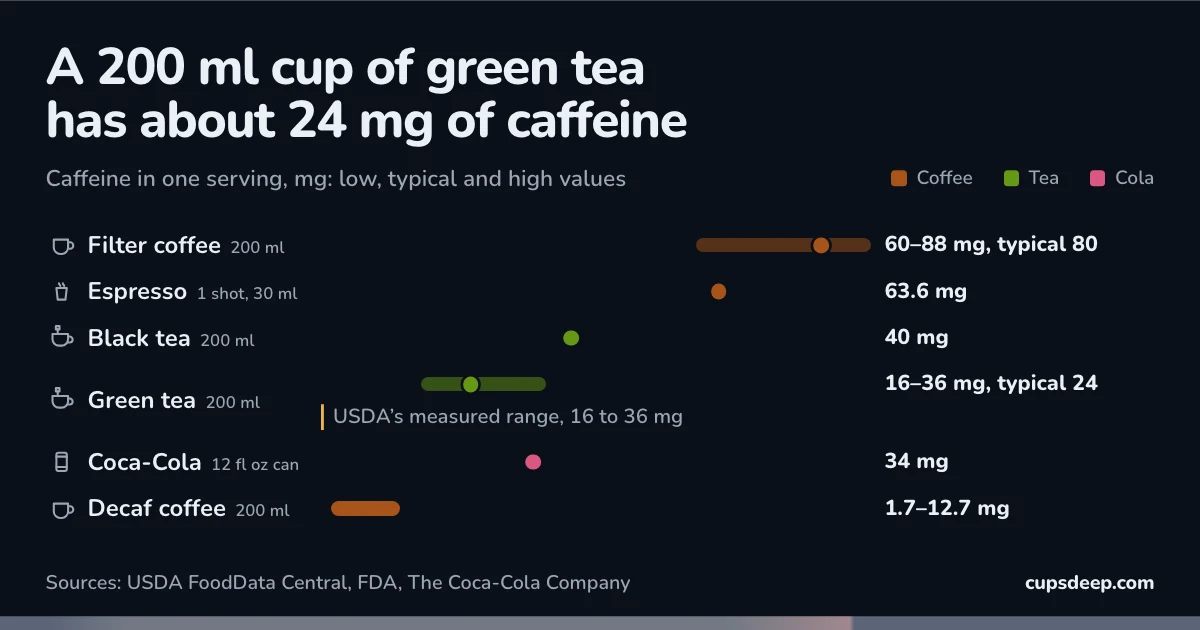
Twinings US gives 19 mg to 45 mg for one oolong bag in 200 ml. The Republic of Tea says 30 mg to 40 mg for a cup the size of its six-ounce black tea cup. Bigelow puts its oolong in one band with black tea, 30 mg to 60 mg per 8 fl oz serving. Compared like with like, USDA’s figure lands inside two of the three: a 200 ml cup at about 32 mg is within Twinings’ range, USDA’s own 240 g cup at about 38 mg, close to an 8 fl oz serving, is within Bigelow’s, and a 6 fl oz cup at about 28 mg is just under The Republic of Tea’s, by our sums. The drinks table has no oolong row yet; its green tea is 24 mg and its black tea 40 mg, per 200 ml.
Does white tea have caffeine, and how much?
Yes. White tea is the youngest leaves and buds of the tea plant, dried with little processing, and nobody we read claims it has none. How much is where it gets messy, starting with the fact that the US government does not say.
USDA’s reference and survey data (SR Legacy, Foundation and FNDDS) have no entry for regular hot white tea. A search for “white tea” with every word required returned 33 survey records on November 12, 2026. In 13, white tea is listed among the additional descriptions of another food, such as iced, bottled or instant green tea or hot decaffeinated green tea; the other 20 match only through a description of black tea blends that names white tea. USDA’s branded product data, which this search did not cover, does list white tea products. 416
So for white tea there is no official cup to lean on, only makers and labs. Here is what the makers state, oolong alongside.
| Maker | Tea | Serving, as they state it | Caffeine |
|---|---|---|---|
| Twinings US | White tea | 1 tea bag in 200 ml (7 oz) | 25 mg to 30 mg |
| The Republic of Tea | White tea, on “Which Tea Has The Most Caffeine?” | 6 oz cup | 10 mg |
| The Republic of Tea | White tea, on “Tea and Caffeine” | Per cup | 15 mg to 20 mg |
| Harney & Sons | Its teas in general; white ranked second most caffeinated | A cup, no size given | 40 mg to 60 mg |
| Twinings US | Oolong | 1 tea bag in 200 ml (7 oz) | 19 mg to 45 mg |
| The Republic of Tea | Oolong, on “Tea and Caffeine” | Cup like its 6 oz black tea cup | 30 mg to 40 mg |
| Bigelow | Oolong, grouped with black tea | 8 fl oz serving | 30 mg to 60 mg |
| Ito En | Green and white tea, bottled, unsweetened | 16.9 fl oz bottle | 75 mg |
Each maker’s own page, read on November 12, 2026. Nothing is converted: every figure is for the serving its maker names. Twinings calls its figures guidance; Bigelow says individual products may vary; Harney & Sons gives one range for its teas in general and names no cup size.
The Republic of Tea gives white tea two different figures on two pages of its own site: about 10 mg per 6-ounce cup on “Which Tea Has The Most Caffeine?”, and 15 to 20 mg per cup on “Tea and Caffeine”, which also says white tea has “the smallest amount of caffeine of all “true” teas” and puts a similarly sized cup of oolong at 30 to 40 mg. 419368
So one company says white tea is about 10 mg on one page and 15 mg to 20 mg on another, and the second page calls it the lowest of all true teas. Twinings puts a white tea bag at 25 mg to 30 mg, above the bottom of its own oolong range. And Harney & Sons goes the other way entirely.
Harney & Sons says its teas typically have 40 to 60 mg of caffeine per cup, with matcha teas first and white teas second in its “Most Caffeinated Tea” category. It names no cup size. 420
Same leaf, three stories. In our opinion that is what you get when a number is passed along instead of measured, which is why the next section goes to the labs.
Does white tea have the least caffeine of all teas?
Not by the lab papers we read. We found four that measured white and green tea side by side and read each one in full. They measured different things in different units, so the honest way to read them is white against green within each paper, never one paper’s number against another’s.
| Paper | Teas | What was measured | White tea | Green tea |
|---|---|---|---|---|
| Hilal and Engelhardt, 2007 | Around 30 samples of each type | Caffeine in the dry leaf, after a full lab extraction | 4.85 g per 100 g of leaf | 2.9 g per 100 g of leaf |
| Komes and colleagues, 2009 | 1 tea of each type | Caffeine as a share of the tea, by HPLC, after ten minutes in water poured on at the boil | 3.62% | 2.35% |
| Boros and colleagues, 2016 | 4 white teas and 16 green teas (Table 2) | Caffeine brewed out of each gram of tea, at 80 °C for three minutes | 16.79 mg/g | 16.28 mg/g |
| Ayakdaş and Ağagündüz, 2025 | 5 white teas; green: 12 teas | Caffeine in 200 mL of brew, from two to ten minutes, at 80 °C and 100 °C | 5.8 mg to 31 mg | 11 mg to 28 mg |
Each paper’s own unit. A share of the leaf, the caffeine brewed from a gram and the caffeine in a cup are different measures, so compare white with green within a row, not across rows. The papers were read on November 12, 2026; Ayakdaş and Ağagündüz’s green tea row is from the same table, read earlier for our green tea article.
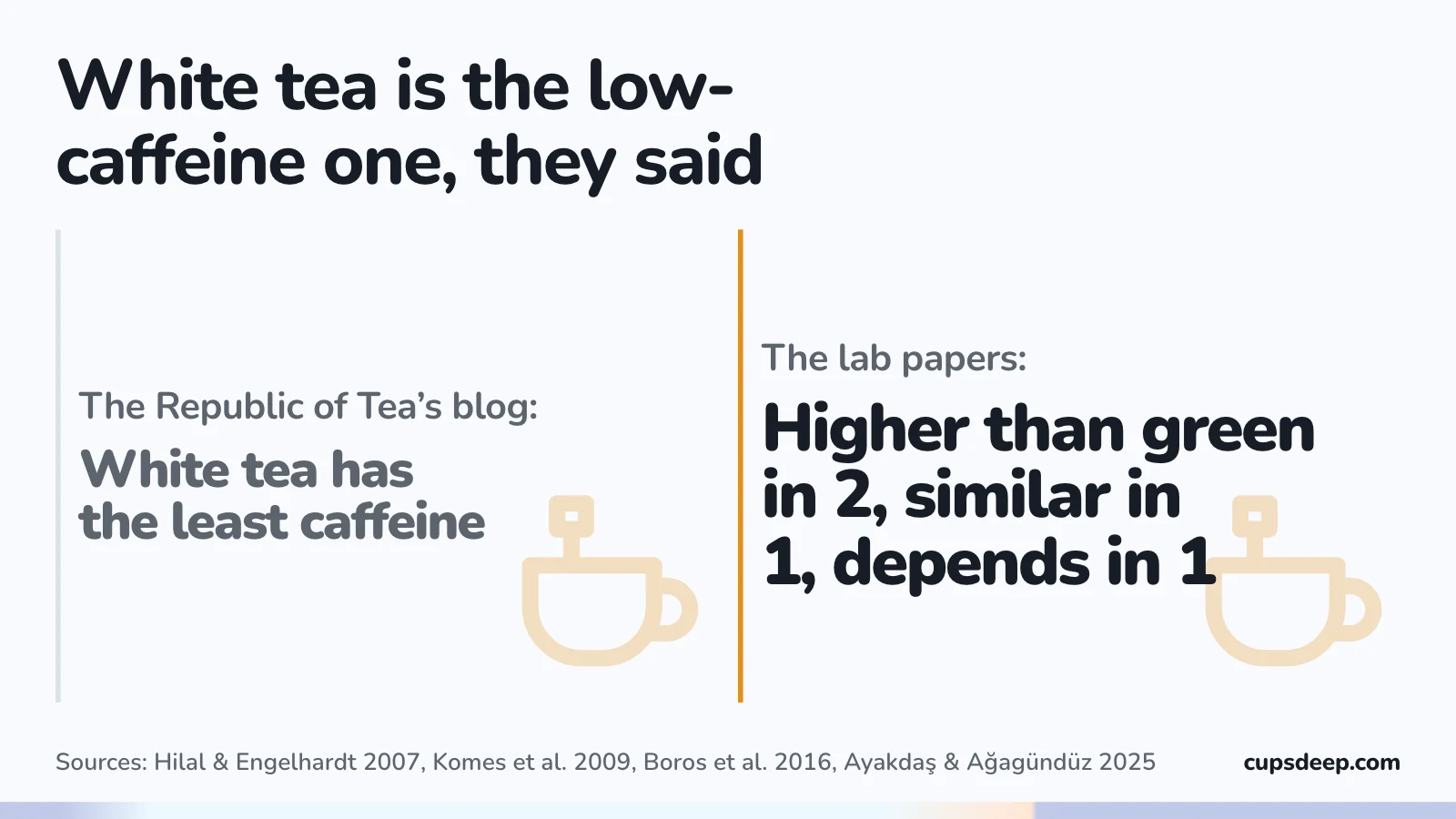
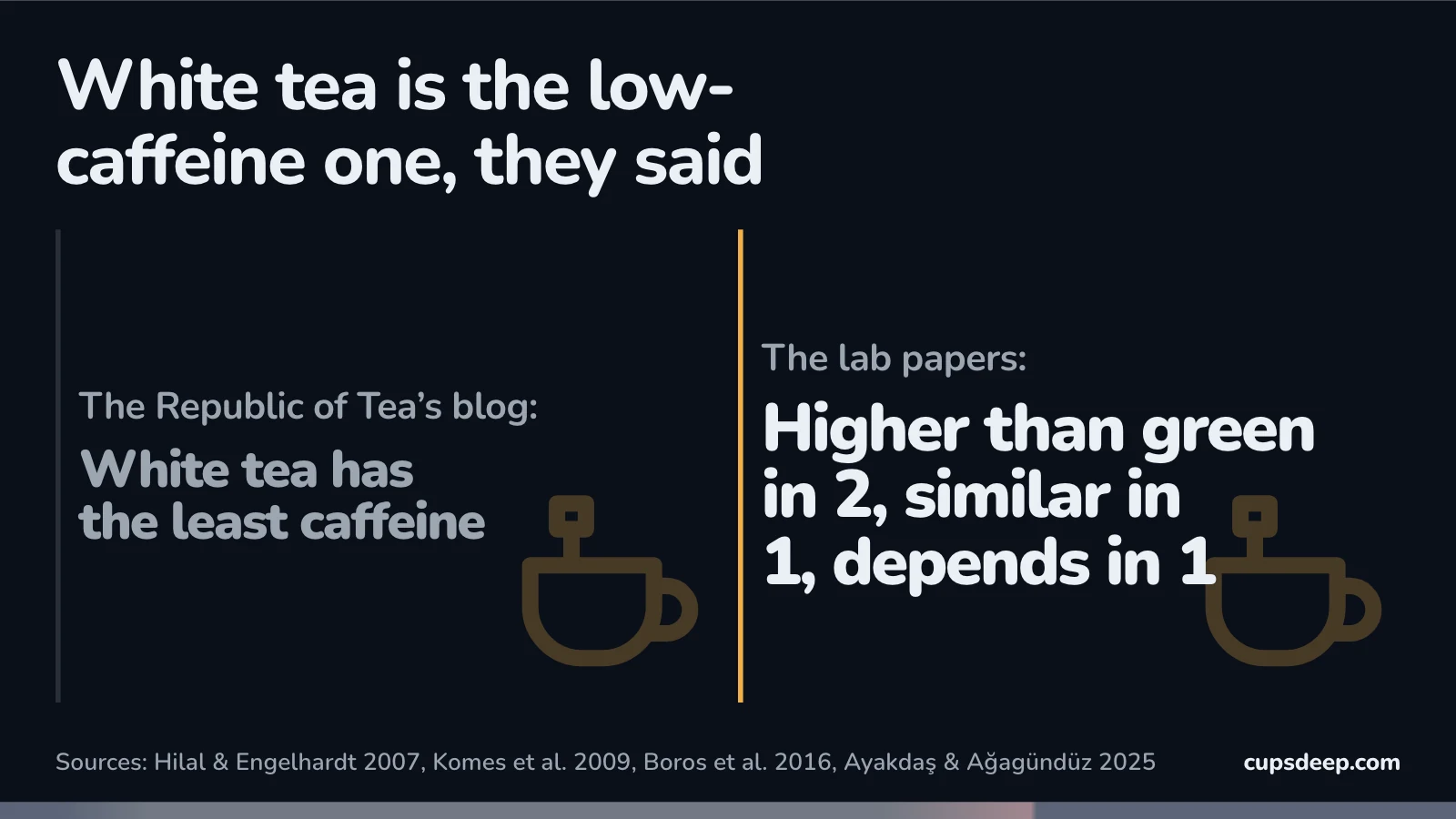
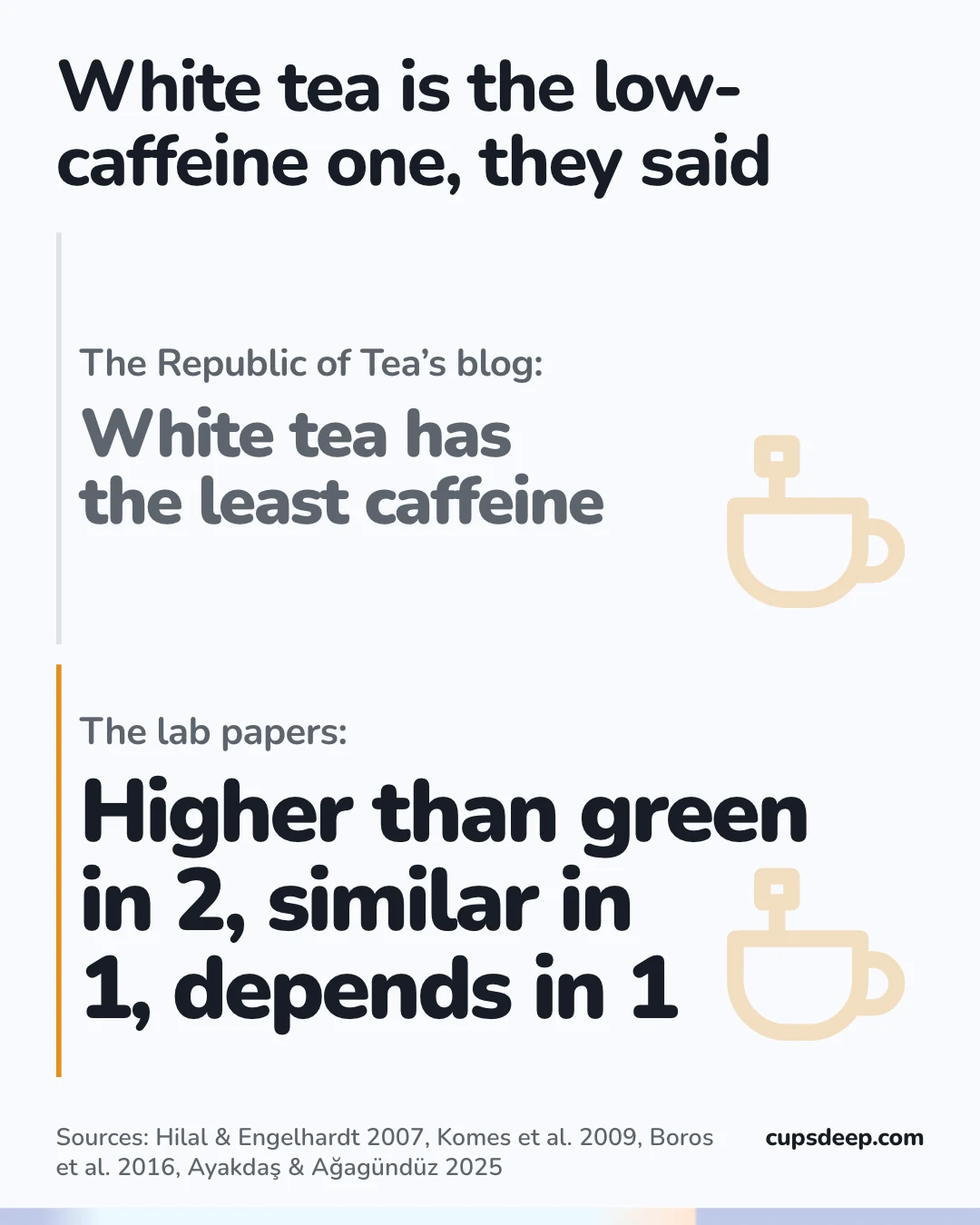
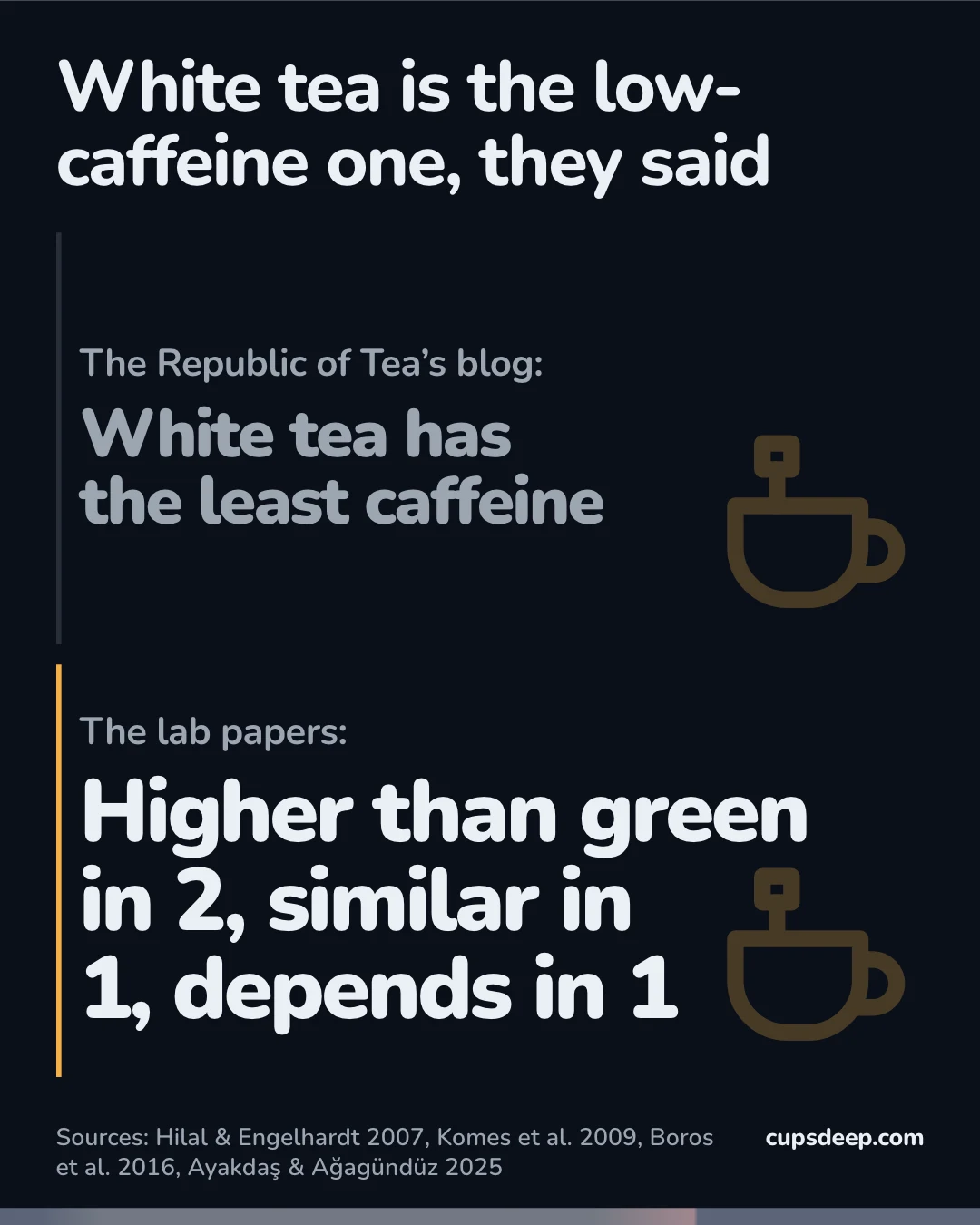
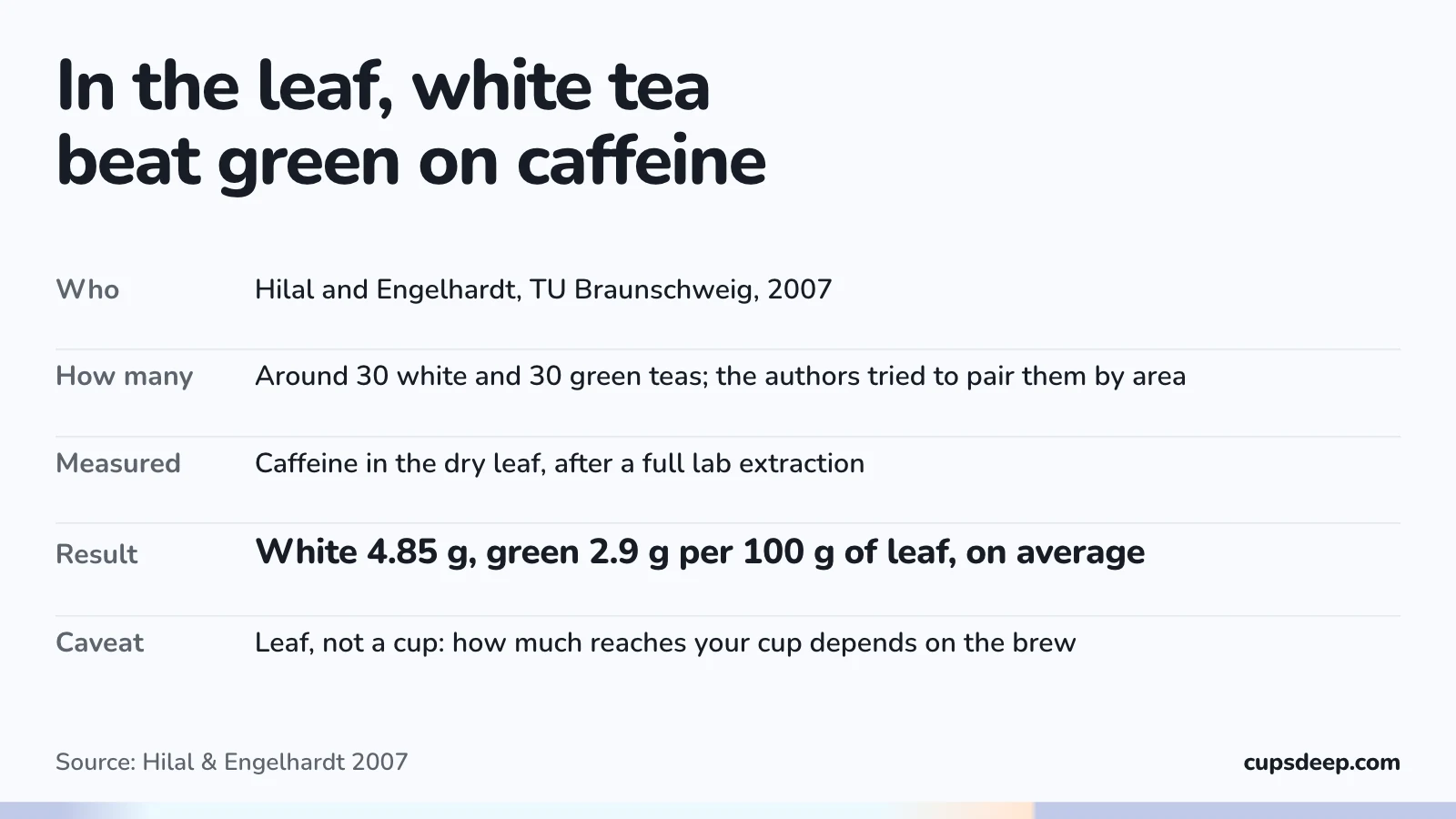
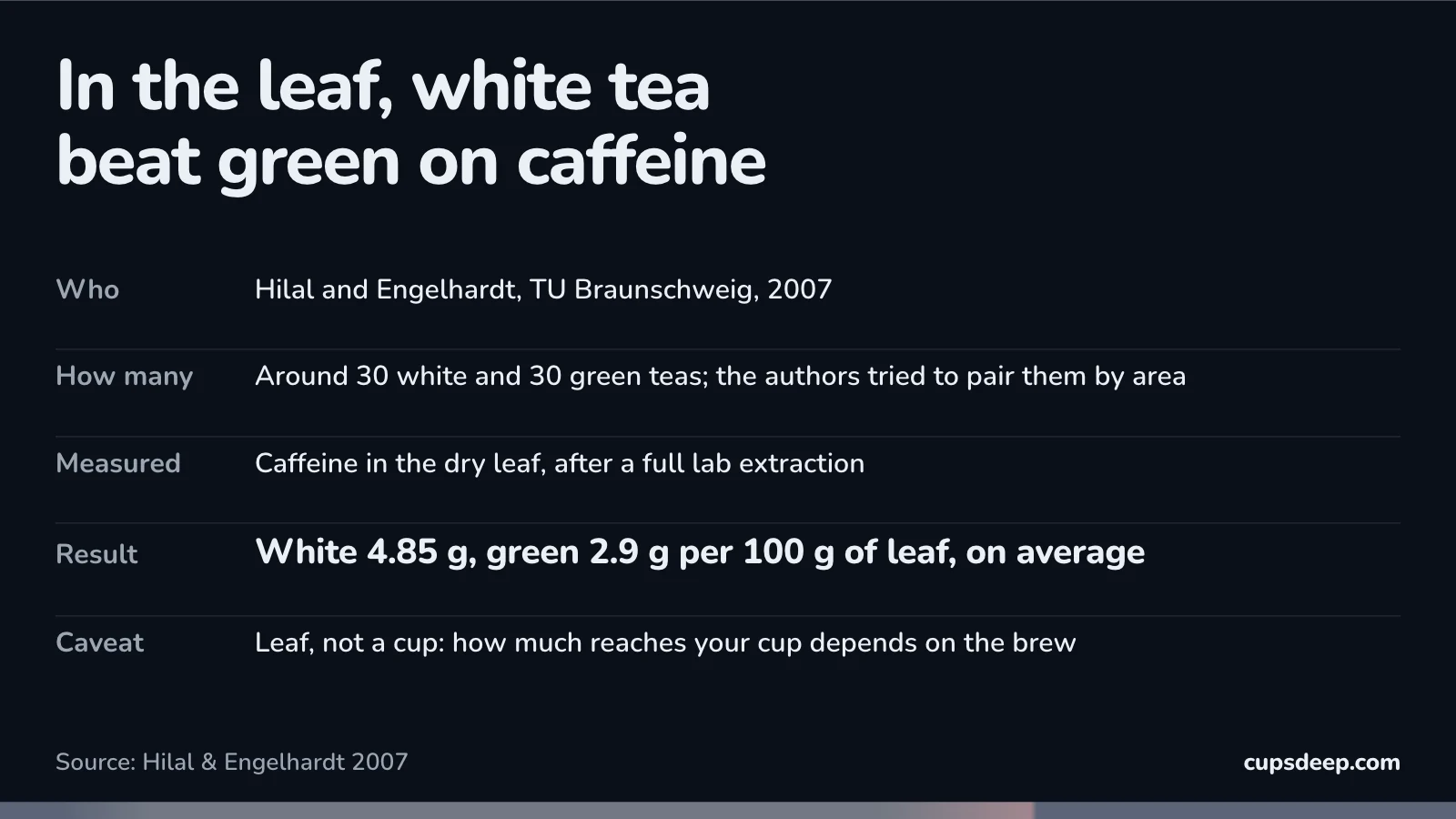
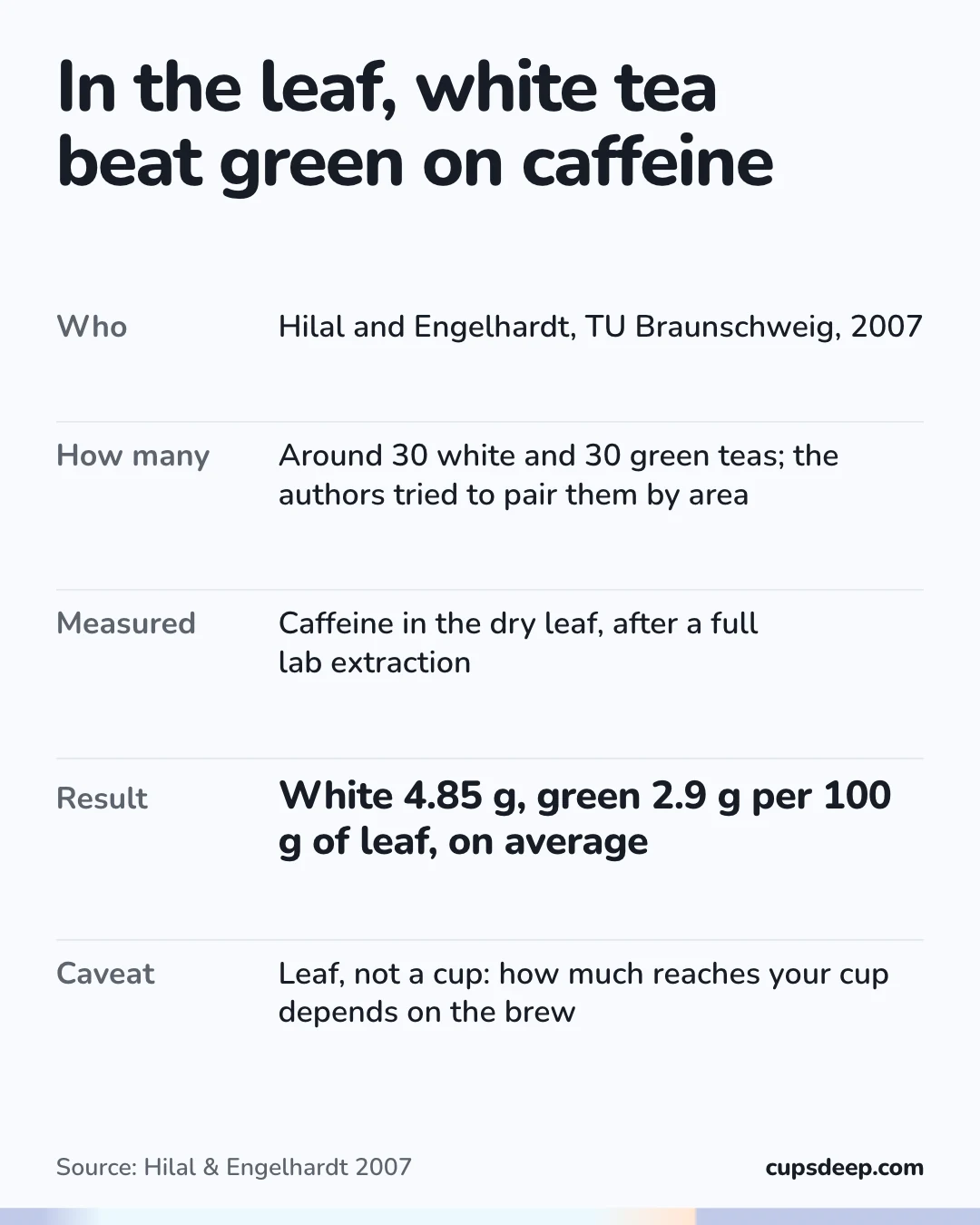
Hilal and Engelhardt (2007) compared white and green teas, around 30 samples of each, which they tried to collect as pairs from one area, and measured the caffeine in the dry leaf after a laboratory extraction with 70% methanol, which they note is not really common to the average consumer. White tea averaged 4.85 g per 100 g of leaf (3.35 to 5.74) and green tea 2.90 g (1.67 to 3.90). They write that the caffeine content of white tea “is often much higher”, and list “white tea is lower in caffeine than green tea” among claims they call “completely nonsense”. 417
This paper has the most white teas of the four, and it names the myth: Hilal and Engelhardt list “white tea is lower in caffeine than green tea” as a claim in circulation and dismiss it in two words. Their figures are for the leaf, though, extracted with methanol in the lab, which the authors note is not how the average consumer makes tea. A leaf with more caffeine is a head start, not a promise about the cup.

The two smaller papers are weaker evidence. Komes and colleagues found white tea highest of five types by all 4 methods, but on 1 tea of each type. Boros and colleagues’ 4 white teas brewed out 16.79 mg/g against 16.28 mg/g for green, which the authors call similar: about the same, not lower.
The fourth paper is the one that brewed tea the way people do. At 80 °C for two minutes, its white teas gave 5.8 mg per 200 mL against 11 mg for green. At 100 °C for ten minutes they gave 31 mg against 27 mg. So white tea can be the low one, if you brew it short and cool. That is a fact about the brew, not about the leaf.
White tea’s low-caffeine reputation rests mostly on it looking pale and well rested
Is oolong between green and black tea in caffeine?
On USDA’s numbers, yes. A 200 ml cup of oolong comes to about 32 mg by our sum, between green tea at 24 mg and black tea at 40 mg for the same cup. That is the tidy story that oolong, partly oxidized, sits halfway in caffeine too. The labs make it less tidy.
Boros and colleagues (2016) brewed 1 g of each commercial tea in 100 ml of water at 80 °C for 3 minutes and measured the caffeine that came out. By the abstract, the mean was 16.79 mg per gram of tea for white teas, 16.28 for green, 19.31 for oolong and 17.73 for black, and the authors call the caffeine content similar. The oolongs varied the most: 8.01 to 39.71 mg per gram by Table 2, which the text gives as 10.96 to 39.71. Table 2 lists 4 white, 16 green, 12 black, 5 oolong and 1 pu-erh tea (38 rows); the abstract says 37 teas and the introduction 34. Its 16 green rows, 6 of them flavored blends, average 16.00 mg/g by Table 2, against the abstract’s 16.28. 373
In that paper oolong had the highest mean of the four types, above black at 17.73 mg/g, and also the widest spread, 8.01–39.71 mg/g across its 5 oolongs by Table 2 (the paper’s text gives the low end as 10.96 mg/g). The top one is about twice the oolong mean, by our arithmetic. In Komes and colleagues’ single samples, by HPLC, oolong at 2.77% sat level with black at 2.79%. In Ayakdaş and Ağagündüz, oolong brewed at 80 °C for two minutes gave the least of any tea in the table, 4 mg per 200 mL.
The makers do not agree either. Twinings US gives oolong the same 19 mg to 45 mg it gives green tea, The Republic of Tea puts it between, and Bigelow files it with black. A lab that measured brewed white, green and black teas found 14–61 mg per serving and no trend by variety at all. Oolong is a wide family, from barely rolled green-ish leaves to dark roasted ones, and in our opinion “between green and black” is a fair average and a poor prediction for any one bag.
The full green and black comparisons are in the green tea and black tea articles. If you want the tea that reliably carries more, it is matcha, because you drink the leaf.
Does water temperature or steep time change the caffeine in oolong and white tea?
A lot, in the one study we read that varied them. Ayakdaş and Ağagündüz brewed 2 g of each tea in 200 mL at two temperatures and three steep times.
| Tea and water | Two minutes | Five minutes | Ten minutes |
|---|---|---|---|
| White, 80 °C | 5.8 mg | 26 mg | 24 mg |
| White, 100 °C | 16 mg | 22 mg | 31 mg |
| Oolong, 80 °C | 4 mg | 11 mg | 19 mg |
| Oolong, 100 °C | 14 mg | 25 mg | 29 mg |
| Green, 100 °C, for comparison | 15 mg | 25 mg | 27 mg |
| Black, 100 °C, for comparison | 17 mg | 23 mg | 27 mg |
Ayakdaş and Ağagündüz, 2025, Table 2: means of 5 white teas and 4 oolongs, loose and bagged, bought in Istanbul in 2023, each brewed twice. The green row is the same table’s mean of 12 teas; the black row, of all its black teas.
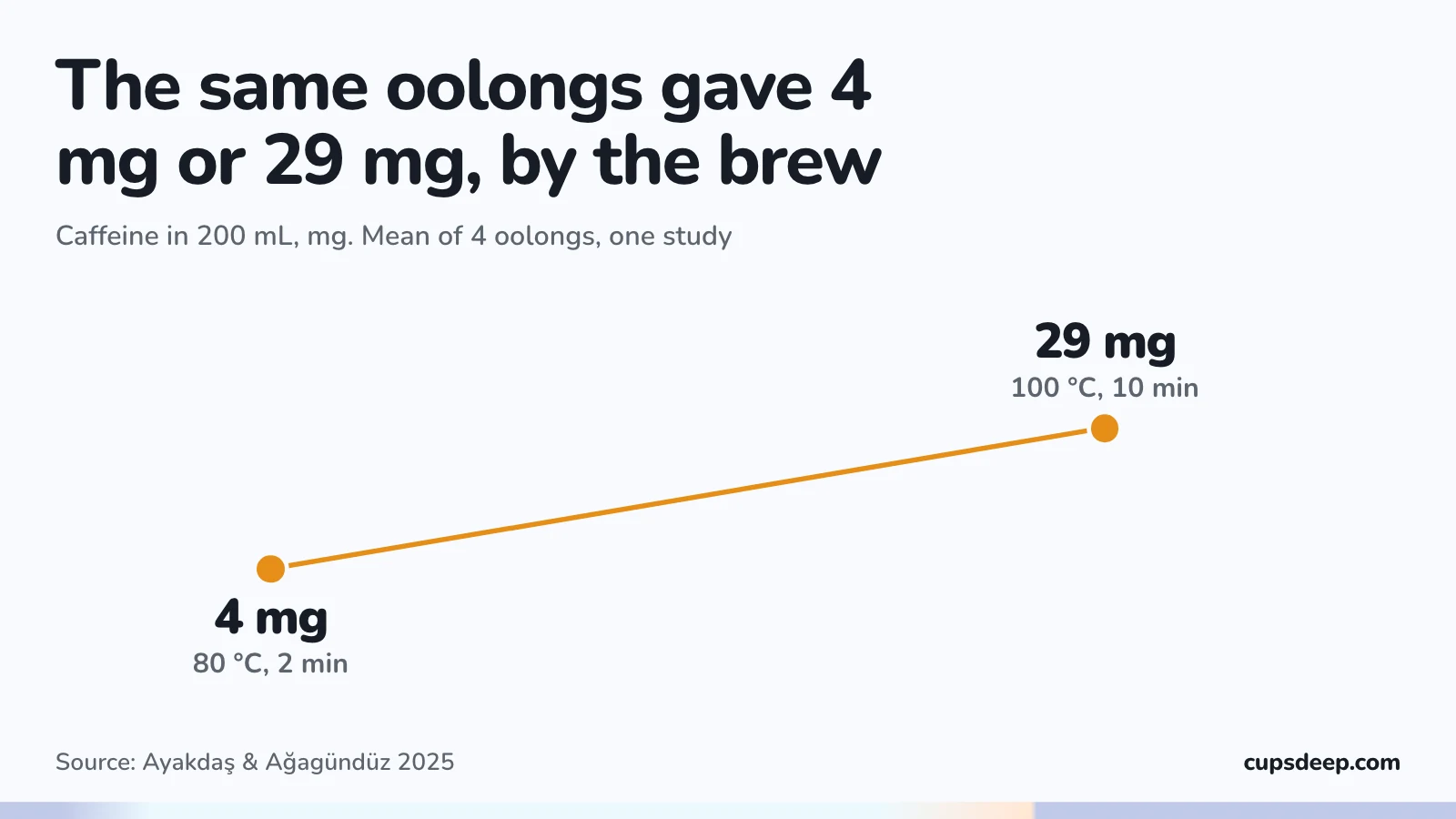
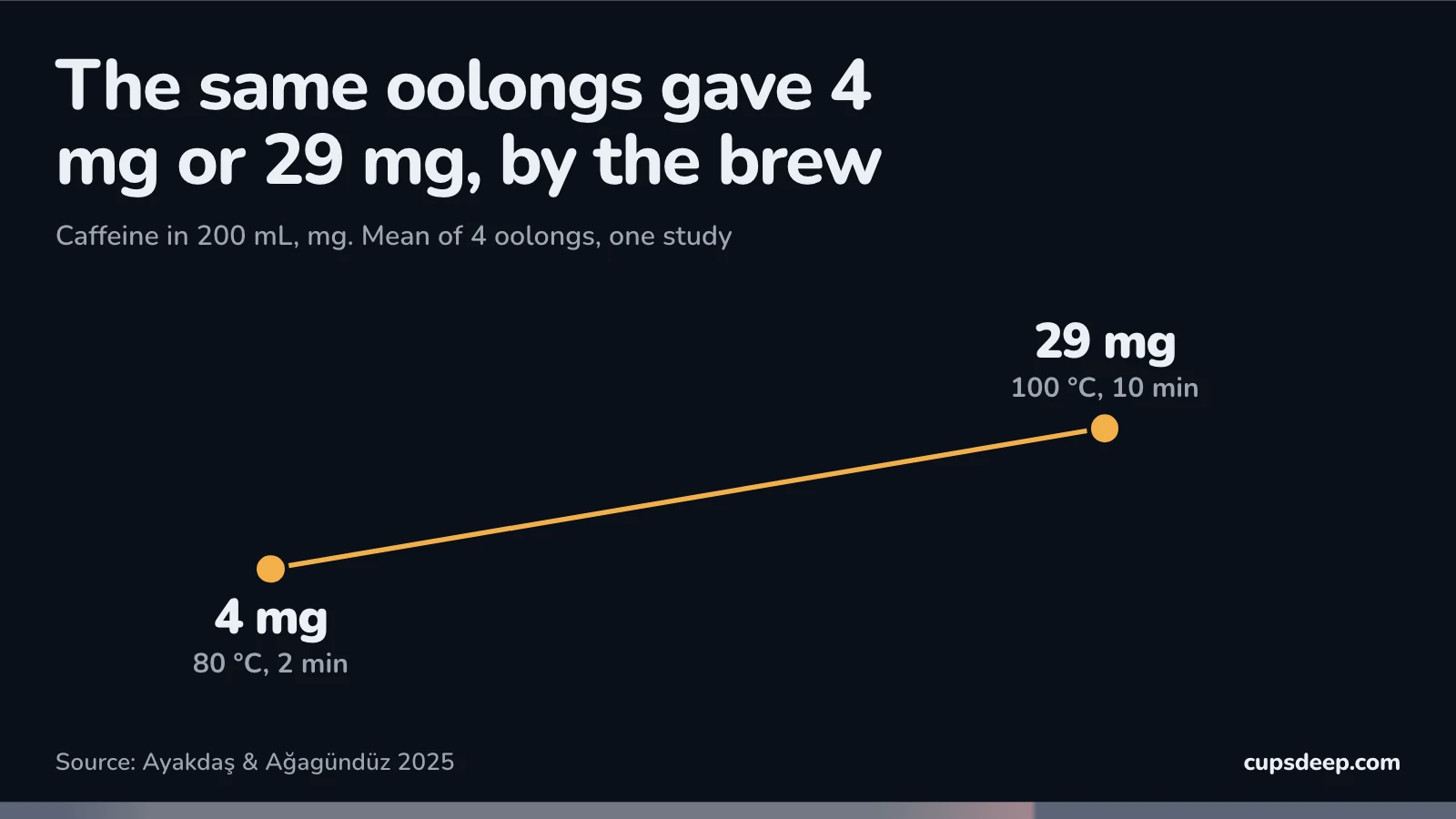
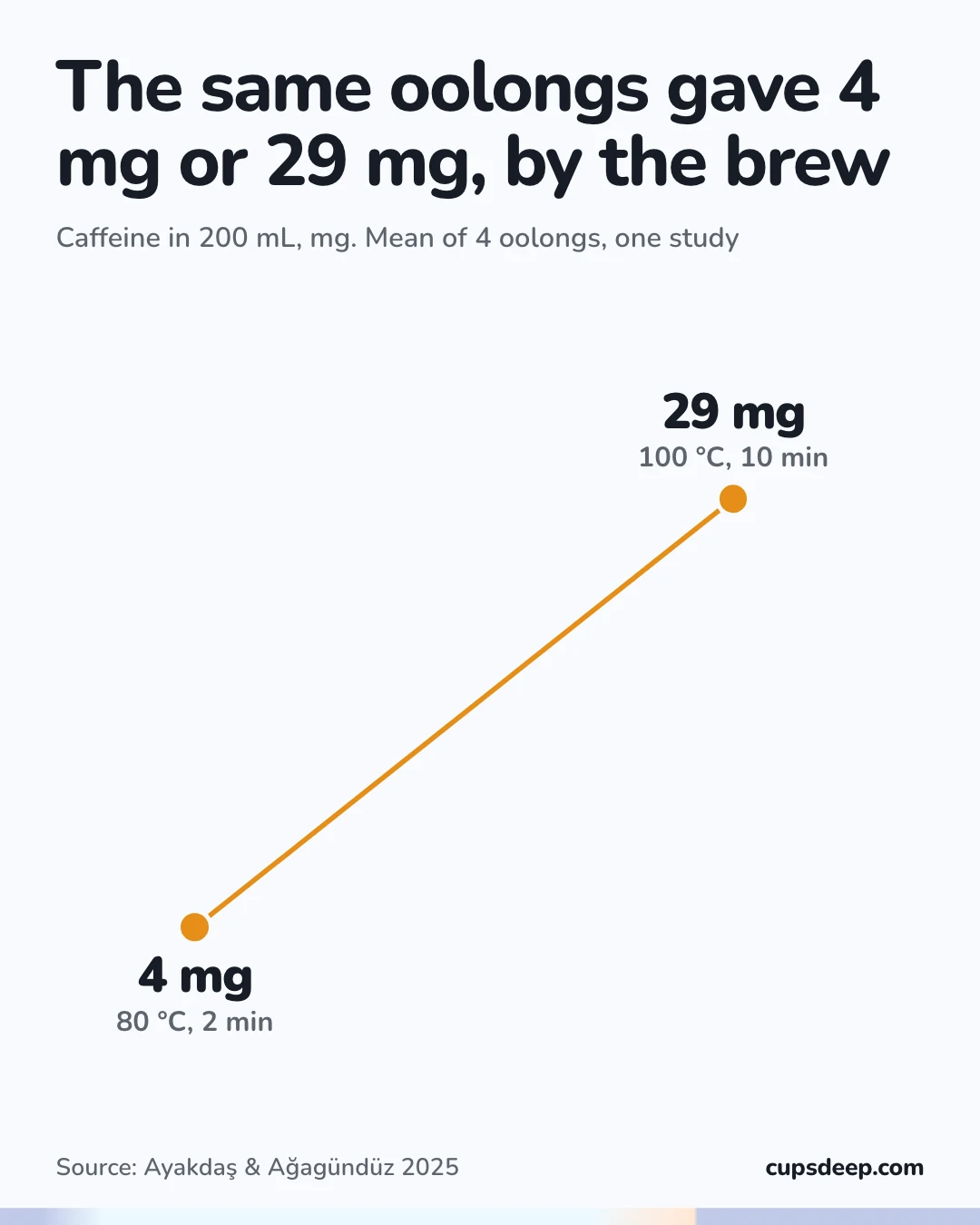
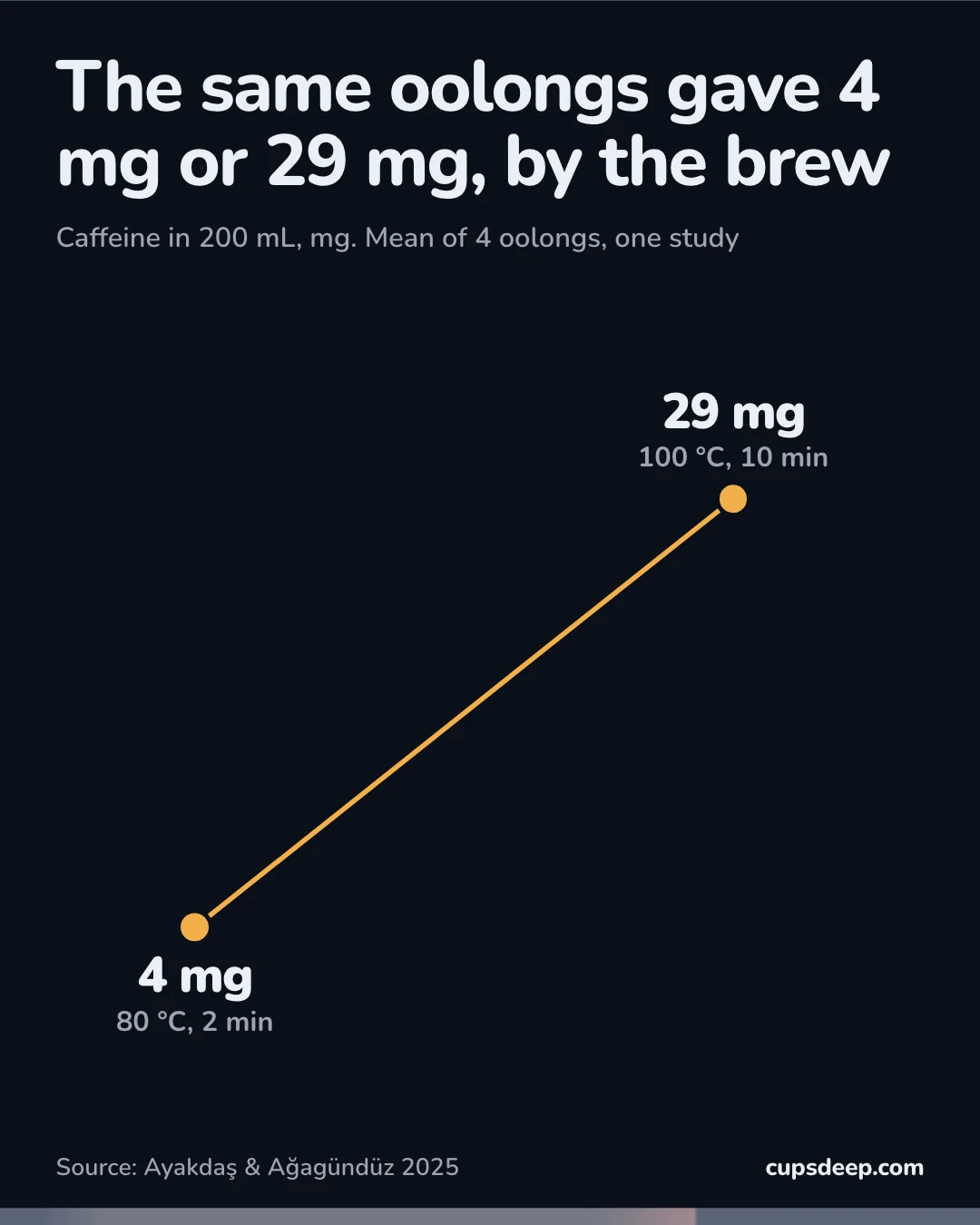
In Ayakdaş and Ağagündüz (2025), the hottest, longest brew gave about 7 times the caffeine of the coolest, shortest for oolong (29 mg against 4 mg per 200 mL in Table 2) and about 5.3 times for white tea (31 mg against 5.8 mg). Our sums. 120
The paper says temperature made a statistically significant difference only in oolong. White tea swung widely too, but the paper did not find temperature significant for it. Either way, at the hot, long end both teas matched or passed the green and black in the same table. The type on the box moved the number less than the kettle and the clock did.
Bags or loose leaf? For white tea, this paper found no significant difference between them, on two bags and three loose teas. Harney & Sons says on its caffeine page that bagged, broken leaves typically give more than whole leaf; we found no measurement for oolong either way.
The kettle has more say in my caffeine than the tea does. I find that unsettling
How many cups of oolong or white tea equal a coffee, and are they OK at night?
By USDA’s numbers, a 200 ml filter coffee at 80 mg is the caffeine of about 2.5 cups of oolong of the same size. For the day, EFSA’s line for healthy adults is 400 mg/day from all sources, which at the same sum is 12.5 cups of oolong, before anything else you drink. For white tea there is no USDA cup to divide by, so we will not invent one; Twinings and The Republic of Tea put a cup of white tea at 10 mg to 30 mg, each for its own serving.
Bottles are the exception. Ito En states about 75 mg for a 16.9 fl oz bottle of its Green + White tea, more than our oolong cup and more than a single shot of espresso at 63.6 mg. Its Golden Oolong bottle prints no milligram figure at all. Bottled tea that has been fermented is a different drink again: kombucha keeps only part of its tea’s caffeine.
Ito En prints no milligram figure for its bottled Organic Golden Oolong; its page says the tea “contains approximately 1/3 the amount of caffeine found in coffee”. Its Organic Unsweetened Green + White Tea, a blend of green and white tea, states approximately 75 mg per 16.9 fl oz bottle. 422423
At night: caffeine peaks 30 minutes to 120 minutes after you drink it, and half of it is still there about 4 hours later, longer for some people.
A single 100 mg dose of caffeine, about 1.4 mg/kg body weight for a 70 kg adult, may increase the time it takes to fall asleep and reduce sleep duration in some adults, particularly when taken close to bedtime. 2223
One cup of oolong or white tea is well under that dose. A pot is not one cup, and a gongfu session, the many-short-steeps way oolong is often brewed, is a pot that keeps coming back. If you are cutting caffeine, neither tea is the free pass The Republic of Tea’s pages make white tea sound like; herbal tea is the zero, and the herbal tea article checks which ones really are.
Oolong is half-oxidized, which is also how I would describe myself by the third pot
Questions people ask
Does oolong tea have caffeine?
Yes. USDA measured brewed oolong at 16 mg per 100 g, which comes to about 38 mg in USDA’s 240 g cup by our sum. Makers state 19 mg to 45 mg for a Twinings US bag and 30 mg to 60 mg for a Bigelow 8 fl oz serving.
Does white tea have caffeine?
Yes. Twinings US states 25 mg to 30 mg for one white tea bag in 200 ml. In one lab, the same white teas gave 5.8 mg to 31 mg per 200 mL, depending on water temperature and steep time. USDA’s reference and survey data have no entry for hot white tea.
Does white tea have less caffeine than green tea?
None of the four lab papers we read found white tea lowest overall. Two found it higher than green: in one, white tea leaf averaged 4.85 g against 2.9 g per 100 g of leaf. One found the two about the same, and the fourth found white tea lower after a short, cool brew (5.8 mg against 11 mg per 200 mL) and higher after a long, hot one (31 mg against 27 mg).
Does oolong have more caffeine than green tea?
By USDA’s cups, a little: about 32 mg for 200 ml of oolong by our sum, against 24 mg for green tea. Labs disagree on the order. One found oolong the highest of four types on average, 19.31 mg/g against 16.28 mg/g for green; another found it the lowest of all its teas after a short, cool brew.
Does steeping oolong longer give it more caffeine?
Yes, in the one study we read that timed it. At 80 °C, oolong gave 4 mg per 200 mL at two minutes and 19 mg at ten; at 100 °C, 14 mg and 29 mg. The paper says temperature made a significant difference only for oolong.
How much caffeine is in bottled oolong or white tea?
Ito En states about 75 mg for a 16.9 fl oz bottle of its Organic Unsweetened Green + White Tea. For its Golden Oolong bottle it gives no milligram figure, only that it has about a third of the caffeine of coffee.
Sources
Every number above links to the place it came from. How the numbers are chosen and checked is on the method page; the drink table is at /drinks. Written with AI agents, as the whole site is. A model of a typical body, not advice for pregnancy, illness or medication.
- Beverages, coffee, brewed, prepared with tap water
- Beverages, coffee, brewed, espresso, restaurant-prepared
- Beverages, tea, green, brewed, regular
- Beverages, tea, black, brewed, prepared with tap water
- Scientific Opinion on the safety of caffeine
- EFSA explains risk assessment: Caffeine
- Caffeine content of brewed teas (Chin, Merves, Goldberger, Sampson-Cone, Cone; J Anal Toxicol 2008;32(8):702-4)
- Standard Tables of Food Composition in Japan 2020 (Eighth Revised Edition), main table
- FAQs: How much caffeine does tea contain?
- Ayakdaş G, Ağagündüz D. Determination of L-Theanine and Caffeine Contents in Tea Infusions with Different Fermentation Degrees and Brewing Conditions Using the Chromatographic Method. Foods 2025;14(13):2313. doi:10.3390/foods14132313
- Which Tea Has The Most Caffeine?
- Theanine and Caffeine Content of Infusions Prepared from Commercial Tea Samples (Boros et al.; Pharmacogn Mag 2016;12(45):75-9)
- Beverages, tea, Oolong, brewed (SR Legacy 174120, NDB 14185)
- Tea, hot, leaf, oolong (FNDDS 2710492, food code 92304100)
- FoodData Central search: “white tea”, SR Legacy, Foundation and FNDDS (Branded not included)
- Characterisation of white tea – Comparison to green and black tea (Hilal and Engelhardt; J Verbr Lebensm 2007;2:414–421; doi:10.1007/s00003-007-0250-3)
- Determination of Caffeine Content in Tea and Maté Tea by using Different Methods (Komes, Horžić, Belščak, Kovačević Ganič, Baljak; Czech J Food Sci 2009;27 Special Issue:S213–S216)
- Tea and Caffeine
- How Much Caffeine Is in My Tea? (Emeric Harney, February 15, 2019)
- Oolong Tea
- Organic Unsweetened Green + White Tea
- Organic Golden Oolong Tea
Keep reading
Tea and mate
Does green tea have caffeine?
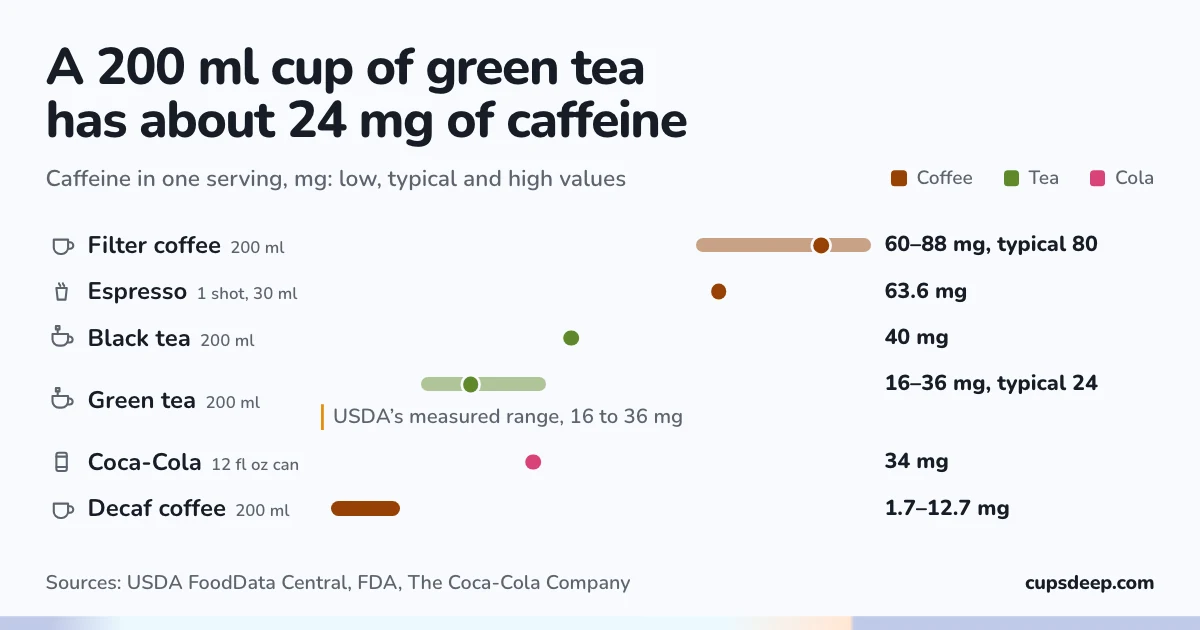
Yes: about 24 mg in a 200 ml cup, by USDA. How long you steep it, the bag, gyokuro and bottled teas from Ito En to AriZona, all with sources.
Tea and mate
Does black tea have caffeine?
Yes: about 40 mg in a 200 ml cup, by USDA. Earl Grey, English Breakfast, steep time, decaf and bottled tea from Pure Leaf to AriZona, all sourced.
Tea and mate
Does matcha have caffeine?
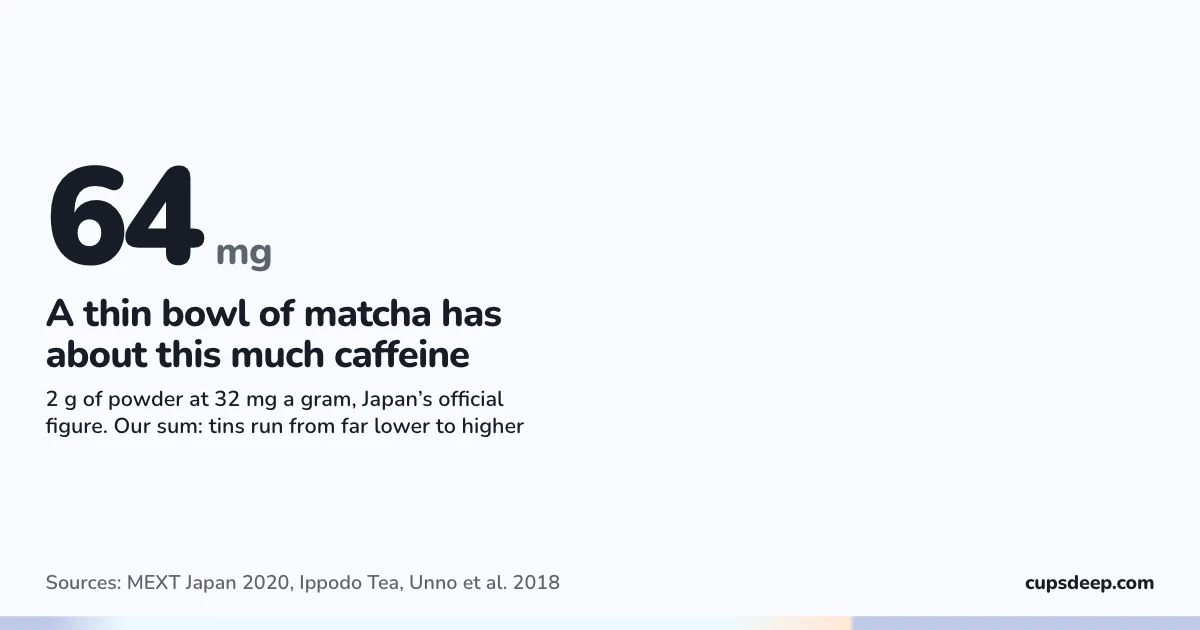
Yes. Matcha powder is about 32 mg/g: 64 mg in a thin 2 g bowl, 128 mg in a thick one. A Starbucks grande matcha latte is 65 mg.