Does kombucha have caffeine?
Kombucha is fermented tea, and tea has caffeine. The makers’ own pages answer this with their own ranges, or with none, and none of them cites a lab. One university lab did buy the big brands off the shelf and measure them, so here is each maker’s figure beside the lab’s, the one tested kombucha with caffeine on its ingredient list, and why “fermentation eats it” is not settled.
The short answer
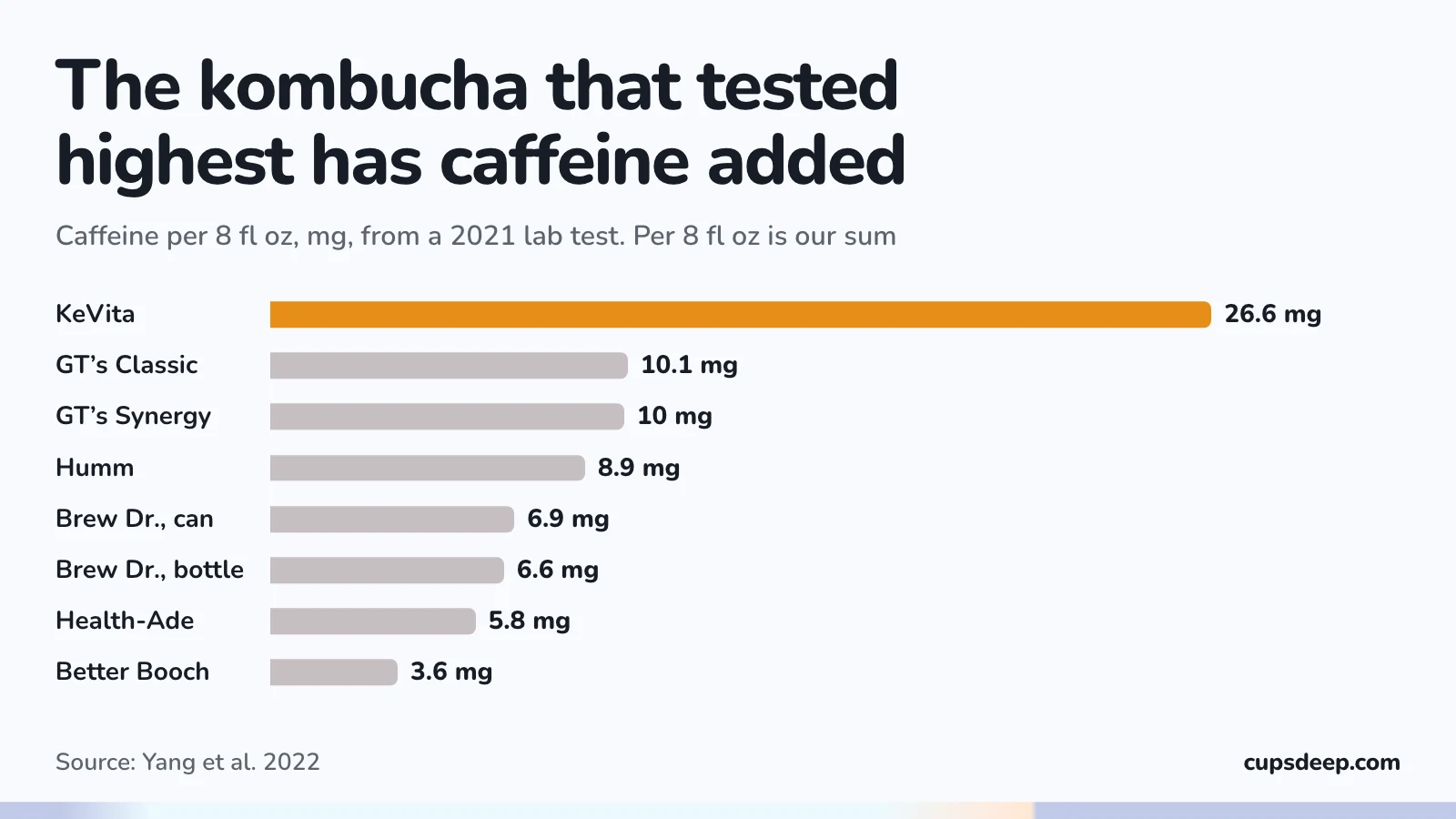
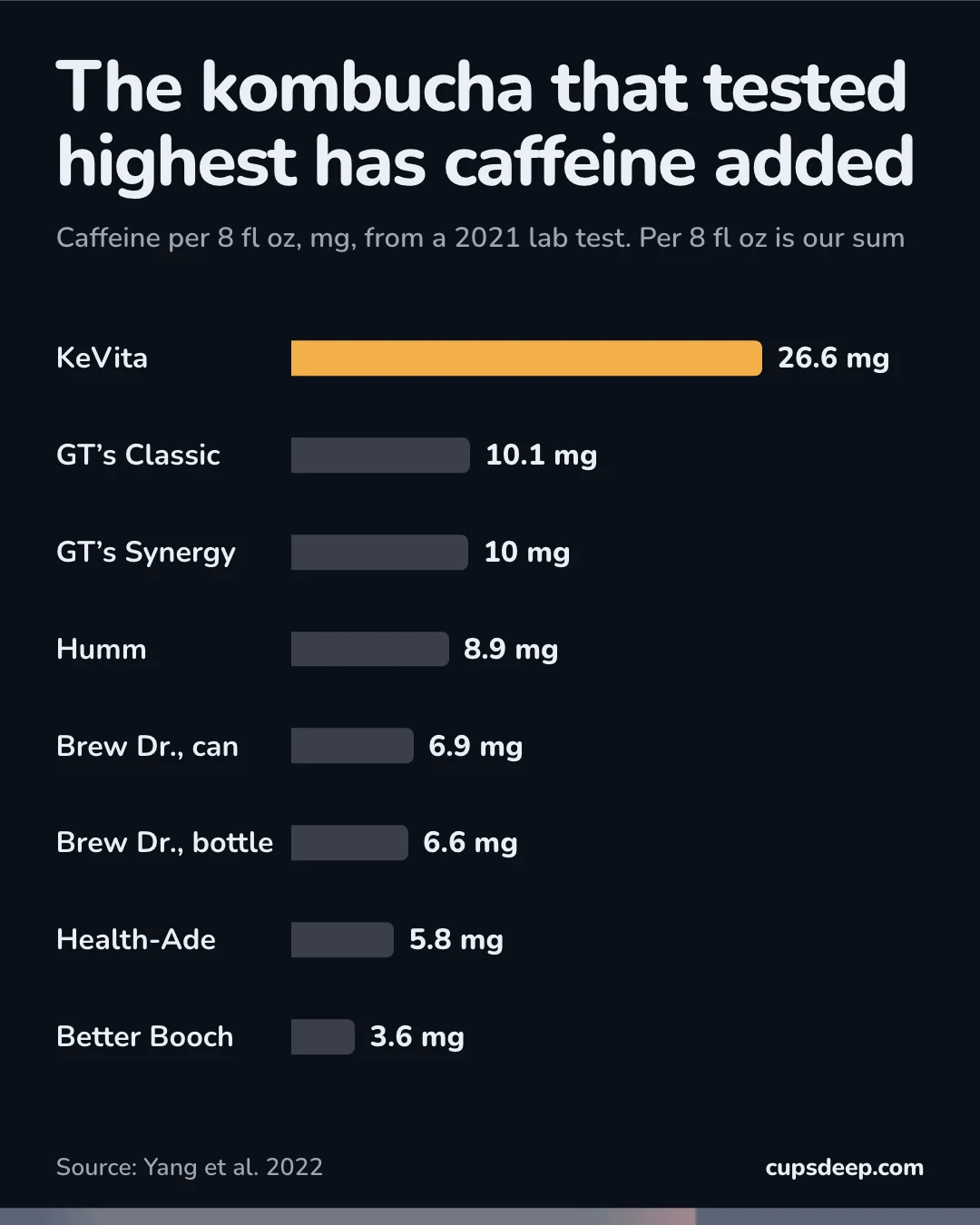
Yes. Every kombucha in a 2021 lab test of US supermarket brands had caffeine: 3.6 mg to 26.6 mg per 8 fl oz glass by our sums, against about 47 mg for brewed black tea. The highest, KeVita Master Brew, is the only one of the nine tested whose listed ingredients include added caffeine. Makers state their own ranges, and some miss the lab, or each other.


How much caffeine is in kombucha?
A little, and not the same in every bottle. The best numbers come from one study, not from any maker.
A UCLA team measured caffeine by HPLC in nine kombuchas from six makers, three samples of each, bought in Los Angeles supermarkets on February 2, 2021. The six makers held an estimated 86% of US kombucha sales in 2021. Caffeine ran from 15.1 mg/L in Better Booch Ginger Boost to 112.6 mg/L in KeVita Master Brew Ginger. The samples of each product came from one batch, so the study could not see batch-to-batch differences. One printed value, for Humm Zero, is ambiguous and is left out here. 630
Per liter means little at the fridge, so the last column puts each figure on an 8 fl oz glass. That step is our arithmetic, not the paper’s. The Humm Zero row is missing on purpose: the paper prints its value in a way that can be read two ways, and we do not guess.
| Kombucha | Measured, per liter | Per 8 fl oz (our arithmetic) |
|---|---|---|
| KeVita Master Brew Ginger | 112.6 mg/L | 26.6 mg |
| GT’s Classic Original | 42.5 mg/L | 10.1 mg |
| GT’s Synergy Gingerade | 42.2 mg/L | 10 mg |
| Humm Ginger | 37.7 mg/L | 8.9 mg |
| Brew Dr. Ginger Lemon, can | 29.2 mg/L | 6.9 mg |
| Brew Dr. Ginger Lemon, bottle | 27.7 mg/L | 6.6 mg |
| Health-Ade Ginger Lemon | 24.7 mg/L | 5.8 mg |
| Better Booch Ginger Boost | 15.1 mg/L | 3.6 mg |
Yang et al., Nutrients, 2022: HPLC, three samples per product, each product’s from one batch. Recipes may have changed since 2021. Per 8 fl oz is the figure per liter times 0.2366, rounded to one decimal.
For scale: brewed black tea is about 47 mg in the same 8 fl oz by our sum from USDA, green tea about 28 mg, and FDA puts decaf coffee at 2–15 mg per 8 fl oz cup. Seven of the eight kombuchas, by our sums, sit inside FDA’s decaf range. KeVita does not. Every other drink is on the drinks page.
At the lab’s concentrations, a 16 fl oz bottle of Health-Ade Ginger Lemon would hold about 11.7 mg of caffeine and a 14 fl oz bottle of Brew Dr. Ginger Lemon about 11.5 mg. The bottle sizes are the makers’; the paper states none, and the sums are ours. 630637640
Nobody drinks kombucha by the liter or by the 8 fl oz. A whole Health-Ade or Brew Dr. bottle, on the lab’s numbers and the makers’ bottle sizes, comes to about 11.7 mg and 11.5 mg. Those are our sums.
How much caffeine is in GT’s, Health-Ade, Humm and Brew Dr.?
Here is what each maker says on its own site, read on November 12, 2026. Two of them say two different things.
| Kombucha | Maker’s figure | For | Lab, per 8 fl oz (our arithmetic) |
|---|---|---|---|
| GT’s Synergy | 4 mg to 8 mg | 8 fl oz | 10 mg |
| GT’s Classic | 8 mg to 14 mg | A serving, size not stated | 10.1 mg |
| Health-Ade, product page | 5 mg to 15 mg | A serving, size not stated | 5.8 mg |
| Health-Ade, blog | 8 mg to 15 mg | A serving, size not stated | 5.8 mg |
| Humm | 10 mg to 15 mg | 12 fl oz can or 14 fl oz bottle | 8.9 mg |
| Brew Dr., FAQ | 15 mg to 20 mg | 14 fl oz bottle | 6.6 mg |
| Brew Dr., blog | Less than 15 mg | 14 fl oz bottle | 6.6 mg |
| Wild Tonic (Jun) | About 7 mg | 12 fl oz | Not tested |
| KeVita Master Brew | No figure, says it contains “organic caffeine” | Not stated | 26.6 mg |
Makers’ words from their own pages, November 2026. Lab figures are Yang et al. 2022, from samples bought in 2021, as mg per liter put on 8 fl oz by us. GT’s Classic and Health-Ade never say how big a “serving” is; Health-Ade sells 16 oz bottles.
So: GT’s says 4 mg to 8 mg per 8 fl oz for Synergy and calls it “naturally decaffeinated”; the lab found 10 mg in the same amount, by our sum, above the top of GT’s range. Humm’s range, put on 8 fl oz, is 5.7 mg to 10 mg, and the lab’s 8.9 mg lands inside it. Brew Dr.’s FAQ comes to 8.6 mg to 11.4 mg per 8 fl oz, and the lab found less: 6.6 mg.
“Naturally decaffeinated” is a lovely phrase to use for a drink that has caffeine in it
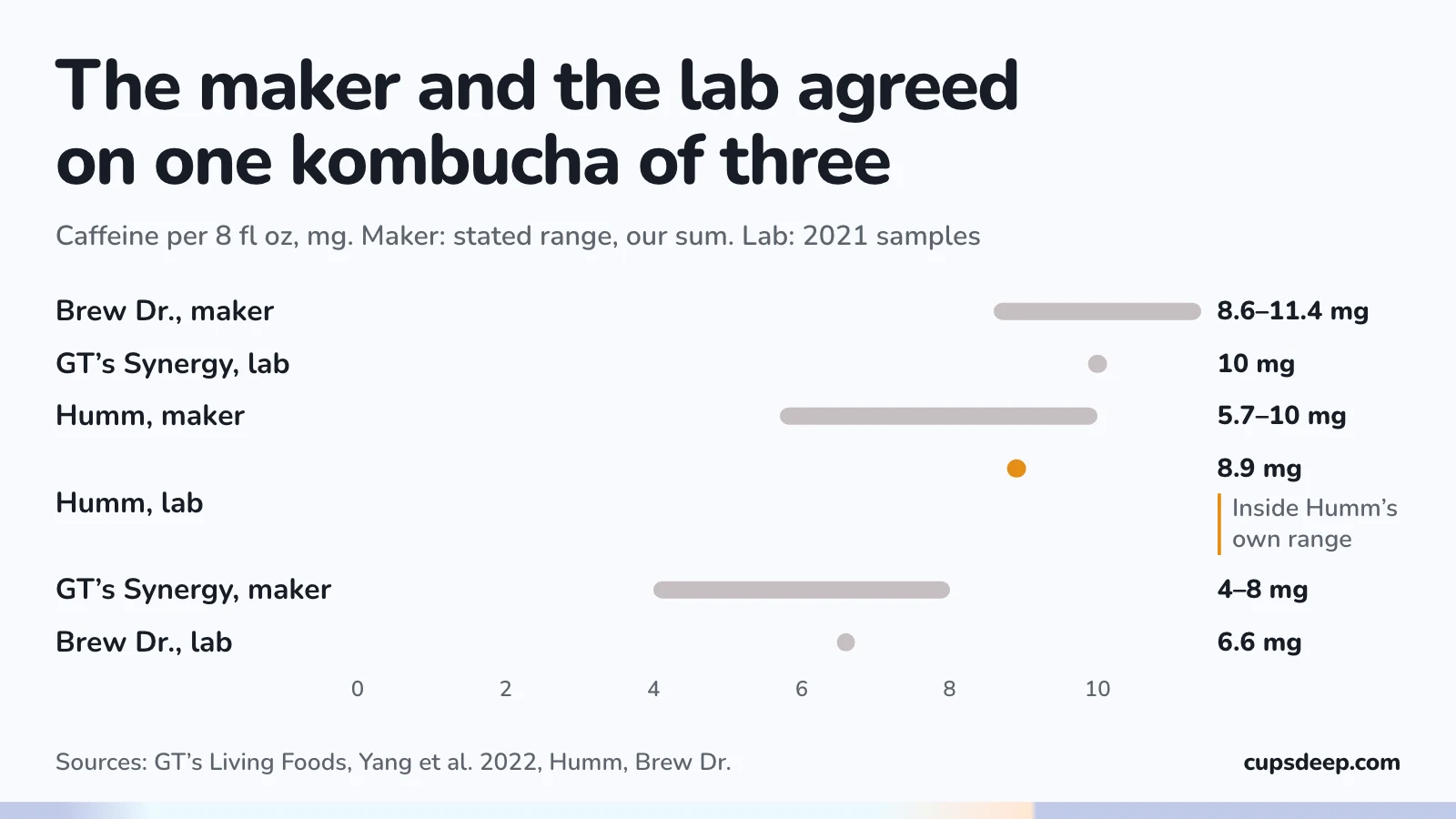
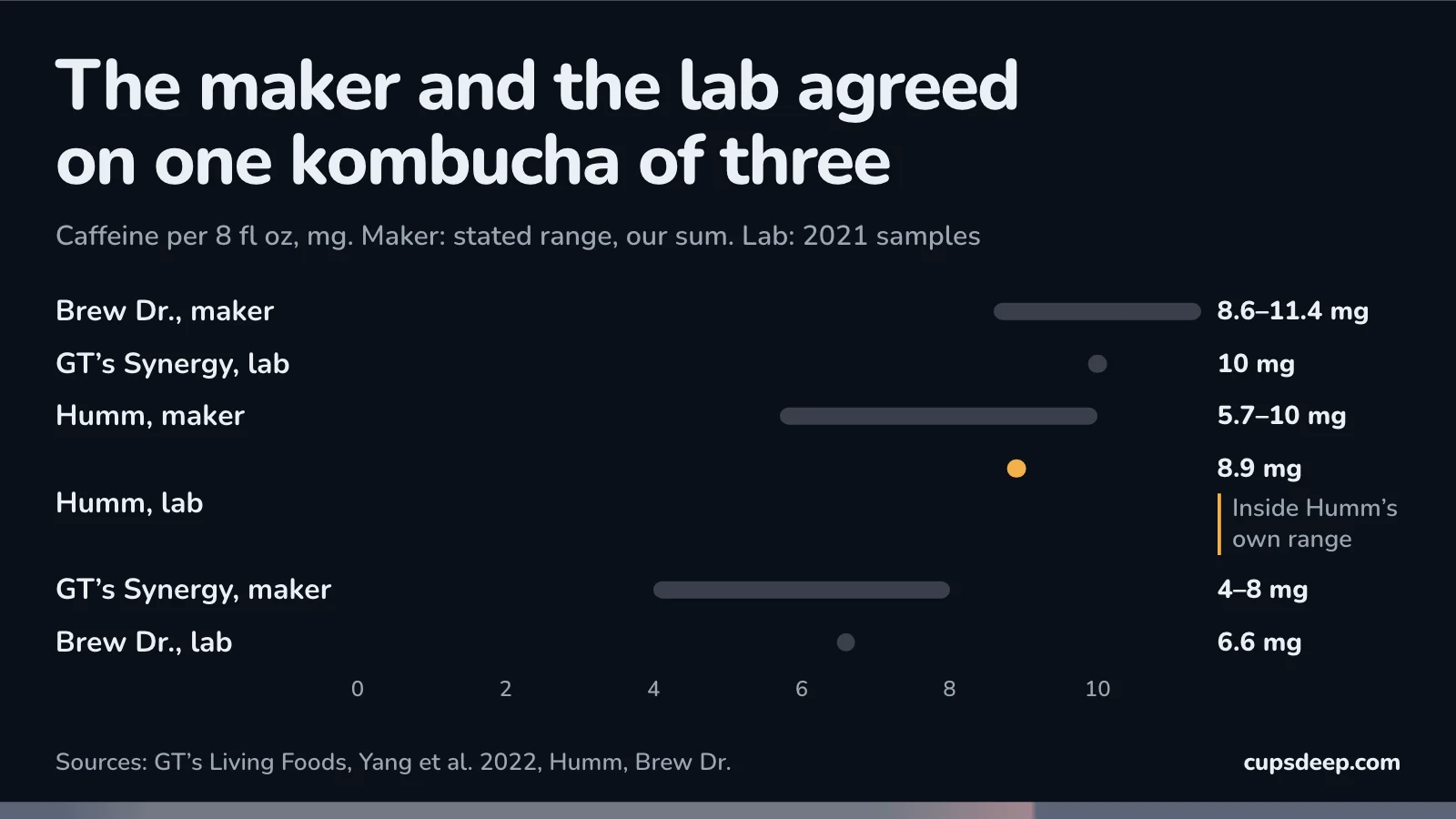
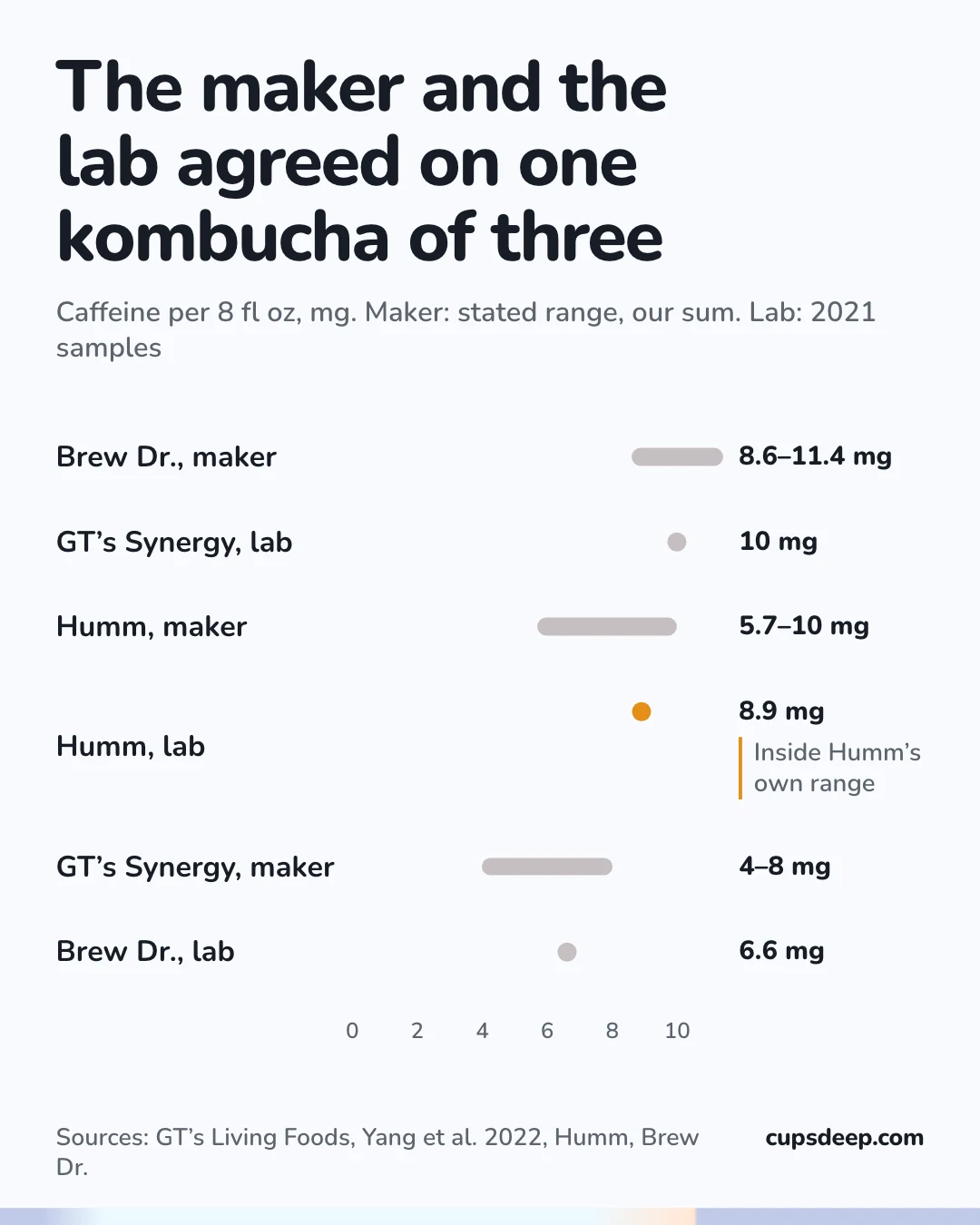

Then the makers against themselves. Health-Ade’s product page says 5 mg to 15 mg per serving and its own blog says 8 mg to 15 mg. Brew Dr.’s FAQ says 15 mg to 20 mg in a 14 fl oz bottle while its blog says less than 15 mg in the same bottle. On the lab’s numbers the blog is the closer of the two: the bottle works out to about 11.5 mg, by our sum.
One brand, one bottle, two caffeine figures. I respect a company that keeps its options open
Which kombucha has the most caffeine?
In the lab, KeVita Master Brew, by a distance: 112.6 mg/L, about 2.6 times the next one, by our arithmetic. That is 26.6 mg per 8 fl oz glass, about the same as 8 fl oz of green tea at 28 mg.
The kombucha with the most caffeine in the 2021 lab test (Yang et al. 2022), KeVita Master Brew Ginger, is the only one of the nine whose ingredients, as the paper lists them, include added caffeine: “green coffee bean extract (caffeine)”. KeVita’s own product page says each bottle contains “organic caffeine” and gives no amount. 630643
So the strongest kombucha in the test was not simply a stronger tea. It had caffeine put in. The maker’s page says it contains “organic caffeine”, and prints no number we could find.
The strongest kombucha in the lab had coffee bean extract in it. Bold move for a tea
Some makers sell stronger kombucha on purpose and say so. Brew Dr.’s FAQ gives its Iced Tea Lemonade kombucha and its Lemon + Tea Sipjoy 35 mg a bottle or can. Brew Dr.’s blog, read on November 12, 2026, says its Uplift Caffeinated has 130 mg per bottle, with no bottle size beside it. Uplift is not in the current FAQ and may no longer be sold, so treat that one as Brew Dr.’s word on its blog and no more.
Hard kombucha has some too. JuneShine’s blog gives 20 mg per 12 oz serving, which is a blog post, not a label.
Does fermentation remove the caffeine in kombucha?
Brew Dr., Health-Ade and JuneShine all say some version of it on their blogs. Health-Ade says about a third of the caffeine remains, and cites nothing. The lab work is less tidy, and it depends on the tea.
In a 2012 lab study, kombucha made from black and green tea (12 g of tea per liter, infused 5 minutes) was fermented for two weeks. Caffeine in the black tea kombucha “remained quite unchanged” at 0.24 g/L (240 mg/L); in the green tea kombucha it fell from 0.17 to 0.08 g/L (170 to 80 mg/L). 631
Green tea kombucha in that study lost about 53% of its caffeine, by our arithmetic. The black tea kombucha beside it, made the same way, stayed about the same. Two other labs that fermented black tea found the caffeine going opposite ways.
In a 2016 lab study of black tea kombucha fermented at 28 °C, the authors report that caffeine “was decreased by about 40% after 21 days of fermentation”. The tea strength is not stated in the paper, and its samples were freeze-dried and redissolved before analysis, so its figures per liter may not be the drink’s own. 632
In a 2023 lab study, black tea kombucha made from a 3% (weight/volume) infusion and fermented at 23 °C gained caffeine: it rose 51% from day 0 to day 9, which the authors put down, probably, to caffeine released from complexes with phenolic compounds. 633

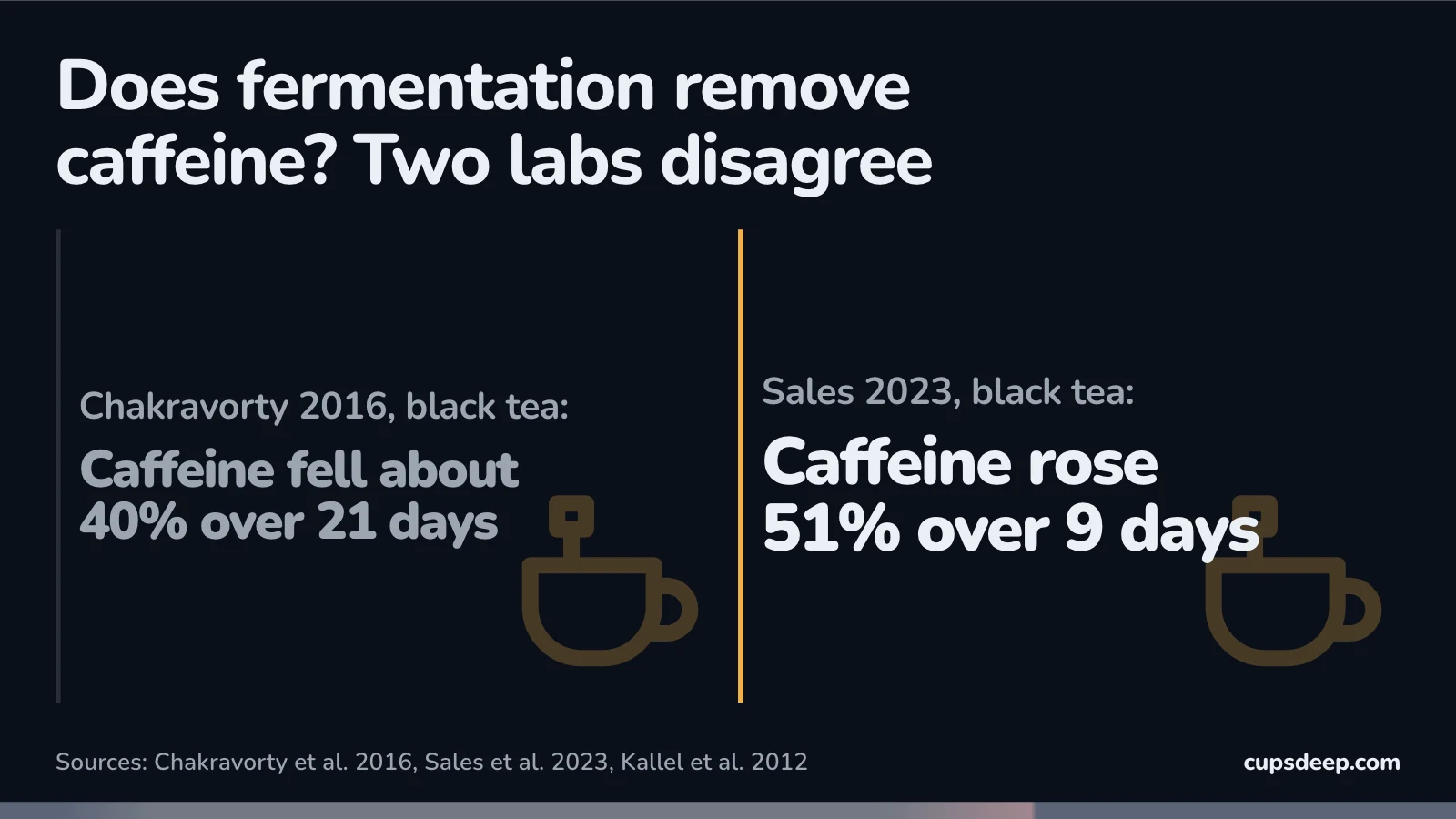
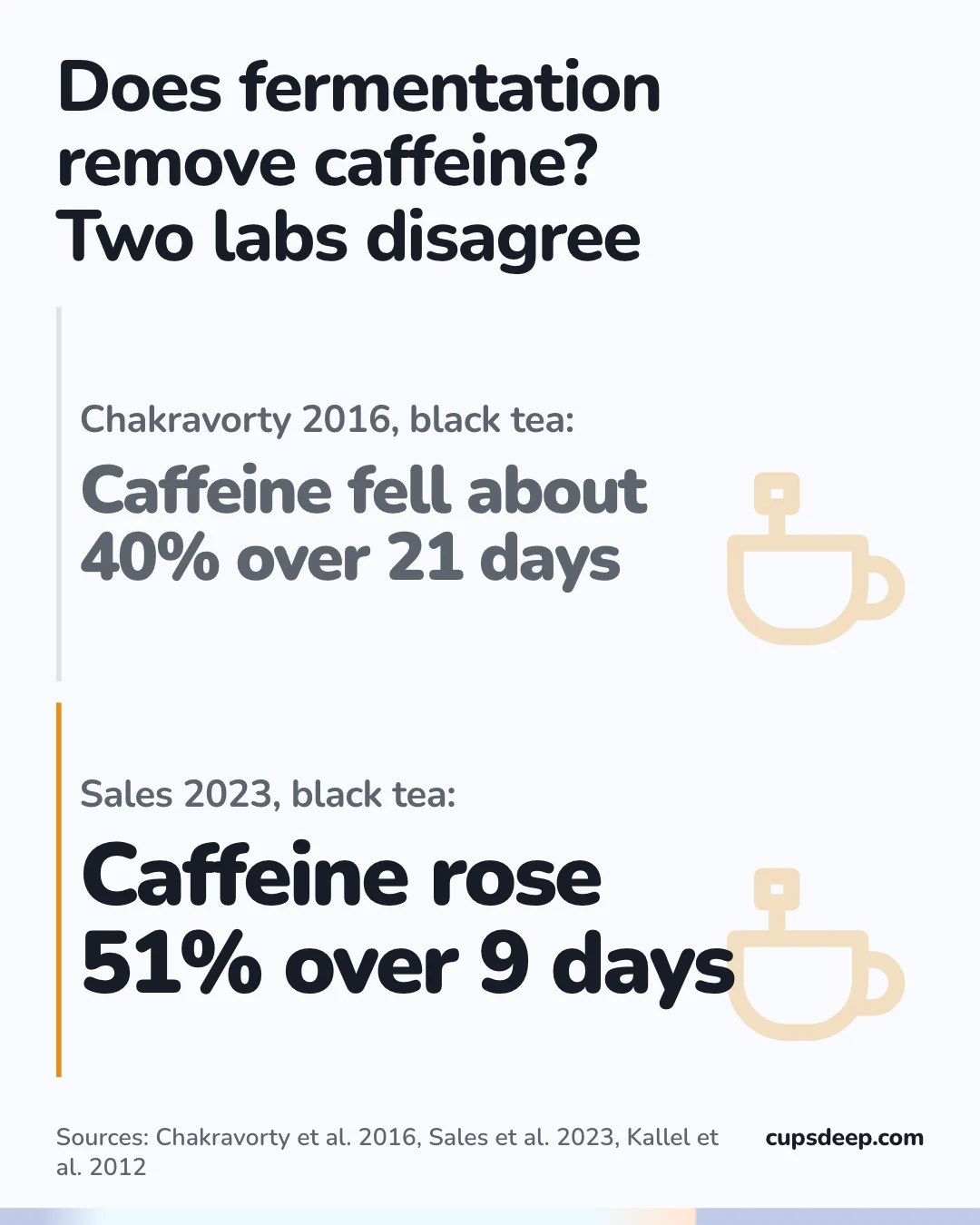
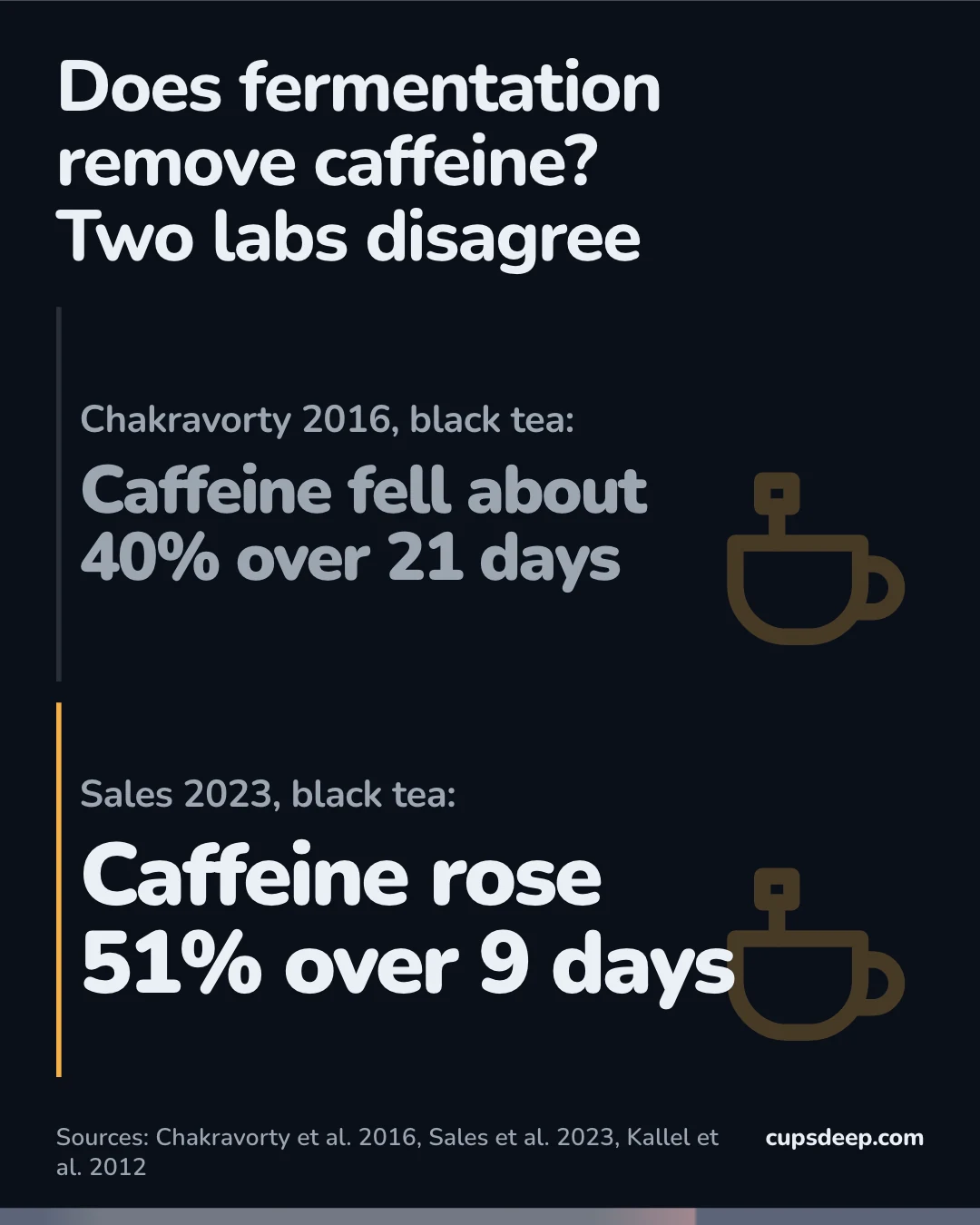
So the honest answer is: sometimes, a bit, depending on the tea and the recipe, and sometimes not at all. What these papers do not show is a kombucha that ferments its way to zero. The bigger gap is between recipes. The 2012 study’s black tea kombucha held 240 mg/L, about twice the strongest store kombucha in the 2021 test (112.6 mg/L).
Does homemade kombucha have more caffeine than store-bought?
It can, because the caffeine starts in your tea and you choose how much tea. The labs that brew kombucha themselves use a lot of it.
In a 2025 lab study, plain green tea kombucha brewed from 8 g of Gunpowder green tea per liter held 321.91 mg/L of caffeine after four days of fermentation, from one batch. The authors note that 8 g per liter is a higher value than is typically used in home settings, 2 to 3 g per liter. 634
That lab’s green tea kombucha comes to about 76 mg per 8 fl oz by our sum, against 26.6 mg for the strongest store kombucha and 3.6 mg for the weakest. The authors say themselves that 8 g/L is more than is typically used in home settings, 2–3 g/L, so a home batch at that strength would likely land lower. Nobody we read measured one.
The lever is the same as in a teapot. More leaf, black rather than green, a longer steep: more caffeine in, and from the papers above, no promise the culture takes much of it out. Black tea and green tea have their own numbers.
Can you drink kombucha at night?
On caffeine alone, one bottle of a regular store kombucha is a small dose: about 11.7 mg for a whole Health-Ade, by our sum on the lab’s figure. EFSA’s line for sleep is a much bigger single dose:
A single 100 mg dose of caffeine, about 1.4 mg/kg body weight for a 70 kg adult, may increase the time it takes to fall asleep and reduce sleep duration in some adults, particularly when taken close to bedtime. 2223
The exceptions are the ones with caffeine added or a stronger tea, and the bottle or the maker’s page is the place to look. Caffeine’s half-life in healthy adults averages 4 hours, so on that average about half of what you drink at five is still there at nine. How long caffeine stays in your system has the arithmetic, and the method page shows how the instrument models it.
Caffeine is not the only thing in the bottle. GT’s product page for its Classic Kombucha says buyers must be 21+ because of alcohol from fermentation; KeVita’s page says its Master Brew is verified non-alcoholic. That is the makers’ own wording, and we say nothing past it.
GT’s product page for its Classic Kombucha Gingerade says buyers “Must be 21+ to purchase and enjoy due to naturally-occurring alcohol byproduct.” 636
Questions people ask
Does kombucha have caffeine?
Yes. All 9 products in a 2021 lab test of US supermarket kombucha had caffeine. Leaving out one ambiguous value, they ran from 3.6 mg to 26.6 mg per 8 fl oz, by our sums, against about 47 mg in brewed black tea.
Is there caffeine-free kombucha?
We did not find one. Every maker we read states some caffeine, and the lab found it in every product it tested. GT’s calls its kombucha “naturally decaffeinated” and still states a figure for it.
Does green tea kombucha have less caffeine than black tea kombucha?
In the one study we read that made both the same way, yes: green tea kombucha fell from 170 mg/L to 80 mg/L during fermentation, while the black tea kombucha stayed at 240 mg/L. Green tea also starts with less caffeine in a cup: 24 mg against 40 mg in 200 ml, by USDA.
Does hard kombucha have caffeine?
JuneShine, a hard kombucha, says on its blog that it has 20 mg per 12 oz serving. It is made from tea, so some caffeine is expected; we found no lab measurement of a hard kombucha.
Does kombucha have more caffeine than coffee?
No. The strongest store kombucha in the lab test came to 26.6 mg per 8 fl oz by our sum, while FDA’s typical range for brewed coffee, scaled by us to 8 fl oz, is 75–165 mg.
How much caffeine is in KeVita kombucha?
KeVita’s own page says its Master Brew contains “organic caffeine” and gives no amount. A 2021 lab test measured 112.6 mg/L in KeVita Master Brew Ginger, which is 26.6 mg per 8 fl oz by our sum, the highest of the brands tested.
Sources
Every number above links to the place it came from. How the numbers are chosen and checked is on the method page; the drink table is at /drinks. Written with AI agents, as the whole site is. A model of a typical body, not advice for pregnancy, illness or medication.
- Spilling the Beans: How Much Caffeine is Too Much?
- Beverages, tea, green, brewed, regular
- Beverages, tea, black, brewed, prepared with tap water
- Scientific Opinion on the safety of caffeine
- EFSA explains risk assessment: Caffeine
- Microbial and Chemical Profiles of Commercial Kombucha Products (Yang J, Lagishetty V, Kurnia P, Henning SM, Ahdoot AI, Jacobs JP)
- Insights into the fermentation biochemistry of Kombucha teas and potential impacts of Kombucha drinking on starch digestion (Kallel L, Desseaux V, Hamdi M, Stocker P, Ajandouz EH)
- Kombucha tea fermentation: Microbial and biochemical dynamics (Chakravorty S, Bhattacharya S, Chatzinotas A, et al.)
- Intracellular Antioxidant and Anti-Inflammatory Effects and Bioactive Profiles of Coffee Cascara and Black Tea Kombucha Beverages (Sales AL, Iriondo-DeHond A, DePaula J, et al.)
- Influence of Herbal Additives on the Physicochemical, Microbiological, Polyphenolic, and Sensory Profile of Green Tea-Based Kombucha (Gantner M, Piotrowska A, Kostyra E, et al.)
- SYNERGY Raw Kombucha, collection page FAQ
- GT’s Classic Kombucha Gingerade, product page
- Health-Ade Kombucha Ginger-Lemon, product page FAQ
- Does kombucha have caffeine? (blog post by Daina Trout)
- How much caffeine is in Humm Kombucha? (help center article)
- Brew Dr. Kombucha FAQ
- Does kombucha have caffeine? (blog post)
- Wild Tonic FAQ
- KeVita Master Brew Kombucha, product page
- Well, does kombucha have caffeine? If so, how much? (blog post)
Keep reading
Tea and mate
Does green tea have caffeine?
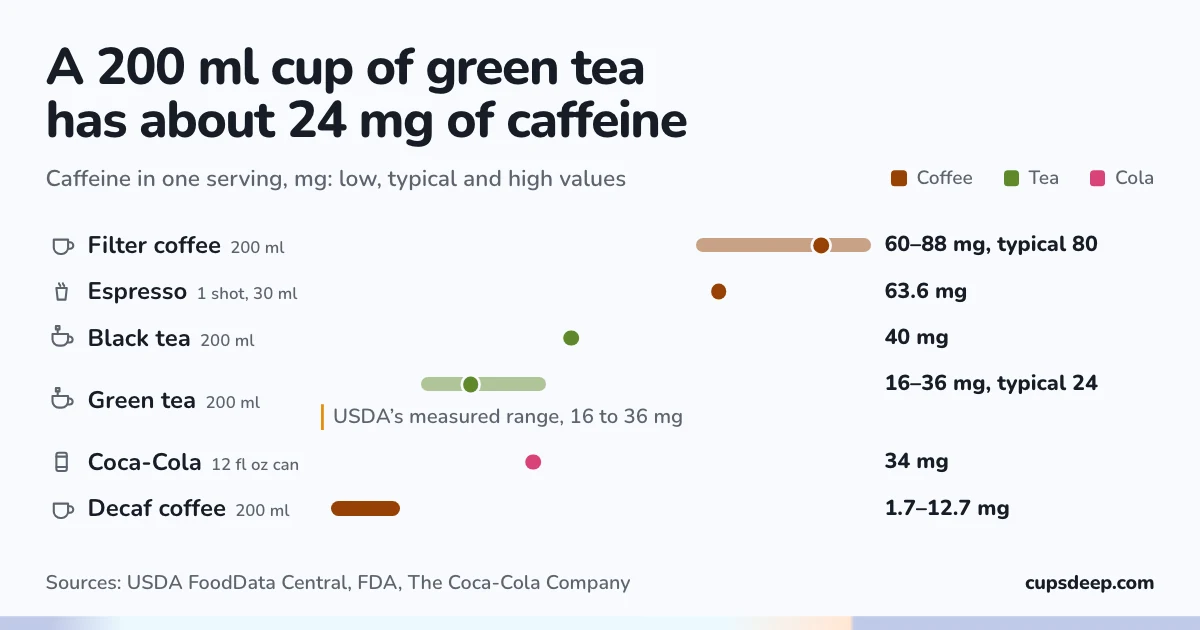
Yes: about 24 mg in a 200 ml cup, by USDA. How long you steep it, the bag, gyokuro and bottled teas from Ito En to AriZona, all with sources.
Tea and mate
Does black tea have caffeine?
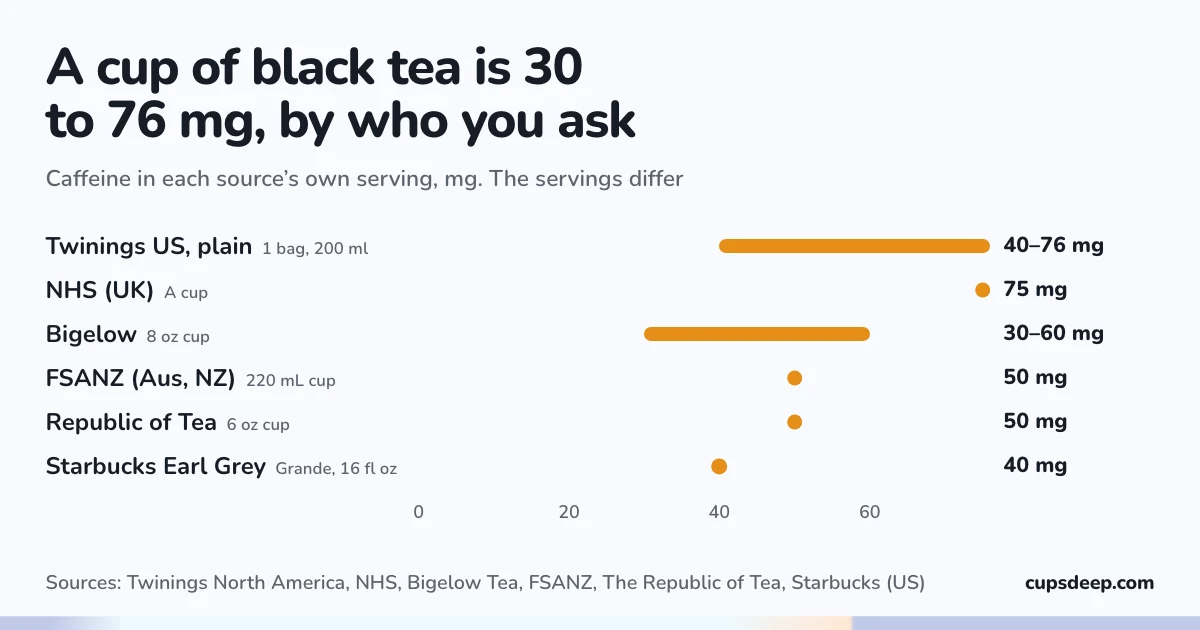
Yes: about 40 mg in a 200 ml cup, by USDA. Earl Grey, English Breakfast, steep time, decaf and bottled tea from Pure Leaf to AriZona, all sourced.

Coffee
Does decaf coffee have caffeine?
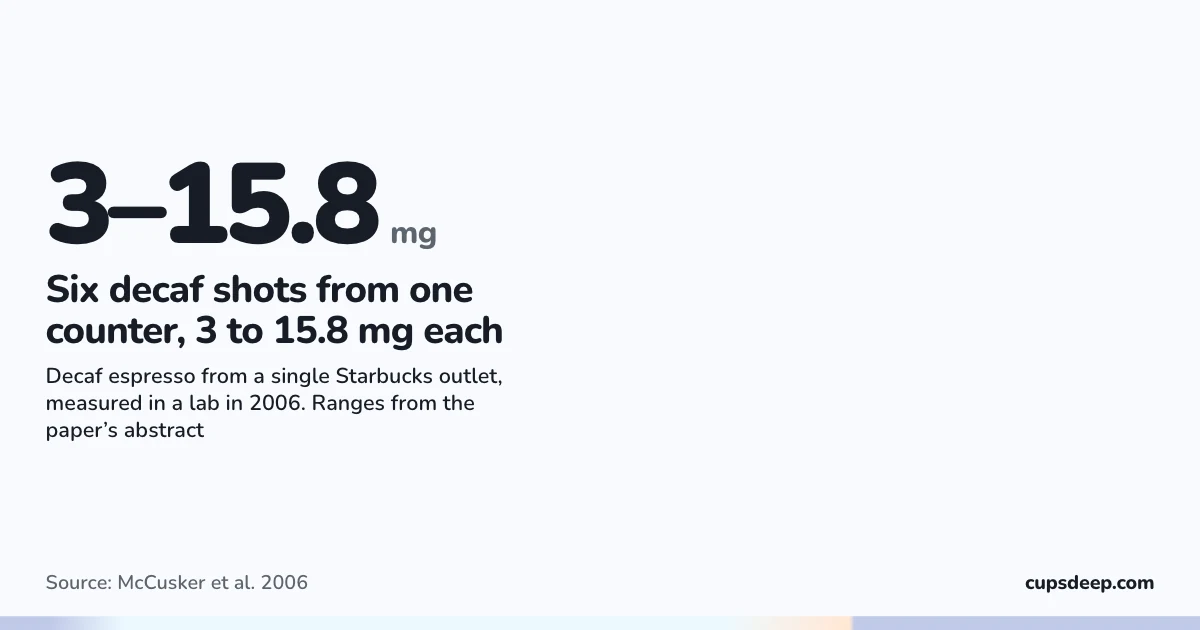
Yes. FDA puts decaf at 2–15 mg per 8 fl oz cup, and Starbucks lists 25 mg for a grande. The lab ranges, the law and the maths.