Does boba have caffeine? (And Thai tea and milk tea)
Boba is a dessert you drink through a straw, which makes the tea inside it easy to forget. The tea does not care. Here is what a government lab found in the cup, why USDA’s figure is a fraction of that, why Thai tea is not always the tea you think, and which chains print a number. Spoiler: of the US chains we checked, one, and it calls its figures approximate.
The short answer
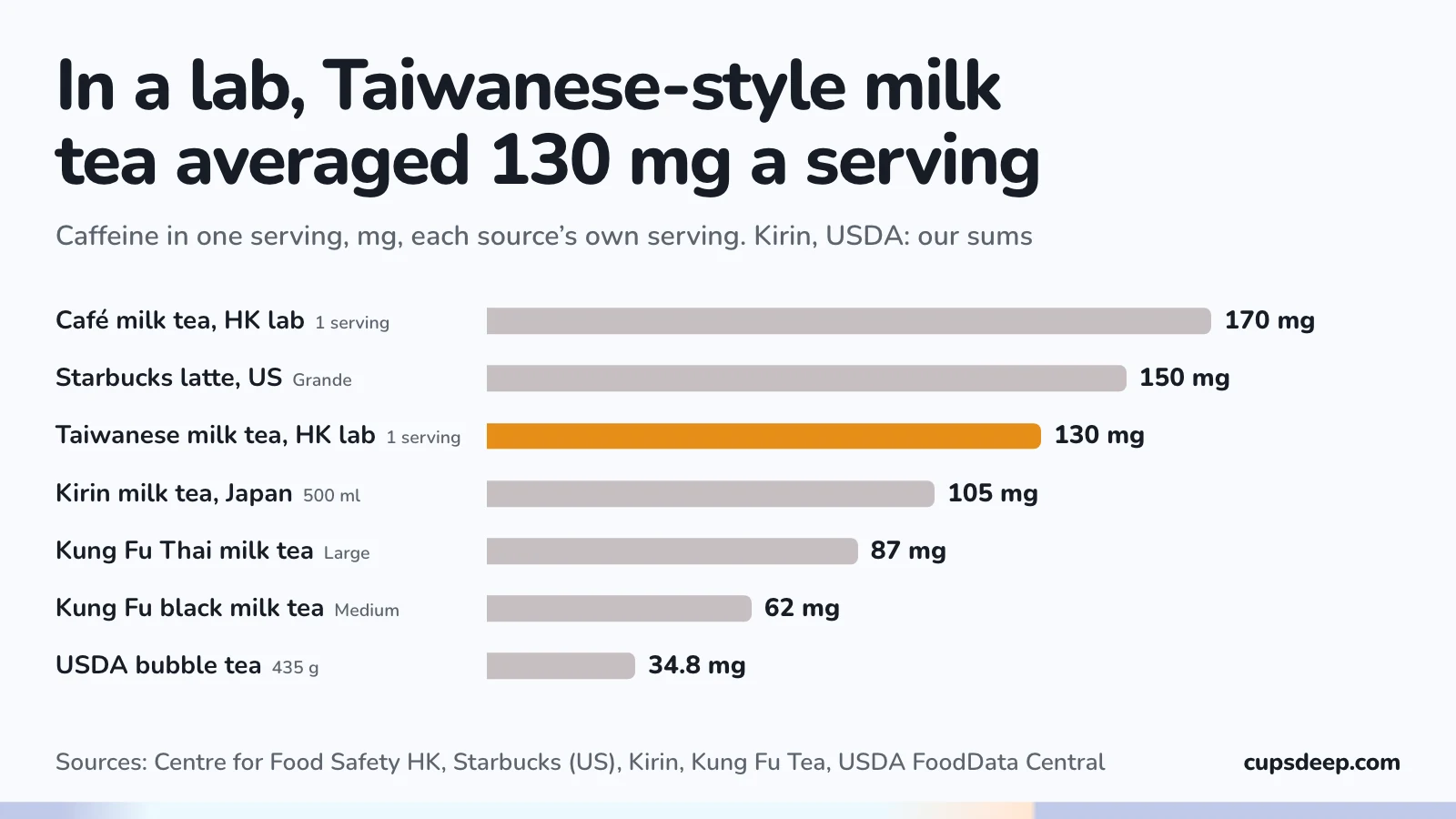
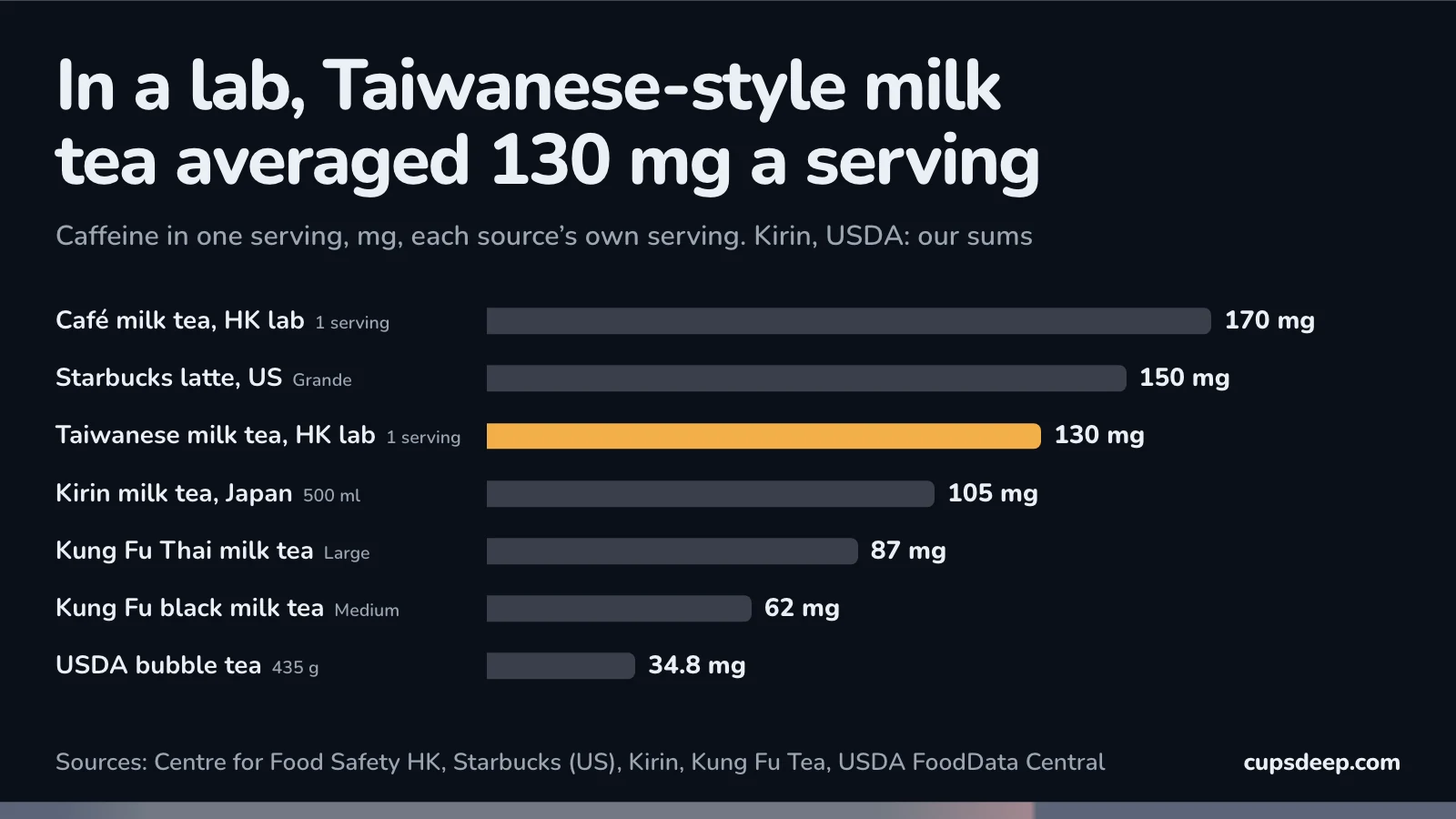
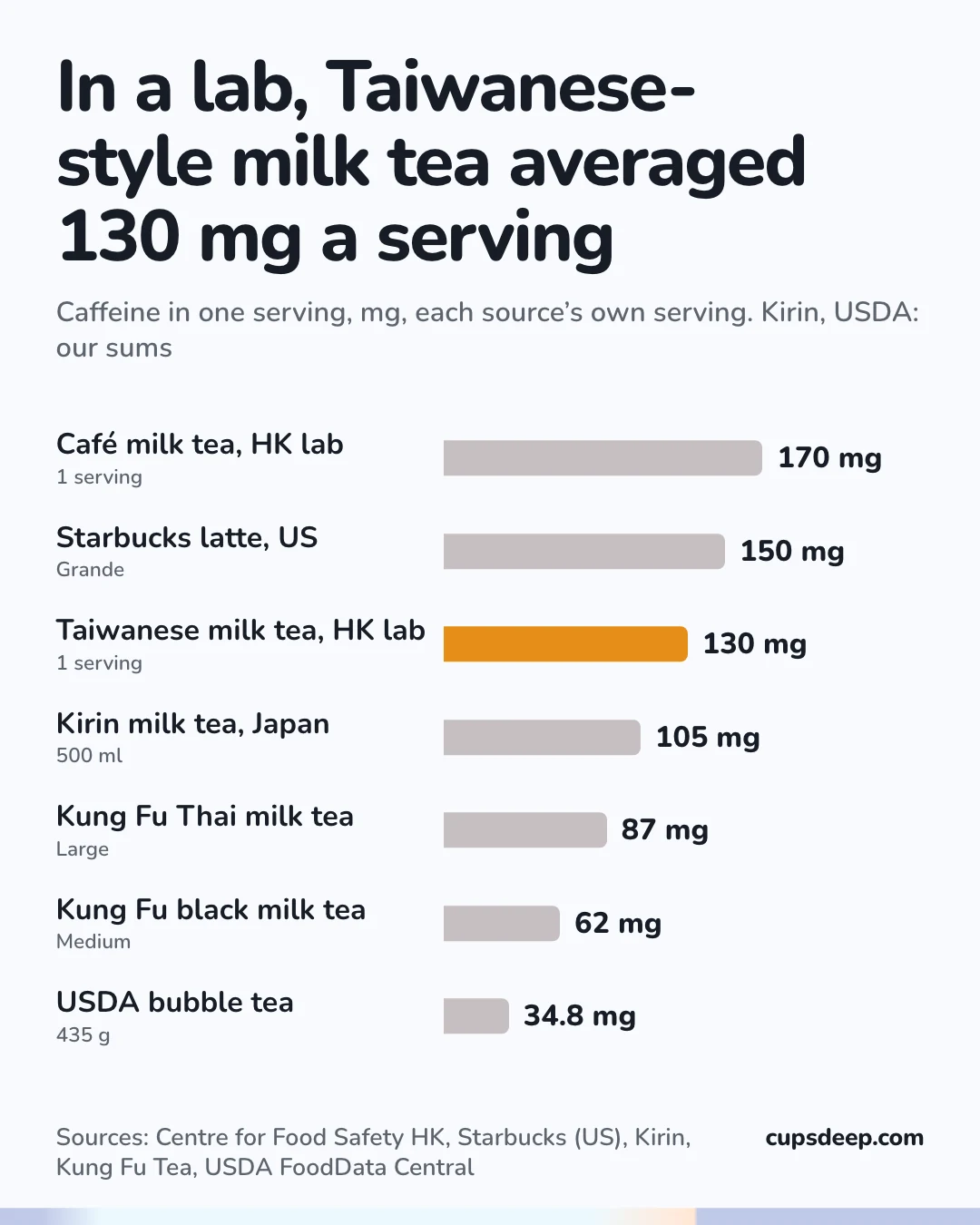
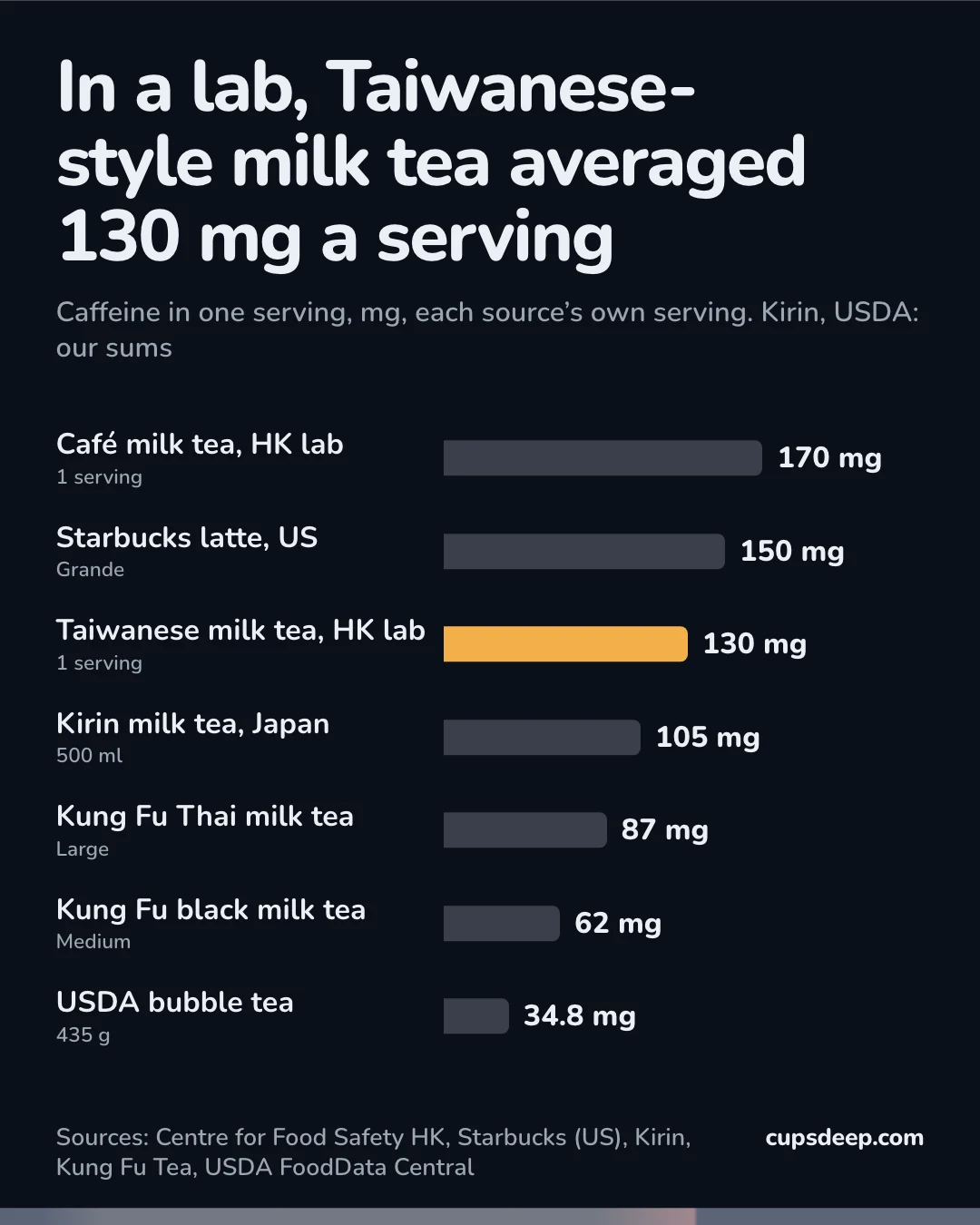
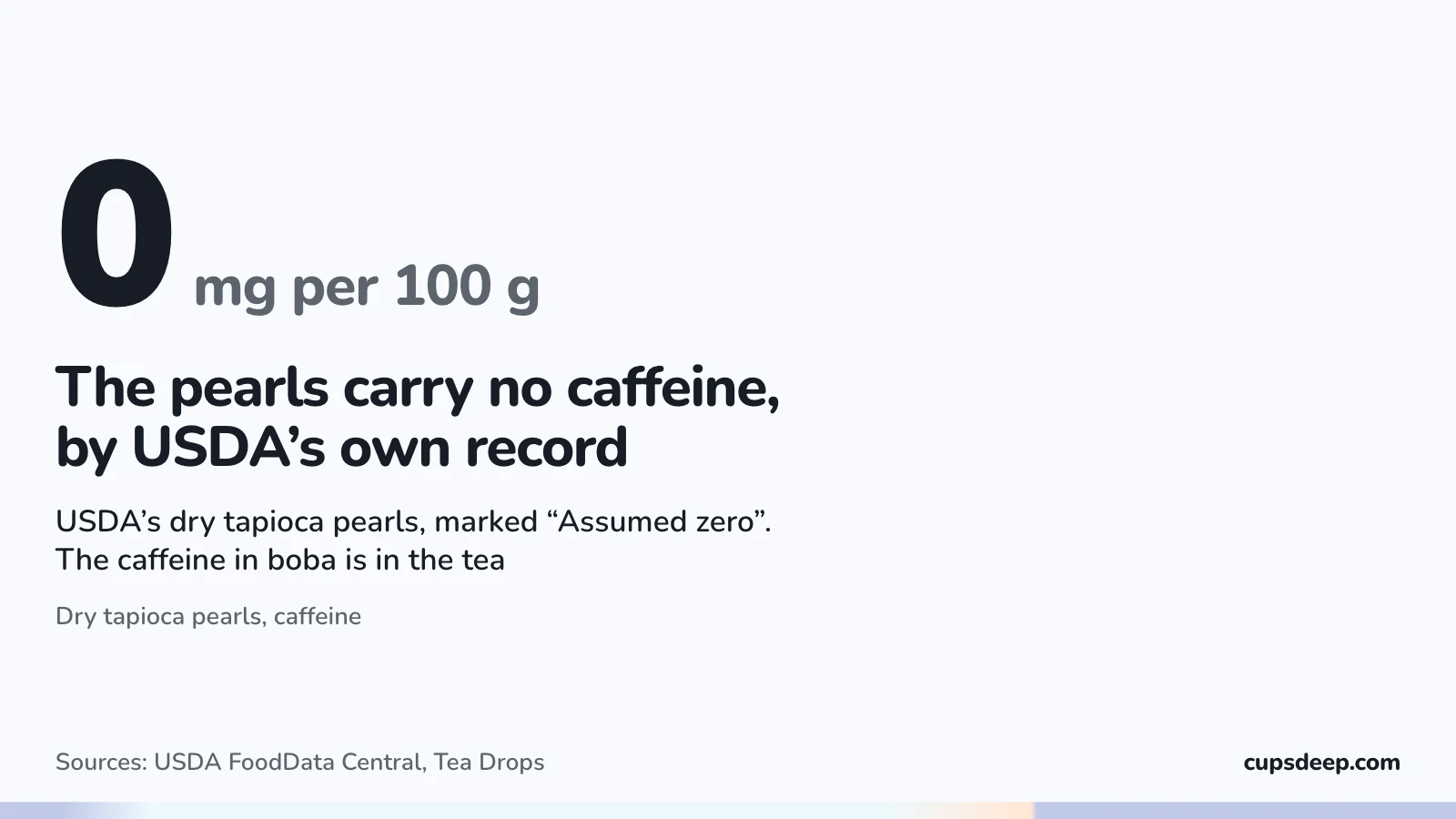
Yes, whenever there is tea or coffee in the cup. The pearls carry none: USDA lists dry tapioca pearls at 0 mg per 100 g. A Hong Kong government lab measured 10 samples of Taiwanese-style milk tea at 130 mg a serving on average, from 100 mg to 160 mg, a little under the 150 mg Starbucks lists for a Grande latte. Of the US chains we checked, only Kung Fu Tea prints figures: about 62 mg for a Medium black or Thai milk tea, with no cup volume stated.
Does boba tea have caffeine?
Boba is the pearls: balls of tapioca starch cooked in syrup and dropped into a drink, most often a sweet milk tea. The pearls bring the chew and the sugar. In a tea drink the tea brings the caffeine, all of it, so the question is never really about boba. It is about what the pearls are swimming in, and some boba menus carry coffee drinks too: Kung Fu Tea lists its Medium Coffee Milk Tea at about 190 mg.
USDA lists dry tapioca pearls at 0 mg of caffeine, marked “Assumed zero (Insignificant amount or not naturally occurring in a food…)”. One US boba kit lists its pearls as tapioca starch, water, modified tapioca starch, caramel color and sodium alginate; the rest of its boba pack is fructose syrup, brown sugar, xanthan gum, pectin, cellulose gum, DL-malic acid and monopotassium phosphate. No tea, coffee or cocoa is listed. 647654

The pearls have an alibi. The tea they were floating in does not
So a boba drink made on black, green, oolong or Thai tea has caffeine, and one made on milk, fruit syrup or brown sugar alone has none from the tea. Kung Fu Tea lists its plain boba topping at 0 mg. Two chains put it in words, too.
Kung Fu Tea’s FAQ says “Our four core teas (Black, Green, Oolong, Thai) all contain caffeine”, that its black tea is Earl Grey, and that its Nutrition page lists caffeine per drink for each size. The figures are in a PDF calorie guide linked from that page, not on the page itself. 657
Gong cha’s UK menu describes Brown Sugar Milk with Pearls as “Caffeine-free”. The menu page prints no caffeine figure for any drink. 658
Taro, fruit and smoothie drinks are where it gets murky: some shops build them on a tea base and some do not. Kung Fu Tea is the one chain we checked that says in milligrams: about 62 mg for a Medium Taro Black Milk Tea, 44 mg for a Medium Taro Milk Green Tea and 0 mg for a Taro Slush. Elsewhere, if the menu calls it a milk tea, assume there is tea in it until somebody behind the counter tells you otherwise.
How much caffeine is in a boba milk tea?
One US chain prints approximate figures; they come further down. The best measurement we found comes from Hong Kong, where the Centre for Food Safety and the Consumer Council bought drinks over the counter in 2013 and tested them in a government lab.
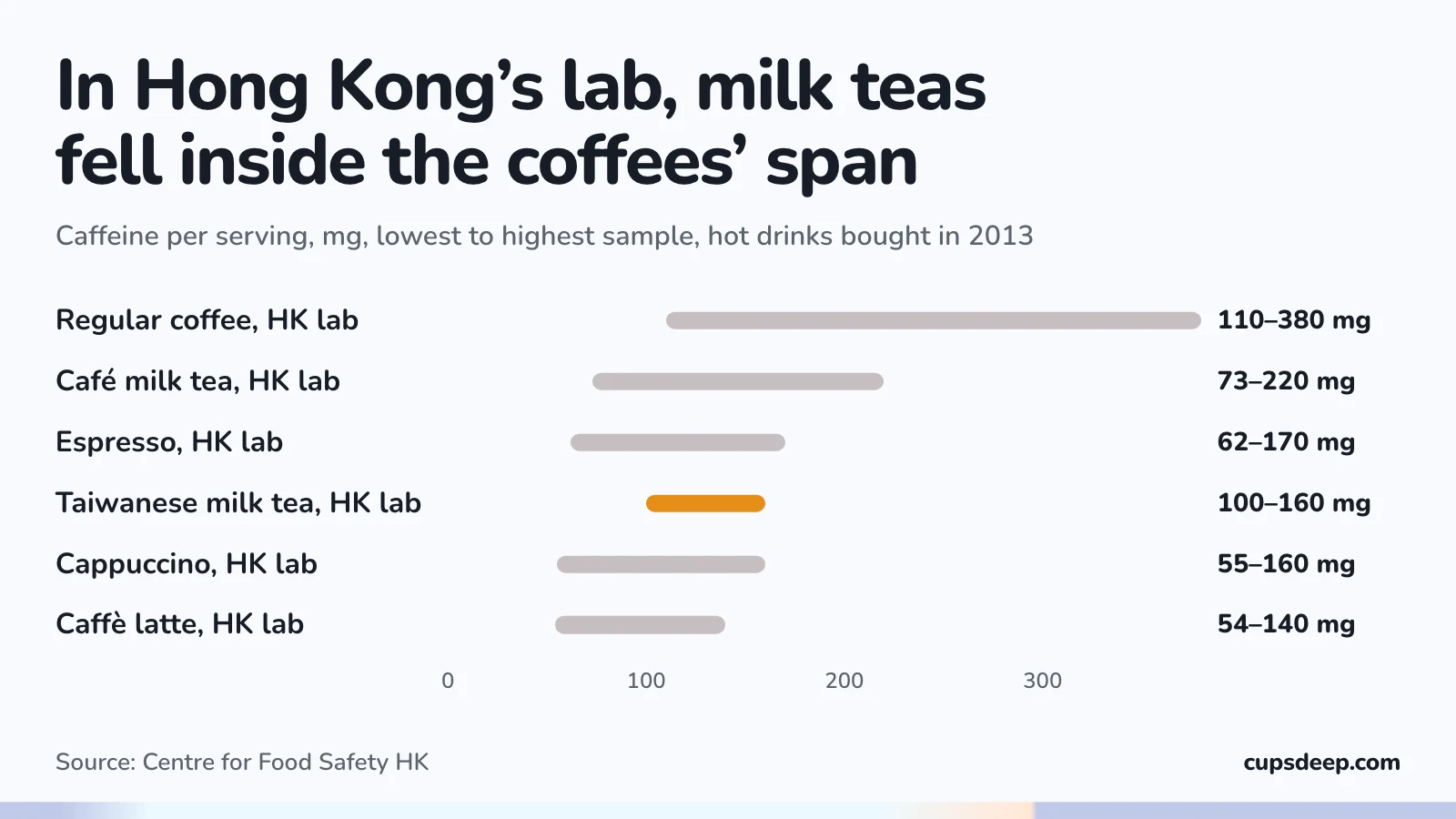
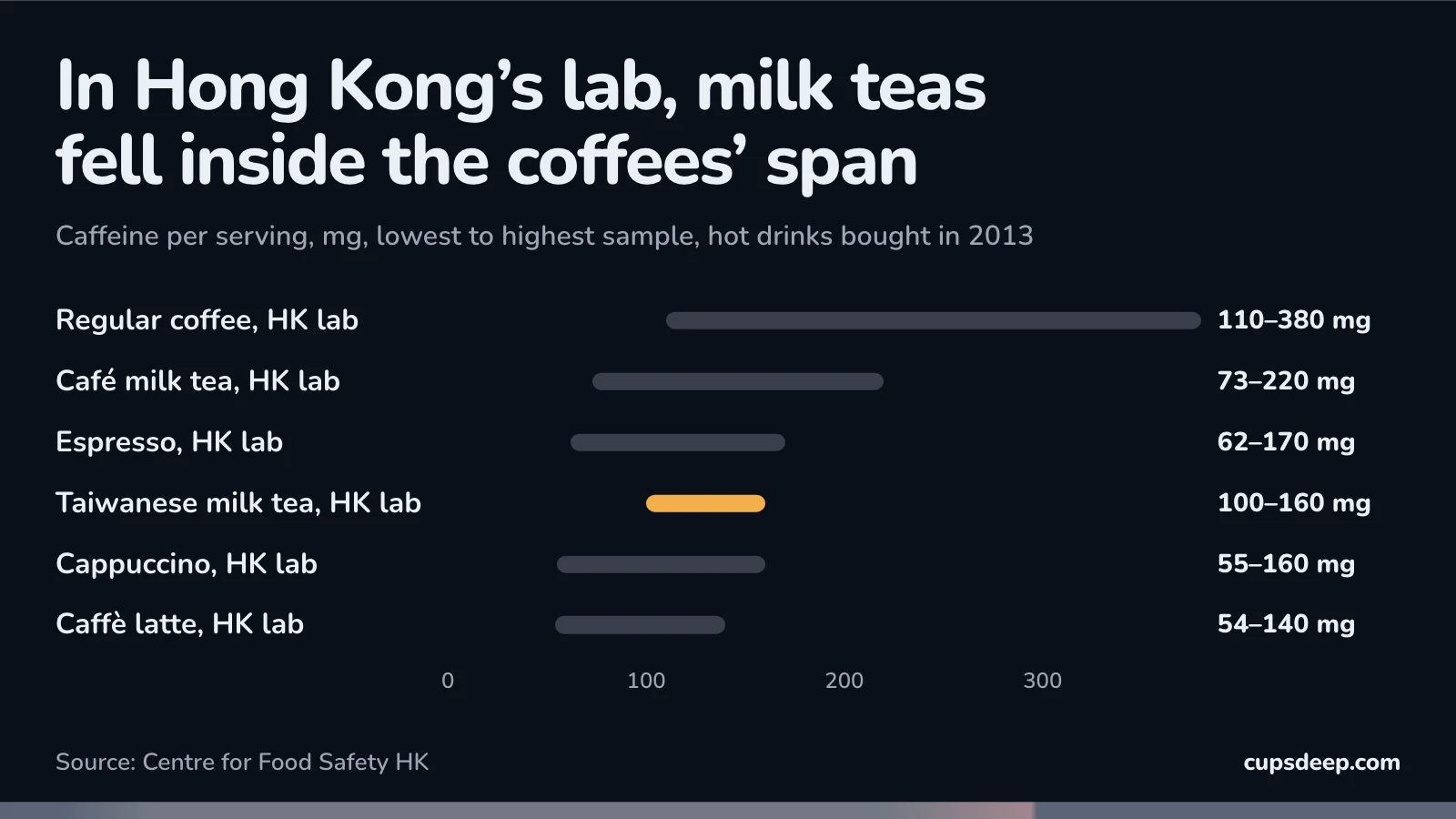
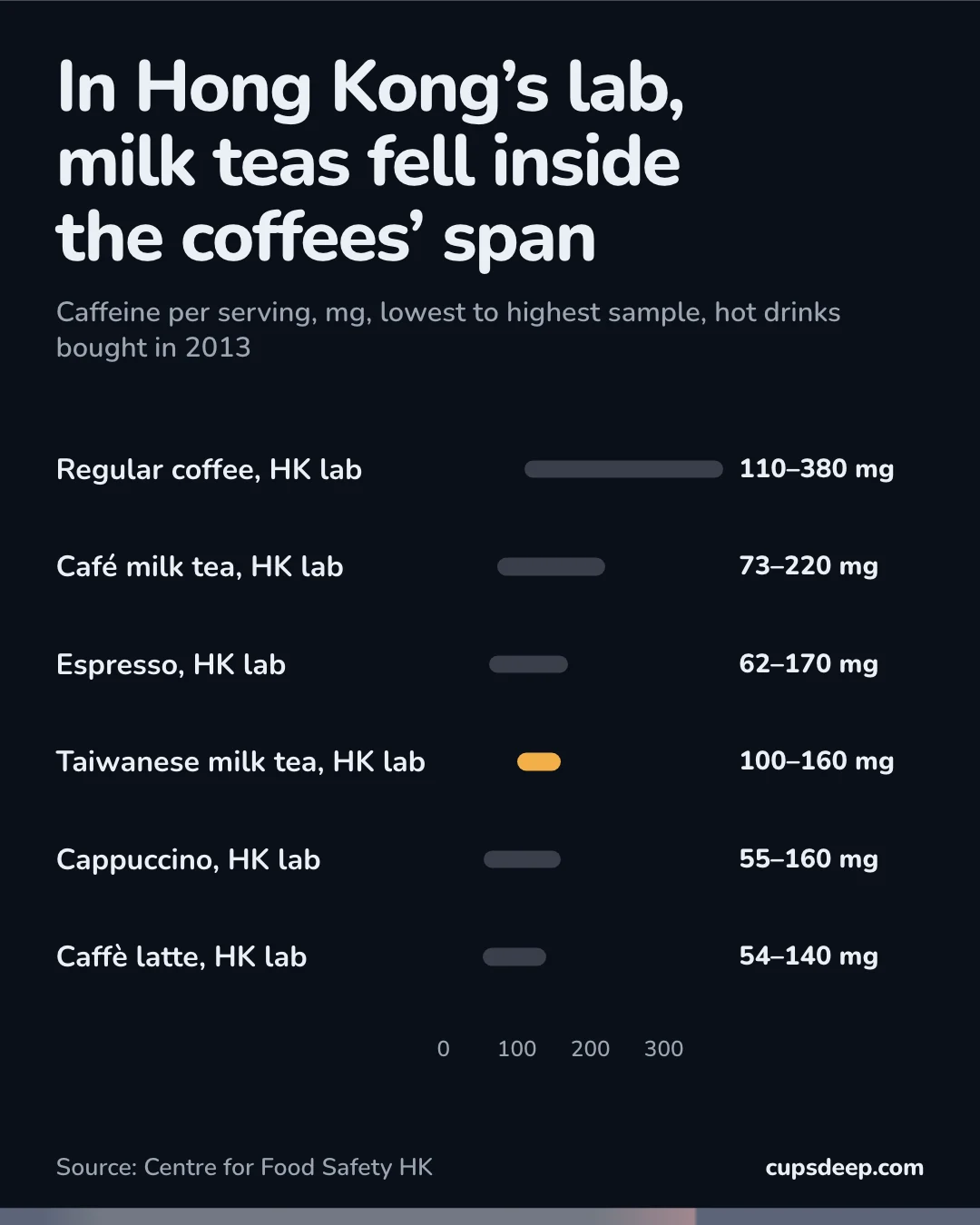
Hong Kong’s Centre for Food Safety and Consumer Council bought 80 hot-served coffees and milk teas from chain and individual fast-food shops, local cafés, restaurants, specialist coffee shops, Taiwanese-style beverage shops and convenience stores in April and May 2013, and the CFS laboratory tested them. Ten Taiwanese-style milk teas averaged 130 mg of caffeine a serving (100 to 160 mg), or 320 mg per liter (250 to 490). Thirty Hong Kong café-style milk teas averaged 170 mg a serving (73 to 220 mg). In the same study regular coffee averaged 200 mg a serving, espresso 97 mg, cappuccino 110 mg and caffè latte 90 mg. The abstract prints no serving volume. 645
That is 130 mg a serving for Taiwanese-style milk tea, bought partly from Taiwanese-style drink shops (the abstract does not say whether the samples had pearls), measured, not estimated, and the strongest of the 10 samples came in at 160 mg. Hong Kong’s own café-style milk tea averaged 170 mg. Both were hot drinks; the study does not say whether iced versions differ.
The Hong Kong study prints no serving size. Dividing its mean per serving by its mean per liter suggests a Taiwanese-style milk tea of about 0.4 liters and a café-style milk tea of about 0.23 liters. This is our inference, not the study’s figure. 645

I ordered a dessert with a straw and it came with a dose
| Drink | Source | Serving | Caffeine | How the figure was reached |
|---|---|---|---|---|
| Café-style milk tea | Hong Kong CFS lab, 2013 | 1 serving, size not printed | 170 mg (73 mg to 220 mg) | Lab mean of 30 samples, with their range |
| Taiwanese-style milk tea | Hong Kong CFS lab, 2013 | 1 serving, size not printed | 130 mg (100 mg to 160 mg) | Lab mean of 10 samples, with their range |
| Gogo no Kocha Milk Tea | Kirin, Japan | 500 ml bottle | 105 mg | Our arithmetic: Kirin’s reference value, 21 mg per 100 ml, × 500 ml |
| Gogo no Kocha Straight Tea | Kirin, Japan | 500 ml bottle | 50 mg | Our arithmetic: Kirin’s reference value, 10 mg per 100 ml, × 500 ml |
| Thai Boba kit | Tea Drops, US | 1 cup, volume not stated | 60 mg | Maker’s printed figure |
| Tiger Boba kit | Tea Drops, US | 1 cup, volume not stated | 60 mg | Maker’s printed figure |
| Bubble tea | USDA, US | 1 item, any size, 435 g | 34.8 mg | Our arithmetic: USDA’s recipe-calculated 8 mg per 100 g × 435 g |
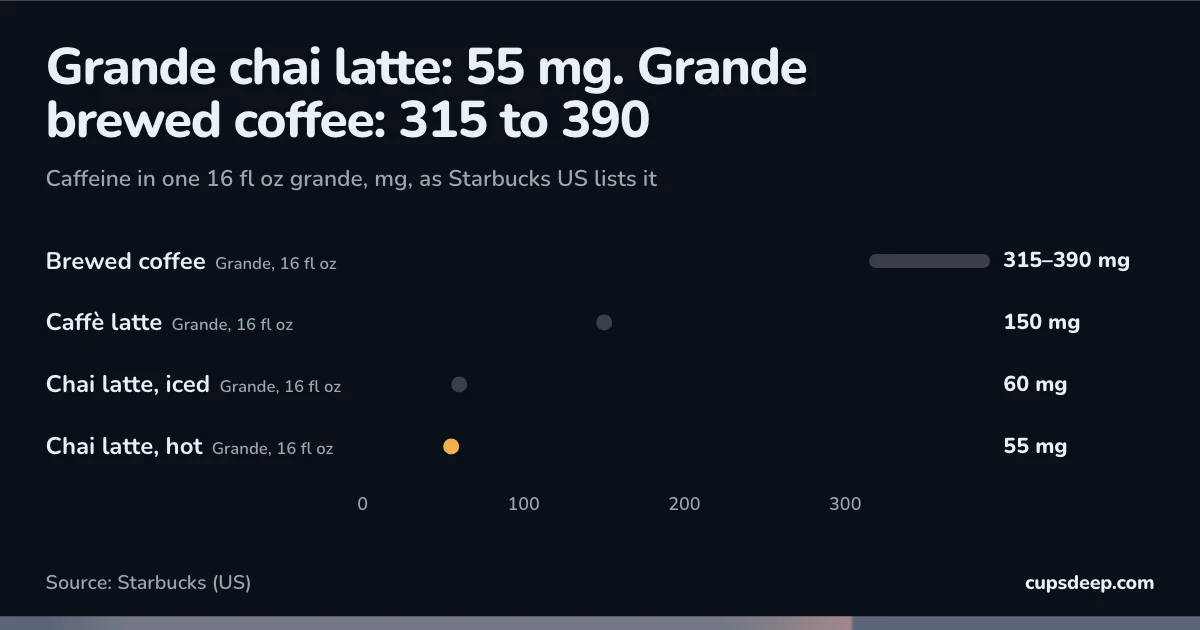
| Chai latte, for scale | Starbucks US | Grande, 16 fl oz | 55 mg | Chain’s stated figure |
| Caffè latte, for scale | Starbucks US | Grande, 16 fl oz | 150 mg | Chain’s stated figure |
| Brown Sugar Milk with Pearls | Gong cha UK | Not stated | 0 mg | Maker’s word “Caffeine-free”, no figure |
Read on November 12, 2026; Starbucks rows read on November 10, 2026. Hong Kong figures are lab means with the lowest and highest sample; the abstract prints no serving volume. Kirin’s figures per 100 ml are reference values, not label claims, and the bottle totals are our multiplication. Gong cha’s zero is its word “Caffeine-free”, with no figure.
Why does USDA say bubble tea has so much less?
Because USDA did not measure a bubble tea. It wrote a recipe and added up the parts.
USDA’s survey food database has an entry “Tea, bubble”, described as milk tea, boba and tapioca balls, at 8 mg of caffeine per 100 g. Its recipe, per 100 g, is 74 g of ready-to-drink black tea, 6 g of simple syrup, 12 g of half and half and 8 g of dry tapioca pearls. Its portion for “1 item, any size” is 435 g. The figure is calculated from the recipe, not measured in a shop drink. 646
By our arithmetic, USDA’s bubble tea comes to about 35 mg of caffeine in its 435 g portion and about 19 mg in a 240 g cup. The black tea in its recipe accounts for the whole figure: 74 g at USDA’s 11 mg per 100 g is about 8.1 mg. The Hong Kong lab’s Taiwanese-style milk tea average, 130 mg a serving, is about 3.7 times the USDA portion. 646648645
So the two government figures disagree, the lab average coming to about 3.7 times the USDA portion, and they are not measuring the same thing. USDA’s is a calculation from a ready-to-drink black tea at 11 mg per 100 g, a little over half the 20 mg per 100 g it gives hot brewed black tea. Hong Kong’s is what shops actually poured, in one city, in 2013. Neither source says why the other is different, and we will not invent a reason. For a drink from a shop, the measurement of shop drinks is the closer of the two; it is still one study of 10 samples, from another city.
The useful thing USDA’s recipe does tell you: by our arithmetic, the pearls, the syrup and the half and half add nothing to its figure. The tea is the whole number, which is why the method page treats every drink as its caffeine source and nothing else.
Does milk tea have more caffeine than regular tea?
You would expect milk to water it down. Milk has no caffeine, so a splash in a mug of black tea leaves the total where it was. A bottled milk tea is not a mug with a splash, though, and one maker’s own figures point the other way.
Kirin gives caffeine per 100 ml for its Gogo no Kocha bottles in Japan as reference values (参考値), not label claims: 21 mg for the milk tea, 10 mg for the straight tea and 7 mg for the lemon tea. In the unsweetened line, the milk tea is 19 mg and the plain tea 10 mg. 649650651652653
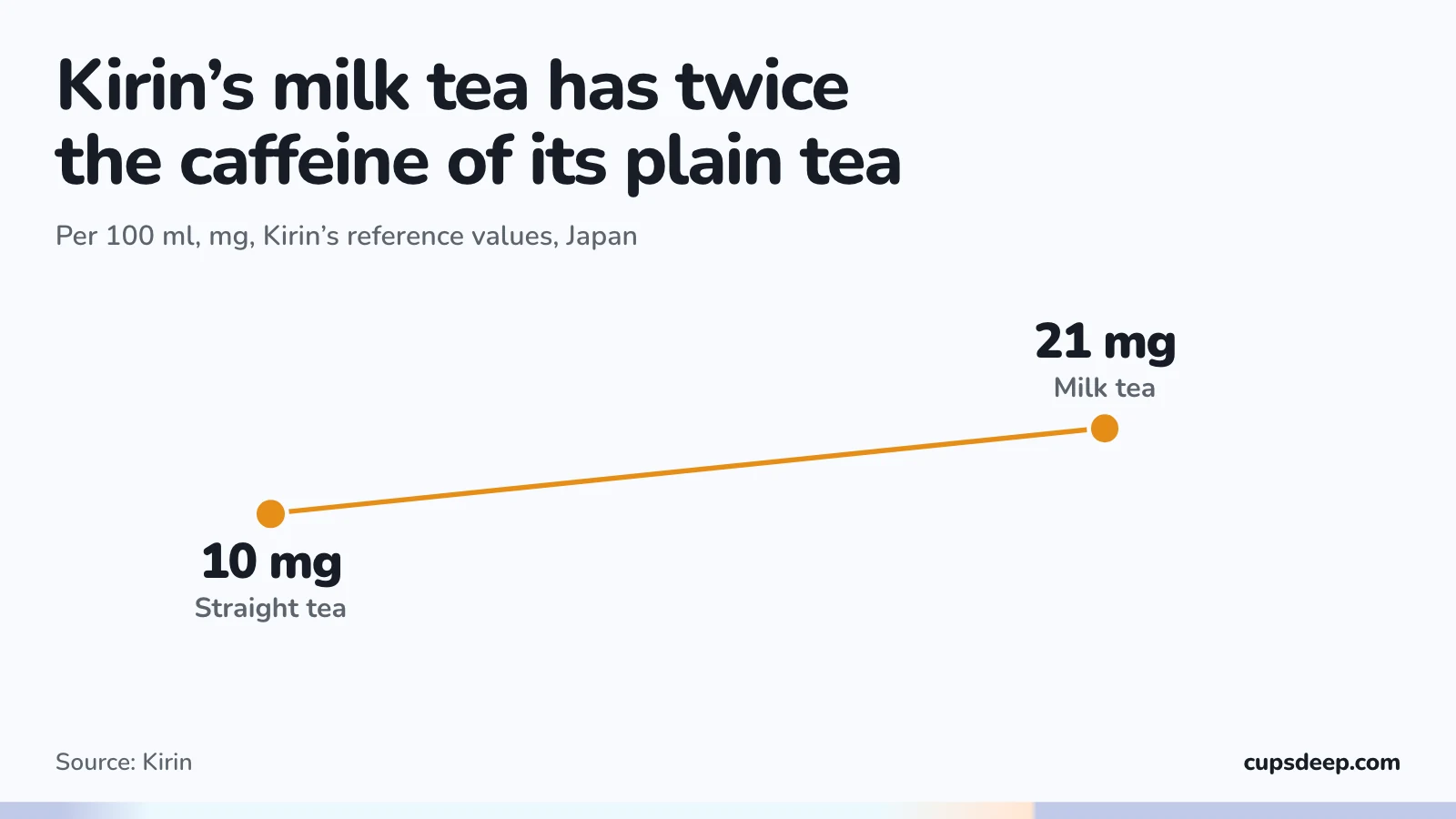
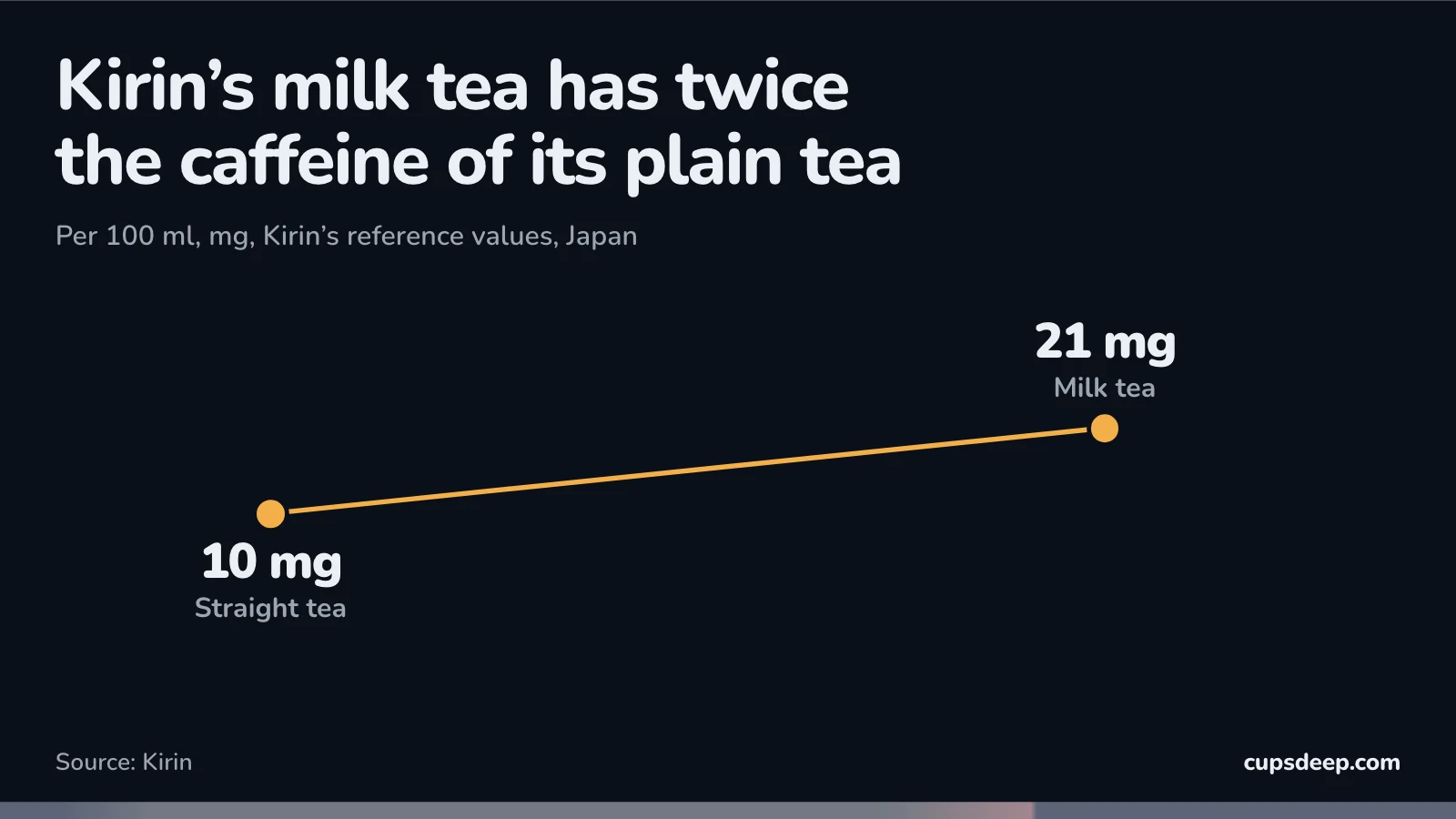
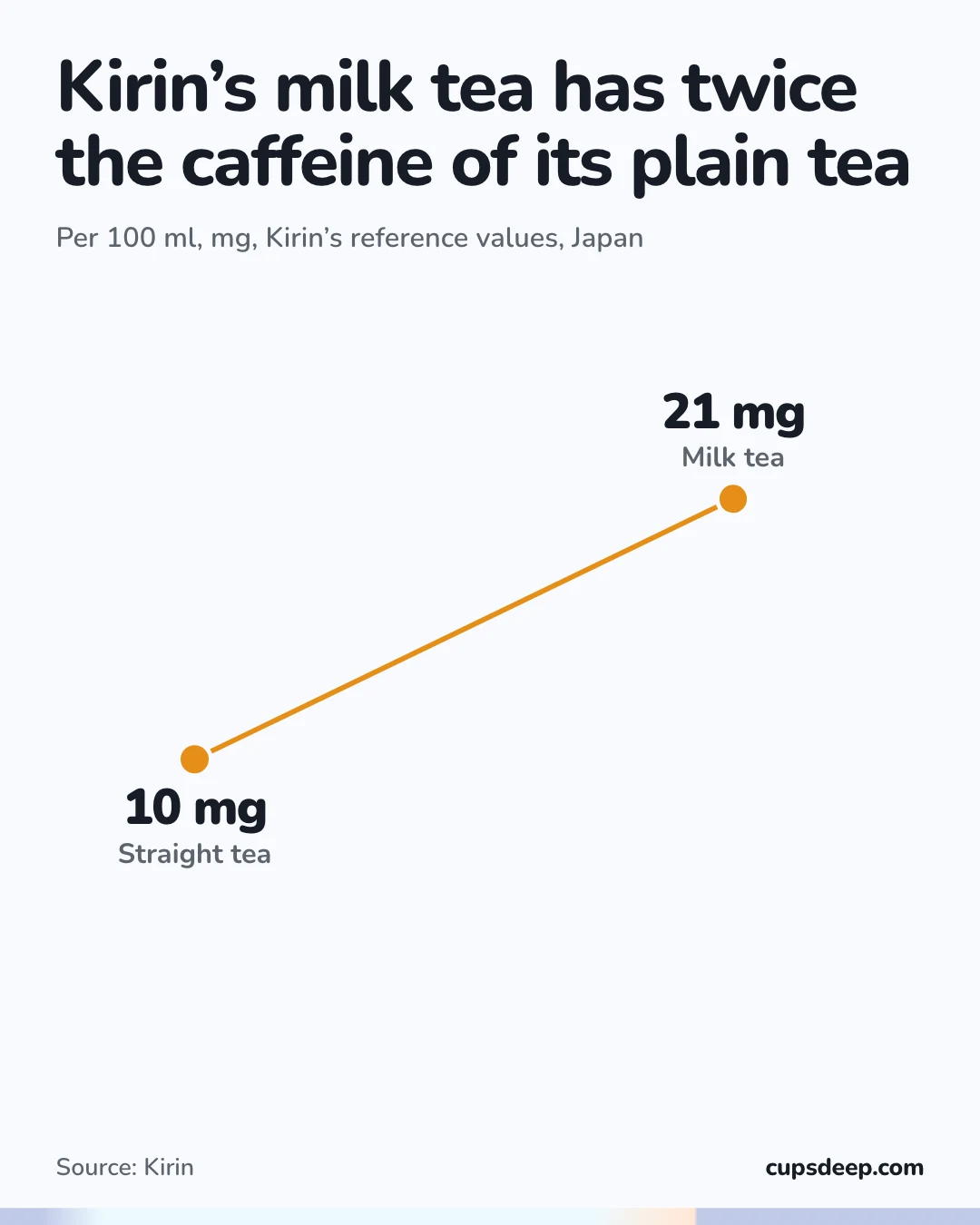
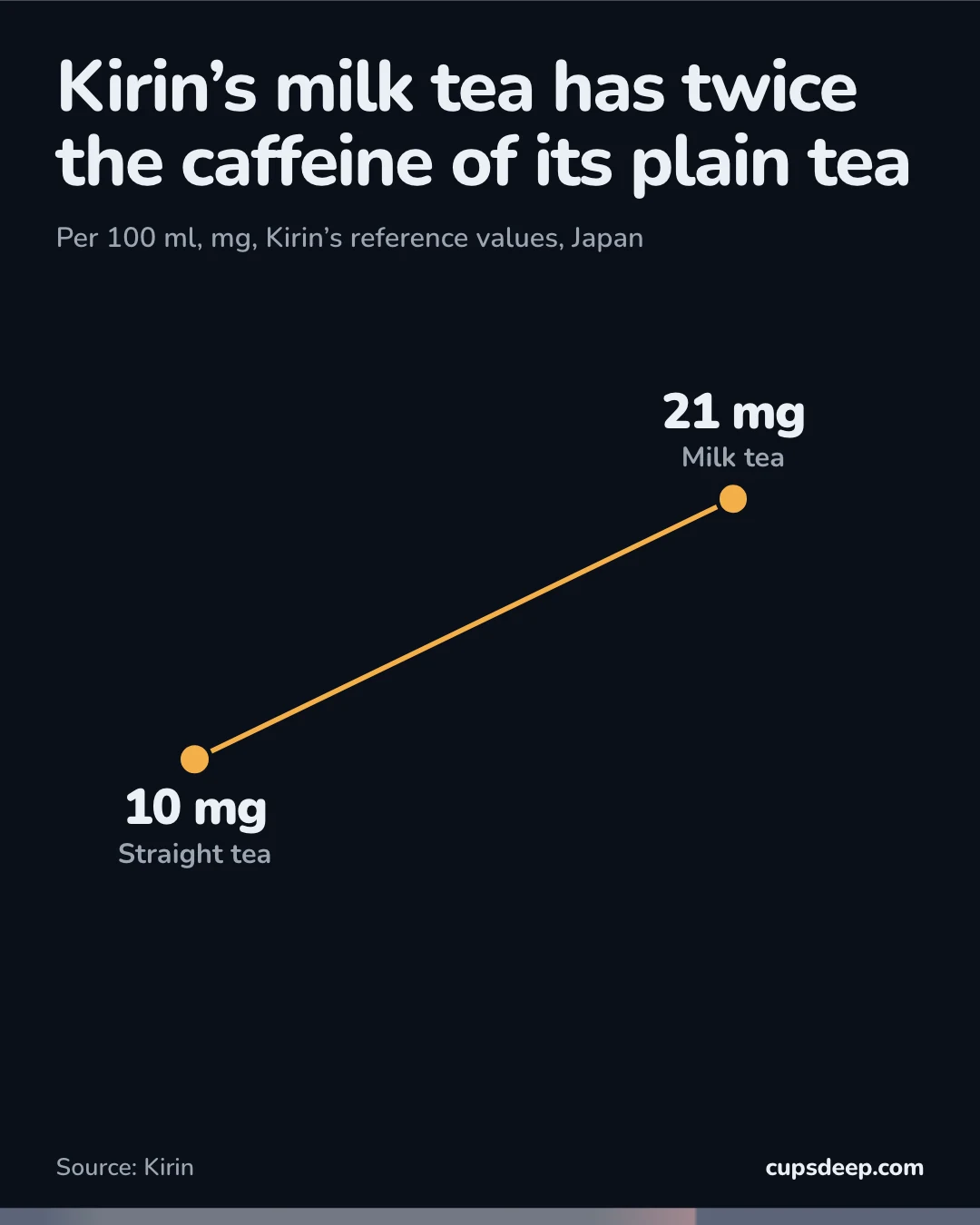
By our arithmetic from Kirin’s reference values, a 500 ml bottle of Gogo no Kocha milk tea holds about 105 mg of caffeine and the straight tea about 50 mg. Per 100 ml the milk tea has 2.1 times the caffeine of the straight tea, and 1.9 times in the unsweetened pair. 649650652653
Kirin does not say why its milk tea runs stronger, and the same pattern holds in its unsweetened pair, so sugar is not what separates them, by our reading. For scale, Japan’s food tables give brewed black tea 30 mg per 100 g. A Starbucks Grande chai latte, a tea concentrate cut with milk, is listed at 55 mg. The chai article has every size. Milk tea is not one drink; it is whatever ratio the maker picked.
Does Thai tea have caffeine?
Yes, when it is made from tea. The catch is which tea. Kung Fu Tea’s Thai tea is black and oolong tea; the one US kit we found that prints a figure uses green tea.
Kung Fu Tea’s ingredient guide lists its Thai tea as “Black Tea, Oolong Tea, Cassia, Caramel Flavor Powder, Vanilla Powder, Condensed Milk Flavor, FD&C Yellow No.6, FD&C Red No. 40, Citric Acid”. Its FAQ says “Our Thai tea uses no artificial coloring.” The two pages disagree, and Kung Fu Tea does not say which is current. 660657
Tea Drops, a US maker of boba kits, prints 60 mg of caffeine per cup for its Thai Boba kit and for its Tiger Boba kit, and states no cup volume. The Thai kit’s tea is listed as “Thai Tea (Green Tea, FD+C Yellow No. 6)”; the Tiger kit’s as organic black Assam with vanilla. 654655
My Thai tea kit turned out to be green tea in an orange costume
That is 60 mg a cup from the kit maker, with no size for the cup, so it cannot be set against a measured serving. Kung Fu Tea lists a Medium Thai Milk Tea at about 62 mg, the same as its black milk tea, again with no cup volume. If you want the green tea version in numbers, the green tea article has them.
The figure that fills page one for Thai tea, a range per 8 oz cup repeated from blog to blog, comes with no source on any page we read. We looked for the study behind it and found none, so it is not on this page.
Do boba shops list caffeine?
One of the ones we checked does. Kung Fu Tea publishes caffeine for every drink and size in a PDF calorie guide linked from its Nutrition page, and calls the figures approximate. On November 12, 2026 we found no figure on the sites of Boba Guys, Tiger Sugar and Coco, of Gong cha in the UK, Australia and Taiwan (its US site would not open), or of Chatime and Sharetea in Australia.
Kung Fu Tea’s 2026 calorie guide gives caffeine per drink and size, and calls every figure approximate. It states no cup volume. A Medium Kung Fu Black Milk Tea or Thai Milk Tea is listed at 62 mg, a Large at 87 mg and a Hot at 74 mg. Taro Black Milk Tea matches them; Taro Milk Green Tea is 44, 62 and 53 mg; Coffee Milk Tea is 190, 269 and 238 mg; a Coffee Latte 65 mg Medium and 90 mg Large. Taro Slush and the boba topping are listed at 0 mg. 659
| Drink | Medium | Large | Hot |
|---|---|---|---|
| Black Milk Tea | 62 mg | 87 mg | 74 mg |
| Thai Milk Tea | 62 mg | 87 mg | 74 mg |
| Taro Black Milk Tea | 62 mg | 87 mg | 74 mg |
| Taro Milk Green Tea | 44 mg | 62 mg | 53 mg |
| Coffee Milk Tea | 190 mg | 269 mg | 238 mg |
| Coffee Latte | 65 mg | 90 mg | 90 mg |
From Kung Fu Tea’s 2026 calorie guide, read on November 12, 2026. The chain calls every figure approximate and gives no cup volume for any size.
Taiwan puts it in the rules.
In Taiwan, tax-registered chain drink shops, chain convenience stores and chain fast-food outlets must state the highest total caffeine of each made-to-order cup that contains it, such as black tea, green tea or cocoa, or may use colored marks instead: red for 201 mg or more a cup, yellow for 101 to 200 mg, and green for below 100 mg. The rule was amended in June 2022. 656
Read as written, the bands leave out exactly 100 mg per cup: green is below it and yellow starts at 101 mg per cup. On the Hong Kong averages, a Taiwanese-style milk tea at 130 mg would wear yellow, and so would the café-style one at 170 mg. That is our placing, not Taiwan’s; the rule asks each chain to state its own cup.
In Taiwan the cup has to confess its caffeine. Here most cups only confess the sugar level
Is boba stronger than coffee?
Less than a regular coffee; in Hong Kong’s lab, more than an espresso, a cappuccino or a latte. In the same Hong Kong study, a regular coffee averaged 200 mg, a Taiwanese-style milk tea 130 mg, a cappuccino 110 mg, an espresso 97 mg and a caffè latte 90 mg. So the milk tea out-measured the espresso, the cappuccino and the latte, on average, and lost to the plain coffee. At Kung Fu Tea the two are almost level: a Medium black milk tea is listed at about 62 mg and a Medium Coffee Latte at 65 mg. On our drinks page a 200 ml filter coffee is about 80 mg and a single espresso 63.6 mg.
Time of day matters as much as the drink. A boba at four in the afternoon is a coffee at four in the afternoon as far as your body is concerned, and it leaves at the same slow rate: how long caffeine stays in your system has the arithmetic.
A single 100 mg dose of caffeine, about 1.4 mg/kg body weight for a 70 kg adult, may increase the time it takes to fall asleep and reduce sleep duration in some adults, particularly when taken close to bedtime. 2223
Questions people ask
Do tapioca pearls have caffeine?
No. USDA lists dry tapioca pearls at 0 mg per 100 g, marked as assumed zero, and the pearls in one US kit are tapioca starch, water, caramel color and thickeners. The caffeine in a boba drink comes from the tea.
How much caffeine is in Thai tea?
It depends on the tea and the cup. Kung Fu Tea lists a Medium Thai Milk Tea at about 62 mg, approximate and with no cup volume. The one US kit we found that prints a figure, Tea Drops, states 60 mg per cup with no cup size, and its Thai tea is green tea with a yellow dye.
Does taro milk tea have caffeine?
Only if the shop makes it on tea. Taro itself is a root, not a tea. Kung Fu Tea lists a Medium Taro Black Milk Tea at about 62 mg and its Taro Slush at 0 mg. Elsewhere, ask whether your shop’s taro drink has a tea base, or pick one the shop labels caffeine-free, as Gong cha UK does for its brown sugar milk.
Does milk tea have more caffeine than coffee?
Less than a regular coffee; in Hong Kong’s lab, more than an espresso, a cappuccino or a latte. There, Taiwanese-style milk tea averaged 130 mg a serving, regular coffee 200 mg and espresso 97 mg.
Can kids or pregnant women drink boba?
Hong Kong’s Centre for Food Safety said that because the coffee and milk tea drinks it tested contained rather high caffeine, children are advised not to drink them. EFSA puts the level of no concern for pregnant women at 200 mg/day from all sources, and one lab-average milk tea is 130 mg. A boba with no tea in it has no caffeine from tea.
Sources
Every number above links to the place it came from. How the numbers are chosen and checked is on the method page; the drink table is at /drinks. Written with AI agents, as the whole site is. A model of a typical body, not advice for pregnancy, illness or medication.
- Beverages, coffee, brewed, prepared with tap water
- Beverages, coffee, brewed, espresso, restaurant-prepared
- Scientific Opinion on the safety of caffeine
- EFSA explains risk assessment: Caffeine
- Caffè Latte: nutrition (starbucks.com, United States)
- Standard Tables of Food Composition in Japan 2020 (Eighth Revised Edition), main table
- Chai Latte: nutrition (starbucks.com, United States)
- Tea, hot, leaf, black (FNDDS 2021-2023, food code 92302000)
- Caffeine Content in Coffee and Milk Tea Prepared in Local Food Premises (abstract)
- Tea, bubble (FNDDS 2021-2023, food code 92306910)
- Tapioca, pearl, dry
- Beverages, tea, black, ready to drink
- キリン 午後の紅茶 ミルクティー 500ml ペットボトル (Kirin Gogo no Kocha Milk Tea, 500 ml PET bottle)
- キリン 午後の紅茶 ストレートティー 500ml ペットボトル (Kirin Gogo no Kocha Straight Tea, 500 ml PET bottle)
- キリン 午後の紅茶 レモンティー 500ml ペットボトル (Kirin Gogo no Kocha Lemon Tea, 500 ml PET bottle)
- キリン 午後の紅茶 おいしい無糖 ミルクティー 500ml ペットボトル (Kirin Gogo no Kocha Oishii Muto Milk Tea, unsweetened, 500 ml)
- キリン 午後の紅茶 おいしい無糖 500ml ペットボトル (Kirin Gogo no Kocha Oishii Muto, unsweetened tea, 500 ml)
- Thai Boba: nutrition and ingredients
- Tiger Boba: nutrition and ingredients
- 現場調製飲料如何標示?食藥署帶您一探究竟 (How are made-to-order drinks labeled?), Drug and Food Safety Weekly, issue 990
- FAQ
- Kung Fu Tea Calorie Information 2026 (PDF, “Kung Fu Tea Calorie Information (Website) 10.16.26”)
- Product Ingredient Information 10.16.26 (PDF)
Keep reading
Tea and mate
Does black tea have caffeine?
Yes: about 40 mg in a 200 ml cup, by USDA. Earl Grey, English Breakfast, steep time, decaf and bottled tea from Pure Leaf to AriZona, all sourced.

Tea and mate
Does chai have caffeine?
Yes. Chai is spiced black tea. A Starbucks grande chai latte lists 55 mg, a brewed cup is about 40 mg, and rooibos chai has none.
Tea and mate
Does green tea have caffeine?
Yes: about 24 mg in a 200 ml cup, by USDA. How long you steep it, the bag, gyokuro and bottled teas from Ito En to AriZona, all with sources.