How much caffeine is in a 5-hour Energy?
It is the smallest thing on the shelf and, ounce for ounce, stronger than any can or cup in our data whose size is stated. The 5-hour Energy numbers come from the maker’s own labels, a federal label database, an FDA document and the Washington Attorney General’s releases on a court case; the cans and coffee are each maker’s own figures, or USDA’s. Here is how a tiny bottle got so much caffeine, and so much attention.
The short answer
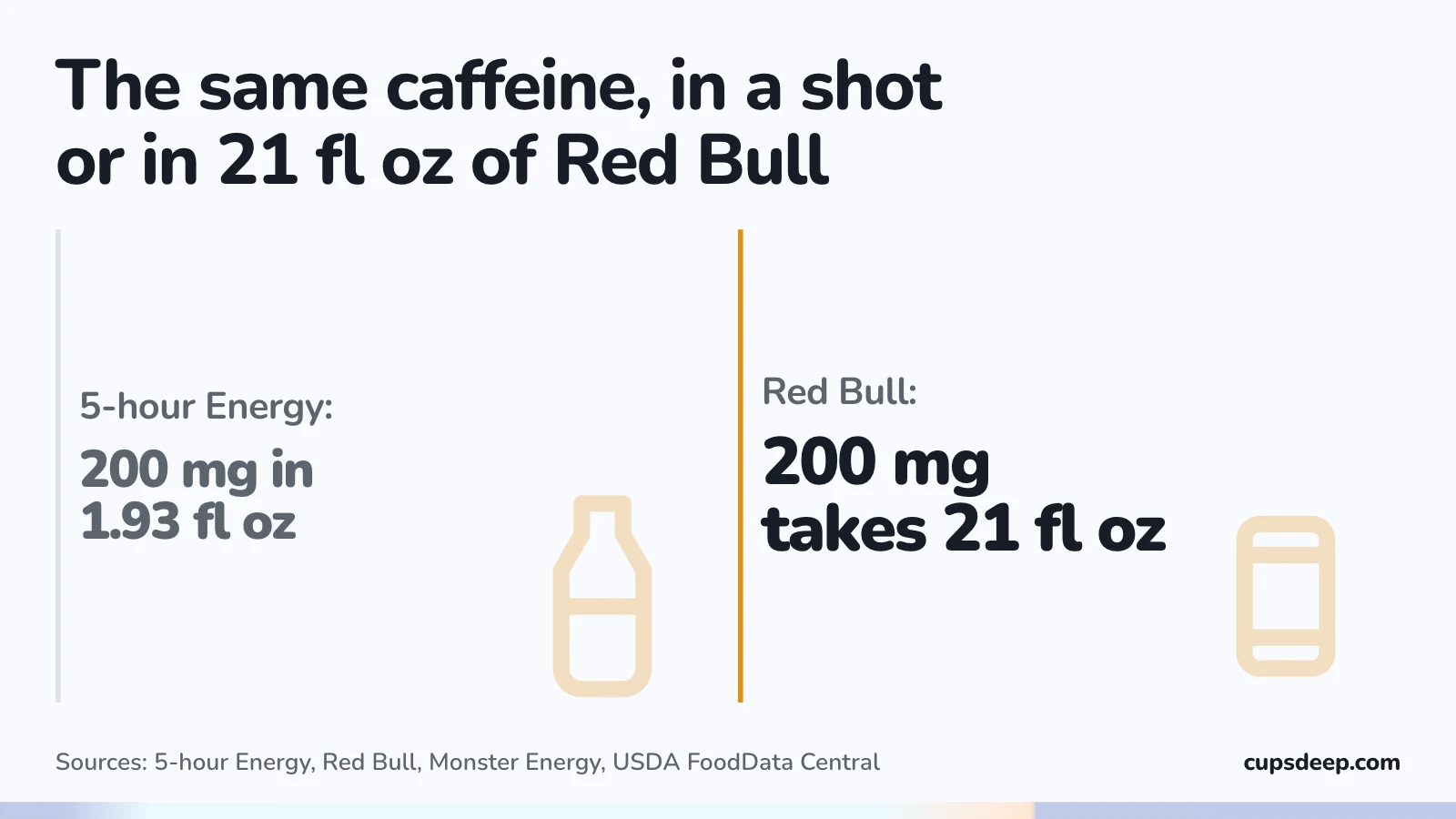
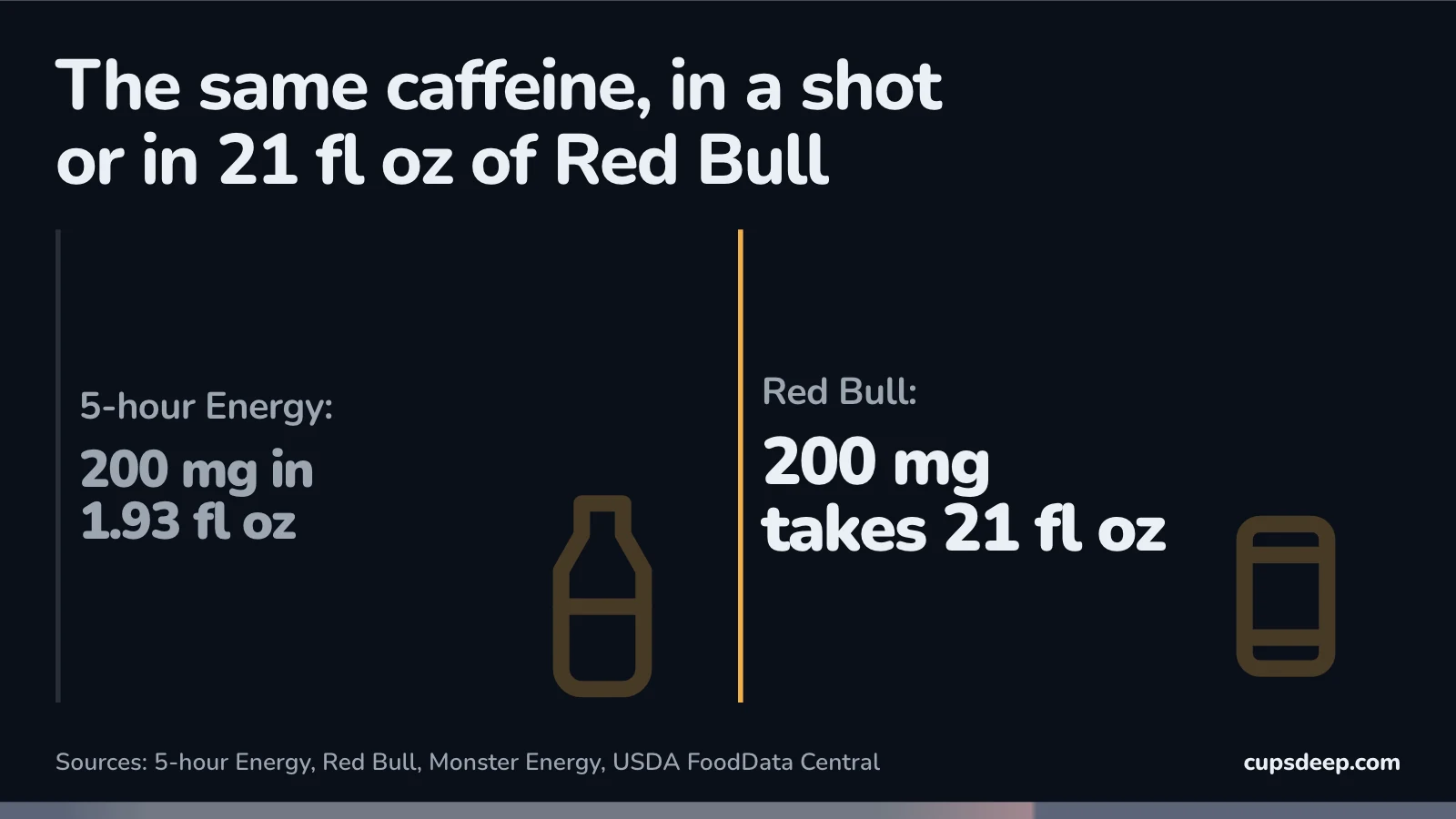
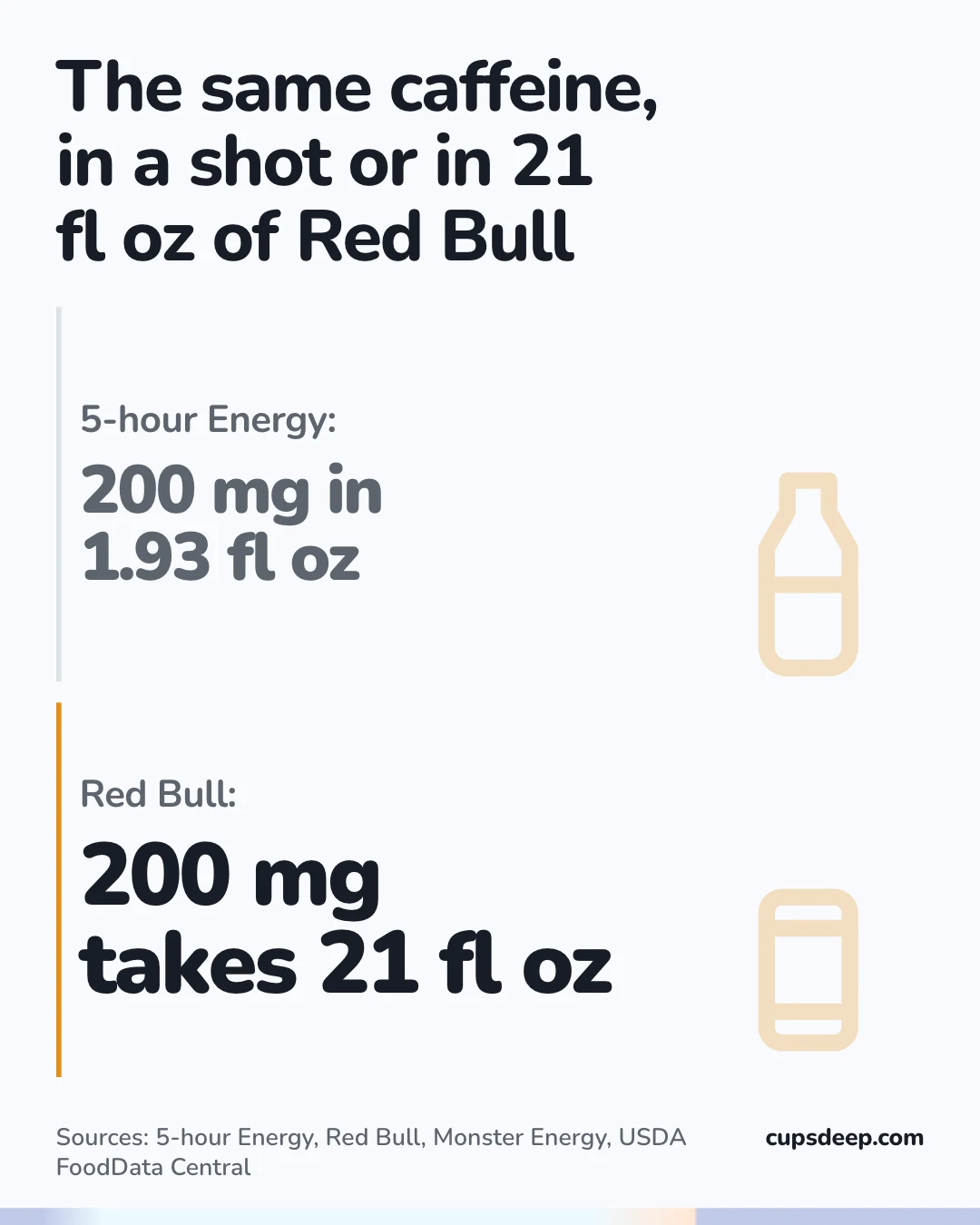
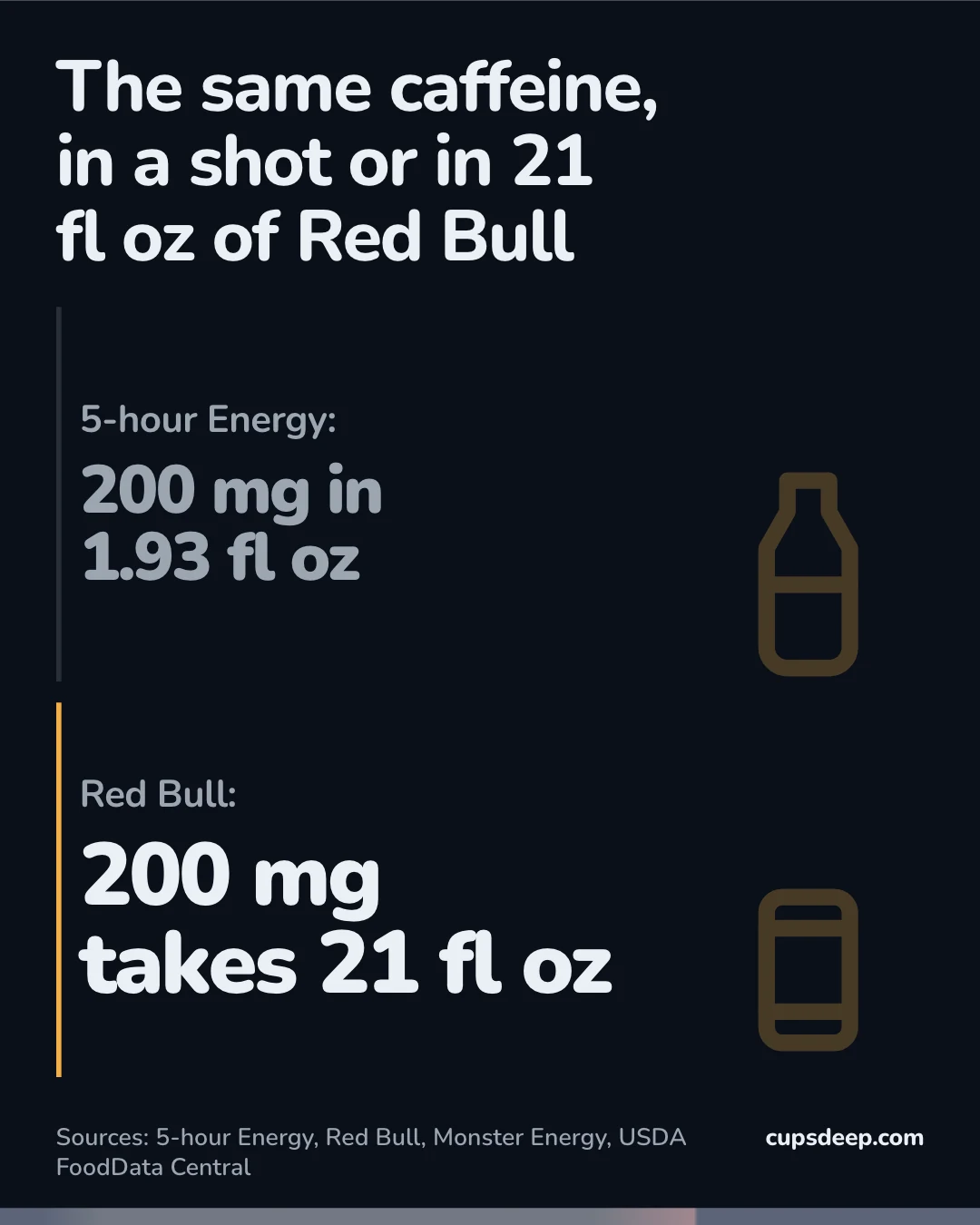
A Regular Strength 5-hour Energy has 200 mg of caffeine and an Extra Strength one has 230 mg, by the maker’s own labels, each in a 1.93 fl oz bottle. By our arithmetic that is 103.6 mg per fl oz and 119.2 mg per fl oz: more than ten times a can of Red Bull or Monster, ounce for ounce.
How much caffeine is in a 5-hour Energy shot?
5-hour Energy’s current Berry labels give 200 mg of caffeine in a Regular Strength shot and 230 mg in an Extra Strength shot, each a serving of 1.93 fl oz, the whole bottle. The caffeine is printed in brackets inside an “Energy Blend” of 1,870 mg (regular) or 2,000 mg (extra strength). The product pages call it a “2-ounce bottle”. 402403171
So the famous number is right, as long as you know which bottle. Regular is 200 mg, Extra Strength is 230 mg, and the bottle is the same 1.93 fl oz either way: the product pages round it up to a “2-ounce bottle”, the label does not. The caffeine is not on a line of its own. It sits in brackets inside an “Energy Blend” of 1,870 mg or 2,000 mg, between L-phenylalanine and citicoline, which is a strange place to keep the main ingredient.
| Product | Serving | Caffeine | Per fl oz (our arithmetic) | On the store |
|---|---|---|---|---|
| Regular Strength | 1.93 fl oz bottle | 200 mg | 103.6 mg per fl oz | On sale |
| Extra Strength | 1.93 fl oz bottle | 230 mg | 119.2 mg per fl oz | On sale |
| Gummies | 4 gummies | 92 mg | no bottle | On sale |
| Decaf | 1.93 fl oz bottle | 6 mg | 3.1 mg per fl oz | Not on the store |
Regular and Extra Strength were read off the Berry flavor’s product pages and Supplement Facts images on November 12, 2026; other flavors were not each opened. Decaf is from a label in NIH’s Dietary Supplement Label Database, because the maker no longer lists it. Per fl oz is the caffeine divided by the bottle, rounded to one decimal: our sum, not the maker’s.
The maker’s own pages do not always agree with the label. On the day we read it, the Regular Strength page got its own headline number wrong, in a row of icons above its Supplement Facts.
On November 12, 2026, the Regular Strength Berry product page said “230mg of Caffeine / The same amount in a 8 oz cup of coffee” in its icon row, while the Supplement Facts panel on the same page said “Caffeine (200mg)”. The 230 mg is the Extra Strength figure. 402
The label is the thing on the bottle, so trust the 200 mg. If you are counting your day, the drinks page has the cans and cups to count it against.
Is 5-hour Energy stronger than Red Bull or Monster?
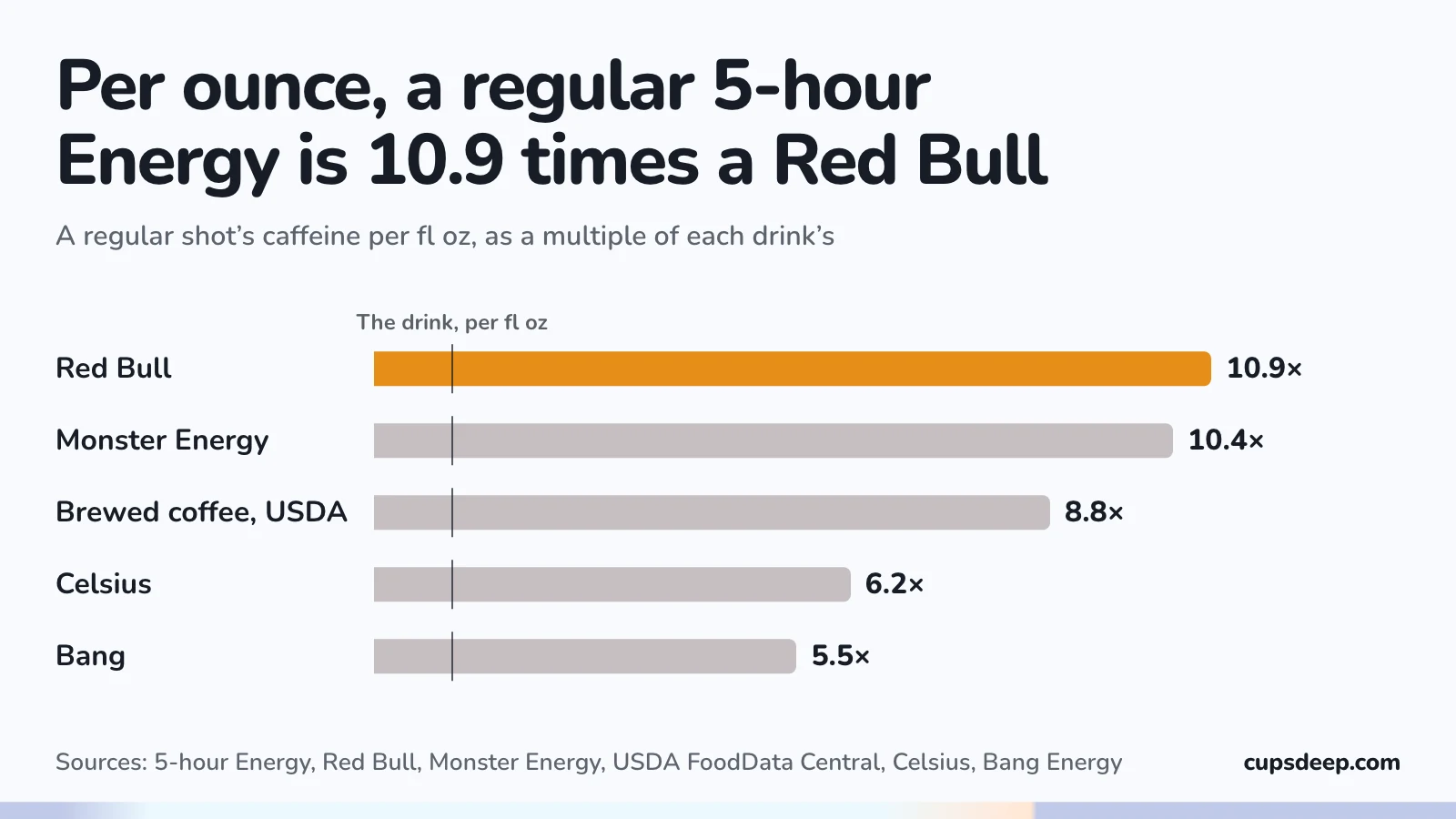
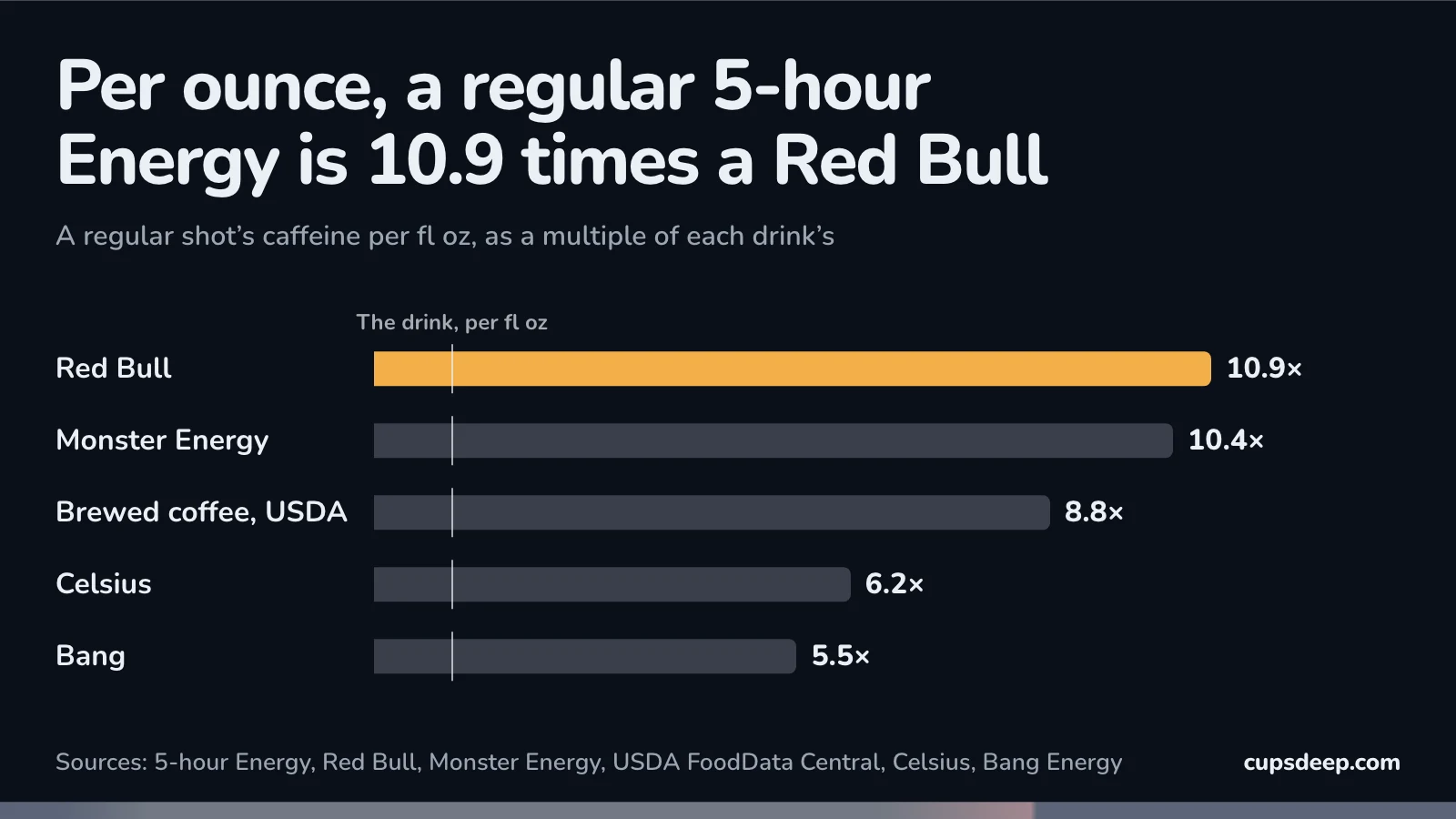
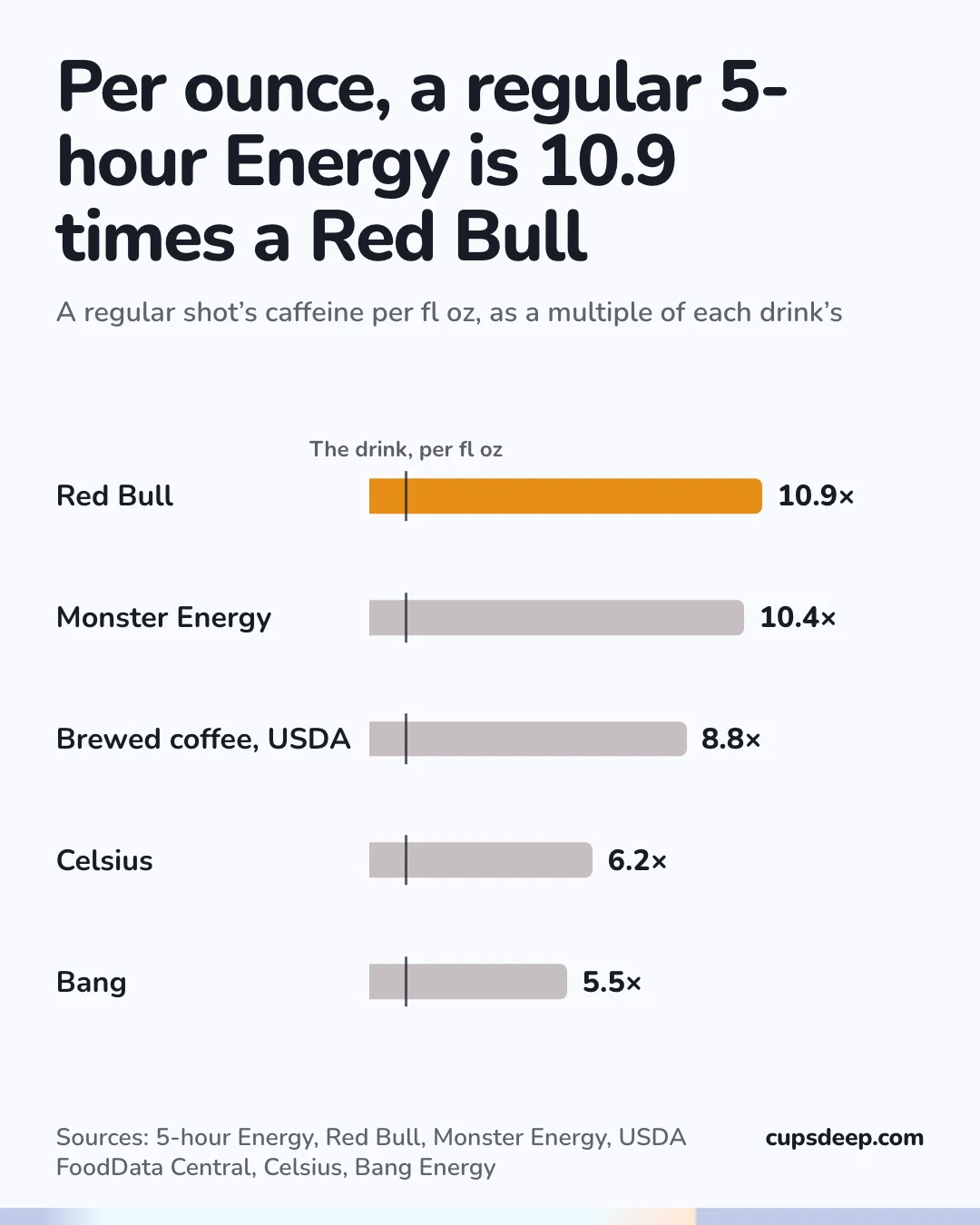
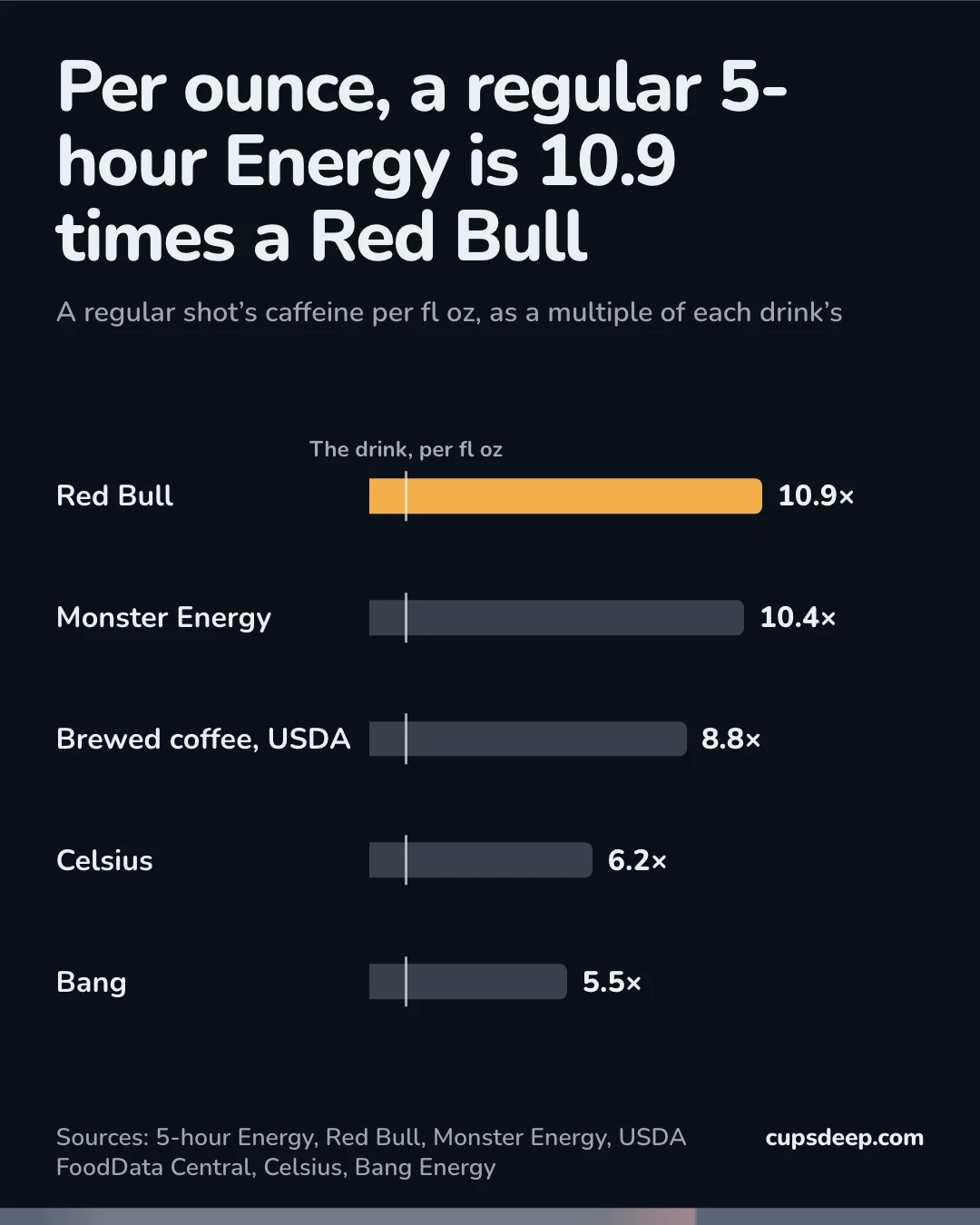
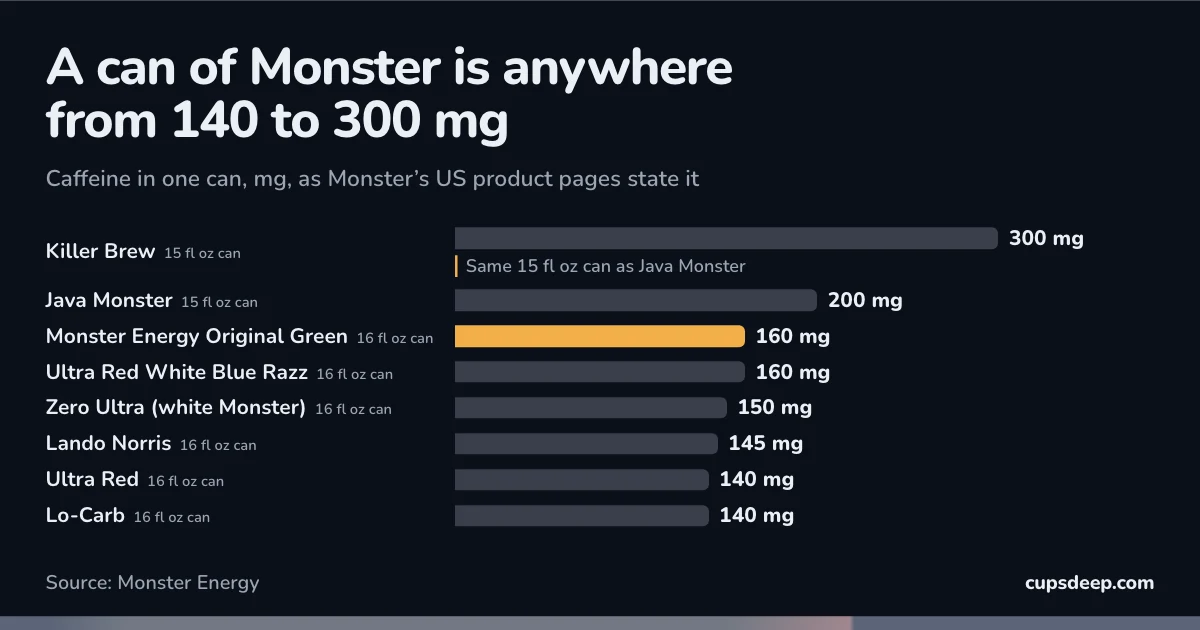
Per container, a little: 200 mg against 160 mg in a 16 fl oz Monster and 151 mg in a 16 fl oz Red Bull. Per fluid ounce, it is not close. A regular shot is 103.6 mg per fl oz; Monster is 10 mg per fl oz and Red Bull 9.5 mg per fl oz. By our arithmetic that makes the shot 10.4 times as strong as Monster and 10.9 times as strong as Red Bull, and Extra Strength 12.5 times as strong as Red Bull.
| Drink | Size | Caffeine | Per fl oz (our arithmetic) |
|---|---|---|---|
| 5-hour Energy Extra Strength | 1.93 fl oz bottle | 230 mg | 119.2 mg per fl oz |
| 5-hour Energy Regular Strength | 1.93 fl oz bottle | 200 mg | 103.6 mg per fl oz |
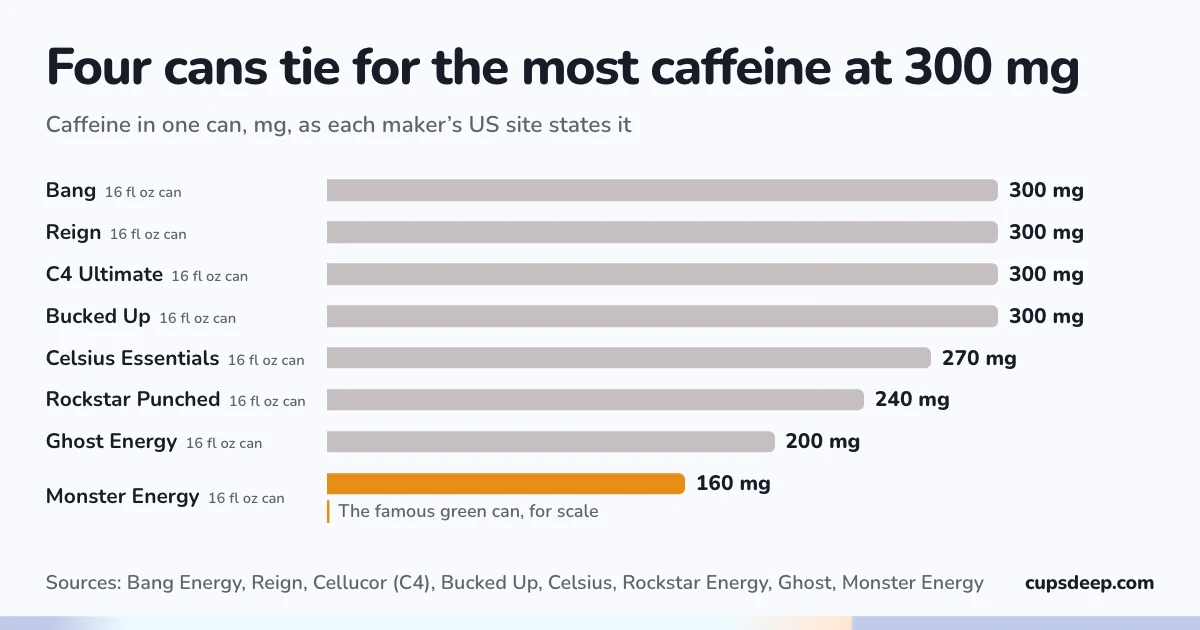
| Bang | 16 fl oz can | 300 mg | 18.8 mg per fl oz |
| Celsius | 12 fl oz can | 200 mg | 16.7 mg per fl oz |
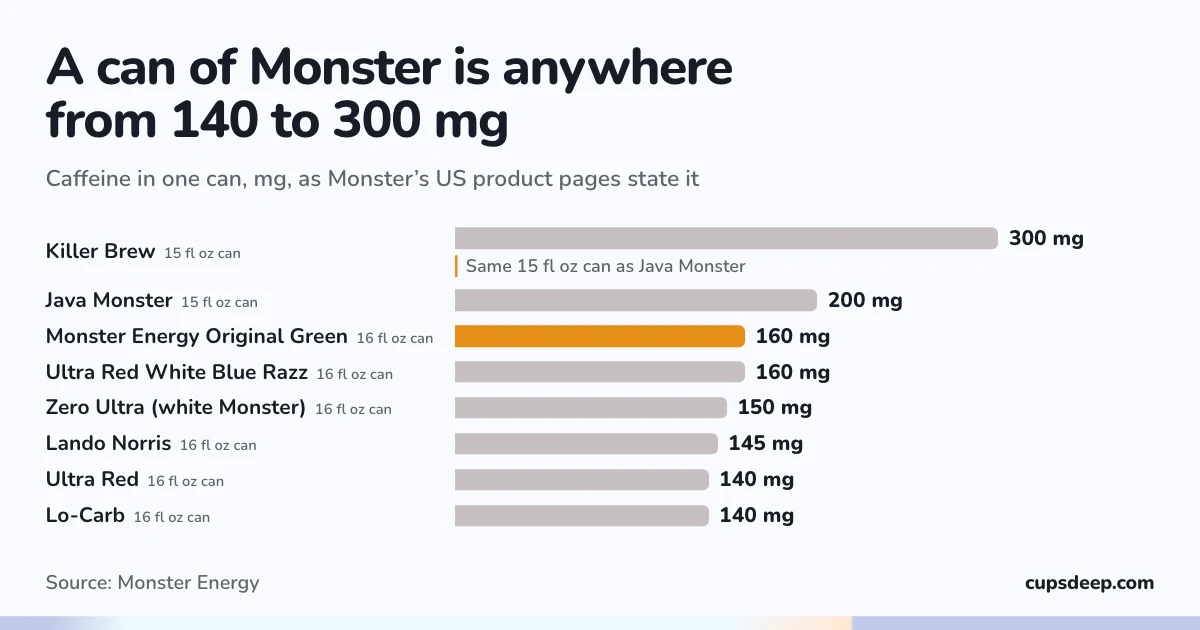
| Monster Energy | 16 fl oz can | 160 mg | 10 mg per fl oz |
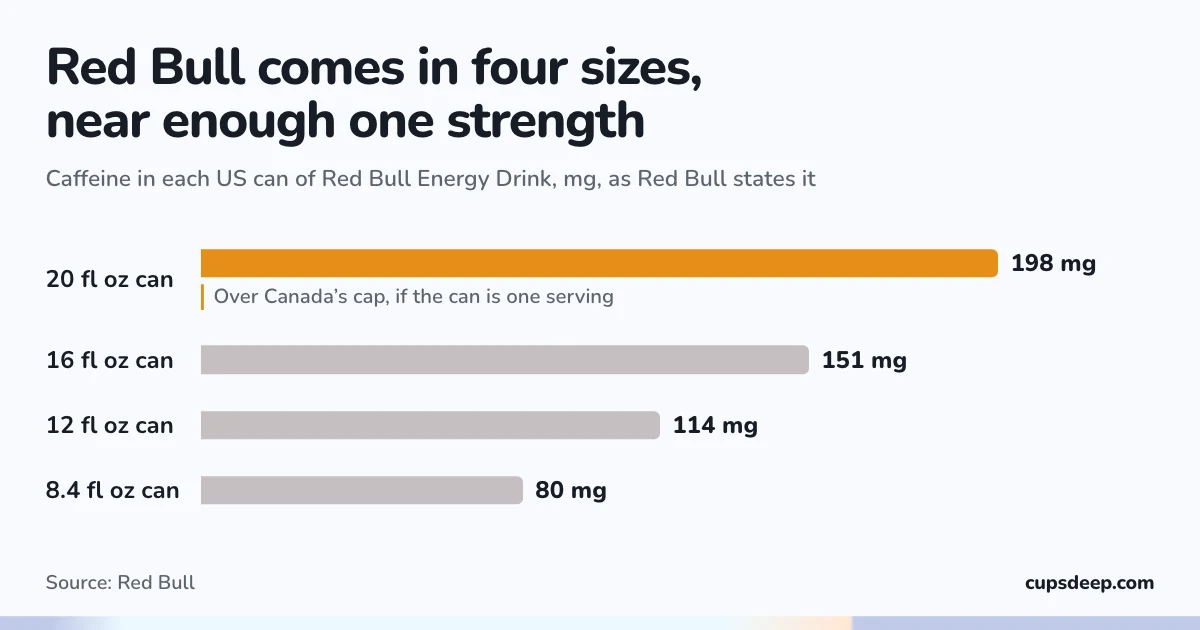
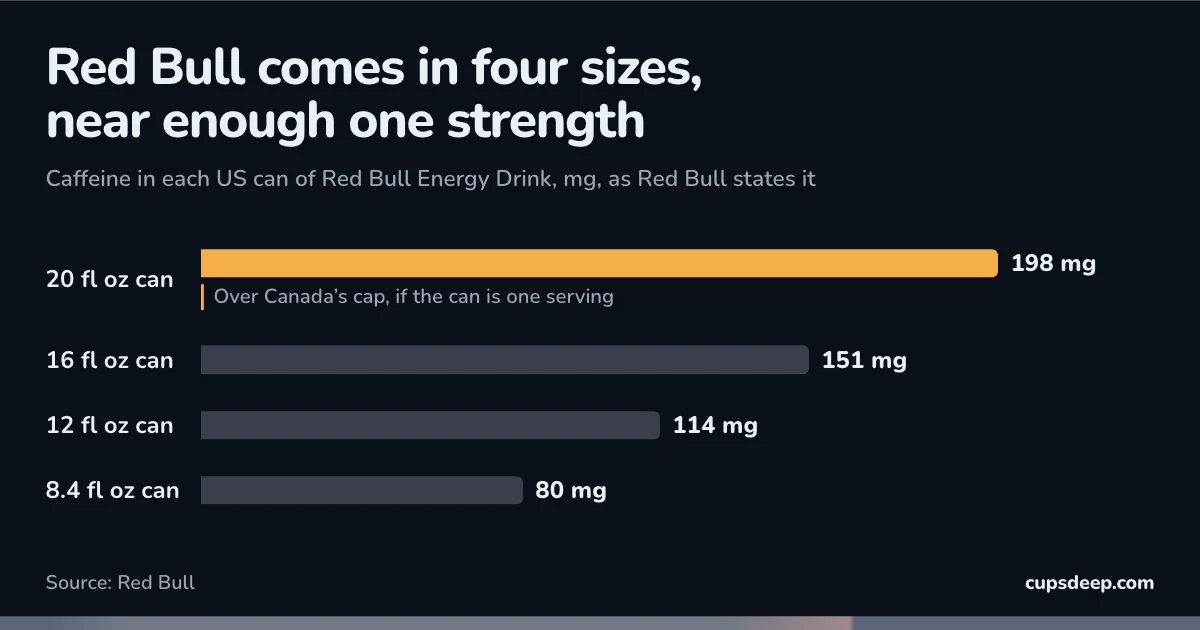
| Red Bull | 8.4 fl oz can | 80 mg | 9.5 mg per fl oz |
Per fl oz is the caffeine divided by the size, rounded to one decimal. The cans are the ones whose maker prints both the caffeine and the size.
Even the strongest cans in our energy-can table, Bang and the rivals that tie it at 300 mg, are 18.8 mg per fl oz, which leaves the regular shot 5.5 times as strong. That is why a chart that ranks shots and cans on one scale is no use: the cans become a row of crumbs. The full ranking of cans is in which energy drink has the most caffeine, and Celsius has its own page.
A 5-hour Energy is a Red Bull with the water wrung out. I respect the efficiency and fear it
Is a 5-hour Energy the same as a cup of coffee?
The maker says so, in three different ways.
5-hour Energy’s FAQ says a Regular Strength shot contains “about as much caffeine as 8 ounces of the leading premium coffee”, and Extra Strength about as much as “12 ounces of the leading premium coffee”. Its caffeine page puts the regular figure as “8 ounces of the leading premium coffee, or 200 mg”. The footer on its product pages says regular is “comparable to a cup of the leading premium coffee”. None of these pages names the coffee. 404171402
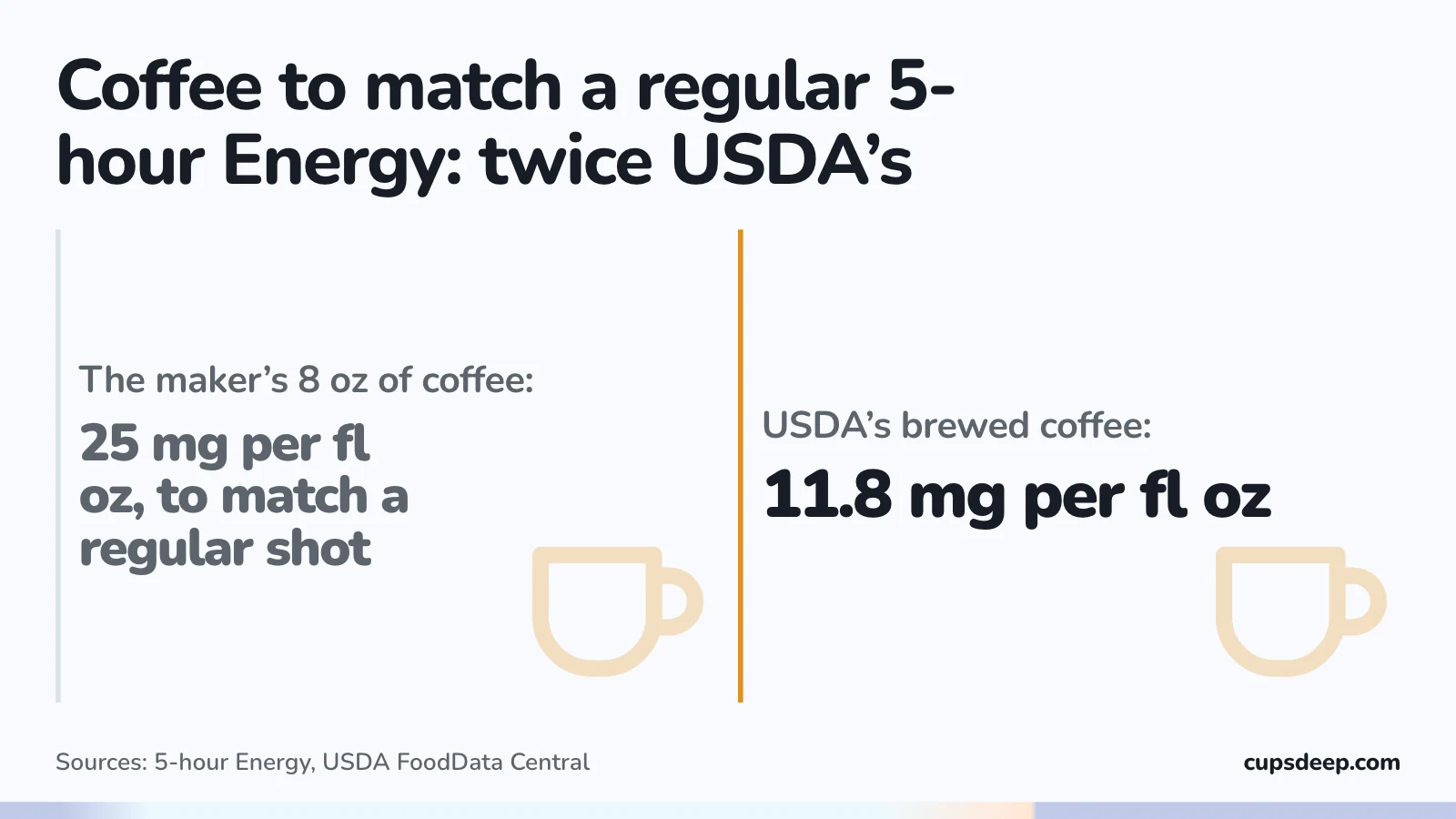
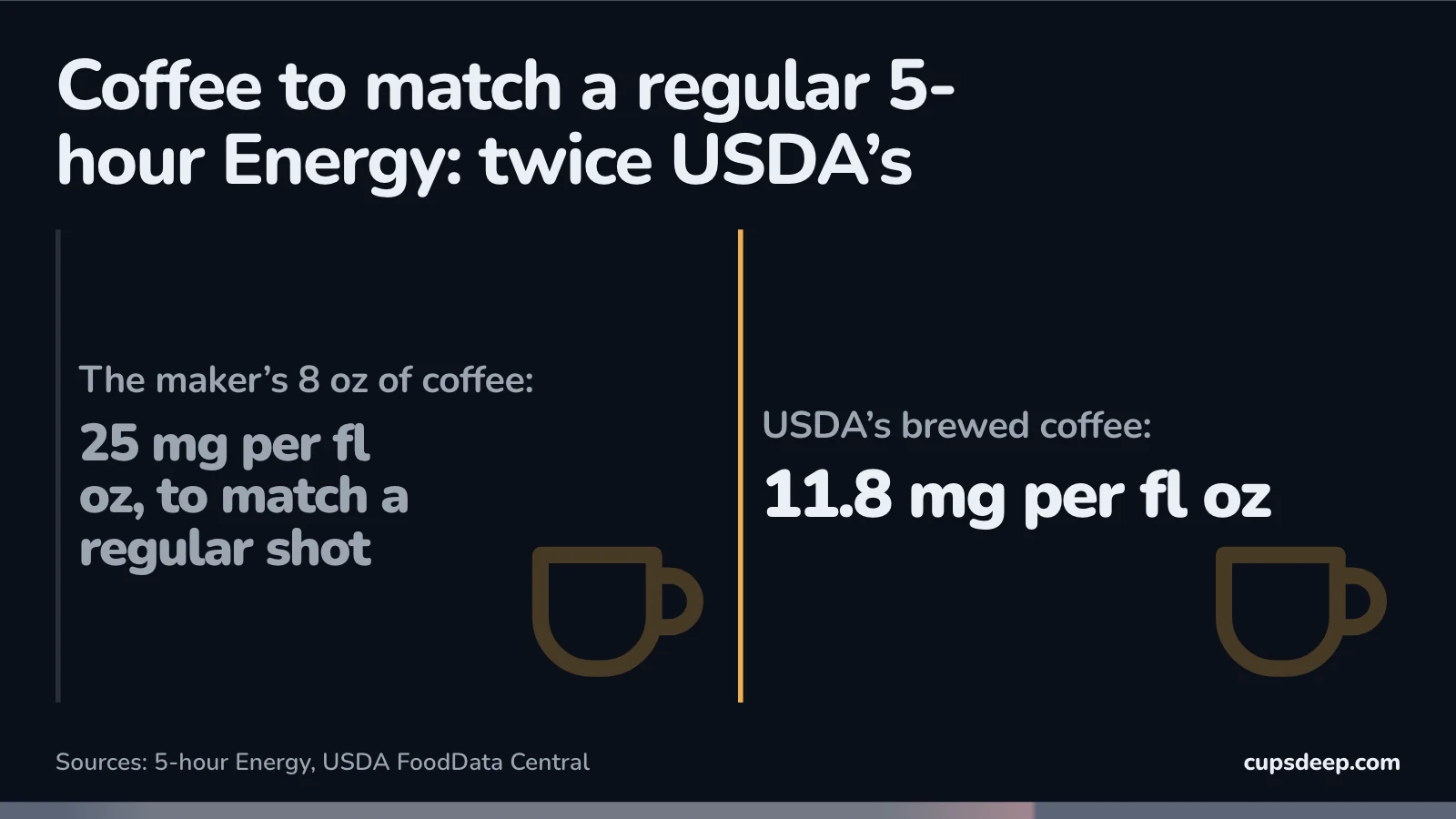
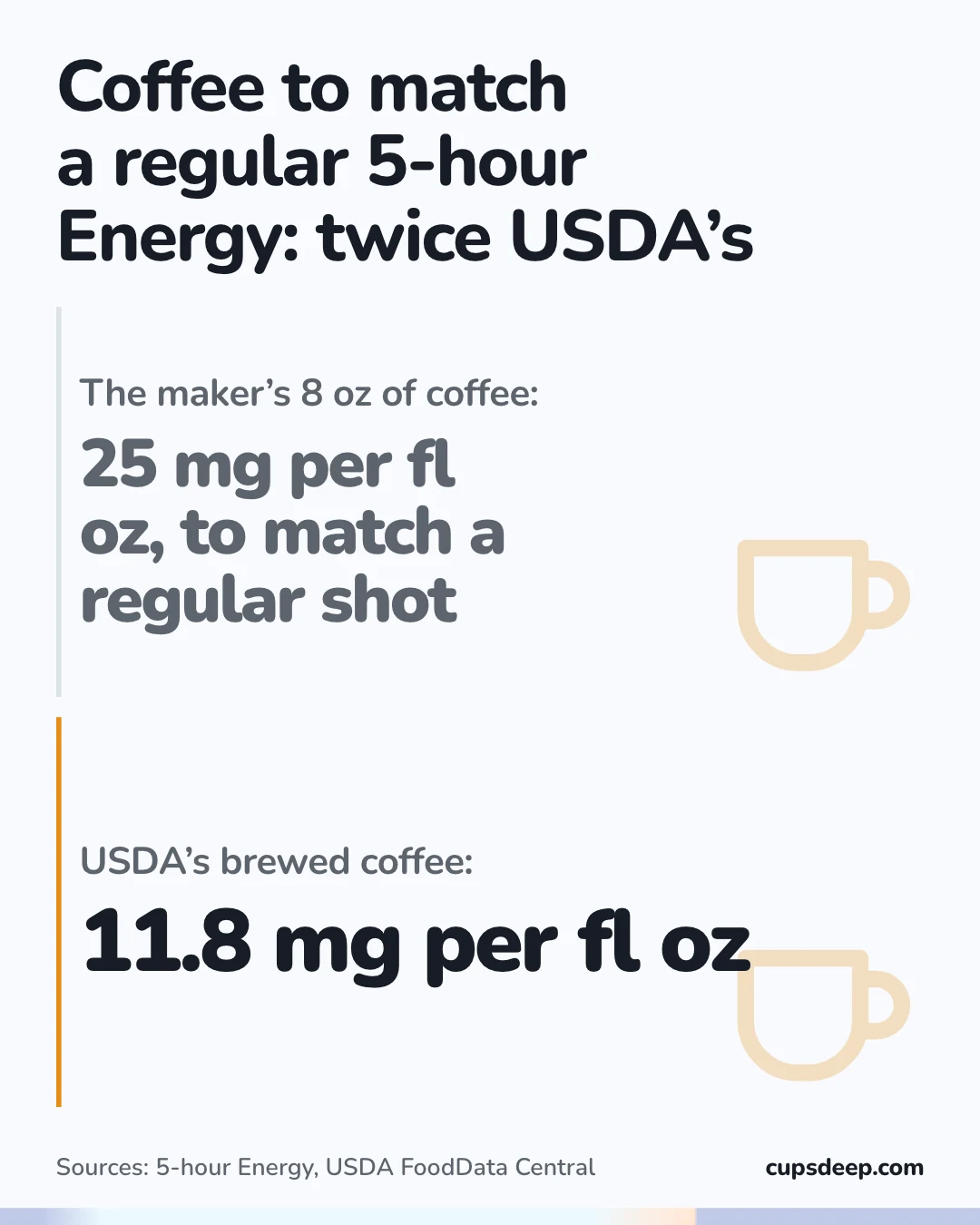
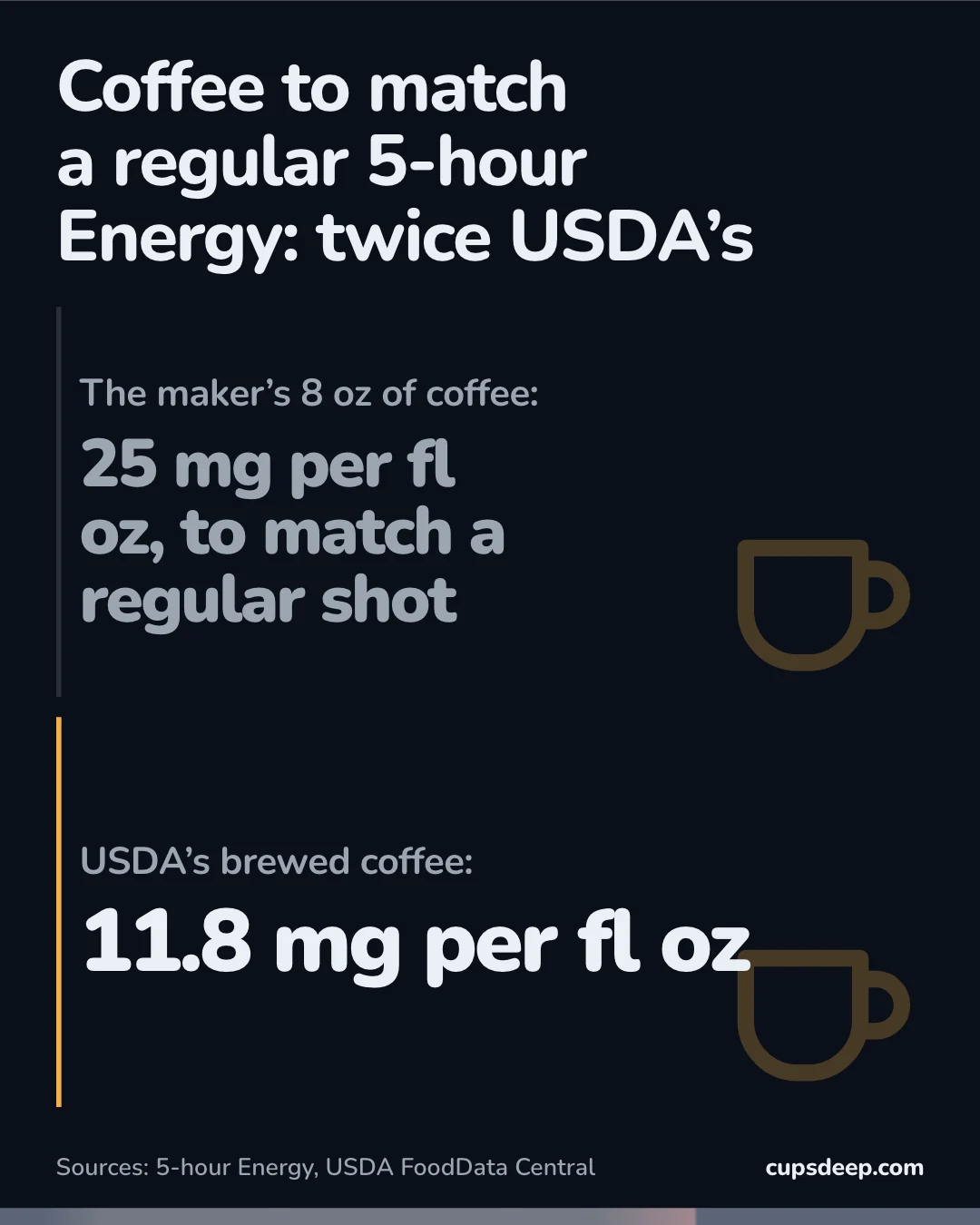
Do the division and the two comparisons describe two different coffees. Eight ounces holding 200 mg is 25 mg per fl oz; twelve ounces holding 230 mg is 19.2 mg per fl oz. USDA’s brewed coffee, the plain cup in our coffee article, is 11.8 mg per fl oz, so 8 fl oz of it holds about 95 mg. The maker’s regular comparison needs coffee 2.1 times USDA’s strength. The coffee is never named, so there is nothing to check it against.
Strong coffee exists: Starbucks states 315 mg to 390 mg for a grande brewed coffee. But a plain 8 fl oz mug at USDA’s strength is about half a regular shot. The label used to be vaguer still.
In NIH’s Dietary Supplement Label Database, a 5-hour Energy Berry label entered on October 26, 2011 gives a 2 fl oz serving, lists caffeine with no amount and says “Contains about as much caffeine as a cup of coffee.” A Berry label entered on August 23, 2019 lists 200 mg of caffeine in a 1.93 fl oz bottle. The database does not say when the label changed. The 2019 record’s label carries a ©2015 notice and the version code ZS0004-US (01/15/15). 409410
So the older label compared itself to a cup of coffee without printing how much caffeine it held. By the label entered in 2019 the milligrams were there, and the coffee comparison had stayed, now as “a cup of the leading premium coffee”.
Does decaf 5-hour Energy have caffeine?
It did, and the maker no longer sells it on its own store. Decaf was real, it was sold to people sensitive to caffeine, and it was not caffeine-free.
A Decaf 5-hour Energy label in NIH’s Dietary Supplement Label Database (Decaf Citrus, entered May 22, 2015) says “Decaf 5-hour ENERGY(R) contains 6mg of caffeine - about as much as a half cup of decaffeinated coffee.”, in a 1.93 fl oz serving, “For people sensitive to caffeine”. On November 12, 2026 no decaf product was on the maker’s online store or its list of discontinued products. 408407
By our arithmetic that is 3.1 mg per fl oz, against 103.6 mg per fl oz for the regular shot. The trouble was what it promised. Washington State sued the makers, and the court looked hard at Decaf.
In a suit Washington’s Attorney General filed in 2014, a King County Superior Court judge ruled in October 2016 that the makers of 5-hour Energy had broken the state Consumer Protection Act. She found that none of the studies they submitted supported the claim that the other ingredients make caffeine’s effects last longer than caffeine alone, and that the claim that Decaf gave similar effects lacked “competent and reliable scientific evidence”. She also found evidence that the non-caffeine ingredients may themselves support energy and alertness, and that the “no crash” claim did not break the Act. In February 2017 she ordered the makers to pay nearly $4.3 million in penalties, fees and costs, nearly $2.2 million of it civil penalties. 412413
Read that ruling precisely. The judge did not find the shot useless: she found evidence that its other ingredients may support energy and alertness, and she cleared the “no crash” claim. Among what she found deceptive: the claim that the blend makes caffeine last longer than caffeine alone, the claim that Decaf did what the caffeinated shot does, and the claim that doctors recommend it. If you want a low-caffeine drink, decaf coffee is easier to find.
Is 5-hour Energy FDA approved, and is it bad for you?
5-hour Energy is sold as a dietary supplement, with a Supplement Facts panel rather than Nutrition Facts. The maker’s FAQ answers “Have 5-hour ENERGY® shots been approved by the FDA?” with “No, they haven’t. Dietary supplements like 5-hour ENERGY® shots don’t need to be approved by the FDA.” The label says “This statement has not been evaluated by the Food and Drug Administration. This product is not intended to diagnose, treat, cure or prevent any disease.” 405404402
That status matters. A supplement’s maker, packer or distributor must pass on to FDA the reports of serious adverse events it receives; FDA’s document below says that duty “applies only to dietary supplements and not to beverages”. In 2012 FDA published a summary of the reports in its system for three energy brands.
FDA’s 2012 document on adverse event reports for 5-Hour Energy, Monster and Rockstar, from January 1, 2004 to October 23, 2012, has a table of reports “Allegedly Related to 5 Hour Energy”. By our count of its rows there are 92 reports; the outcomes of 33 include hospitalization and of 13 include death. FDA writes that the reports “only reflect information AS REPORTED and do not represent any conclusion by FDA about whether the product actually caused the adverse events.” 411
Say it plainly: 13 reports with death among the outcomes prove nothing about what caused those deaths. A report records what someone told FDA; it is not a finding that the shot caused anything, and FDA’s own document says so in the words above. It also notes that people may have taken other products, and that reports can be duplicated or incomplete.
What is settled is the caffeine. One regular shot is 200 mg, exactly the 200 mg single dose that EFSA says raises no safety concern for healthy non-pregnant adults. Extra Strength is above it. How long caffeine stays in your system explains why the dose keeps going after the shot is gone, and when a dose counts as a lot sets the shot against every agency’s line.
Legally it’s a dietary supplement, which is also how I file my third coffee
How many 5-hour Energy shots can you have in a day?
The label sets its own limit, and the sums are worth doing.
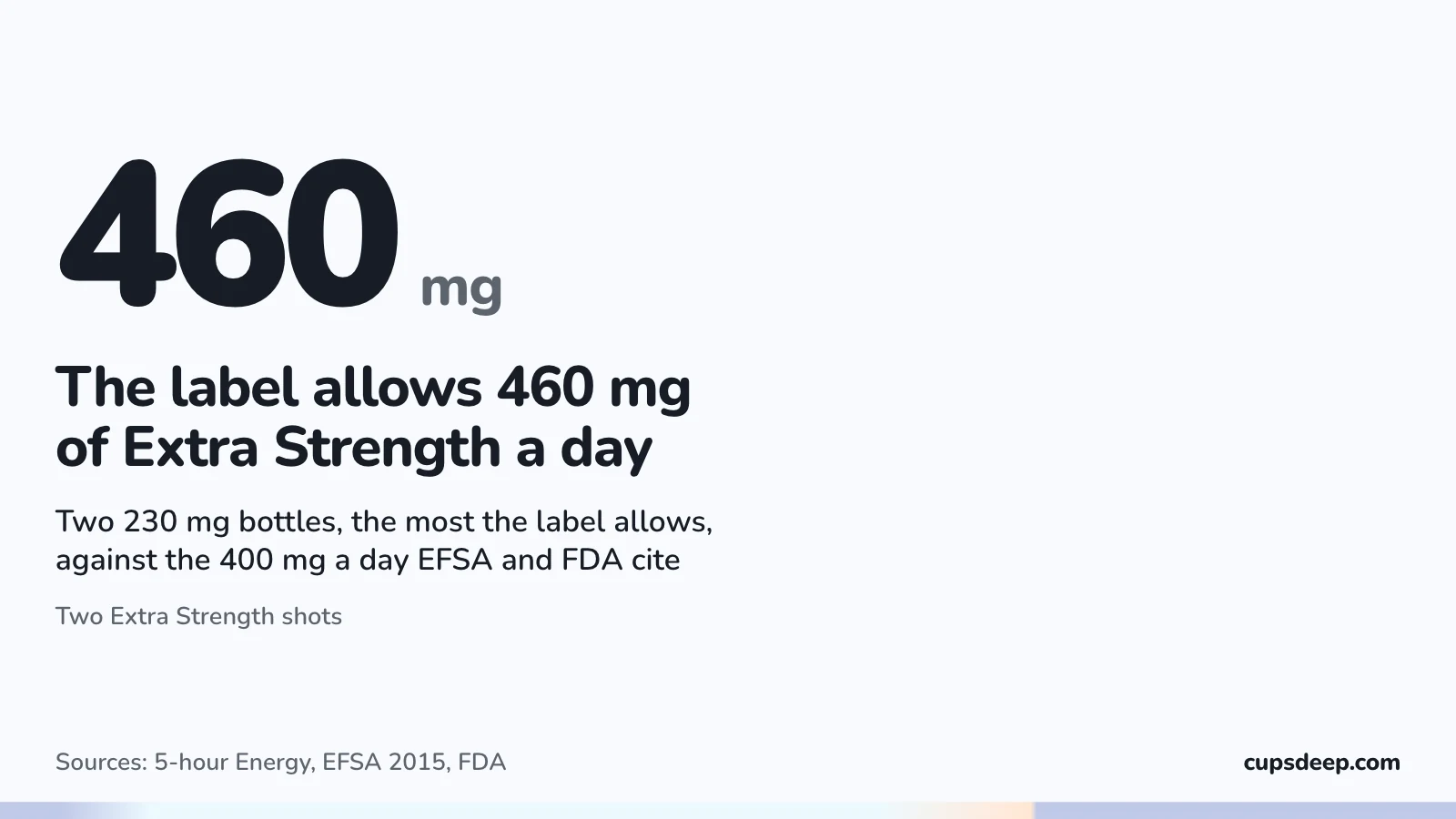
The label says “Do not exceed two bottles daily, consumed several hours apart.” Two 200 mg Regular Strength shots are 400 mg, the daily amount EFSA and FDA cite for healthy adults; two 230 mg Extra Strength shots are 460 mg, 60 mg over it. The label’s “one half (1/2) bottle” is 100 mg of regular or 115 mg of extra strength. The gummies’ limit of 20 a day, at 92 mg per 4, is also 460 mg. These sums are ours. 402403406225
EFSA concludes that caffeine intakes up to 400 mg a day from all sources, spread through the day, do not raise safety concerns for healthy adults, except pregnant women. FDA cites 400 mg a day for most adults as an amount not generally associated with negative effects, and notes wide variation in how sensitive people are to caffeine and how fast they eliminate it. 225
So two regular shots land exactly on the line with nothing else counted, and two Extra Strength shots are 60 mg over it, inside the maker’s own limit. The half bottle the label suggests is 100 mg of regular, a little more than our 80 mg cup of filter coffee. Neither line is a cliff, and people differ a lot in how fast they clear caffeine: its half-life in healthy adults averages 4 hours and runs as long as 8 hours.
The label says no more than two bottles a day, several hours apart. I read that as a schedule
Questions people ask
How much caffeine is in a 5-hour Energy Extra Strength?
230 mg in a 1.93 fl oz bottle, by the maker’s label, against 200 mg in Regular Strength. By our arithmetic that is 119.2 mg per fl oz.
How many ounces is a 5-hour Energy?
The label gives a serving of 1.93 fl oz, the whole bottle. The product pages call it a “2-ounce bottle”, which is rounded.
Is a 5-hour Energy stronger than coffee?
Than a plain cup, yes. A regular shot is 200 mg; 8 fl oz of brewed coffee at USDA’s strength is about 95 mg. The maker likens the shot to eight ounces of “the leading premium coffee”, which would need coffee about 2.1 times USDA’s strength.
Sources
Every number above links to the place it came from. How the numbers are chosen and checked is on the method page; the drink table is at /drinks. Written with AI agents, as the whole site is. A model of a typical body, not advice for pregnancy, illness or medication.
- Spilling the Beans: How Much Caffeine is Too Much?
- Monster Energy Original Green
- How much caffeine is in a can of Red Bull Energy Drink?
- Beverages, coffee, brewed, prepared with tap water
- Scientific Opinion on the safety of caffeine
- Medium Roast - Pike Place Roast: nutrition (starbucks.com, United States)
- Essential Facts
- Bang Energy, Blue Razz
- 5-hour ENERGY Caffeine Facts
- Berry Flavor Regular Strength 5-hour ENERGY Shots
- Berry Flavor Extra Strength 5-hour ENERGY Shots
- Frequently Asked Questions
- Nutrition & Ingredients
- Fruity Rainbow Gummy
- 5-hour Energy store product list (products.json)
- 5-Hour Energy Decaf Citrus, label 45878
- 5-Hour Energy Berry, label 1176
- 5-hour Energy Berry, label 206098
- CFSAN Adverse Event Reporting System: Voluntary and Mandatory Reports on 5-Hour Energy, Monster Energy, and Rockstar Energy Drink, January 1, 2004, through October 23, 2012
- Judge rules 5-Hour ENERGY® violated Consumer Protection Act
- AG: 5-hour ENERGY® makers ordered to pay nearly $4.3 million for consumer violations
Keep reading

Cans
Which energy drink has the most caffeine?
Four US cans tie at 300 mg in 16 fl oz: Bang, Reign, C4 Ultimate and Bucked Up. Per fl oz, Killer Brew wins. Each can by its maker, plus the legal caps.
Cans
How much caffeine is in a Red Bull?
An 8.4 fl oz Red Bull has 80 mg of caffeine. The 12, 16 and 20 fl oz cans have 114 mg, 151 mg and 198 mg. Every flavor, checked.
Cans
How much caffeine is in a Monster?
A 16 fl oz can of original Monster has 160 mg of caffeine. White Monster has 150 mg, Java Monster 200 mg and Killer Brew 300 mg.